IPv6
Internet protocol version6
What is the ip address?
An Internet Protocol (IP) address is a numerical
identification (logical address) that is assigned to
devices participating in a computer network
utilizing the Internet Protocol for communication
between its nodes
Intro to IP versions
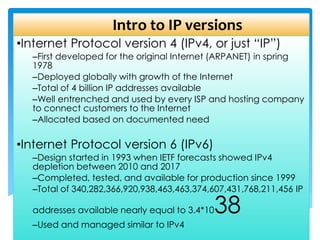
•Internet Protocol version 4 (IPv4, or just “IP”)
–First developed for the original Internet (ARPANET) in spring
1978
–Deployed globally with growth of the Internet
–Total of 4 billion IP addresses available
–Well entrenched and used by every ISP and hosting company
to connect customers to the Internet
–Allocated based on documented need
•Internet Protocol version 6 (IPv6)
–Design started in 1993 when IETF forecasts showed IPv4
depletion between 2010 and 2017
–Completed, tested, and available for production since 1999
–Total of 340,282,366,920,938,463,463,374,607,431,768,211,456 IP
addresses available nearly equal to 3.4*1038
–Used and managed similar to IPv4
Difference between ipv4 and ipv6
IPV4
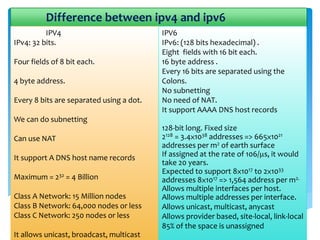
IPv4: 32 bits.
Four fields of 8 bit each.
4 byte address.
Every 8 bits are separated using a dot.
We can do subnetting
Can use NAT
It support A DNS host name records
Maximum = 232 = 4 Billion
Class A Network: 15 Million nodes
Class B Network: 64,000 nodes or less
Class C Network: 250 nodes or less
It allows unicast, broadcast, multicast
IPV6
IPv6: (128 bits hexadecimal) .
Eight fields with 16 bit each.
16 byte address .
Every 16 bits are separated using the
Colons.
No subnetting
No need of NAT.
It support AAAA DNS host records
128-bit long. Fixed size
2128 = 3.4×1038 addresses => 665×1021
addresses per m2 of earth surface
If assigned at the rate of 106/s, it would
take 20 years.
Expected to support 8×10¹⁷ to 2×1033
addresses 8×1017 => 1,564 address per m2.
Allows multiple interfaces per host.
Allows multiple addresses per interface.
Allows unicast, multicast, anycast
Allows provider based, site-local, link-local
85% of the space is unassigned
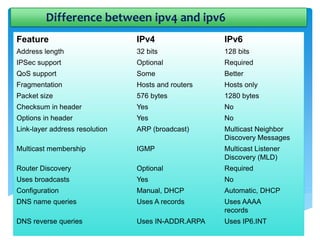
Difference between ipv4 and ipv6
Feature IPv4 IPv6
Address length 32 bits 128 bits
IPSec support Optional Required
QoS support Some Better
Fragmentation Hosts and routers Hosts only
Packet size 576 bytes 1280 bytes
Checksum in header Yes No
Options in header Yes No
Link-layer address resolution ARP (broadcast) Multicast Neighbor
Discovery Messages
Multicast membership IGMP Multicast Listener
Discovery (MLD)
Router Discovery Optional Required
Uses broadcasts Yes No
Configuration Manual, DHCP Automatic, DHCP
DNS name queries Uses A records Uses AAAA
records
DNS reverse queries Uses IN-ADDR.ARPA Uses IP6.INT
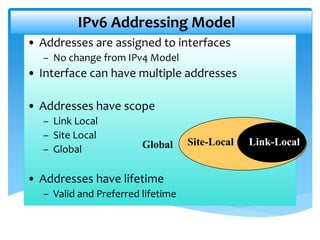
IPv6 Addressing Model
• Addresses are assigned to interfaces
– No change from IPv4 Model
• Interface can have multiple addresses
• Addresses have scope
– Link Local
– Site Local
– Global
• Addresses have lifetime
– Valid and Preferred lifetime
Link-LocalSite-LocalGlobal
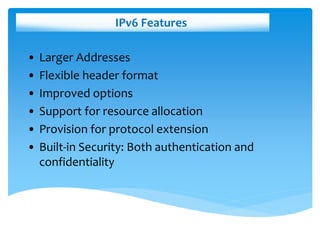
IPv6 Features
• Larger Addresses
• Flexible header format
• Improved options
• Support for resource allocation
• Provision for protocol extension
• Built-in Security: Both authentication and
confidentiality
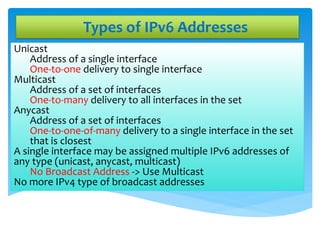
Types of IPv6 Addresses
Unicast
Address of a single interface
One-to-one delivery to single interface
Multicast
Address of a set of interfaces
One-to-many delivery to all interfaces in the set
Anycast
Address of a set of interfaces
One-to-one-of-many delivery to a single interface in the set
that is closest
A single interface may be assigned multiple IPv6 addresses of
any type (unicast, anycast, multicast)
No Broadcast Address -> Use Multicast
No more IPv4 type of broadcast addresses
Types of IPv6 Addresses
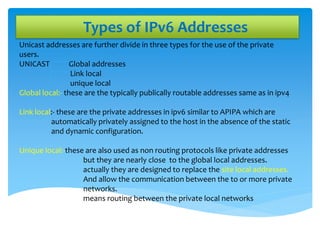
Unicast addresses are further divide in three types for the use of the private
users.
UNICAST Global addresses
Link local
unique local
Global local:- these are the typically publically routable addresses same as in ipv4
Link local:- these are the private addresses in ipv6 similar to APIPA which are
automatically privately assigned to the host in the absence of the static
and dynamic configuration.
Unique local:-these are also used as non routing protocols like private addresses
but they are nearly close to the global local addresses.
actually they are designed to replace the site local addresses.
And allow the communication between the to or more private
networks.
means routing between the private local networks
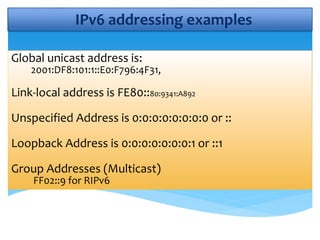
Global unicast address is:
2001:DF8:101:1::E0:F796:4F31,
Link-local address is FE80::80:9341:A892
Unspecified Address is 0:0:0:0:0:0:0:0 or ::
Loopback Address is 0:0:0:0:0:0:0:1 or ::1
Group Addresses (Multicast)
FF02::9 for RIPv6
IPv6 addressing examples
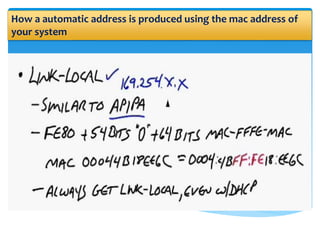
How a automatic address is produced using the mac address of
your system

Ipv6^ new

  • 1.
    IPv6 Internet protocol version6 Whatis the ip address? An Internet Protocol (IP) address is a numerical identification (logical address) that is assigned to devices participating in a computer network utilizing the Internet Protocol for communication between its nodes
  • 2.
    Intro to IPversions •Internet Protocol version 4 (IPv4, or just “IP”) –First developed for the original Internet (ARPANET) in spring 1978 –Deployed globally with growth of the Internet –Total of 4 billion IP addresses available –Well entrenched and used by every ISP and hosting company to connect customers to the Internet –Allocated based on documented need •Internet Protocol version 6 (IPv6) –Design started in 1993 when IETF forecasts showed IPv4 depletion between 2010 and 2017 –Completed, tested, and available for production since 1999 –Total of 340,282,366,920,938,463,463,374,607,431,768,211,456 IP addresses available nearly equal to 3.4*1038 –Used and managed similar to IPv4
  • 3.
    Difference between ipv4and ipv6 IPV4 IPv4: 32 bits. Four fields of 8 bit each. 4 byte address. Every 8 bits are separated using a dot. We can do subnetting Can use NAT It support A DNS host name records Maximum = 232 = 4 Billion Class A Network: 15 Million nodes Class B Network: 64,000 nodes or less Class C Network: 250 nodes or less It allows unicast, broadcast, multicast IPV6 IPv6: (128 bits hexadecimal) . Eight fields with 16 bit each. 16 byte address . Every 16 bits are separated using the Colons. No subnetting No need of NAT. It support AAAA DNS host records 128-bit long. Fixed size 2128 = 3.4×1038 addresses => 665×1021 addresses per m2 of earth surface If assigned at the rate of 106/s, it would take 20 years. Expected to support 8×10¹⁷ to 2×1033 addresses 8×1017 => 1,564 address per m2. Allows multiple interfaces per host. Allows multiple addresses per interface. Allows unicast, multicast, anycast Allows provider based, site-local, link-local 85% of the space is unassigned
  • 4.
    Difference between ipv4and ipv6 Feature IPv4 IPv6 Address length 32 bits 128 bits IPSec support Optional Required QoS support Some Better Fragmentation Hosts and routers Hosts only Packet size 576 bytes 1280 bytes Checksum in header Yes No Options in header Yes No Link-layer address resolution ARP (broadcast) Multicast Neighbor Discovery Messages Multicast membership IGMP Multicast Listener Discovery (MLD) Router Discovery Optional Required Uses broadcasts Yes No Configuration Manual, DHCP Automatic, DHCP DNS name queries Uses A records Uses AAAA records DNS reverse queries Uses IN-ADDR.ARPA Uses IP6.INT
  • 5.
    IPv6 Addressing Model •Addresses are assigned to interfaces – No change from IPv4 Model • Interface can have multiple addresses • Addresses have scope – Link Local – Site Local – Global • Addresses have lifetime – Valid and Preferred lifetime Link-LocalSite-LocalGlobal
  • 6.
    IPv6 Features • LargerAddresses • Flexible header format • Improved options • Support for resource allocation • Provision for protocol extension • Built-in Security: Both authentication and confidentiality
  • 7.
    Types of IPv6Addresses Unicast Address of a single interface One-to-one delivery to single interface Multicast Address of a set of interfaces One-to-many delivery to all interfaces in the set Anycast Address of a set of interfaces One-to-one-of-many delivery to a single interface in the set that is closest A single interface may be assigned multiple IPv6 addresses of any type (unicast, anycast, multicast) No Broadcast Address -> Use Multicast No more IPv4 type of broadcast addresses
  • 8.
    Types of IPv6Addresses Unicast addresses are further divide in three types for the use of the private users. UNICAST Global addresses Link local unique local Global local:- these are the typically publically routable addresses same as in ipv4 Link local:- these are the private addresses in ipv6 similar to APIPA which are automatically privately assigned to the host in the absence of the static and dynamic configuration. Unique local:-these are also used as non routing protocols like private addresses but they are nearly close to the global local addresses. actually they are designed to replace the site local addresses. And allow the communication between the to or more private networks. means routing between the private local networks
  • 9.
    Global unicast addressis: 2001:DF8:101:1::E0:F796:4F31, Link-local address is FE80::80:9341:A892 Unspecified Address is 0:0:0:0:0:0:0:0 or :: Loopback Address is 0:0:0:0:0:0:0:1 or ::1 Group Addresses (Multicast) FF02::9 for RIPv6 IPv6 addressing examples
  • 10.
    How a automaticaddress is produced using the mac address of your system