Maulana Azad National Institute of Technology
Bhopal
Department of Mathematics & Computer Applications
Seminar-I
IPv4 ROUTING
Supervisor: Presented by:
Dr. Sanjay Sharma Sonal Telang Chandel
PhD Scholar
143220002
Introduction of Internet Layer
Routing
Routing Protocols
Future of Routing
Conclusion
References
OutlineOutline
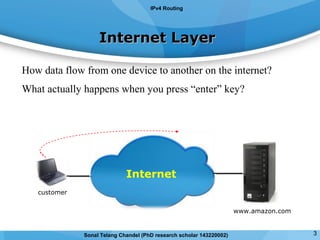
customer
www.amazon.com
How data flow from one device to another on the internet?
Internet
Internet LayerInternet Layer
Sonal Telang Chandel (PhD research scholar 143220002)
IPv4 Routing
What actually happens when you press “enter” key?
3
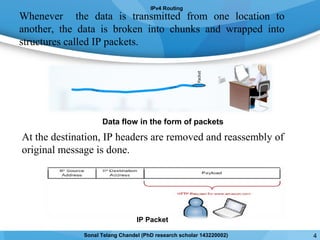
Whenever the data is transmitted from one location to
another, the data is broken into chunks and wrapped into
structures called IP packets.
At the destination, IP headers are removed and reassembly of
original message is done.
IPv4 Routing
IP Packet
Data flow in the form of packets
4Sonal Telang Chandel (PhD research scholar 143220002)
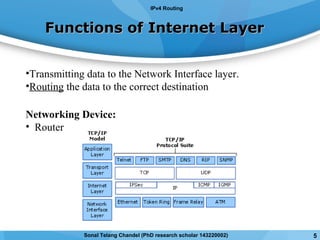
Functions of Internet LayerFunctions of Internet Layer
•Transmitting data to the Network Interface layer.
•Routing the data to the correct destination
Networking Device:
• Router
IPv4 Routing
5Sonal Telang Chandel (PhD research scholar 143220002)
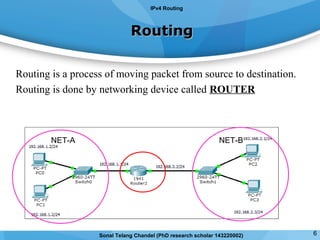
RoutingRouting
Routing is a process of moving packet from source to destination.
Routing is done by networking device called ROUTER
IPv4 Routing
Sonal Telang Chandel (PhD research scholar 143220002)
NET-A NET-B
6
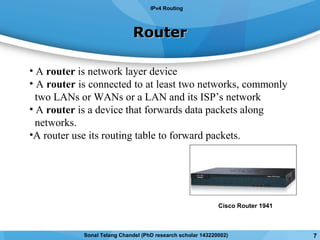
• A router is network layer device
• A router is connected to at least two networks, commonly
two LANs or WANs or a LAN and its ISP’s network
• A router is a device that forwards data packets along
networks.
•A router use its routing table to forward packets.
RouterRouter
IPv4 Routing
Cisco Router 1941
7Sonal Telang Chandel (PhD research scholar 143220002)
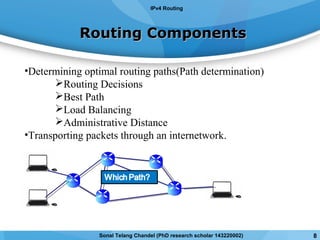
Routing ComponentsRouting Components
•Determining optimal routing paths(Path determination)
Routing Decisions
Best Path
Load Balancing
Administrative Distance
•Transporting packets through an internetwork.
IPv4 Routing
Sonal Telang Chandel (PhD research scholar 143220002) 8
Routing Decision-
 Directly connected network: packet is forwarded
directly to the destination device.
Remote network: the packet is forwarded to
another router in the remote network.
Default Route: A Gateway of last resort is set
when a default route is configured on a router. If
the router does not have a default route, then the
packet is discarded.
Path DeterminationPath Determination
IPv4 Routing
9Sonal Telang Chandel (PhD research scholar 143220002)
Best Path-
based on the value or metric
Load Balancing-
If a routing table has two or more paths with identical metrics
to the same destination network.
Administrative Distance-
How does the router know which route to use? AD defines
the reliability of routing protocol.
Path DeterminationPath Determination
IPv4 Routing
Sonal Telang Chandel (PhD research scholar 143220002) 10
Routing TableRouting Table
Static Routing/Default Routing
-Static table is one with manual entries by admin
-It is one way communication
Dynamic Routing/ Automatic Routing
-A dynamic table is updated automatically when there
is a change somewhere in the internet.
-Routing is done by Routing Protocols
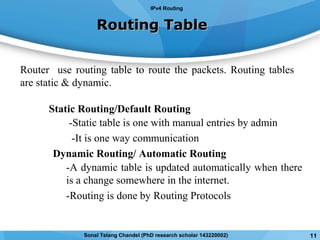
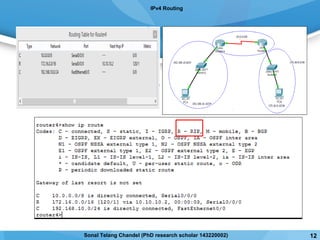
Router use routing table to route the packets. Routing tables
are static & dynamic.
IPv4 Routing
11Sonal Telang Chandel (PhD research scholar 143220002)
IPv4 Routing
12Sonal Telang Chandel (PhD research scholar 143220002)
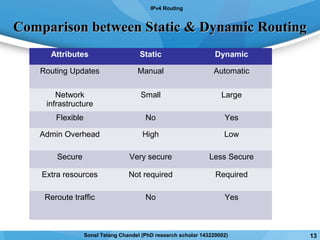
Comparison between Static & Dynamic RoutingComparison between Static & Dynamic Routing
Attributes Static Dynamic
Routing Updates Manual Automatic
Network
infrastructure
Small Large
Flexible No Yes
Admin Overhead High Low
Secure Very secure Less Secure
Extra resources Not required Required
Reroute traffic No Yes
IPv4 Routing
13Sonal Telang Chandel (PhD research scholar 143220002)
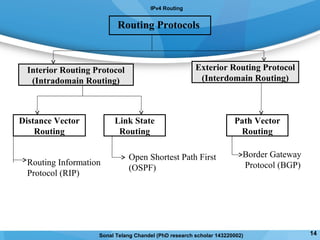
Routing Protocols
Interior Routing Protocol
(Intradomain Routing)
Exterior Routing Protocol
(Interdomain Routing)
Distance Vector
Routing
Link State
Routing
Path Vector
Routing
Routing Information
Protocol (RIP)
Open Shortest Path First
(OSPF)
Border Gateway
Protocol (BGP)
IPv4 Routing
Sonal Telang Chandel (PhD research scholar 143220002) 14
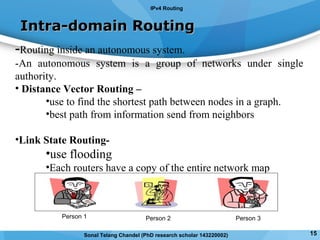
-Routing inside an autonomous system.
-An autonomous system is a group of networks under single
authority.
• Distance Vector Routing –
•use to find the shortest path between nodes in a graph.
•best path from information send from neighbors
•Link State Routing-
•use flooding
•Each routers have a copy of the entire network map
Intra-domain RoutingIntra-domain Routing
Person 1 Person 3Person 2
IPv4 Routing
15Sonal Telang Chandel (PhD research scholar 143220002)
Inter-domain RoutingInter-domain Routing
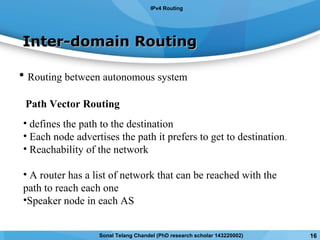
• Routing between autonomous system
Path Vector Routing
• defines the path to the destination
• Each node advertises the path it prefers to get to destination.
• Reachability of the network
• A router has a list of network that can be reached with the
path to reach each one
•Speaker node in each AS
IPv4 Routing
Sonal Telang Chandel (PhD research scholar 143220002) 16
Routing Information Protocol(RIP)Routing Information Protocol(RIP)
-Intra-domain routing protocol used inside an autonomous
system.
-RIP implements distance vector routing.
- hop count(metric).
- Use Bellman-ford algorithm to find the shortest path between
nodes.
- Maximum number of hops is 0-15.
- RIP use timers.
-Version of RIP
•RIP v-1
•RIP v-2
IPv4 Routing
17Sonal Telang Chandel (PhD research scholar 143220002)
-dynamic routingrip.pkt
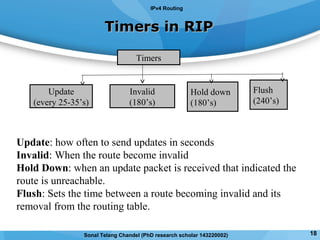
Timers in RIPTimers in RIP
Timers
Invalid
(180’s)
Hold down
(180’s)
Update
(every 25-35’s)
Update: how often to send updates in seconds
Invalid: When the route become invalid
Hold Down: when an update packet is received that indicated the
route is unreachable.
Flush: Sets the time between a route becoming invalid and its
removal from the routing table.
IPv4 Routing
Flush
(240’s)
18Sonal Telang Chandel (PhD research scholar 143220002)
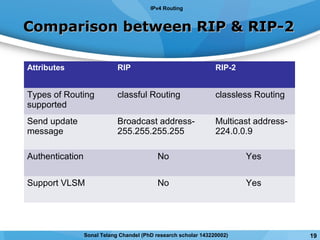
Comparison between RIP & RIP-2Comparison between RIP & RIP-2
Attributes RIP RIP-2
Types of Routing
supported
classful Routing classless Routing
Send update
message
Broadcast address-
255.255.255.255
Multicast address-
224.0.0.9
Authentication No Yes
Support VLSM No Yes
IPv4 Routing
19Sonal Telang Chandel (PhD research scholar 143220002)
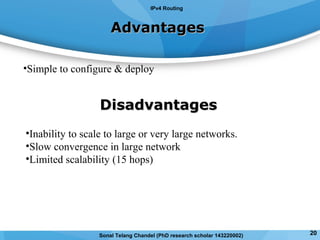
AdvantagesAdvantages
•Simple to configure & deploy
DisadvantagesDisadvantages
•Inability to scale to large or very large networks.
•Slow convergence in large network
•Limited scalability (15 hops)
IPv4 Routing
Sonal Telang Chandel (PhD research scholar 143220002) 20
Open Shortest Path First(OSPF)Open Shortest Path First(OSPF)
•Intra-Domain Routing Protocol ,Link State Routing
•Classless Routing Protocol
•Use Dijkstra’s algorithm to determine the shortest path
•Advertise the status of directly connected link using LSA
•Send very small periodic (Hello) message to maintain link
condition
•Use multicasting within area
•OSPF divides AS into areas
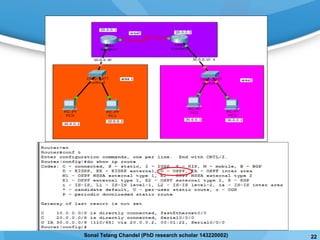
ospf routing.pkt
IPv4 Routing
21Sonal Telang Chandel (PhD research scholar 143220002)
22Sonal Telang Chandel (PhD research scholar 143220002)
AdvantagesAdvantages
•OSPF has fast convergence
• It is classless protocol and uses VLSM
•Uses the concept of area to implement hierarchical routing
DisadvantagesDisadvantages
•It requires more memory to hold the adjacency (list of OSPF
neighbors), topology and routing tables.
•It requires extra CPU processing to run the SPF algorithm
•It is complex to configure and more difficult to troubleshoot.
IPv4 Routing
23Sonal Telang Chandel (PhD research scholar 143220002)
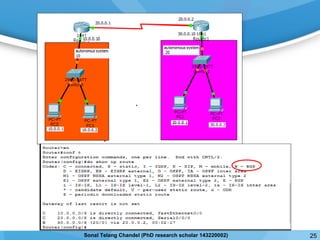
Border Gateway Protocol(BGP)Border Gateway Protocol(BGP)
• Inter-domain routing protocol
• based on path vector routing
•BGP uses the services of TCP.
•BGP Sessions
•External & Internal BGP
•BGP Messages:
Open- used to establish a peering session
Update- used to exchange network reachability information
Keep alive- to check whether a link or connection has failed or
not
Notification- when an error condition is detected.
bgp routing.pkt
IPv4 Routing
24Sonal Telang Chandel (PhD research scholar 143220002)
25Sonal Telang Chandel (PhD research scholar 143220002)
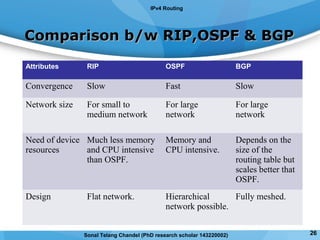
Comparison b/w RIP,OSPF & BGPComparison b/w RIP,OSPF & BGP
Attributes RIP OSPF BGP
Convergence Slow Fast Slow
Network size For small to
medium network
For large
network
For large
network
Need of device
resources
Much less memory
and CPU intensive
than OSPF.
Memory and
CPU intensive.
Depends on the
size of the
routing table but
scales better that
OSPF.
Design Flat network. Hierarchical
network possible.
Fully meshed.
IPv4 Routing
26Sonal Telang Chandel (PhD research scholar 143220002)
Future of RoutingFuture of Routing
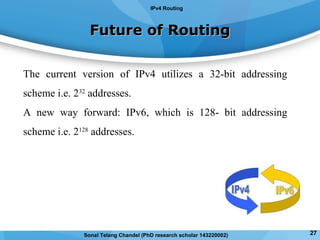
The current version of IPv4 utilizes a 32-bit addressing
scheme i.e. 232
addresses.
A new way forward: IPv6, which is 128- bit addressing
scheme i.e. 2128
addresses.
IPv4 Routing
27Sonal Telang Chandel (PhD research scholar 143220002)
ConclusionConclusion
•The main purpose of a router is to connect multiple networks
and forward packets from one network to the next.
•Router use routing table to forward the packet. Routing table is
one of two ways: either by the network administrator manually
configuring static routes or by implementing a dynamic routing
protocol.
IPv4 Routing
28Sonal Telang Chandel (PhD research scholar 143220002)
ReferencesReferences
IPv4 Routing
[1]. Behrouz A Forouzan, “Data Communication & Networking ” (4th
edition),
[2]. Behrouz A Forouzan, “TCP/IP Protocol Suite”(4th
edition)
[3]. Andrew S. Tanenbaum “Computer Networks”, (4th
edition)
[4]. Chandra Wijaya , Parahyangan Catholic University, “Performance Analysis of
Dynamic Routing Protocol EIGRP & OSPF in IPv4 & IPv6 Network ” 2011 First
International Conference on Informatics & Computational Intelligence
[5]. http://www.omnisecu.com/cisco-certified-network-associate-ccna/what-is-
dynamic-routing-and-different-types-of-dynamic-routing.php
[6]. RFC 1058, “Routing Information Protocol (https://tools.ietf.org/html/rfc1058)
[7].http://www.enterprisenetworkingplanet.com/netsp/article.php/3615896/Networking-
101-Understanding-BGP-Routing.htm
[8]. “How Router Works” Microsoft TechNet Library
[9].http://computernetworkingnotes.com/routing-static-dynamics-rip-ospf-igrp-
eigrp/rip-routing.html
[10]http://networklessons.com/ip-routing/classful-vs-classless-routing-protocols/
29Sonal Telang Chandel (PhD research scholar 143220002)
30Sonal Telang Chandel (PhD research scholar 143220002)

Ipv4 ppt

  • 1.
    Maulana Azad NationalInstitute of Technology Bhopal Department of Mathematics & Computer Applications Seminar-I IPv4 ROUTING Supervisor: Presented by: Dr. Sanjay Sharma Sonal Telang Chandel PhD Scholar 143220002
  • 2.
    Introduction of InternetLayer Routing Routing Protocols Future of Routing Conclusion References OutlineOutline
  • 3.
    customer www.amazon.com How data flowfrom one device to another on the internet? Internet Internet LayerInternet Layer Sonal Telang Chandel (PhD research scholar 143220002) IPv4 Routing What actually happens when you press “enter” key? 3
  • 4.
    Whenever the datais transmitted from one location to another, the data is broken into chunks and wrapped into structures called IP packets. At the destination, IP headers are removed and reassembly of original message is done. IPv4 Routing IP Packet Data flow in the form of packets 4Sonal Telang Chandel (PhD research scholar 143220002)
  • 5.
    Functions of InternetLayerFunctions of Internet Layer •Transmitting data to the Network Interface layer. •Routing the data to the correct destination Networking Device: • Router IPv4 Routing 5Sonal Telang Chandel (PhD research scholar 143220002)
  • 6.
    RoutingRouting Routing is aprocess of moving packet from source to destination. Routing is done by networking device called ROUTER IPv4 Routing Sonal Telang Chandel (PhD research scholar 143220002) NET-A NET-B 6
  • 7.
    • A routeris network layer device • A router is connected to at least two networks, commonly two LANs or WANs or a LAN and its ISP’s network • A router is a device that forwards data packets along networks. •A router use its routing table to forward packets. RouterRouter IPv4 Routing Cisco Router 1941 7Sonal Telang Chandel (PhD research scholar 143220002)
  • 8.
    Routing ComponentsRouting Components •Determiningoptimal routing paths(Path determination) Routing Decisions Best Path Load Balancing Administrative Distance •Transporting packets through an internetwork. IPv4 Routing Sonal Telang Chandel (PhD research scholar 143220002) 8
  • 9.
    Routing Decision-  Directlyconnected network: packet is forwarded directly to the destination device. Remote network: the packet is forwarded to another router in the remote network. Default Route: A Gateway of last resort is set when a default route is configured on a router. If the router does not have a default route, then the packet is discarded. Path DeterminationPath Determination IPv4 Routing 9Sonal Telang Chandel (PhD research scholar 143220002)
  • 10.
    Best Path- based onthe value or metric Load Balancing- If a routing table has two or more paths with identical metrics to the same destination network. Administrative Distance- How does the router know which route to use? AD defines the reliability of routing protocol. Path DeterminationPath Determination IPv4 Routing Sonal Telang Chandel (PhD research scholar 143220002) 10
  • 11.
    Routing TableRouting Table StaticRouting/Default Routing -Static table is one with manual entries by admin -It is one way communication Dynamic Routing/ Automatic Routing -A dynamic table is updated automatically when there is a change somewhere in the internet. -Routing is done by Routing Protocols Router use routing table to route the packets. Routing tables are static & dynamic. IPv4 Routing 11Sonal Telang Chandel (PhD research scholar 143220002)
  • 12.
    IPv4 Routing 12Sonal TelangChandel (PhD research scholar 143220002)
  • 13.
    Comparison between Static& Dynamic RoutingComparison between Static & Dynamic Routing Attributes Static Dynamic Routing Updates Manual Automatic Network infrastructure Small Large Flexible No Yes Admin Overhead High Low Secure Very secure Less Secure Extra resources Not required Required Reroute traffic No Yes IPv4 Routing 13Sonal Telang Chandel (PhD research scholar 143220002)
  • 14.
    Routing Protocols Interior RoutingProtocol (Intradomain Routing) Exterior Routing Protocol (Interdomain Routing) Distance Vector Routing Link State Routing Path Vector Routing Routing Information Protocol (RIP) Open Shortest Path First (OSPF) Border Gateway Protocol (BGP) IPv4 Routing Sonal Telang Chandel (PhD research scholar 143220002) 14
  • 15.
    -Routing inside anautonomous system. -An autonomous system is a group of networks under single authority. • Distance Vector Routing – •use to find the shortest path between nodes in a graph. •best path from information send from neighbors •Link State Routing- •use flooding •Each routers have a copy of the entire network map Intra-domain RoutingIntra-domain Routing Person 1 Person 3Person 2 IPv4 Routing 15Sonal Telang Chandel (PhD research scholar 143220002)
  • 16.
    Inter-domain RoutingInter-domain Routing •Routing between autonomous system Path Vector Routing • defines the path to the destination • Each node advertises the path it prefers to get to destination. • Reachability of the network • A router has a list of network that can be reached with the path to reach each one •Speaker node in each AS IPv4 Routing Sonal Telang Chandel (PhD research scholar 143220002) 16
  • 17.
    Routing Information Protocol(RIP)RoutingInformation Protocol(RIP) -Intra-domain routing protocol used inside an autonomous system. -RIP implements distance vector routing. - hop count(metric). - Use Bellman-ford algorithm to find the shortest path between nodes. - Maximum number of hops is 0-15. - RIP use timers. -Version of RIP •RIP v-1 •RIP v-2 IPv4 Routing 17Sonal Telang Chandel (PhD research scholar 143220002) -dynamic routingrip.pkt
  • 18.
    Timers in RIPTimersin RIP Timers Invalid (180’s) Hold down (180’s) Update (every 25-35’s) Update: how often to send updates in seconds Invalid: When the route become invalid Hold Down: when an update packet is received that indicated the route is unreachable. Flush: Sets the time between a route becoming invalid and its removal from the routing table. IPv4 Routing Flush (240’s) 18Sonal Telang Chandel (PhD research scholar 143220002)
  • 19.
    Comparison between RIP& RIP-2Comparison between RIP & RIP-2 Attributes RIP RIP-2 Types of Routing supported classful Routing classless Routing Send update message Broadcast address- 255.255.255.255 Multicast address- 224.0.0.9 Authentication No Yes Support VLSM No Yes IPv4 Routing 19Sonal Telang Chandel (PhD research scholar 143220002)
  • 20.
    AdvantagesAdvantages •Simple to configure& deploy DisadvantagesDisadvantages •Inability to scale to large or very large networks. •Slow convergence in large network •Limited scalability (15 hops) IPv4 Routing Sonal Telang Chandel (PhD research scholar 143220002) 20
  • 21.
    Open Shortest PathFirst(OSPF)Open Shortest Path First(OSPF) •Intra-Domain Routing Protocol ,Link State Routing •Classless Routing Protocol •Use Dijkstra’s algorithm to determine the shortest path •Advertise the status of directly connected link using LSA •Send very small periodic (Hello) message to maintain link condition •Use multicasting within area •OSPF divides AS into areas ospf routing.pkt IPv4 Routing 21Sonal Telang Chandel (PhD research scholar 143220002)
  • 22.
    22Sonal Telang Chandel(PhD research scholar 143220002)
  • 23.
    AdvantagesAdvantages •OSPF has fastconvergence • It is classless protocol and uses VLSM •Uses the concept of area to implement hierarchical routing DisadvantagesDisadvantages •It requires more memory to hold the adjacency (list of OSPF neighbors), topology and routing tables. •It requires extra CPU processing to run the SPF algorithm •It is complex to configure and more difficult to troubleshoot. IPv4 Routing 23Sonal Telang Chandel (PhD research scholar 143220002)
  • 24.
    Border Gateway Protocol(BGP)BorderGateway Protocol(BGP) • Inter-domain routing protocol • based on path vector routing •BGP uses the services of TCP. •BGP Sessions •External & Internal BGP •BGP Messages: Open- used to establish a peering session Update- used to exchange network reachability information Keep alive- to check whether a link or connection has failed or not Notification- when an error condition is detected. bgp routing.pkt IPv4 Routing 24Sonal Telang Chandel (PhD research scholar 143220002)
  • 25.
    25Sonal Telang Chandel(PhD research scholar 143220002)
  • 26.
    Comparison b/w RIP,OSPF& BGPComparison b/w RIP,OSPF & BGP Attributes RIP OSPF BGP Convergence Slow Fast Slow Network size For small to medium network For large network For large network Need of device resources Much less memory and CPU intensive than OSPF. Memory and CPU intensive. Depends on the size of the routing table but scales better that OSPF. Design Flat network. Hierarchical network possible. Fully meshed. IPv4 Routing 26Sonal Telang Chandel (PhD research scholar 143220002)
  • 27.
    Future of RoutingFutureof Routing The current version of IPv4 utilizes a 32-bit addressing scheme i.e. 232 addresses. A new way forward: IPv6, which is 128- bit addressing scheme i.e. 2128 addresses. IPv4 Routing 27Sonal Telang Chandel (PhD research scholar 143220002)
  • 28.
    ConclusionConclusion •The main purposeof a router is to connect multiple networks and forward packets from one network to the next. •Router use routing table to forward the packet. Routing table is one of two ways: either by the network administrator manually configuring static routes or by implementing a dynamic routing protocol. IPv4 Routing 28Sonal Telang Chandel (PhD research scholar 143220002)
  • 29.
    ReferencesReferences IPv4 Routing [1]. BehrouzA Forouzan, “Data Communication & Networking ” (4th edition), [2]. Behrouz A Forouzan, “TCP/IP Protocol Suite”(4th edition) [3]. Andrew S. Tanenbaum “Computer Networks”, (4th edition) [4]. Chandra Wijaya , Parahyangan Catholic University, “Performance Analysis of Dynamic Routing Protocol EIGRP & OSPF in IPv4 & IPv6 Network ” 2011 First International Conference on Informatics & Computational Intelligence [5]. http://www.omnisecu.com/cisco-certified-network-associate-ccna/what-is- dynamic-routing-and-different-types-of-dynamic-routing.php [6]. RFC 1058, “Routing Information Protocol (https://tools.ietf.org/html/rfc1058) [7].http://www.enterprisenetworkingplanet.com/netsp/article.php/3615896/Networking- 101-Understanding-BGP-Routing.htm [8]. “How Router Works” Microsoft TechNet Library [9].http://computernetworkingnotes.com/routing-static-dynamics-rip-ospf-igrp- eigrp/rip-routing.html [10]http://networklessons.com/ip-routing/classful-vs-classless-routing-protocols/ 29Sonal Telang Chandel (PhD research scholar 143220002)
  • 30.
    30Sonal Telang Chandel(PhD research scholar 143220002)

Editor's Notes

  • #18 The number of links that have to be used to reach the destination is known as Hop count(metric)