Disclaimer: This presentation is prepared by trainees of
baabtra as a part of mentoring program. This is not official
document of baabtra –Mentoring Partner
Baabtra-Mentoring Partner is the mentoring division of baabte System Technologies Pvt .
Ltd
IP address


     FREDDY P.V
     Email :F4FREDDY@GMAIL.COM
     Facebook :F4FREDDY@GMAIL.COM
IP
• Short for Internet Protocol.

• IP specifies the format of packets, also called datagrams,
  and the addressing scheme.

• Most networks combine IP with a higher-level protocol
  called Transmission Control Protocol (TCP), which
  establishes a virtual connection between a destination and
  a source.

• The current version of IP is IPv4. A new version, called IPv6
  or IPng, is under development.
IP address
• IP address is short for Internet Protocol (IP)
  address.

• An IP address is an identifier for a computer or
  device on a TCP/IP network.

• Networks using the TCP/IP protocol route
  messages based on the IP address of the
  destination.
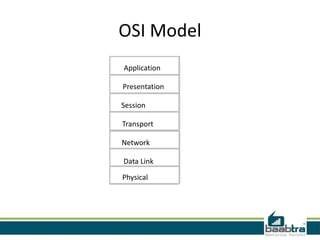
OSI Model
Application

Presentation

Session

Transport

Network

Data Link

Physical
The Network Layer
Navigating data

Source

Destination
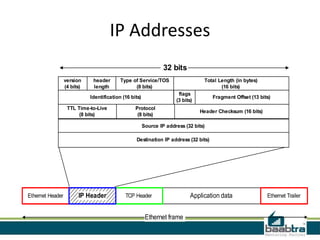
IP Addresses
                                                                 32 bits
                  version     header       Type of Service/TOS                    Total Length (in bytes)
                  (4 bits)    length             (8 bits)                                (16 bits)
                                                                       flags
                             Identification (16 bits)                                 Fragment Offset (13 bits)
                                                                      (3 bits)
                   TTL Time-to-Live               Protocol
                                                                                 Header Checksum (16 bits)
                        (8 bits)                   (8 bits)

                                                        Source IP address (32 bits)

                                                  Destination IP address (32 bits)


Ethernet Header         IP Header            TCP Header                      Application data                Ethernet Trailer


                                                         Ethernet frame
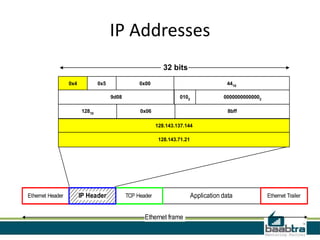
IP Addresses
                                                              32 bits
                  0x4            0x5               0x00                                  4410

                                       9d08                         0102                00000000000002

                         12810                     0x06                                   8bff

                                                           128.143.137.144

                                                            128.143.71.21


Ethernet Header         IP Header             TCP Header                    Application data             Ethernet Trailer


                                                     Ethernet frame
• An IP address is a unique global address for a
  network interface

• The format of an IP address is a 32-bit numeric
  address written as four numbers separated by
  periods.

• Each number can be zero to 255.

• Example, 1.160.10.240 could be an IP address.
IP address Classes
5 Classes of IP address A B C D and E

Class A reserved for governments

Class B reserved for medium companies

Class C reserved for small companies

Class D are reserved for multicasting

Class E are reserved for future use
IP structure

       Class A begins 1 to 126

       Class B begins 128 to 191

       Class C begins 192 to 223
How does your computer get its IP
              address?
• An IP address can be either dynamic or static.
• A static address is one that you configure yourself by
  editing your computer's network settings.
• Dynamic addresses are the most common. They're
  assigned by the Dynamic Host Configuration
  Protocol (DHCP), a service running on the network.
• DHCP typically runs on network hardware such as
  routers or dedicated DHCP servers.
Internet Protocol version 4 (IPv4)
• It is the fourth revision in the development of the Internet
  Protocol (IP) and the first version of the protocol to be widely
  deployed.

• Together with IPv6, it is at the core of standards-based
  internetworking methods of the Internet.

• As of 2012 IPv4 is still the most widely deployed Internet
  Layer protocol
• IPv4 is a connectionless protocol for use on packet-switched Link
  Layer networks (e.g., Ethernet).

•   It operates on a best effort delivery model, in that it does not
    guarantee delivery, nor does it assure proper sequencing or
    avoidance of duplicate delivery.

• These aspects, including data integrity, are addressed by an upper
  layer transport protocol, such as the Transmission Control Protocol
  (TCP).

• IPv4 uses 32-bit (four-byte) addresses, which limits the address
  space to 4294967296 (232) addresses.

• Addresses were assigned to users, and the number of unassigned
  addresses decreased.

• IPv4 address exhaustion occurred on February 3, 2011.
IPV6
• All addresses are 128 bits
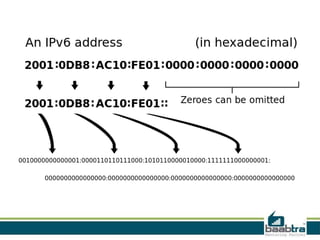
• Write as sequence of eight sets of four hex
  digits (16 bits each) separated by colons
  – Leading zeros in group may be omitted
  – Contiguous all-zero groups may be replaced by “::”
  – Only one such group can be replaced
• 3ffe:3700:0200:00ff:0000:0000:0
  000:0001

• can be written

• 3ffe:3700:200:ff:0:0:0:1

• Or

• 3ffe:3700:200:ff::1
• IPv6 uses 128-bit addresses, allowing for 2128,
  or approximately 3.4×1038 addresses —
• more than 7.9×1028 times as many as IPv4
• The deployment of IPv6 is accelerating, with a
  symbolic World IPv6 Launch having taken
  place on 6 June 2012
If this presentation helped you, please visit our
           page facebook.com/baabtra and like it.
               Thanks in advance.
www.baabtra.com | www.massbaab.com |www.baabte.com
Contact Us

IP Address

  • 2.
    Disclaimer: This presentationis prepared by trainees of baabtra as a part of mentoring program. This is not official document of baabtra –Mentoring Partner Baabtra-Mentoring Partner is the mentoring division of baabte System Technologies Pvt . Ltd
  • 3.
    IP address FREDDY P.V Email :F4FREDDY@GMAIL.COM Facebook :F4FREDDY@GMAIL.COM
  • 4.
    IP • Short forInternet Protocol. • IP specifies the format of packets, also called datagrams, and the addressing scheme. • Most networks combine IP with a higher-level protocol called Transmission Control Protocol (TCP), which establishes a virtual connection between a destination and a source. • The current version of IP is IPv4. A new version, called IPv6 or IPng, is under development.
  • 5.
    IP address • IPaddress is short for Internet Protocol (IP) address. • An IP address is an identifier for a computer or device on a TCP/IP network. • Networks using the TCP/IP protocol route messages based on the IP address of the destination.
  • 6.
  • 7.
    The Network Layer Navigatingdata Source Destination
  • 8.
    IP Addresses 32 bits version header Type of Service/TOS Total Length (in bytes) (4 bits) length (8 bits) (16 bits) flags Identification (16 bits) Fragment Offset (13 bits) (3 bits) TTL Time-to-Live Protocol Header Checksum (16 bits) (8 bits) (8 bits) Source IP address (32 bits) Destination IP address (32 bits) Ethernet Header IP Header TCP Header Application data Ethernet Trailer Ethernet frame
  • 9.
    IP Addresses 32 bits 0x4 0x5 0x00 4410 9d08 0102 00000000000002 12810 0x06 8bff 128.143.137.144 128.143.71.21 Ethernet Header IP Header TCP Header Application data Ethernet Trailer Ethernet frame
  • 10.
    • An IPaddress is a unique global address for a network interface • The format of an IP address is a 32-bit numeric address written as four numbers separated by periods. • Each number can be zero to 255. • Example, 1.160.10.240 could be an IP address.
  • 11.
    IP address Classes 5Classes of IP address A B C D and E Class A reserved for governments Class B reserved for medium companies Class C reserved for small companies Class D are reserved for multicasting Class E are reserved for future use
  • 12.
    IP structure  Class A begins 1 to 126  Class B begins 128 to 191  Class C begins 192 to 223
  • 13.
    How does yourcomputer get its IP address? • An IP address can be either dynamic or static. • A static address is one that you configure yourself by editing your computer's network settings. • Dynamic addresses are the most common. They're assigned by the Dynamic Host Configuration Protocol (DHCP), a service running on the network. • DHCP typically runs on network hardware such as routers or dedicated DHCP servers.
  • 14.
    Internet Protocol version4 (IPv4) • It is the fourth revision in the development of the Internet Protocol (IP) and the first version of the protocol to be widely deployed. • Together with IPv6, it is at the core of standards-based internetworking methods of the Internet. • As of 2012 IPv4 is still the most widely deployed Internet Layer protocol
  • 16.
    • IPv4 isa connectionless protocol for use on packet-switched Link Layer networks (e.g., Ethernet). • It operates on a best effort delivery model, in that it does not guarantee delivery, nor does it assure proper sequencing or avoidance of duplicate delivery. • These aspects, including data integrity, are addressed by an upper layer transport protocol, such as the Transmission Control Protocol (TCP). • IPv4 uses 32-bit (four-byte) addresses, which limits the address space to 4294967296 (232) addresses. • Addresses were assigned to users, and the number of unassigned addresses decreased. • IPv4 address exhaustion occurred on February 3, 2011.
  • 17.
    IPV6 • All addressesare 128 bits • Write as sequence of eight sets of four hex digits (16 bits each) separated by colons – Leading zeros in group may be omitted – Contiguous all-zero groups may be replaced by “::” – Only one such group can be replaced
  • 19.
    • 3ffe:3700:0200:00ff:0000:0000:0 000:0001 • can be written • 3ffe:3700:200:ff:0:0:0:1 • Or • 3ffe:3700:200:ff::1
  • 20.
    • IPv6 uses128-bit addresses, allowing for 2128, or approximately 3.4×1038 addresses — • more than 7.9×1028 times as many as IPv4 • The deployment of IPv6 is accelerating, with a symbolic World IPv6 Launch having taken place on 6 June 2012
  • 21.
    If this presentationhelped you, please visit our page facebook.com/baabtra and like it. Thanks in advance. www.baabtra.com | www.massbaab.com |www.baabte.com
  • 22.