Ahmed AL Tememe
Computer Science
ahmed.altemememe@uokerbala.edu.iq
1
Babylon University
IT College
Software Department
Outline
Why a IPv6 ?
IPv4 and IPv6 Coexistence
IPv6 Address Representation
IPv6 Prefix Length
IPv6 Address Types
Summary
2
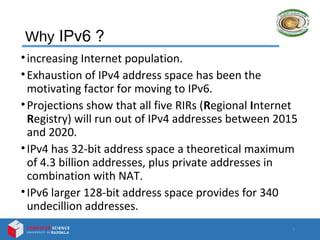
Why IPv6 ?
•increasing Internet population.
•Exhaustion of IPv4 address space has been the
motivating factor for moving to IPv6.
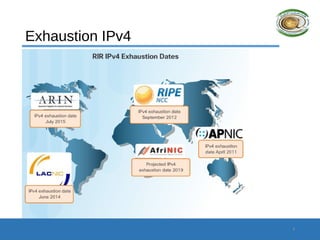
•Projections show that all five RIRs (Regional Internet
Registry) will run out of IPv4 addresses between 2015
and 2020.
•IPv4 has 32-bit address space a theoretical maximum
of 4.3 billion addresses, plus private addresses in
combination with NAT.
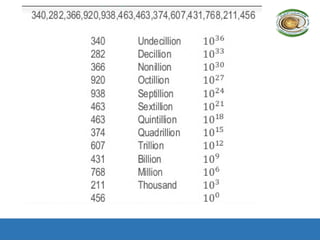
•IPv6 larger 128-bit address space provides for 340
undecillion addresses.
3
4
Exhaustion IPv4
5
Internet Of Things
6
IPv4 Issues
IPv4 and IPv6 Coexistence
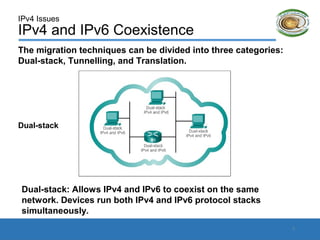
The migration techniques can be divided into three categories:
Dual-stack, Tunnelling, and Translation.
Dual-stack: Allows IPv4 and IPv6 to coexist on the same
network. Devices run both IPv4 and IPv6 protocol stacks
simultaneously.
Dual-stack
7
IPv4 Issues
IPv4 and IPv6 Coexistence
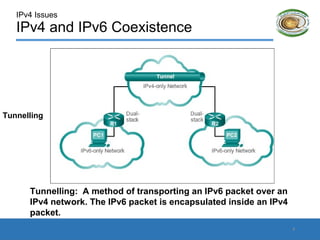
Tunnelling: A method of transporting an IPv6 packet over an
IPv4 network. The IPv6 packet is encapsulated inside an IPv4
packet.
Tunnelling
8
IPv4 Issues
IPv4 and IPv6 Coexistence (cont.)
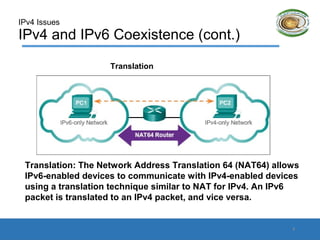
Translation: The Network Address Translation 64 (NAT64) allows
IPv6-enabled devices to communicate with IPv4-enabled devices
using a translation technique similar to NAT for IPv4. An IPv6
packet is translated to an IPv4 packet, and vice versa.
Translation
9
IPv6 Addressing
IPv6 Address Representation
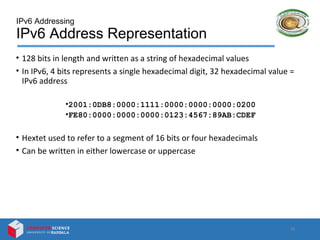
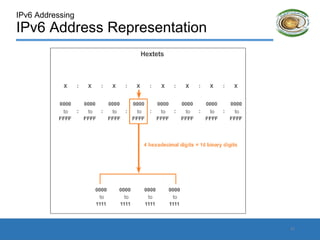
• 128 bits in length and written as a string of hexadecimal values
• In IPv6, 4 bits represents a single hexadecimal digit, 32 hexadecimal value =
IPv6 address
•2001:0DB8:0000:1111:0000:0000:0000:0200
•FE80:0000:0000:0000:0123:4567:89AB:CDEF
• Hextet used to refer to a segment of 16 bits or four hexadecimals
• Can be written in either lowercase or uppercase
10
IPv6 Addressing
IPv6 Address Representation
11
IPv6 Addressing
Rule 1- Omitting Leading 0s
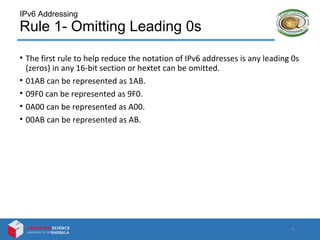
• The first rule to help reduce the notation of IPv6 addresses is any leading 0s
(zeros) in any 16-bit section or hextet can be omitted.
• 01AB can be represented as 1AB.
• 09F0 can be represented as 9F0.
• 0A00 can be represented as A00.
• 00AB can be represented as AB.
12
IPv6 Addressing
Rule 2 - Omitting All 0 Segments
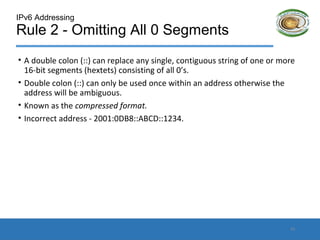
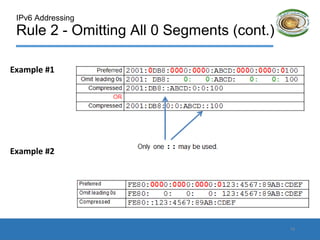
• A double colon (::) can replace any single, contiguous string of one or more
16-bit segments (hextets) consisting of all 0’s.
• Double colon (::) can only be used once within an address otherwise the
address will be ambiguous.
• Known as the compressed format.
• Incorrect address - 2001:0DB8::ABCD::1234.
13
IPv6 Addressing
Rule 2 - Omitting All 0 Segments (cont.)
Example #1
Example #2
14
Types of IPv6 Addresses
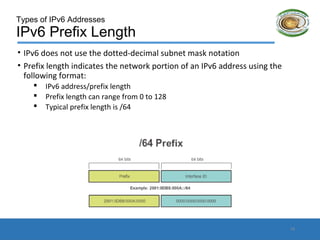
IPv6 Prefix Length
• IPv6 does not use the dotted-decimal subnet mask notation
• Prefix length indicates the network portion of an IPv6 address using the
following format:
 IPv6 address/prefix length
 Prefix length can range from 0 to 128
 Typical prefix length is /64
15
Types of IPv6 Addresses
IPv6 Address Types
There are three types of IPv6 addresses:
Unicast
Multicast
Anycast.
Note: IPv6 does not have broadcast addresses.
16
Types of IPv6 Addresses
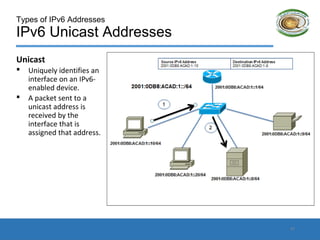
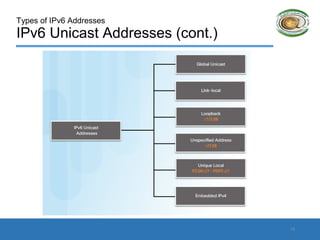
IPv6 Unicast Addresses
Unicast
 Uniquely identifies an
interface on an IPv6-
enabled device.
 A packet sent to a
unicast address is
received by the
interface that is
assigned that address.
17
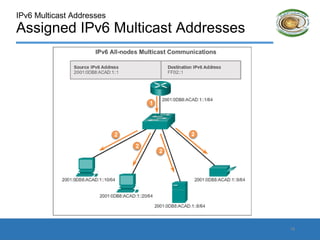
IPv6 Multicast Addresses
Assigned IPv6 Multicast Addresses
18
Types of IPv6 Addresses
IPv6 Unicast Addresses (cont.)
19
Types of IPv6 Addresses
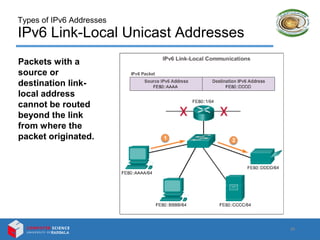
IPv6 Link-Local Unicast Addresses
Packets with a
source or
destination link-
local address
cannot be routed
beyond the link
from where the
packet originated.
20
IPv6 Unicast Addresses
Structure of an IPv6 Global Unicast Address
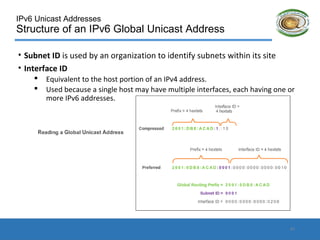
• Subnet ID is used by an organization to identify subnets within its site
• Interface ID
 Equivalent to the host portion of an IPv4 address.
 Used because a single host may have multiple interfaces, each having one or
more IPv6 addresses.
21
IPv6 Unicast Addresses
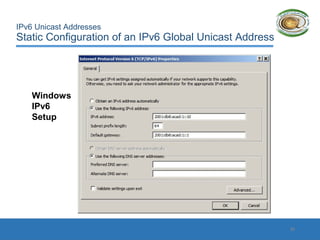
Static Configuration of an IPv6 Global Unicast Address
Windows
IPv6
Setup
22
IP Addressing
Summary
• The depletion of IPv4 address space is the motivating factor for moving to
IPv6.
• Each IPv6 address has 128 bits verses the 32 bits in an IPv4 address.
• The prefix length is used to indicate the network portion of an IPv6
address using the following format: IPv6 address/prefix length.
• There are three types of IPv6 addresses: unicast, multicast, and anycast.
• An IPv6 link-local address enables a device to communicate with other
IPv6-enabled devices on the same link and only on that link (subnet).
• Packets with a source or destination link-local address cannot be routed
beyond the link from where the packet originated.
• IPv6 link-local addresses are in the FE80::/10 range.
• ICMP is available for both IPv4 and IPv6.
23
24

Ip v6

  • 1.
    Ahmed AL Tememe ComputerScience ahmed.altemememe@uokerbala.edu.iq 1 Babylon University IT College Software Department
  • 2.
    Outline Why a IPv6? IPv4 and IPv6 Coexistence IPv6 Address Representation IPv6 Prefix Length IPv6 Address Types Summary 2
  • 3.
    Why IPv6 ? •increasingInternet population. •Exhaustion of IPv4 address space has been the motivating factor for moving to IPv6. •Projections show that all five RIRs (Regional Internet Registry) will run out of IPv4 addresses between 2015 and 2020. •IPv4 has 32-bit address space a theoretical maximum of 4.3 billion addresses, plus private addresses in combination with NAT. •IPv6 larger 128-bit address space provides for 340 undecillion addresses. 3
  • 4.
  • 5.
  • 6.
  • 7.
    IPv4 Issues IPv4 andIPv6 Coexistence The migration techniques can be divided into three categories: Dual-stack, Tunnelling, and Translation. Dual-stack: Allows IPv4 and IPv6 to coexist on the same network. Devices run both IPv4 and IPv6 protocol stacks simultaneously. Dual-stack 7
  • 8.
    IPv4 Issues IPv4 andIPv6 Coexistence Tunnelling: A method of transporting an IPv6 packet over an IPv4 network. The IPv6 packet is encapsulated inside an IPv4 packet. Tunnelling 8
  • 9.
    IPv4 Issues IPv4 andIPv6 Coexistence (cont.) Translation: The Network Address Translation 64 (NAT64) allows IPv6-enabled devices to communicate with IPv4-enabled devices using a translation technique similar to NAT for IPv4. An IPv6 packet is translated to an IPv4 packet, and vice versa. Translation 9
  • 10.
    IPv6 Addressing IPv6 AddressRepresentation • 128 bits in length and written as a string of hexadecimal values • In IPv6, 4 bits represents a single hexadecimal digit, 32 hexadecimal value = IPv6 address •2001:0DB8:0000:1111:0000:0000:0000:0200 •FE80:0000:0000:0000:0123:4567:89AB:CDEF • Hextet used to refer to a segment of 16 bits or four hexadecimals • Can be written in either lowercase or uppercase 10
  • 11.
  • 12.
    IPv6 Addressing Rule 1-Omitting Leading 0s • The first rule to help reduce the notation of IPv6 addresses is any leading 0s (zeros) in any 16-bit section or hextet can be omitted. • 01AB can be represented as 1AB. • 09F0 can be represented as 9F0. • 0A00 can be represented as A00. • 00AB can be represented as AB. 12
  • 13.
    IPv6 Addressing Rule 2- Omitting All 0 Segments • A double colon (::) can replace any single, contiguous string of one or more 16-bit segments (hextets) consisting of all 0’s. • Double colon (::) can only be used once within an address otherwise the address will be ambiguous. • Known as the compressed format. • Incorrect address - 2001:0DB8::ABCD::1234. 13
  • 14.
    IPv6 Addressing Rule 2- Omitting All 0 Segments (cont.) Example #1 Example #2 14
  • 15.
    Types of IPv6Addresses IPv6 Prefix Length • IPv6 does not use the dotted-decimal subnet mask notation • Prefix length indicates the network portion of an IPv6 address using the following format:  IPv6 address/prefix length  Prefix length can range from 0 to 128  Typical prefix length is /64 15
  • 16.
    Types of IPv6Addresses IPv6 Address Types There are three types of IPv6 addresses: Unicast Multicast Anycast. Note: IPv6 does not have broadcast addresses. 16
  • 17.
    Types of IPv6Addresses IPv6 Unicast Addresses Unicast  Uniquely identifies an interface on an IPv6- enabled device.  A packet sent to a unicast address is received by the interface that is assigned that address. 17
  • 18.
    IPv6 Multicast Addresses AssignedIPv6 Multicast Addresses 18
  • 19.
    Types of IPv6Addresses IPv6 Unicast Addresses (cont.) 19
  • 20.
    Types of IPv6Addresses IPv6 Link-Local Unicast Addresses Packets with a source or destination link- local address cannot be routed beyond the link from where the packet originated. 20
  • 21.
    IPv6 Unicast Addresses Structureof an IPv6 Global Unicast Address • Subnet ID is used by an organization to identify subnets within its site • Interface ID  Equivalent to the host portion of an IPv4 address.  Used because a single host may have multiple interfaces, each having one or more IPv6 addresses. 21
  • 22.
    IPv6 Unicast Addresses StaticConfiguration of an IPv6 Global Unicast Address Windows IPv6 Setup 22
  • 23.
    IP Addressing Summary • Thedepletion of IPv4 address space is the motivating factor for moving to IPv6. • Each IPv6 address has 128 bits verses the 32 bits in an IPv4 address. • The prefix length is used to indicate the network portion of an IPv6 address using the following format: IPv6 address/prefix length. • There are three types of IPv6 addresses: unicast, multicast, and anycast. • An IPv6 link-local address enables a device to communicate with other IPv6-enabled devices on the same link and only on that link (subnet). • Packets with a source or destination link-local address cannot be routed beyond the link from where the packet originated. • IPv6 link-local addresses are in the FE80::/10 range. • ICMP is available for both IPv4 and IPv6. 23
  • 24.

Editor's Notes

  • #3 Overview of Internet Protocol version 6 Current status of IPv6 specifications, implementations, and transition tools Not Cisco specific! Background Header formats Packet size issues Addressing & routing Security Quality of service Mobility ICMPv6 & neighbor discovery Effects on higher layers IPv4-IPv6 coexistence & transition Current status