11- ECE 424  Design of Microprocessor-Based Systems   Haibo Wang ECE Department Southern Illinois University Carbondale, IL 62901 I/O System Design
11- Overview of 8088 I/O System 65,536 possible I/O ports Data transfer between ports and the processor is over data bus 8088 uses address bus A[15:0] to locate an I/O port  AL (or AX) is the processor register that takes input data (or provide   output data)  I/O I/O I/O Data bus Address bus A[15:0] AL AX 8088
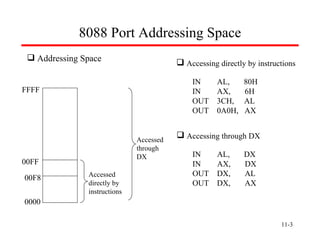
11- 8088 Port Addressing Space Addressing Space FFFF 0000 00F8 00FF Accessed  directly by instructions Accessed  through DX Accessing directly by instructions IN  AL,  80H IN  AX,  6H OUT  3CH,  AL OUT  0A0H,  AX Accessing through DX IN  AL,  DX IN  AX,  DX OUT  DX,  AL OUT  DX,  AX
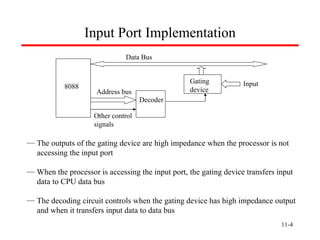
11- Input Port Implementation 8088 Data Bus Address bus Decoder Input Gating  device Other control  signals The outputs of the gating device are high impedance when the processor is not   accessing the input port When the processor is accessing the input port, the gating device transfers input    data to CPU data bus The decoding circuit controls when the gating device has high impedance output   and when it transfers input data to data bus
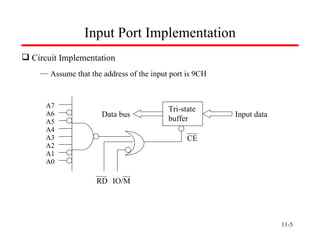
11- Input Port Implementation Circuit Implementation Assume that the address of the input port is 9CH Data bus Input data Tri-state buffer CE RD IO/M A7 A6 A5 A4 A3 A2 A1 A0
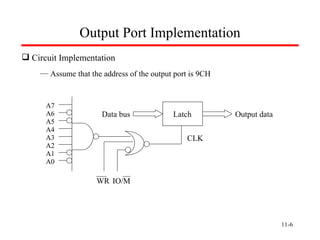
11- Output Port Implementation Circuit Implementation Assume that the address of the output port is 9CH Data bus Output data Latch CLK WR IO/M A7 A6 A5 A4 A3 A2 A1 A0
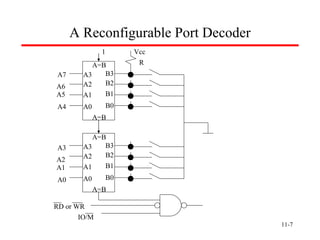
11- A Reconfigurable Port Decoder 1 Vcc A3 A2 A1 A0 B3 B2 B1 B0 A=B A=B A3 A2 A1 A0 B3 B2 B1 B0 A=B A=B A7 A6 A5 A4 A3 A2 A1 A0 R RD or WR IO/M
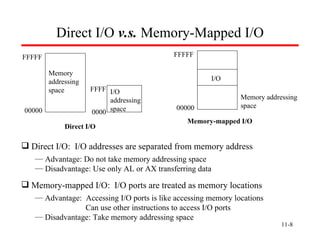
11- Direct I/O  v.s.  Memory-Mapped I/O Memory addressing space I/O addressing space I/O Memory addressing space 00000 FFFFF 0000 FFFF 00000 FFFFF Direct I/O Memory-mapped I/O Direct I/O:  I/O addresses are separated from memory address Advantage: Do not take memory addressing space Disadvantage: Use only AL or AX transferring data  Memory-mapped I/O:  I/O ports are treated as memory locations Advantage:  Accessing I/O ports is like accessing memory locations   Can use other instructions to access I/O ports Disadvantage: Take memory addressing space
11- 8255 Programmable Peripheral Interface Data bus 8088 D[7:0] A0 A1 RD WR RESET CS Control port PA[7:0] PB[7:0] PC[7:0] A7 A6 A5 A4 A3 A2 IO/M A1  A0 Port 0  0 0  1 0 1  1 PA PB PC Control
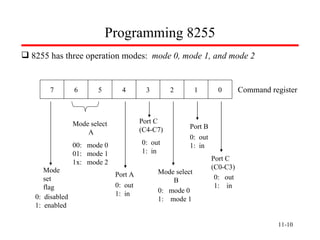
11- Programming 8255 8255 has three operation modes:  mode 0, mode 1, and mode 2 7 6 5 4 3 2 1 0 Command register Mode set flag 0:  disabled 1:  enabled Mode select A 00:  mode 0 01:  mode 1 1x:  mode 2 Port A 0:  out 1:  in Port C (C4-C7) 0:  out 1:  in Mode select   B 0:  mode 0 1:  mode 1 Port B 0:  out 1:  in Port C (C0-C3) 0:  out 1:  in
11- Programming 8255 Mode 0: Ports A, B, and C can be individually programmed as input or output ports Port C is divided into two 4-bit ports which are independent from each other Mode 1: Ports A and B are programmed as input or output ports Port C is used for handshaking PA[7:0] STB A IBF A INTR A PC3 PC5 PC4 PB[7:0] STB B IBF B INTR B PC0 PC1 PC2 PC6, 7 8255 PA[7:0] OBF A ACK A INTR A PC3 PC6 PC7 PB[7:0] OBF B ACK B INTR B PC0 PC1 PC2 PC4, 5 8255
11- Programming 8255 Mode 2: Port A is programmed to be bi-directional Port C is for handshaking Port B can be either input or output in mode 0 or mode 1 Can you design a decoder for an 8255 chip such that its base address is 40H? Write the instructions that set 8255 into mode 0, port A as input, port B as output,  PC0-PC3 as input, PC4-PC7 as output ? PA[7:0] OBF A ACK A INTR A PC4 PC6 PC7 STB A IBF A PC0 PC3 PC5 8255 PC0 PC0 PB[7:0] In  Out  In  Out In  Out Mode 0 STB B   OBF B   IBF B   ACK B INTR B   INTR B Mode 1
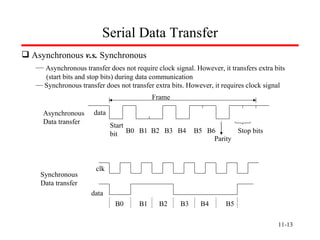
11- Serial Data Transfer Asynchronous  v.s.  Synchronous Asynchronous transfer does not require clock signal. However, it transfers extra bits   (start bits and stop bits) during data communication  Synchronous transfer does not transfer extra bits. However, it requires clock signal Frame Asynchronous Data transfer Synchronous Data transfer clk data B0 B1 B2 B3 B4 B5 data Start bit B0 B1 B2 B3 B4 B5 B6 Parity Stop bits
11- 8251 USART Interface A7 A6 A5 A4 A3 A2 A1 IO/M D[7:0] RD RD WR WR A0 C/D CLK CLK TxC RxC TxD RxD 8251 RS232
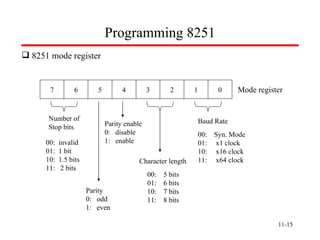
11- Programming 8251 8251 mode register 7 6 5 4 3 2 1 0 Mode register Number of  Stop bits 00:  invalid 01:  1 bit 10:  1.5 bits 11:  2 bits Parity 0:  odd 1:  even Parity enable 0:  disable 1:  enable Character length 00:  5 bits 01:  6 bits 10:  7 bits 11:  8 bits Baud Rate 00:  Syn. Mode 01:  x1 clock 10:  x16 clock 11:  x64 clock
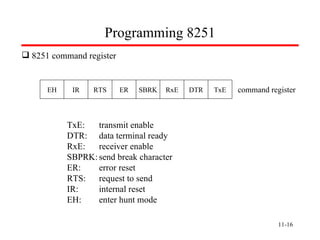
11- Programming 8251 8251 command register EH IR RTS ER SBRK RxE DTR TxE command register TxE: transmit enable DTR: data terminal ready RxE: receiver enable SBPRK: send break character ER: error reset RTS: request to send IR: internal reset EH: enter hunt mode
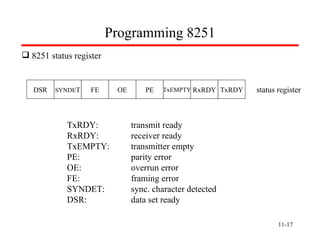
11- Programming 8251 8251 status register status register TxRDY: transmit ready RxRDY: receiver ready TxEMPTY: transmitter empty PE: parity error OE: overrun error FE: framing error SYNDET: sync. character detected DSR: data set ready DSR SYNDE T FE OE PE TxEMPTY RxRDY TxRDY
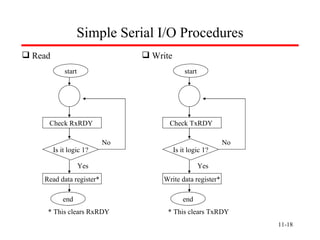
11- Simple Serial I/O Procedures Read start Check RxRDY  Is it logic 1? Read data register* end Yes No * This clears RxRDY Write start Check TxRDY  Is it logic 1? Write data register* end Yes No * This clears TxRDY

Io (2)

  • 1.
    11- ECE 424 Design of Microprocessor-Based Systems Haibo Wang ECE Department Southern Illinois University Carbondale, IL 62901 I/O System Design
  • 2.
    11- Overview of8088 I/O System 65,536 possible I/O ports Data transfer between ports and the processor is over data bus 8088 uses address bus A[15:0] to locate an I/O port AL (or AX) is the processor register that takes input data (or provide output data) I/O I/O I/O Data bus Address bus A[15:0] AL AX 8088
  • 3.
    11- 8088 PortAddressing Space Addressing Space FFFF 0000 00F8 00FF Accessed directly by instructions Accessed through DX Accessing directly by instructions IN AL, 80H IN AX, 6H OUT 3CH, AL OUT 0A0H, AX Accessing through DX IN AL, DX IN AX, DX OUT DX, AL OUT DX, AX
  • 4.
    11- Input PortImplementation 8088 Data Bus Address bus Decoder Input Gating device Other control signals The outputs of the gating device are high impedance when the processor is not accessing the input port When the processor is accessing the input port, the gating device transfers input data to CPU data bus The decoding circuit controls when the gating device has high impedance output and when it transfers input data to data bus
  • 5.
    11- Input PortImplementation Circuit Implementation Assume that the address of the input port is 9CH Data bus Input data Tri-state buffer CE RD IO/M A7 A6 A5 A4 A3 A2 A1 A0
  • 6.
    11- Output PortImplementation Circuit Implementation Assume that the address of the output port is 9CH Data bus Output data Latch CLK WR IO/M A7 A6 A5 A4 A3 A2 A1 A0
  • 7.
    11- A ReconfigurablePort Decoder 1 Vcc A3 A2 A1 A0 B3 B2 B1 B0 A=B A=B A3 A2 A1 A0 B3 B2 B1 B0 A=B A=B A7 A6 A5 A4 A3 A2 A1 A0 R RD or WR IO/M
  • 8.
    11- Direct I/O v.s. Memory-Mapped I/O Memory addressing space I/O addressing space I/O Memory addressing space 00000 FFFFF 0000 FFFF 00000 FFFFF Direct I/O Memory-mapped I/O Direct I/O: I/O addresses are separated from memory address Advantage: Do not take memory addressing space Disadvantage: Use only AL or AX transferring data Memory-mapped I/O: I/O ports are treated as memory locations Advantage: Accessing I/O ports is like accessing memory locations Can use other instructions to access I/O ports Disadvantage: Take memory addressing space
  • 9.
    11- 8255 ProgrammablePeripheral Interface Data bus 8088 D[7:0] A0 A1 RD WR RESET CS Control port PA[7:0] PB[7:0] PC[7:0] A7 A6 A5 A4 A3 A2 IO/M A1 A0 Port 0 0 0 1 0 1 1 PA PB PC Control
  • 10.
    11- Programming 82558255 has three operation modes: mode 0, mode 1, and mode 2 7 6 5 4 3 2 1 0 Command register Mode set flag 0: disabled 1: enabled Mode select A 00: mode 0 01: mode 1 1x: mode 2 Port A 0: out 1: in Port C (C4-C7) 0: out 1: in Mode select B 0: mode 0 1: mode 1 Port B 0: out 1: in Port C (C0-C3) 0: out 1: in
  • 11.
    11- Programming 8255Mode 0: Ports A, B, and C can be individually programmed as input or output ports Port C is divided into two 4-bit ports which are independent from each other Mode 1: Ports A and B are programmed as input or output ports Port C is used for handshaking PA[7:0] STB A IBF A INTR A PC3 PC5 PC4 PB[7:0] STB B IBF B INTR B PC0 PC1 PC2 PC6, 7 8255 PA[7:0] OBF A ACK A INTR A PC3 PC6 PC7 PB[7:0] OBF B ACK B INTR B PC0 PC1 PC2 PC4, 5 8255
  • 12.
    11- Programming 8255Mode 2: Port A is programmed to be bi-directional Port C is for handshaking Port B can be either input or output in mode 0 or mode 1 Can you design a decoder for an 8255 chip such that its base address is 40H? Write the instructions that set 8255 into mode 0, port A as input, port B as output, PC0-PC3 as input, PC4-PC7 as output ? PA[7:0] OBF A ACK A INTR A PC4 PC6 PC7 STB A IBF A PC0 PC3 PC5 8255 PC0 PC0 PB[7:0] In Out In Out In Out Mode 0 STB B OBF B IBF B ACK B INTR B INTR B Mode 1
  • 13.
    11- Serial DataTransfer Asynchronous v.s. Synchronous Asynchronous transfer does not require clock signal. However, it transfers extra bits (start bits and stop bits) during data communication Synchronous transfer does not transfer extra bits. However, it requires clock signal Frame Asynchronous Data transfer Synchronous Data transfer clk data B0 B1 B2 B3 B4 B5 data Start bit B0 B1 B2 B3 B4 B5 B6 Parity Stop bits
  • 14.
    11- 8251 USARTInterface A7 A6 A5 A4 A3 A2 A1 IO/M D[7:0] RD RD WR WR A0 C/D CLK CLK TxC RxC TxD RxD 8251 RS232
  • 15.
    11- Programming 82518251 mode register 7 6 5 4 3 2 1 0 Mode register Number of Stop bits 00: invalid 01: 1 bit 10: 1.5 bits 11: 2 bits Parity 0: odd 1: even Parity enable 0: disable 1: enable Character length 00: 5 bits 01: 6 bits 10: 7 bits 11: 8 bits Baud Rate 00: Syn. Mode 01: x1 clock 10: x16 clock 11: x64 clock
  • 16.
    11- Programming 82518251 command register EH IR RTS ER SBRK RxE DTR TxE command register TxE: transmit enable DTR: data terminal ready RxE: receiver enable SBPRK: send break character ER: error reset RTS: request to send IR: internal reset EH: enter hunt mode
  • 17.
    11- Programming 82518251 status register status register TxRDY: transmit ready RxRDY: receiver ready TxEMPTY: transmitter empty PE: parity error OE: overrun error FE: framing error SYNDET: sync. character detected DSR: data set ready DSR SYNDE T FE OE PE TxEMPTY RxRDY TxRDY
  • 18.
    11- Simple SerialI/O Procedures Read start Check RxRDY Is it logic 1? Read data register* end Yes No * This clears RxRDY Write start Check TxRDY Is it logic 1? Write data register* end Yes No * This clears TxRDY