Programmable Peripheral
Interface Devices
Support chips: 8155, 8255, 8279, 8254, DMA
Controller, Interrupt Controller, USART
Programmable Interface
Devices
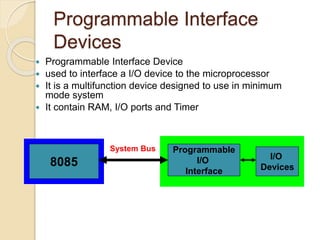
 Programmable Interface Device
 used to interface a I/O device to the microprocessor
 It is a multifunction device designed to use in minimum
mode system
 It contain RAM, I/O ports and Timer
8085
Programmable
I/O
Interface
I/O
Devices
System Bus
Requirement for PPI
 I/P & O/P Regs: A group of latches to
hold data
 Tri-State Buffer
 Capability of Bidirectional data flow
 Handshake & Interrupt signal
 Control Logic
 Chip Select Logic
 Interrupt control logic
8155 – A multipurpose
programmable interface
 Designed to be compatible with 8085
 It includes
◦ 256 bytes of Read/Write memory
◦ Three I/O ports
 Port A (8-bit)
 Port B (8-bit)
 Port C (6-bit)
◦ A 14-bit timer
◦ Internal address latch to Demux AD0-
AD7, using ALE line
Block Diagram - 8155
256 X 8
Static
RAM
A
B
CTimer
8
8
6
Port A
Port B
Port C
PA0-7
PB0-7
PC0-5
8AD0-7
IO/M
CE
ALE
RD
WR
Timer CLK
TIMER OUT
Vcc (+5 V)
Vss (0 V)
RESET
I/ODevices
8085
Application design with 8155
 Objectives
◦ Interfacing 8155 with 8085
◦ Programming 8155
8085
Interfacing 8085 with 8155
256 X 8
Static
RAM
A
B
CTimer
8
8
6
Port A
Port B
Port C
8AD0-7
IO/M
CE
ALE
RD
WR
RESET
A15
8085 8155
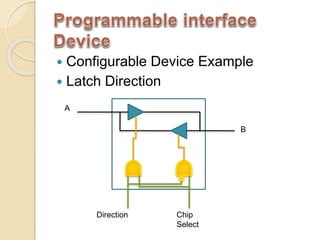
 Configurable Device Example
 Latch Direction
A
B
Direction Chip
Select
Programming 8155
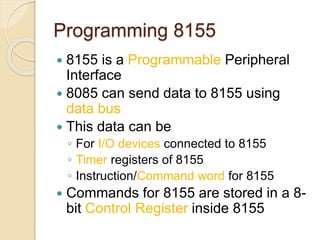
 8155 is a Programmable Peripheral
Interface
 8085 can send data to 8155 using
data bus
 This data can be
◦ For I/O devices connected to 8155
◦ Timer registers of 8155
◦ Instruction/Command word for 8155
 Commands for 8155 are stored in a 8-
bit Control Register inside 8155
 Program
MVI A,01 H ; Set Do=1, D1-D7==0
OUTFFH ;Write in control register
MVI A,BYTE1 ;Load data bye
OUTFEH ; Send Data out
7A
0A
DIR
G: Enable
7B
0B
Control
Reg
D0
D1
D7A7
A6
A5
A4
A3
A2
A1
A0
3 to 8
Decoder
CWR
Port
A
Port
B
Port
C
Timer
MSB
LSB
Latch
Clock for timer
PA0-PA7
PB0-
PB7
PC0-
PC5
Timer
Out
A0
A1
A2
ALE
AD0-AD7
A0-A7
D7-D0
0
1
2
3
4
5
CEb
A2 A
1
A0 Port (ALE
high,
AD0=A0)
0 0 0 Command
/Status
Register
0 0 1 PA
0 1 0 PB
0 1 1 PC
1 0 0 Timer LSB
1 0 1 Timer MSB
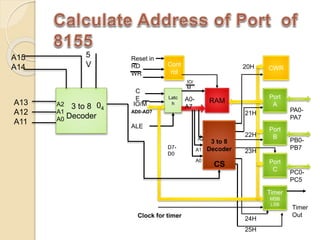
3 to 8
Decoder
04
A13
A12
A11
A15
A14
A2
A1
A0
5
V
3 to 8
Decoder
RAM
Cont
rol
CWR
Port
A
Port
B
Port
C
Timer
MSB
LSB
Latc
h
Clock for timer
PA0-
PA7
PB0-
PB7
PC0-
PC5
Timer
Out
Reset in
RD
WR
A0
A1
A2
ALE
C
E
IO/M
IO/
M
AD0-AD7
A0-
A7
D7-
D0
20H
21H
22H
23H
24H
25H
CS
What type of Commands can be
given to 8155?
 To configure the I/O ports as Input or
Output
 To start/stop timer etc.
 To use handshake mode or not
Control word for 8155
 A command/instruction for 8155 is also
called control word
 This control word is written to control
register of 8155
 Control word of 8155 is of 8-bits
Control Word Definition for
8155
D0
D1
D2
D3
D4
D5
D6
D7
D3 D2 PORT C
0 0 ALT1
0 1 ALT2
1 0 ALT3
1 1 ALT4
D7 D6 Timer
0 0 NOP
0 1 Stop
1 0 Stop
after TC
1 0 Start
Port A
Port B
0, Input
1, Output
Port C
Interrupt Enable Port A
Interrupt Enable Port B
0, Disable
1, Enable
Timer
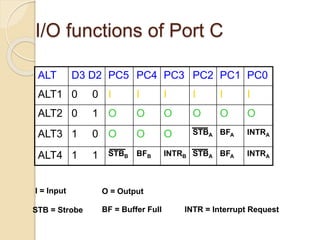
I/O functions of Port C
ALT D3 D2 PC5 PC4 PC3 PC2 PC1 PC0
ALT1 0 0 I I I I I I
ALT2 0 1 O O O O O O
ALT3 1 0 O O O STBA BFA INTRA
ALT4 1 1 STBB BFB INTRB STBA BFA INTRA
I = Input O = Output
STB = Strobe BF = Buffer Full INTR = Interrupt Request
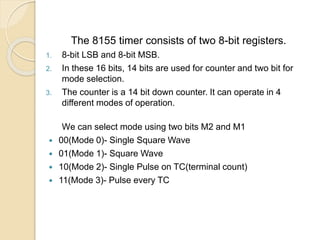
The 8155 timer consists of two 8-bit registers.
1. 8-bit LSB and 8-bit MSB.
2. In these 16 bits, 14 bits are used for counter and two bit for
mode selection.
3. The counter is a 14 bit down counter. It can operate in 4
different modes of operation.
We can select mode using two bits M2 and M1
 00(Mode 0)- Single Square Wave
 01(Mode 1)- Square Wave
 10(Mode 2)- Single Pulse on TC(terminal count)
 11(Mode 3)- Pulse every TC
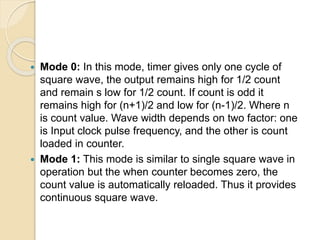
 Mode 0: In this mode, timer gives only one cycle of
square wave, the output remains high for 1/2 count
and remain s low for 1/2 count. If count is odd it
remains high for (n+1)/2 and low for (n-1)/2. Where n
is count value. Wave width depends on two factor: one
is Input clock pulse frequency, and the other is count
loaded in counter.
 Mode 1: This mode is similar to single square wave in
operation but the when counter becomes zero, the
count value is automatically reloaded. Thus it provides
continuous square wave.
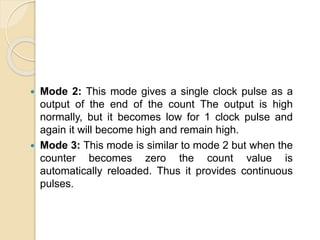
 Mode 2: This mode gives a single clock pulse as a
output of the end of the count The output is high
normally, but it becomes low for 1 clock pulse and
again it will become high and remain high.
 Mode 3: This mode is similar to mode 2 but when the
counter becomes zero the count value is
automatically reloaded. Thus it provides continuous
pulses.
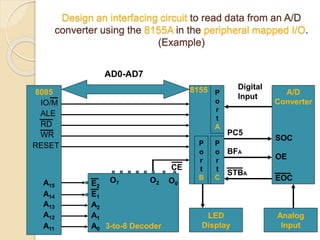
Design an interfacing circuit to read data from an A/D
converter using the 8155A in the peripheral mapped I/O.
(Example)
8085
3-to-8 Decoder
A/D
Converter
Analog
Input
Digital
Input
P
o
r
t
A
AD0-AD7
O0O7
8155
P
o
r
t
C
P
o
r
t
B
SOC
OE
EOCO2
CE
E2
E1
A2
A1
A0A11
A12
A13
A14
A15
IO/M
RD
WR
RESET
ALE
LED
Display
BFA
STBA
PC5
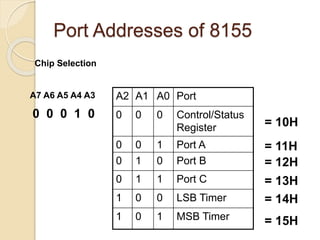
Port Addresses of 8155
A2 A1 A0 Port
0 0 0 Control/Status
Register
0 0 1 Port A
0 1 0 Port B
0 1 1 Port C
1 0 0 LSB Timer
1 0 1 MSB Timer
Chip Selection
A7 A6 A5 A4 A3
0 0 0 1 0
= 10H
= 11H
= 12H
= 13H
= 14H
= 15H
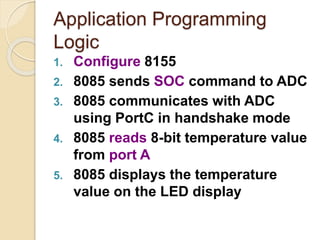
Application Programming
Logic
1. Configure 8155
2. 8085 sends SOC command to ADC
3. 8085 communicates with ADC
using PortC in handshake mode
4. 8085 reads 8-bit temperature value
from port A
5. 8085 displays the temperature
value on the LED display
1. Configure 8155 I/O Ports
 Port A as INPUT port
 Port B as OUTPUT
port
 Port C in ALT3 mode
ALT D3 D2 PC5 PC4 PC3 PC2 PC1 PC0
ALT3 1 0 O O O STBA BFA INTRA
SOC EOC OE
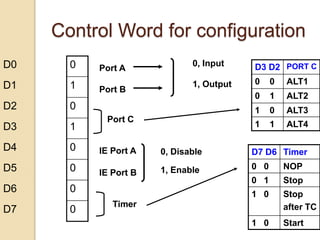
Control Word for configuration
D0
D1
D2
D3
D4
D5
D6
D7
D3 D2 PORT C
0 0 ALT1
0 1 ALT2
1 0 ALT3
1 1 ALT4
D7 D6 Timer
0 0 NOP
0 1 Stop
1 0 Stop
after TC
1 0 Start
Port A
Port B
0, Input
1, Output
Port C
IE Port A
IE Port B
0, Disable
1, Enable
Timer
0
1
0
1
0
0
0
0
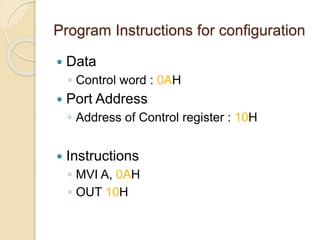
Program Instructions for configuration
 Data
◦ Control word : 0AH
 Port Address
◦ Address of Control register : 10H
 Instructions
◦ MVI A, 0AH
◦ OUT 10H
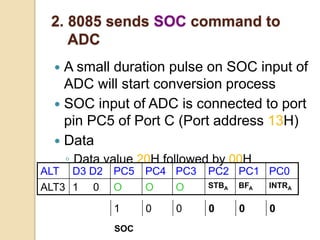
2. 8085 sends SOC command to
ADC
 A small duration pulse on SOC input of
ADC will start conversion process
 SOC input of ADC is connected to port
pin PC5 of Port C (Port address 13H)
 Data
◦ Data value 20H followed by 00H
ALT D3 D2 PC5 PC4 PC3 PC2 PC1 PC0
ALT3 1 0 O O O STBA BFA INTRA
SOC
1 0 0 0 0 0
 Instructions
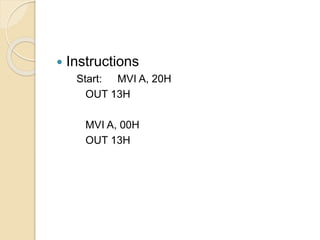
Start: MVI A, 20H
OUT 13H
MVI A, 00H
OUT 13H
3. 8085 communicates with ADC
using Port C in handshake mode
 Port A used to input 8-bit data from
ADC
 Port C used for handshakingALT D3 D2 PC5 PC4 PC3 PC2 PC1 PC0
ALT3 1 0 O O O STBA BFA INTRA
EOC OE
 ADC resets EOC to LOW at end of
conversion
 8155 sets BF to 1 to enable ADC output
latch
 8085 is waiting for BF to be SET to 1 and
◦ Reads port A by making RD signal active (0)
 At the end of read cycle RD goes HIGH
(1)
 This resets BF signal to 0.
 8085 waits for BF signal to be RESET
and
◦ starts conversion process again
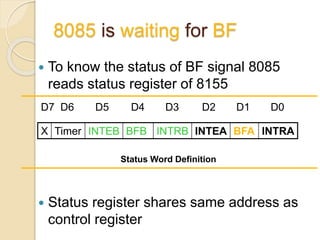
8085 is waiting for BF
 To know the status of BF signal 8085
reads status register of 8155
 Status register shares same address as
control register
X Timer INTEB BFB INTRB INTEA BFA INTRA
D7 D6 D5 D4 D3 D2 D1 D0
Status Word Definition
Program Instructions
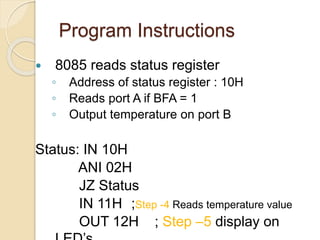
 8085 reads status register
◦ Address of status register : 10H
◦ Reads port A if BFA = 1
◦ Output temperature on port B
Status: IN 10H
ANI 02H
JZ Status
IN 11H ;Step -4 Reads temperature value
OUT 12H ; Step –5 display on
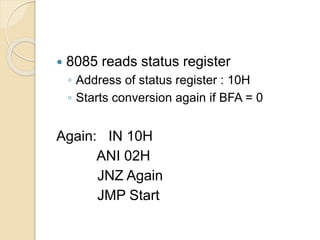
 8085 reads status register
◦ Address of status register : 10H
◦ Starts conversion again if BFA = 0
Again: IN 10H
ANI 02H
JNZ Again
JMP Start
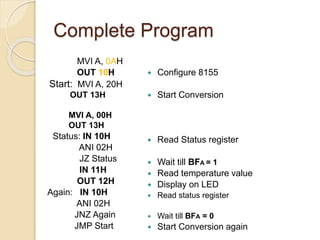
Complete Program
MVI A, 0AH
OUT 10H
Start: MVI A, 20H
OUT 13H
MVI A, 00H
OUT 13H
Status: IN 10H
ANI 02H
JZ Status
IN 11H
OUT 12H
Again: IN 10H
ANI 02H
JNZ Again
JMP Start
 Configure 8155
 Start Conversion
 Read Status register
 Wait till BFA = 1
 Read temperature value
 Display on LED
 Read status register
 Wait till BFA = 0
 Start Conversion again
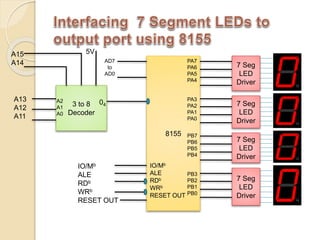
8155
PA7
PA6
PA5
PA4
PA3
PA2
PA1
PA0
PB7
PB6
PB5
PB4
PB3
PB2
PB1
PB0
AD7
to
AD0
IO/Mb
ALE
RDb
WRb
RESET OUT
IO/Mb
ALE
RDb
WRb
RESET OUT
7 Seg
LED
Driver
7 Seg
LED
Driver
7 Seg
LED
Driver
7 Seg
LED
Driver
3 to 8
Decoder
04
A13
A12
A11
A15
A14
A2
A1
A0
5V
 Port Address
◦ Control Register=20H, Port A= 21H, Port B= 22H
 Control word:
 Program
◦ MVI A,03 ; initialize Port A &B for O/P
◦ OUT 20H
◦ MVI A, BYTE1 ; Display BYTE1 at port A
◦ OUT 21H
◦ MVI A, BYTE2 ; Display BYTE2 at port B
◦ OUT 22H
D7 D6 D5 D4 D3 D2 D1 D0
0 0 0 0 0 0 1 1
Timer Not
Applicable
Use for
Port C
Port B
Output
Port A
Output

8155 GPPI

  • 1.
    Programmable Peripheral Interface Devices Supportchips: 8155, 8255, 8279, 8254, DMA Controller, Interrupt Controller, USART
  • 2.
    Programmable Interface Devices  ProgrammableInterface Device  used to interface a I/O device to the microprocessor  It is a multifunction device designed to use in minimum mode system  It contain RAM, I/O ports and Timer 8085 Programmable I/O Interface I/O Devices System Bus
  • 3.
    Requirement for PPI I/P & O/P Regs: A group of latches to hold data  Tri-State Buffer  Capability of Bidirectional data flow  Handshake & Interrupt signal  Control Logic  Chip Select Logic  Interrupt control logic
  • 4.
    8155 – Amultipurpose programmable interface  Designed to be compatible with 8085  It includes ◦ 256 bytes of Read/Write memory ◦ Three I/O ports  Port A (8-bit)  Port B (8-bit)  Port C (6-bit) ◦ A 14-bit timer ◦ Internal address latch to Demux AD0- AD7, using ALE line
  • 5.
    Block Diagram -8155 256 X 8 Static RAM A B CTimer 8 8 6 Port A Port B Port C PA0-7 PB0-7 PC0-5 8AD0-7 IO/M CE ALE RD WR Timer CLK TIMER OUT Vcc (+5 V) Vss (0 V) RESET I/ODevices 8085
  • 6.
    Application design with8155  Objectives ◦ Interfacing 8155 with 8085 ◦ Programming 8155
  • 7.
    8085 Interfacing 8085 with8155 256 X 8 Static RAM A B CTimer 8 8 6 Port A Port B Port C 8AD0-7 IO/M CE ALE RD WR RESET A15 8085 8155
  • 8.
     Configurable DeviceExample  Latch Direction A B Direction Chip Select
  • 9.
    Programming 8155  8155is a Programmable Peripheral Interface  8085 can send data to 8155 using data bus  This data can be ◦ For I/O devices connected to 8155 ◦ Timer registers of 8155 ◦ Instruction/Command word for 8155  Commands for 8155 are stored in a 8- bit Control Register inside 8155
  • 10.
     Program MVI A,01H ; Set Do=1, D1-D7==0 OUTFFH ;Write in control register MVI A,BYTE1 ;Load data bye OUTFEH ; Send Data out 7A 0A DIR G: Enable 7B 0B Control Reg D0 D1 D7A7 A6 A5 A4 A3 A2 A1 A0
  • 11.
    3 to 8 Decoder CWR Port A Port B Port C Timer MSB LSB Latch Clockfor timer PA0-PA7 PB0- PB7 PC0- PC5 Timer Out A0 A1 A2 ALE AD0-AD7 A0-A7 D7-D0 0 1 2 3 4 5 CEb A2 A 1 A0 Port (ALE high, AD0=A0) 0 0 0 Command /Status Register 0 0 1 PA 0 1 0 PB 0 1 1 PC 1 0 0 Timer LSB 1 0 1 Timer MSB
  • 12.
    3 to 8 Decoder 04 A13 A12 A11 A15 A14 A2 A1 A0 5 V 3to 8 Decoder RAM Cont rol CWR Port A Port B Port C Timer MSB LSB Latc h Clock for timer PA0- PA7 PB0- PB7 PC0- PC5 Timer Out Reset in RD WR A0 A1 A2 ALE C E IO/M IO/ M AD0-AD7 A0- A7 D7- D0 20H 21H 22H 23H 24H 25H CS
  • 13.
    What type ofCommands can be given to 8155?  To configure the I/O ports as Input or Output  To start/stop timer etc.  To use handshake mode or not
  • 14.
    Control word for8155  A command/instruction for 8155 is also called control word  This control word is written to control register of 8155  Control word of 8155 is of 8-bits
  • 15.
    Control Word Definitionfor 8155 D0 D1 D2 D3 D4 D5 D6 D7 D3 D2 PORT C 0 0 ALT1 0 1 ALT2 1 0 ALT3 1 1 ALT4 D7 D6 Timer 0 0 NOP 0 1 Stop 1 0 Stop after TC 1 0 Start Port A Port B 0, Input 1, Output Port C Interrupt Enable Port A Interrupt Enable Port B 0, Disable 1, Enable Timer
  • 16.
    I/O functions ofPort C ALT D3 D2 PC5 PC4 PC3 PC2 PC1 PC0 ALT1 0 0 I I I I I I ALT2 0 1 O O O O O O ALT3 1 0 O O O STBA BFA INTRA ALT4 1 1 STBB BFB INTRB STBA BFA INTRA I = Input O = Output STB = Strobe BF = Buffer Full INTR = Interrupt Request
  • 17.
    The 8155 timerconsists of two 8-bit registers. 1. 8-bit LSB and 8-bit MSB. 2. In these 16 bits, 14 bits are used for counter and two bit for mode selection. 3. The counter is a 14 bit down counter. It can operate in 4 different modes of operation. We can select mode using two bits M2 and M1  00(Mode 0)- Single Square Wave  01(Mode 1)- Square Wave  10(Mode 2)- Single Pulse on TC(terminal count)  11(Mode 3)- Pulse every TC
  • 18.
     Mode 0:In this mode, timer gives only one cycle of square wave, the output remains high for 1/2 count and remain s low for 1/2 count. If count is odd it remains high for (n+1)/2 and low for (n-1)/2. Where n is count value. Wave width depends on two factor: one is Input clock pulse frequency, and the other is count loaded in counter.  Mode 1: This mode is similar to single square wave in operation but the when counter becomes zero, the count value is automatically reloaded. Thus it provides continuous square wave.
  • 19.
     Mode 2:This mode gives a single clock pulse as a output of the end of the count The output is high normally, but it becomes low for 1 clock pulse and again it will become high and remain high.  Mode 3: This mode is similar to mode 2 but when the counter becomes zero the count value is automatically reloaded. Thus it provides continuous pulses.
  • 20.
    Design an interfacingcircuit to read data from an A/D converter using the 8155A in the peripheral mapped I/O. (Example) 8085 3-to-8 Decoder A/D Converter Analog Input Digital Input P o r t A AD0-AD7 O0O7 8155 P o r t C P o r t B SOC OE EOCO2 CE E2 E1 A2 A1 A0A11 A12 A13 A14 A15 IO/M RD WR RESET ALE LED Display BFA STBA PC5
  • 21.
    Port Addresses of8155 A2 A1 A0 Port 0 0 0 Control/Status Register 0 0 1 Port A 0 1 0 Port B 0 1 1 Port C 1 0 0 LSB Timer 1 0 1 MSB Timer Chip Selection A7 A6 A5 A4 A3 0 0 0 1 0 = 10H = 11H = 12H = 13H = 14H = 15H
  • 22.
    Application Programming Logic 1. Configure8155 2. 8085 sends SOC command to ADC 3. 8085 communicates with ADC using PortC in handshake mode 4. 8085 reads 8-bit temperature value from port A 5. 8085 displays the temperature value on the LED display
  • 23.
    1. Configure 8155I/O Ports  Port A as INPUT port  Port B as OUTPUT port  Port C in ALT3 mode ALT D3 D2 PC5 PC4 PC3 PC2 PC1 PC0 ALT3 1 0 O O O STBA BFA INTRA SOC EOC OE
  • 24.
    Control Word forconfiguration D0 D1 D2 D3 D4 D5 D6 D7 D3 D2 PORT C 0 0 ALT1 0 1 ALT2 1 0 ALT3 1 1 ALT4 D7 D6 Timer 0 0 NOP 0 1 Stop 1 0 Stop after TC 1 0 Start Port A Port B 0, Input 1, Output Port C IE Port A IE Port B 0, Disable 1, Enable Timer 0 1 0 1 0 0 0 0
  • 25.
    Program Instructions forconfiguration  Data ◦ Control word : 0AH  Port Address ◦ Address of Control register : 10H  Instructions ◦ MVI A, 0AH ◦ OUT 10H
  • 26.
    2. 8085 sendsSOC command to ADC  A small duration pulse on SOC input of ADC will start conversion process  SOC input of ADC is connected to port pin PC5 of Port C (Port address 13H)  Data ◦ Data value 20H followed by 00H ALT D3 D2 PC5 PC4 PC3 PC2 PC1 PC0 ALT3 1 0 O O O STBA BFA INTRA SOC 1 0 0 0 0 0
  • 27.
     Instructions Start: MVIA, 20H OUT 13H MVI A, 00H OUT 13H
  • 28.
    3. 8085 communicateswith ADC using Port C in handshake mode  Port A used to input 8-bit data from ADC  Port C used for handshakingALT D3 D2 PC5 PC4 PC3 PC2 PC1 PC0 ALT3 1 0 O O O STBA BFA INTRA EOC OE
  • 29.
     ADC resetsEOC to LOW at end of conversion  8155 sets BF to 1 to enable ADC output latch  8085 is waiting for BF to be SET to 1 and ◦ Reads port A by making RD signal active (0)  At the end of read cycle RD goes HIGH (1)  This resets BF signal to 0.  8085 waits for BF signal to be RESET and ◦ starts conversion process again
  • 30.
    8085 is waitingfor BF  To know the status of BF signal 8085 reads status register of 8155  Status register shares same address as control register X Timer INTEB BFB INTRB INTEA BFA INTRA D7 D6 D5 D4 D3 D2 D1 D0 Status Word Definition
  • 31.
    Program Instructions  8085reads status register ◦ Address of status register : 10H ◦ Reads port A if BFA = 1 ◦ Output temperature on port B Status: IN 10H ANI 02H JZ Status IN 11H ;Step -4 Reads temperature value OUT 12H ; Step –5 display on
  • 32.
     8085 readsstatus register ◦ Address of status register : 10H ◦ Starts conversion again if BFA = 0 Again: IN 10H ANI 02H JNZ Again JMP Start
  • 33.
    Complete Program MVI A,0AH OUT 10H Start: MVI A, 20H OUT 13H MVI A, 00H OUT 13H Status: IN 10H ANI 02H JZ Status IN 11H OUT 12H Again: IN 10H ANI 02H JNZ Again JMP Start  Configure 8155  Start Conversion  Read Status register  Wait till BFA = 1  Read temperature value  Display on LED  Read status register  Wait till BFA = 0  Start Conversion again
  • 34.
    8155 PA7 PA6 PA5 PA4 PA3 PA2 PA1 PA0 PB7 PB6 PB5 PB4 PB3 PB2 PB1 PB0 AD7 to AD0 IO/Mb ALE RDb WRb RESET OUT IO/Mb ALE RDb WRb RESET OUT 7Seg LED Driver 7 Seg LED Driver 7 Seg LED Driver 7 Seg LED Driver 3 to 8 Decoder 04 A13 A12 A11 A15 A14 A2 A1 A0 5V
  • 35.
     Port Address ◦Control Register=20H, Port A= 21H, Port B= 22H  Control word:  Program ◦ MVI A,03 ; initialize Port A &B for O/P ◦ OUT 20H ◦ MVI A, BYTE1 ; Display BYTE1 at port A ◦ OUT 21H ◦ MVI A, BYTE2 ; Display BYTE2 at port B ◦ OUT 22H D7 D6 D5 D4 D3 D2 D1 D0 0 0 0 0 0 0 1 1 Timer Not Applicable Use for Port C Port B Output Port A Output

Editor's Notes