8255

Programmable Peripheral Interface
Interfacing

Presented By: Kulshrestha Utkarsh
Review



Intro With Handshaking



More on Address decoding



Interface with memory



Introduction to Programmable Peripheral Interface 82C55

Kulsrestha Utkarsh

02/01/14
05:37 AM

2
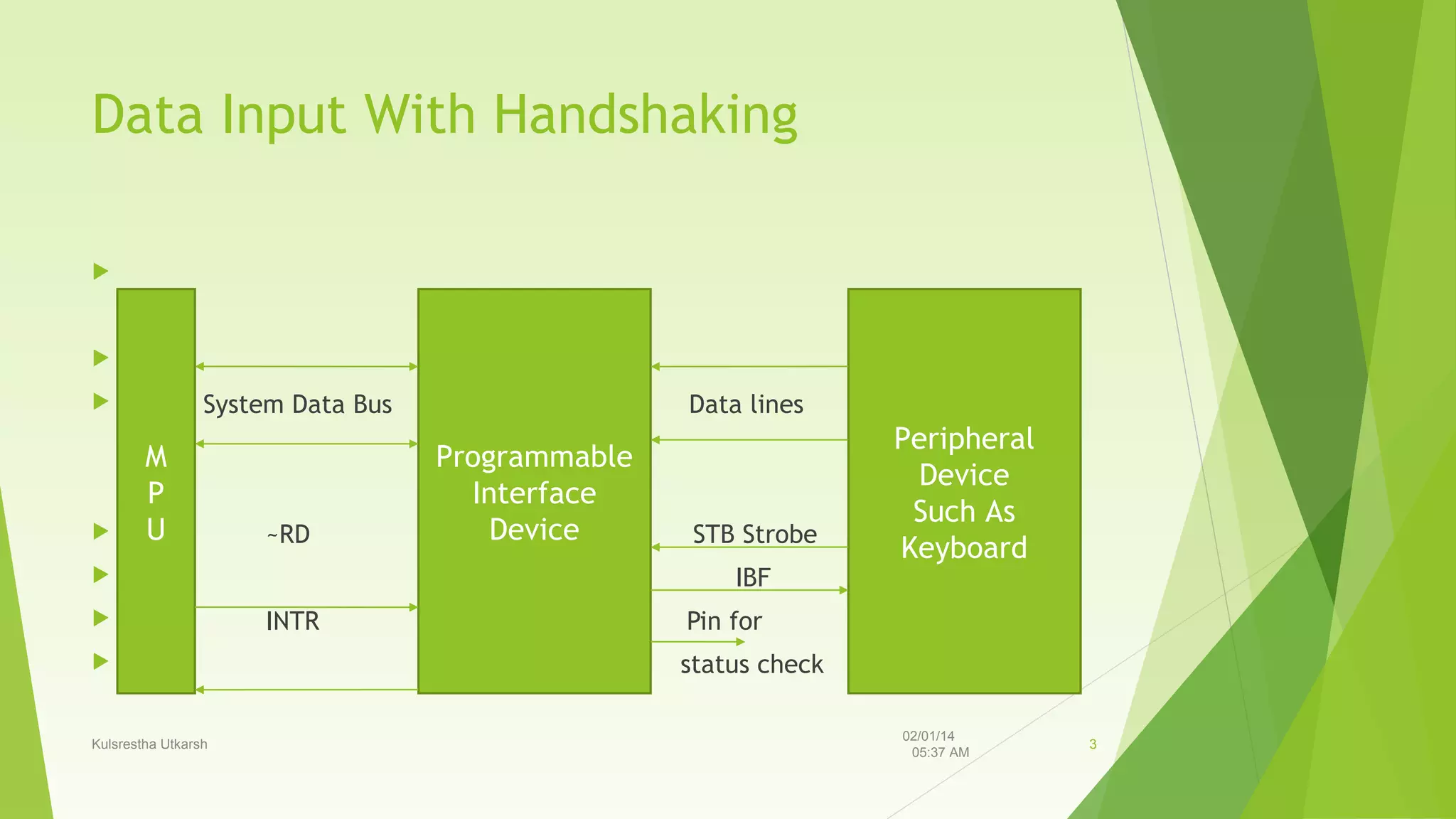
Data Input With Handshaking




System Data Bus





M
P
U

~RD



Kulsrestha Utkarsh

Programmable
Interface
Device

STB Strobe
IBF




Data lines

INTR

Peripheral
Device
Such As
Keyboard

Pin for
status check
02/01/14
05:37 AM

3
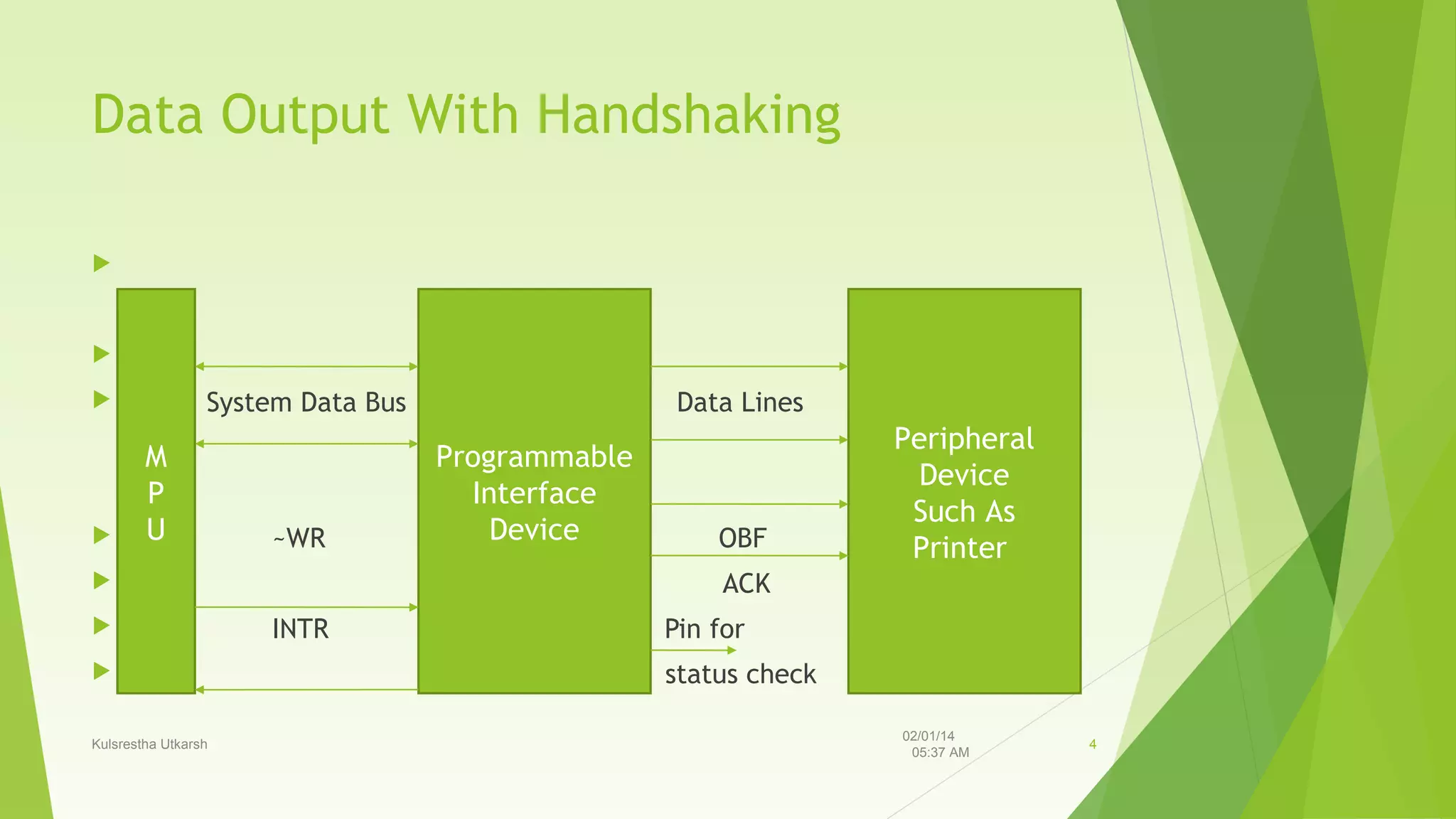
Data Output With Handshaking




System Data Bus





M
P
U

~WR


Kulsrestha Utkarsh

Programmable
Interface
Device

OBF

Peripheral
Device
Such As
Printer

ACK




Data Lines

INTR

Pin for
status check
02/01/14
05:37 AM

4
About 8255


The 8255 is a popular interfacing component, that can
interface any TTL-compatible I/O device to a
microprocessor.



It is used to interface to the keyboard and a parallel
printer port in PCs (usually as part of an integrated
chipset).



Requires insertion of wait states if used with a
microprocessor using higher that an 8 MHz clock.



PPI has 24 pins for I/O that are programmable in groups of
12 pins and has three distinct modes of operation.

Kulsrestha Utkarsh

02/01/14
05:37 AM

5
82C55 : Pin Layout

Kulsrestha Utkarsh

02/01/14
05:37 AM

6
PA7 – PA0

Group 1
Control
D0D
7

Data Bus
Buffer

Group 1
Port C
upper
Group 2
Port C
Lower

RD
WR

A0
A1
RESET

Kulsrestha Utkarsh

CS

Read/
Write
Control
Logic

Group 1
Port A

Group 2
Control

PC7 – PC4

PC3 – PC0

PB7 – PB0
Group 2
Port B
02/01/14
05:37 AM

7
Programming 8255

Kulsrestha Utkarsh

02/01/14
05:37 AM

8
Mode 0 (Basic Input/Output).


This functional configuration provides simple input and output operations for
each of the three ports.



No “handshaking” is required, data is simply written to or read from a
specified port.

Kulsrestha Utkarsh

02/01/14
05:37 AM

9
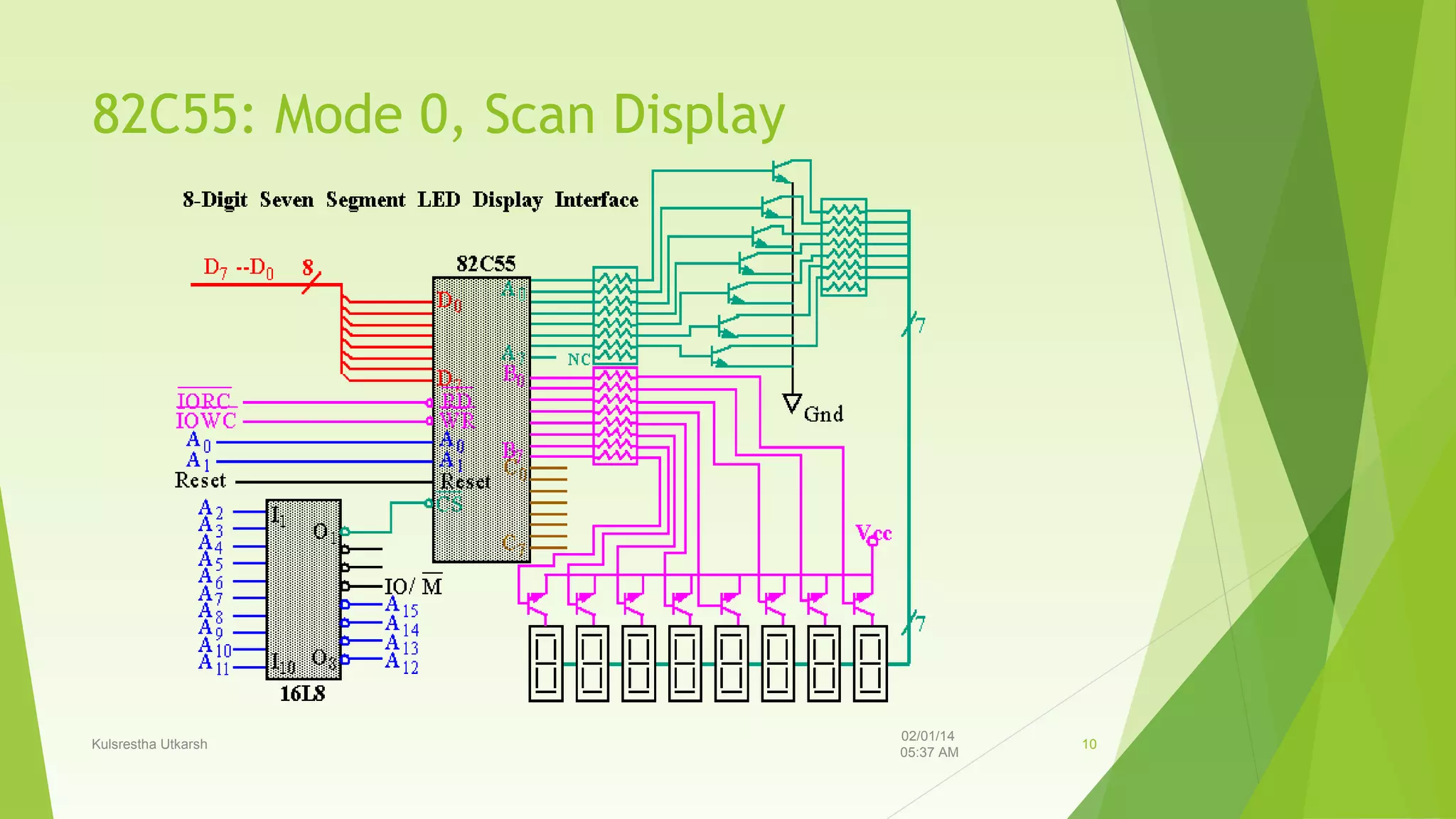
82C55: Mode 0, Scan Display

Kulsrestha Utkarsh

02/01/14
05:37 AM

10
8255: Mode 0, Scan Display
 Mode

0 operation causes the 8255 to function as a
buffered input device or as a latched output
device.
 In previous example, both ports A and B are
programmed as (mode 0) simple latched output
ports.
 Port A provides the segment data inputs to display
and port B provides a means of selecting one
display position at a time.
 Different values are displayed in each digit via
fast time multiplexing.
Kulsrestha Utkarsh

02/01/14
05:37 AM

11
8255: Mode 0, Scan Key

Kulsrestha Utkarsh

02/01/14
05:37 AM

12
MODE 1 (Input/Output with handshake)




Kulsrestha Utkarsh

This functional configuration provides a means for transferring I/O data
to or from a specified port in conjunction with strobes or
“handshaking” signals.
In mode 1, Port A and Port B use the lines on Port C to generate or
accept these “handshaking” signals

02/01/14
05:37 AM

13
Mode 1 Basic functional Definitions
 Two

Groups (Group A and Group B).

 Each

group contains one 8-bit data port and one
4-bit control/data port.

 The

8-bit data port can be either input or output
Both inputs and outputs are latched.

 The

4-bit port is used for control and status of the
8-bit data port.

Kulsrestha Utkarsh

02/01/14
05:37 AM

14
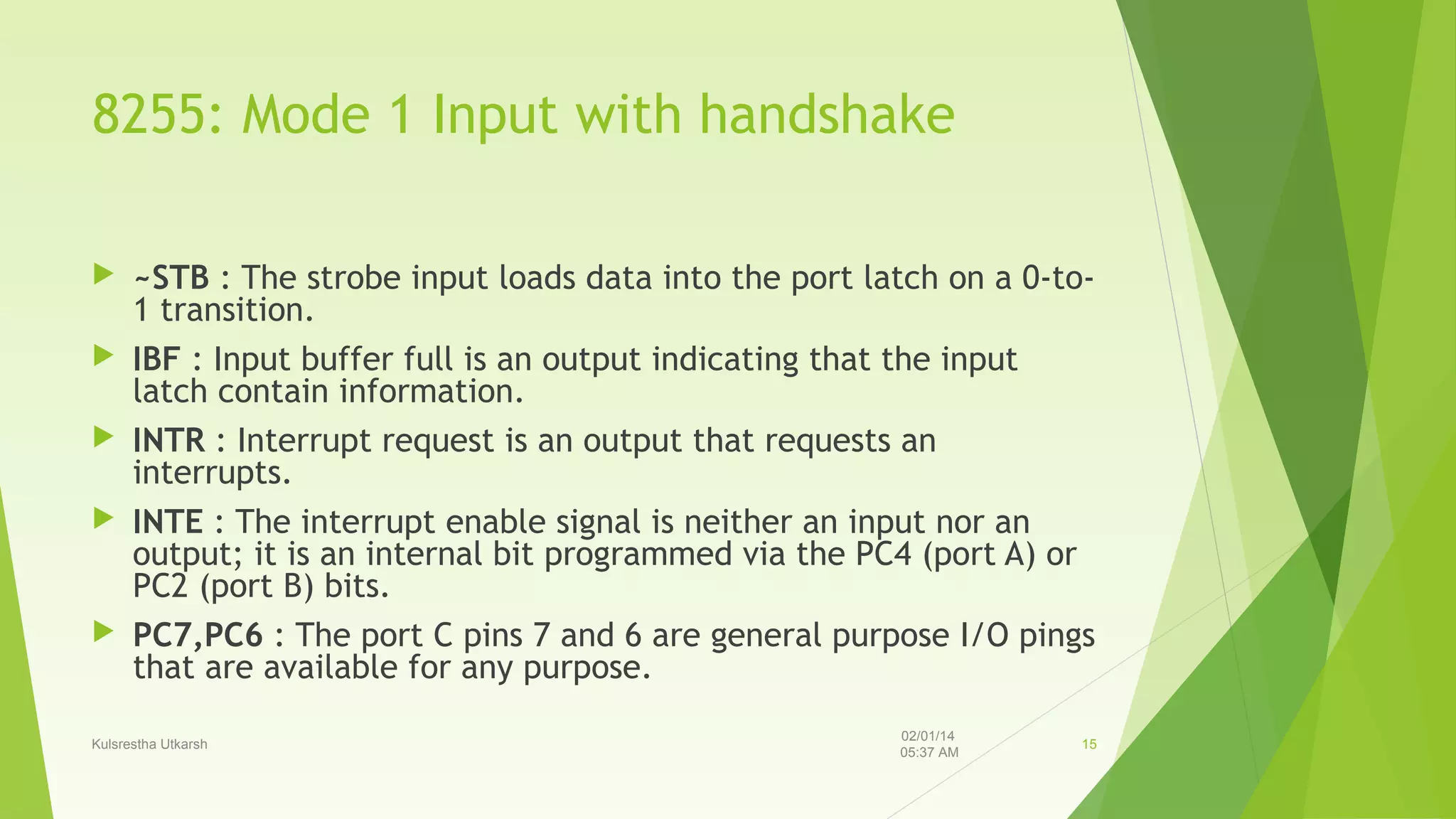
8255: Mode 1 Input with handshake







~STB : The strobe input loads data into the port latch on a 0-to1 transition.
IBF : Input buffer full is an output indicating that the input
latch contain information.
INTR : Interrupt request is an output that requests an
interrupts.
INTE : The interrupt enable signal is neither an input nor an
output; it is an internal bit programmed via the PC4 (port A) or
PC2 (port B) bits.
PC7,PC6 : The port C pins 7 and 6 are general purpose I/O pings
that are available for any purpose.

Kulsrestha Utkarsh

02/01/14
05:37 AM

15
8255: Mode 1 Input with handshake

Kulsrestha Utkarsh

02/01/14
05:37 AM

16

Signal definitions for Mode 1 Strobe Input
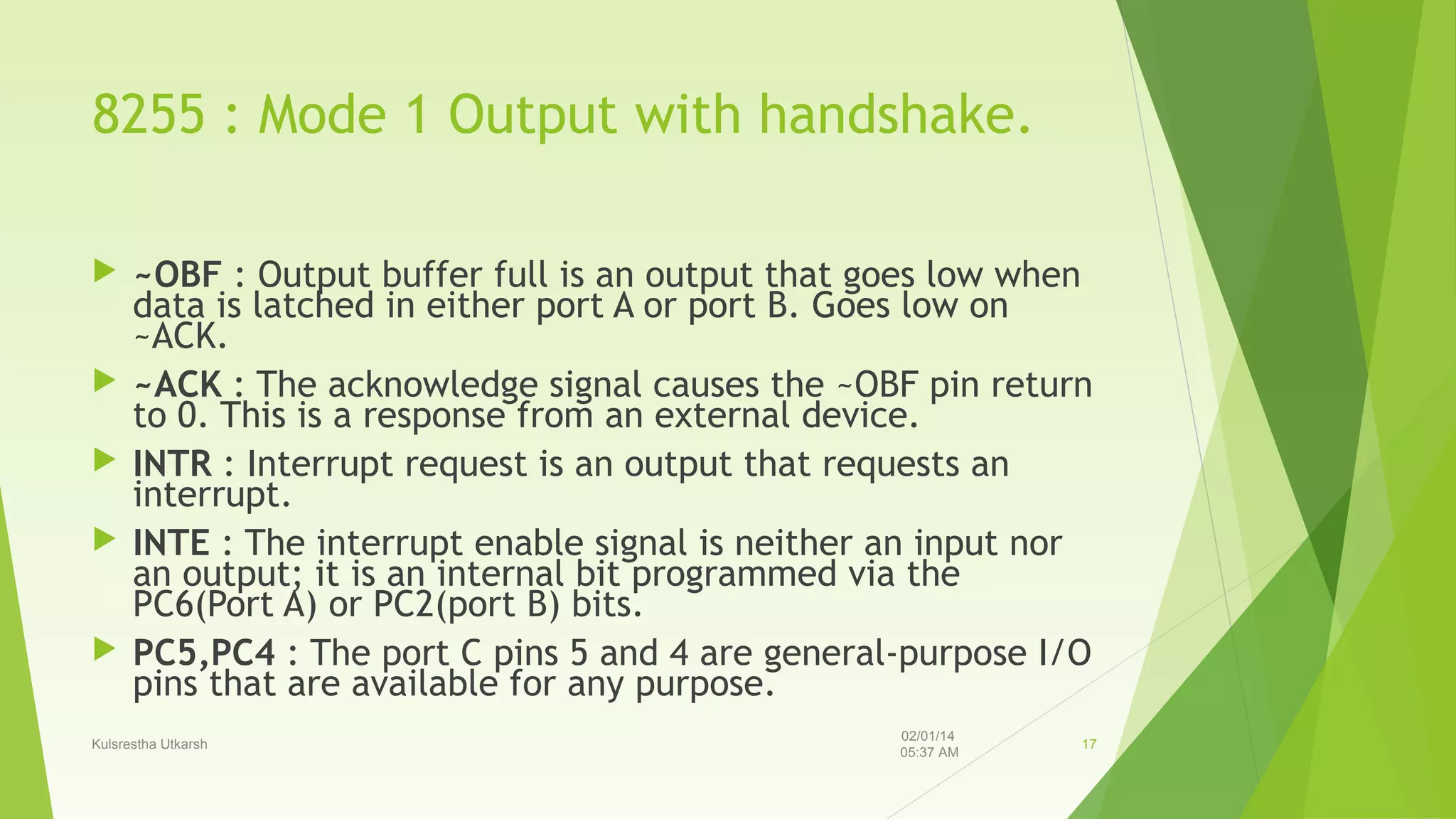
8255 : Mode 1 Output with handshake.








~OBF : Output buffer full is an output that goes low when
data is latched in either port A or port B. Goes low on
~ACK.
~ACK : The acknowledge signal causes the ~OBF pin return
to 0. This is a response from an external device.
INTR : Interrupt request is an output that requests an
interrupt.
INTE : The interrupt enable signal is neither an input nor
an output; it is an internal bit programmed via the
PC6(Port A) or PC2(port B) bits.
PC5,PC4 : The port C pins 5 and 4 are general-purpose I/O
pins that are available for any purpose.

Kulsrestha Utkarsh

02/01/14
05:37 AM

17
8255 : Mode 1 Output handshake.

Kulsrestha Utkarsh

02/01/14
05:37 AM

18
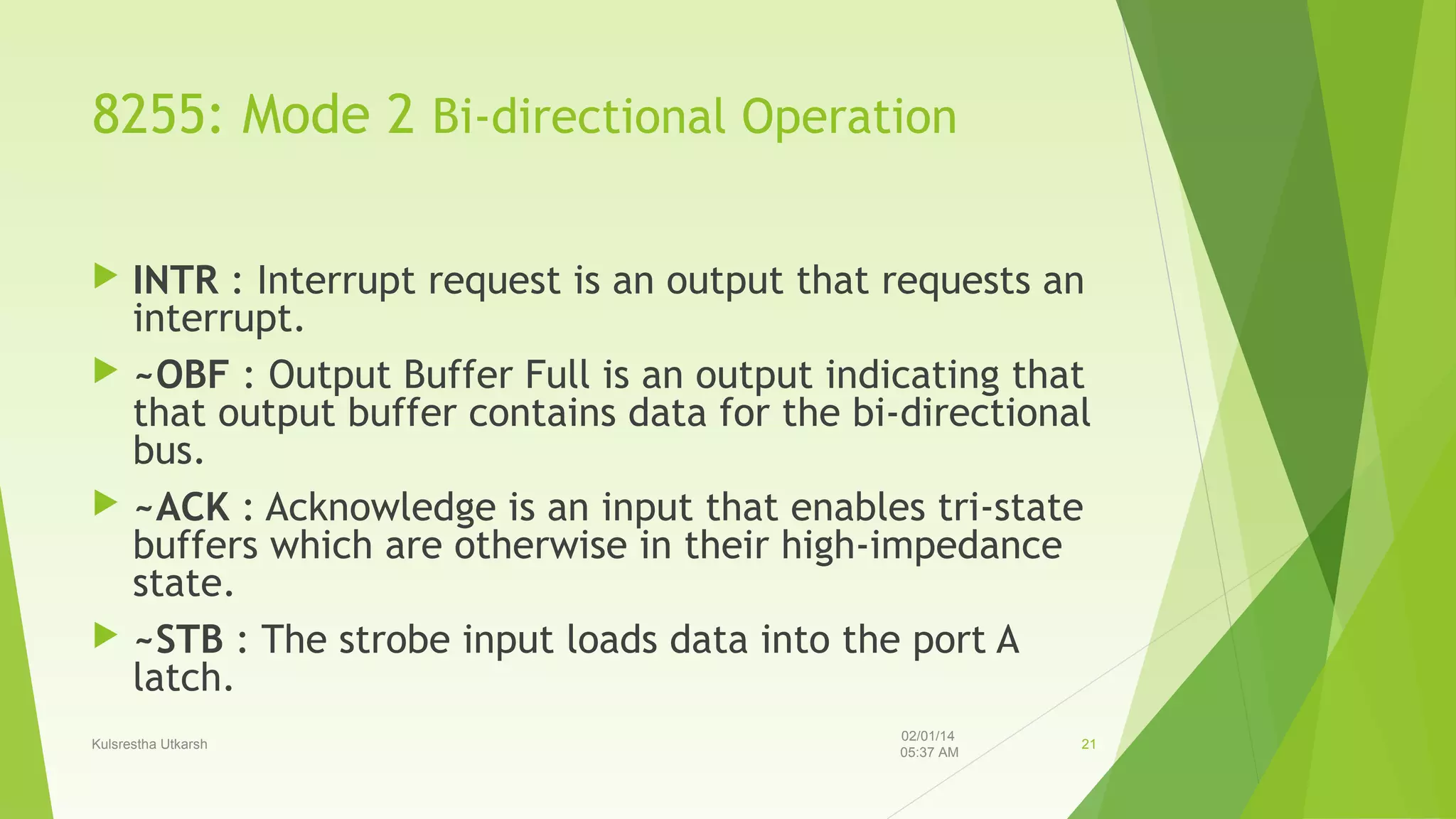
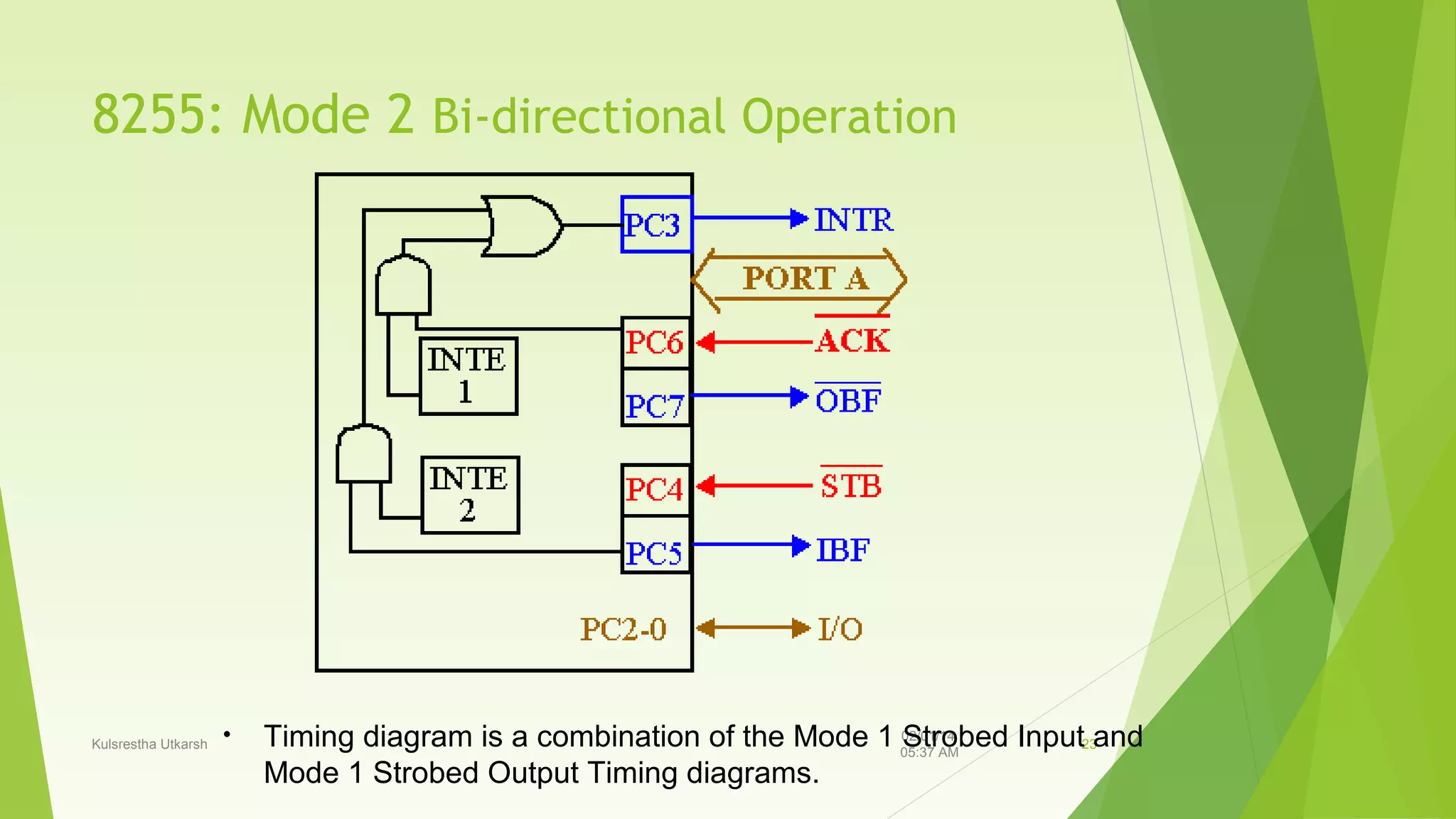
8255: Mode 2 Bi-directional Operation
 This

functional configuration provides a means for
communicating with a peripheral device or
structure on a single 8-bit bus for both
transmitting and receiving data (bidirectional bus
I/O).
 “Handshaking” signals are provided to maintain
proper bus flow discipline in a similar manner to
MODE 1.
 Interrupt generation and enable/disable functions
are also available.
Kulsrestha Utkarsh

02/01/14
05:37 AM

19
MODE 2 Basic Functional Definitions:
 Used

in Group A only.

 One

8-bit, bi-directional bus port (Port A) and a 5bit control port (Port C).

 Both

inputs and outputs are latched.

 The

5-bit control port (Port C) is used for control
and status for the 8-bit, bi-directional bus port
(Port A).

Kulsrestha Utkarsh

02/01/14
05:37 AM

20
8255: Mode 2 Bi-directional Operation
INTR : Interrupt request is an output that requests an
interrupt.
 ~OBF : Output Buffer Full is an output indicating that
that output buffer contains data for the bi-directional
bus.
 ~ACK : Acknowledge is an input that enables tri-state
buffers which are otherwise in their high-impedance
state.
 ~STB : The strobe input loads data into the port A
latch.


Kulsrestha Utkarsh

02/01/14
05:37 AM

21
8255: Mode 2 Bi-directional Operation
 IBF

: Input buffer full is an output indicating that
the input latch contains information for the
external bi-directional bus.

 INTE

: Interrupt enable are internal bits that
enable the INTR pin. BIT PC6(INTE1) and
PC4(INTE2).

 PC2,PC1,PC0

: These port C pins are generalpurpose I/O pins that are available for any
purpose.

Kulsrestha Utkarsh

02/01/14
05:37 AM

22
8255: Mode 2 Bi-directional Operation

Kulsrestha Utkarsh

•

02/01/14
Timing diagram is a combination of the Mode 1 05:37 AM
Strobed Input23and
Mode 1 Strobed Output Timing diagrams.
Mode definition summary

Kulsrestha Utkarsh

02/01/14
05:37 AM

24
More on interface, next time.
By Kulshrestha utkarsh

8255_utkarsh_kulshrestha

  • 1.
  • 2.
    Review  Intro With Handshaking  Moreon Address decoding  Interface with memory  Introduction to Programmable Peripheral Interface 82C55 Kulsrestha Utkarsh 02/01/14 05:37 AM 2
  • 3.
    Data Input WithHandshaking   System Data Bus   M P U ~RD  Kulsrestha Utkarsh Programmable Interface Device STB Strobe IBF   Data lines INTR Peripheral Device Such As Keyboard Pin for status check 02/01/14 05:37 AM 3
  • 4.
    Data Output WithHandshaking   System Data Bus   M P U ~WR  Kulsrestha Utkarsh Programmable Interface Device OBF Peripheral Device Such As Printer ACK   Data Lines INTR Pin for status check 02/01/14 05:37 AM 4
  • 5.
    About 8255  The 8255is a popular interfacing component, that can interface any TTL-compatible I/O device to a microprocessor.  It is used to interface to the keyboard and a parallel printer port in PCs (usually as part of an integrated chipset).  Requires insertion of wait states if used with a microprocessor using higher that an 8 MHz clock.  PPI has 24 pins for I/O that are programmable in groups of 12 pins and has three distinct modes of operation. Kulsrestha Utkarsh 02/01/14 05:37 AM 5
  • 6.
    82C55 : PinLayout Kulsrestha Utkarsh 02/01/14 05:37 AM 6
  • 7.
    PA7 – PA0 Group1 Control D0D 7 Data Bus Buffer Group 1 Port C upper Group 2 Port C Lower RD WR A0 A1 RESET Kulsrestha Utkarsh CS Read/ Write Control Logic Group 1 Port A Group 2 Control PC7 – PC4 PC3 – PC0 PB7 – PB0 Group 2 Port B 02/01/14 05:37 AM 7
  • 8.
  • 9.
    Mode 0 (BasicInput/Output).  This functional configuration provides simple input and output operations for each of the three ports.  No “handshaking” is required, data is simply written to or read from a specified port. Kulsrestha Utkarsh 02/01/14 05:37 AM 9
  • 10.
    82C55: Mode 0,Scan Display Kulsrestha Utkarsh 02/01/14 05:37 AM 10
  • 11.
    8255: Mode 0,Scan Display  Mode 0 operation causes the 8255 to function as a buffered input device or as a latched output device.  In previous example, both ports A and B are programmed as (mode 0) simple latched output ports.  Port A provides the segment data inputs to display and port B provides a means of selecting one display position at a time.  Different values are displayed in each digit via fast time multiplexing. Kulsrestha Utkarsh 02/01/14 05:37 AM 11
  • 12.
    8255: Mode 0,Scan Key Kulsrestha Utkarsh 02/01/14 05:37 AM 12
  • 13.
    MODE 1 (Input/Outputwith handshake)   Kulsrestha Utkarsh This functional configuration provides a means for transferring I/O data to or from a specified port in conjunction with strobes or “handshaking” signals. In mode 1, Port A and Port B use the lines on Port C to generate or accept these “handshaking” signals 02/01/14 05:37 AM 13
  • 14.
    Mode 1 Basicfunctional Definitions  Two Groups (Group A and Group B).  Each group contains one 8-bit data port and one 4-bit control/data port.  The 8-bit data port can be either input or output Both inputs and outputs are latched.  The 4-bit port is used for control and status of the 8-bit data port. Kulsrestha Utkarsh 02/01/14 05:37 AM 14
  • 15.
    8255: Mode 1Input with handshake      ~STB : The strobe input loads data into the port latch on a 0-to1 transition. IBF : Input buffer full is an output indicating that the input latch contain information. INTR : Interrupt request is an output that requests an interrupts. INTE : The interrupt enable signal is neither an input nor an output; it is an internal bit programmed via the PC4 (port A) or PC2 (port B) bits. PC7,PC6 : The port C pins 7 and 6 are general purpose I/O pings that are available for any purpose. Kulsrestha Utkarsh 02/01/14 05:37 AM 15
  • 16.
    8255: Mode 1Input with handshake Kulsrestha Utkarsh 02/01/14 05:37 AM 16 Signal definitions for Mode 1 Strobe Input
  • 17.
    8255 : Mode1 Output with handshake.      ~OBF : Output buffer full is an output that goes low when data is latched in either port A or port B. Goes low on ~ACK. ~ACK : The acknowledge signal causes the ~OBF pin return to 0. This is a response from an external device. INTR : Interrupt request is an output that requests an interrupt. INTE : The interrupt enable signal is neither an input nor an output; it is an internal bit programmed via the PC6(Port A) or PC2(port B) bits. PC5,PC4 : The port C pins 5 and 4 are general-purpose I/O pins that are available for any purpose. Kulsrestha Utkarsh 02/01/14 05:37 AM 17
  • 18.
    8255 : Mode1 Output handshake. Kulsrestha Utkarsh 02/01/14 05:37 AM 18
  • 19.
    8255: Mode 2Bi-directional Operation  This functional configuration provides a means for communicating with a peripheral device or structure on a single 8-bit bus for both transmitting and receiving data (bidirectional bus I/O).  “Handshaking” signals are provided to maintain proper bus flow discipline in a similar manner to MODE 1.  Interrupt generation and enable/disable functions are also available. Kulsrestha Utkarsh 02/01/14 05:37 AM 19
  • 20.
    MODE 2 BasicFunctional Definitions:  Used in Group A only.  One 8-bit, bi-directional bus port (Port A) and a 5bit control port (Port C).  Both inputs and outputs are latched.  The 5-bit control port (Port C) is used for control and status for the 8-bit, bi-directional bus port (Port A). Kulsrestha Utkarsh 02/01/14 05:37 AM 20
  • 21.
    8255: Mode 2Bi-directional Operation INTR : Interrupt request is an output that requests an interrupt.  ~OBF : Output Buffer Full is an output indicating that that output buffer contains data for the bi-directional bus.  ~ACK : Acknowledge is an input that enables tri-state buffers which are otherwise in their high-impedance state.  ~STB : The strobe input loads data into the port A latch.  Kulsrestha Utkarsh 02/01/14 05:37 AM 21
  • 22.
    8255: Mode 2Bi-directional Operation  IBF : Input buffer full is an output indicating that the input latch contains information for the external bi-directional bus.  INTE : Interrupt enable are internal bits that enable the INTR pin. BIT PC6(INTE1) and PC4(INTE2).  PC2,PC1,PC0 : These port C pins are generalpurpose I/O pins that are available for any purpose. Kulsrestha Utkarsh 02/01/14 05:37 AM 22
  • 23.
    8255: Mode 2Bi-directional Operation Kulsrestha Utkarsh • 02/01/14 Timing diagram is a combination of the Mode 1 05:37 AM Strobed Input23and Mode 1 Strobed Output Timing diagrams.
  • 24.
    Mode definition summary KulsresthaUtkarsh 02/01/14 05:37 AM 24
  • 25.
    More on interface,next time. By Kulshrestha utkarsh

Editor's Notes

  • #11 Examples of connecting LCD displays and stepper motors are also given.
  • #19 Similar to Mode 0 output operation, except that handshaking signals are provided using port C. Signal Definitions for Mode 1 Strobed Output