82C55A Programmable Peripheral
Interface
 The 82C55A is an LSI peripheral designed to
permit easy implementation of parallel I/O in
the 8088- and 8086-microcomputer system.
 Flexible parallel interface:
 Single-bit, 4-bit, and byte-wide input and output
ports
 Level sensitive inputs
 Latched outputs
 Strobed inputs or outputs
 Strobed bidirectional input/outputs
 Timing of the data transfers to the 82C55A is
controlled by the read/write control (RD and
WR) signals.
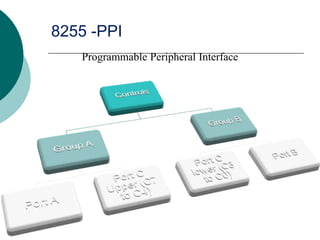
8255 -PPI
Programmable Peripheral Interface
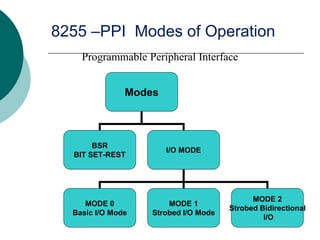
8255 –PPI Modes of Operation
Programmable Peripheral Interface
Modes
BSR
BIT SET-REST
I/O MODE
MODE 0
Basic I/O Mode
MODE 1
Strobed I/O Mode
MODE 2
Strobed Bidirectional
I/O
82C55A Programmable Peripheral
Interface (cont.)
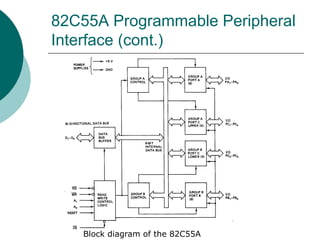
Block diagram of the 82C55A
82C55A Programmable Peripheral
Interface (cont.)
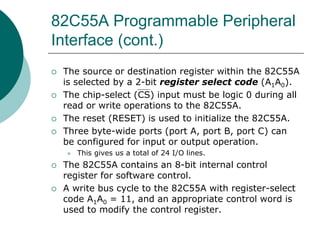
 The source or destination register within the 82C55A
is selected by a 2-bit register select code (A1A0).
 The chip-select (CS) input must be logic 0 during all
read or write operations to the 82C55A.
 The reset (RESET) is used to initialize the 82C55A.
 Three byte-wide ports (port A, port B, port C) can
be configured for input or output operation.
 This gives us a total of 24 I/O lines.
 The 82C55A contains an 8-bit internal control
register for software control.
 A write bus cycle to the 82C55A with register-select
code A1A0 = 11, and an appropriate control word is
used to modify the control register.
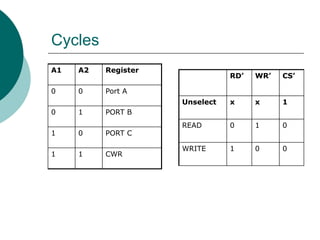
Cycles
A1 A2 Register
0 0 Port A
0 1 PORT B
1 0 PORT C
1 1 CWR
RD’ WR’ CS’
Unselect x x 1
READ 0 1 0
WRITE 1 0 0
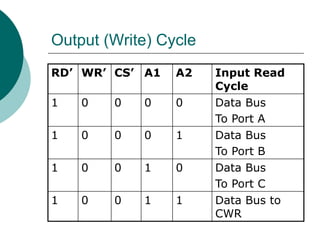
Output (Write) Cycle
RD’ WR’ CS’ A1 A2 Input Read
Cycle
1 0 0 0 0 Data Bus
To Port A
1 0 0 0 1 Data Bus
To Port B
1 0 0 1 0 Data Bus
To Port C
1 0 0 1 1 Data Bus to
CWR
82C55A Programmable Peripheral
Interface (cont.)
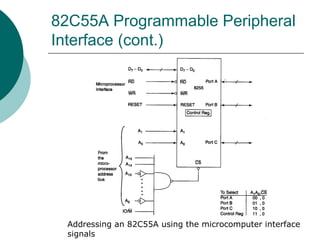
Addressing an 82C55A using the microcomputer interface
signals
82C55A Programmable Peripheral
Interface (cont.)
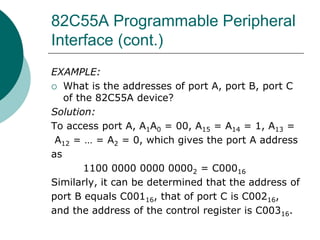
EXAMPLE:
 What is the addresses of port A, port B, port C
of the 82C55A device?
Solution:
To access port A, A1A0 = 00, A15 = A14 = 1, A13 =
A12 = … = A2 = 0, which gives the port A address
as
1100 0000 0000 00002 = C00016
Similarly, it can be determined that the address of
port B equals C00116, that of port C is C00216,
and the address of the control register is C00316.
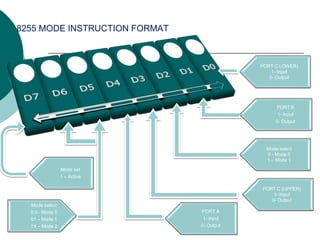
8255 MODE INSTRUCTION FORMAT
PORT C (UPPER)
1- Input
0- Output
PORT A
1- Input
0- Output
Mode select
0 0 - Mode 0
01 – Mode 1
1X – Mode 2
Mode set
1 – Active
PORT B
1- Input
0- Output
PORT C LOWER)
1- Input
0- Output
Mode select
0 - Mode 0
1 – Mode 1
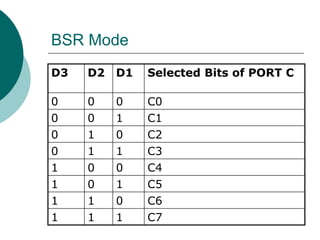
BSR Mode
D3 D2 D1 Selected Bits of PORT C
0 0 0 C0
0 0 1 C1
0 1 0 C2
0 1 1 C3
1 0 0 C4
1 0 1 C5
1 1 0 C6
1 1 1 C7
82C55A Programmable Peripheral
Interface (cont.)
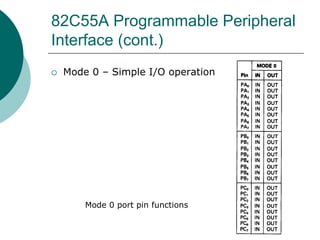
 Mode 0 – Simple I/O operation
Mode 0 port pin functions
82C55A Programmable Peripheral
Interface (cont.)
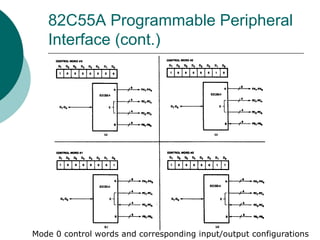
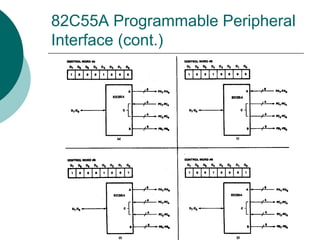
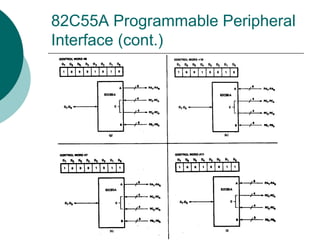
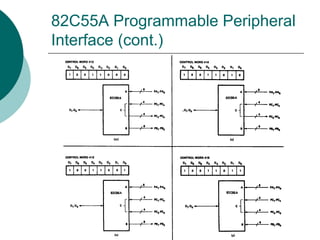
Mode 0 control words and corresponding input/output configurations
82C55A Programmable Peripheral
Interface (cont.)
82C55A Programmable Peripheral
Interface (cont.)
82C55A Programmable Peripheral
Interface (cont.)
82C55A Programmable Peripheral
Interface (cont.)
EXAMPLE:
 What is the mode and I/O configuration for
ports A, B, and C of an 82C55A after its control
register is loaded with 8216?
Solution:
Expressing the control register contents in binary
form, we get
D7D6D5D4D3D2D1D0 = 100000102
Since D7 is 1, the modes of operation of the ports
are selected by the control word.
D0 = 0 Lower four bits of port C are outputs.
D1 = 1 Port B is an input port.
D2 = 0 Mode 0 for both port B and the lower four bits of
port C.
82C55A Programmable Peripheral
Interface (cont.)
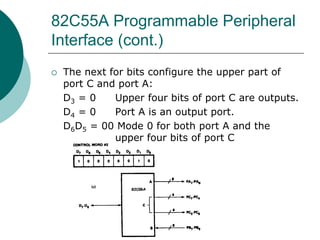
 The next for bits configure the upper part of
port C and port A:
D3 = 0 Upper four bits of port C are outputs.
D4 = 0 Port A is an output port.
D6D5 = 00 Mode 0 for both port A and the
upper four bits of port C
82C55A Programmable Peripheral
Interface (cont.)
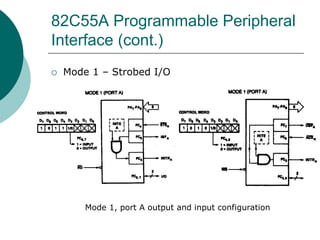
 Mode 1 – Strobed I/O
 In mode 1, the A and B ports are configured as
two independent byte-wide I/O ports, each of
which has a 4-bit control/data port associated
with it.
 The control/data ports are formed from the lower and
upper nibbles of port C, respectively
 In mode 1, data applied to an input port must be
strobed in with a signal produced in external
hardware
 An output port in mode 1 is provided with
handshake signals that indicate when new data
are available at its outputs and when an external
device has read these values
82C55A Programmable Peripheral
Interface (cont.)
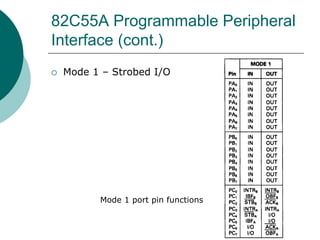
 Mode 1 – Strobed I/O
Mode 1 port pin functions
82C55A Programmable Peripheral
Interface (cont.)
 Mode 1 – Strobed I/O
Mode 1, port A output and input configuration
82C55A Programmable Peripheral
Interface (cont.)
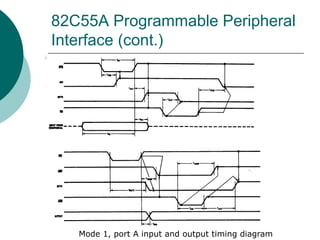
Mode 1, port A input and output timing diagram
82C55A Programmable Peripheral
Interface (cont.)
EXAMPLE:
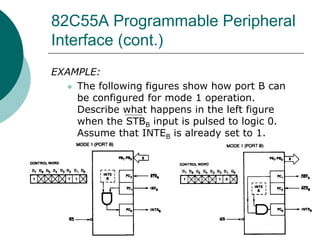
 The following figures show how port B can
be configured for mode 1 operation.
Describe what happens in the left figure
when the STBB input is pulsed to logic 0.
Assume that INTEB is already set to 1.
82C55A Programmable Peripheral
Interface (cont.)
SOLUTION:
 As STBB is pulsed, the byte of data at PB7
through PB0 is latched into the port B register.
This causes the IBFB output to switch to 1.
Since INTEB is 1, INTRB switches to logic 1.
82C55A Programmable Peripheral
Interface (cont.)
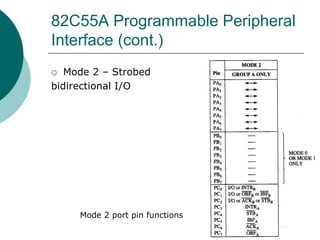
 Mode 2 – Strobed
bidirectional I/O
Mode 2 port pin functions
82C55A Programmable Peripheral
Interface (cont.)
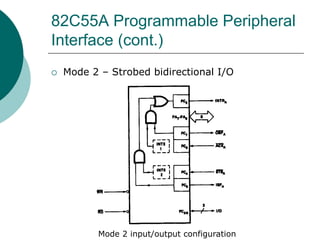
 Mode 2 – Strobed bidirectional I/O
Mode 2 input/output configuration
82C55A Programmable Peripheral
Interface (cont.)
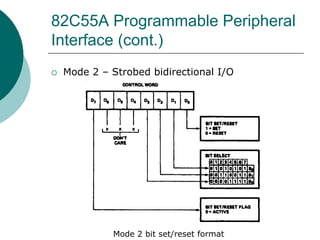
 Mode 2 – Strobed bidirectional I/O
Mode 2 bit set/reset format
82C55A Programmable Peripheral
Interface (cont.)
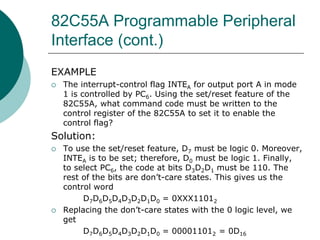
EXAMPLE
 The interrupt-control flag INTEA for output port A in mode
1 is controlled by PC6. Using the set/reset feature of the
82C55A, what command code must be written to the
control register of the 82C55A to set it to enable the
control flag?
Solution:
 To use the set/reset feature, D7 must be logic 0. Moreover,
INTEA is to be set; therefore, D0 must be logic 1. Finally,
to select PC6, the code at bits D3D2D1 must be 110. The
rest of the bits are don’t-care states. This gives us the
control word
D7D6D5D4D3D2D1D0 = 0XXX11012
 Replacing the don’t-care states with the 0 logic level, we
get
D7D6D5D4D3D2D1D0 = 000011012 = 0D16
82C55A Programmable Peripheral
Interface
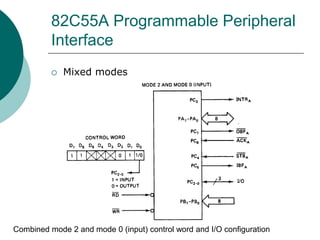
 Mixed modes
Combined mode 2 and mode 0 (input) control word and I/O configuration
82C55A Programmable Peripheral
Interface
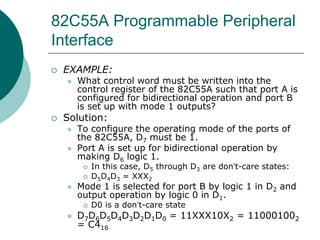
 EXAMPLE:
 What control word must be written into the
control register of the 82C55A such that port A is
configured for bidirectional operation and port B
is set up with mode 1 outputs?
 Solution:
 To configure the operating mode of the ports of
the 82C55A, D7 must be 1.
 Port A is set up for bidirectional operation by
making D6 logic 1.
 In this case, D5 through D3 are don’t-care states:
 D5D4D3 = XXX2
 Mode 1 is selected for port B by logic 1 in D2 and
output operation by logic 0 in D1.
 D0 is a don’t-care state
 D7D6D5D4D3D2D1D0 = 11XXX10X2 = 110001002
= C416
82C55A Programmable Peripheral
Interface
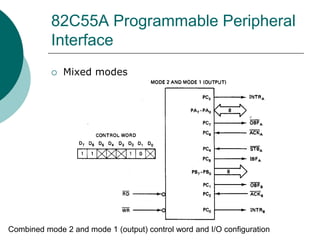
 Mixed modes
Combined mode 2 and mode 1 (output) control word and I/O configuration
82C55A Programmable Peripheral
Interface
 EXAMPLE
 Write the sequence of instructions needed to load
the control register of an 82C55A with the control
word formed in the previous example. Assume
that the control register of the 82C55A resides at
address 0F16 of the I/O address space?
 Solution:
 First we must load AL with C416 . This is the value
of the control word that is to be written to the
control register at address 0F16. The move
instruction used to load AL is
 MOV AL, 0C4H
 These data are output to the control register with
OUT instruction
 OUT 0FH, AL
 Because the I/O address of the control register is
less than FF16, this instruction uses direct I/O.
82C55A Programmable Peripheral
Interface
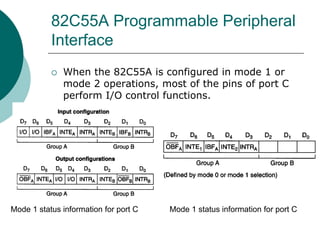
 When the 82C55A is configured in mode 1 or
mode 2 operations, most of the pins of port C
perform I/O control functions.
Mode 1 status information for port C Mode 1 status information for port C
82C55A Implementation of Parallel
Input/Output Ports
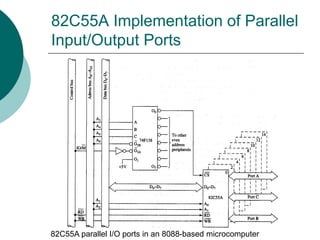
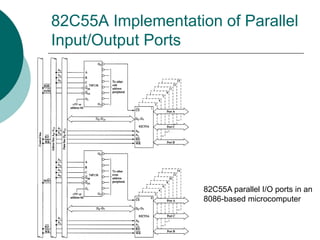
82C55A parallel I/O ports in an 8088-based microcomputer
82C55A Implementation of Parallel
Input/Output Ports
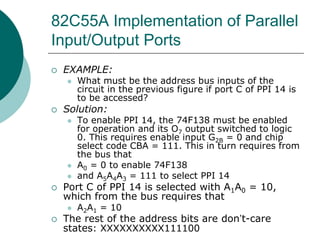
 EXAMPLE:
 What must be the address bus inputs of the
circuit in the previous figure if port C of PPI 14 is
to be accessed?
 Solution:
 To enable PPI 14, the 74F138 must be enabled
for operation and its O7 output switched to logic
0. This requires enable input G2B = 0 and chip
select code CBA = 111. This in turn requires from
the bus that
 A0 = 0 to enable 74F138
 and A5A4A3 = 111 to select PPI 14
 Port C of PPI 14 is selected with A1A0 = 10,
which from the bus requires that
 A2A1 = 10
 The rest of the address bits are don’t-care
states: XXXXXXXXXX111100
82C55A Implementation of Parallel
Input/Output Ports
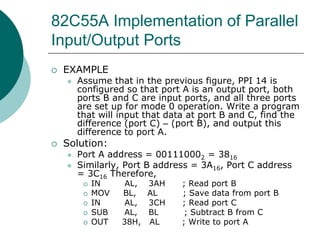
 EXAMPLE
 Assume that in the previous figure, PPI 14 is
configured so that port A is an output port, both
ports B and C are input ports, and all three ports
are set up for mode 0 operation. Write a program
that will input that data at port B and C, find the
difference (port C) – (port B), and output this
difference to port A.
 Solution:
 Port A address = 001110002 = 3816
 Similarly, Port B address = 3A16, Port C address
= 3C16 Therefore,
 IN AL, 3AH ; Read port B
 MOV BL, AL ; Save data from port B
 IN AL, 3CH ; Read port C
 SUB AL, BL ; Subtract B from C
 OUT 38H, AL ; Write to port A
82C55A Implementation of Parallel
Input/Output Ports
82C55A parallel I/O ports in an
8086-based microcomputer
Memory-Mapped Input/Output
Ports
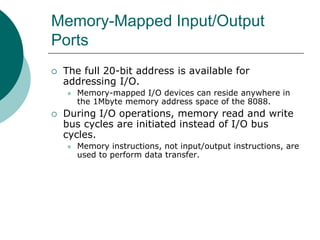
 The full 20-bit address is available for
addressing I/O.
 Memory-mapped I/O devices can reside anywhere in
the 1Mbyte memory address space of the 8088.
 During I/O operations, memory read and write
bus cycles are initiated instead of I/O bus
cycles.
 Memory instructions, not input/output instructions, are
used to perform data transfer.
Memory-Mapped Input/Output
Ports
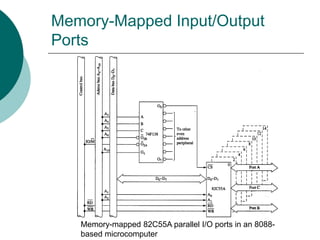
Memory-mapped 82C55A parallel I/O ports in an 8088-
based microcomputer
Memory-Mapped Input/Output
Ports
 EXAMPLE:
 Which I/O port in the previous figure is selected
for operation when the memory address output
on the bus is 0040216?
 Solution:
 We begin by converting the address to binary
form. This gives
 A19…A1A0 = 000000000100000000102
 In this address, bits A10 = 1 and A0 = 0.
Therefore, the 74F138 address decoder is
enabled whenever IO/M = 0.
 A5A4A3 = 000
 This input code switches decoder output O0 to
logic 0 and chip selects PPI 0 for operation.
 The address bits applied to the port select inputs
of the PPI are A2A1 = 01. These inputs cause port
B to be accessed. Thus, the address 0040216
selects port B on PPI 0 for memory-map I/O.
Memory-Mapped Input/Output
Ports
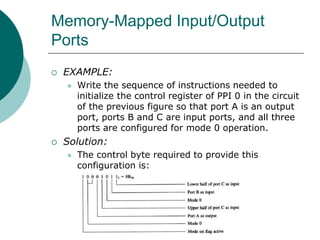
 EXAMPLE:
 Write the sequence of instructions needed to
initialize the control register of PPI 0 in the circuit
of the previous figure so that port A is an output
port, ports B and C are input ports, and all three
ports are configured for mode 0 operation.
 Solution:
 The control byte required to provide this
configuration is:
Memory-Mapped Input/Output
Ports
 From the circuit diagram, the memory address of
the control register for PPI 0 is found to be
 000000000100000001102 = 0040616
 Since PPI 0 is memory mapped, the following
move instructions can be used to initialized the
control register:
 MOV AX, 0 ; Create data segment at 00000H
 MOV DS, AX
 MOV AL, 8BH ; Load AL with control byte
 MOV [406H], AL ; Write control byte to PPI 0
control register
Memory-Mapped Input/Output
Ports
 EXAMPLE:
 Assume that PPI 0 in the previous figure is configured
as described in the previous example. Write a program
that will input the contents of ports B and C, AND
them together, and output the results to port A.
 Solution:
 The addresses of the three I/O ports on PPI 0 are:
 Port A = 0040016 Port B = 0040216 Port C =
0040416
 Now we set up a data segment at 0000016 and the
program is:
 AND AX, 0 ; Create data segment at 00000H
 MOV DS, AX
 MOV BL, [402H] ; Read port B
 MOV AL, [404H] ; Read port C
 AND AL, BL ; AND data at port B and C
 MOV [400H], AL ; Write to port A

8255.ppt

  • 1.
    82C55A Programmable Peripheral Interface The 82C55A is an LSI peripheral designed to permit easy implementation of parallel I/O in the 8088- and 8086-microcomputer system.  Flexible parallel interface:  Single-bit, 4-bit, and byte-wide input and output ports  Level sensitive inputs  Latched outputs  Strobed inputs or outputs  Strobed bidirectional input/outputs  Timing of the data transfers to the 82C55A is controlled by the read/write control (RD and WR) signals.
  • 2.
  • 3.
    8255 –PPI Modesof Operation Programmable Peripheral Interface Modes BSR BIT SET-REST I/O MODE MODE 0 Basic I/O Mode MODE 1 Strobed I/O Mode MODE 2 Strobed Bidirectional I/O
  • 4.
    82C55A Programmable Peripheral Interface(cont.) Block diagram of the 82C55A
  • 5.
    82C55A Programmable Peripheral Interface(cont.)  The source or destination register within the 82C55A is selected by a 2-bit register select code (A1A0).  The chip-select (CS) input must be logic 0 during all read or write operations to the 82C55A.  The reset (RESET) is used to initialize the 82C55A.  Three byte-wide ports (port A, port B, port C) can be configured for input or output operation.  This gives us a total of 24 I/O lines.  The 82C55A contains an 8-bit internal control register for software control.  A write bus cycle to the 82C55A with register-select code A1A0 = 11, and an appropriate control word is used to modify the control register.
  • 6.
    Cycles A1 A2 Register 00 Port A 0 1 PORT B 1 0 PORT C 1 1 CWR RD’ WR’ CS’ Unselect x x 1 READ 0 1 0 WRITE 1 0 0
  • 7.
    Output (Write) Cycle RD’WR’ CS’ A1 A2 Input Read Cycle 1 0 0 0 0 Data Bus To Port A 1 0 0 0 1 Data Bus To Port B 1 0 0 1 0 Data Bus To Port C 1 0 0 1 1 Data Bus to CWR
  • 8.
    82C55A Programmable Peripheral Interface(cont.) Addressing an 82C55A using the microcomputer interface signals
  • 9.
    82C55A Programmable Peripheral Interface(cont.) EXAMPLE:  What is the addresses of port A, port B, port C of the 82C55A device? Solution: To access port A, A1A0 = 00, A15 = A14 = 1, A13 = A12 = … = A2 = 0, which gives the port A address as 1100 0000 0000 00002 = C00016 Similarly, it can be determined that the address of port B equals C00116, that of port C is C00216, and the address of the control register is C00316.
  • 10.
    8255 MODE INSTRUCTIONFORMAT PORT C (UPPER) 1- Input 0- Output PORT A 1- Input 0- Output Mode select 0 0 - Mode 0 01 – Mode 1 1X – Mode 2 Mode set 1 – Active PORT B 1- Input 0- Output PORT C LOWER) 1- Input 0- Output Mode select 0 - Mode 0 1 – Mode 1
  • 11.
    BSR Mode D3 D2D1 Selected Bits of PORT C 0 0 0 C0 0 0 1 C1 0 1 0 C2 0 1 1 C3 1 0 0 C4 1 0 1 C5 1 1 0 C6 1 1 1 C7
  • 12.
    82C55A Programmable Peripheral Interface(cont.)  Mode 0 – Simple I/O operation Mode 0 port pin functions
  • 13.
    82C55A Programmable Peripheral Interface(cont.) Mode 0 control words and corresponding input/output configurations
  • 14.
  • 15.
  • 16.
  • 17.
    82C55A Programmable Peripheral Interface(cont.) EXAMPLE:  What is the mode and I/O configuration for ports A, B, and C of an 82C55A after its control register is loaded with 8216? Solution: Expressing the control register contents in binary form, we get D7D6D5D4D3D2D1D0 = 100000102 Since D7 is 1, the modes of operation of the ports are selected by the control word. D0 = 0 Lower four bits of port C are outputs. D1 = 1 Port B is an input port. D2 = 0 Mode 0 for both port B and the lower four bits of port C.
  • 18.
    82C55A Programmable Peripheral Interface(cont.)  The next for bits configure the upper part of port C and port A: D3 = 0 Upper four bits of port C are outputs. D4 = 0 Port A is an output port. D6D5 = 00 Mode 0 for both port A and the upper four bits of port C
  • 19.
    82C55A Programmable Peripheral Interface(cont.)  Mode 1 – Strobed I/O  In mode 1, the A and B ports are configured as two independent byte-wide I/O ports, each of which has a 4-bit control/data port associated with it.  The control/data ports are formed from the lower and upper nibbles of port C, respectively  In mode 1, data applied to an input port must be strobed in with a signal produced in external hardware  An output port in mode 1 is provided with handshake signals that indicate when new data are available at its outputs and when an external device has read these values
  • 20.
    82C55A Programmable Peripheral Interface(cont.)  Mode 1 – Strobed I/O Mode 1 port pin functions
  • 21.
    82C55A Programmable Peripheral Interface(cont.)  Mode 1 – Strobed I/O Mode 1, port A output and input configuration
  • 22.
    82C55A Programmable Peripheral Interface(cont.) Mode 1, port A input and output timing diagram
  • 23.
    82C55A Programmable Peripheral Interface(cont.) EXAMPLE:  The following figures show how port B can be configured for mode 1 operation. Describe what happens in the left figure when the STBB input is pulsed to logic 0. Assume that INTEB is already set to 1.
  • 24.
    82C55A Programmable Peripheral Interface(cont.) SOLUTION:  As STBB is pulsed, the byte of data at PB7 through PB0 is latched into the port B register. This causes the IBFB output to switch to 1. Since INTEB is 1, INTRB switches to logic 1.
  • 25.
    82C55A Programmable Peripheral Interface(cont.)  Mode 2 – Strobed bidirectional I/O Mode 2 port pin functions
  • 26.
    82C55A Programmable Peripheral Interface(cont.)  Mode 2 – Strobed bidirectional I/O Mode 2 input/output configuration
  • 27.
    82C55A Programmable Peripheral Interface(cont.)  Mode 2 – Strobed bidirectional I/O Mode 2 bit set/reset format
  • 28.
    82C55A Programmable Peripheral Interface(cont.) EXAMPLE  The interrupt-control flag INTEA for output port A in mode 1 is controlled by PC6. Using the set/reset feature of the 82C55A, what command code must be written to the control register of the 82C55A to set it to enable the control flag? Solution:  To use the set/reset feature, D7 must be logic 0. Moreover, INTEA is to be set; therefore, D0 must be logic 1. Finally, to select PC6, the code at bits D3D2D1 must be 110. The rest of the bits are don’t-care states. This gives us the control word D7D6D5D4D3D2D1D0 = 0XXX11012  Replacing the don’t-care states with the 0 logic level, we get D7D6D5D4D3D2D1D0 = 000011012 = 0D16
  • 29.
    82C55A Programmable Peripheral Interface Mixed modes Combined mode 2 and mode 0 (input) control word and I/O configuration
  • 30.
    82C55A Programmable Peripheral Interface EXAMPLE:  What control word must be written into the control register of the 82C55A such that port A is configured for bidirectional operation and port B is set up with mode 1 outputs?  Solution:  To configure the operating mode of the ports of the 82C55A, D7 must be 1.  Port A is set up for bidirectional operation by making D6 logic 1.  In this case, D5 through D3 are don’t-care states:  D5D4D3 = XXX2  Mode 1 is selected for port B by logic 1 in D2 and output operation by logic 0 in D1.  D0 is a don’t-care state  D7D6D5D4D3D2D1D0 = 11XXX10X2 = 110001002 = C416
  • 31.
    82C55A Programmable Peripheral Interface Mixed modes Combined mode 2 and mode 1 (output) control word and I/O configuration
  • 32.
    82C55A Programmable Peripheral Interface EXAMPLE  Write the sequence of instructions needed to load the control register of an 82C55A with the control word formed in the previous example. Assume that the control register of the 82C55A resides at address 0F16 of the I/O address space?  Solution:  First we must load AL with C416 . This is the value of the control word that is to be written to the control register at address 0F16. The move instruction used to load AL is  MOV AL, 0C4H  These data are output to the control register with OUT instruction  OUT 0FH, AL  Because the I/O address of the control register is less than FF16, this instruction uses direct I/O.
  • 33.
    82C55A Programmable Peripheral Interface When the 82C55A is configured in mode 1 or mode 2 operations, most of the pins of port C perform I/O control functions. Mode 1 status information for port C Mode 1 status information for port C
  • 34.
    82C55A Implementation ofParallel Input/Output Ports 82C55A parallel I/O ports in an 8088-based microcomputer
  • 35.
    82C55A Implementation ofParallel Input/Output Ports  EXAMPLE:  What must be the address bus inputs of the circuit in the previous figure if port C of PPI 14 is to be accessed?  Solution:  To enable PPI 14, the 74F138 must be enabled for operation and its O7 output switched to logic 0. This requires enable input G2B = 0 and chip select code CBA = 111. This in turn requires from the bus that  A0 = 0 to enable 74F138  and A5A4A3 = 111 to select PPI 14  Port C of PPI 14 is selected with A1A0 = 10, which from the bus requires that  A2A1 = 10  The rest of the address bits are don’t-care states: XXXXXXXXXX111100
  • 36.
    82C55A Implementation ofParallel Input/Output Ports  EXAMPLE  Assume that in the previous figure, PPI 14 is configured so that port A is an output port, both ports B and C are input ports, and all three ports are set up for mode 0 operation. Write a program that will input that data at port B and C, find the difference (port C) – (port B), and output this difference to port A.  Solution:  Port A address = 001110002 = 3816  Similarly, Port B address = 3A16, Port C address = 3C16 Therefore,  IN AL, 3AH ; Read port B  MOV BL, AL ; Save data from port B  IN AL, 3CH ; Read port C  SUB AL, BL ; Subtract B from C  OUT 38H, AL ; Write to port A
  • 37.
    82C55A Implementation ofParallel Input/Output Ports 82C55A parallel I/O ports in an 8086-based microcomputer
  • 38.
    Memory-Mapped Input/Output Ports  Thefull 20-bit address is available for addressing I/O.  Memory-mapped I/O devices can reside anywhere in the 1Mbyte memory address space of the 8088.  During I/O operations, memory read and write bus cycles are initiated instead of I/O bus cycles.  Memory instructions, not input/output instructions, are used to perform data transfer.
  • 39.
    Memory-Mapped Input/Output Ports Memory-mapped 82C55Aparallel I/O ports in an 8088- based microcomputer
  • 40.
    Memory-Mapped Input/Output Ports  EXAMPLE: Which I/O port in the previous figure is selected for operation when the memory address output on the bus is 0040216?  Solution:  We begin by converting the address to binary form. This gives  A19…A1A0 = 000000000100000000102  In this address, bits A10 = 1 and A0 = 0. Therefore, the 74F138 address decoder is enabled whenever IO/M = 0.  A5A4A3 = 000  This input code switches decoder output O0 to logic 0 and chip selects PPI 0 for operation.  The address bits applied to the port select inputs of the PPI are A2A1 = 01. These inputs cause port B to be accessed. Thus, the address 0040216 selects port B on PPI 0 for memory-map I/O.
  • 41.
    Memory-Mapped Input/Output Ports  EXAMPLE: Write the sequence of instructions needed to initialize the control register of PPI 0 in the circuit of the previous figure so that port A is an output port, ports B and C are input ports, and all three ports are configured for mode 0 operation.  Solution:  The control byte required to provide this configuration is:
  • 42.
    Memory-Mapped Input/Output Ports  Fromthe circuit diagram, the memory address of the control register for PPI 0 is found to be  000000000100000001102 = 0040616  Since PPI 0 is memory mapped, the following move instructions can be used to initialized the control register:  MOV AX, 0 ; Create data segment at 00000H  MOV DS, AX  MOV AL, 8BH ; Load AL with control byte  MOV [406H], AL ; Write control byte to PPI 0 control register
  • 43.
    Memory-Mapped Input/Output Ports  EXAMPLE: Assume that PPI 0 in the previous figure is configured as described in the previous example. Write a program that will input the contents of ports B and C, AND them together, and output the results to port A.  Solution:  The addresses of the three I/O ports on PPI 0 are:  Port A = 0040016 Port B = 0040216 Port C = 0040416  Now we set up a data segment at 0000016 and the program is:  AND AX, 0 ; Create data segment at 00000H  MOV DS, AX  MOV BL, [402H] ; Read port B  MOV AL, [404H] ; Read port C  AND AL, BL ; AND data at port B and C  MOV [400H], AL ; Write to port A