Improving
Profitability for
Small Business
Owners
Benjamin Wann, CMA, CSCA, MBA,
PMP
About CFO
Consultants
CFO Consultants is a dynamic and
comprehensive financial consultancy firm
dedicated to empowering small businesses
through specialized services designed to
enhance financial performance and operational
efficiency.
Focusing on delivering exceptional value, CFO
Consultants leverage information technology
and standardized processes to keep costs low
while ensuring high-quality service delivery.
Their offerings are broad and tailored to
address everyday financial and operational
challenges small businesses face, including
outgrowing bookkeeping capabilities, managing
messy books, and needing advanced financial
strategies for growth.
2
About CFO Consultants (Cont.)
3
At the core of CFO Consultants' services are business consulting, fractional CFO roles,
outsourced controller services, bookkeeping, QuickBooks consulting, tax filing and
planning, business valuation, and risk analysis. These services are designed to provide
businesses with the financial expertise and support they need at an affordable cost. From
process improvement and ERP implementation to financial planning, strategy, and market
analysis, CFO Consultants brings a wealth of experience and expertise to help small
businesses thrive.
The firm stands out for its commitment to delivering solutions that create obvious everyday
value, ensuring clients receive practical advice and support that directly impacts their
bottom line. CFO Consultants is a critical partner in driving business growth and profitability
by focusing on performance KPIs, market analysis, financial modeling, and strategic
planning.
Additionally, their services in tax planning, business valuation, and risk analysis support
businesses in navigating the complexities of financial management, ensuring compliance
and maximizing value.
For further information and to explore how CFO Consultants can assist your business, visit
their website at CFOConsultants.net.
Understanding Profitability
4
Understanding profitability is crucial for small business owners as it indicates the
efficiency with which their business operates and generates profit relative to its size,
encompassing revenues and costs. Here’s a comprehensive overview to help you
grasp this concept:
What is Profitability?
Profitability measures your business's income beyond the costs incurred to produce
goods or services. It's not just about making sales; it's about what remains after
covering all your expenses. High profitability means your business is doing well
financially, whereas low profitability suggests there's room for improvement.
Profitability: Beyond the Bottom Line
While many equate business success with high revenue, true profitability goes beyond
simply generating income. It's about the efficiency with which you convert revenue into
net profit, the lifeblood of your business. Profitability ensures your company has the
financial resources to stay afloat, reinvest in growth, and reward your efforts.
Understanding Profitability (Cont.)
5
Profit vs. Cash Flow: Understanding the Difference
It's important to distinguish between profit and cash flow. Profit represents the income
remaining after deducting all expenses from your revenue over a specific period. Cash
flow, on the other hand, focuses on the actual movement of cash in and out of your
business at a particular point in time. While they are interrelated, they are not identical.
It's possible to be profitable but have temporary cash flow constraints.
Why Margins Matter More Than Revenue
Many new business owners prioritize high revenue figures. However, focusing solely
on revenue can be misleading. Your profit margin tells the true story of your financial
efficiency. Profit margin is a percentage metric that indicates how much profit you
generate from each sales dollar. Focusing on healthy profit margins ensures your
business remains profitable even with fluctuations in revenue.
Understanding Profitability (Cont.)
6
Profit vs. Cash Flow: Understanding the Difference
It's important to distinguish between profit and cash flow. Profit represents the income
remaining after deducting all expenses from your revenue over a specific period. Cash
flow, on the other hand, focuses on the actual movement of cash in and out of your
business at a particular point in time. While they are interrelated, they are not identical.
It's possible to be profitable but have temporary cash flow constraints.
Why Margins Matter More Than Revenue
Many new business owners prioritize high revenue figures. However, focusing solely
on revenue can be misleading. Your profit margin tells the true story of your financial
efficiency. Profit margin is a percentage metric that indicates how much profit you
generate from each sales dollar. Focusing on healthy profit margins ensures your
business remains profitable even with fluctuations in revenue.
Understanding Profitability (Cont.)
7
Key Performance Indicators (KPIs) for Profitability
Several key performance indicators (KPIs) provide valuable insights into your
business's profitability. Regularly monitoring these metrics allows you to identify areas
for improvement and make data-driven decisions to optimize your financial
performance. Here are a few critical KPIs to keep an eye on:
• Gross Profit Margin: Measures the profit remaining after deducting the cost of
goods sold from your revenue.
• Net Profit Margin: Shows the percentage of profit remaining after accounting for all
business expenses.
• Return on Investment (ROI): Evaluate the efficiency of your investments by
comparing the profit generated to the cost of the investment.
Understanding Profitability (Cont.)
8
The Power of Profitability Knowledge
By understanding profitability and its key metrics, you gain the power to:
• Set Realistic Financial Goals: Profitability benchmarks guide you in setting
achievable financial targets that ensure sustainable growth.
• Make Informed Decisions: Financial data empowers you to choose pricing,
resource allocation, and investment opportunities strategically.
• Identify Areas for Improvement: Profitability analysis reveals areas where you can
optimize operations, reduce costs, and boost your bottom line.
Profitability: A Compass for Long-Term Success
Profitability is not just an accounting measure; it's a strategic tool for navigating the
journey of small business ownership. By prioritizing profitability and leveraging financial
insights, you can make sound decisions that propel your business toward long-term
success and economic stability. Remember, a profitable business is resilient and well-
equipped to weather challenges and emerge victorious.
Profitability Versus
Cash Flow
Imagine your business as a car.
Profitability tells you how efficiently
your engine runs, converting fuel
(expenses) into power (revenue) to
move forward. Cash flow, on the
other hand, reflects the gas gauge,
indicating how much fuel (cash) you
have available to keep going. Both
are essential for a healthy and
sustainable business journey.
9
Profitability: The Engine of Your
Business
 What it is: Profitability measures your ability to generate a surplus after
accounting for all expenses. It's a long-term indicator of your business's
financial health and efficiency.
 How it's measured: Profitability is typically measured by net profit
margin, a percentage of revenue remaining after all expenses are paid.
 Example: Let's say your bakery has a revenue of $10,000 this month
and spends $7,000 on ingredients, rent, and salaries. Your net profit
would be $3,000, resulting in a net profit margin of 30% ($3,000 divided
by $10,000). This indicates your bakery is efficient at turning expenses
into profit.
10
Cash Flow: The Gas Gauge of
Your Business
 What it is: Cash flow refers to the movement of cash in and out of your
business at a specific point in time. It shows your ability to meet your
short-term financial obligations like rent, payroll, and bills.
 How it's monitored: Cash flow is often tracked through cash flow
statements, which categorize cash inflows (sales, investments) and
outflows (expenses, loan payments).
 Example: Even with a profitable bakery, you might face cash flow issues
if customers pay on credit. This means your income (revenue) appears
good on paper, but you might not have enough ready cash (inflow) to
cover immediate expenses (outflow) until those bills are paid.
11
Why Both Matter: Sustainability
Through Balance
A business can be profitable but experience cash flow problems. Here's
why managing both is crucial:
• Cash Flow for Day-to-Day Operations: Good cash flow ensures you
have enough gas in the tank to cover everyday expenses and avoid
disruptions.
• Profitability for Long-Term Growth: Profitability fuels your engine,
allowing you to reinvest in growth, improve efficiency, and weather
economic downturns.
12
Strategies for a Healthy Balance
• Profitability: To boost your profit margin, focus on cost reduction,
explore ways to increase sales prices, or expand product offerings.
• Cash Flow: Implement strategies like collecting receivables faster,
offering early payment discounts to incentivize quicker payments, or
managing inventory levels to reduce holding costs.
13
The Importance of
Margins Over Mere
Revenue
Chasing a high revenue number in
the fast-paced business world can be
tempting. However, true financial
success lies in how much you sell
and how much profit you generate
from those sales. This is where
understanding margins becomes
crucial.
14
Margins: The Unsung Hero of
Profitability
15
Imagine a bakery selling delicious cupcakes. They might sell a lot (high
revenue), but if the cost of ingredients and baking is significant, leaving little
profit on each cupcake sold, their business model is vulnerable. Here's where
margins come in:
• Margins represent the difference between your selling price and the cost of
producing or acquiring your product or service. They indicate the efficiency
with which you convert expenses into profit.
Margins: The Unsung Hero of
Profitability (Cont.)
16
There are two key margin metrics to focus on:
• Gross Profit Margin: This metric reveals the profit remaining after deducting
the cost of goods sold (COGS) from your total revenue. A higher gross profit
margin indicates better efficiency in managing your direct costs.
• Net Profit Margin: This metric takes a more comprehensive view, considering
all business expenses, including rent, salaries, marketing, and taxes. It
shows the percentage of your revenue remaining as net profit.
Why Margins Matter More Than
Revenue
17
Focusing solely on revenue can be misleading. Here's why margins take centre
stage:
• Sustainability During Downturns: Even with a decrease in revenue, healthy
margins can provide a buffer and allow your business to remain profitable.
• Room for Reinvestment: Stronger margins generate more profit, which you
can reinvest in growth initiatives, marketing, or product development,
propelling your business forward.
• Price Flexibility: Healthy margins give you more breathing room when
adjusting prices. You can be more competitive without significantly impacting
your bottom line.
Analyzing Margins: The Key to
Smart Decisions
18
Regularly monitoring your margins allows you to:
• Identify Areas for Improvement: Analyze if your margins are low and explore
cost-cutting measures or ways to increase your selling price.
• Benchmark Against Competitors: Compare your margins to industry
standards to understand your competitive positioning.
• Make Informed Pricing Decisions: Pricing strategies should consider both
covering costs and achieving healthy margins.
Key Performance Indicators (KPIs)
to Monitor
19
Monitoring the right Key Performance Indicators (KPIs) is essential for
maintaining and boosting profitability. These include:
• Gross Profit Margin: Measures the efficiency of production and pricing
strategies.
• Net Profit Margin: Indicates overall profitability after all expenses.
• Operating Cash Flow: Tracks the cash generated by regular business
operations, highlighting the company's ability to sustain itself.
• Return on Investment (ROI): Assesses the profitability of investments made
within the business.
• Break-even Point: Determines the sales volume at which total revenues
equal total costs, indicating the minimum performance required to avoid
losses.
Key Performance Indicators (KPIs)
to Monitor (Cont.)
20
Understanding and regularly reviewing these KPIs allows business owners to
make informed decisions, adjust strategies in a timely, and set realistic financial
goals. It's not just about tracking numbers but interpreting what they mean for
the business's health and strategic direction.
In conclusion, profitability is not just about having a great idea or working hard;
it's about smart financial management, strategic decision-making, and
continuous improvement. By demystifying these concepts, small business
owners can achieve sustainable growth and success.
The Small Business
Landscape
The Power of Small Business: A Driving
Force
Small businesses are the backbone of
the global economy. They represent a
significant portion of job creation,
innovation, and community
development. From your neighborhood
bakery to the cutting-edge tech startup,
small businesses play a vital role in
providing goods and services, fostering
competition, and driving economic
growth.
21
The Current Landscape: A
Glimpse into Today's Ecosystem
The small business landscape is constantly evolving. Here are some key trends shaping
the current environment:
• Technological Advancements: Technology is a double-edged sword. On the one hand,
it offers powerful tools for marketing, communication, and data analysis. On the other
hand, it can disrupt traditional business models and require adaptation.
• Evolving Customer Expectations: Today's customers are increasingly demanding,
seeking personalized experiences, convenience, and social responsibility from the
businesses they patronize.
• The Rise of E-commerce: The growth of online shopping presents challenges and
opportunities for small businesses. Having a solid online presence is crucial in today's
market.
22
Challenges and Pitfalls:
Obstacles on the Road to
Success
The path of small business ownership is not without its hurdles. Some common
challenges include:
• Securing Funding: Obtaining adequate financial resources can be a hurdle for
many small businesses.
• Competing with Established Players: Small businesses may struggle to
compete with larger corporations with greater resources and brand
recognition.
• Managing Cash Flow: Maintaining steady cash flow is critical for survival.
Many small businesses struggle with managing inflows and outflows
effectively.
23
Learning from Success Stories:
Finding Inspiration
Despite the challenges, numerous inspiring small businesses thrive in today's
competitive landscape. Studying their success stories can provide valuable
lessons:
• Embracing Innovation: Successful businesses constantly adapt and evolve,
embracing new technologies and trends.
• Building a Strong Brand: A well-defined brand identity differentiates your
business and resonates with your target audience.
• Prioritizing Customer Service: Excellent customer service fosters loyalty and
encourages repeat business.
24
The Road Ahead: A Supportive
Community
As a small business owner, you are not alone. A thriving community of
entrepreneurs, mentors, and resources exists to support your journey. By
understanding the landscape, the challenges and opportunities it presents, and
the power of collaboration, you can navigate the path to success.
25
Trends Shaping the Small
Business Environment
Several key trends are currently shaping the small business landscape:
• Digital Transformation: Small businesses seeking to stay competitive must adopt digital
technologies. From cloud computing to social media marketing, digital tools offer new
ways to reach customers, streamline operations, and reduce costs.
• Sustainability and Social Responsibility: Consumers increasingly favor businesses
prioritizing sustainability and social responsibility. This shift allows small businesses to
differentiate themselves by adopting eco-friendly practices and giving back to their
communities.
• Remote Work and Flexibility: The COVID-19 pandemic accelerated the trend toward
remote work, influencing how businesses operate. Small businesses have the agility to
adapt to these changes, offering flexibility that can attract top talent and reduce
overhead costs.
26
Challenges Facing Small
Businesses
Despite the opportunities, small businesses face several challenges that can impede their
growth and profitability:
• Access to Capital: Financing remains a significant hurdle for many small business
owners, particularly startups and minority-owned enterprises. The challenge lies in
meeting the strict criteria set by traditional lenders and navigating the complex
landscape of funding options.
• Competition: Small businesses often compete with larger corporations with more
resources, brand recognition, and market reach. Developing a unique value proposition
and leveraging niche markets can help small businesses compete more effectively.
• Regulatory Compliance: Navigating the maze of government regulations and
compliance requirements can be daunting for small business owners. This challenge
underscores the importance of staying informed and seeking expert advice when
necessary. 27
Opportunities for Growth
In the face of these challenges, there are ample opportunities for small
businesses to thrive:
• Niche Markets: Small businesses can cater to underserved markets by
focusing on specific niches and offering specialized products or services that
differentiate them from larger competitors.
• Innovation: Small businesses are often more nimble than larger corporations,
allowing them to innovate more quickly and respond to market changes with
agility.
• Personalized Customer Experiences: Small businesses have the opportunity
to build close relationships with their customers, offering personalized
experiences that can lead to higher customer loyalty and retention.
28
Opportunities for Growth
In the face of these challenges, there are ample opportunities for small
businesses to thrive:
• Niche Markets: Small businesses can cater to underserved markets by
focusing on specific niches and offering specialized products or services that
differentiate them from larger competitors.
• Innovation: Small businesses are often more nimble than larger corporations,
allowing them to innovate more quickly and respond to market changes with
agility.
• Personalized Customer Experiences: Small businesses have the opportunity
to build close relationships with their customers, offering personalized
experiences that can lead to higher customer loyalty and retention.
29
Chapter 2:
Foundations of
Profitable Small
Businesses
30
Developing a Strong Business Plan
31
A robust business plan is the cornerstone of profitable operations. This section
walks the reader through creating a comprehensive business plan covering
everything from the executive summary to the financial projections. It
underscores the importance of clear and realistic business planning, which
serves as a roadmap for the business and a pitch for potential investors.
Elements like the company description, market strategies, organizational
structure, product line, and funding requirements are broken down to help
owners craft a document that is both visionary and practical.
Developing a Strong Business Plan
(Cont.)
32
A strong business plan serves several purposes:
• Clarity and Focus: The planning process itself forces clarity on your vision,
mission, and goals. It compels you to research your market, identify your
target audience, and develop concrete strategies to achieve your objectives.
• Roadmap for Growth: Your business plan serves as a roadmap, outlining the
steps required to take your business from concept to reality and guiding your
decision-making process along the way.
• Investor Pitch: If you seek funding, a well-structured business plan is
essential to convincing investors of your venture's viability and profitability.
Essential Elements of a Powerful
Business Plan
33
Your business plan should be a comprehensive document that encompasses
several key elements:
• Executive Summary: A concise overview of your entire business plan that
captures the essence of your venture and grabs the reader's attention.
• Company Description: Provide a detailed description of your business,
including its mission, vision, and the products or services you offer.
• Market Analysis: Conduct a thorough analysis of your target market,
including competitor research, customer demographics, and industry trends.
Essential Elements of a Powerful
Business Plan (Cont.)
34
• Marketing and Sales Strategy: How will you reach your target audience?
This section details your marketing and sales strategies to generate leads
and convert them into paying customers.
• Management Team: Highlight your team members' experience and
qualifications, demonstrating your leadership's capability to navigate the
business landscape.
• Product or Service Description: A detailed description of your products or
services, emphasizing their unique selling propositions and value proposition
to your target market.
• Financial Projections: This section forecasts your business's financial
performance, including revenue projections, cost analysis, and funding
requirements.
Crafting a Winning Plan: Practical
Tips
35
• Clarity and Concision: Use clear and concise language. Avoid technical
jargon that your audience might not understand.
• Data-Driven Approach: Back up your claims with data and market research
to add credibility to your plan.
• Realistic Projections: While optimism is essential, ensure your financial
projections are realistic and achievable.
• Compelling Visuals: Incorporate charts, graphs, and images to enhance
readability and effectively communicate your ideas.
Here’s a comprehensive guide to developing a business plan that lays the
foundation for a profitable venture.
Executive Summary
36
The executive summary is a concise overview of your business plan, providing
readers with a quick snapshot of your business and its strategy. Despite being
placed at the beginning, it's often written last. This section should include:
• Business Concept: A brief description of your business, including the
products or services offered.
• Financial Features: Highlights of the financial forecasts, such as sales,
profits, and cash flow.
• Financial Requirements: Capital needed for start-up or expansion and how it
will be used.
• Current Business Position: The current stage of the business, major
contracts, or clients.
• Major Achievements: Milestones or achievements that provide evidence of
the business’s potential.
Company Description
37
Provide a detailed description of your business. Explain the problem your
business solves or the opportunity it takes advantage of. Detail your target
market, the needs of your potential customers, and how your offerings meet
those needs. Include your business model, the competitive advantage that will
make your business successful, and any regulatory issues you face.
A company description explains a business's purpose, target market, and
competitive advantage. It outlines the problem the business solves or the
opportunity it seizes. The description also details the company's offerings,
business model, and regulatory issues.
Company Description (Cont.)
38
Company Description
1. Value Proposition
•What problem does your
business solve, or what
opportunity does it address?
•What need are you fulfilling for
your target market?
2. Target Market
•Who are your ideal
customers?
•What are their characteristics
and pain points?
3. Offerings (Products or
Services)
What products or services do
you offer to address your target
market's needs?
How do your offerings uniquely
solve their problems?
Company Description (Cont.)
39
Company Description
4. Business Model
•How will your business generate
revenue?
What is your pricing strategy?
5. Competitive Advantage
•What sets your business apart from
competitors?
What unique value proposition do
you offer?
6. Regulatory Issues
Are there any legal or regulatory
hurdles your business needs to
consider?
How will you ensure compliance?
By providing a clear and concise company description, a
business can effectively communicate its value proposition to
potential investors, customers, and partners.
Market Strategies
This section requires thorough market research to define your target market and
position your business effectively. Discuss your market segmentation, target
customer demographics, needs, and how you plan to reach them. Explain your
pricing strategy, sales and distribution plan, and advertising and promotions
activities.
Market Strategies outline a business's specific actions to reach its target
customers and achieve its sales goals. It's essentially a roadmap that translates
your market understanding into concrete tactics. Here's a breakdown of the
critical elements involved in crafting a market strategy:
40
Market Strategies (Cont.)
1. Market Segmentation:
Dividing a broad market into subgroups (segments) with similar needs,
characteristics, and buying behaviors. This allows you to tailor your marketing
efforts more effectively.
2. Target Customer Definition:
Identifying the specific segment(s) you'll focus on within the overall market. This
involves understanding their demographics (age, income, location),
psychographics (values, interests, lifestyles), and behavioral traits (buying
habits).
41
Market Strategies (Cont.)
3. Customer Needs:
Clearly define the problems your target customers are facing and the desires
they're trying to fulfill. Understanding their needs is crucial for crafting messaging
and developing products/services that resonate.
4. Reaching Your Target Market:
Defining the channels you'll use to communicate with your target audience. This
could include online advertising, content marketing, social media engagement,
partnerships, or attending industry events.
42
Market Strategies (Cont.)
5. Pricing Strategy:
Determining the price points for your products or services. This considers factors
like production costs, customer value perception, and competitor pricing. You
must decide on a pricing model (e.g., freemium, subscription, pay-per-use) that
aligns with your overall business goals.
6. Sales & Distribution Plan:
Outlining how you'll get your products or services into the hands of your
customers. This involves defining your sales channels (direct sales team, online
store, partnerships with resellers) and your distribution network (physical stores,
downloadable software, cloud-based services).
43
Market Strategies (Cont.)
7. Advertising & Promotions:
Creating strategies to raise awareness about your brand and generate
interest in your offerings. This could involve content marketing, social media
campaigns, influencer marketing, promotional offers, or participation in trade
shows.
By developing a comprehensive market strategy, businesses can make informed
decisions about allocating resources, targeting the right audience, and ultimately
achieving success in the marketplace.
44
Organizational Structure
Detail your business’s legal structure (e.g., sole proprietorship, partnership,
corporation) and the organizational structure. Include information about the
company's ownership, profiles of your management team, and the qualifications
of your board of directors if you have one.
An organizational structure defines the framework of how a company operates. It
outlines the following key elements:
45
Organizational Structure (Cont.)
1. Legal Structure: This refers to the formal legal classification of the business.
Common structures include:
• Sole Proprietorship: Owned and operated by one person, with
unlimited liability (owner's personal assets are on the hook for
business debts).
• Partnership: Co-owned by two or more people who share profits
and losses. There are different partnership variations (general,
limited liability) with varying degrees of owner liability.
• Corporation: A separate legal entity from its owners
(shareholders). Offers limited liability protection to owners.
46
Organizational Structure (Cont.)
2. Ownership: This details who owns the company. In a corporation, ownership is
divided into shares. Shareholders elect a board of directors to oversee the
company's management.
3. Management Team: These individuals are responsible for the business's day-to-
day operations. They typically include:
• CEO (Chief Executive Officer): Leads company strategy and vision.
• CFO (Chief Financial Officer): Oversees financial management.
• COO (Chief Operating Officer): Manages day-to-day operations.
• Department Heads: Lead specific functional areas like marketing, sales, human
resources, etc.
47
Organizational Structure (Cont.)
4. Board of Directors (Optional): An elected body that provides
oversight and guidance to the management team. They typically
consist of experienced professionals with relevant industry expertise.
48
Product Line or Services
49
Describe your products or services in detail. Focus on the customer benefits,
the product lifecycle, and your plans for research and development. Explain
your services portfolio, pricing model, and service delivery process if you offer
services.
This section outlines the details of what your business offers to its customers. It
can encompass physical products, digital offerings, or professional services.
Here's a breakdown of the critical elements to consider:
Product Line or Services (Cont.)
50
For Physical Products:
• Product Description: A detailed explanation of the product's features,
functionalities, and technical specifications.
• Customer Benefits: Communicate how the product solves customer
problems or fulfills their needs. Highlight the advantages and unique selling
points.
• Product Lifecycle: Outline the different stages a product goes through, from
initial concept and development to launch, growth, maturity, decline, and
potential end-of-life strategies.
• Research & Development (R&D): Describe your continuous improvement
and innovation plans. This could involve developing new product features,
exploring new technologies, or upgrading existing product lines.
Product Line or Services (Cont.)
51
For Services:
Services Portfolio: A comprehensive list of your services. These could include
consultations, training programs, ongoing maintenance, or project-based
services.
Pricing Model: Explain how you charge for your services. Common models
include hourly rates, retainers, project-based fees, or tiered subscription plans.
Service Delivery Process: Outline the steps involved in delivering your services.
This could include initial client consultation, project planning, execution, quality
control, and post-service support.
Product Line or Services (Cont.)
52
Additional Considerations:
• Target Audience: Reiterate which customer segments your products or
services are designed for.
• Value Proposition: Clearly articulate your offerings' overall benefit to your
target market.
You can effectively communicate your value proposition to potential customers,
investors, and partners by describing your products or services. This
transparency builds trust and lets them understand how your offerings can
address their needs.
Marketing and Sales Strategies
53
Explain how you intend to enter the market, communicate with your customers,
and distribute your products or services. Detail your sales strategy, sales
activities, and the salesforce. Discuss how you’ll measure success and adapt
your strategy based on market response.
This section outlines a roadmap for how your business will reach its target
audience, convert interest into sales, and ultimately achieve its revenue goals. It
combines elements of marketing (generating interest) and sales (closing deals).
Here's a breakdown of the key elements involved:
Marketing and Sales Strategies
(Cont.)
54
Market Entry & Customer Communication:
• Market Entry Strategy: Define how to introduce your product or service to the
target market. This could involve launching a marketing campaign, attending
industry trade shows, or offering free trials.
• Customer Communication Channels: Identify your channels to connect with
your target audience. This could include social media platforms, content
marketing (blog posts, articles), email marketing, search engine optimization
(SEO), or online community participation.
Marketing and Sales Strategies
(Cont.)
55
Sales Strategy & Activities:
• Sales Strategy: Outline your sales team's approach to converting leads into
paying customers. This could involve focusing on inbound marketing leads,
outbound telesales prospecting, or a combination of both.
• Sales Activities: Define your sales team's specific actions to close deals.
This could include lead nurturing, product demonstrations, proposal creation,
negotiation, and customer onboarding.
Marketing and Sales Strategies
(Cont.)
56
Salesforce Structure:
• Sales Team Composition: Decide on the structure of your sales team.
Depending on your business model and target market, this could involve
individual account executives, telesales representatives, or a mix.
• Sales Enablement: Equip your sales team with the tools and resources they
need to be successful. This could include product training, sales collateral
(presentations, brochures), and a customer relationship management (CRM)
system.
Marketing and Sales Strategies
(Cont.)
57
Measuring Success & Adapting Strategies:
• Sales Metrics: Define key performance indicators (KPIs) to track the effectiveness of
your marketing and sales efforts. Common metrics include lead generation rate,
conversion rate, sales cycle length, and customer lifetime value.
• Market Feedback & Response: Continuously monitor market response and customer
feedback. Analyze sales data and marketing campaign performance to identify areas
for improvement.
• Strategic Adjustments: Be prepared to adapt your marketing and sales strategies
based on market feedback and performance data. This could involve modifying your
messaging, refining your target audience, or exploring new sales channels.
By implementing a comprehensive marketing and sales strategy, businesses can
effectively reach their target market, generate qualified leads, close deals, and achieve
sustainable growth. It's crucial to continuously measure results and adapt your approach
based on market dynamics and customer needs.
Funding Requirements
58
If your business plan is intended to secure funding, be explicit about your funding
requirements. Specify the amount of funding you need over the next five years
and how you plan to use it. Explain the type of funding you seek, such as equity
or debt, and the required terms.
The funding requirements section of a business plan is crucial when seeking
financial backing from investors or lenders. It clearly outlines the financial
resources your business needs to operate and grow over a specific timeframe.
Here's a breakdown of the critical elements to detail:
Funding Requirements (Cont.)
59
Funding Amount and Timeline:
• Total Funding Requested: Specify the exact amount of capital you require.
• Funding Breakdown by Year: Outline how the total funding will be distributed
across a specific timeframe (typically 3-5 years). This demonstrates a well-
thought-out plan for resource allocation.
Funding Requirements (Cont.)
60
Use of Funds:
Detailed Breakdown: Clearly explain how each portion of the requested funds will
be used. This could include expenses for:
• Product Development: Research and development costs for your offerings.
• Marketing & Sales: Budget for marketing campaigns, sales team building, and
customer acquisition efforts.
• Operational Costs: Expenses related to running the business, such as rent,
salaries, equipment, and software.
• Inventory & Manufacturing: Costs associated with procuring materials,
managing inventory, or production processes (if applicable).
Funding Requirements (Cont.)
61
Type of Funding Sought:
• Debt vs. Equity: Specify whether you seek debt financing (loans) or equity
financing (investment). Debt financing requires repayment with interest, while
equity financing gives investors partial ownership of your company.
• Debt Terms (if applicable): If seeking debt financing, outline desired loan
terms such as interest rate, repayment schedule, and collateral offered (if
any).
• Equity Terms (if applicable): If seeking equity financing, specify the
percentage of ownership you're willing to offer investors and the valuation of
your company.
Financial Projections
62
This section should include detailed forecasts, including income statements,
balance sheets, cash flow statements, and capital expenditure budgets for the
next three to five years. Highlight the assumptions you’ve made in your forecasts.
If you have existing financial data, include it here to support your projections.
The financial projections section of a business plan is critical for understanding
the future economic health of your business. It provides a roadmap of anticipated
income, expenses, cash flow, and capital needs over a specific timeframe
(usually 3-5 years).
Here's a breakdown of the key elements involved:
Financial Projections (Cont.)
63
Financial Statements:
• Income Statement (Profit & Loss): Forecasts future revenue streams and
operating expenses, ultimately calculating your projected profit or loss.
• Balance Sheet: This provides a snapshot of your company's financial position
at a specific point in time, outlining assets, liabilities, and shareholder equity.
• Cash Flow Statement: Projects your future cash inflows and outflows,
ensuring you have sufficient liquidity to cover operational needs and debt
obligations.
• Capital Expenditure Budget: Estimates the future spending required on fixed
assets (property, equipment) crucial for your business operations and growth.
Financial Projections (Cont.)
64
Making Assumptions:
• Financial projections rely on a series of assumptions about future market
conditions, customer behavior, and your business's performance. Be
transparent about these assumptions and explain the reasoning behind them.
Common assumptions include:
• Market Growth Rate: The anticipated growth rate of the overall market for your
products or services.
• Sales Forecast: Projected sales volume based on market penetration strategy
and pricing model.
• Cost Estimates: Forecasted expenses for manufacturing, marketing, and
personnel.
Financial Projections (Cont.)
65
Limitations and Risks:
Acknowledge the inherent limitations of financial projections and potential risks
that could impact your forecasts. This demonstrates awareness of possible
challenges, and fosters trust with investors or lenders.
By crafting a comprehensive financial projections section, you can communicate
the economic viability of your business plan to key stakeholders. It allows them to
assess the potential for growth, profitability, and the overall financial health of
your company over time.
66
Appendix
Include any additional information that will help establish your business plan's
credibility and proposition. This can include resumes of your management team,
technical specifications of your product, legal documents, or detailed market
research data.
Final Thoughts
A strong business plan combines logic and creativity, blending detailed analyses
with a compelling narrative that convinces stakeholders of your business's
potential. It’s not a static document but a living framework that should evolve with
your business. Regular reviews and updates will ensure it remains an accurate
guide for your business decisions and strategies.
Market Research and Competitive
Analysis
67
Conducting thorough market research and competitive analysis is indispensable
for businesses aiming to enter a market successfully and sustain profitability. This
process involves gathering, analyzing, and interpreting information about your
target market, customer needs and behaviors, and your competitors.
Here's a step-by-step guide on how to conduct effective market research and
competitive analysis:
Conducting Market Research
68
1. Define Your Objectives: Clearly outline what you want to learn from your
market research. This could include understanding customer demographics,
preferences, buying behaviors, or identifying market trends.
2. Choose Your Research Methods: Market research can be primary
(conducted firsthand) or secondary (analyzing existing research). Primary
research methods include surveys, interviews, and focus groups, while
secondary research involves studying industry reports, academic papers, and
competitor analysis.
Conducting Market Research
(Cont.)
69
3. Segment Your Market: Break down the larger market into smaller segments to
better understand the specific needs and characteristics of different customer
groups. Segmentation can be based on demographics, geographic location,
behavior, or lifestyle.
4. Collect Data: Gather information using your chosen research methods. Ensure
your data collection techniques are ethical and respect privacy laws.
5. Analyze the Data: Look for market patterns, preferences, and gaps. Tools like
SWOT analysis (Strengths, Weaknesses, Opportunities, Threats) can help
organize your findings and draw actionable insights.
Conducting Competitive Analysis
70
• Identify Your Competitors: List direct and indirect competitors. Direct
competitors offer the same products or services, while indirect competitors
meet the same customer needs but in different ways.
• Gather Information about Your Competitors: Research their products, sales,
marketing strategies, and customer feedback. This information can often be
found on their websites, in industry reports, and through customer reviews.
• Analyze Their Strengths and Weaknesses: Evaluate what your competitors do
well and where they fall short. Consider their product quality, pricing, branding,
customer service, and market share.
Conducting Competitive Analysis
(Cont.)
71
• Identify Opportunities for Differentiation: Based on your analysis, pinpoint
areas where your business can stand out. This could be through superior
quality, innovative products, exceptional service, or a unique brand story.
• Monitor Competitors Regularly: Competitive landscapes can change rapidly.
Monitor your competitors regularly to stay ahead of trends, strategy shifts, or
new market entrants.
Using Market Research and
Competitive Analysis
72
With a thorough understanding of the market and competition, you can:
• Effectively Position Your Business: Use your insights to craft a compelling
value proposition that resonates with your target market and distinguishes you
from competitors.
• Meet Customer Needs More Effectively: Tailor your products, services, and
marketing messages to address your customers' specific desires and pain
points.
• Identify Market Opportunities: Spot trends and gaps in the market that your
business can exploit for growth.
• Refine Your Marketing Strategies: Target your marketing efforts more
precisely, choosing the channels and messages with the most significant
impact.
Conclusion
73
Conducting in-depth market research and competitive analysis is not a one-time
task but an ongoing process that can significantly impact the profitability and
success of your business. You can make strategic decisions, anticipate changes,
and maintain a competitive edge by staying informed about your market and
competitors.
Setting Financial Goals
74
Profitable businesses don't leave success to chance; they plan for it. Setting
financial goals is essential for measuring progress and steering the business in
the right direction. This part of the chapter will help owners understand how to set
SMART (Specific, Measurable, Achievable, Relevant, Time-bound) financial
goals.
It will cover short-term versus long-term goals, the importance of budgeting and
forecasting, and how to adjust goals as the business evolves. By setting and
revisiting these financial targets, business owners can maintain focus and align
their operational efforts with profitability objectives.
Utilizing the SMART Framework
75
1. Specific: Your financial goals should be clear and specific so you know
exactly what you aim to achieve. Instead of setting a goal to "increase sales,"
specify the amount or percentage you want to increase sales, such as
"increase sales by 20% over the next 12 months.“
2. Measurable: Ensure you can track your progress towards the goal. This means
setting up systems to monitor financial metrics such as revenue, expenses, profit
margins, and cash flow regularly.
3. Achievable: Your goals should be realistic and attainable to be truly
motivational. Setting impossible targets can lead to frustration and demotivation.
Assess your resources, market conditions, and past performance to set
achievable goals.
Utilizing the SMART Framework
(Cont.)
76
4. Relevant: The goals must align with your business's strategic objectives. For
example, if your primary aim is market expansion, your financial goals should
support this, such as allocating funds for research into new markets.
5. Time-bound: Every goal needs a deadline to create urgency and help prioritize
tasks. Whether it’s a quarter, a year, or five years, setting a time frame helps plan
and execute strategies more effectively.
Short-term vs. Long-term Goals
77
• Short-term Goals: These are objectives you plan to achieve within a year.
They could include improving cash flow, reducing costs, or achieving a
specific sales target. Short-term goals often focus on immediate operational
improvements and financial stability.
• Long-term Goals: These goals span several years and focus on the business's
growth and sustainability. Examples include doubling the business size in five
years, expanding into new markets, or launching new product lines. Long-term
goals guide the overall strategy and direction of the business.
The Importance of Budgeting and
Forecasting
78
• Budgeting: A detailed budget helps you plan for future financial needs and
allocate resources effectively. It serves as an economic blueprint for the
business, setting limits for operational expenses and guiding spending
decisions.
• Forecasting: Financial forecasting, on the other hand, involves making
informed predictions about future revenue, costs, and market trends. This
helps prepare for what lies ahead, anticipate challenges, and seize
opportunities.
Adjusting Goals as the Business
Evolves
79
It’s crucial to understand that financial goals are not set in stone. As your
business grows and the market changes, you must revisit and adjust your goals
accordingly. Regularly review your financial performance, market conditions, and
strategic objectives to ensure your goals remain relevant and achievable. This
may mean setting higher targets as your business gains momentum or revising
goals downward in response to unforeseen challenges.
Conclusion
Setting SMART financial goals is fundamental to driving a business toward
success. It requires balancing ambition and realism, guided by careful planning
and ongoing evaluation. Establishing, monitoring, and adjusting your financial
goals can steer your business toward sustained growth and profitability.
Chapter 3:
Financial
Management for
Increased Profits
80
Basics of Accounting and
Financial Statements
An understanding of accounting principles is vital for effective financial
management. This section introduces small business owners to accounting
fundamentals, providing a grounding in recording, analyzing, and interpreting
economic transactions. It elucidates the critical components of financial
statements — the balance sheet, income statement, and cash flow statement —
and explains how these documents can offer invaluable insights into the
business's economic health. With a firm grasp of these concepts, owners can
make data-driven decisions to enhance profitability.
Accounting is often called the "language of business" because it provides
critical information about a company's financial activities and health. Here,
we'll discuss the basics of accounting and the financial statements that every
owner should know.
81
The Fundamentals of Accounting
At its core, accounting involves recording, summarizing, and analyzing
financial transactions. These transactions are then used to prepare financial
statements that offer insights into the business's performance and financial
position.
The process is governed by a set of rules known as Generally Accepted
Accounting Principles (GAAP) in the United States or other standards like the
International Financial Reporting Standards (IFRS) outside the U.S.
Double-entry Bookkeeping: This system is at the heart of accounting, where
every transaction is recorded in at least two accounts (debit in one account
and credit in another), ensuring the accounting equation (Assets = Liabilities +
Equity) always remains balanced.
82
Key Financial Statements
1. Balance Sheet: The balance sheet provides a snapshot of a company's
financial position at a specific point in time. It lists the company's assets (what
it owns), liabilities (what it owes), and equity (the owner's share).
Understanding the balance sheet is crucial for assessing the company's
stability, liquidity, and financial flexibility.
• Assets: These are divided into current assets (cash, inventory,
receivables) and non-current assets (property, equipment).
• Liabilities: These include current liabilities (debts due within a year) and
long-term liabilities (debts owing after a year).
• Equity: This represents the owner’s claims on the assets after settling all
liabilities.
83
Key Financial Statements (Cont.)
2. Income Statement: Also known as the profit and loss statement, the income
statement shows the company’s revenues, expenses, and profits over a
specific period. It helps owners evaluate the company’s profitability,
operational efficiency, and prospects for future growth.
• Revenues: The total income earned from normal business activities.
• Expenses: The costs incurred in generating revenue, including costs of
goods sold, operating expenses, and taxes.
• Net Income: The difference between revenues and expenses indicates
profit or loss.
84
Key Financial Statements (Cont.)
3. Cash Flow Statement: This statement tracks the cash flow in and out of the
business, offering insight into the company’s liquidity and long-term solvency.
It is categorized into cash flow from operating, investing, and financing
activities.
• Operating Activities: Cash generated or spent during regular business
operations.
• Investing Activities: Cash used for or generated from the purchase and
sale of assets.
• Financing Activities: Cash received from or repaid to investors and
creditors.
85
Key Financial Statements (Cont.)
Interpreting Financial Statements
Understanding these financial statements allows business owners to perform
financial analysis, which can reveal trends, opportunities, and potential threats to
the business. Ratio analysis, for example, can provide insights into the company’s
efficiency, liquidity, profitability, and solvency.
Conclusion
A firm understanding of accounting principles and financial statements empowers
small business owners to make informed decisions, plan strategically, and
communicate more effectively with financial professionals. By keeping accurate
records and regularly reviewing financial statements, owners can monitor their
business's performance, identify areas for improvement, and enhance overall
profitability.
86
Managing Cash Flow
Managing cash flow effectively is crucial for the survival and growth of any
small business. Cash flow, simply put, is the movement of funds in and out of
your business. It covers everything from receiving payments for products or
services to paying your bills and employees. Proper cash flow management
ensures that a business has enough cash to meet its obligations while
identifying potential shortfalls or surpluses.
87
Managing Cash Flow (Cont.)
Projecting Cash Flow
1. Understand Your Cash Cycle: Identify how long it takes for your business to
convert purchases into cash from sales. This cycle affects your cash flow
projection accuracy.
2. Create a Cash Flow Forecast: Use historical data and future projections to
predict your cash inflows and outflows over a specific period. Regularly update
your forecasts based on actual performance and changes in your business
environment.
3. Monitor Regularly: Compare your actual cash flows against your forecasts
to identify discrepancies, understand their causes, and adjust your strategies
accordingly.
88
Managing Cash Flow (Cont.)
Maintaining a Cash Reserve
1. Build an Emergency Fund: Aim to save enough cash to cover several
months of operating expenses. This fund acts as a buffer against unexpected
cash shortfalls.
2. Plan for Seasonality: If your business is seasonal, build your cash reserves
during peak periods to cover expenses during off-peak times.
89
Managing Cash Flow (Cont.)
Accelerating Cash Inflows
1. Invoice Promptly: Send invoices when goods or services are delivered.
Delayed invoicing can lead to delayed payments.
2. Offer Multiple Payment Methods: Make it easy for customers to pay by
accepting various payment methods, including online payments.
3. Encourage Early Payments: Offer discounts or incentives for early payment to
encourage customers to pay sooner.
4. Manage Customer Credit Effectively: Conduct credit checks on new credit
customers and establish clear credit terms to minimize the risk of late payments.
90
Managing Cash Flow (Cont.)
Managing Outflows
1. Schedule Payments Wisely: Take advantage of payment terms by scheduling
payments closer to the due date, but avoid late payments that can incur fees.
2. Negotiate with Suppliers: Work with your suppliers to extend payment terms or
negotiate discounts for early payments.
3. Prioritize Payments: Pay the most critical bills first, especially those necessary
for keeping the business running.
91
Managing Cash Flow (Cont.)
Avoiding and Mitigating Cash Flow Pitfalls
1. Anticipate and Plan for Large Expenses: Set aside funds for significant
upcoming expenses, such as tax payments or equipment purchases.
2. Reduce Expenses: Regularly review and cut unnecessary expenses to
improve cash flow.
3. Improve Inventory Management: Excess inventory ties up cash. Implement
inventory management practices to align inventory levels closely with sales.
4. Use Financing Wisely: Short-term financing options like lines of credit can help
cover gaps, but be cautious of the costs and don't rely on debt to solve cash flow
problems.
92
Managing Cash Flow (Cont.)
Practical Tips for Improving Invoicing and Collection Processes
• Use Cloud-Based Invoicing Software: Automate invoicing and follow-ups to save
time and reduce errors.
• Set Clear Payment Terms: Communicate payment terms upfront and on each
invoice.
• Follow Up on Late Payments: Implement a systematic process for following up on
overdue invoices.
Conclusion: Managing cash flow effectively requires careful planning, monitoring,
and adjustment. By understanding and applying these strategies, small business
owners can navigate cash flow management challenges and ensure their businesses
remain solvent and profitable.
93
Cost Reduction Strategies
Cost reduction is a critical strategy for enhancing the profitability of any business.
By lowering costs, a business can improve its bottom line without necessarily
increasing sales or compromising the quality of its products or services. Effective
cost-reduction strategies can also increase efficiency, reduce waste, and make a
business more competitive. Here are some actionable strategies for small
business owners:
94
Cost Reduction Strategies
(Cont.)
Supply Chain Management
1. Negotiate with Suppliers: Regularly review and negotiate your purchasing
agreements. Suppliers are often willing to offer discounts or better terms to
maintain a good relationship and secure your business.
2. Consolidate Suppliers: Simplify your supply chain by consolidating suppliers
where possible. This can lead to volume discounts and reduce administrative
costs.
3. Optimize Inventory Levels: Implement inventory management techniques such
as Just-In-Time (JIT) to minimize holding costs without risking stockouts.
95
Cost Reduction Strategies
(Cont.)
Operational Efficiencies
1. Streamline Processes: Analyze your business processes to identify
inefficiencies. Adopt lean principles to eliminate waste and improve productivity.
2. Automate Where Possible: Use technology to automate repetitive and time-
consuming tasks. This can free up your employees' time for more value-added
activities.
3. Optimize Workplace Layout: Redesign your workspace to improve flow and
reduce time wasted between tasks.
96
Cost Reduction Strategies
(Cont.)
Overhead Cost Control
1. Reduce Utility Expenses: Invest in energy-efficient equipment and encourage
practices that reduce electricity and water usage.
2. Review Service Contracts: Regularly assess your needs and shop around for
better internet, phone, and insurance deals.
3. Implement Remote Work: If feasible, allow employees to work from home to
reduce office space requirements and associated overheads.
97
Cost Reduction Strategies
(Cont.)
Outsourcing Non-Core Activities
1. Identify Non-Core Functions: Determine which tasks are essential to your value
proposition and which can be outsourced. Common examples include payroll processing,
HR management, and IT services.
2. Select the Right Partners: Choose outsourcing partners that offer cost savings, quality,
and reliability. Proper vetting is crucial.
98
Cost Reduction Strategies
(Cont.)
Going Green
1. Adopt Sustainable Practices: Going green is good for the environment and can save
money. Implement recycling programs, reduce paper use by moving to digital files, and
consider renewable energy sources.
2. Encourage Telecommuting: Allowing employees to work from home reduces the need
for office space and can significantly lower utility costs.
99
Cost Reduction Strategies
(Cont.)
Conducting Regular Cost Reviews
1. Schedule Periodic Reviews: Establish a regular schedule for reviewing costs throughout
the business. This can help identify savings opportunities and prevent cost creep.
2. Involve Your Team: Engage employees in identifying cost-saving ideas. Frontline
workers often have insights into where efficiencies can be gained.
Conclusion
Reducing costs is a multifaceted approach that requires ongoing attention and strategic
thinking. Small business owners can find significant savings opportunities by focusing on
areas like supply chain management, operational efficiencies, overhead costs,
outsourcing, and sustainability. Implementing these cost-reduction strategies effectively
can lead to substantial improvements in profitability without compromising the quality of
products or services or customer satisfaction.
100
Pricing Strategies for Maximum
Profit
101
Pricing products or services appropriately is fundamental to profitability. This
subsection educates business owners on the different pricing strategies available
and how they can be applied to their business model. Topics include cost-plus
pricing, value-based pricing, and competitive pricing.
The section will guide owners in analyzing the market and costs, assessing
customer value perception, and adjusting pricing to maximize profit margins while
remaining competitive and attractive to customers.
Pricing Strategies for Maximum Profit (Cont.)
102
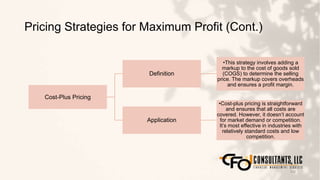
Cost-Plus Pricing
Definition
•This strategy involves adding a
markup to the cost of goods sold
(COGS) to determine the selling
price. The markup covers overheads
and ensures a profit margin.
Application
•Cost-plus pricing is straightforward
and ensures that all costs are
covered. However, it doesn’t account
for market demand or competition.
It’s most effective in industries with
relatively standard costs and low
competition.
Pricing Strategies for Maximum Profit (Cont.)
103
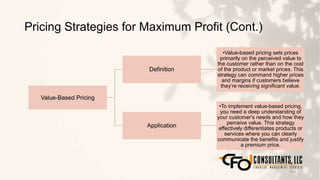
Value-Based Pricing
Definition
•Value-based pricing sets prices
primarily on the perceived value to
the customer rather than on the cost
of the product or market prices. This
strategy can command higher prices
and margins if customers believe
they’re receiving significant value.
Application
•To implement value-based pricing,
you need a deep understanding of
your customer's needs and how they
perceive value. This strategy
effectively differentiates products or
services where you can clearly
communicate the benefits and justify
a premium price.
Pricing Strategies for Maximum Profit (Cont.)
104
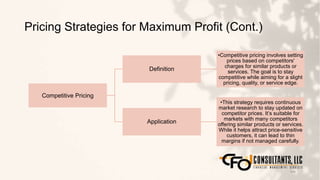
Competitive Pricing
Definition
•Competitive pricing involves setting
prices based on competitors'
charges for similar products or
services. The goal is to stay
competitive while aiming for a slight
pricing, quality, or service edge.
Application
•This strategy requires continuous
market research to stay updated on
competitor prices. It’s suitable for
markets with many competitors
offering similar products or services.
While it helps attract price-sensitive
customers, it can lead to thin
margins if not managed carefully.
Pricing Strategies for Maximum
Profit (Cont.)
105
Analyzing Market and Costs
Market Analysis: Understanding your market is crucial for effective pricing.
Analyze customer demographics, purchasing behavior, and sensitivity to price
changes. Identify how your product or service fits into the market and the unique
value it offers.
Cost Analysis: Calculate your total costs, including direct costs (materials, labor)
and indirect costs (overhead, marketing). Understanding your cost structure is
essential for setting prices that cover costs and achieve desired profit margins.
Pricing Strategies for Maximum
Profit (Cont.)
106
Analyzing Market and Costs
Market Analysis: Understanding your market is crucial for effective pricing.
Analyze customer demographics, purchasing behavior, and sensitivity to price
changes. Identify how your product or service fits into the market and the unique
value it offers.
Cost Analysis: Calculate your total costs, including direct costs (materials, labor)
and indirect costs (overhead, marketing). Understanding your cost structure is
essential for setting prices that cover costs and achieve desired profit margins.
Assessing Customer Value Perception
Conduct surveys, focus groups, or one-on-one interviews to gauge how much
customers will pay for your product or service's benefits. Understanding customer
value perception allows you to align your pricing strategy with what customers
believe your offering is worth.
Pricing Strategies for Maximum
Profit (Cont.)
107
Adjusting Pricing
• Flexibility: Be prepared to adjust your prices as market conditions, costs, or value
perceptions change. Regular reviews will help you stay competitive and profitable.
• Psychological Pricing: Consider psychological aspects, such as setting prices just below a
round number (e.g., $9.99 instead of $10) to make the price seem lower.
• Discounts and Promotions: Use discounts and promotions wisely to boost sales without
eroding the perceived value. Ensure that any price reductions are strategic and temporary.
Conclusion
Selecting the right pricing strategy is a balancing act between covering costs, providing value,
and staying competitive. By understanding your costs, assessing the market and customer
perceptions, and being flexible, you can set prices that maximize your profit margins while
remaining attractive to your target customers.
Chapter 4:
Boosting Sales and
Revenue
108
Effective Marketing on a Budget
109
This section will explore how small business owners can amplify their marketing
efforts without depleting their resources. It will offer strategies for identifying the
most cost-effective marketing channels that align with the business's target
audience.
Readers will learn about leveraging social media, email marketing, content
marketing, and guerrilla marketing tactics to maximize reach with minimal
expenditure. It will also cover measuring and analyzing the return on investment
for various marketing activities to ensure that every dollar spent contributes to
increased revenue.
Effective Marketing on a Budget (Cont.)
110
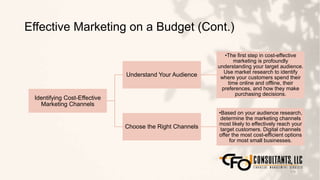
Identifying Cost-Effective
Marketing Channels
Understand Your Audience
•The first step in cost-effective
marketing is profoundly
understanding your target audience.
Use market research to identify
where your customers spend their
time online and offline, their
preferences, and how they make
purchasing decisions.
Choose the Right Channels
•Based on your audience research,
determine the marketing channels
most likely to effectively reach your
target customers. Digital channels
offer the most cost-efficient options
for most small businesses.
Effective Marketing on a Budget (Cont.)
111
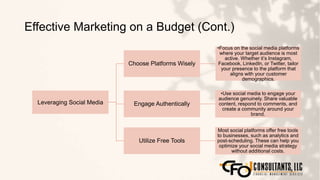
Leveraging Social Media
Choose Platforms Wisely
•Focus on the social media platforms
where your target audience is most
active. Whether it’s Instagram,
Facebook, LinkedIn, or Twitter, tailor
your presence to the platform that
aligns with your customer
demographics.
Engage Authentically
•Use social media to engage your
audience genuinely. Share valuable
content, respond to comments, and
create a community around your
brand.
Utilize Free Tools
Most social platforms offer free tools
to businesses, such as analytics and
post-scheduling. These can help you
optimize your social media strategy
without additional costs.
Effective Marketing on a Budget (Cont.)
112
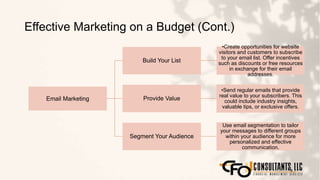
Email Marketing
Build Your List
•Create opportunities for website
visitors and customers to subscribe
to your email list. Offer incentives
such as discounts or free resources
in exchange for their email
addresses.
Provide Value
•Send regular emails that provide
real value to your subscribers. This
could include industry insights,
valuable tips, or exclusive offers.
Segment Your Audience
Use email segmentation to tailor
your messages to different groups
within your audience for more
personalized and effective
communication.
Effective Marketing on a Budget (Cont.)
113
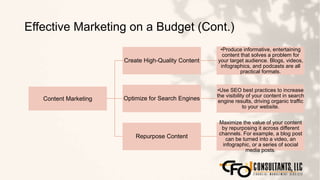
Content Marketing
Create High-Quality Content
•Produce informative, entertaining
content that solves a problem for
your target audience. Blogs, videos,
infographics, and podcasts are all
practical formats.
Optimize for Search Engines
•Use SEO best practices to increase
the visibility of your content in search
engine results, driving organic traffic
to your website.
Repurpose Content
Maximize the value of your content
by repurposing it across different
channels. For example, a blog post
can be turned into a video, an
infographic, or a series of social
media posts.
Effective Marketing on a Budget (Cont.)
114
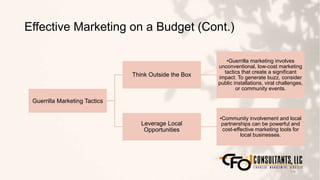
Guerrilla Marketing Tactics
Think Outside the Box
•Guerrilla marketing involves
unconventional, low-cost marketing
tactics that create a significant
impact. To generate buzz, consider
public installations, viral challenges,
or community events.
Leverage Local
Opportunities
•Community involvement and local
partnerships can be powerful and
cost-effective marketing tools for
local businesses.
Effective Marketing on a Budget
(Cont.)
115
Measuring and Analyzing ROI
1. Track Your Results: Use analytics tools to track the performance of your marketing
activities. Monitor metrics such as website traffic, engagement rates, and conversion
rates.
2. Calculate ROI: For each marketing activity, calculate the return on investment by
comparing the cost of the activity against the revenue it generated.
3. Adjust Based on Performance: Use your ROI analysis to inform future marketing
decisions. Invest more in high-performing channels and tactics and reconsider those that
are not delivering results.
Conclusion
Effective marketing on a budget is achievable by understanding your audience, selecting
the proper channels, and creating engaging content. By leveraging the power of digital
marketing tools and measuring the impact of your efforts, you can ensure that every
dollar spent contributes to your business's growth and profitability.
Sales Techniques That Work for
Small Businesses
116
Sales are critical to driving profitability, and small businesses must be adept at
converting leads into customers. This subsection delves into practical sales
techniques tailored to the small business context.
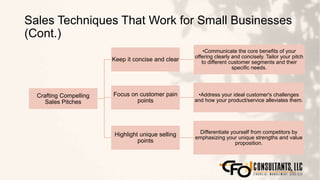
Topics include relationship selling, solution selling, and consultative selling, which
focus on building trust and providing value to the customer. The course will provide
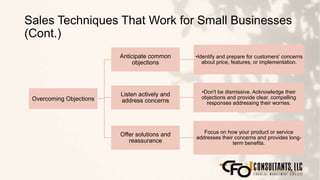
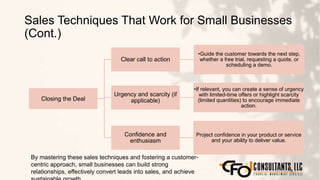
tips on training sales staff, creating compelling sales pitches, overcoming objections,
and closing deals effectively.
Effective sales techniques are the backbone of any successful business and are even
more critical for small businesses competing in a crowded marketplace. Here's an
overview of practical approaches that prioritize building trust and value for your
customers:
Sales Techniques That Work for Small Businesses
(Cont.)
117
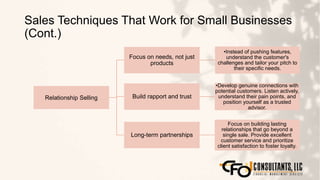
Relationship Selling
Focus on needs, not just
products
•Instead of pushing features,
understand the customer's
challenges and tailor your pitch to
their specific needs.
Build rapport and trust
•Develop genuine connections with
potential customers. Listen actively,
understand their pain points, and
position yourself as a trusted
advisor.
Long-term partnerships
Focus on building lasting
relationships that go beyond a
single sale. Provide excellent
customer service and prioritize
client satisfaction to foster loyalty.
Sales Techniques That Work for Small Businesses
(Cont.)
118
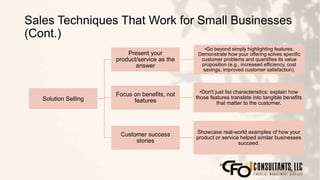
Solution Selling
Present your
product/service as the
answer
•Go beyond simply highlighting features.
Demonstrate how your offering solves specific
customer problems and quantifies its value
proposition (e.g., increased efficiency, cost
savings, improved customer satisfaction).
Focus on benefits, not
features
•Don't just list characteristics; explain how
those features translate into tangible benefits
that matter to the customer.
Customer success
stories
Showcase real-world examples of how your
product or service helped similar businesses
succeed.
Sales Techniques That Work for Small Businesses
(Cont.)
119
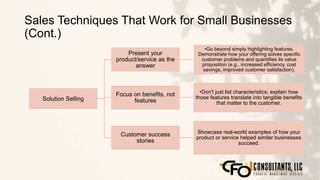
Solution Selling
Present your
product/service as the
answer
•Go beyond simply highlighting features.
Demonstrate how your offering solves specific
customer problems and quantifies its value
proposition (e.g., increased efficiency, cost
savings, improved customer satisfaction).
Focus on benefits, not
features
•Don't just list characteristics; explain how
those features translate into tangible benefits
that matter to the customer.
Customer success
stories
Showcase real-world examples of how your
product or service helped similar businesses
succeed.
Sales Techniques That Work for Small Businesses
(Cont.)
120
Solution Selling
Collaborative problem-
solving
•Work with customers to diagnose their
challenges and co-create solutions. Ask
insightful questions to understand their unique
situation and tailor your offerings accordingly.
Expertise and industry
knowledge
•Position yourself as a thought leader in your
field. Demonstrate a deep understanding of
customer challenges and industry trends.
Value beyond the sale
Offer consultative advice, resources, or post-
sale support to position yourself as a valuable
partner, not just a salesperson.
Sales Techniques That Work for Small Businesses
(Cont.)
121
Training and Development
Invest in your sales team
•Equip your team with the
knowledge and skills needed to
excel. Provide sales training
workshops, role-playing exercises,
and ongoing coaching to hone their
communication and negotiation
skills.
Product knowledge is critical
•Ensure your sales team
comprehensively understands your
product or service, its functionalities,
and its value proposition.
Sales Techniques That Work for Small Businesses
(Cont.)
122
Crafting Compelling
Sales Pitches
Keep it concise and clear
•Communicate the core benefits of your
offering clearly and concisely. Tailor your pitch
to different customer segments and their
specific needs.
Focus on customer pain
points
•Address your ideal customer's challenges
and how your product/service alleviates them.
Highlight unique selling
points
Differentiate yourself from competitors by
emphasizing your unique strengths and value
proposition.
Sales Techniques That Work for Small Businesses
(Cont.)
123
Overcoming Objections
Anticipate common
objections
•Identify and prepare for customers' concerns
about price, features, or implementation.
Listen actively and
address concerns
•Don't be dismissive. Acknowledge their
objections and provide clear, compelling
responses addressing their worries.
Offer solutions and
reassurance
Focus on how your product or service
addresses their concerns and provides long-
term benefits.
Sales Techniques That Work for Small Businesses
(Cont.)
124
Closing the Deal
Clear call to action
•Guide the customer towards the next step,
whether a free trial, requesting a quote, or
scheduling a demo.
Urgency and scarcity (if
applicable)
•If relevant, you can create a sense of urgency
with limited-time offers or highlight scarcity
(limited quantities) to encourage immediate
action.
Confidence and
enthusiasm
Project confidence in your product or service
and your ability to deliver value.
By mastering these sales techniques and fostering a customer-
centric approach, small businesses can build strong
relationships, effectively convert leads into sales, and achieve
Diversifying Your Product Line
125
Product diversification can be a powerful way to boost sales and reduce risk. This
part of the chapter will guide owners through the process of assessing their
current product line and identifying expansion opportunities. It will discuss the
benefits and risks associated with diversification, including how to conduct market
research to find new product opportunities, ways to test new products before a full
launch, and strategies for cross-selling and upselling to existing customers.
Diversifying Your Product Line
(Cont.)
126
Diversifying your product line involves strategically introducing new products or
services alongside your existing offerings. This approach can be a powerful tool
for businesses to:
• Increase Sales and Market Share: By catering to a broader range of
customer needs and preferences, you can expand your market reach and
generate new revenue streams.
• Reduce Risk: Reliance on a single product line leaves you vulnerable to
market fluctuations. Diversification mitigates this risk by having multiple income
sources.
• Stay Ahead of the Competition: Innovation is critical to longevity.
Diversification allows you to explore new market trends and opportunities, keeping
you competitive.
Diversifying Your Product Line
(Cont.)
127
Before You Diversify:
• Evaluate Your Current Product Line: Analyze your existing products'
performance, identify strengths and weaknesses, and consider potential gaps in
your offerings.
• Market Research: Conduct thorough market research to identify customer
needs, buying habits, and emerging trends. This will help you determine whether
there is a demand for potential new products.
Diversifying Your Product Line
(Cont.)
128
Identifying Opportunities:
• Complementary Products: Consider products that complement your
existing offerings. For example, a clothing store might introduce a line of
accessories.
• New Customer Segments: Explore opportunities to target new customer
segments with products tailored to their specific needs.
• Problem-Solving Focus: Look for opportunities to address unmet
customer needs or solve problems that your current offerings do not address.
Diversifying Your Product Line
(Cont.)
129
Testing the Waters:
 Market Testing and Prototyping: Before a full launch, conduct market testing to
gauge customer interest in your new product ideas. This could involve surveys,
focus groups, or creating prototypes.
 Minimum Viable Product (MVP): Develop a Minimum Viable Product (MVP), a
basic version of your new product, to gather real-world customer feedback and
iterate before full-scale production.
Diversifying Your Product Line
(Cont.)
130
Leveraging Existing Customers:
 Cross-selling: Promote your new products to existing customers who might
also benefit from them.
 Upselling: Encourage customers to purchase higher-end versions or bundles
that include your new products.
 Loyalty Programs: Reward loyal customers for trying your new offerings with
exclusive discounts or early access.
Diversifying Your Product Line
(Cont.)
131
Risks and Considerations:
 Development Costs: Diversification requires investment in research, development, and
marketing for new products.
 Cannibalization: New products might compete with your existing offerings, potentially
reducing established product sales.
 Focus and Resources: Diversification can strain resources. Ensure you can effectively
manage and market your expanded product line.
By carefully assessing your current market position, conducting thorough market research,
and implementing a strategic diversification plan, businesses can leverage the benefits of
product line expansion while mitigating potential risks. This approach can lead to increased
sales, reduced risk, and a more sustainable business model in the long run.
Exploring New Markets
132
Venturing into new markets can open up additional revenue streams for small
businesses. This subsection will cover identifying and evaluating new market
opportunities, whether they are demographic segments, geographic areas, or online
markets.
It will outline steps for market entry, including market analysis, regulatory
considerations, localization strategies, and building a presence in the new market. The
section will emphasize the importance of a well-planned market expansion and
provide real-world examples of small businesses that have successfully entered new
markets.
Venturing into new markets allows businesses to tap into fresh customer bases and
generate additional revenue streams. This section dives into strategies for identifying
and evaluating these exciting opportunities.
Exploring New Markets (Cont.)
133
Identifying New Market Opportunities:
 Demographic Targeting: Analyze different demographic segments (age,
income, location, interests) to see if your product or service appeals to a
broader audience.
 Geographic Expansion: Consider new geographic areas, nationally or
internationally, with a demand for your offerings.
 Digital Marketplaces: Explore online and e-commerce platforms to reach a
more comprehensive online audience beyond your local reach.
Exploring New Markets (Cont.)
134
Evaluation and Market Research:
 Market Analysis: Conduct thorough market research to understand the new
market's size, growth potential, customer preferences, and competitor
landscape.
 Regulatory Considerations: Research legal and regulatory requirements for
your target market. Ensure your product or service complies with all necessary
regulations to avoid obstacles and delays.
 Demand Assessment: Evaluate the potential demand for your offerings in the
new market. Consider factors like customer needs, buying power, and existing
competition.
Exploring New Markets (Cont.)
135
Importance of Planning:
 Develop a Market Expansion Plan: Create a comprehensive plan outlining your market
entry strategy, marketing approach, budget allocation, and projected timelines.
 Phased Approach: Consider a phased approach to entering a new market. Start small,
test the waters, and adapt your strategy based on initial results.
Real-World Examples:
 Small Clothing Boutique: A local boutique successfully expands online, reaching a
national audience through a well-designed e-commerce platform and targeted social
media marketing.
 Software Startup: A software company develops a localized version of its product with
language translations and features catering to the specific needs of a new international
market.
Exploring New Markets (Cont.)
136
By following these steps and learning from successful examples, small
businesses can approach new market exploration strategically. This calculated
approach can lead to a successful expansion, increased revenue streams, and a
stronger overall market position.
Remember: Entering a new market requires careful planning, flexibility, and
cultural awareness. By understanding your target market and developing a well-
defined strategy, small businesses can navigate the challenges and reap the
rewards of market expansion.
Chapter 5:
Operational
Efficiency
137
Streamlining Business
Processes
Streamlining business processes is a strategic approach aimed at enhancing operational
efficiency, which is vital for improving profitability and ensuring long-term success in
today's competitive market. By identifying inefficiencies and implementing improvements,
businesses can achieve greater productivity, reduce costs, and enhance product or
service quality.
Operational efficiency is paramount for business success in today's competitive
landscape. Streamlining business processes involves systematically optimizing how tasks
are completed to achieve greater speed, quality, and cost-effectiveness. This section
delves into methods for analyzing your current operations and implementing strategies for
continuous improvement.
138
Streamlining Business
Processes (Cont.)
Identifying Areas for Improvement:
 Process Mapping: Visually map out your current business processes, identifying each
step involved from start to finish. This provides a clear picture of workflow and potential
bottlenecks.
 Process Analysis: Critically evaluate each step within your mapped processes. Look
for redundancies, inefficiencies, and areas where delays or errors occur.
 Data Analysis: Leverage data (e.g., cycle times, error rates) to quantify the impact of
inefficiencies in your processes. This data helps prioritize improvement efforts.
139
Streamlining Business
Processes (Cont.)
Reengineering for Efficiency:
 Eliminate Redundancies: Identify and remove unnecessary steps that don't add value
to the overall process.
 Standardization: Establish clear and consistent procedures for completing tasks. This
reduces errors and improves overall consistency.
 Automation: Consider automating repetitive tasks where feasible. Technology can free
up human resources for higher-value activities.
140
Streamlining Business
Processes (Cont.)
Continuous Improvement Techniques:
 Lean Management: This philosophy focuses on eliminating waste (anything that
doesn't add value) from processes and promoting continuous minor improvements
over time.
 Kaizen: A Japanese term for "continuous improvement," Kaizen encourages a
company culture in which everyone can identify and suggest improvements in their
daily work.
 Process Re-evaluation: Regularly revisit and re-evaluate your streamlined processes.
As your business evolves, your processes may need to adapt as well.
141
Streamlining Business
Processes (Cont.)
Benefits of Streamlining:
 Increased Efficiency: Reduced bottlenecks and optimized workflows lead to faster
completion times and improved overall productivity.
 Enhanced Quality: Streamlined processes often lead to fewer errors and higher quality
outputs.
 Cost Reduction: Eliminating waste and inefficiencies reduces operational costs and
improves profitability.
 Improved Employee Morale: Empowering employees to contribute to process
improvements and fostering a culture of continuous learning can boost employee
morale and engagement.
142
Streamlining Business
Processes (Cont.)
By implementing these streamlining techniques, businesses can significantly improve their
operational efficiency. This translates to faster turnaround times, better quality products or
services, and ultimately, a more decisive competitive edge and increased profitability.
Remember: Streamlining is an ongoing process. By fostering a culture of continuous
improvement and regularly re-evaluating their processes, businesses can ensure they
remain efficient and adaptable in the ever-changing business landscape.
143
The Role of Technology in
Efficiency
Technology is an excellent enabler of efficiency in modern business operations. In this
subsection, readers will learn about various technological tools and software that can
automate tasks, reduce errors, and speed up operations.
This part will cover selecting the right technology solutions that align with specific business
needs, from customer relationship management (CRM) systems to enterprise resource
planning (ERP) and beyond. It will also address integrating these systems into existing
workflows and ensuring staff are trained effectively.
Technology has revolutionized businesses' operations, becoming a powerful driver of
efficiency and productivity. This section explores various technological tools and software
solutions that streamline operations, minimize errors, and significantly enhance your
business's efficiency.
144
The Role of Technology in Efficiency (Cont.)
145
Technology Solutions for
Efficiency
Customer Relationship
Management (CRM)
•CRMs centralize customer data and
interactions, allowing you to manage customer
relationships more effectively. This can
automate tasks like lead tracking,
communication, and sales pipeline
management.
Enterprise Resource
Planning (ERP)
•ERPs integrate departments and functions
(finance, inventory, HR) into a unified system.
This streamlines data flow improves visibility
across operations and facilitates better
decision-making.
Project Management
Tools
These tools offer features for task
management, collaboration, communication,
and resource allocation. They enhance project
planning, execution, and overall visibility.
The Role of Technology in Efficiency (Cont.)
146
Technology Solutions for
Efficiency
Automation Software
•Repetitive tasks can be automated
using software robots (bots) that can
handle data entry, form processing,
and even fundamental customer
interactions, freeing human
resources for more complex work.
Data Analytics Tools
•By leveraging data analytics
software, businesses can gather
valuable insights from customer
behavior, operational metrics, and
market trends. This data-driven
approach informs better decision-
making and helps identify areas for
improvement.
The Role of Technology in Efficiency (Cont.)
147
Selecting the Right
Technology
Needs Assessment •Identify your pain points and areas where
efficiency gains are most crucial.
Software Evaluation
•Research and compare software solutions
that address your identified needs. Consider
factors like features, scalability, budget, and
ease of use.
Integration
Considerations
Ensure the chosen technology integrates
seamlessly with your existing systems to avoid
data silos and maintain a smooth workflow.
The Role of Technology in Efficiency (Cont.)
148
Implementation and Training
Change Management
Strategy
•Implementing new technology often
requires a change management
strategy to ensure employee buy-in
and adoption. Provide clear
communication, training, and support
to facilitate a smooth transition.
User Training
•Invest in proper user training to
ensure employees understand how
to leverage the new technology
effectively and maximize its
efficiency benefits.
The Role of Technology in
Efficiency (Cont.)
Benefits of Technological Efficiency:
 Reduced Errors: Automation and process standardization minimize human error,
leading to more accurate data and improved overall quality.
 Increased Productivity: By automating repetitive tasks and streamlining workflows,
technology frees up employee time for higher-value activities, boosting overall
productivity.
 Enhanced Decision-Making: Data analytics tools provide valuable insights that
empower data-driven decision-making, leading to more strategic and informed
business choices.
 Improved Customer Service: Technology can enhance customer service by
enabling faster response times, personalized interactions, and efficient issue
resolution. 149
The Role of Technology in
Efficiency (Cont.)
Remember: Technology is a powerful tool, but it should be implemented
strategically with a clear understanding of your business needs. Businesses can
leverage technology by selecting the right solutions, ensuring proper integration,
and investing in user training to unlock significant efficiency gains and achieve a
competitive advantage.
150
Inventory Management
Effective inventory management is crucial for both profitability and customer
satisfaction. This part of the chapter will explore inventory management
techniques such as just-in-time (JIT), Economic Order Quantity (EOQ), and ABC
analysis. It will demonstrate how to balance the costs of storing inventory with the
need for sufficient stock to meet customer demand. Additionally, it will cover the
importance of inventory audits and the use of inventory management software.
Inventory Management: Balancing Stock and Cost
Inventory management is the art of maintaining the right amount of stock to fulfill
customer demand while minimizing associated costs. Excessive inventory ties up
capital, while insufficient stock leads to stockouts and lost sales. This section
explores key strategies to achieve this balance.
151
Inventory Management (Cont.)
Inventory Management Techniques:
 Just-in-Time (JIT): Focuses on receiving inventory exactly when needed for
production, minimizing storage costs and waste. This approach requires close
collaboration with suppliers and predictable demand forecasts.
 Economic Order Quantity (EOQ): A formula to determine the ideal order
quantity that minimizes total inventory holding and ordering costs. EOQ
considers factors like demand, ordering cost, and storage cost.
 ABC Analysis: Classifies inventory items into categories (A, B, C) based on
their value and annual usage. Category A (highest value/usage) requires
stricter controls, while Category C (low value/usage) can have looser controls.
152
Inventory Management (Cont.)
Balancing Inventory Costs:
 Holding Costs: The costs associated with storing inventory, including storage
space, insurance, and potential spoilage or obsolescence.
 Ordering Costs: Costs incurred each time you order inventory, including
processing the order, shipping, and receiving.
 Stockout Costs: The costs associated with running out of stock, such as lost
sales, customer dissatisfaction, and potential backorders.
The goal is to balance these costs by maintaining optimal inventory levels.
153
Inventory Management (Cont.)
Inventory Control Practices:
 Regular Inventory Audits: Physically counting inventory periodically to ensure
accuracy and identify discrepancies between accounting records and actual
stock levels.
 Demand Forecasting: Predicting future customer demand to anticipate
inventory needs and avoid stockouts.
 Safety Stock: Maintaining a buffer of certain items to mitigate unexpected
demand fluctuations or supply chain disruptions.
154
Inventory Management (Cont.)
Inventory Management Software:
Technology can significantly enhance inventory management. Inventory
management software automates stock tracking, order placement, and reporting
tasks, improving efficiency and data accuracy.
155
Inventory Management (Cont.)
Benefits of Effective Inventory Management:
 Reduced Costs: Minimizes holding and ordering costs, improving profitability.
 Enhanced Customer Satisfaction: Prevents stockouts and ensures products are available
when customers need them.
 Improved Cash Flow: By optimizing inventory levels, you tie up less capital in stock,
improving cash flow.
 Better Decision-Making: Inventory data and analytics provide insights to inform purchasing
decisions and production planning.
Businesses can achieve a significant competitive advantage by implementing effective
inventory management techniques. This includes streamlined operations, reduced costs,
improved customer satisfaction, and the ability to adapt to fluctuating market demands.
156
Supplier Relationships and
Negotiations
157
A business's relationship with its suppliers can significantly impact its bottom line.
This subsection will address building strong partnerships with suppliers that can
lead to better pricing, terms, and reliability.
Negotiation strategies will be outlined to help business owners secure the best
deals without compromising supplier relationships. Topics will include conducting
market research to understand fair pricing, the art of negotiation, and contract
management for long-term savings and efficiency.
Supplier Relationships and
Negotiations (Cont.)
158
The success of any business hinges on its relationships with suppliers. Strong
partnerships with reliable vendors can lead to a multitude of benefits, including:
 Reduced Costs: Favorable pricing, discounts, and potential volume-based
rebates.
 Improved Quality and Consistency: Reliable suppliers ensure consistent
product quality and timely deliveries.
 Enhanced Innovation: Collaboration with suppliers can lead to joint
development of new products or improved processes.
This section dives into strategies for building strong supplier relationships and
effective negotiation tactics to secure the best deals without jeopardizing these
partnerships.
Supplier Relationships and
Negotiations (Cont.)
159
Building Strong Supplier Relationships:
 Clear Communication: Maintain open and honest communication with your
suppliers. Regularly discuss expectations, challenges, and opportunities for
collaboration.
 Reliability and Trust: Demonstrate your reliability as a customer by fulfilling
payment obligations on time and maintaining consistent ordering patterns.
 Mutual Respect: Treat your suppliers with respect and value their expertise.
Building a win-win mentality fosters a long-term partnership.
Supplier Relationships and
Negotiations (Cont.)
160
Effective Negotiation Strategies:
 Market Research: Conduct thorough market research to understand prevailing
market prices, competitor offerings, and industry standards. This equips you
with a substantial baseline for negotiation.
 Win-Win Approach: Aim for mutually beneficial agreements. Focus on creating
long-term value for both parties rather than seeking short-term gains at the
expense of the supplier relationship.
 Collaborative Problem-Solving: Approach negotiation as a collaborative effort
to find solutions that address both your needs and the supplier's.
Supplier Relationships and
Negotiations (Cont.)
161
Negotiation Techniques:
 Leverage Data: Use market research data and supplier quotes to support your
pricing requests and demonstrate your understanding of fair market value.
 Focus on Value: Highlight the value your business brings to the supplier, such
as consistent demand, on-time payments, or collaborative opportunities.
 Be Prepared to Walk Away: Knowing your alternatives and being prepared to
walk away from a negotiation if terms are unfavorable strengthens your
bargaining position.
Supplier Relationships and
Negotiations (Cont.)
162
Contract Management:
 Clearly Defined Terms: Ensure contracts clearly outline responsibilities, pricing,
payment terms, delivery schedules, and quality standards.
 Performance Monitoring: Monitor supplier performance against agreed-upon
terms. Address any issues promptly and collaboratively.
 Regular Reviews: Schedule regular contract reviews to discuss performance,
pricing adjustments based on market changes, and opportunities for further
collaboration.
Fostering strong supplier relationships and employing effective negotiation strategies
can help businesses secure favorable pricing, reliable deliveries, and high-quality
products. This translates to increased profitability, improved operational efficiency,
and a competitive advantage in the marketplace.
Chapter 6:
Customer
Relationship
Management
163
Building Customer Loyalty
164
Building customer loyalty is crucial for the sustained success of any business. Loyal
customers are more likely to make repeat purchases, tend to spend more, and can
become advocates for your brand, recommending it to others. Moreover, retaining
existing customers is generally more cost-effective than acquiring new ones.
This section will emphasize the importance of understanding customer needs and
expectations and how meeting or exceeding these can lead to repeat business and
referrals.
Cultivating Loyalty: Building a Strong Customer Base
Loyal customers are the lifeblood of any business. Acquiring new customers can be
expensive while retaining existing ones is often more cost-effective. This section
explores strategies to foster customer loyalty, encourage repeat business, make
positive word-of-mouth recommendations, and increase customer lifetime value.
Building Customer Loyalty (Cont.)
165
Understanding Customer Needs and Expectations:
 Customer Centricity: Place the customer at the center of your business
strategy. Identify their needs, wants, and pain points through surveys, feedback
forms, and direct interactions.
 Exceeding Expectations: Go beyond simply meeting customer expectations.
Strive to consistently exceed them by offering exceptional service and
personalized experiences.
Building Customer Loyalty (Cont.)
166
Strategies for Building Customer Loyalty:
 Loyalty Programs: Reward repeat customers with points, discounts, or
exclusive benefits. Loyalty programs incentivize repeat business and provide
valuable customer data for targeted marketing efforts.
 Personalized Interactions: Personalize customer interactions whenever
possible. Use customer data to tailor communication, recommendations, and
promotions to their specific needs and interests.
 Exceptional Customer Service: Train your staff to provide exceptional customer
service that is friendly, professional, and efficient. Empower them to resolve
issues promptly and effectively.
Building Customer Loyalty (Cont.)
167
Additional Strategies:
 Building Relationships: Develop genuine relationships with your customers.
Remember their names, preferences, and purchase history. Show them you
appreciate their business.
 Community Building: Foster a sense of community around your brand. Host
events, engage with customers on social media, and create a welcoming
environment that keeps them returning.
 Exceeding Promises: Always strive to deliver on your promises. If unforeseen
circumstances arise, communicate proactively and do your best to rectify the
situation.
Building Customer Loyalty (Cont.)
168
The Rewards of Customer Loyalty:
 Increased Customer Lifetime Value: Loyal customers spend more over time, contributing
significantly to your business's profitability.
 Reduced Customer Acquisition Costs: Retaining existing customers is often less expensive
than acquiring new ones.
 Positive Word-of-Mouth Marketing: Loyal customers are your best advertisers. They'll
recommend your products or services to others, expanding your reach organically.
 Valuable Customer Insights: Loyal customers are likelier to provide feedback and participate
in surveys. This valuable data informs product development, marketing strategies, and
overall customer experience improvements.
Businesses can cultivate a loyal customer base by prioritizing customer needs, implementing
effective loyalty programs, and consistently exceeding expectations. This loyal base translates
to sustainable growth, increased profitability, and a solid competitive advantage in the
marketplace.
Using Feedback to Improve Service
169
Feedback is a valuable tool for continuous improvement in customer service. This
subsection will explore various methods for collecting customer feedback, including
surveys, comment cards, and online reviews. It will guide analyzing this feedback to
uncover areas for service enhancement and product development.
Furthermore, it will cover the importance of responding to feedback, particularly negative
comments, in a way that shows the business's commitment to its customers and
willingness to adapt.
Customer feedback is a goldmine of information, offering invaluable insights for improving
your service, products, and overall customer experience. This section dives into various
methods for collecting feedback and demonstrates how to leverage it for continuous
improvement.
Using Feedback to Improve Service
(Cont.)
170
Gathering Customer Feedback:
 Surveys: Conduct customer satisfaction surveys via email, in-store, or online forms.
Tailor surveys to gather specific feedback on recent interactions, overall service
experience, or product features.
 Comment Cards: Provide easily accessible comment cards at physical locations for
customers to share quick feedback or suggestions.
 Social Media Monitoring: Actively monitor social media platforms for mentions of your
brand. Analyze customer sentiment and address any negative comments promptly.
 Online Review Platforms: Encourage customers to leave reviews on online platforms
like Google My Business or Yelp. These reviews provide valuable insights and can
influence purchasing decisions for potential customers.
Using Feedback to Improve Service
(Cont.)
171
Analyzing and Utilizing Feedback:
 Categorize Feedback: Organize and categorize feedback by theme (positive, negative,
suggestions for improvement). Identify recurring issues or areas consistently praised by
customers.
 Identify Trends: Look for patterns and trends in the feedback. This can reveal systemic
issues or areas where minor adjustments can significantly improve.
 Actionable Insights: Translate feedback into actionable insights to guide your staff's
service improvements, product development, or training needs.
Using Feedback to Improve Service
(Cont.)
172
Closing the Feedback Loop:
 Communicate Improvements: Let your customers know when you implement changes
based on feedback. This demonstrates that their feedback is valued and directly
impacts your business.
Businesses can gain a deeper understanding of their customer base by actively soliciting,
analyzing, and responding to customer feedback. This valuable information allows them to
improve their service, products continuously, and overall customer experience, fostering
loyalty and driving long-term success. Remember, customer feedback is a gift.
Customer Retention Strategies
Acquiring a new customer can be several times more expensive than retaining an existing
one, making customer retention strategies vital to profitability. This part of the chapter will
focus on proven tactics for keeping customers engaged and committed to the business.
We will delve into the psychology of customer satisfaction, using CRM tools to track
customer behavior and communication strategies that keep the business top-of-mind for
the customer. Techniques such as segmentation for targeted marketing, creating value
beyond the product or service, and establishing customer touchpoints will be discussed to
help businesses maintain a robust and loyal customer base.
Customer retention is the lifeblood of any successful business. Studies show acquiring a
new customer can be several times more expensive than retaining an existing one. This
section explores key strategies to keep customers engaged, satisfied, and coming back
for more.
173
Customer Retention Strategies
(Cont.)
Customer Relationship Management (CRM) Tools:
 Customer Data Collection: Leverage CRM tools to collect and centralize customer data
from various touchpoints (purchases, interactions, surveys).
 Customer Segmentation: Segment your customer base into groups based on
demographics, purchase history, or behavior. This allows for targeted marketing and
communication strategies.
 Personalized Communication: Use customer data to personalize communication. Send
targeted emails, promotions, or birthday offers that resonate with each customer
segment.
174
Customer Retention Strategies
(Cont.)
Building Long-Term Value:
 Going Beyond the Product/Service: Offer value beyond the core product or service.
Provide informative content, educational resources, or loyalty programs that build
customer loyalty and strengthen relationships.
 Customer Engagement: Create opportunities for ongoing customer engagement. Host
events, webinars, or online communities where customers can interact with your brand
and each other.
175
Customer Retention Strategies
(Cont.)
Communication Strategies:
 Staying Top-of-Mind: Implement strategic communication plans to stay top-of-mind for
your customers. Send regular email newsletters, engaging social media content, or
personalized birthday messages.
 Multiple Touchpoints: Create a variety of customer touchpoints. This could include
social media interaction, email communication, loyalty programs, or a mobile app. The
goal is to provide a seamless and consistent customer experience across all channels.
176
Customer Retention Strategies
(Cont.)
Additional Strategies:
 Feedback Mechanisms: Make it easy for customers to provide feedback. Use surveys,
comment cards, or social media to gather insights on improving your service and
offerings.
 Responding to Feedback: Actively respond to customer feedback, both positive and
negative. Thank customers for their input and address any concerns promptly and
professionally.
Businesses can cultivate a loyal customer base by implementing these customer retention
strategies. This translates to increased profitability, predictable revenue streams, and a
strong competitive advantage in the marketplace.
177
Chapter 7:
Human Resources
and Team
Management
178
Hiring the Right People
Finding and attracting the right talent is pivotal for the success of any small business. This
section will provide insight into the recruitment process, from creating clear and
compelling job descriptions to conducting effective interviews. It will stress the importance
of aligning candidate values with company culture and the role of structured hiring
processes in making objective and beneficial hiring decisions. Additionally, tips on
leveraging traditional and digital recruitment platforms will be shared.
179
Hiring the Right People (Cont.)
Building a Strong Foundation:
 Clear Job Descriptions: Craft clear, concise, and compelling job descriptions. Highlight
the role's responsibilities, required skills and experience, and company culture. This
will attract qualified candidates who fit the position and your business well.
 Defining Company Culture: Identify your core company values and what makes your
work environment unique. Highlight this culture in your job descriptions and throughout
the recruitment process.
180
Hiring the Right People (Cont.)
Structured Hiring Process:
 Standardization: Develop a standardized hiring process to ensure fairness and
objectivity in evaluating candidates. This includes consistent interview questions,
scoring rubrics, and reference checks.
 Skill Assessments: Consider incorporating skill assessments relevant to the position.
This can help identify candidates with the technical expertise required to excel in the
role.
181
Hiring the Right People (Cont.)
Recruitment Strategies:
 Traditional Methods: Use traditional recruitment methods, such as job boards, industry
publications, and professional networking events, to reach a wider pool of qualified
candidates.
 Digital Platforms: Leverage digital platforms like social media and professional
networking sites like LinkedIn to target specific skill sets and attract passive candidates
who may not be actively searching for a new position.
182
Hiring the Right People (Cont.)
The Interview Process:
 Behavioral Interviewing: Focus on behavioral interview questions that ask candidates
to describe past experiences and how they approached specific challenges. This
provides valuable insights into their problem-solving skills and work style.
 Assessing Culture Fit: During the interview, evaluate how well the candidate's values
and personality align with your company culture. Look for enthusiastic, team-oriented
individuals who share your vision for the business.
183
Hiring the Right People (Cont.)
Beyond the Resume:
 Reference Checks: Always conduct thorough reference checks to verify a candidate's
skills, experience, and work ethic.
 Trial Periods: Consider a trial or probationary period to assess a candidate's fit within
the team and the role before making a permanent hiring decision.
184
Hiring the Right People (Cont.)
Building a Talent Pipeline:
 Employer Branding: Showcasing your company culture and employee success stories
cultivates a strong employer brand, which attracts top talent and positions you as an
attractive workplace.
 Stay Connected: Even if a candidate isn't the perfect fit for the current role, stay
connected. They may be a good candidate for future opportunities or recommend
qualified individuals within their network.
Implementing these strategies can help you attract qualified candidates, conduct
compelling interviews, and make informed hiring decisions. Hiring the right people is an
investment in your business's future.
185
Training and Development for
Your Team
Once the right people are on board, investing in their development is critical to maintaining a
knowledgeable and agile workforce. This subsection will explore the elements of a successful
training and development program, including orientation for new hires, ongoing skill
development, and leadership training for emerging managers.
It will discuss identifying training needs, setting up mentoring and coaching programs, and
using in-house and external professional development resources. Moreover, it will emphasize
how a commitment to employee growth contributes to job satisfaction and retention.
Cultivating Your Talent: Investing in Employee Training and Development
Hiring the right people is just the first step. Equally important is equipping them with the
knowledge and skills they need to excel in their roles and contribute to your business's
success. This section delves into practical strategies for training and developing your team,
fostering a culture of continuous learning and growth.
186
Training and Development for
Your Team (Cont.)
Building a Strong Foundation:
 New Hire Onboarding: Develop a comprehensive onboarding program to welcome new
hires, introduce them to your company culture, and equip them with the necessary
skills to succeed. Include role-specific training, an overview of company policies, and
opportunities to connect with team members.
 Identifying Training Needs: Conduct regular performance reviews and skill gap
assessments to identify areas where employees need additional training or
development.
187
Training and Development for
Your Team (Cont.)
Ongoing Learning and Development:
 Skill Development Programs: Provide ongoing training opportunities to help employees
develop new skills or enhance existing ones. This could include in-house workshops,
online courses, or industry conferences relevant to their roles.
 Leadership Training: Invest in leadership training programs for emerging managers to
equip them with the skills they need to motivate, guide, and develop their teams
effectively.
188
Training and Development for
Your Team (Cont.)
Learning Methods:
 In-House Training: Develop and deliver in-house training sessions led by internal
experts or experienced team members. This fosters a culture of knowledge sharing
and allows for customization to your specific needs.
 External Resources: Utilize external resources such as online learning platforms,
industry associations, or professional development courses to give employees access
to a broader range of expertise.
189
Training and Development for
Your Team (Cont.)
Mentorship and Coaching:
 Mentorship Programs: Establish mentorship programs where experienced employees
can guide and support new hires or less experienced team members.
 Coaching Programs: Implement coaching programs to provide employees with
personalized guidance and feedback on their performance and development goals.
Benefits of Training and Development:
 Increased Employee Engagement: Investing in your employees' development
demonstrates your commitment to their growth and well-being. This fosters a sense of
engagement and motivates them to contribute their best work.
190
Training and Development for
Your Team (Cont.)
 Improved Job Satisfaction: Employees who continuously learn and develop are more
likely to be satisfied in their roles and less likely to seek opportunities elsewhere.
 Enhanced Skills and Knowledge: A well-trained workforce is more capable and
adaptable. Training equips your team with the skills to navigate change, adopt new
technologies, and contribute to your business's growth.
 Stronger Company Culture: Focusing on learning and development creates a culture of
continuous improvement and innovation. It encourages knowledge-sharing and
collaboration within your team.
By prioritizing training and development, you create a learning environment where your
employees can flourish. This translates to a motivated and skilled workforce, improved
performance, and a competitive advantage in the marketplace.
191
Creating a Productive Workplace
Culture
192
A productive workplace culture is one where employees are motivated, engaged, and
aligned with the business’s goals. This chapter will focus on the elements that contribute to
a strong culture, such as open communication, employee recognition, and a shared vision.
It will offer strategies for building a positive work environment that encourages collaboration
and innovation. Furthermore, it will discuss handling common cultural challenges, such as
conflict resolution and change management. By creating a supportive and inclusive culture,
businesses can ensure their teams are both practical and happy in their work.
Creating a Productive Workplace
Culture (Cont.)
193
Fostering Success: Cultivating a Productive Workplace Culture
A productive workplace culture is the cornerstone of a successful business. It's the
environment where employees feel motivated, engaged, and empowered to do their best
work. This section explores vital elements of a strong company culture and provides
strategies for fostering a positive work environment that drives collaboration, innovation,
and overall business success.
Creating a Productive Workplace
Culture (Cont.)
194
Building the Foundation:
 Shared Vision and Values: Clearly define your company's vision, mission, and core
values. Ensure these values are communicated effectively throughout the organization
and reflected in leadership behavior.
 Open Communication: Encourage open communication at all levels. Employees should
feel comfortable expressing their ideas, concerns, and feedback. Regularly hold town
hall meetings and team discussions, and have an open-door policy for managers.
Creating a Productive Workplace
Culture (Cont.)
195
Encouraging Engagement:
 Employee Recognition: Recognize and appreciate employee contributions. Implement a
recognition program to acknowledge achievements, both big and small. This reinforces
positive behaviors and motivates employees to excel.
 Professional Development: Invest in your employees' professional development
(covered previously). Provide opportunities for learning and growth, demonstrating your
commitment to their success and fostering a culture of continuous improvement.
Creating a Productive Workplace
Culture (Cont.)
196
Collaboration and Innovation:
 Teamwork: Promote teamwork and collaboration across departments. Break down silos
and encourage cross-functional interaction to facilitate the sharing of ideas and
expertise.
 Empowerment: Empower your employees to take ownership of their work. Giving them
the autonomy to make decisions and solve problems fosters a sense of accountability
and innovation.
Creating a Productive Workplace
Culture (Cont.)
197
Addressing Challenges:
 Conflict Resolution: Establish clear procedures for addressing conflict professionally
and respectfully. Equip managers with the skills to mediate disagreements
constructively.
 Change Management: When implementing change, communicate effectively and
support employees throughout the transition. Address concerns openly and involve
employees in decision-making as much as possible.
Creating a Productive Workplace
Culture (Cont.)
198
The Benefits of a Strong Culture:
 Increased Productivity: A positive and supportive work environment increases employee
morale, engagement, and productivity.
 Improved Retention: Employees who feel valued and appreciated are likelier to stay with the
company, reducing turnover costs.
 Enhanced Innovation: A culture that encourages collaboration and open communication
fosters creativity and innovation, leading to new ideas and a competitive advantage.
 Stronger Employer Brand: A positive company culture attracts top talent and positions you as
an employer of choice.
By fostering a productive workplace culture, businesses create an environment where
employees can thrive. This translates to a high-performing workforce, a strong employer brand,
and sustainable success in the long run.
Chapter 8:
Innovation and
Growth
199
Embracing Change and Innovation
200
This section is dedicated to instilling a mindset of continuous improvement and innovation
within the small business environment. It will explain why change should be embraced and
actively sought after for a business to remain competitive and profitable.
Readers will learn about fostering a culture of innovation where creative thinking and risk-
taking are encouraged. It will also guide staying abreast of industry trends and
technological advancements and implementing change management practices to ensure
the organization and its employees can adapt quickly and effectively to new challenges and
opportunities.
Embracing Change and Innovation
(Cont.)
201
Why Change is Your Friend:
 Staying Competitive: The business world is not static. Companies that resist change risk
falling behind competitors, adapting to new trends and technologies.
 Identifying Opportunities: Change can present exciting opportunities. By staying
informed and embracing change, businesses can identify new market gaps, develop
innovative products or services, and gain a competitive edge.
Embracing Change and Innovation
(Cont.)
202
Fostering a Culture of Innovation:
 Creative Thinking: Encourage creative thinking and problem-solving within your team.
Break away from traditional methods and encourage employees to generate new ideas
and approaches.
 Safe Space for Exploration: Create a safe space for exploration and experimentation.
Allow employees to take calculated risks and learn from failures. A culture of fear stifles
innovation.
 Open Communication: Maintain open communication channels. Encourage employees
to share ideas freely, regardless of their position or experience level. The best ideas can
come from anywhere.
Embracing Change and Innovation
(Cont.)
203
Staying Ahead of the Curve:
 Industry Trends: Actively monitor industry trends and technological advancements.
Attend industry conferences, subscribe to relevant publications, and participate in online
communities to stay informed.
 Competitor Analysis: Monitor your competitors. Analyze their strategies, products, and
marketing efforts to identify opportunities for differentiation and innovation.
Embracing Change and Innovation
(Cont.)
204
Managing Change Effectively:
 Clear Communication: When implementing change, communicate clearly and
transparently with your employees. Explain the rationale behind the change, how it will
impact them, and the benefits it will bring to the company.
 Employee Training: Provide appropriate training and support to ensure employees have
the skills and knowledge to adapt to the changes. This minimizes disruption and helps
employees feel confident in their ability to succeed in the new environment.
 Change Management Plan: Develop a comprehensive change management plan that
outlines the steps involved in implementing the change, a timeline, and resources
allocated.
Embracing Change and Innovation
(Cont.)
205
Benefits of Embracing Change:
 Enhanced Agility: A culture of innovation fosters agility, allowing your business to respond
quickly to changing market conditions and emerging opportunities.
 Improved Problem-Solving: By encouraging creative problem-solving, your team is better
equipped to overcome challenges and develop practical solutions.
 Increased Employee Engagement: Employees who feel involved in innovation and
empowered to make a difference are often more engaged and motivated.
 Sustainable Growth: Small businesses can achieve sustainable growth and long-term
success by continuously adapting and innovating.
In today's dynamic business world, embracing change and innovation is not optional; it's
essential. By fostering a culture of creativity, staying informed about industry trends, and
implementing effective change management practices, small businesses can navigate change
effectively and position themselves for continued success.
Expansion: When and How to Grow
Your Business
206
Deciding to expand is a significant move that requires careful planning and strategy. This
subsection will outline the critical factors that need consideration before growing, including
market conditions, financial stability, and operational capacity.
This part will present various expansion strategies, such as opening new locations,
franchising, scaling up production, and diversifying product lines. Additionally, it will discuss
the financial implications of expansion, how to fund growth, and the metrics that help
determine the right time to expand.
Business growth is exciting, but it shouldn't be impulsive. This section guides you through
the decision-making process of expanding your business, exploring key factors to consider,
effective expansion strategies, and financial implications.
Expansion: When and How to Grow
Your Business (Cont.)
207
Planning for Expansion:
 Define Your Goals: Clearly define your expansion goals. Do you want to increase market
share, reach new customers, or offer new products or services?
 Expansion Strategies: Explore various expansion strategies aligned with your goals. Here
are some options to consider:
o Opening New Locations: Expand your physical footprint by opening new brick-and-
mortar stores or satellite offices.
o Franchising: Partner with franchisees to establish and operate outlets under your brand
name.
o Scaling Up Production: Increase production capacity to meet growing demand for your
existing products or services.
o Diversifying Product Lines: Develop and launch new product lines to cater to a broader
customer base or enter new markets.
Expansion: When and How to Grow
Your Business (Cont.)
208
Planning for Expansion:
 Financial Considerations: Develop a comprehensive financial plan forecasting the costs
associated with expansion, including capital expenditures, operational expenses, and
potential marketing costs.
 Funding Your Growth: Explore various financing options for your expansion, such as
bank loans, venture capital, or angel investors.
Expansion: When and How to Grow
Your Business (Cont.)
209
Making the Decision:
 Key Performance Indicators (KPIs): Identify key performance indicators (KPIs) relevant
to your expansion goals. These could include sales growth, market share, customer
acquisition costs, or return on investment (ROI). Track these metrics to measure the
success of your expansion efforts.
 The Right Time: There is no one-size-fits-all answer to determining the right time to
expand. Carefully analyze market conditions, financial health, and team readiness
before leaping.
Expansion: When and How to Grow
Your Business (Cont.)
210
The Rewards of Strategic Expansion:
 Increased Revenue and Market Share: Successful expansion can increase revenue,
market share, and brand awareness.
 Diversification and Risk Mitigation: Expanding into new markets or product lines can
mitigate risk by reducing dependence on a single customer base or product category.
 Economies of Scale: Expansion can lead to economies of scale, allowing you to
negotiate better prices with suppliers and potentially reduce production costs per unit.
Remember, successful expansion is about planning, strategy, and execution. By carefully
considering the abovementioned factors, choosing the right expansion strategy, and
diligently managing your finances, you can position your small business for sustainable
growth and long-term success.

Collaborations, Partnerships, and
Networking
211
Collaboration can be a powerful strategy for business growth and development. This part of
the chapter will explore how partnerships and strategic alliances can provide mutual
benefits such as shared resources, expertise, and market access.
It will discuss identifying potential partners, what to look for in a partnership, and how to
structure agreements that protect all parties' interests. Additionally, the value of networking
will be emphasized, with advice on how to build and leverage a business network to find
collaborators, mentors, and new business opportunities. The section will include tips on
networking effectively online and offline and maintaining and nurturing business
relationships.
Collaborations, Partnerships, and
Networking (Cont.)
212
Building Bridges: Collaboration, Partnerships, and Networking for Success
In today's interconnected business world, collaboration is no longer optional; it's a strategic
imperative. This section explores the power of partnerships, strategic alliances, and
networking to fuel business growth.
Collaborations, Partnerships, and
Networking (Cont.)
213
The Power of Collaboration:
 Shared Resources and Expertise: Partnering with complementary businesses allows
you to share resources, expertise, and knowledge. This can be particularly
advantageous for small businesses lacking in-house resources or capabilities.
 Market Expansion and Reach: Collaborations can help you expand your market reach
and access new customer segments. Partners can leverage their existing networks and
distribution channels to introduce their products or services to a broader audience.
 Enhanced Innovation: Working with other businesses can spark creativity and lead to
new ideas, products, or services. The combined expertise of multiple partners can foster
innovation and accelerate development.
Collaborations, Partnerships, and
Networking (Cont.)
214
Finding the Right Partner:
 Identify Potential Partners: Look for businesses that complement your own but don't
directly compete. Consider businesses with shared target audiences but non-
overlapping product or service offerings.
 Shared Values and Goals: Choose partners whose values and goals align with yours.
This forms a strong foundation for a successful and long-lasting partnership.
 Mutual Benefits: Ensure the partnership offers clear benefits to all parties involved.
Negotiate a win-win agreement outlining each partner's roles, responsibilities, and
expected outcomes.
Collaborations, Partnerships, and
Networking (Cont.)
215
Structuring Successful Partnerships:
 Formal Agreements: While a handshake agreement may suffice for smaller
collaborations, consider formal contracts for complex partnerships. Clearly define the
terms of the agreement, responsibilities of each party, confidentiality clauses, and
dispute resolution procedures.
 Open Communication: Maintain open and transparent communication with your
partners. Regularly discuss progress, address any challenges, and work together to
achieve shared goals.
Collaborations, Partnerships, and
Networking (Cont.)
216
The Value of Networking:
 Building Relationships: Networking is about building genuine relationships with other
professionals and businesses. Focus on connecting and providing value, and the
opportunities will follow.
 Finding Collaborators and Mentors: Your network can be valuable for finding potential
collaborators, mentors, and advisors. These connections can provide guidance and
support and open doors to new opportunities.
 Staying Informed: A strong network informs you about industry trends, emerging
technologies, and potential business opportunities.
Collaborations, Partnerships, and
Networking (Cont.)
217
Effective Networking Strategies:
 Attend Industry Events: Attend industry conferences, trade shows, and networking
events to connect with potential partners and colleagues.
 Join Professional Organizations: Become involved in professional organizations
relevant to your industry. This allows you to connect with like-minded individuals and
participate in industry discussions.
 Leverage Online Platforms: Utilize online professional networking platforms like
LinkedIn to connect with professionals in your field and build relationships virtually.
Collaborations, Partnerships, and
Networking (Cont.)
218
Nurturing Relationships:
 Provide Value: Always strive to provide value to your network. Offer insights, share
industry knowledge, or make helpful introductions.
 Stay Connected: Don't just connect, stay connected. Regularly communicate with your
network through email updates, social media interactions, or occasional coffee
meetings.
Chapter 9:
Legal and Ethical
Considerations
219
Compliance with Laws and
Regulations
Navigating the complex web of laws and regulations is essential for any business. This
section will guide small business owners through the basics of legal compliance,
highlighting the most common areas of concern, such as licensing, employment law, tax
obligations, and industry-specific regulations.
It will offer advice on how to stay informed about legal requirements, the importance of
record-keeping, and when to seek professional legal advice. Additionally, this section will
discuss the potential consequences of non-compliance and how to develop an internal
compliance program to minimize risks.
220
Compliance with Laws and
Regulations (Cont.)
Navigating the Legal Landscape: Compliance for Small Businesses
A successful business requires a great product or service and adherence to many laws
and regulations. This section serves as a guide for small business owners, highlighting
critical areas of legal compliance and offering strategies to navigate this complex
landscape.
221
Compliance with Laws and
Regulations (Cont.)
Understanding Your Legal Obligations:
 Business Structure: Your business's legal requirements depend on its structure (sole
proprietorship, partnership, LLC, corporation). Familiarize yourself with the specific
regulations associated with your chosen structure.
 Licensing and Permits: Many businesses require legal licenses and permits. These
can be federal, state, or local. Research the necessary licenses and permits for your
business activity and location.
222
Compliance with Laws and
Regulations (Cont.)
Understanding Your Legal Obligations:
 Common Legal Areas: Here's a glimpse into some of the most common areas of legal
compliance for small businesses:
o Employment Law: Ensure you comply with labor laws regarding minimum wage,
overtime pay, and anti-discrimination practices.
o Tax Obligations: Understand your federal, state, and local tax filing requirements.
o Industry-Specific Regulations: Certain industries have specific compliance
requirements. Research and regulations that apply to your industry.
223
Compliance with Laws and
Regulations (Cont.)
Staying Informed and Organized:
 Government Websites: Numerous government websites provide valuable information
on legal requirements for businesses. Bookmark relevant resources for easy
reference.
 Professional Associations: Industry associations can provide information on legal
matters specific to your industry.
 Record Keeping: Maintain meticulous records of your business transactions, tax
documents, and employee files. This is crucial for compliance purposes and helps in
the case of audits.
224
Compliance with Laws and
Regulations (Cont.)
When to Seek Professional Help:
While this section provides a general overview, legal matters can be complex. Consider
seeking professional legal advice for:
 Complexities: Consult a business lawyer if you're unsure about legal requirements or
face intricate legal issues.
 Contracts: Before signing any contracts, have a lawyer review them to ensure you
understand the terms and implications.
 Serious Legal Issues: Consulting a lawyer is imperative in serious legal matters such
as lawsuits or government investigations.
225
Compliance with Laws and
Regulations (Cont.)
The Importance of Compliance:
 Avoiding Penalties: Non-compliance with laws and regulations can result in fines,
penalties, and even business closure.
 Protecting Your Business: Compliance safeguards your business from legal liability
and reputational damage.
 Building Trust: Operating compliantly fosters trust with customers, partners, and
investors.
226
Compliance with Laws and
Regulations (Cont.)
Developing a Compliance Program:
 Internal Policies: Establish clear internal policies outlining compliance expectations for
employees. These can cover areas like anti-bribery, data security, and anti-
discrimination practices.
 Training and Education: Regularly train your employees on relevant legal requirements
and company compliance policies.
 Regular Reviews: Conduct periodic reviews of your compliance practices to identify
and address any potential gaps.
227
Ethical Business Practices
Ethical considerations in business go beyond legal compliance; they are about doing what
is right, even when no one is watching. This subsection will delve into the principles of
ethical business conduct and why they are critical to long-term success. It will cover topics
like fair treatment of employees, honest marketing, responsible sourcing, confidentiality,
and conflict of interest.
The section will also provide strategies for creating an ethical business culture, including
establishing a code of ethics, training employees on moral issues, and handling ethical
dilemmas. Ethical business practices are good for society; they can build trust with
customers and partners, driving profitability.
Operating a business ethically is not just about following the law; it's about building trust,
fostering a positive reputation, and demonstrating a commitment to doing what's right.
This section explores the importance of ethical business practices and provides strategies
for creating an ethical culture within your small business.
228
Ethical Business Practices
(Cont.)
Why Ethics Matter:
 Building Trust: Ethical behavior fosters trust with customers, partners, investors, and
the community. This trust is essential for sustainable business success.
 Employee Engagement: Employees who believe their company operates ethically are
likelier to be engaged, productive, and loyal.
 Risk Mitigation: Ethical conduct minimizes legal risks, reputational damage, and costly
fines associated with unethical business practices.
229
Ethical Business Practices
(Cont.)
Fundamental Principles of Ethical Conduct:
 Fairness and Integrity: Treat all stakeholders, including employees, customers, and
suppliers, with fairness and integrity.
 Honesty and Transparency: Be honest and transparent in all business dealings. Avoid
misleading advertising or deceptive practices.
 Responsible Sourcing: Source materials and products responsibly, considering
environmental and social impact.
 Confidentiality: Maintain confidentiality of sensitive information entrusted to you by
customers, partners, and employees.
 Avoiding Conflicts of Interest: Avoid situations that create conflicts between personal and
professional interests.
230
Ethical Business Practices
(Cont.)
Creating an Ethical Culture:
 Code of Ethics: Develop a clear and concise code of ethics that outlines your
company's values and expected standards of conduct.
 Employee Training: Educate and train your employees on ethical business practices
and the company's code of ethics.
 Open Communication: Encourage open communication and provide safe channels for
employees to report any observed unethical conduct.
 Leadership by Example: Leaders set the tone for the organizational culture.
Demonstrate ethical behavior in your decisions and actions.
231
Ethical Business Practices
(Cont.)
The Benefits of Ethical Business Practices:
 Enhanced Reputation: A strong ethical reputation attracts customers, partners, and top
talent, ultimately leading to competitive advantage.
 Increased Customer Loyalty: Customers are likelier to remain loyal to brands they trust
and perceive as ethical.
 Improved Long-Term Performance: Ethical business practices contribute to long-term
business success and profitability.
232
Chapter 10:
Planning for the
Future
233
Developing a Long-Term Strategy
234
Focusing on the day-to-day can often overshadow long-term planning for small business
owners. However, developing a long-term strategy is crucial for sustained success and
growth. This section will guide readers in envisioning their business's future and setting
long-term goals and objectives.
It will discuss conducting a SWOT analysis (Strengths, Weaknesses, Opportunities,
Threats) to inform strategic planning, adapting to changing market conditions, and the
importance of innovation in ensuring long-term relevance. Additionally, it will cover the role
of strategic alliances and investments in technology as part of a forward-looking strategy.
Running a small business can be all-consuming, leaving long-term planning by the
wayside. However, a clearly defined long-term strategy is the roadmap to your business's
sustained success and growth. This section guides you through crafting a long-term
strategy, conducting strategic analysis, and navigating change to ensure your business
remains relevant and thrives in future years.
Developing a Long-Term Strategy
(Cont.)
235
Vision and Goals:
 Envisioning the Future: Take time to envision your business's future. What will it
achieve in the next 3, 5, or 10 years? Define your long-term vision and translate it into
clear and measurable long-term goals.
SWOT Analysis:
 Understanding Your Landscape: Conduct a SWOT analysis to comprehensively
understand your business's internal strengths and weaknesses and the external
opportunities and threats you face. This analysis provides valuable insights to inform
your strategic decisions.
 Strengths: Identify your business's inherent strengths. This could include your unique
product or service offering, a strong brand reputation, or a highly skilled workforce.
Developing a Long-Term Strategy
(Cont.)
236
SWOT Analysis:
 Weaknesses: Analyze your business's weaknesses. Are there gaps in your product
line? Do you lack specific resources or expertise? Identifying weaknesses allows you to
address them and improve your competitive advantage.
 Opportunities: Explore potential opportunities in the market. Are there new markets you
can enter? Are there emerging trends you can leverage to your advantage? Identifying
opportunities allows you to capitalize on them and drive growth.
 Threats: Be aware of potential threats to your business. This could include new
competitors, changes in customer preferences, or technological disruptions.
Understanding threats allows you to develop contingency plans and mitigate risks.
Developing a Long-Term Strategy
(Cont.)
237
Adapting to Change:
 Market Dynamics: The business landscape is constantly evolving. Your long-term
strategy needs to be adaptable to accommodate changes in market dynamics,
customer needs, and technological advancements.
Innovation for Long-Term Relevance:
 Future-Proofing Your Business: Continuous innovation is essential for ensuring your
business remains relevant and competitive in the long run. Invest in research and
development, explore new technologies, and be open to new ideas to stay ahead of the
curve.
Developing a Long-Term Strategy
(Cont.)
238
Strategic Alliances:
 Collaboration for Growth: Consider strategic alliances and partnerships to expand your
reach, access new markets, and complement your strengths. Partnerships can be a
powerful tool for long-term growth.
Technology Investments:
 Investing in the Future: The right technologies can significantly improve your operational
efficiency, enhance customer experience, and give you a competitive edge. Carefully
evaluate technology solutions that align with your long-term goals.
Developing a Long-Term Strategy
(Cont.)
239
The Benefits of a Long-Term Strategy:
 Clear Direction: A long-term strategy provides a clear direction for your business,
ensuring everyone is working towards common goals.
 Informed Decision-Making: The insights gained through strategic planning empower you
to make informed decisions that support long-term growth.
 Proactive Management: A long-term perspective allows you to manage change and
capitalize on opportunities proactively.
 Sustainable Success: By taking a long-term view, you lay the foundation for sustainable
success and ensure your business remains relevant and competitive for years to come.
Succession Planning
240
Many small businesses are closely tied to their founders, making succession planning a
critical yet often overlooked component of business planning. This subsection will address
the importance of planning for the future leadership of the business, whether through
passing it on to family members, selling it to employees, or preparing it for sale to an
outside buyer.
We will provide a roadmap for identifying potential successors, training and preparing them
for leadership roles, and the legal and financial considerations involved in transferring
ownership.
For many small businesses, the founder's vision and leadership are synonymous with the
company's identity. However, every business owner eventually faces the question of
succession. This section highlights the importance of succession planning, explores
different transition options, and offers a roadmap for ensuring a smooth leadership
handover.
Succession Planning (Cont.)
241
Why Succession Planning Matters:
 Business Continuity: A well-defined succession plan safeguards business continuity and
minimizes disruption during the leadership transition.
 Preserving Legacy: Succession planning allows you to ensure your business's legacy
lives on, guided by the values and principles you established.
 Enhanced Value: A business with a clear succession plan is generally more valuable to
potential buyers, as it reduces uncertainty about the company's future.
Succession Planning (Cont.)
242
Planning for Transition:
 Timing is Key: Don't wait until retirement to consider succession planning. Start
planning early to allow ample time for identifying and grooming potential successors.
 Identifying Successors: Look within your company for talented individuals who
demonstrate leadership potential, commitment to the company's values, and the skills
necessary to lead the business forward.
 Developing Successors: Invest in training and development programs to equip your
chosen successor with the knowledge, skills, and experience needed to assume
leadership effectively.
Succession Planning (Cont.)
243
Transition Options:
 Passing the Torch to Family: If you have family members interested in taking over the
business, ensure they possess the necessary qualifications and establish a clear plan
for ownership transfer.
 Employee Ownership: Consider transitioning ownership to employees through stock
options or Employee Stock Ownership Plans (ESOPs). This can motivate employees
and ensure a smooth leadership transition.
 Selling to an Outside Buyer: Prepare your business for sale to an external buyer by
ensuring its financial health and establishing a clear sales strategy.
Succession Planning (Cont.)
244
Legal and Financial Considerations:
 Legal Advice: Seek legal counsel to navigate the legal implications of ownership
transfer, including tax considerations and contractual obligations.
 Financial Planning: Work with a financial advisor to develop a financial plan for your
own retirement and ensure the business remains financially sound throughout the
transition.
Succession Planning (Cont.)
245
The Benefits of Proactive Planning:
 Reduced Uncertainty: A well-defined succession plan reduces uncertainty for
employees, customers, and partners, fostering stability during the leadership change.
 Increased Employee Morale: Knowing the company's future boosts employee morale
and reduces anxiety about potential job security.
 Enhanced Business Value: A clear succession plan makes your business more
attractive to potential buyers, potentially leading to a higher selling price.
Exiting Your Business Profitably
Exiting a business is a significant event in an entrepreneur's life. This chapter will explore
the various exit strategies available to small business owners, including selling the
business, merging with another company, or simply winding down operations.
We will discuss preparing the business for sale to maximize its value, including financial
preparation, improving business processes, and strategic positioning. Additionally, it will
cover the emotional aspects of exiting a business and how to ensure a smooth transition
for employees, customers, and suppliers.
As an entrepreneur, you've poured your heart and soul into building your business. But
every journey eventually comes to an end. This section explores various exit strategies for
small business owners, helping you choose the path that best suits your goals and
maximizes profitability.
246
Exiting Your Business Profitably
(Cont.)
Planning for Your Exit:
 Define Your Goals: Clearly define your goals for exiting the business. Are you looking to maximize
your return on investment, secure the company's legacy, or create opportunities for your
employees? Knowing your goals will guide your exit strategy selection.
 Exit Options: Explore various exit options, each with its advantages and considerations:
o Selling Your Business: This is a common exit strategy where you sell the entire business or a
majority stake to a new owner.
o Merger or Acquisition: Merging with another company or being acquired by a larger one can
provide access to new resources and markets.
o Employee Stock Ownership Plan (ESOP): Sell your ownership stake to your employees
through an ESOP, promoting employee ownership and potentially receiving tax benefits.
o Liquidation: Sometimes, the best option is closing down the business and selling off assets.
247
Exiting Your Business Profitably
(Cont.)
Preparing for Sale:
 Financial Performance: Improve your business's financial performance to maximize its
value to potential buyers. Focus on increasing profitability, reducing debt, and
strengthening your financial statements.
 Operational Efficiency: Streamline your business processes for improved efficiency
and cost savings. This demonstrates a well-managed operation to potential buyers.
 Strategic Positioning: Position your business strategically to attract desirable buyers.
This could involve expanding into new markets, developing innovative products or
services, or strengthening your brand recognition.
248
Exiting Your Business Profitably
(Cont.)
Emotional Considerations:
 Letting Go: Exiting a business you've built can be emotionally challenging. Allow
yourself time to process your emotions and seek support from trusted advisors or
mentors.
 Legacy Planning: Consider how you want your legacy to be carried forward. Will the
new owner uphold the company's values and culture? Communicate your vision for the
future of the business.
249
Exiting Your Business Profitably
(Cont.)
Ensuring a Smooth Transition:
 Employee Communication: Communicate clearly and honestly with your employees
throughout the exit process. Address their concerns and provide support during the
transition.
 Customer Communication: Inform your customers about the ownership change and
assure them of continued quality service.
 Supplier Communication: Notify your suppliers about the transition and establish clear
communication channels with the new ownership.
250
Exiting Your Business Profitably
(Cont.)
Choosing the Right Exit Strategy:
The ideal exit strategy depends on your circumstances and goals. When deciding,
consider factors like your financial needs, business performance, and desired timeline.
Consulting with financial advisors, business brokers, or legal counsel can provide valuable
guidance throughout the exit process.
A Successful Exit:
Exiting your business profitably is not just about financial gain; it's about achieving your
goals and ensuring a smooth transition for all stakeholders. By planning strategically,
preparing your business for sale, and managing the emotional aspects of the process, you
can exit your business on a high note and pave the way for its continued success.
251
Chapter 11:
Conclusion
252
Conclusion(Cont.)
253
Key Takeaways
Congratulations! You've reached the final chapter of this guide designed to empower you
on your small business journey. Throughout this book, we've explored various strategies
and best practices for increasing profitability and achieving long-term success. Now, let's
begin a quick recap to solidify these key takeaways and envision how they integrate into a
cohesive roadmap for your business.
Financial Fitness: The Cornerstone of Success
 Financial Literacy: A strong foundation in financial management is essential for any
business. Understanding financial statements, profitability ratios, and cash flow
management empowers you to make informed decisions that drive growth.
Conclusion(Cont.)
254
Operational Efficiency: Streamlining for Success
 Optimizing Processes: Efficient operations are the backbone of a thriving business. You
can improve productivity and profitability by streamlining processes, minimizing waste,
and leveraging technology.
Customer Centricity: Building Loyalty and Advocacy
 The Heart of Your Business: Your customers are the heart of your business. Prioritizing
customer satisfaction, building strong relationships, and exceeding expectations fosters
loyalty and advocacy, leading to repeat business and positive word-of-mouth.
Conclusion(Cont.)
255
Embrace Change and Innovation: Staying Ahead of the Curve
 Continuous Improvement: The business landscape is constantly evolving. A
commitment to continuous improvement, innovation, and adaptability is essential to stay
ahead of the competition and capitalize on emerging opportunities.
Planning for the Future: Charting Your Course
 Vision and Strategy: Develop a clear vision for the future of your business and translate
that vision into a well-defined long-term strategy. This strategic roadmap will guide your
decision-making and ensure your business remains relevant and competitive.
 Succession Planning: Don't wait until retirement to consider succession planning. A
well-crafted succession plan safeguards business continuity and ensures a smooth
leadership transition when the time comes.
Conclusion(Cont.)
256
The Power of Integration: A Holistic Approach
These principles we've explored are not isolated concepts; they work together
synergistically. Financial literacy empowers you to make sound investment decisions in
technology and people, ultimately enhancing customer satisfaction and driving innovation.
Operational efficiency frees up resources for marketing and customer relationship
management. Continuously focusing on these aspects fosters a sustainable competitive
advantage for your small business.
Conclusion(Cont.)
257
The Journey Continues: Beyond This Book
The knowledge you've gained from this book equips you with a valuable toolkit to navigate
the exciting yet challenging world of small business ownership. Remember, this is just the
beginning of your entrepreneurial journey.
As you move forward, embrace lifelong learning, stay curious, and seek new knowledge
and growth opportunities. The most successful business owners are those who
continuously adapt, learn and evolve alongside their businesses.
By applying the strategies outlined in this book, fostering a culture of innovation, and
remaining passionate about your vision, you are well-positioned to build a thriving small
business that leaves a lasting positive impact. Remember, the road to success is paved
with dedication, strategic planning, and an unwavering belief in your business idea. Now,
go forth and conquer!
Conclusion(Cont.)
258
Staying Motivated and Focused
The rollercoaster ride of small business ownership can be exhilarating and grueling in equal
measure. Days will be filled with triumphant victories, and nights will be filled with
unforeseen challenges. This section serves as a beacon, guiding you through maintaining
motivation and focus amidst entrepreneurship's inevitable ups and downs.
Conclusion(Cont.)
259
Fueling Your Passion: Setting the Course for Success
 SMART Goals: Establish clear, Specific, Measurable, Achievable, Relevant, and Time-
bound (SMART) goals. Breaking down your long-term vision into smaller, achievable
milestones keeps you motivated and offers a sense of accomplishment as you cross
them off the list.
 Celebrating Milestones: Acknowledge and celebrate your victories, no matter how
small. Taking the time to appreciate your progress reinforces a positive mindset and
fuels your drive to keep moving forward.
Conclusion(Cont.)
260
Learning from Setbacks: Embracing the Growth Mindset
 Failure as a Stepping Stone: Failures are inevitable, but they don't define you. View
setbacks as valuable learning experiences. Analyze what went wrong, adapt your
approach, and use those lessons to propel yourself forward with renewed
determination.
The Power of Perspective: Keeping the Big Picture in Mind
 Long-Term Vision: During challenging times, revisit your long-term vision. Remind
yourself of the "why" behind your entrepreneurial journey. Reconnecting with your core
purpose can reignite your passion and provide the strength to persevere.
Conclusion(Cont.)
261
Learning from Setbacks: Embracing the Growth Mindset
 Failure as a Stepping Stone: Failures are inevitable, but they don't define you. View
setbacks as valuable learning experiences. Analyze what went wrong, adapt your
approach, and use those lessons to propel yourself forward with renewed
determination.
The Power of Perspective: Keeping the Big Picture in Mind
 Long-Term Vision: During challenging times, revisit your long-term vision. Remind
yourself of the "why" behind your entrepreneurial journey. Reconnecting with your core
purpose can reignite your passion and provide the strength to persevere.
Conclusion(Cont.)
262
Building Your Support System: A Network of Strength
 Mentors and Peers: Surround yourself with a supportive network of mentors, peers, and
advisors. These individuals can offer guidance, encouragement, and a valuable
perspective during difficult times.
 Supportive Family and Friends: Don't underestimate the power of a supportive family
and friend circle. Share your challenges and victories with those who believe in you.
Their unwavering support can be a source of strength and motivation.
Conclusion(Cont.)
263
Remember Your Why: The Entrepreneurial Spirit
Recall the spark that ignited your passion for this venture. What problem are you solving?
What positive impact are you aiming to make? Reconnecting with your core purpose will
reignite your enthusiasm and encourage you to persist with unwavering determination.
The Road to Success is Paved with Persistence
Running a small business is a marathon, not a sprint. There will be obstacles, but you can
overcome any challenge with unwavering focus, a supportive network, and a commitment
to lifelong learning. Embrace the journey, celebrate the victories, learn from the setbacks,
and never lose sight of the dream that propelled you forward. With dedication, resilience,
and a sprinkle of inspiration, you can transform your entrepreneurial vision into a thriving
and impactful business.
Thank you
Benjamin Wann
828-385-8635
ben@cfoconsultants.net
www.cfoconsultants.net
264

Improving profitability for small business

  • 1.
  • 2.
    About CFO Consultants CFO Consultantsis a dynamic and comprehensive financial consultancy firm dedicated to empowering small businesses through specialized services designed to enhance financial performance and operational efficiency. Focusing on delivering exceptional value, CFO Consultants leverage information technology and standardized processes to keep costs low while ensuring high-quality service delivery. Their offerings are broad and tailored to address everyday financial and operational challenges small businesses face, including outgrowing bookkeeping capabilities, managing messy books, and needing advanced financial strategies for growth. 2
  • 3.
    About CFO Consultants(Cont.) 3 At the core of CFO Consultants' services are business consulting, fractional CFO roles, outsourced controller services, bookkeeping, QuickBooks consulting, tax filing and planning, business valuation, and risk analysis. These services are designed to provide businesses with the financial expertise and support they need at an affordable cost. From process improvement and ERP implementation to financial planning, strategy, and market analysis, CFO Consultants brings a wealth of experience and expertise to help small businesses thrive. The firm stands out for its commitment to delivering solutions that create obvious everyday value, ensuring clients receive practical advice and support that directly impacts their bottom line. CFO Consultants is a critical partner in driving business growth and profitability by focusing on performance KPIs, market analysis, financial modeling, and strategic planning. Additionally, their services in tax planning, business valuation, and risk analysis support businesses in navigating the complexities of financial management, ensuring compliance and maximizing value. For further information and to explore how CFO Consultants can assist your business, visit their website at CFOConsultants.net.
  • 4.
    Understanding Profitability 4 Understanding profitabilityis crucial for small business owners as it indicates the efficiency with which their business operates and generates profit relative to its size, encompassing revenues and costs. Here’s a comprehensive overview to help you grasp this concept: What is Profitability? Profitability measures your business's income beyond the costs incurred to produce goods or services. It's not just about making sales; it's about what remains after covering all your expenses. High profitability means your business is doing well financially, whereas low profitability suggests there's room for improvement. Profitability: Beyond the Bottom Line While many equate business success with high revenue, true profitability goes beyond simply generating income. It's about the efficiency with which you convert revenue into net profit, the lifeblood of your business. Profitability ensures your company has the financial resources to stay afloat, reinvest in growth, and reward your efforts.
  • 5.
    Understanding Profitability (Cont.) 5 Profitvs. Cash Flow: Understanding the Difference It's important to distinguish between profit and cash flow. Profit represents the income remaining after deducting all expenses from your revenue over a specific period. Cash flow, on the other hand, focuses on the actual movement of cash in and out of your business at a particular point in time. While they are interrelated, they are not identical. It's possible to be profitable but have temporary cash flow constraints. Why Margins Matter More Than Revenue Many new business owners prioritize high revenue figures. However, focusing solely on revenue can be misleading. Your profit margin tells the true story of your financial efficiency. Profit margin is a percentage metric that indicates how much profit you generate from each sales dollar. Focusing on healthy profit margins ensures your business remains profitable even with fluctuations in revenue.
  • 6.
    Understanding Profitability (Cont.) 6 Profitvs. Cash Flow: Understanding the Difference It's important to distinguish between profit and cash flow. Profit represents the income remaining after deducting all expenses from your revenue over a specific period. Cash flow, on the other hand, focuses on the actual movement of cash in and out of your business at a particular point in time. While they are interrelated, they are not identical. It's possible to be profitable but have temporary cash flow constraints. Why Margins Matter More Than Revenue Many new business owners prioritize high revenue figures. However, focusing solely on revenue can be misleading. Your profit margin tells the true story of your financial efficiency. Profit margin is a percentage metric that indicates how much profit you generate from each sales dollar. Focusing on healthy profit margins ensures your business remains profitable even with fluctuations in revenue.
  • 7.
    Understanding Profitability (Cont.) 7 KeyPerformance Indicators (KPIs) for Profitability Several key performance indicators (KPIs) provide valuable insights into your business's profitability. Regularly monitoring these metrics allows you to identify areas for improvement and make data-driven decisions to optimize your financial performance. Here are a few critical KPIs to keep an eye on: • Gross Profit Margin: Measures the profit remaining after deducting the cost of goods sold from your revenue. • Net Profit Margin: Shows the percentage of profit remaining after accounting for all business expenses. • Return on Investment (ROI): Evaluate the efficiency of your investments by comparing the profit generated to the cost of the investment.
  • 8.
    Understanding Profitability (Cont.) 8 ThePower of Profitability Knowledge By understanding profitability and its key metrics, you gain the power to: • Set Realistic Financial Goals: Profitability benchmarks guide you in setting achievable financial targets that ensure sustainable growth. • Make Informed Decisions: Financial data empowers you to choose pricing, resource allocation, and investment opportunities strategically. • Identify Areas for Improvement: Profitability analysis reveals areas where you can optimize operations, reduce costs, and boost your bottom line. Profitability: A Compass for Long-Term Success Profitability is not just an accounting measure; it's a strategic tool for navigating the journey of small business ownership. By prioritizing profitability and leveraging financial insights, you can make sound decisions that propel your business toward long-term success and economic stability. Remember, a profitable business is resilient and well- equipped to weather challenges and emerge victorious.
  • 9.
    Profitability Versus Cash Flow Imagineyour business as a car. Profitability tells you how efficiently your engine runs, converting fuel (expenses) into power (revenue) to move forward. Cash flow, on the other hand, reflects the gas gauge, indicating how much fuel (cash) you have available to keep going. Both are essential for a healthy and sustainable business journey. 9
  • 10.
    Profitability: The Engineof Your Business  What it is: Profitability measures your ability to generate a surplus after accounting for all expenses. It's a long-term indicator of your business's financial health and efficiency.  How it's measured: Profitability is typically measured by net profit margin, a percentage of revenue remaining after all expenses are paid.  Example: Let's say your bakery has a revenue of $10,000 this month and spends $7,000 on ingredients, rent, and salaries. Your net profit would be $3,000, resulting in a net profit margin of 30% ($3,000 divided by $10,000). This indicates your bakery is efficient at turning expenses into profit. 10
  • 11.
    Cash Flow: TheGas Gauge of Your Business  What it is: Cash flow refers to the movement of cash in and out of your business at a specific point in time. It shows your ability to meet your short-term financial obligations like rent, payroll, and bills.  How it's monitored: Cash flow is often tracked through cash flow statements, which categorize cash inflows (sales, investments) and outflows (expenses, loan payments).  Example: Even with a profitable bakery, you might face cash flow issues if customers pay on credit. This means your income (revenue) appears good on paper, but you might not have enough ready cash (inflow) to cover immediate expenses (outflow) until those bills are paid. 11
  • 12.
    Why Both Matter:Sustainability Through Balance A business can be profitable but experience cash flow problems. Here's why managing both is crucial: • Cash Flow for Day-to-Day Operations: Good cash flow ensures you have enough gas in the tank to cover everyday expenses and avoid disruptions. • Profitability for Long-Term Growth: Profitability fuels your engine, allowing you to reinvest in growth, improve efficiency, and weather economic downturns. 12
  • 13.
    Strategies for aHealthy Balance • Profitability: To boost your profit margin, focus on cost reduction, explore ways to increase sales prices, or expand product offerings. • Cash Flow: Implement strategies like collecting receivables faster, offering early payment discounts to incentivize quicker payments, or managing inventory levels to reduce holding costs. 13
  • 14.
    The Importance of MarginsOver Mere Revenue Chasing a high revenue number in the fast-paced business world can be tempting. However, true financial success lies in how much you sell and how much profit you generate from those sales. This is where understanding margins becomes crucial. 14
  • 15.
    Margins: The UnsungHero of Profitability 15 Imagine a bakery selling delicious cupcakes. They might sell a lot (high revenue), but if the cost of ingredients and baking is significant, leaving little profit on each cupcake sold, their business model is vulnerable. Here's where margins come in: • Margins represent the difference between your selling price and the cost of producing or acquiring your product or service. They indicate the efficiency with which you convert expenses into profit.
  • 16.
    Margins: The UnsungHero of Profitability (Cont.) 16 There are two key margin metrics to focus on: • Gross Profit Margin: This metric reveals the profit remaining after deducting the cost of goods sold (COGS) from your total revenue. A higher gross profit margin indicates better efficiency in managing your direct costs. • Net Profit Margin: This metric takes a more comprehensive view, considering all business expenses, including rent, salaries, marketing, and taxes. It shows the percentage of your revenue remaining as net profit.
  • 17.
    Why Margins MatterMore Than Revenue 17 Focusing solely on revenue can be misleading. Here's why margins take centre stage: • Sustainability During Downturns: Even with a decrease in revenue, healthy margins can provide a buffer and allow your business to remain profitable. • Room for Reinvestment: Stronger margins generate more profit, which you can reinvest in growth initiatives, marketing, or product development, propelling your business forward. • Price Flexibility: Healthy margins give you more breathing room when adjusting prices. You can be more competitive without significantly impacting your bottom line.
  • 18.
    Analyzing Margins: TheKey to Smart Decisions 18 Regularly monitoring your margins allows you to: • Identify Areas for Improvement: Analyze if your margins are low and explore cost-cutting measures or ways to increase your selling price. • Benchmark Against Competitors: Compare your margins to industry standards to understand your competitive positioning. • Make Informed Pricing Decisions: Pricing strategies should consider both covering costs and achieving healthy margins.
  • 19.
    Key Performance Indicators(KPIs) to Monitor 19 Monitoring the right Key Performance Indicators (KPIs) is essential for maintaining and boosting profitability. These include: • Gross Profit Margin: Measures the efficiency of production and pricing strategies. • Net Profit Margin: Indicates overall profitability after all expenses. • Operating Cash Flow: Tracks the cash generated by regular business operations, highlighting the company's ability to sustain itself. • Return on Investment (ROI): Assesses the profitability of investments made within the business. • Break-even Point: Determines the sales volume at which total revenues equal total costs, indicating the minimum performance required to avoid losses.
  • 20.
    Key Performance Indicators(KPIs) to Monitor (Cont.) 20 Understanding and regularly reviewing these KPIs allows business owners to make informed decisions, adjust strategies in a timely, and set realistic financial goals. It's not just about tracking numbers but interpreting what they mean for the business's health and strategic direction. In conclusion, profitability is not just about having a great idea or working hard; it's about smart financial management, strategic decision-making, and continuous improvement. By demystifying these concepts, small business owners can achieve sustainable growth and success.
  • 21.
    The Small Business Landscape ThePower of Small Business: A Driving Force Small businesses are the backbone of the global economy. They represent a significant portion of job creation, innovation, and community development. From your neighborhood bakery to the cutting-edge tech startup, small businesses play a vital role in providing goods and services, fostering competition, and driving economic growth. 21
  • 22.
    The Current Landscape:A Glimpse into Today's Ecosystem The small business landscape is constantly evolving. Here are some key trends shaping the current environment: • Technological Advancements: Technology is a double-edged sword. On the one hand, it offers powerful tools for marketing, communication, and data analysis. On the other hand, it can disrupt traditional business models and require adaptation. • Evolving Customer Expectations: Today's customers are increasingly demanding, seeking personalized experiences, convenience, and social responsibility from the businesses they patronize. • The Rise of E-commerce: The growth of online shopping presents challenges and opportunities for small businesses. Having a solid online presence is crucial in today's market. 22
  • 23.
    Challenges and Pitfalls: Obstacleson the Road to Success The path of small business ownership is not without its hurdles. Some common challenges include: • Securing Funding: Obtaining adequate financial resources can be a hurdle for many small businesses. • Competing with Established Players: Small businesses may struggle to compete with larger corporations with greater resources and brand recognition. • Managing Cash Flow: Maintaining steady cash flow is critical for survival. Many small businesses struggle with managing inflows and outflows effectively. 23
  • 24.
    Learning from SuccessStories: Finding Inspiration Despite the challenges, numerous inspiring small businesses thrive in today's competitive landscape. Studying their success stories can provide valuable lessons: • Embracing Innovation: Successful businesses constantly adapt and evolve, embracing new technologies and trends. • Building a Strong Brand: A well-defined brand identity differentiates your business and resonates with your target audience. • Prioritizing Customer Service: Excellent customer service fosters loyalty and encourages repeat business. 24
  • 25.
    The Road Ahead:A Supportive Community As a small business owner, you are not alone. A thriving community of entrepreneurs, mentors, and resources exists to support your journey. By understanding the landscape, the challenges and opportunities it presents, and the power of collaboration, you can navigate the path to success. 25
  • 26.
    Trends Shaping theSmall Business Environment Several key trends are currently shaping the small business landscape: • Digital Transformation: Small businesses seeking to stay competitive must adopt digital technologies. From cloud computing to social media marketing, digital tools offer new ways to reach customers, streamline operations, and reduce costs. • Sustainability and Social Responsibility: Consumers increasingly favor businesses prioritizing sustainability and social responsibility. This shift allows small businesses to differentiate themselves by adopting eco-friendly practices and giving back to their communities. • Remote Work and Flexibility: The COVID-19 pandemic accelerated the trend toward remote work, influencing how businesses operate. Small businesses have the agility to adapt to these changes, offering flexibility that can attract top talent and reduce overhead costs. 26
  • 27.
    Challenges Facing Small Businesses Despitethe opportunities, small businesses face several challenges that can impede their growth and profitability: • Access to Capital: Financing remains a significant hurdle for many small business owners, particularly startups and minority-owned enterprises. The challenge lies in meeting the strict criteria set by traditional lenders and navigating the complex landscape of funding options. • Competition: Small businesses often compete with larger corporations with more resources, brand recognition, and market reach. Developing a unique value proposition and leveraging niche markets can help small businesses compete more effectively. • Regulatory Compliance: Navigating the maze of government regulations and compliance requirements can be daunting for small business owners. This challenge underscores the importance of staying informed and seeking expert advice when necessary. 27
  • 28.
    Opportunities for Growth Inthe face of these challenges, there are ample opportunities for small businesses to thrive: • Niche Markets: Small businesses can cater to underserved markets by focusing on specific niches and offering specialized products or services that differentiate them from larger competitors. • Innovation: Small businesses are often more nimble than larger corporations, allowing them to innovate more quickly and respond to market changes with agility. • Personalized Customer Experiences: Small businesses have the opportunity to build close relationships with their customers, offering personalized experiences that can lead to higher customer loyalty and retention. 28
  • 29.
    Opportunities for Growth Inthe face of these challenges, there are ample opportunities for small businesses to thrive: • Niche Markets: Small businesses can cater to underserved markets by focusing on specific niches and offering specialized products or services that differentiate them from larger competitors. • Innovation: Small businesses are often more nimble than larger corporations, allowing them to innovate more quickly and respond to market changes with agility. • Personalized Customer Experiences: Small businesses have the opportunity to build close relationships with their customers, offering personalized experiences that can lead to higher customer loyalty and retention. 29
  • 30.
  • 31.
    Developing a StrongBusiness Plan 31 A robust business plan is the cornerstone of profitable operations. This section walks the reader through creating a comprehensive business plan covering everything from the executive summary to the financial projections. It underscores the importance of clear and realistic business planning, which serves as a roadmap for the business and a pitch for potential investors. Elements like the company description, market strategies, organizational structure, product line, and funding requirements are broken down to help owners craft a document that is both visionary and practical.
  • 32.
    Developing a StrongBusiness Plan (Cont.) 32 A strong business plan serves several purposes: • Clarity and Focus: The planning process itself forces clarity on your vision, mission, and goals. It compels you to research your market, identify your target audience, and develop concrete strategies to achieve your objectives. • Roadmap for Growth: Your business plan serves as a roadmap, outlining the steps required to take your business from concept to reality and guiding your decision-making process along the way. • Investor Pitch: If you seek funding, a well-structured business plan is essential to convincing investors of your venture's viability and profitability.
  • 33.
    Essential Elements ofa Powerful Business Plan 33 Your business plan should be a comprehensive document that encompasses several key elements: • Executive Summary: A concise overview of your entire business plan that captures the essence of your venture and grabs the reader's attention. • Company Description: Provide a detailed description of your business, including its mission, vision, and the products or services you offer. • Market Analysis: Conduct a thorough analysis of your target market, including competitor research, customer demographics, and industry trends.
  • 34.
    Essential Elements ofa Powerful Business Plan (Cont.) 34 • Marketing and Sales Strategy: How will you reach your target audience? This section details your marketing and sales strategies to generate leads and convert them into paying customers. • Management Team: Highlight your team members' experience and qualifications, demonstrating your leadership's capability to navigate the business landscape. • Product or Service Description: A detailed description of your products or services, emphasizing their unique selling propositions and value proposition to your target market. • Financial Projections: This section forecasts your business's financial performance, including revenue projections, cost analysis, and funding requirements.
  • 35.
    Crafting a WinningPlan: Practical Tips 35 • Clarity and Concision: Use clear and concise language. Avoid technical jargon that your audience might not understand. • Data-Driven Approach: Back up your claims with data and market research to add credibility to your plan. • Realistic Projections: While optimism is essential, ensure your financial projections are realistic and achievable. • Compelling Visuals: Incorporate charts, graphs, and images to enhance readability and effectively communicate your ideas. Here’s a comprehensive guide to developing a business plan that lays the foundation for a profitable venture.
  • 36.
    Executive Summary 36 The executivesummary is a concise overview of your business plan, providing readers with a quick snapshot of your business and its strategy. Despite being placed at the beginning, it's often written last. This section should include: • Business Concept: A brief description of your business, including the products or services offered. • Financial Features: Highlights of the financial forecasts, such as sales, profits, and cash flow. • Financial Requirements: Capital needed for start-up or expansion and how it will be used. • Current Business Position: The current stage of the business, major contracts, or clients. • Major Achievements: Milestones or achievements that provide evidence of the business’s potential.
  • 37.
    Company Description 37 Provide adetailed description of your business. Explain the problem your business solves or the opportunity it takes advantage of. Detail your target market, the needs of your potential customers, and how your offerings meet those needs. Include your business model, the competitive advantage that will make your business successful, and any regulatory issues you face. A company description explains a business's purpose, target market, and competitive advantage. It outlines the problem the business solves or the opportunity it seizes. The description also details the company's offerings, business model, and regulatory issues.
  • 38.
    Company Description (Cont.) 38 CompanyDescription 1. Value Proposition •What problem does your business solve, or what opportunity does it address? •What need are you fulfilling for your target market? 2. Target Market •Who are your ideal customers? •What are their characteristics and pain points? 3. Offerings (Products or Services) What products or services do you offer to address your target market's needs? How do your offerings uniquely solve their problems?
  • 39.
    Company Description (Cont.) 39 CompanyDescription 4. Business Model •How will your business generate revenue? What is your pricing strategy? 5. Competitive Advantage •What sets your business apart from competitors? What unique value proposition do you offer? 6. Regulatory Issues Are there any legal or regulatory hurdles your business needs to consider? How will you ensure compliance? By providing a clear and concise company description, a business can effectively communicate its value proposition to potential investors, customers, and partners.
  • 40.
    Market Strategies This sectionrequires thorough market research to define your target market and position your business effectively. Discuss your market segmentation, target customer demographics, needs, and how you plan to reach them. Explain your pricing strategy, sales and distribution plan, and advertising and promotions activities. Market Strategies outline a business's specific actions to reach its target customers and achieve its sales goals. It's essentially a roadmap that translates your market understanding into concrete tactics. Here's a breakdown of the critical elements involved in crafting a market strategy: 40
  • 41.
    Market Strategies (Cont.) 1.Market Segmentation: Dividing a broad market into subgroups (segments) with similar needs, characteristics, and buying behaviors. This allows you to tailor your marketing efforts more effectively. 2. Target Customer Definition: Identifying the specific segment(s) you'll focus on within the overall market. This involves understanding their demographics (age, income, location), psychographics (values, interests, lifestyles), and behavioral traits (buying habits). 41
  • 42.
    Market Strategies (Cont.) 3.Customer Needs: Clearly define the problems your target customers are facing and the desires they're trying to fulfill. Understanding their needs is crucial for crafting messaging and developing products/services that resonate. 4. Reaching Your Target Market: Defining the channels you'll use to communicate with your target audience. This could include online advertising, content marketing, social media engagement, partnerships, or attending industry events. 42
  • 43.
    Market Strategies (Cont.) 5.Pricing Strategy: Determining the price points for your products or services. This considers factors like production costs, customer value perception, and competitor pricing. You must decide on a pricing model (e.g., freemium, subscription, pay-per-use) that aligns with your overall business goals. 6. Sales & Distribution Plan: Outlining how you'll get your products or services into the hands of your customers. This involves defining your sales channels (direct sales team, online store, partnerships with resellers) and your distribution network (physical stores, downloadable software, cloud-based services). 43
  • 44.
    Market Strategies (Cont.) 7.Advertising & Promotions: Creating strategies to raise awareness about your brand and generate interest in your offerings. This could involve content marketing, social media campaigns, influencer marketing, promotional offers, or participation in trade shows. By developing a comprehensive market strategy, businesses can make informed decisions about allocating resources, targeting the right audience, and ultimately achieving success in the marketplace. 44
  • 45.
    Organizational Structure Detail yourbusiness’s legal structure (e.g., sole proprietorship, partnership, corporation) and the organizational structure. Include information about the company's ownership, profiles of your management team, and the qualifications of your board of directors if you have one. An organizational structure defines the framework of how a company operates. It outlines the following key elements: 45
  • 46.
    Organizational Structure (Cont.) 1.Legal Structure: This refers to the formal legal classification of the business. Common structures include: • Sole Proprietorship: Owned and operated by one person, with unlimited liability (owner's personal assets are on the hook for business debts). • Partnership: Co-owned by two or more people who share profits and losses. There are different partnership variations (general, limited liability) with varying degrees of owner liability. • Corporation: A separate legal entity from its owners (shareholders). Offers limited liability protection to owners. 46
  • 47.
    Organizational Structure (Cont.) 2.Ownership: This details who owns the company. In a corporation, ownership is divided into shares. Shareholders elect a board of directors to oversee the company's management. 3. Management Team: These individuals are responsible for the business's day-to- day operations. They typically include: • CEO (Chief Executive Officer): Leads company strategy and vision. • CFO (Chief Financial Officer): Oversees financial management. • COO (Chief Operating Officer): Manages day-to-day operations. • Department Heads: Lead specific functional areas like marketing, sales, human resources, etc. 47
  • 48.
    Organizational Structure (Cont.) 4.Board of Directors (Optional): An elected body that provides oversight and guidance to the management team. They typically consist of experienced professionals with relevant industry expertise. 48
  • 49.
    Product Line orServices 49 Describe your products or services in detail. Focus on the customer benefits, the product lifecycle, and your plans for research and development. Explain your services portfolio, pricing model, and service delivery process if you offer services. This section outlines the details of what your business offers to its customers. It can encompass physical products, digital offerings, or professional services. Here's a breakdown of the critical elements to consider:
  • 50.
    Product Line orServices (Cont.) 50 For Physical Products: • Product Description: A detailed explanation of the product's features, functionalities, and technical specifications. • Customer Benefits: Communicate how the product solves customer problems or fulfills their needs. Highlight the advantages and unique selling points. • Product Lifecycle: Outline the different stages a product goes through, from initial concept and development to launch, growth, maturity, decline, and potential end-of-life strategies. • Research & Development (R&D): Describe your continuous improvement and innovation plans. This could involve developing new product features, exploring new technologies, or upgrading existing product lines.
  • 51.
    Product Line orServices (Cont.) 51 For Services: Services Portfolio: A comprehensive list of your services. These could include consultations, training programs, ongoing maintenance, or project-based services. Pricing Model: Explain how you charge for your services. Common models include hourly rates, retainers, project-based fees, or tiered subscription plans. Service Delivery Process: Outline the steps involved in delivering your services. This could include initial client consultation, project planning, execution, quality control, and post-service support.
  • 52.
    Product Line orServices (Cont.) 52 Additional Considerations: • Target Audience: Reiterate which customer segments your products or services are designed for. • Value Proposition: Clearly articulate your offerings' overall benefit to your target market. You can effectively communicate your value proposition to potential customers, investors, and partners by describing your products or services. This transparency builds trust and lets them understand how your offerings can address their needs.
  • 53.
    Marketing and SalesStrategies 53 Explain how you intend to enter the market, communicate with your customers, and distribute your products or services. Detail your sales strategy, sales activities, and the salesforce. Discuss how you’ll measure success and adapt your strategy based on market response. This section outlines a roadmap for how your business will reach its target audience, convert interest into sales, and ultimately achieve its revenue goals. It combines elements of marketing (generating interest) and sales (closing deals). Here's a breakdown of the key elements involved:
  • 54.
    Marketing and SalesStrategies (Cont.) 54 Market Entry & Customer Communication: • Market Entry Strategy: Define how to introduce your product or service to the target market. This could involve launching a marketing campaign, attending industry trade shows, or offering free trials. • Customer Communication Channels: Identify your channels to connect with your target audience. This could include social media platforms, content marketing (blog posts, articles), email marketing, search engine optimization (SEO), or online community participation.
  • 55.
    Marketing and SalesStrategies (Cont.) 55 Sales Strategy & Activities: • Sales Strategy: Outline your sales team's approach to converting leads into paying customers. This could involve focusing on inbound marketing leads, outbound telesales prospecting, or a combination of both. • Sales Activities: Define your sales team's specific actions to close deals. This could include lead nurturing, product demonstrations, proposal creation, negotiation, and customer onboarding.
  • 56.
    Marketing and SalesStrategies (Cont.) 56 Salesforce Structure: • Sales Team Composition: Decide on the structure of your sales team. Depending on your business model and target market, this could involve individual account executives, telesales representatives, or a mix. • Sales Enablement: Equip your sales team with the tools and resources they need to be successful. This could include product training, sales collateral (presentations, brochures), and a customer relationship management (CRM) system.
  • 57.
    Marketing and SalesStrategies (Cont.) 57 Measuring Success & Adapting Strategies: • Sales Metrics: Define key performance indicators (KPIs) to track the effectiveness of your marketing and sales efforts. Common metrics include lead generation rate, conversion rate, sales cycle length, and customer lifetime value. • Market Feedback & Response: Continuously monitor market response and customer feedback. Analyze sales data and marketing campaign performance to identify areas for improvement. • Strategic Adjustments: Be prepared to adapt your marketing and sales strategies based on market feedback and performance data. This could involve modifying your messaging, refining your target audience, or exploring new sales channels. By implementing a comprehensive marketing and sales strategy, businesses can effectively reach their target market, generate qualified leads, close deals, and achieve sustainable growth. It's crucial to continuously measure results and adapt your approach based on market dynamics and customer needs.
  • 58.
    Funding Requirements 58 If yourbusiness plan is intended to secure funding, be explicit about your funding requirements. Specify the amount of funding you need over the next five years and how you plan to use it. Explain the type of funding you seek, such as equity or debt, and the required terms. The funding requirements section of a business plan is crucial when seeking financial backing from investors or lenders. It clearly outlines the financial resources your business needs to operate and grow over a specific timeframe. Here's a breakdown of the critical elements to detail:
  • 59.
    Funding Requirements (Cont.) 59 FundingAmount and Timeline: • Total Funding Requested: Specify the exact amount of capital you require. • Funding Breakdown by Year: Outline how the total funding will be distributed across a specific timeframe (typically 3-5 years). This demonstrates a well- thought-out plan for resource allocation.
  • 60.
    Funding Requirements (Cont.) 60 Useof Funds: Detailed Breakdown: Clearly explain how each portion of the requested funds will be used. This could include expenses for: • Product Development: Research and development costs for your offerings. • Marketing & Sales: Budget for marketing campaigns, sales team building, and customer acquisition efforts. • Operational Costs: Expenses related to running the business, such as rent, salaries, equipment, and software. • Inventory & Manufacturing: Costs associated with procuring materials, managing inventory, or production processes (if applicable).
  • 61.
    Funding Requirements (Cont.) 61 Typeof Funding Sought: • Debt vs. Equity: Specify whether you seek debt financing (loans) or equity financing (investment). Debt financing requires repayment with interest, while equity financing gives investors partial ownership of your company. • Debt Terms (if applicable): If seeking debt financing, outline desired loan terms such as interest rate, repayment schedule, and collateral offered (if any). • Equity Terms (if applicable): If seeking equity financing, specify the percentage of ownership you're willing to offer investors and the valuation of your company.
  • 62.
    Financial Projections 62 This sectionshould include detailed forecasts, including income statements, balance sheets, cash flow statements, and capital expenditure budgets for the next three to five years. Highlight the assumptions you’ve made in your forecasts. If you have existing financial data, include it here to support your projections. The financial projections section of a business plan is critical for understanding the future economic health of your business. It provides a roadmap of anticipated income, expenses, cash flow, and capital needs over a specific timeframe (usually 3-5 years). Here's a breakdown of the key elements involved:
  • 63.
    Financial Projections (Cont.) 63 FinancialStatements: • Income Statement (Profit & Loss): Forecasts future revenue streams and operating expenses, ultimately calculating your projected profit or loss. • Balance Sheet: This provides a snapshot of your company's financial position at a specific point in time, outlining assets, liabilities, and shareholder equity. • Cash Flow Statement: Projects your future cash inflows and outflows, ensuring you have sufficient liquidity to cover operational needs and debt obligations. • Capital Expenditure Budget: Estimates the future spending required on fixed assets (property, equipment) crucial for your business operations and growth.
  • 64.
    Financial Projections (Cont.) 64 MakingAssumptions: • Financial projections rely on a series of assumptions about future market conditions, customer behavior, and your business's performance. Be transparent about these assumptions and explain the reasoning behind them. Common assumptions include: • Market Growth Rate: The anticipated growth rate of the overall market for your products or services. • Sales Forecast: Projected sales volume based on market penetration strategy and pricing model. • Cost Estimates: Forecasted expenses for manufacturing, marketing, and personnel.
  • 65.
    Financial Projections (Cont.) 65 Limitationsand Risks: Acknowledge the inherent limitations of financial projections and potential risks that could impact your forecasts. This demonstrates awareness of possible challenges, and fosters trust with investors or lenders. By crafting a comprehensive financial projections section, you can communicate the economic viability of your business plan to key stakeholders. It allows them to assess the potential for growth, profitability, and the overall financial health of your company over time.
  • 66.
    66 Appendix Include any additionalinformation that will help establish your business plan's credibility and proposition. This can include resumes of your management team, technical specifications of your product, legal documents, or detailed market research data. Final Thoughts A strong business plan combines logic and creativity, blending detailed analyses with a compelling narrative that convinces stakeholders of your business's potential. It’s not a static document but a living framework that should evolve with your business. Regular reviews and updates will ensure it remains an accurate guide for your business decisions and strategies.
  • 67.
    Market Research andCompetitive Analysis 67 Conducting thorough market research and competitive analysis is indispensable for businesses aiming to enter a market successfully and sustain profitability. This process involves gathering, analyzing, and interpreting information about your target market, customer needs and behaviors, and your competitors. Here's a step-by-step guide on how to conduct effective market research and competitive analysis:
  • 68.
    Conducting Market Research 68 1.Define Your Objectives: Clearly outline what you want to learn from your market research. This could include understanding customer demographics, preferences, buying behaviors, or identifying market trends. 2. Choose Your Research Methods: Market research can be primary (conducted firsthand) or secondary (analyzing existing research). Primary research methods include surveys, interviews, and focus groups, while secondary research involves studying industry reports, academic papers, and competitor analysis.
  • 69.
    Conducting Market Research (Cont.) 69 3.Segment Your Market: Break down the larger market into smaller segments to better understand the specific needs and characteristics of different customer groups. Segmentation can be based on demographics, geographic location, behavior, or lifestyle. 4. Collect Data: Gather information using your chosen research methods. Ensure your data collection techniques are ethical and respect privacy laws. 5. Analyze the Data: Look for market patterns, preferences, and gaps. Tools like SWOT analysis (Strengths, Weaknesses, Opportunities, Threats) can help organize your findings and draw actionable insights.
  • 70.
    Conducting Competitive Analysis 70 •Identify Your Competitors: List direct and indirect competitors. Direct competitors offer the same products or services, while indirect competitors meet the same customer needs but in different ways. • Gather Information about Your Competitors: Research their products, sales, marketing strategies, and customer feedback. This information can often be found on their websites, in industry reports, and through customer reviews. • Analyze Their Strengths and Weaknesses: Evaluate what your competitors do well and where they fall short. Consider their product quality, pricing, branding, customer service, and market share.
  • 71.
    Conducting Competitive Analysis (Cont.) 71 •Identify Opportunities for Differentiation: Based on your analysis, pinpoint areas where your business can stand out. This could be through superior quality, innovative products, exceptional service, or a unique brand story. • Monitor Competitors Regularly: Competitive landscapes can change rapidly. Monitor your competitors regularly to stay ahead of trends, strategy shifts, or new market entrants.
  • 72.
    Using Market Researchand Competitive Analysis 72 With a thorough understanding of the market and competition, you can: • Effectively Position Your Business: Use your insights to craft a compelling value proposition that resonates with your target market and distinguishes you from competitors. • Meet Customer Needs More Effectively: Tailor your products, services, and marketing messages to address your customers' specific desires and pain points. • Identify Market Opportunities: Spot trends and gaps in the market that your business can exploit for growth. • Refine Your Marketing Strategies: Target your marketing efforts more precisely, choosing the channels and messages with the most significant impact.
  • 73.
    Conclusion 73 Conducting in-depth marketresearch and competitive analysis is not a one-time task but an ongoing process that can significantly impact the profitability and success of your business. You can make strategic decisions, anticipate changes, and maintain a competitive edge by staying informed about your market and competitors.
  • 74.
    Setting Financial Goals 74 Profitablebusinesses don't leave success to chance; they plan for it. Setting financial goals is essential for measuring progress and steering the business in the right direction. This part of the chapter will help owners understand how to set SMART (Specific, Measurable, Achievable, Relevant, Time-bound) financial goals. It will cover short-term versus long-term goals, the importance of budgeting and forecasting, and how to adjust goals as the business evolves. By setting and revisiting these financial targets, business owners can maintain focus and align their operational efforts with profitability objectives.
  • 75.
    Utilizing the SMARTFramework 75 1. Specific: Your financial goals should be clear and specific so you know exactly what you aim to achieve. Instead of setting a goal to "increase sales," specify the amount or percentage you want to increase sales, such as "increase sales by 20% over the next 12 months.“ 2. Measurable: Ensure you can track your progress towards the goal. This means setting up systems to monitor financial metrics such as revenue, expenses, profit margins, and cash flow regularly. 3. Achievable: Your goals should be realistic and attainable to be truly motivational. Setting impossible targets can lead to frustration and demotivation. Assess your resources, market conditions, and past performance to set achievable goals.
  • 76.
    Utilizing the SMARTFramework (Cont.) 76 4. Relevant: The goals must align with your business's strategic objectives. For example, if your primary aim is market expansion, your financial goals should support this, such as allocating funds for research into new markets. 5. Time-bound: Every goal needs a deadline to create urgency and help prioritize tasks. Whether it’s a quarter, a year, or five years, setting a time frame helps plan and execute strategies more effectively.
  • 77.
    Short-term vs. Long-termGoals 77 • Short-term Goals: These are objectives you plan to achieve within a year. They could include improving cash flow, reducing costs, or achieving a specific sales target. Short-term goals often focus on immediate operational improvements and financial stability. • Long-term Goals: These goals span several years and focus on the business's growth and sustainability. Examples include doubling the business size in five years, expanding into new markets, or launching new product lines. Long-term goals guide the overall strategy and direction of the business.
  • 78.
    The Importance ofBudgeting and Forecasting 78 • Budgeting: A detailed budget helps you plan for future financial needs and allocate resources effectively. It serves as an economic blueprint for the business, setting limits for operational expenses and guiding spending decisions. • Forecasting: Financial forecasting, on the other hand, involves making informed predictions about future revenue, costs, and market trends. This helps prepare for what lies ahead, anticipate challenges, and seize opportunities.
  • 79.
    Adjusting Goals asthe Business Evolves 79 It’s crucial to understand that financial goals are not set in stone. As your business grows and the market changes, you must revisit and adjust your goals accordingly. Regularly review your financial performance, market conditions, and strategic objectives to ensure your goals remain relevant and achievable. This may mean setting higher targets as your business gains momentum or revising goals downward in response to unforeseen challenges. Conclusion Setting SMART financial goals is fundamental to driving a business toward success. It requires balancing ambition and realism, guided by careful planning and ongoing evaluation. Establishing, monitoring, and adjusting your financial goals can steer your business toward sustained growth and profitability.
  • 80.
  • 81.
    Basics of Accountingand Financial Statements An understanding of accounting principles is vital for effective financial management. This section introduces small business owners to accounting fundamentals, providing a grounding in recording, analyzing, and interpreting economic transactions. It elucidates the critical components of financial statements — the balance sheet, income statement, and cash flow statement — and explains how these documents can offer invaluable insights into the business's economic health. With a firm grasp of these concepts, owners can make data-driven decisions to enhance profitability. Accounting is often called the "language of business" because it provides critical information about a company's financial activities and health. Here, we'll discuss the basics of accounting and the financial statements that every owner should know. 81
  • 82.
    The Fundamentals ofAccounting At its core, accounting involves recording, summarizing, and analyzing financial transactions. These transactions are then used to prepare financial statements that offer insights into the business's performance and financial position. The process is governed by a set of rules known as Generally Accepted Accounting Principles (GAAP) in the United States or other standards like the International Financial Reporting Standards (IFRS) outside the U.S. Double-entry Bookkeeping: This system is at the heart of accounting, where every transaction is recorded in at least two accounts (debit in one account and credit in another), ensuring the accounting equation (Assets = Liabilities + Equity) always remains balanced. 82
  • 83.
    Key Financial Statements 1.Balance Sheet: The balance sheet provides a snapshot of a company's financial position at a specific point in time. It lists the company's assets (what it owns), liabilities (what it owes), and equity (the owner's share). Understanding the balance sheet is crucial for assessing the company's stability, liquidity, and financial flexibility. • Assets: These are divided into current assets (cash, inventory, receivables) and non-current assets (property, equipment). • Liabilities: These include current liabilities (debts due within a year) and long-term liabilities (debts owing after a year). • Equity: This represents the owner’s claims on the assets after settling all liabilities. 83
  • 84.
    Key Financial Statements(Cont.) 2. Income Statement: Also known as the profit and loss statement, the income statement shows the company’s revenues, expenses, and profits over a specific period. It helps owners evaluate the company’s profitability, operational efficiency, and prospects for future growth. • Revenues: The total income earned from normal business activities. • Expenses: The costs incurred in generating revenue, including costs of goods sold, operating expenses, and taxes. • Net Income: The difference between revenues and expenses indicates profit or loss. 84
  • 85.
    Key Financial Statements(Cont.) 3. Cash Flow Statement: This statement tracks the cash flow in and out of the business, offering insight into the company’s liquidity and long-term solvency. It is categorized into cash flow from operating, investing, and financing activities. • Operating Activities: Cash generated or spent during regular business operations. • Investing Activities: Cash used for or generated from the purchase and sale of assets. • Financing Activities: Cash received from or repaid to investors and creditors. 85
  • 86.
    Key Financial Statements(Cont.) Interpreting Financial Statements Understanding these financial statements allows business owners to perform financial analysis, which can reveal trends, opportunities, and potential threats to the business. Ratio analysis, for example, can provide insights into the company’s efficiency, liquidity, profitability, and solvency. Conclusion A firm understanding of accounting principles and financial statements empowers small business owners to make informed decisions, plan strategically, and communicate more effectively with financial professionals. By keeping accurate records and regularly reviewing financial statements, owners can monitor their business's performance, identify areas for improvement, and enhance overall profitability. 86
  • 87.
    Managing Cash Flow Managingcash flow effectively is crucial for the survival and growth of any small business. Cash flow, simply put, is the movement of funds in and out of your business. It covers everything from receiving payments for products or services to paying your bills and employees. Proper cash flow management ensures that a business has enough cash to meet its obligations while identifying potential shortfalls or surpluses. 87
  • 88.
    Managing Cash Flow(Cont.) Projecting Cash Flow 1. Understand Your Cash Cycle: Identify how long it takes for your business to convert purchases into cash from sales. This cycle affects your cash flow projection accuracy. 2. Create a Cash Flow Forecast: Use historical data and future projections to predict your cash inflows and outflows over a specific period. Regularly update your forecasts based on actual performance and changes in your business environment. 3. Monitor Regularly: Compare your actual cash flows against your forecasts to identify discrepancies, understand their causes, and adjust your strategies accordingly. 88
  • 89.
    Managing Cash Flow(Cont.) Maintaining a Cash Reserve 1. Build an Emergency Fund: Aim to save enough cash to cover several months of operating expenses. This fund acts as a buffer against unexpected cash shortfalls. 2. Plan for Seasonality: If your business is seasonal, build your cash reserves during peak periods to cover expenses during off-peak times. 89
  • 90.
    Managing Cash Flow(Cont.) Accelerating Cash Inflows 1. Invoice Promptly: Send invoices when goods or services are delivered. Delayed invoicing can lead to delayed payments. 2. Offer Multiple Payment Methods: Make it easy for customers to pay by accepting various payment methods, including online payments. 3. Encourage Early Payments: Offer discounts or incentives for early payment to encourage customers to pay sooner. 4. Manage Customer Credit Effectively: Conduct credit checks on new credit customers and establish clear credit terms to minimize the risk of late payments. 90
  • 91.
    Managing Cash Flow(Cont.) Managing Outflows 1. Schedule Payments Wisely: Take advantage of payment terms by scheduling payments closer to the due date, but avoid late payments that can incur fees. 2. Negotiate with Suppliers: Work with your suppliers to extend payment terms or negotiate discounts for early payments. 3. Prioritize Payments: Pay the most critical bills first, especially those necessary for keeping the business running. 91
  • 92.
    Managing Cash Flow(Cont.) Avoiding and Mitigating Cash Flow Pitfalls 1. Anticipate and Plan for Large Expenses: Set aside funds for significant upcoming expenses, such as tax payments or equipment purchases. 2. Reduce Expenses: Regularly review and cut unnecessary expenses to improve cash flow. 3. Improve Inventory Management: Excess inventory ties up cash. Implement inventory management practices to align inventory levels closely with sales. 4. Use Financing Wisely: Short-term financing options like lines of credit can help cover gaps, but be cautious of the costs and don't rely on debt to solve cash flow problems. 92
  • 93.
    Managing Cash Flow(Cont.) Practical Tips for Improving Invoicing and Collection Processes • Use Cloud-Based Invoicing Software: Automate invoicing and follow-ups to save time and reduce errors. • Set Clear Payment Terms: Communicate payment terms upfront and on each invoice. • Follow Up on Late Payments: Implement a systematic process for following up on overdue invoices. Conclusion: Managing cash flow effectively requires careful planning, monitoring, and adjustment. By understanding and applying these strategies, small business owners can navigate cash flow management challenges and ensure their businesses remain solvent and profitable. 93
  • 94.
    Cost Reduction Strategies Costreduction is a critical strategy for enhancing the profitability of any business. By lowering costs, a business can improve its bottom line without necessarily increasing sales or compromising the quality of its products or services. Effective cost-reduction strategies can also increase efficiency, reduce waste, and make a business more competitive. Here are some actionable strategies for small business owners: 94
  • 95.
    Cost Reduction Strategies (Cont.) SupplyChain Management 1. Negotiate with Suppliers: Regularly review and negotiate your purchasing agreements. Suppliers are often willing to offer discounts or better terms to maintain a good relationship and secure your business. 2. Consolidate Suppliers: Simplify your supply chain by consolidating suppliers where possible. This can lead to volume discounts and reduce administrative costs. 3. Optimize Inventory Levels: Implement inventory management techniques such as Just-In-Time (JIT) to minimize holding costs without risking stockouts. 95
  • 96.
    Cost Reduction Strategies (Cont.) OperationalEfficiencies 1. Streamline Processes: Analyze your business processes to identify inefficiencies. Adopt lean principles to eliminate waste and improve productivity. 2. Automate Where Possible: Use technology to automate repetitive and time- consuming tasks. This can free up your employees' time for more value-added activities. 3. Optimize Workplace Layout: Redesign your workspace to improve flow and reduce time wasted between tasks. 96
  • 97.
    Cost Reduction Strategies (Cont.) OverheadCost Control 1. Reduce Utility Expenses: Invest in energy-efficient equipment and encourage practices that reduce electricity and water usage. 2. Review Service Contracts: Regularly assess your needs and shop around for better internet, phone, and insurance deals. 3. Implement Remote Work: If feasible, allow employees to work from home to reduce office space requirements and associated overheads. 97
  • 98.
    Cost Reduction Strategies (Cont.) OutsourcingNon-Core Activities 1. Identify Non-Core Functions: Determine which tasks are essential to your value proposition and which can be outsourced. Common examples include payroll processing, HR management, and IT services. 2. Select the Right Partners: Choose outsourcing partners that offer cost savings, quality, and reliability. Proper vetting is crucial. 98
  • 99.
    Cost Reduction Strategies (Cont.) GoingGreen 1. Adopt Sustainable Practices: Going green is good for the environment and can save money. Implement recycling programs, reduce paper use by moving to digital files, and consider renewable energy sources. 2. Encourage Telecommuting: Allowing employees to work from home reduces the need for office space and can significantly lower utility costs. 99
  • 100.
    Cost Reduction Strategies (Cont.) ConductingRegular Cost Reviews 1. Schedule Periodic Reviews: Establish a regular schedule for reviewing costs throughout the business. This can help identify savings opportunities and prevent cost creep. 2. Involve Your Team: Engage employees in identifying cost-saving ideas. Frontline workers often have insights into where efficiencies can be gained. Conclusion Reducing costs is a multifaceted approach that requires ongoing attention and strategic thinking. Small business owners can find significant savings opportunities by focusing on areas like supply chain management, operational efficiencies, overhead costs, outsourcing, and sustainability. Implementing these cost-reduction strategies effectively can lead to substantial improvements in profitability without compromising the quality of products or services or customer satisfaction. 100
  • 101.
    Pricing Strategies forMaximum Profit 101 Pricing products or services appropriately is fundamental to profitability. This subsection educates business owners on the different pricing strategies available and how they can be applied to their business model. Topics include cost-plus pricing, value-based pricing, and competitive pricing. The section will guide owners in analyzing the market and costs, assessing customer value perception, and adjusting pricing to maximize profit margins while remaining competitive and attractive to customers.
  • 102.
    Pricing Strategies forMaximum Profit (Cont.) 102 Cost-Plus Pricing Definition •This strategy involves adding a markup to the cost of goods sold (COGS) to determine the selling price. The markup covers overheads and ensures a profit margin. Application •Cost-plus pricing is straightforward and ensures that all costs are covered. However, it doesn’t account for market demand or competition. It’s most effective in industries with relatively standard costs and low competition.
  • 103.
    Pricing Strategies forMaximum Profit (Cont.) 103 Value-Based Pricing Definition •Value-based pricing sets prices primarily on the perceived value to the customer rather than on the cost of the product or market prices. This strategy can command higher prices and margins if customers believe they’re receiving significant value. Application •To implement value-based pricing, you need a deep understanding of your customer's needs and how they perceive value. This strategy effectively differentiates products or services where you can clearly communicate the benefits and justify a premium price.
  • 104.
    Pricing Strategies forMaximum Profit (Cont.) 104 Competitive Pricing Definition •Competitive pricing involves setting prices based on competitors' charges for similar products or services. The goal is to stay competitive while aiming for a slight pricing, quality, or service edge. Application •This strategy requires continuous market research to stay updated on competitor prices. It’s suitable for markets with many competitors offering similar products or services. While it helps attract price-sensitive customers, it can lead to thin margins if not managed carefully.
  • 105.
    Pricing Strategies forMaximum Profit (Cont.) 105 Analyzing Market and Costs Market Analysis: Understanding your market is crucial for effective pricing. Analyze customer demographics, purchasing behavior, and sensitivity to price changes. Identify how your product or service fits into the market and the unique value it offers. Cost Analysis: Calculate your total costs, including direct costs (materials, labor) and indirect costs (overhead, marketing). Understanding your cost structure is essential for setting prices that cover costs and achieve desired profit margins.
  • 106.
    Pricing Strategies forMaximum Profit (Cont.) 106 Analyzing Market and Costs Market Analysis: Understanding your market is crucial for effective pricing. Analyze customer demographics, purchasing behavior, and sensitivity to price changes. Identify how your product or service fits into the market and the unique value it offers. Cost Analysis: Calculate your total costs, including direct costs (materials, labor) and indirect costs (overhead, marketing). Understanding your cost structure is essential for setting prices that cover costs and achieve desired profit margins. Assessing Customer Value Perception Conduct surveys, focus groups, or one-on-one interviews to gauge how much customers will pay for your product or service's benefits. Understanding customer value perception allows you to align your pricing strategy with what customers believe your offering is worth.
  • 107.
    Pricing Strategies forMaximum Profit (Cont.) 107 Adjusting Pricing • Flexibility: Be prepared to adjust your prices as market conditions, costs, or value perceptions change. Regular reviews will help you stay competitive and profitable. • Psychological Pricing: Consider psychological aspects, such as setting prices just below a round number (e.g., $9.99 instead of $10) to make the price seem lower. • Discounts and Promotions: Use discounts and promotions wisely to boost sales without eroding the perceived value. Ensure that any price reductions are strategic and temporary. Conclusion Selecting the right pricing strategy is a balancing act between covering costs, providing value, and staying competitive. By understanding your costs, assessing the market and customer perceptions, and being flexible, you can set prices that maximize your profit margins while remaining attractive to your target customers.
  • 108.
  • 109.
    Effective Marketing ona Budget 109 This section will explore how small business owners can amplify their marketing efforts without depleting their resources. It will offer strategies for identifying the most cost-effective marketing channels that align with the business's target audience. Readers will learn about leveraging social media, email marketing, content marketing, and guerrilla marketing tactics to maximize reach with minimal expenditure. It will also cover measuring and analyzing the return on investment for various marketing activities to ensure that every dollar spent contributes to increased revenue.
  • 110.
    Effective Marketing ona Budget (Cont.) 110 Identifying Cost-Effective Marketing Channels Understand Your Audience •The first step in cost-effective marketing is profoundly understanding your target audience. Use market research to identify where your customers spend their time online and offline, their preferences, and how they make purchasing decisions. Choose the Right Channels •Based on your audience research, determine the marketing channels most likely to effectively reach your target customers. Digital channels offer the most cost-efficient options for most small businesses.
  • 111.
    Effective Marketing ona Budget (Cont.) 111 Leveraging Social Media Choose Platforms Wisely •Focus on the social media platforms where your target audience is most active. Whether it’s Instagram, Facebook, LinkedIn, or Twitter, tailor your presence to the platform that aligns with your customer demographics. Engage Authentically •Use social media to engage your audience genuinely. Share valuable content, respond to comments, and create a community around your brand. Utilize Free Tools Most social platforms offer free tools to businesses, such as analytics and post-scheduling. These can help you optimize your social media strategy without additional costs.
  • 112.
    Effective Marketing ona Budget (Cont.) 112 Email Marketing Build Your List •Create opportunities for website visitors and customers to subscribe to your email list. Offer incentives such as discounts or free resources in exchange for their email addresses. Provide Value •Send regular emails that provide real value to your subscribers. This could include industry insights, valuable tips, or exclusive offers. Segment Your Audience Use email segmentation to tailor your messages to different groups within your audience for more personalized and effective communication.
  • 113.
    Effective Marketing ona Budget (Cont.) 113 Content Marketing Create High-Quality Content •Produce informative, entertaining content that solves a problem for your target audience. Blogs, videos, infographics, and podcasts are all practical formats. Optimize for Search Engines •Use SEO best practices to increase the visibility of your content in search engine results, driving organic traffic to your website. Repurpose Content Maximize the value of your content by repurposing it across different channels. For example, a blog post can be turned into a video, an infographic, or a series of social media posts.
  • 114.
    Effective Marketing ona Budget (Cont.) 114 Guerrilla Marketing Tactics Think Outside the Box •Guerrilla marketing involves unconventional, low-cost marketing tactics that create a significant impact. To generate buzz, consider public installations, viral challenges, or community events. Leverage Local Opportunities •Community involvement and local partnerships can be powerful and cost-effective marketing tools for local businesses.
  • 115.
    Effective Marketing ona Budget (Cont.) 115 Measuring and Analyzing ROI 1. Track Your Results: Use analytics tools to track the performance of your marketing activities. Monitor metrics such as website traffic, engagement rates, and conversion rates. 2. Calculate ROI: For each marketing activity, calculate the return on investment by comparing the cost of the activity against the revenue it generated. 3. Adjust Based on Performance: Use your ROI analysis to inform future marketing decisions. Invest more in high-performing channels and tactics and reconsider those that are not delivering results. Conclusion Effective marketing on a budget is achievable by understanding your audience, selecting the proper channels, and creating engaging content. By leveraging the power of digital marketing tools and measuring the impact of your efforts, you can ensure that every dollar spent contributes to your business's growth and profitability.
  • 116.
    Sales Techniques ThatWork for Small Businesses 116 Sales are critical to driving profitability, and small businesses must be adept at converting leads into customers. This subsection delves into practical sales techniques tailored to the small business context. Topics include relationship selling, solution selling, and consultative selling, which focus on building trust and providing value to the customer. The course will provide tips on training sales staff, creating compelling sales pitches, overcoming objections, and closing deals effectively. Effective sales techniques are the backbone of any successful business and are even more critical for small businesses competing in a crowded marketplace. Here's an overview of practical approaches that prioritize building trust and value for your customers:
  • 117.
    Sales Techniques ThatWork for Small Businesses (Cont.) 117 Relationship Selling Focus on needs, not just products •Instead of pushing features, understand the customer's challenges and tailor your pitch to their specific needs. Build rapport and trust •Develop genuine connections with potential customers. Listen actively, understand their pain points, and position yourself as a trusted advisor. Long-term partnerships Focus on building lasting relationships that go beyond a single sale. Provide excellent customer service and prioritize client satisfaction to foster loyalty.
  • 118.
    Sales Techniques ThatWork for Small Businesses (Cont.) 118 Solution Selling Present your product/service as the answer •Go beyond simply highlighting features. Demonstrate how your offering solves specific customer problems and quantifies its value proposition (e.g., increased efficiency, cost savings, improved customer satisfaction). Focus on benefits, not features •Don't just list characteristics; explain how those features translate into tangible benefits that matter to the customer. Customer success stories Showcase real-world examples of how your product or service helped similar businesses succeed.
  • 119.
    Sales Techniques ThatWork for Small Businesses (Cont.) 119 Solution Selling Present your product/service as the answer •Go beyond simply highlighting features. Demonstrate how your offering solves specific customer problems and quantifies its value proposition (e.g., increased efficiency, cost savings, improved customer satisfaction). Focus on benefits, not features •Don't just list characteristics; explain how those features translate into tangible benefits that matter to the customer. Customer success stories Showcase real-world examples of how your product or service helped similar businesses succeed.
  • 120.
    Sales Techniques ThatWork for Small Businesses (Cont.) 120 Solution Selling Collaborative problem- solving •Work with customers to diagnose their challenges and co-create solutions. Ask insightful questions to understand their unique situation and tailor your offerings accordingly. Expertise and industry knowledge •Position yourself as a thought leader in your field. Demonstrate a deep understanding of customer challenges and industry trends. Value beyond the sale Offer consultative advice, resources, or post- sale support to position yourself as a valuable partner, not just a salesperson.
  • 121.
    Sales Techniques ThatWork for Small Businesses (Cont.) 121 Training and Development Invest in your sales team •Equip your team with the knowledge and skills needed to excel. Provide sales training workshops, role-playing exercises, and ongoing coaching to hone their communication and negotiation skills. Product knowledge is critical •Ensure your sales team comprehensively understands your product or service, its functionalities, and its value proposition.
  • 122.
    Sales Techniques ThatWork for Small Businesses (Cont.) 122 Crafting Compelling Sales Pitches Keep it concise and clear •Communicate the core benefits of your offering clearly and concisely. Tailor your pitch to different customer segments and their specific needs. Focus on customer pain points •Address your ideal customer's challenges and how your product/service alleviates them. Highlight unique selling points Differentiate yourself from competitors by emphasizing your unique strengths and value proposition.
  • 123.
    Sales Techniques ThatWork for Small Businesses (Cont.) 123 Overcoming Objections Anticipate common objections •Identify and prepare for customers' concerns about price, features, or implementation. Listen actively and address concerns •Don't be dismissive. Acknowledge their objections and provide clear, compelling responses addressing their worries. Offer solutions and reassurance Focus on how your product or service addresses their concerns and provides long- term benefits.
  • 124.
    Sales Techniques ThatWork for Small Businesses (Cont.) 124 Closing the Deal Clear call to action •Guide the customer towards the next step, whether a free trial, requesting a quote, or scheduling a demo. Urgency and scarcity (if applicable) •If relevant, you can create a sense of urgency with limited-time offers or highlight scarcity (limited quantities) to encourage immediate action. Confidence and enthusiasm Project confidence in your product or service and your ability to deliver value. By mastering these sales techniques and fostering a customer- centric approach, small businesses can build strong relationships, effectively convert leads into sales, and achieve
  • 125.
    Diversifying Your ProductLine 125 Product diversification can be a powerful way to boost sales and reduce risk. This part of the chapter will guide owners through the process of assessing their current product line and identifying expansion opportunities. It will discuss the benefits and risks associated with diversification, including how to conduct market research to find new product opportunities, ways to test new products before a full launch, and strategies for cross-selling and upselling to existing customers.
  • 126.
    Diversifying Your ProductLine (Cont.) 126 Diversifying your product line involves strategically introducing new products or services alongside your existing offerings. This approach can be a powerful tool for businesses to: • Increase Sales and Market Share: By catering to a broader range of customer needs and preferences, you can expand your market reach and generate new revenue streams. • Reduce Risk: Reliance on a single product line leaves you vulnerable to market fluctuations. Diversification mitigates this risk by having multiple income sources. • Stay Ahead of the Competition: Innovation is critical to longevity. Diversification allows you to explore new market trends and opportunities, keeping you competitive.
  • 127.
    Diversifying Your ProductLine (Cont.) 127 Before You Diversify: • Evaluate Your Current Product Line: Analyze your existing products' performance, identify strengths and weaknesses, and consider potential gaps in your offerings. • Market Research: Conduct thorough market research to identify customer needs, buying habits, and emerging trends. This will help you determine whether there is a demand for potential new products.
  • 128.
    Diversifying Your ProductLine (Cont.) 128 Identifying Opportunities: • Complementary Products: Consider products that complement your existing offerings. For example, a clothing store might introduce a line of accessories. • New Customer Segments: Explore opportunities to target new customer segments with products tailored to their specific needs. • Problem-Solving Focus: Look for opportunities to address unmet customer needs or solve problems that your current offerings do not address.
  • 129.
    Diversifying Your ProductLine (Cont.) 129 Testing the Waters:  Market Testing and Prototyping: Before a full launch, conduct market testing to gauge customer interest in your new product ideas. This could involve surveys, focus groups, or creating prototypes.  Minimum Viable Product (MVP): Develop a Minimum Viable Product (MVP), a basic version of your new product, to gather real-world customer feedback and iterate before full-scale production.
  • 130.
    Diversifying Your ProductLine (Cont.) 130 Leveraging Existing Customers:  Cross-selling: Promote your new products to existing customers who might also benefit from them.  Upselling: Encourage customers to purchase higher-end versions or bundles that include your new products.  Loyalty Programs: Reward loyal customers for trying your new offerings with exclusive discounts or early access.
  • 131.
    Diversifying Your ProductLine (Cont.) 131 Risks and Considerations:  Development Costs: Diversification requires investment in research, development, and marketing for new products.  Cannibalization: New products might compete with your existing offerings, potentially reducing established product sales.  Focus and Resources: Diversification can strain resources. Ensure you can effectively manage and market your expanded product line. By carefully assessing your current market position, conducting thorough market research, and implementing a strategic diversification plan, businesses can leverage the benefits of product line expansion while mitigating potential risks. This approach can lead to increased sales, reduced risk, and a more sustainable business model in the long run.
  • 132.
    Exploring New Markets 132 Venturinginto new markets can open up additional revenue streams for small businesses. This subsection will cover identifying and evaluating new market opportunities, whether they are demographic segments, geographic areas, or online markets. It will outline steps for market entry, including market analysis, regulatory considerations, localization strategies, and building a presence in the new market. The section will emphasize the importance of a well-planned market expansion and provide real-world examples of small businesses that have successfully entered new markets. Venturing into new markets allows businesses to tap into fresh customer bases and generate additional revenue streams. This section dives into strategies for identifying and evaluating these exciting opportunities.
  • 133.
    Exploring New Markets(Cont.) 133 Identifying New Market Opportunities:  Demographic Targeting: Analyze different demographic segments (age, income, location, interests) to see if your product or service appeals to a broader audience.  Geographic Expansion: Consider new geographic areas, nationally or internationally, with a demand for your offerings.  Digital Marketplaces: Explore online and e-commerce platforms to reach a more comprehensive online audience beyond your local reach.
  • 134.
    Exploring New Markets(Cont.) 134 Evaluation and Market Research:  Market Analysis: Conduct thorough market research to understand the new market's size, growth potential, customer preferences, and competitor landscape.  Regulatory Considerations: Research legal and regulatory requirements for your target market. Ensure your product or service complies with all necessary regulations to avoid obstacles and delays.  Demand Assessment: Evaluate the potential demand for your offerings in the new market. Consider factors like customer needs, buying power, and existing competition.
  • 135.
    Exploring New Markets(Cont.) 135 Importance of Planning:  Develop a Market Expansion Plan: Create a comprehensive plan outlining your market entry strategy, marketing approach, budget allocation, and projected timelines.  Phased Approach: Consider a phased approach to entering a new market. Start small, test the waters, and adapt your strategy based on initial results. Real-World Examples:  Small Clothing Boutique: A local boutique successfully expands online, reaching a national audience through a well-designed e-commerce platform and targeted social media marketing.  Software Startup: A software company develops a localized version of its product with language translations and features catering to the specific needs of a new international market.
  • 136.
    Exploring New Markets(Cont.) 136 By following these steps and learning from successful examples, small businesses can approach new market exploration strategically. This calculated approach can lead to a successful expansion, increased revenue streams, and a stronger overall market position. Remember: Entering a new market requires careful planning, flexibility, and cultural awareness. By understanding your target market and developing a well- defined strategy, small businesses can navigate the challenges and reap the rewards of market expansion.
  • 137.
  • 138.
    Streamlining Business Processes Streamlining businessprocesses is a strategic approach aimed at enhancing operational efficiency, which is vital for improving profitability and ensuring long-term success in today's competitive market. By identifying inefficiencies and implementing improvements, businesses can achieve greater productivity, reduce costs, and enhance product or service quality. Operational efficiency is paramount for business success in today's competitive landscape. Streamlining business processes involves systematically optimizing how tasks are completed to achieve greater speed, quality, and cost-effectiveness. This section delves into methods for analyzing your current operations and implementing strategies for continuous improvement. 138
  • 139.
    Streamlining Business Processes (Cont.) IdentifyingAreas for Improvement:  Process Mapping: Visually map out your current business processes, identifying each step involved from start to finish. This provides a clear picture of workflow and potential bottlenecks.  Process Analysis: Critically evaluate each step within your mapped processes. Look for redundancies, inefficiencies, and areas where delays or errors occur.  Data Analysis: Leverage data (e.g., cycle times, error rates) to quantify the impact of inefficiencies in your processes. This data helps prioritize improvement efforts. 139
  • 140.
    Streamlining Business Processes (Cont.) Reengineeringfor Efficiency:  Eliminate Redundancies: Identify and remove unnecessary steps that don't add value to the overall process.  Standardization: Establish clear and consistent procedures for completing tasks. This reduces errors and improves overall consistency.  Automation: Consider automating repetitive tasks where feasible. Technology can free up human resources for higher-value activities. 140
  • 141.
    Streamlining Business Processes (Cont.) ContinuousImprovement Techniques:  Lean Management: This philosophy focuses on eliminating waste (anything that doesn't add value) from processes and promoting continuous minor improvements over time.  Kaizen: A Japanese term for "continuous improvement," Kaizen encourages a company culture in which everyone can identify and suggest improvements in their daily work.  Process Re-evaluation: Regularly revisit and re-evaluate your streamlined processes. As your business evolves, your processes may need to adapt as well. 141
  • 142.
    Streamlining Business Processes (Cont.) Benefitsof Streamlining:  Increased Efficiency: Reduced bottlenecks and optimized workflows lead to faster completion times and improved overall productivity.  Enhanced Quality: Streamlined processes often lead to fewer errors and higher quality outputs.  Cost Reduction: Eliminating waste and inefficiencies reduces operational costs and improves profitability.  Improved Employee Morale: Empowering employees to contribute to process improvements and fostering a culture of continuous learning can boost employee morale and engagement. 142
  • 143.
    Streamlining Business Processes (Cont.) Byimplementing these streamlining techniques, businesses can significantly improve their operational efficiency. This translates to faster turnaround times, better quality products or services, and ultimately, a more decisive competitive edge and increased profitability. Remember: Streamlining is an ongoing process. By fostering a culture of continuous improvement and regularly re-evaluating their processes, businesses can ensure they remain efficient and adaptable in the ever-changing business landscape. 143
  • 144.
    The Role ofTechnology in Efficiency Technology is an excellent enabler of efficiency in modern business operations. In this subsection, readers will learn about various technological tools and software that can automate tasks, reduce errors, and speed up operations. This part will cover selecting the right technology solutions that align with specific business needs, from customer relationship management (CRM) systems to enterprise resource planning (ERP) and beyond. It will also address integrating these systems into existing workflows and ensuring staff are trained effectively. Technology has revolutionized businesses' operations, becoming a powerful driver of efficiency and productivity. This section explores various technological tools and software solutions that streamline operations, minimize errors, and significantly enhance your business's efficiency. 144
  • 145.
    The Role ofTechnology in Efficiency (Cont.) 145 Technology Solutions for Efficiency Customer Relationship Management (CRM) •CRMs centralize customer data and interactions, allowing you to manage customer relationships more effectively. This can automate tasks like lead tracking, communication, and sales pipeline management. Enterprise Resource Planning (ERP) •ERPs integrate departments and functions (finance, inventory, HR) into a unified system. This streamlines data flow improves visibility across operations and facilitates better decision-making. Project Management Tools These tools offer features for task management, collaboration, communication, and resource allocation. They enhance project planning, execution, and overall visibility.
  • 146.
    The Role ofTechnology in Efficiency (Cont.) 146 Technology Solutions for Efficiency Automation Software •Repetitive tasks can be automated using software robots (bots) that can handle data entry, form processing, and even fundamental customer interactions, freeing human resources for more complex work. Data Analytics Tools •By leveraging data analytics software, businesses can gather valuable insights from customer behavior, operational metrics, and market trends. This data-driven approach informs better decision- making and helps identify areas for improvement.
  • 147.
    The Role ofTechnology in Efficiency (Cont.) 147 Selecting the Right Technology Needs Assessment •Identify your pain points and areas where efficiency gains are most crucial. Software Evaluation •Research and compare software solutions that address your identified needs. Consider factors like features, scalability, budget, and ease of use. Integration Considerations Ensure the chosen technology integrates seamlessly with your existing systems to avoid data silos and maintain a smooth workflow.
  • 148.
    The Role ofTechnology in Efficiency (Cont.) 148 Implementation and Training Change Management Strategy •Implementing new technology often requires a change management strategy to ensure employee buy-in and adoption. Provide clear communication, training, and support to facilitate a smooth transition. User Training •Invest in proper user training to ensure employees understand how to leverage the new technology effectively and maximize its efficiency benefits.
  • 149.
    The Role ofTechnology in Efficiency (Cont.) Benefits of Technological Efficiency:  Reduced Errors: Automation and process standardization minimize human error, leading to more accurate data and improved overall quality.  Increased Productivity: By automating repetitive tasks and streamlining workflows, technology frees up employee time for higher-value activities, boosting overall productivity.  Enhanced Decision-Making: Data analytics tools provide valuable insights that empower data-driven decision-making, leading to more strategic and informed business choices.  Improved Customer Service: Technology can enhance customer service by enabling faster response times, personalized interactions, and efficient issue resolution. 149
  • 150.
    The Role ofTechnology in Efficiency (Cont.) Remember: Technology is a powerful tool, but it should be implemented strategically with a clear understanding of your business needs. Businesses can leverage technology by selecting the right solutions, ensuring proper integration, and investing in user training to unlock significant efficiency gains and achieve a competitive advantage. 150
  • 151.
    Inventory Management Effective inventorymanagement is crucial for both profitability and customer satisfaction. This part of the chapter will explore inventory management techniques such as just-in-time (JIT), Economic Order Quantity (EOQ), and ABC analysis. It will demonstrate how to balance the costs of storing inventory with the need for sufficient stock to meet customer demand. Additionally, it will cover the importance of inventory audits and the use of inventory management software. Inventory Management: Balancing Stock and Cost Inventory management is the art of maintaining the right amount of stock to fulfill customer demand while minimizing associated costs. Excessive inventory ties up capital, while insufficient stock leads to stockouts and lost sales. This section explores key strategies to achieve this balance. 151
  • 152.
    Inventory Management (Cont.) InventoryManagement Techniques:  Just-in-Time (JIT): Focuses on receiving inventory exactly when needed for production, minimizing storage costs and waste. This approach requires close collaboration with suppliers and predictable demand forecasts.  Economic Order Quantity (EOQ): A formula to determine the ideal order quantity that minimizes total inventory holding and ordering costs. EOQ considers factors like demand, ordering cost, and storage cost.  ABC Analysis: Classifies inventory items into categories (A, B, C) based on their value and annual usage. Category A (highest value/usage) requires stricter controls, while Category C (low value/usage) can have looser controls. 152
  • 153.
    Inventory Management (Cont.) BalancingInventory Costs:  Holding Costs: The costs associated with storing inventory, including storage space, insurance, and potential spoilage or obsolescence.  Ordering Costs: Costs incurred each time you order inventory, including processing the order, shipping, and receiving.  Stockout Costs: The costs associated with running out of stock, such as lost sales, customer dissatisfaction, and potential backorders. The goal is to balance these costs by maintaining optimal inventory levels. 153
  • 154.
    Inventory Management (Cont.) InventoryControl Practices:  Regular Inventory Audits: Physically counting inventory periodically to ensure accuracy and identify discrepancies between accounting records and actual stock levels.  Demand Forecasting: Predicting future customer demand to anticipate inventory needs and avoid stockouts.  Safety Stock: Maintaining a buffer of certain items to mitigate unexpected demand fluctuations or supply chain disruptions. 154
  • 155.
    Inventory Management (Cont.) InventoryManagement Software: Technology can significantly enhance inventory management. Inventory management software automates stock tracking, order placement, and reporting tasks, improving efficiency and data accuracy. 155
  • 156.
    Inventory Management (Cont.) Benefitsof Effective Inventory Management:  Reduced Costs: Minimizes holding and ordering costs, improving profitability.  Enhanced Customer Satisfaction: Prevents stockouts and ensures products are available when customers need them.  Improved Cash Flow: By optimizing inventory levels, you tie up less capital in stock, improving cash flow.  Better Decision-Making: Inventory data and analytics provide insights to inform purchasing decisions and production planning. Businesses can achieve a significant competitive advantage by implementing effective inventory management techniques. This includes streamlined operations, reduced costs, improved customer satisfaction, and the ability to adapt to fluctuating market demands. 156
  • 157.
    Supplier Relationships and Negotiations 157 Abusiness's relationship with its suppliers can significantly impact its bottom line. This subsection will address building strong partnerships with suppliers that can lead to better pricing, terms, and reliability. Negotiation strategies will be outlined to help business owners secure the best deals without compromising supplier relationships. Topics will include conducting market research to understand fair pricing, the art of negotiation, and contract management for long-term savings and efficiency.
  • 158.
    Supplier Relationships and Negotiations(Cont.) 158 The success of any business hinges on its relationships with suppliers. Strong partnerships with reliable vendors can lead to a multitude of benefits, including:  Reduced Costs: Favorable pricing, discounts, and potential volume-based rebates.  Improved Quality and Consistency: Reliable suppliers ensure consistent product quality and timely deliveries.  Enhanced Innovation: Collaboration with suppliers can lead to joint development of new products or improved processes. This section dives into strategies for building strong supplier relationships and effective negotiation tactics to secure the best deals without jeopardizing these partnerships.
  • 159.
    Supplier Relationships and Negotiations(Cont.) 159 Building Strong Supplier Relationships:  Clear Communication: Maintain open and honest communication with your suppliers. Regularly discuss expectations, challenges, and opportunities for collaboration.  Reliability and Trust: Demonstrate your reliability as a customer by fulfilling payment obligations on time and maintaining consistent ordering patterns.  Mutual Respect: Treat your suppliers with respect and value their expertise. Building a win-win mentality fosters a long-term partnership.
  • 160.
    Supplier Relationships and Negotiations(Cont.) 160 Effective Negotiation Strategies:  Market Research: Conduct thorough market research to understand prevailing market prices, competitor offerings, and industry standards. This equips you with a substantial baseline for negotiation.  Win-Win Approach: Aim for mutually beneficial agreements. Focus on creating long-term value for both parties rather than seeking short-term gains at the expense of the supplier relationship.  Collaborative Problem-Solving: Approach negotiation as a collaborative effort to find solutions that address both your needs and the supplier's.
  • 161.
    Supplier Relationships and Negotiations(Cont.) 161 Negotiation Techniques:  Leverage Data: Use market research data and supplier quotes to support your pricing requests and demonstrate your understanding of fair market value.  Focus on Value: Highlight the value your business brings to the supplier, such as consistent demand, on-time payments, or collaborative opportunities.  Be Prepared to Walk Away: Knowing your alternatives and being prepared to walk away from a negotiation if terms are unfavorable strengthens your bargaining position.
  • 162.
    Supplier Relationships and Negotiations(Cont.) 162 Contract Management:  Clearly Defined Terms: Ensure contracts clearly outline responsibilities, pricing, payment terms, delivery schedules, and quality standards.  Performance Monitoring: Monitor supplier performance against agreed-upon terms. Address any issues promptly and collaboratively.  Regular Reviews: Schedule regular contract reviews to discuss performance, pricing adjustments based on market changes, and opportunities for further collaboration. Fostering strong supplier relationships and employing effective negotiation strategies can help businesses secure favorable pricing, reliable deliveries, and high-quality products. This translates to increased profitability, improved operational efficiency, and a competitive advantage in the marketplace.
  • 163.
  • 164.
    Building Customer Loyalty 164 Buildingcustomer loyalty is crucial for the sustained success of any business. Loyal customers are more likely to make repeat purchases, tend to spend more, and can become advocates for your brand, recommending it to others. Moreover, retaining existing customers is generally more cost-effective than acquiring new ones. This section will emphasize the importance of understanding customer needs and expectations and how meeting or exceeding these can lead to repeat business and referrals. Cultivating Loyalty: Building a Strong Customer Base Loyal customers are the lifeblood of any business. Acquiring new customers can be expensive while retaining existing ones is often more cost-effective. This section explores strategies to foster customer loyalty, encourage repeat business, make positive word-of-mouth recommendations, and increase customer lifetime value.
  • 165.
    Building Customer Loyalty(Cont.) 165 Understanding Customer Needs and Expectations:  Customer Centricity: Place the customer at the center of your business strategy. Identify their needs, wants, and pain points through surveys, feedback forms, and direct interactions.  Exceeding Expectations: Go beyond simply meeting customer expectations. Strive to consistently exceed them by offering exceptional service and personalized experiences.
  • 166.
    Building Customer Loyalty(Cont.) 166 Strategies for Building Customer Loyalty:  Loyalty Programs: Reward repeat customers with points, discounts, or exclusive benefits. Loyalty programs incentivize repeat business and provide valuable customer data for targeted marketing efforts.  Personalized Interactions: Personalize customer interactions whenever possible. Use customer data to tailor communication, recommendations, and promotions to their specific needs and interests.  Exceptional Customer Service: Train your staff to provide exceptional customer service that is friendly, professional, and efficient. Empower them to resolve issues promptly and effectively.
  • 167.
    Building Customer Loyalty(Cont.) 167 Additional Strategies:  Building Relationships: Develop genuine relationships with your customers. Remember their names, preferences, and purchase history. Show them you appreciate their business.  Community Building: Foster a sense of community around your brand. Host events, engage with customers on social media, and create a welcoming environment that keeps them returning.  Exceeding Promises: Always strive to deliver on your promises. If unforeseen circumstances arise, communicate proactively and do your best to rectify the situation.
  • 168.
    Building Customer Loyalty(Cont.) 168 The Rewards of Customer Loyalty:  Increased Customer Lifetime Value: Loyal customers spend more over time, contributing significantly to your business's profitability.  Reduced Customer Acquisition Costs: Retaining existing customers is often less expensive than acquiring new ones.  Positive Word-of-Mouth Marketing: Loyal customers are your best advertisers. They'll recommend your products or services to others, expanding your reach organically.  Valuable Customer Insights: Loyal customers are likelier to provide feedback and participate in surveys. This valuable data informs product development, marketing strategies, and overall customer experience improvements. Businesses can cultivate a loyal customer base by prioritizing customer needs, implementing effective loyalty programs, and consistently exceeding expectations. This loyal base translates to sustainable growth, increased profitability, and a solid competitive advantage in the marketplace.
  • 169.
    Using Feedback toImprove Service 169 Feedback is a valuable tool for continuous improvement in customer service. This subsection will explore various methods for collecting customer feedback, including surveys, comment cards, and online reviews. It will guide analyzing this feedback to uncover areas for service enhancement and product development. Furthermore, it will cover the importance of responding to feedback, particularly negative comments, in a way that shows the business's commitment to its customers and willingness to adapt. Customer feedback is a goldmine of information, offering invaluable insights for improving your service, products, and overall customer experience. This section dives into various methods for collecting feedback and demonstrates how to leverage it for continuous improvement.
  • 170.
    Using Feedback toImprove Service (Cont.) 170 Gathering Customer Feedback:  Surveys: Conduct customer satisfaction surveys via email, in-store, or online forms. Tailor surveys to gather specific feedback on recent interactions, overall service experience, or product features.  Comment Cards: Provide easily accessible comment cards at physical locations for customers to share quick feedback or suggestions.  Social Media Monitoring: Actively monitor social media platforms for mentions of your brand. Analyze customer sentiment and address any negative comments promptly.  Online Review Platforms: Encourage customers to leave reviews on online platforms like Google My Business or Yelp. These reviews provide valuable insights and can influence purchasing decisions for potential customers.
  • 171.
    Using Feedback toImprove Service (Cont.) 171 Analyzing and Utilizing Feedback:  Categorize Feedback: Organize and categorize feedback by theme (positive, negative, suggestions for improvement). Identify recurring issues or areas consistently praised by customers.  Identify Trends: Look for patterns and trends in the feedback. This can reveal systemic issues or areas where minor adjustments can significantly improve.  Actionable Insights: Translate feedback into actionable insights to guide your staff's service improvements, product development, or training needs.
  • 172.
    Using Feedback toImprove Service (Cont.) 172 Closing the Feedback Loop:  Communicate Improvements: Let your customers know when you implement changes based on feedback. This demonstrates that their feedback is valued and directly impacts your business. Businesses can gain a deeper understanding of their customer base by actively soliciting, analyzing, and responding to customer feedback. This valuable information allows them to improve their service, products continuously, and overall customer experience, fostering loyalty and driving long-term success. Remember, customer feedback is a gift.
  • 173.
    Customer Retention Strategies Acquiringa new customer can be several times more expensive than retaining an existing one, making customer retention strategies vital to profitability. This part of the chapter will focus on proven tactics for keeping customers engaged and committed to the business. We will delve into the psychology of customer satisfaction, using CRM tools to track customer behavior and communication strategies that keep the business top-of-mind for the customer. Techniques such as segmentation for targeted marketing, creating value beyond the product or service, and establishing customer touchpoints will be discussed to help businesses maintain a robust and loyal customer base. Customer retention is the lifeblood of any successful business. Studies show acquiring a new customer can be several times more expensive than retaining an existing one. This section explores key strategies to keep customers engaged, satisfied, and coming back for more. 173
  • 174.
    Customer Retention Strategies (Cont.) CustomerRelationship Management (CRM) Tools:  Customer Data Collection: Leverage CRM tools to collect and centralize customer data from various touchpoints (purchases, interactions, surveys).  Customer Segmentation: Segment your customer base into groups based on demographics, purchase history, or behavior. This allows for targeted marketing and communication strategies.  Personalized Communication: Use customer data to personalize communication. Send targeted emails, promotions, or birthday offers that resonate with each customer segment. 174
  • 175.
    Customer Retention Strategies (Cont.) BuildingLong-Term Value:  Going Beyond the Product/Service: Offer value beyond the core product or service. Provide informative content, educational resources, or loyalty programs that build customer loyalty and strengthen relationships.  Customer Engagement: Create opportunities for ongoing customer engagement. Host events, webinars, or online communities where customers can interact with your brand and each other. 175
  • 176.
    Customer Retention Strategies (Cont.) CommunicationStrategies:  Staying Top-of-Mind: Implement strategic communication plans to stay top-of-mind for your customers. Send regular email newsletters, engaging social media content, or personalized birthday messages.  Multiple Touchpoints: Create a variety of customer touchpoints. This could include social media interaction, email communication, loyalty programs, or a mobile app. The goal is to provide a seamless and consistent customer experience across all channels. 176
  • 177.
    Customer Retention Strategies (Cont.) AdditionalStrategies:  Feedback Mechanisms: Make it easy for customers to provide feedback. Use surveys, comment cards, or social media to gather insights on improving your service and offerings.  Responding to Feedback: Actively respond to customer feedback, both positive and negative. Thank customers for their input and address any concerns promptly and professionally. Businesses can cultivate a loyal customer base by implementing these customer retention strategies. This translates to increased profitability, predictable revenue streams, and a strong competitive advantage in the marketplace. 177
  • 178.
    Chapter 7: Human Resources andTeam Management 178
  • 179.
    Hiring the RightPeople Finding and attracting the right talent is pivotal for the success of any small business. This section will provide insight into the recruitment process, from creating clear and compelling job descriptions to conducting effective interviews. It will stress the importance of aligning candidate values with company culture and the role of structured hiring processes in making objective and beneficial hiring decisions. Additionally, tips on leveraging traditional and digital recruitment platforms will be shared. 179
  • 180.
    Hiring the RightPeople (Cont.) Building a Strong Foundation:  Clear Job Descriptions: Craft clear, concise, and compelling job descriptions. Highlight the role's responsibilities, required skills and experience, and company culture. This will attract qualified candidates who fit the position and your business well.  Defining Company Culture: Identify your core company values and what makes your work environment unique. Highlight this culture in your job descriptions and throughout the recruitment process. 180
  • 181.
    Hiring the RightPeople (Cont.) Structured Hiring Process:  Standardization: Develop a standardized hiring process to ensure fairness and objectivity in evaluating candidates. This includes consistent interview questions, scoring rubrics, and reference checks.  Skill Assessments: Consider incorporating skill assessments relevant to the position. This can help identify candidates with the technical expertise required to excel in the role. 181
  • 182.
    Hiring the RightPeople (Cont.) Recruitment Strategies:  Traditional Methods: Use traditional recruitment methods, such as job boards, industry publications, and professional networking events, to reach a wider pool of qualified candidates.  Digital Platforms: Leverage digital platforms like social media and professional networking sites like LinkedIn to target specific skill sets and attract passive candidates who may not be actively searching for a new position. 182
  • 183.
    Hiring the RightPeople (Cont.) The Interview Process:  Behavioral Interviewing: Focus on behavioral interview questions that ask candidates to describe past experiences and how they approached specific challenges. This provides valuable insights into their problem-solving skills and work style.  Assessing Culture Fit: During the interview, evaluate how well the candidate's values and personality align with your company culture. Look for enthusiastic, team-oriented individuals who share your vision for the business. 183
  • 184.
    Hiring the RightPeople (Cont.) Beyond the Resume:  Reference Checks: Always conduct thorough reference checks to verify a candidate's skills, experience, and work ethic.  Trial Periods: Consider a trial or probationary period to assess a candidate's fit within the team and the role before making a permanent hiring decision. 184
  • 185.
    Hiring the RightPeople (Cont.) Building a Talent Pipeline:  Employer Branding: Showcasing your company culture and employee success stories cultivates a strong employer brand, which attracts top talent and positions you as an attractive workplace.  Stay Connected: Even if a candidate isn't the perfect fit for the current role, stay connected. They may be a good candidate for future opportunities or recommend qualified individuals within their network. Implementing these strategies can help you attract qualified candidates, conduct compelling interviews, and make informed hiring decisions. Hiring the right people is an investment in your business's future. 185
  • 186.
    Training and Developmentfor Your Team Once the right people are on board, investing in their development is critical to maintaining a knowledgeable and agile workforce. This subsection will explore the elements of a successful training and development program, including orientation for new hires, ongoing skill development, and leadership training for emerging managers. It will discuss identifying training needs, setting up mentoring and coaching programs, and using in-house and external professional development resources. Moreover, it will emphasize how a commitment to employee growth contributes to job satisfaction and retention. Cultivating Your Talent: Investing in Employee Training and Development Hiring the right people is just the first step. Equally important is equipping them with the knowledge and skills they need to excel in their roles and contribute to your business's success. This section delves into practical strategies for training and developing your team, fostering a culture of continuous learning and growth. 186
  • 187.
    Training and Developmentfor Your Team (Cont.) Building a Strong Foundation:  New Hire Onboarding: Develop a comprehensive onboarding program to welcome new hires, introduce them to your company culture, and equip them with the necessary skills to succeed. Include role-specific training, an overview of company policies, and opportunities to connect with team members.  Identifying Training Needs: Conduct regular performance reviews and skill gap assessments to identify areas where employees need additional training or development. 187
  • 188.
    Training and Developmentfor Your Team (Cont.) Ongoing Learning and Development:  Skill Development Programs: Provide ongoing training opportunities to help employees develop new skills or enhance existing ones. This could include in-house workshops, online courses, or industry conferences relevant to their roles.  Leadership Training: Invest in leadership training programs for emerging managers to equip them with the skills they need to motivate, guide, and develop their teams effectively. 188
  • 189.
    Training and Developmentfor Your Team (Cont.) Learning Methods:  In-House Training: Develop and deliver in-house training sessions led by internal experts or experienced team members. This fosters a culture of knowledge sharing and allows for customization to your specific needs.  External Resources: Utilize external resources such as online learning platforms, industry associations, or professional development courses to give employees access to a broader range of expertise. 189
  • 190.
    Training and Developmentfor Your Team (Cont.) Mentorship and Coaching:  Mentorship Programs: Establish mentorship programs where experienced employees can guide and support new hires or less experienced team members.  Coaching Programs: Implement coaching programs to provide employees with personalized guidance and feedback on their performance and development goals. Benefits of Training and Development:  Increased Employee Engagement: Investing in your employees' development demonstrates your commitment to their growth and well-being. This fosters a sense of engagement and motivates them to contribute their best work. 190
  • 191.
    Training and Developmentfor Your Team (Cont.)  Improved Job Satisfaction: Employees who continuously learn and develop are more likely to be satisfied in their roles and less likely to seek opportunities elsewhere.  Enhanced Skills and Knowledge: A well-trained workforce is more capable and adaptable. Training equips your team with the skills to navigate change, adopt new technologies, and contribute to your business's growth.  Stronger Company Culture: Focusing on learning and development creates a culture of continuous improvement and innovation. It encourages knowledge-sharing and collaboration within your team. By prioritizing training and development, you create a learning environment where your employees can flourish. This translates to a motivated and skilled workforce, improved performance, and a competitive advantage in the marketplace. 191
  • 192.
    Creating a ProductiveWorkplace Culture 192 A productive workplace culture is one where employees are motivated, engaged, and aligned with the business’s goals. This chapter will focus on the elements that contribute to a strong culture, such as open communication, employee recognition, and a shared vision. It will offer strategies for building a positive work environment that encourages collaboration and innovation. Furthermore, it will discuss handling common cultural challenges, such as conflict resolution and change management. By creating a supportive and inclusive culture, businesses can ensure their teams are both practical and happy in their work.
  • 193.
    Creating a ProductiveWorkplace Culture (Cont.) 193 Fostering Success: Cultivating a Productive Workplace Culture A productive workplace culture is the cornerstone of a successful business. It's the environment where employees feel motivated, engaged, and empowered to do their best work. This section explores vital elements of a strong company culture and provides strategies for fostering a positive work environment that drives collaboration, innovation, and overall business success.
  • 194.
    Creating a ProductiveWorkplace Culture (Cont.) 194 Building the Foundation:  Shared Vision and Values: Clearly define your company's vision, mission, and core values. Ensure these values are communicated effectively throughout the organization and reflected in leadership behavior.  Open Communication: Encourage open communication at all levels. Employees should feel comfortable expressing their ideas, concerns, and feedback. Regularly hold town hall meetings and team discussions, and have an open-door policy for managers.
  • 195.
    Creating a ProductiveWorkplace Culture (Cont.) 195 Encouraging Engagement:  Employee Recognition: Recognize and appreciate employee contributions. Implement a recognition program to acknowledge achievements, both big and small. This reinforces positive behaviors and motivates employees to excel.  Professional Development: Invest in your employees' professional development (covered previously). Provide opportunities for learning and growth, demonstrating your commitment to their success and fostering a culture of continuous improvement.
  • 196.
    Creating a ProductiveWorkplace Culture (Cont.) 196 Collaboration and Innovation:  Teamwork: Promote teamwork and collaboration across departments. Break down silos and encourage cross-functional interaction to facilitate the sharing of ideas and expertise.  Empowerment: Empower your employees to take ownership of their work. Giving them the autonomy to make decisions and solve problems fosters a sense of accountability and innovation.
  • 197.
    Creating a ProductiveWorkplace Culture (Cont.) 197 Addressing Challenges:  Conflict Resolution: Establish clear procedures for addressing conflict professionally and respectfully. Equip managers with the skills to mediate disagreements constructively.  Change Management: When implementing change, communicate effectively and support employees throughout the transition. Address concerns openly and involve employees in decision-making as much as possible.
  • 198.
    Creating a ProductiveWorkplace Culture (Cont.) 198 The Benefits of a Strong Culture:  Increased Productivity: A positive and supportive work environment increases employee morale, engagement, and productivity.  Improved Retention: Employees who feel valued and appreciated are likelier to stay with the company, reducing turnover costs.  Enhanced Innovation: A culture that encourages collaboration and open communication fosters creativity and innovation, leading to new ideas and a competitive advantage.  Stronger Employer Brand: A positive company culture attracts top talent and positions you as an employer of choice. By fostering a productive workplace culture, businesses create an environment where employees can thrive. This translates to a high-performing workforce, a strong employer brand, and sustainable success in the long run.
  • 199.
  • 200.
    Embracing Change andInnovation 200 This section is dedicated to instilling a mindset of continuous improvement and innovation within the small business environment. It will explain why change should be embraced and actively sought after for a business to remain competitive and profitable. Readers will learn about fostering a culture of innovation where creative thinking and risk- taking are encouraged. It will also guide staying abreast of industry trends and technological advancements and implementing change management practices to ensure the organization and its employees can adapt quickly and effectively to new challenges and opportunities.
  • 201.
    Embracing Change andInnovation (Cont.) 201 Why Change is Your Friend:  Staying Competitive: The business world is not static. Companies that resist change risk falling behind competitors, adapting to new trends and technologies.  Identifying Opportunities: Change can present exciting opportunities. By staying informed and embracing change, businesses can identify new market gaps, develop innovative products or services, and gain a competitive edge.
  • 202.
    Embracing Change andInnovation (Cont.) 202 Fostering a Culture of Innovation:  Creative Thinking: Encourage creative thinking and problem-solving within your team. Break away from traditional methods and encourage employees to generate new ideas and approaches.  Safe Space for Exploration: Create a safe space for exploration and experimentation. Allow employees to take calculated risks and learn from failures. A culture of fear stifles innovation.  Open Communication: Maintain open communication channels. Encourage employees to share ideas freely, regardless of their position or experience level. The best ideas can come from anywhere.
  • 203.
    Embracing Change andInnovation (Cont.) 203 Staying Ahead of the Curve:  Industry Trends: Actively monitor industry trends and technological advancements. Attend industry conferences, subscribe to relevant publications, and participate in online communities to stay informed.  Competitor Analysis: Monitor your competitors. Analyze their strategies, products, and marketing efforts to identify opportunities for differentiation and innovation.
  • 204.
    Embracing Change andInnovation (Cont.) 204 Managing Change Effectively:  Clear Communication: When implementing change, communicate clearly and transparently with your employees. Explain the rationale behind the change, how it will impact them, and the benefits it will bring to the company.  Employee Training: Provide appropriate training and support to ensure employees have the skills and knowledge to adapt to the changes. This minimizes disruption and helps employees feel confident in their ability to succeed in the new environment.  Change Management Plan: Develop a comprehensive change management plan that outlines the steps involved in implementing the change, a timeline, and resources allocated.
  • 205.
    Embracing Change andInnovation (Cont.) 205 Benefits of Embracing Change:  Enhanced Agility: A culture of innovation fosters agility, allowing your business to respond quickly to changing market conditions and emerging opportunities.  Improved Problem-Solving: By encouraging creative problem-solving, your team is better equipped to overcome challenges and develop practical solutions.  Increased Employee Engagement: Employees who feel involved in innovation and empowered to make a difference are often more engaged and motivated.  Sustainable Growth: Small businesses can achieve sustainable growth and long-term success by continuously adapting and innovating. In today's dynamic business world, embracing change and innovation is not optional; it's essential. By fostering a culture of creativity, staying informed about industry trends, and implementing effective change management practices, small businesses can navigate change effectively and position themselves for continued success.
  • 206.
    Expansion: When andHow to Grow Your Business 206 Deciding to expand is a significant move that requires careful planning and strategy. This subsection will outline the critical factors that need consideration before growing, including market conditions, financial stability, and operational capacity. This part will present various expansion strategies, such as opening new locations, franchising, scaling up production, and diversifying product lines. Additionally, it will discuss the financial implications of expansion, how to fund growth, and the metrics that help determine the right time to expand. Business growth is exciting, but it shouldn't be impulsive. This section guides you through the decision-making process of expanding your business, exploring key factors to consider, effective expansion strategies, and financial implications.
  • 207.
    Expansion: When andHow to Grow Your Business (Cont.) 207 Planning for Expansion:  Define Your Goals: Clearly define your expansion goals. Do you want to increase market share, reach new customers, or offer new products or services?  Expansion Strategies: Explore various expansion strategies aligned with your goals. Here are some options to consider: o Opening New Locations: Expand your physical footprint by opening new brick-and- mortar stores or satellite offices. o Franchising: Partner with franchisees to establish and operate outlets under your brand name. o Scaling Up Production: Increase production capacity to meet growing demand for your existing products or services. o Diversifying Product Lines: Develop and launch new product lines to cater to a broader customer base or enter new markets.
  • 208.
    Expansion: When andHow to Grow Your Business (Cont.) 208 Planning for Expansion:  Financial Considerations: Develop a comprehensive financial plan forecasting the costs associated with expansion, including capital expenditures, operational expenses, and potential marketing costs.  Funding Your Growth: Explore various financing options for your expansion, such as bank loans, venture capital, or angel investors.
  • 209.
    Expansion: When andHow to Grow Your Business (Cont.) 209 Making the Decision:  Key Performance Indicators (KPIs): Identify key performance indicators (KPIs) relevant to your expansion goals. These could include sales growth, market share, customer acquisition costs, or return on investment (ROI). Track these metrics to measure the success of your expansion efforts.  The Right Time: There is no one-size-fits-all answer to determining the right time to expand. Carefully analyze market conditions, financial health, and team readiness before leaping.
  • 210.
    Expansion: When andHow to Grow Your Business (Cont.) 210 The Rewards of Strategic Expansion:  Increased Revenue and Market Share: Successful expansion can increase revenue, market share, and brand awareness.  Diversification and Risk Mitigation: Expanding into new markets or product lines can mitigate risk by reducing dependence on a single customer base or product category.  Economies of Scale: Expansion can lead to economies of scale, allowing you to negotiate better prices with suppliers and potentially reduce production costs per unit. Remember, successful expansion is about planning, strategy, and execution. By carefully considering the abovementioned factors, choosing the right expansion strategy, and diligently managing your finances, you can position your small business for sustainable growth and long-term success.

  • 211.
    Collaborations, Partnerships, and Networking 211 Collaborationcan be a powerful strategy for business growth and development. This part of the chapter will explore how partnerships and strategic alliances can provide mutual benefits such as shared resources, expertise, and market access. It will discuss identifying potential partners, what to look for in a partnership, and how to structure agreements that protect all parties' interests. Additionally, the value of networking will be emphasized, with advice on how to build and leverage a business network to find collaborators, mentors, and new business opportunities. The section will include tips on networking effectively online and offline and maintaining and nurturing business relationships.
  • 212.
    Collaborations, Partnerships, and Networking(Cont.) 212 Building Bridges: Collaboration, Partnerships, and Networking for Success In today's interconnected business world, collaboration is no longer optional; it's a strategic imperative. This section explores the power of partnerships, strategic alliances, and networking to fuel business growth.
  • 213.
    Collaborations, Partnerships, and Networking(Cont.) 213 The Power of Collaboration:  Shared Resources and Expertise: Partnering with complementary businesses allows you to share resources, expertise, and knowledge. This can be particularly advantageous for small businesses lacking in-house resources or capabilities.  Market Expansion and Reach: Collaborations can help you expand your market reach and access new customer segments. Partners can leverage their existing networks and distribution channels to introduce their products or services to a broader audience.  Enhanced Innovation: Working with other businesses can spark creativity and lead to new ideas, products, or services. The combined expertise of multiple partners can foster innovation and accelerate development.
  • 214.
    Collaborations, Partnerships, and Networking(Cont.) 214 Finding the Right Partner:  Identify Potential Partners: Look for businesses that complement your own but don't directly compete. Consider businesses with shared target audiences but non- overlapping product or service offerings.  Shared Values and Goals: Choose partners whose values and goals align with yours. This forms a strong foundation for a successful and long-lasting partnership.  Mutual Benefits: Ensure the partnership offers clear benefits to all parties involved. Negotiate a win-win agreement outlining each partner's roles, responsibilities, and expected outcomes.
  • 215.
    Collaborations, Partnerships, and Networking(Cont.) 215 Structuring Successful Partnerships:  Formal Agreements: While a handshake agreement may suffice for smaller collaborations, consider formal contracts for complex partnerships. Clearly define the terms of the agreement, responsibilities of each party, confidentiality clauses, and dispute resolution procedures.  Open Communication: Maintain open and transparent communication with your partners. Regularly discuss progress, address any challenges, and work together to achieve shared goals.
  • 216.
    Collaborations, Partnerships, and Networking(Cont.) 216 The Value of Networking:  Building Relationships: Networking is about building genuine relationships with other professionals and businesses. Focus on connecting and providing value, and the opportunities will follow.  Finding Collaborators and Mentors: Your network can be valuable for finding potential collaborators, mentors, and advisors. These connections can provide guidance and support and open doors to new opportunities.  Staying Informed: A strong network informs you about industry trends, emerging technologies, and potential business opportunities.
  • 217.
    Collaborations, Partnerships, and Networking(Cont.) 217 Effective Networking Strategies:  Attend Industry Events: Attend industry conferences, trade shows, and networking events to connect with potential partners and colleagues.  Join Professional Organizations: Become involved in professional organizations relevant to your industry. This allows you to connect with like-minded individuals and participate in industry discussions.  Leverage Online Platforms: Utilize online professional networking platforms like LinkedIn to connect with professionals in your field and build relationships virtually.
  • 218.
    Collaborations, Partnerships, and Networking(Cont.) 218 Nurturing Relationships:  Provide Value: Always strive to provide value to your network. Offer insights, share industry knowledge, or make helpful introductions.  Stay Connected: Don't just connect, stay connected. Regularly communicate with your network through email updates, social media interactions, or occasional coffee meetings.
  • 219.
    Chapter 9: Legal andEthical Considerations 219
  • 220.
    Compliance with Lawsand Regulations Navigating the complex web of laws and regulations is essential for any business. This section will guide small business owners through the basics of legal compliance, highlighting the most common areas of concern, such as licensing, employment law, tax obligations, and industry-specific regulations. It will offer advice on how to stay informed about legal requirements, the importance of record-keeping, and when to seek professional legal advice. Additionally, this section will discuss the potential consequences of non-compliance and how to develop an internal compliance program to minimize risks. 220
  • 221.
    Compliance with Lawsand Regulations (Cont.) Navigating the Legal Landscape: Compliance for Small Businesses A successful business requires a great product or service and adherence to many laws and regulations. This section serves as a guide for small business owners, highlighting critical areas of legal compliance and offering strategies to navigate this complex landscape. 221
  • 222.
    Compliance with Lawsand Regulations (Cont.) Understanding Your Legal Obligations:  Business Structure: Your business's legal requirements depend on its structure (sole proprietorship, partnership, LLC, corporation). Familiarize yourself with the specific regulations associated with your chosen structure.  Licensing and Permits: Many businesses require legal licenses and permits. These can be federal, state, or local. Research the necessary licenses and permits for your business activity and location. 222
  • 223.
    Compliance with Lawsand Regulations (Cont.) Understanding Your Legal Obligations:  Common Legal Areas: Here's a glimpse into some of the most common areas of legal compliance for small businesses: o Employment Law: Ensure you comply with labor laws regarding minimum wage, overtime pay, and anti-discrimination practices. o Tax Obligations: Understand your federal, state, and local tax filing requirements. o Industry-Specific Regulations: Certain industries have specific compliance requirements. Research and regulations that apply to your industry. 223
  • 224.
    Compliance with Lawsand Regulations (Cont.) Staying Informed and Organized:  Government Websites: Numerous government websites provide valuable information on legal requirements for businesses. Bookmark relevant resources for easy reference.  Professional Associations: Industry associations can provide information on legal matters specific to your industry.  Record Keeping: Maintain meticulous records of your business transactions, tax documents, and employee files. This is crucial for compliance purposes and helps in the case of audits. 224
  • 225.
    Compliance with Lawsand Regulations (Cont.) When to Seek Professional Help: While this section provides a general overview, legal matters can be complex. Consider seeking professional legal advice for:  Complexities: Consult a business lawyer if you're unsure about legal requirements or face intricate legal issues.  Contracts: Before signing any contracts, have a lawyer review them to ensure you understand the terms and implications.  Serious Legal Issues: Consulting a lawyer is imperative in serious legal matters such as lawsuits or government investigations. 225
  • 226.
    Compliance with Lawsand Regulations (Cont.) The Importance of Compliance:  Avoiding Penalties: Non-compliance with laws and regulations can result in fines, penalties, and even business closure.  Protecting Your Business: Compliance safeguards your business from legal liability and reputational damage.  Building Trust: Operating compliantly fosters trust with customers, partners, and investors. 226
  • 227.
    Compliance with Lawsand Regulations (Cont.) Developing a Compliance Program:  Internal Policies: Establish clear internal policies outlining compliance expectations for employees. These can cover areas like anti-bribery, data security, and anti- discrimination practices.  Training and Education: Regularly train your employees on relevant legal requirements and company compliance policies.  Regular Reviews: Conduct periodic reviews of your compliance practices to identify and address any potential gaps. 227
  • 228.
    Ethical Business Practices Ethicalconsiderations in business go beyond legal compliance; they are about doing what is right, even when no one is watching. This subsection will delve into the principles of ethical business conduct and why they are critical to long-term success. It will cover topics like fair treatment of employees, honest marketing, responsible sourcing, confidentiality, and conflict of interest. The section will also provide strategies for creating an ethical business culture, including establishing a code of ethics, training employees on moral issues, and handling ethical dilemmas. Ethical business practices are good for society; they can build trust with customers and partners, driving profitability. Operating a business ethically is not just about following the law; it's about building trust, fostering a positive reputation, and demonstrating a commitment to doing what's right. This section explores the importance of ethical business practices and provides strategies for creating an ethical culture within your small business. 228

  • 229.
    Ethical Business Practices (Cont.) WhyEthics Matter:  Building Trust: Ethical behavior fosters trust with customers, partners, investors, and the community. This trust is essential for sustainable business success.  Employee Engagement: Employees who believe their company operates ethically are likelier to be engaged, productive, and loyal.  Risk Mitigation: Ethical conduct minimizes legal risks, reputational damage, and costly fines associated with unethical business practices. 229
  • 230.
    Ethical Business Practices (Cont.) FundamentalPrinciples of Ethical Conduct:  Fairness and Integrity: Treat all stakeholders, including employees, customers, and suppliers, with fairness and integrity.  Honesty and Transparency: Be honest and transparent in all business dealings. Avoid misleading advertising or deceptive practices.  Responsible Sourcing: Source materials and products responsibly, considering environmental and social impact.  Confidentiality: Maintain confidentiality of sensitive information entrusted to you by customers, partners, and employees.  Avoiding Conflicts of Interest: Avoid situations that create conflicts between personal and professional interests. 230
  • 231.
    Ethical Business Practices (Cont.) Creatingan Ethical Culture:  Code of Ethics: Develop a clear and concise code of ethics that outlines your company's values and expected standards of conduct.  Employee Training: Educate and train your employees on ethical business practices and the company's code of ethics.  Open Communication: Encourage open communication and provide safe channels for employees to report any observed unethical conduct.  Leadership by Example: Leaders set the tone for the organizational culture. Demonstrate ethical behavior in your decisions and actions. 231
  • 232.
    Ethical Business Practices (Cont.) TheBenefits of Ethical Business Practices:  Enhanced Reputation: A strong ethical reputation attracts customers, partners, and top talent, ultimately leading to competitive advantage.  Increased Customer Loyalty: Customers are likelier to remain loyal to brands they trust and perceive as ethical.  Improved Long-Term Performance: Ethical business practices contribute to long-term business success and profitability. 232
  • 233.
  • 234.
    Developing a Long-TermStrategy 234 Focusing on the day-to-day can often overshadow long-term planning for small business owners. However, developing a long-term strategy is crucial for sustained success and growth. This section will guide readers in envisioning their business's future and setting long-term goals and objectives. It will discuss conducting a SWOT analysis (Strengths, Weaknesses, Opportunities, Threats) to inform strategic planning, adapting to changing market conditions, and the importance of innovation in ensuring long-term relevance. Additionally, it will cover the role of strategic alliances and investments in technology as part of a forward-looking strategy. Running a small business can be all-consuming, leaving long-term planning by the wayside. However, a clearly defined long-term strategy is the roadmap to your business's sustained success and growth. This section guides you through crafting a long-term strategy, conducting strategic analysis, and navigating change to ensure your business remains relevant and thrives in future years.
  • 235.
    Developing a Long-TermStrategy (Cont.) 235 Vision and Goals:  Envisioning the Future: Take time to envision your business's future. What will it achieve in the next 3, 5, or 10 years? Define your long-term vision and translate it into clear and measurable long-term goals. SWOT Analysis:  Understanding Your Landscape: Conduct a SWOT analysis to comprehensively understand your business's internal strengths and weaknesses and the external opportunities and threats you face. This analysis provides valuable insights to inform your strategic decisions.  Strengths: Identify your business's inherent strengths. This could include your unique product or service offering, a strong brand reputation, or a highly skilled workforce.
  • 236.
    Developing a Long-TermStrategy (Cont.) 236 SWOT Analysis:  Weaknesses: Analyze your business's weaknesses. Are there gaps in your product line? Do you lack specific resources or expertise? Identifying weaknesses allows you to address them and improve your competitive advantage.  Opportunities: Explore potential opportunities in the market. Are there new markets you can enter? Are there emerging trends you can leverage to your advantage? Identifying opportunities allows you to capitalize on them and drive growth.  Threats: Be aware of potential threats to your business. This could include new competitors, changes in customer preferences, or technological disruptions. Understanding threats allows you to develop contingency plans and mitigate risks.
  • 237.
    Developing a Long-TermStrategy (Cont.) 237 Adapting to Change:  Market Dynamics: The business landscape is constantly evolving. Your long-term strategy needs to be adaptable to accommodate changes in market dynamics, customer needs, and technological advancements. Innovation for Long-Term Relevance:  Future-Proofing Your Business: Continuous innovation is essential for ensuring your business remains relevant and competitive in the long run. Invest in research and development, explore new technologies, and be open to new ideas to stay ahead of the curve.
  • 238.
    Developing a Long-TermStrategy (Cont.) 238 Strategic Alliances:  Collaboration for Growth: Consider strategic alliances and partnerships to expand your reach, access new markets, and complement your strengths. Partnerships can be a powerful tool for long-term growth. Technology Investments:  Investing in the Future: The right technologies can significantly improve your operational efficiency, enhance customer experience, and give you a competitive edge. Carefully evaluate technology solutions that align with your long-term goals.
  • 239.
    Developing a Long-TermStrategy (Cont.) 239 The Benefits of a Long-Term Strategy:  Clear Direction: A long-term strategy provides a clear direction for your business, ensuring everyone is working towards common goals.  Informed Decision-Making: The insights gained through strategic planning empower you to make informed decisions that support long-term growth.  Proactive Management: A long-term perspective allows you to manage change and capitalize on opportunities proactively.  Sustainable Success: By taking a long-term view, you lay the foundation for sustainable success and ensure your business remains relevant and competitive for years to come.
  • 240.
    Succession Planning 240 Many smallbusinesses are closely tied to their founders, making succession planning a critical yet often overlooked component of business planning. This subsection will address the importance of planning for the future leadership of the business, whether through passing it on to family members, selling it to employees, or preparing it for sale to an outside buyer. We will provide a roadmap for identifying potential successors, training and preparing them for leadership roles, and the legal and financial considerations involved in transferring ownership. For many small businesses, the founder's vision and leadership are synonymous with the company's identity. However, every business owner eventually faces the question of succession. This section highlights the importance of succession planning, explores different transition options, and offers a roadmap for ensuring a smooth leadership handover.
  • 241.
    Succession Planning (Cont.) 241 WhySuccession Planning Matters:  Business Continuity: A well-defined succession plan safeguards business continuity and minimizes disruption during the leadership transition.  Preserving Legacy: Succession planning allows you to ensure your business's legacy lives on, guided by the values and principles you established.  Enhanced Value: A business with a clear succession plan is generally more valuable to potential buyers, as it reduces uncertainty about the company's future.
  • 242.
    Succession Planning (Cont.) 242 Planningfor Transition:  Timing is Key: Don't wait until retirement to consider succession planning. Start planning early to allow ample time for identifying and grooming potential successors.  Identifying Successors: Look within your company for talented individuals who demonstrate leadership potential, commitment to the company's values, and the skills necessary to lead the business forward.  Developing Successors: Invest in training and development programs to equip your chosen successor with the knowledge, skills, and experience needed to assume leadership effectively.
  • 243.
    Succession Planning (Cont.) 243 TransitionOptions:  Passing the Torch to Family: If you have family members interested in taking over the business, ensure they possess the necessary qualifications and establish a clear plan for ownership transfer.  Employee Ownership: Consider transitioning ownership to employees through stock options or Employee Stock Ownership Plans (ESOPs). This can motivate employees and ensure a smooth leadership transition.  Selling to an Outside Buyer: Prepare your business for sale to an external buyer by ensuring its financial health and establishing a clear sales strategy.
  • 244.
    Succession Planning (Cont.) 244 Legaland Financial Considerations:  Legal Advice: Seek legal counsel to navigate the legal implications of ownership transfer, including tax considerations and contractual obligations.  Financial Planning: Work with a financial advisor to develop a financial plan for your own retirement and ensure the business remains financially sound throughout the transition.
  • 245.
    Succession Planning (Cont.) 245 TheBenefits of Proactive Planning:  Reduced Uncertainty: A well-defined succession plan reduces uncertainty for employees, customers, and partners, fostering stability during the leadership change.  Increased Employee Morale: Knowing the company's future boosts employee morale and reduces anxiety about potential job security.  Enhanced Business Value: A clear succession plan makes your business more attractive to potential buyers, potentially leading to a higher selling price.
  • 246.
    Exiting Your BusinessProfitably Exiting a business is a significant event in an entrepreneur's life. This chapter will explore the various exit strategies available to small business owners, including selling the business, merging with another company, or simply winding down operations. We will discuss preparing the business for sale to maximize its value, including financial preparation, improving business processes, and strategic positioning. Additionally, it will cover the emotional aspects of exiting a business and how to ensure a smooth transition for employees, customers, and suppliers. As an entrepreneur, you've poured your heart and soul into building your business. But every journey eventually comes to an end. This section explores various exit strategies for small business owners, helping you choose the path that best suits your goals and maximizes profitability. 246
  • 247.
    Exiting Your BusinessProfitably (Cont.) Planning for Your Exit:  Define Your Goals: Clearly define your goals for exiting the business. Are you looking to maximize your return on investment, secure the company's legacy, or create opportunities for your employees? Knowing your goals will guide your exit strategy selection.  Exit Options: Explore various exit options, each with its advantages and considerations: o Selling Your Business: This is a common exit strategy where you sell the entire business or a majority stake to a new owner. o Merger or Acquisition: Merging with another company or being acquired by a larger one can provide access to new resources and markets. o Employee Stock Ownership Plan (ESOP): Sell your ownership stake to your employees through an ESOP, promoting employee ownership and potentially receiving tax benefits. o Liquidation: Sometimes, the best option is closing down the business and selling off assets. 247
  • 248.
    Exiting Your BusinessProfitably (Cont.) Preparing for Sale:  Financial Performance: Improve your business's financial performance to maximize its value to potential buyers. Focus on increasing profitability, reducing debt, and strengthening your financial statements.  Operational Efficiency: Streamline your business processes for improved efficiency and cost savings. This demonstrates a well-managed operation to potential buyers.  Strategic Positioning: Position your business strategically to attract desirable buyers. This could involve expanding into new markets, developing innovative products or services, or strengthening your brand recognition. 248
  • 249.
    Exiting Your BusinessProfitably (Cont.) Emotional Considerations:  Letting Go: Exiting a business you've built can be emotionally challenging. Allow yourself time to process your emotions and seek support from trusted advisors or mentors.  Legacy Planning: Consider how you want your legacy to be carried forward. Will the new owner uphold the company's values and culture? Communicate your vision for the future of the business. 249
  • 250.
    Exiting Your BusinessProfitably (Cont.) Ensuring a Smooth Transition:  Employee Communication: Communicate clearly and honestly with your employees throughout the exit process. Address their concerns and provide support during the transition.  Customer Communication: Inform your customers about the ownership change and assure them of continued quality service.  Supplier Communication: Notify your suppliers about the transition and establish clear communication channels with the new ownership. 250
  • 251.
    Exiting Your BusinessProfitably (Cont.) Choosing the Right Exit Strategy: The ideal exit strategy depends on your circumstances and goals. When deciding, consider factors like your financial needs, business performance, and desired timeline. Consulting with financial advisors, business brokers, or legal counsel can provide valuable guidance throughout the exit process. A Successful Exit: Exiting your business profitably is not just about financial gain; it's about achieving your goals and ensuring a smooth transition for all stakeholders. By planning strategically, preparing your business for sale, and managing the emotional aspects of the process, you can exit your business on a high note and pave the way for its continued success. 251
  • 252.
  • 253.
    Conclusion(Cont.) 253 Key Takeaways Congratulations! You'vereached the final chapter of this guide designed to empower you on your small business journey. Throughout this book, we've explored various strategies and best practices for increasing profitability and achieving long-term success. Now, let's begin a quick recap to solidify these key takeaways and envision how they integrate into a cohesive roadmap for your business. Financial Fitness: The Cornerstone of Success  Financial Literacy: A strong foundation in financial management is essential for any business. Understanding financial statements, profitability ratios, and cash flow management empowers you to make informed decisions that drive growth.

  • 254.
    Conclusion(Cont.) 254 Operational Efficiency: Streamliningfor Success  Optimizing Processes: Efficient operations are the backbone of a thriving business. You can improve productivity and profitability by streamlining processes, minimizing waste, and leveraging technology. Customer Centricity: Building Loyalty and Advocacy  The Heart of Your Business: Your customers are the heart of your business. Prioritizing customer satisfaction, building strong relationships, and exceeding expectations fosters loyalty and advocacy, leading to repeat business and positive word-of-mouth.
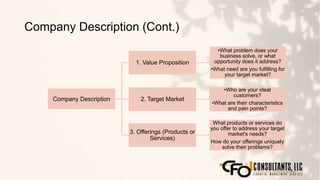
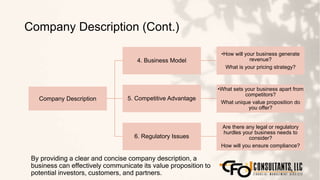
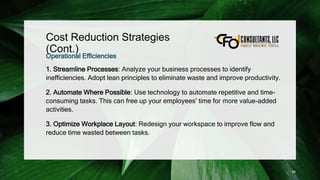
  • 255.
    Conclusion(Cont.) 255 Embrace Change andInnovation: Staying Ahead of the Curve  Continuous Improvement: The business landscape is constantly evolving. A commitment to continuous improvement, innovation, and adaptability is essential to stay ahead of the competition and capitalize on emerging opportunities. Planning for the Future: Charting Your Course  Vision and Strategy: Develop a clear vision for the future of your business and translate that vision into a well-defined long-term strategy. This strategic roadmap will guide your decision-making and ensure your business remains relevant and competitive.  Succession Planning: Don't wait until retirement to consider succession planning. A well-crafted succession plan safeguards business continuity and ensures a smooth leadership transition when the time comes.
  • 256.
    Conclusion(Cont.) 256 The Power ofIntegration: A Holistic Approach These principles we've explored are not isolated concepts; they work together synergistically. Financial literacy empowers you to make sound investment decisions in technology and people, ultimately enhancing customer satisfaction and driving innovation. Operational efficiency frees up resources for marketing and customer relationship management. Continuously focusing on these aspects fosters a sustainable competitive advantage for your small business.
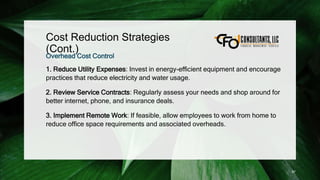
  • 257.
    Conclusion(Cont.) 257 The Journey Continues:Beyond This Book The knowledge you've gained from this book equips you with a valuable toolkit to navigate the exciting yet challenging world of small business ownership. Remember, this is just the beginning of your entrepreneurial journey. As you move forward, embrace lifelong learning, stay curious, and seek new knowledge and growth opportunities. The most successful business owners are those who continuously adapt, learn and evolve alongside their businesses. By applying the strategies outlined in this book, fostering a culture of innovation, and remaining passionate about your vision, you are well-positioned to build a thriving small business that leaves a lasting positive impact. Remember, the road to success is paved with dedication, strategic planning, and an unwavering belief in your business idea. Now, go forth and conquer!
  • 258.
    Conclusion(Cont.) 258 Staying Motivated andFocused The rollercoaster ride of small business ownership can be exhilarating and grueling in equal measure. Days will be filled with triumphant victories, and nights will be filled with unforeseen challenges. This section serves as a beacon, guiding you through maintaining motivation and focus amidst entrepreneurship's inevitable ups and downs.
  • 259.
    Conclusion(Cont.) 259 Fueling Your Passion:Setting the Course for Success  SMART Goals: Establish clear, Specific, Measurable, Achievable, Relevant, and Time- bound (SMART) goals. Breaking down your long-term vision into smaller, achievable milestones keeps you motivated and offers a sense of accomplishment as you cross them off the list.  Celebrating Milestones: Acknowledge and celebrate your victories, no matter how small. Taking the time to appreciate your progress reinforces a positive mindset and fuels your drive to keep moving forward.
  • 260.
    Conclusion(Cont.) 260 Learning from Setbacks:Embracing the Growth Mindset  Failure as a Stepping Stone: Failures are inevitable, but they don't define you. View setbacks as valuable learning experiences. Analyze what went wrong, adapt your approach, and use those lessons to propel yourself forward with renewed determination. The Power of Perspective: Keeping the Big Picture in Mind  Long-Term Vision: During challenging times, revisit your long-term vision. Remind yourself of the "why" behind your entrepreneurial journey. Reconnecting with your core purpose can reignite your passion and provide the strength to persevere.
  • 261.
    Conclusion(Cont.) 261 Learning from Setbacks:Embracing the Growth Mindset  Failure as a Stepping Stone: Failures are inevitable, but they don't define you. View setbacks as valuable learning experiences. Analyze what went wrong, adapt your approach, and use those lessons to propel yourself forward with renewed determination. The Power of Perspective: Keeping the Big Picture in Mind  Long-Term Vision: During challenging times, revisit your long-term vision. Remind yourself of the "why" behind your entrepreneurial journey. Reconnecting with your core purpose can reignite your passion and provide the strength to persevere.
  • 262.
    Conclusion(Cont.) 262 Building Your SupportSystem: A Network of Strength  Mentors and Peers: Surround yourself with a supportive network of mentors, peers, and advisors. These individuals can offer guidance, encouragement, and a valuable perspective during difficult times.  Supportive Family and Friends: Don't underestimate the power of a supportive family and friend circle. Share your challenges and victories with those who believe in you. Their unwavering support can be a source of strength and motivation.
  • 263.
    Conclusion(Cont.) 263 Remember Your Why:The Entrepreneurial Spirit Recall the spark that ignited your passion for this venture. What problem are you solving? What positive impact are you aiming to make? Reconnecting with your core purpose will reignite your enthusiasm and encourage you to persist with unwavering determination. The Road to Success is Paved with Persistence Running a small business is a marathon, not a sprint. There will be obstacles, but you can overcome any challenge with unwavering focus, a supportive network, and a commitment to lifelong learning. Embrace the journey, celebrate the victories, learn from the setbacks, and never lose sight of the dream that propelled you forward. With dedication, resilience, and a sprinkle of inspiration, you can transform your entrepreneurial vision into a thriving and impactful business.
  • 264.