The document provides a comprehensive overview of smart grid technology, highlighting its importance in enhancing electricity generation, transmission, and distribution through digital communication and integration of renewable energy sources. It details the components, technologies, benefits, and challenges associated with the smart grid, contrasting it with traditional grid systems. Key characteristics include real-time monitoring, consumer participation, and resilience against disturbances, positioning the smart grid as essential for meeting future energy demands sustainably.
Class-1: Introduction toSmart Grid
Course: Distribution Generation and Smart Grid
Prof. (Dr.) Pravat Kumar Rout
Department of EEE, ITER,
Siksha ‘O’Anusandhan (Deemed to be University),
Bhubaneswar, Odisha, India
2.
Grid
✓ The termgrid is used for an electrical system that may support all or
some of the following four operations: electricity generation, electricity
transmission, electricity distribution, and electricity control.
3.
What Makes aGrid “Smart?”
✓ In short, the digital technology that allows for two-way communication
between the utility and its customers, and the sensing along the
transmission lines is what makes the grid smart.
✓ Like the Internet, the Smart Grid will consist of controls, computers,
automation, and new technologies and equipment working together, but
in this case, these technologies will work with the electrical grid to
respond digitally to our quickly changing electric demand.
4.
Smart Grid
✓ SmartGrid facilitates efficient and reliable end-to-end intelligent two-way
delivery system from source to sink through integration of renewable
energy sources, smart transmission and distribution.
✓ In this way Smart Grid technology shall bring efficiency and sustainability
in meeting the growing electricity demand with reliability and best of the
quality.
✓ Smart Grid also enables real time monitoring and control of power system
as well as helps in reduction of AT&C losses, demand response and
demand side management, power quality management, outage
management, smart home energy system etc.
5.
Continue...
✓ Smart Gridwill act as a backbone infrastructure to enable new business
models like smart city, electric vehicles, smart communities apart from
more resilient and efficient energy system and tariff structures.
✓ A smart grid also called smart electrical/power grid, intelligent grid, future
grid, inter-grid, or intra-grid, is an enhancement of the 20th century power
grid.
✓ More specifically, the SG can be regarded as an electric system that uses
information, two-way, cyber-secure communication technologies, and
computational intelligence in an integrated fashion across electricity
generation, transmission, substations, distribution and communications
to achieve a system that is clean, safe, secure, reliable, resilient,
efficient, and sustainable.
6.
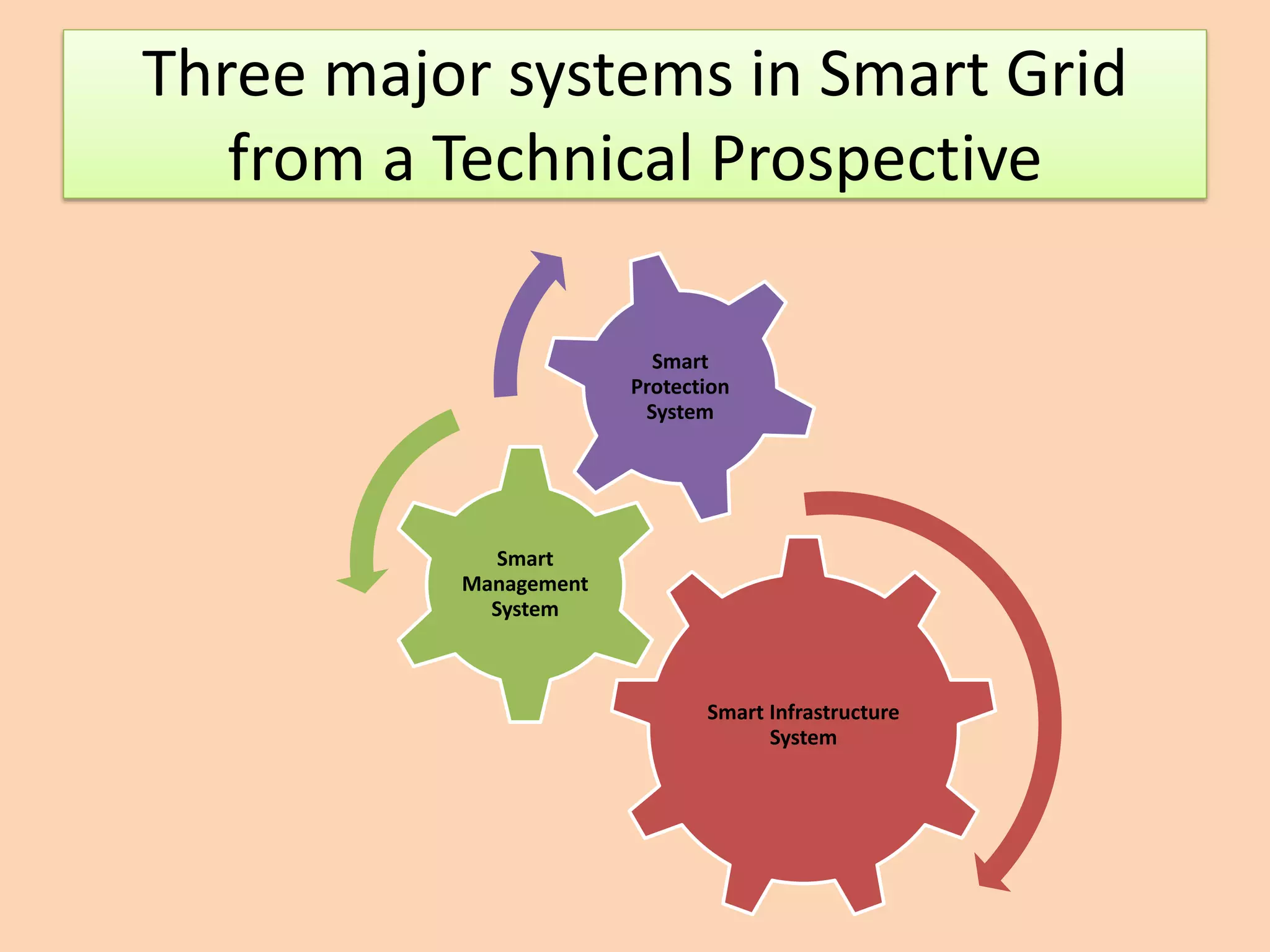
Three major systemsin Smart Grid
from a Technical Prospective
Smart Infrastructure
System
Smart
Management
System
Smart
Protection
System
9.
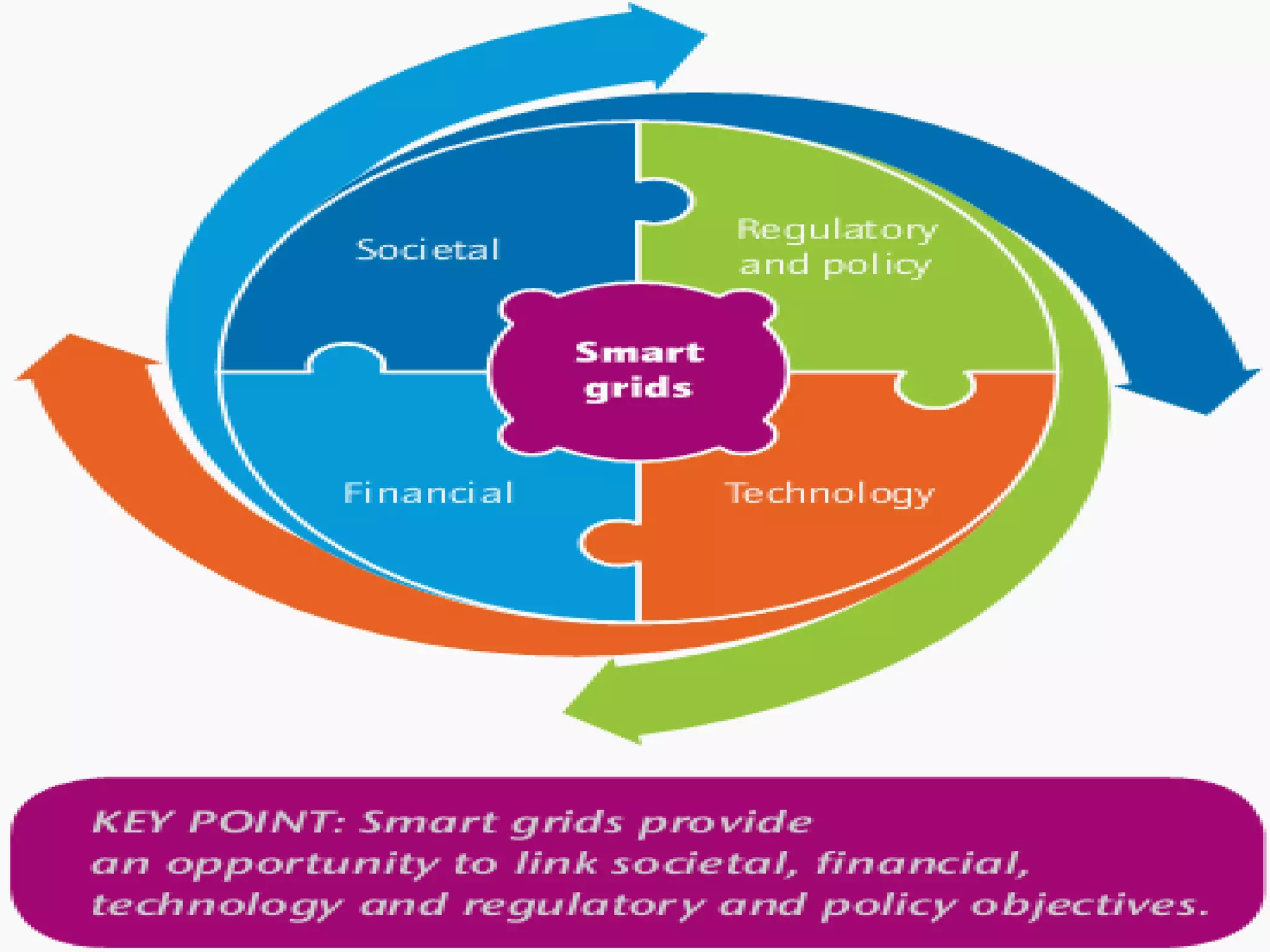
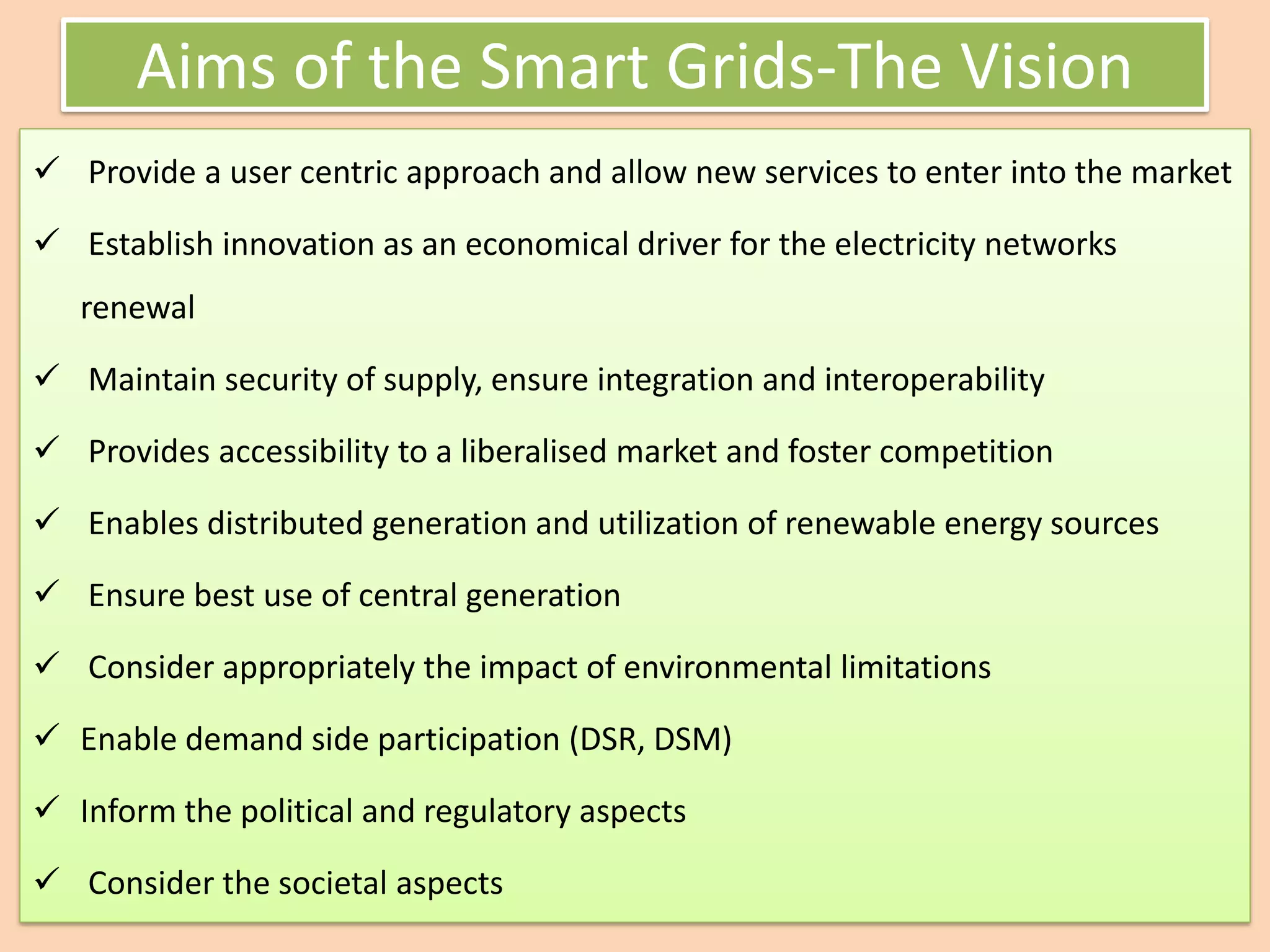
Aims of theSmart Grids-The Vision
✓ Provide a user centric approach and allow new services to enter into the market
✓ Establish innovation as an economical driver for the electricity networks
renewal
✓ Maintain security of supply, ensure integration and interoperability
✓ Provides accessibility to a liberalised market and foster competition
✓ Enables distributed generation and utilization of renewable energy sources
✓ Ensure best use of central generation
✓ Consider appropriately the impact of environmental limitations
✓ Enable demand side participation (DSR, DSM)
✓ Inform the political and regulatory aspects
✓ Consider the societal aspects
10.
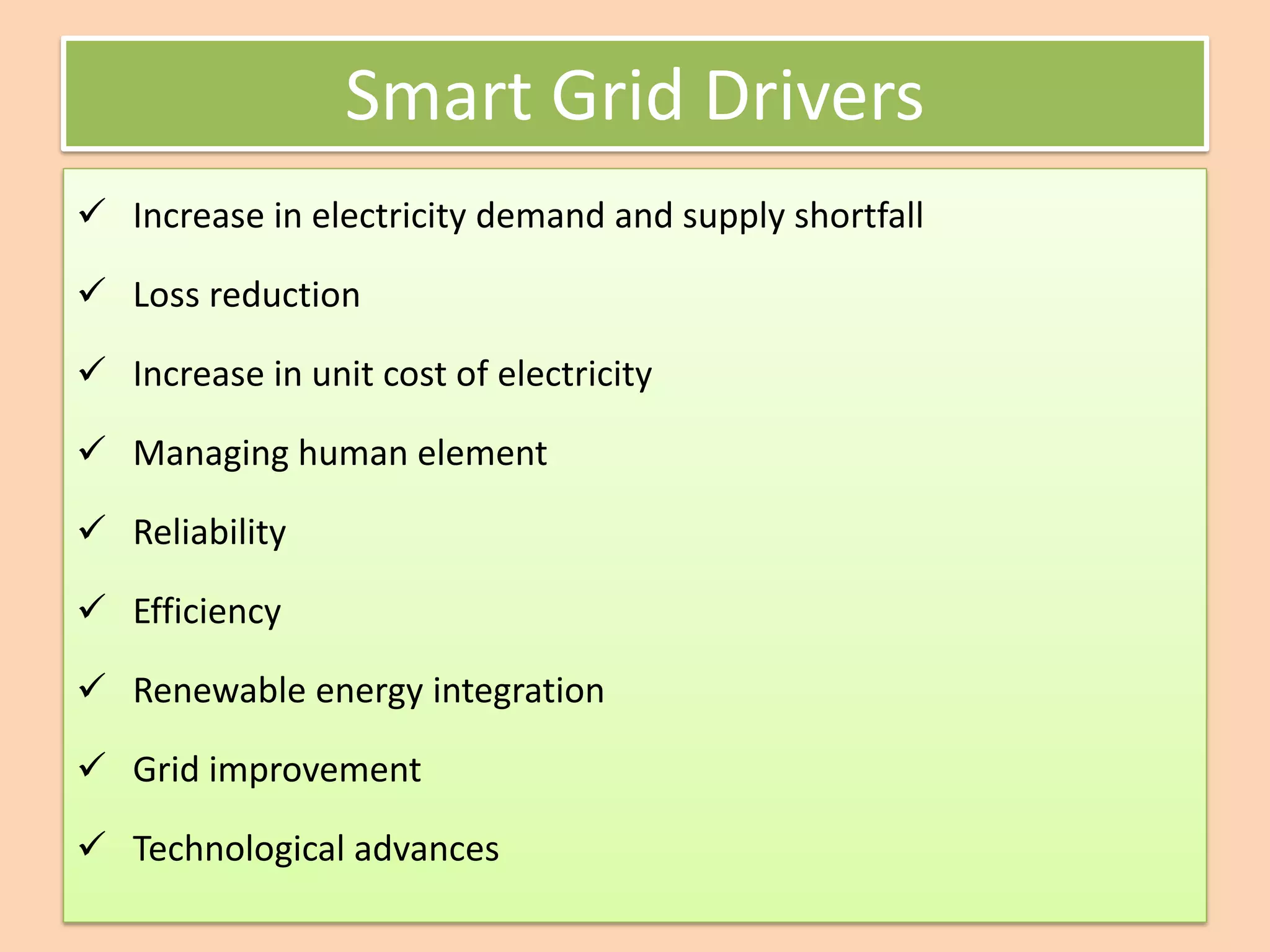
Smart Grid Drivers
✓Increase in electricity demand and supply shortfall
✓ Loss reduction
✓ Increase in unit cost of electricity
✓ Managing human element
✓ Reliability
✓ Efficiency
✓ Renewable energy integration
✓ Grid improvement
✓ Technological advances
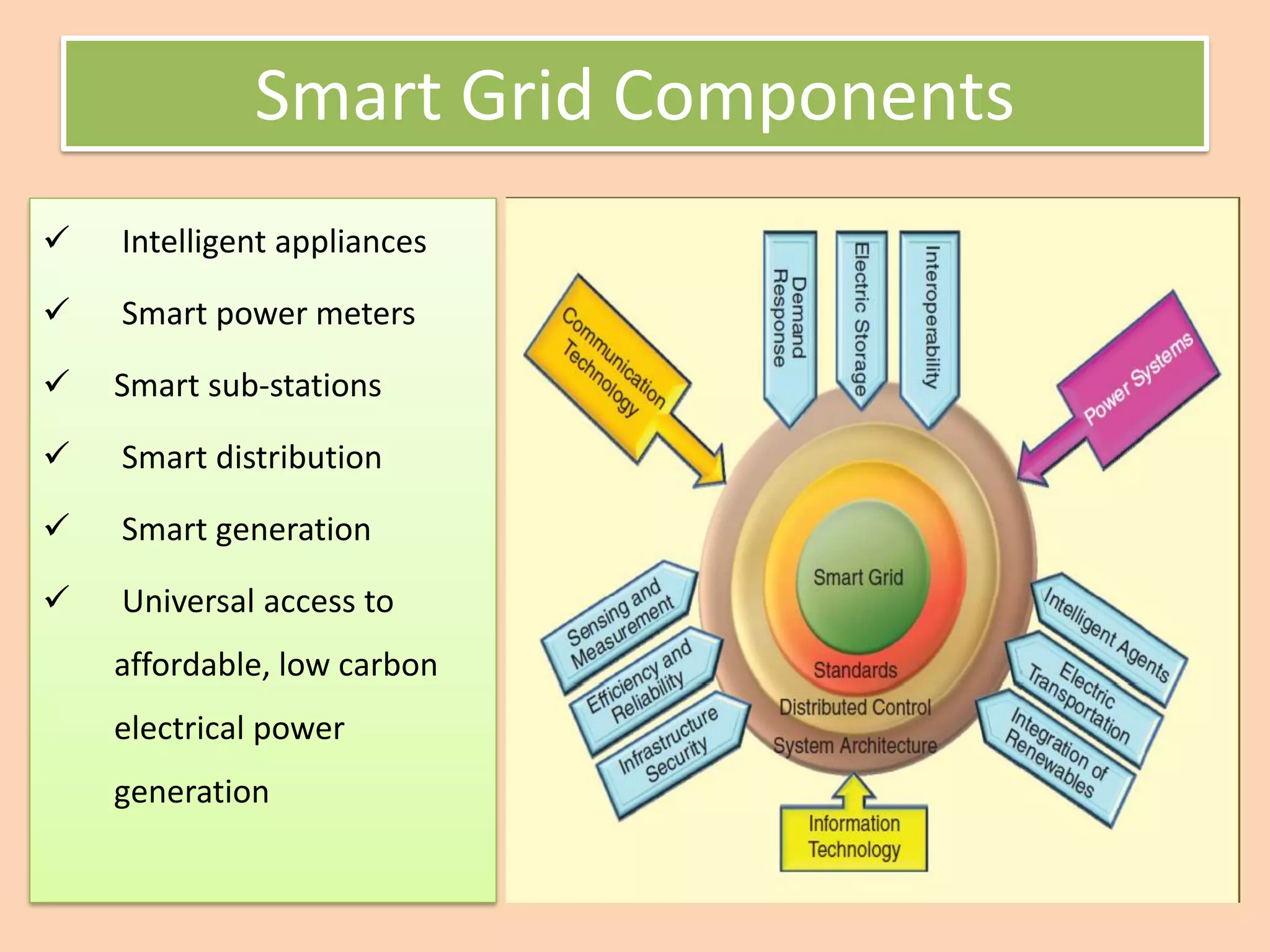
Smart Grid Components
✓Intelligent appliances
✓ Smart power meters
✓ Smart sub-stations
✓ Smart distribution
✓ Smart generation
✓ Universal access to
affordable, low carbon
electrical power
generation
14.
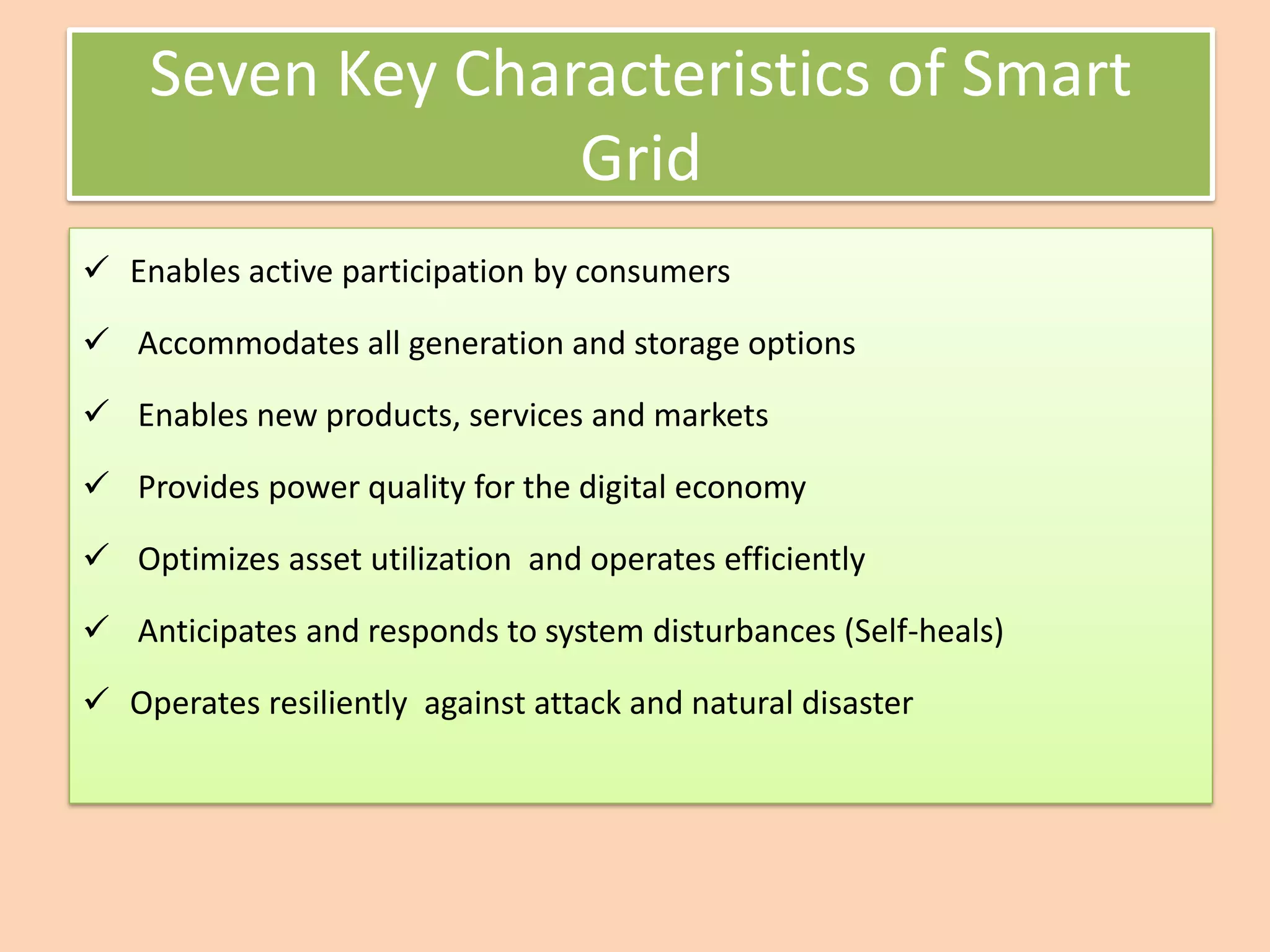
Seven Key Characteristicsof Smart
Grid
✓ Enables active participation by consumers
✓ Accommodates all generation and storage options
✓ Enables new products, services and markets
✓ Provides power quality for the digital economy
✓ Optimizes asset utilization and operates efficiently
✓ Anticipates and responds to system disturbances (Self-heals)
✓ Operates resiliently against attack and natural disaster
15.
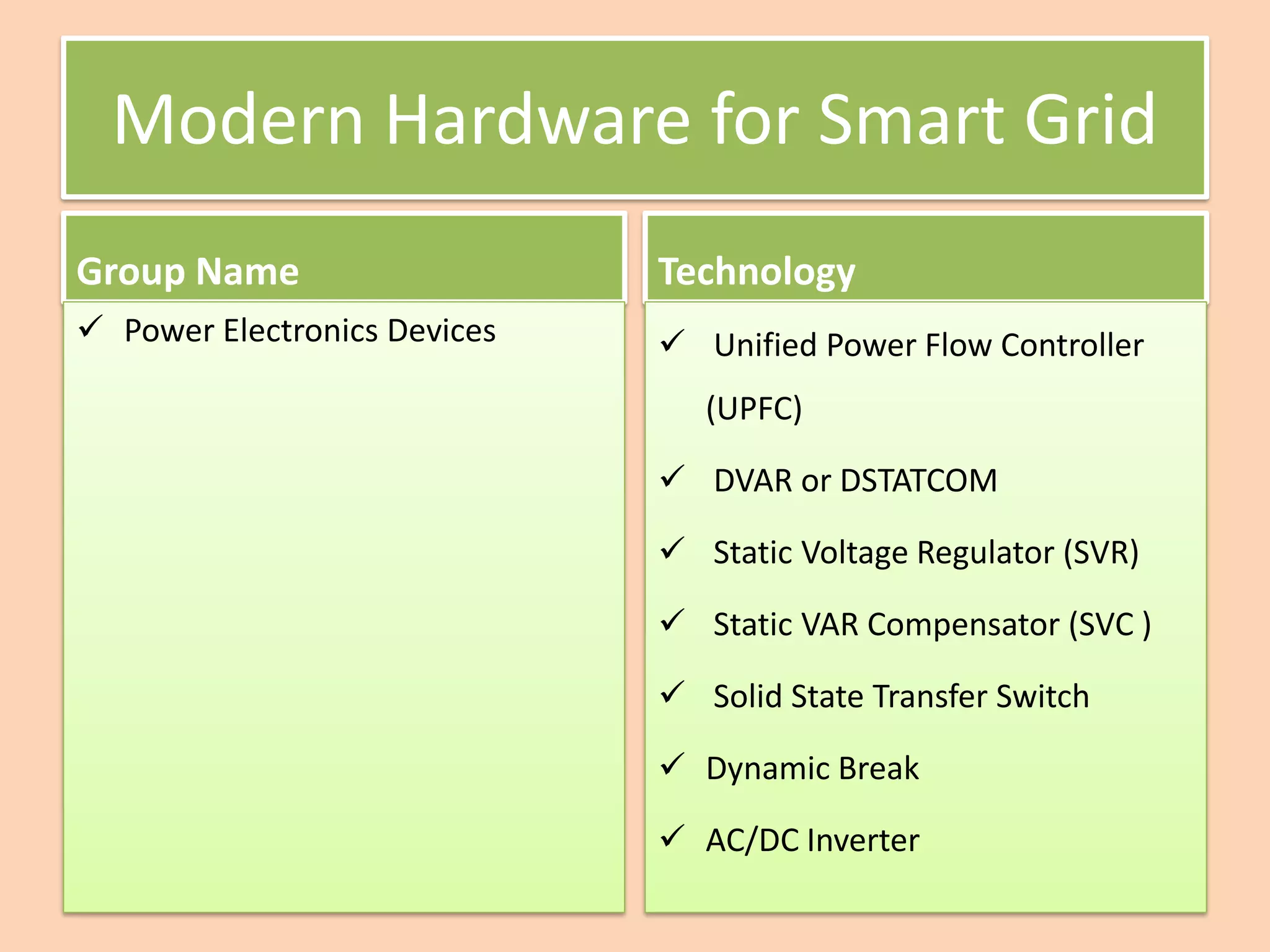
Modern Hardware forSmart Grid
Group Name
✓ Power Electronics Devices
Technology
✓ Unified Power Flow Controller
(UPFC)
✓ DVAR or DSTATCOM
✓ Static Voltage Regulator (SVR)
✓ Static VAR Compensator (SVC )
✓ Solid State Transfer Switch
✓ Dynamic Break
✓ AC/DC Inverter
16.
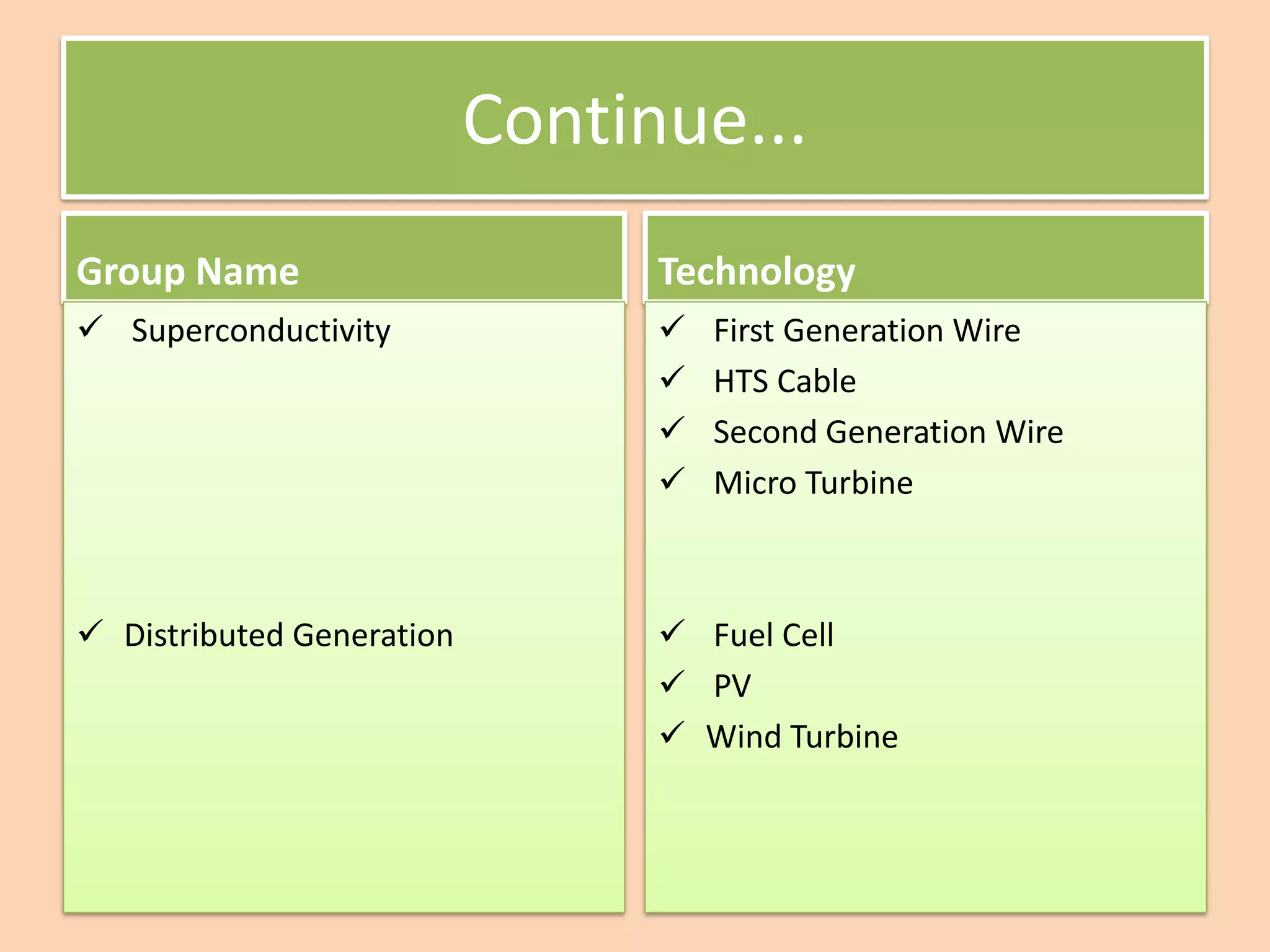
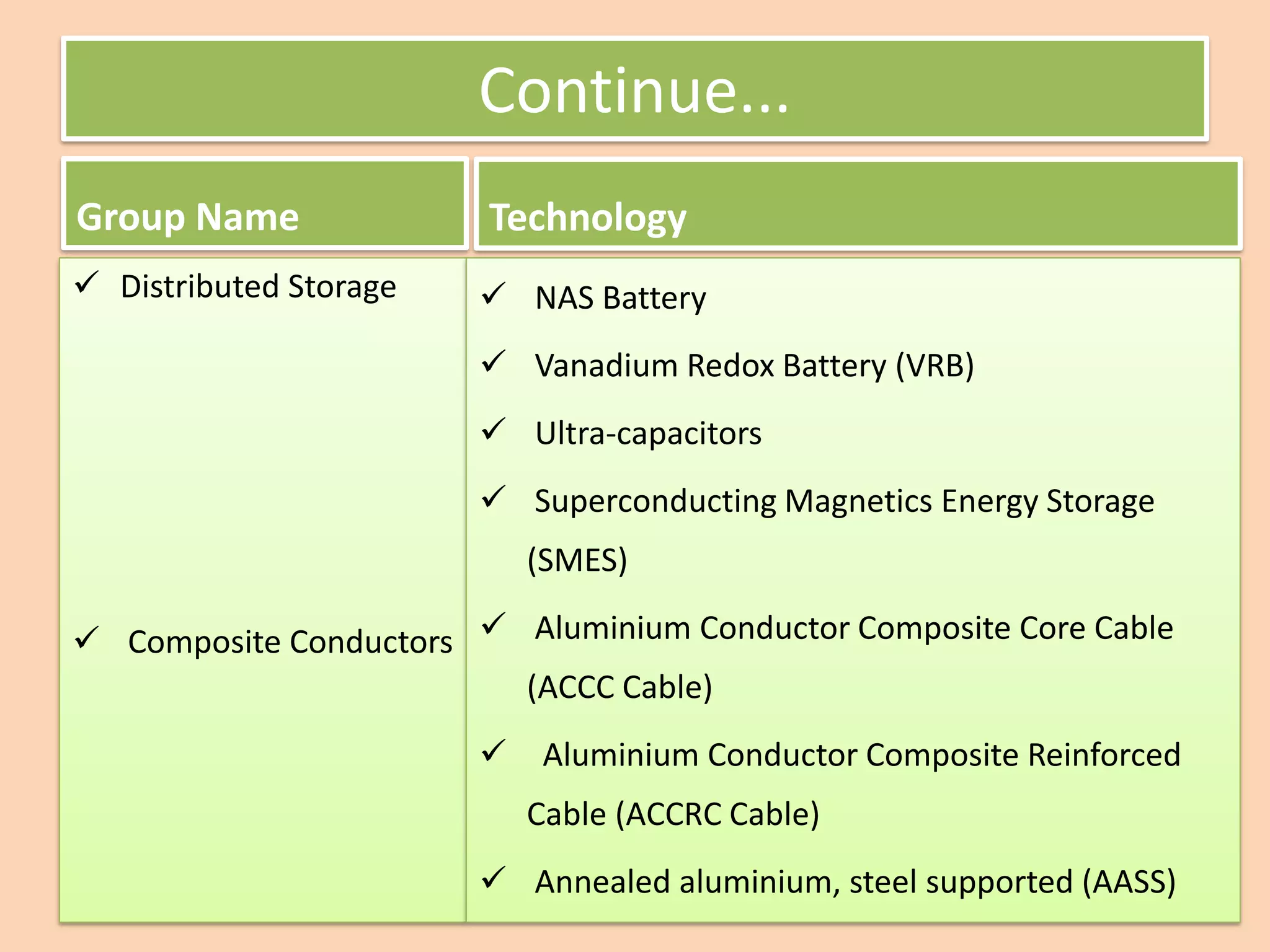
Continue...
Group Name
✓ Superconductivity
✓Distributed Generation
Technology
✓ First Generation Wire
✓ HTS Cable
✓ Second Generation Wire
✓ Micro Turbine
✓ Fuel Cell
✓ PV
✓ Wind Turbine
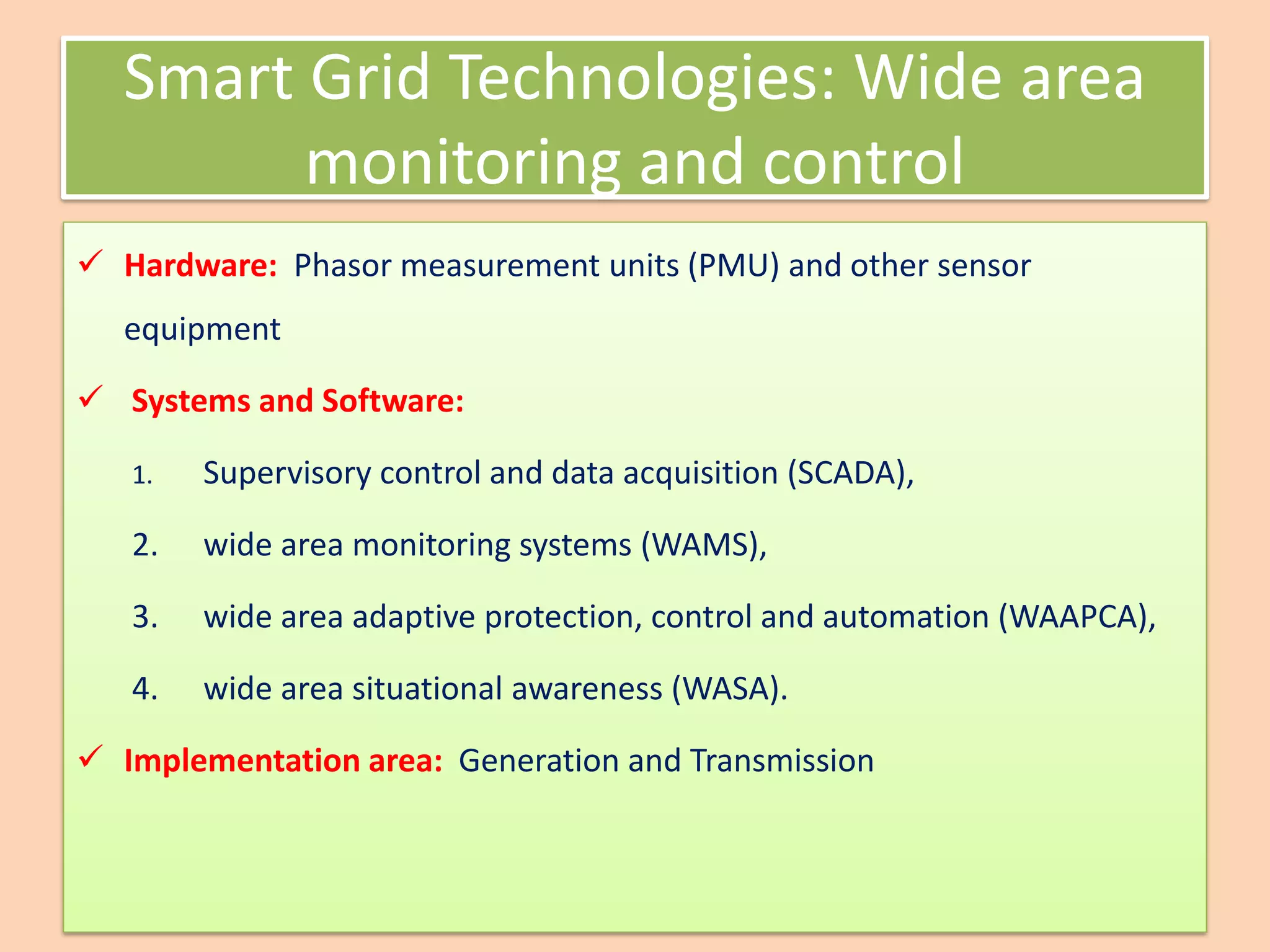
Smart Grid Technologies:Wide area
monitoring and control
✓ Hardware: Phasor measurement units (PMU) and other sensor
equipment
✓ Systems and Software:
1. Supervisory control and data acquisition (SCADA),
2. wide area monitoring systems (WAMS),
3. wide area adaptive protection, control and automation (WAAPCA),
4. wide area situational awareness (WASA).
✓ Implementation area: Generation and Transmission
19.
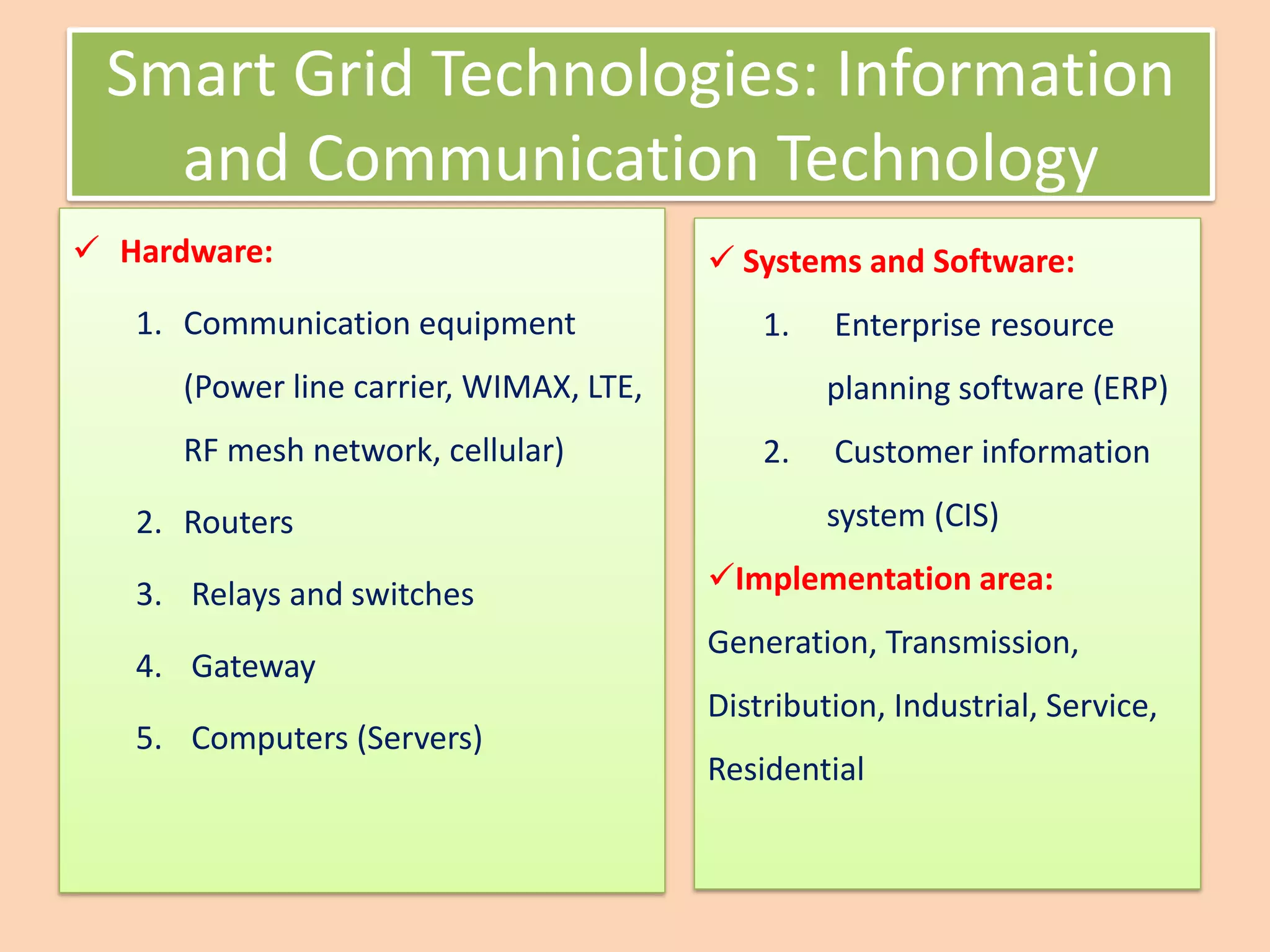
Smart Grid Technologies:Information
and Communication Technology
✓ Hardware:
1. Communication equipment
(Power line carrier, WIMAX, LTE,
RF mesh network, cellular)
2. Routers
3. Relays and switches
4. Gateway
5. Computers (Servers)
✓ Systems and Software:
1. Enterprise resource
planning software (ERP)
2. Customer information
system (CIS)
✓Implementation area:
Generation, Transmission,
Distribution, Industrial, Service,
Residential
20.
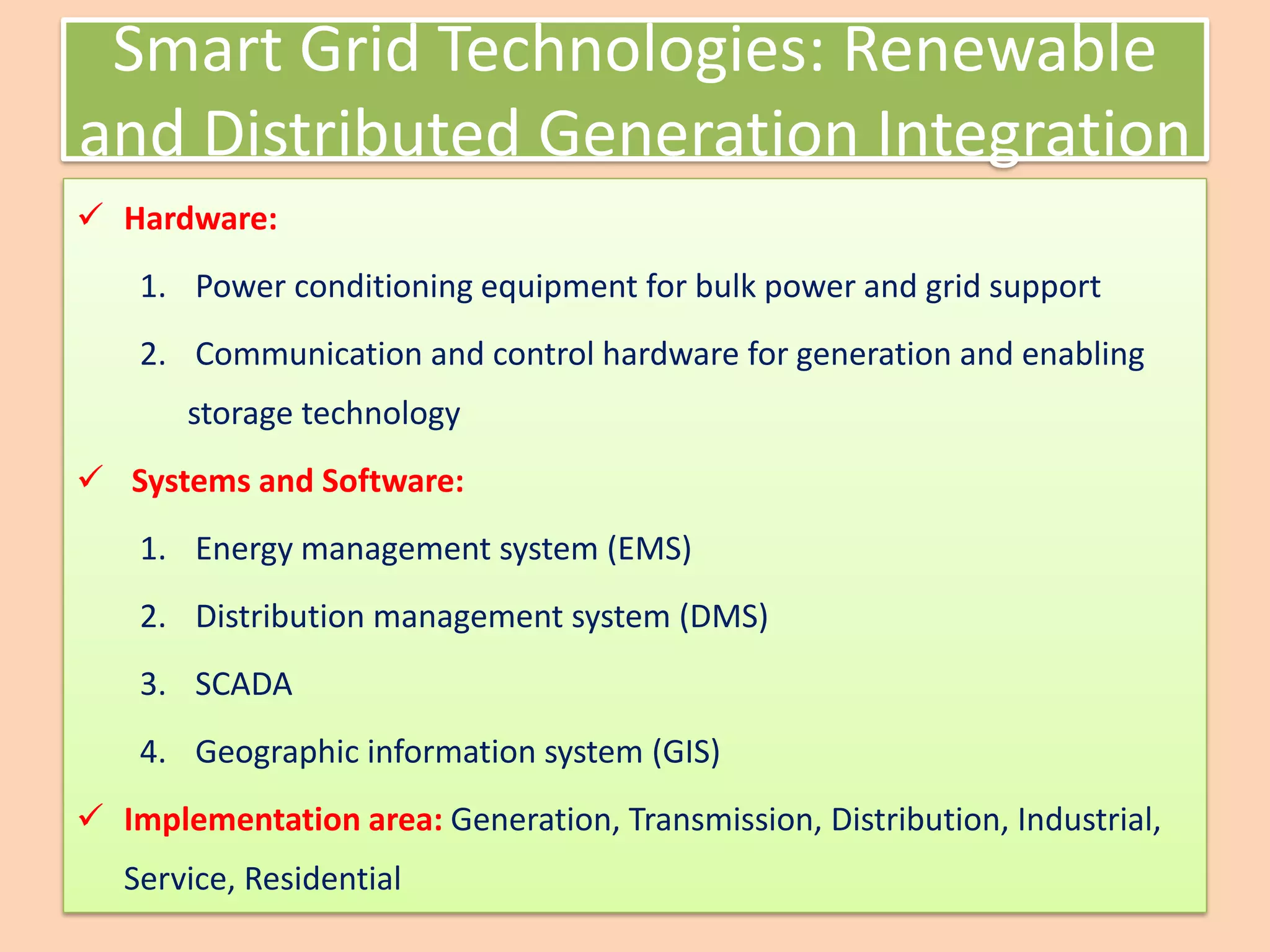
Smart Grid Technologies:Renewable
and Distributed Generation Integration
✓ Hardware:
1. Power conditioning equipment for bulk power and grid support
2. Communication and control hardware for generation and enabling
storage technology
✓ Systems and Software:
1. Energy management system (EMS)
2. Distribution management system (DMS)
3. SCADA
4. Geographic information system (GIS)
✓ Implementation area: Generation, Transmission, Distribution, Industrial,
Service, Residential
21.
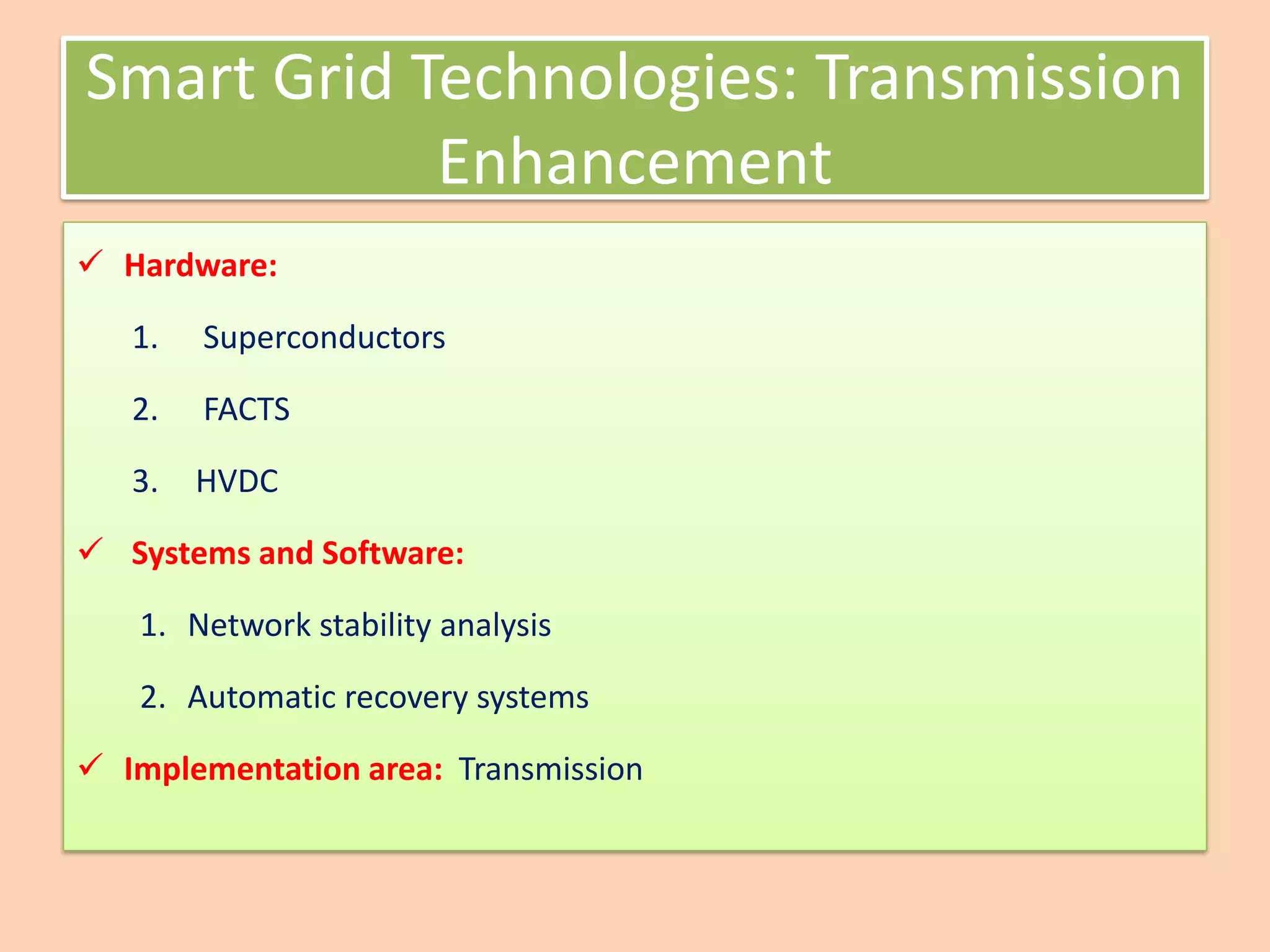
Smart Grid Technologies:Transmission
Enhancement
✓ Hardware:
1. Superconductors
2. FACTS
3. HVDC
✓ Systems and Software:
1. Network stability analysis
2. Automatic recovery systems
✓ Implementation area: Transmission
22.
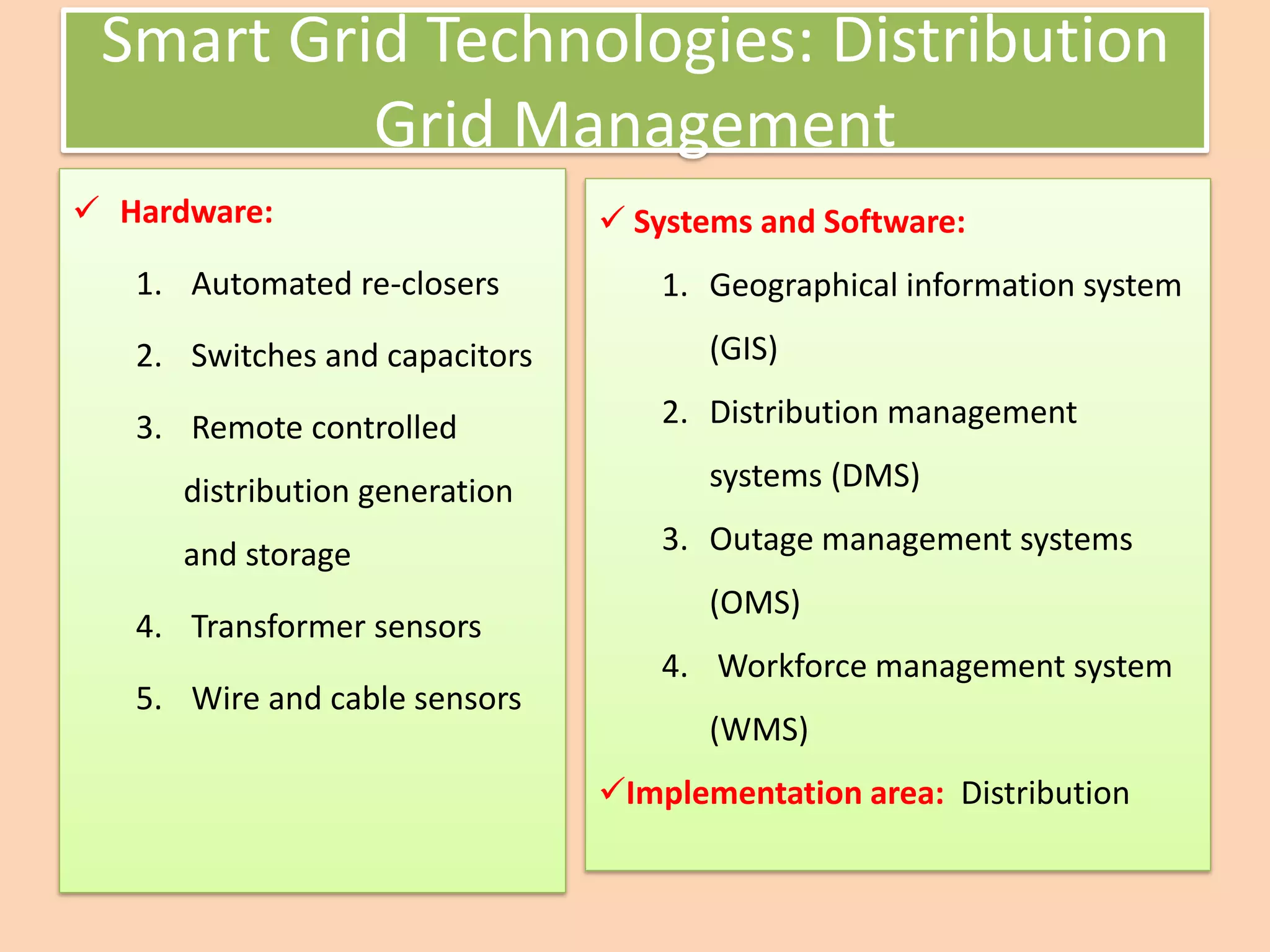
Smart Grid Technologies:Distribution
Grid Management
✓ Hardware:
1. Automated re-closers
2. Switches and capacitors
3. Remote controlled
distribution generation
and storage
4. Transformer sensors
5. Wire and cable sensors
✓ Systems and Software:
1. Geographical information system
(GIS)
2. Distribution management
systems (DMS)
3. Outage management systems
(OMS)
4. Workforce management system
(WMS)
✓Implementation area: Distribution
23.
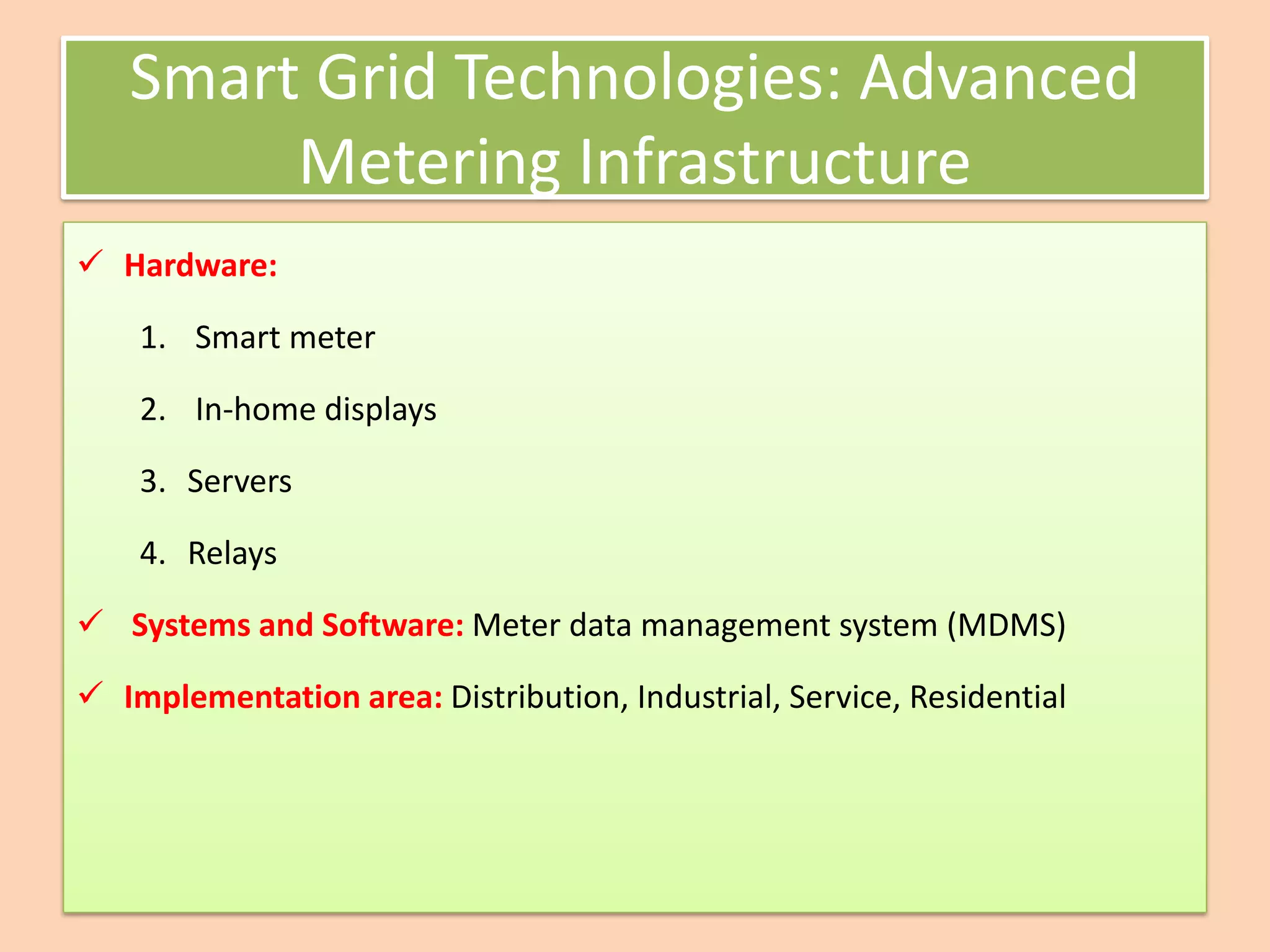
Smart Grid Technologies:Advanced
Metering Infrastructure
✓ Hardware:
1. Smart meter
2. In-home displays
3. Servers
4. Relays
✓ Systems and Software: Meter data management system (MDMS)
✓ Implementation area: Distribution, Industrial, Service, Residential
24.
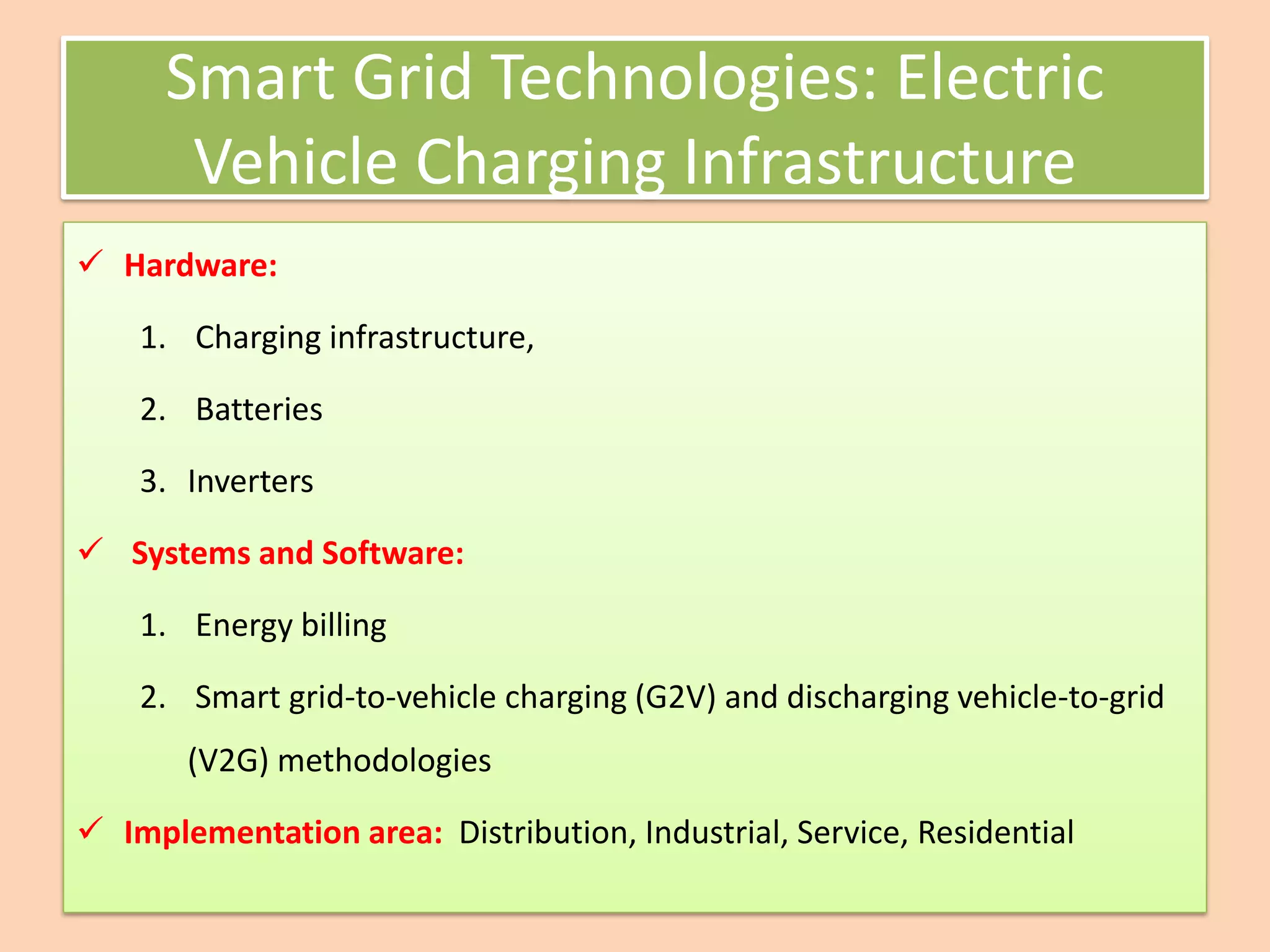
Smart Grid Technologies:Electric
Vehicle Charging Infrastructure
✓ Hardware:
1. Charging infrastructure,
2. Batteries
3. Inverters
✓ Systems and Software:
1. Energy billing
2. Smart grid-to-vehicle charging (G2V) and discharging vehicle-to-grid
(V2G) methodologies
✓ Implementation area: Distribution, Industrial, Service, Residential
25.
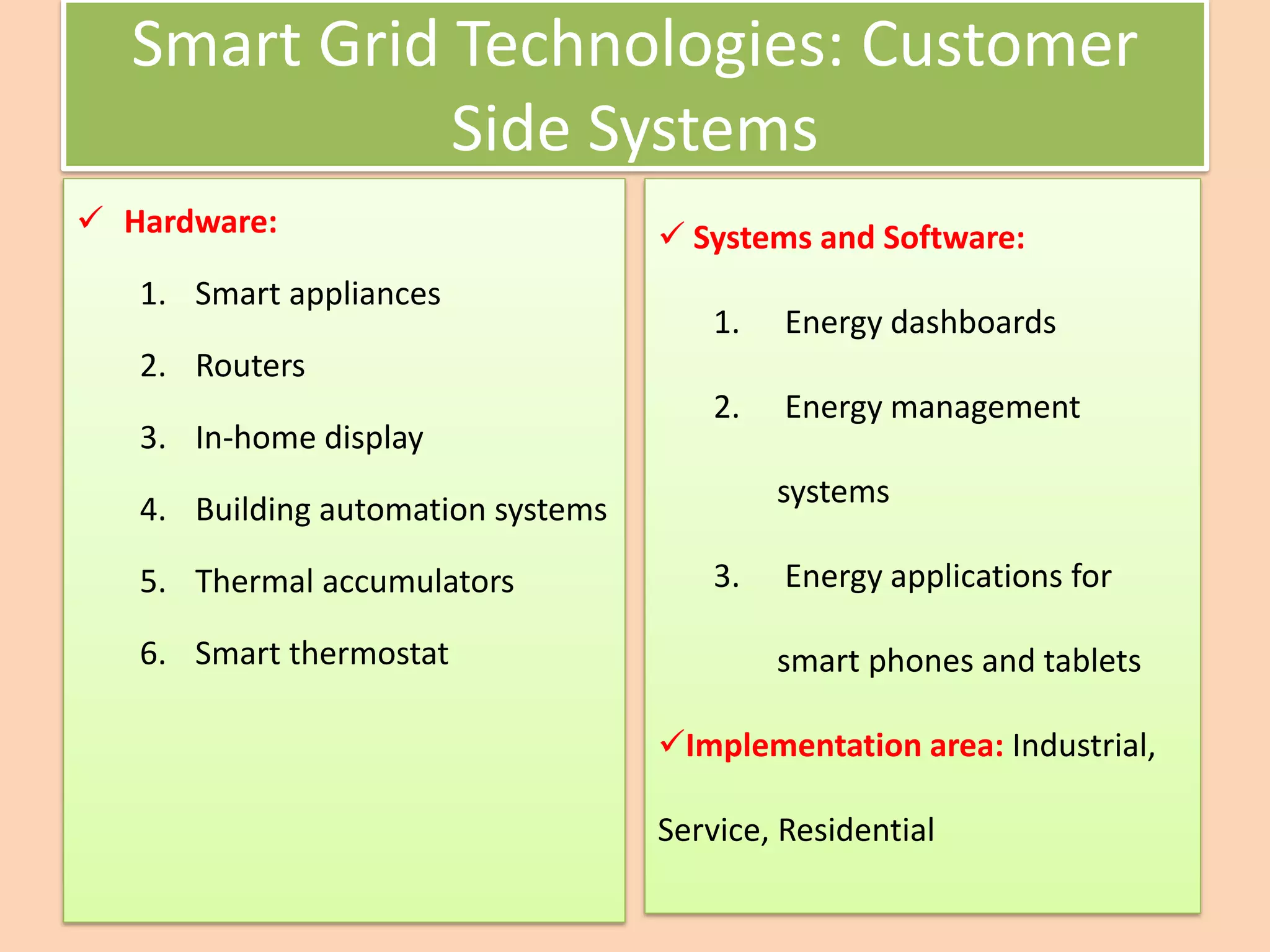
Smart Grid Technologies:Customer
Side Systems
✓ Hardware:
1. Smart appliances
2. Routers
3. In-home display
4. Building automation systems
5. Thermal accumulators
6. Smart thermostat
✓ Systems and Software:
1. Energy dashboards
2. Energy management
systems
3. Energy applications for
smart phones and tablets
✓Implementation area: Industrial,
Service, Residential
26.
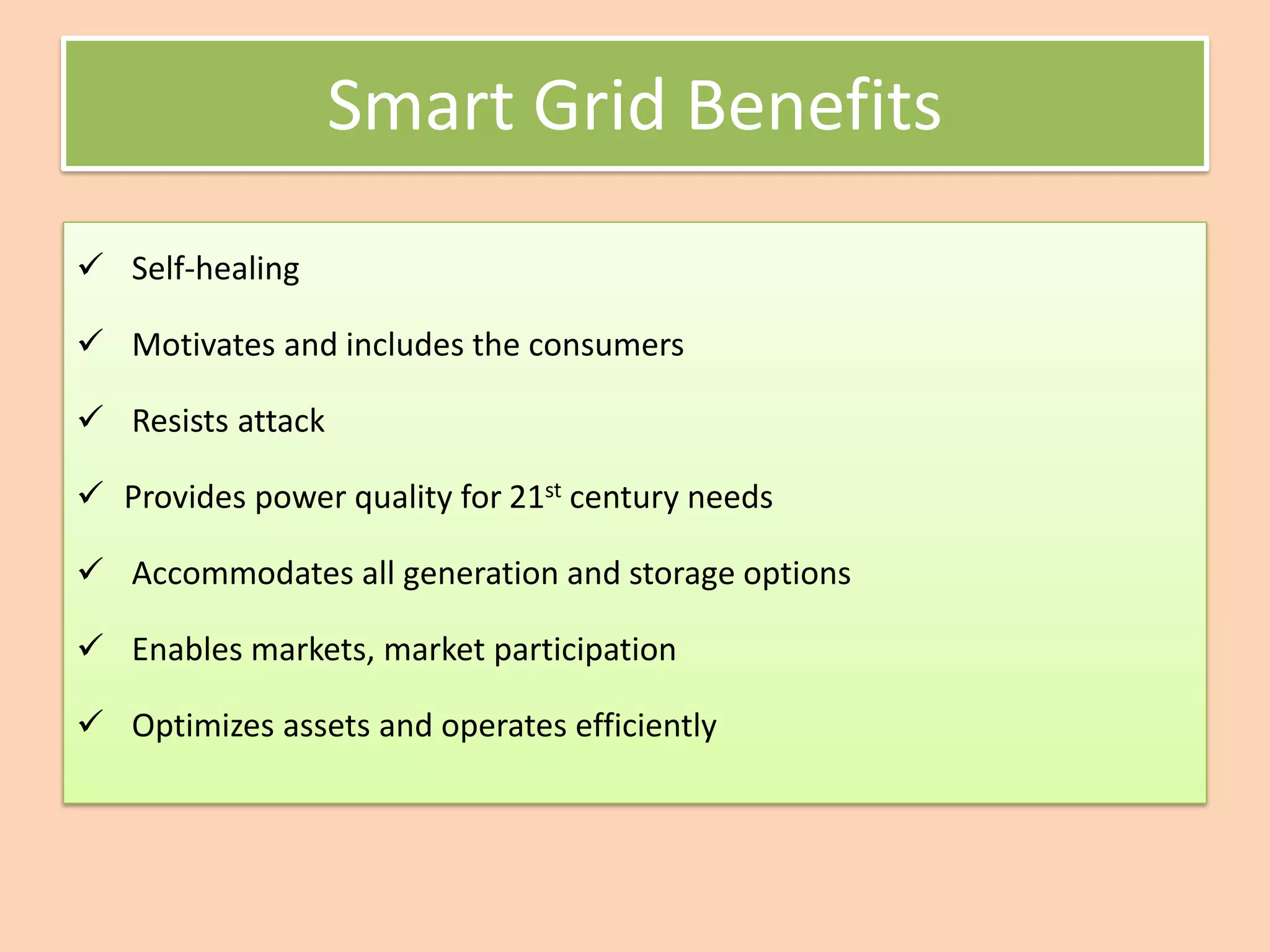
Smart Grid Benefits
✓Self-healing
✓ Motivates and includes the consumers
✓ Resists attack
✓ Provides power quality for 21st century needs
✓ Accommodates all generation and storage options
✓ Enables markets, market participation
✓ Optimizes assets and operates efficiently
27.
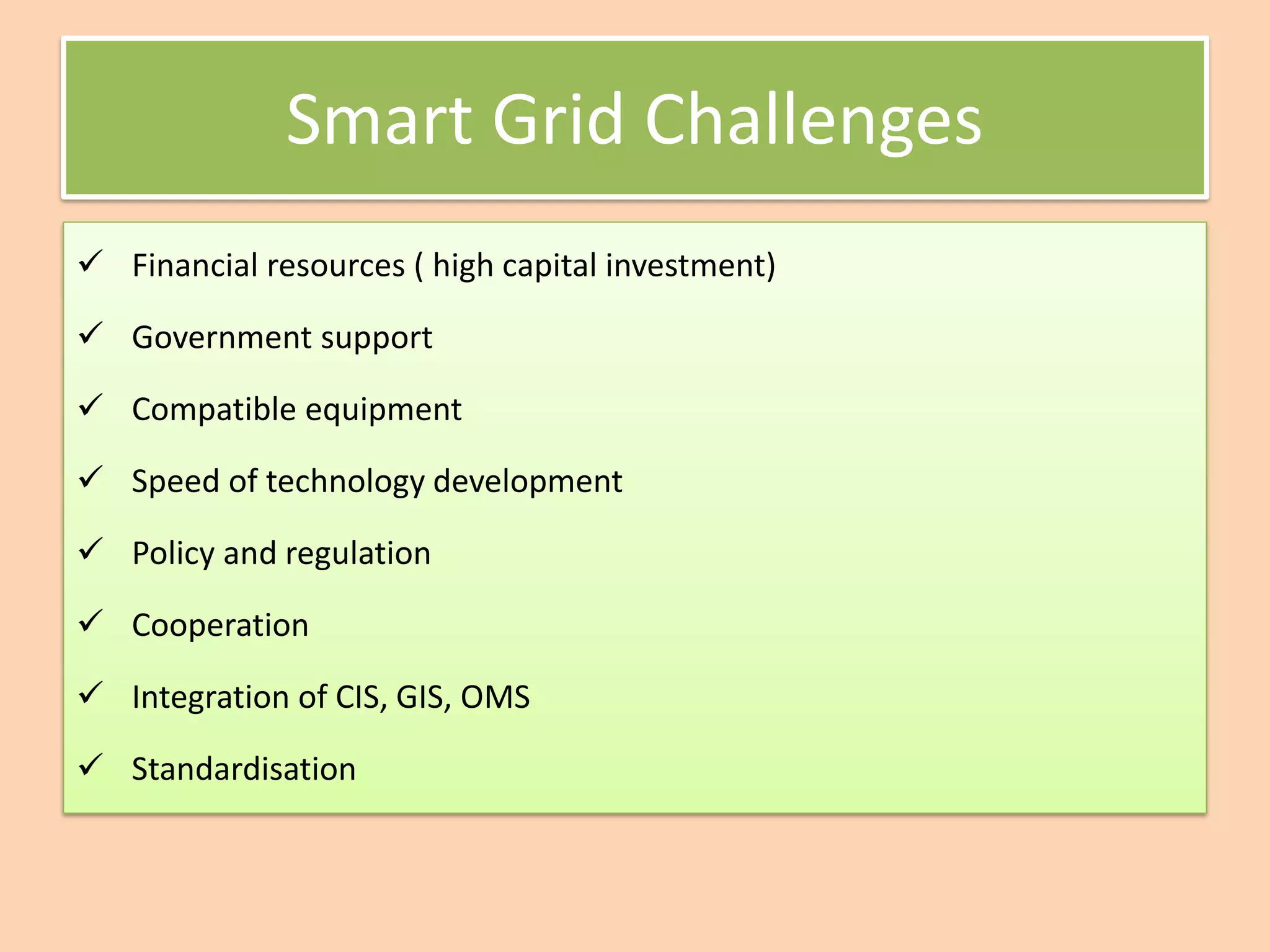
Smart Grid Challenges
✓Financial resources ( high capital investment)
✓ Government support
✓ Compatible equipment
✓ Speed of technology development
✓ Policy and regulation
✓ Cooperation
✓ Integration of CIS, GIS, OMS
✓ Standardisation
28.
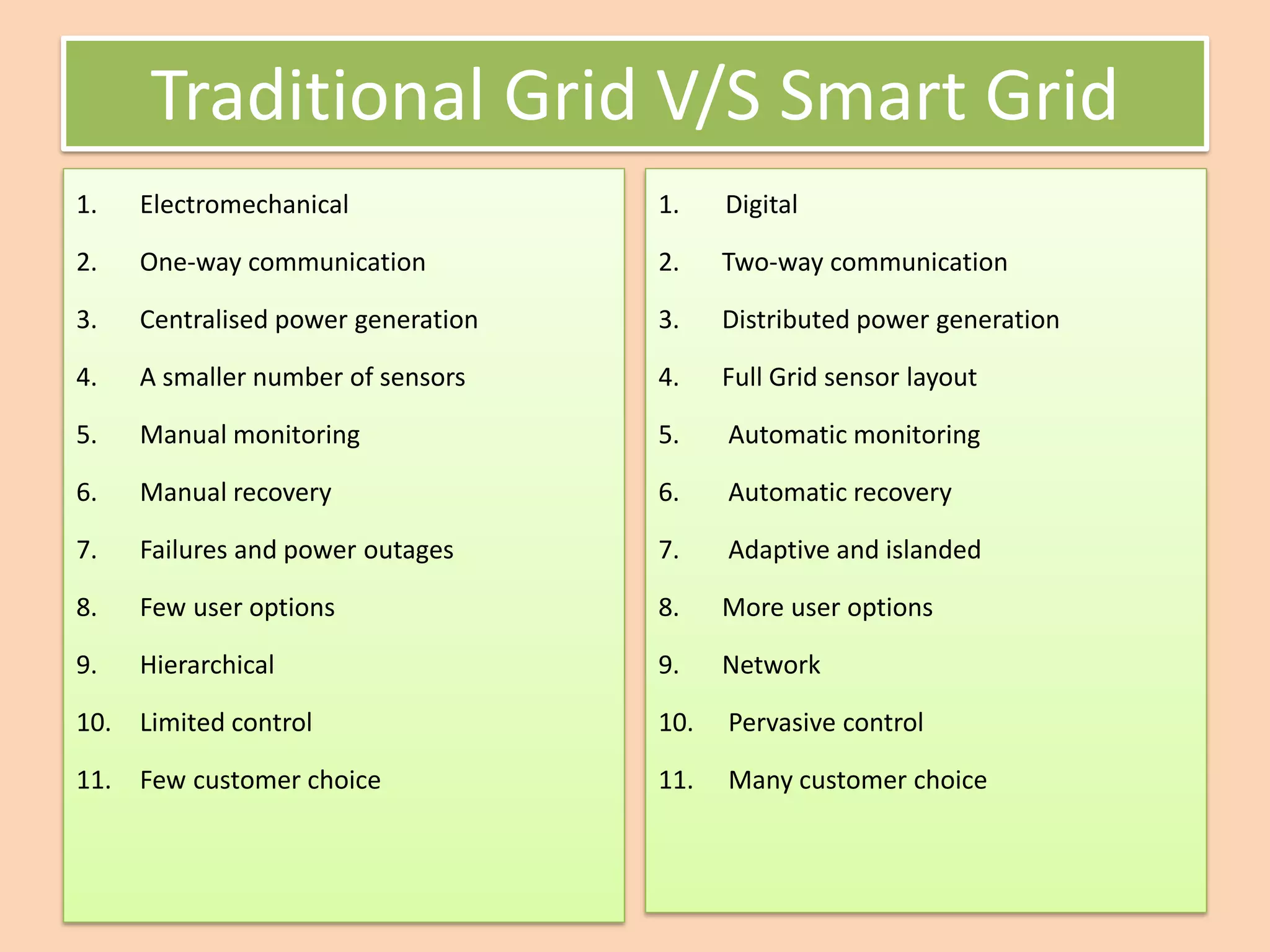
Traditional Grid V/SSmart Grid
1. Electromechanical
2. One-way communication
3. Centralised power generation
4. A smaller number of sensors
5. Manual monitoring
6. Manual recovery
7. Failures and power outages
8. Few user options
9. Hierarchical
10. Limited control
11. Few customer choice
1. Digital
2. Two-way communication
3. Distributed power generation
4. Full Grid sensor layout
5. Automatic monitoring
6. Automatic recovery
7. Adaptive and islanded
8. More user options
9. Network
10. Pervasive control
11. Many customer choice
29.
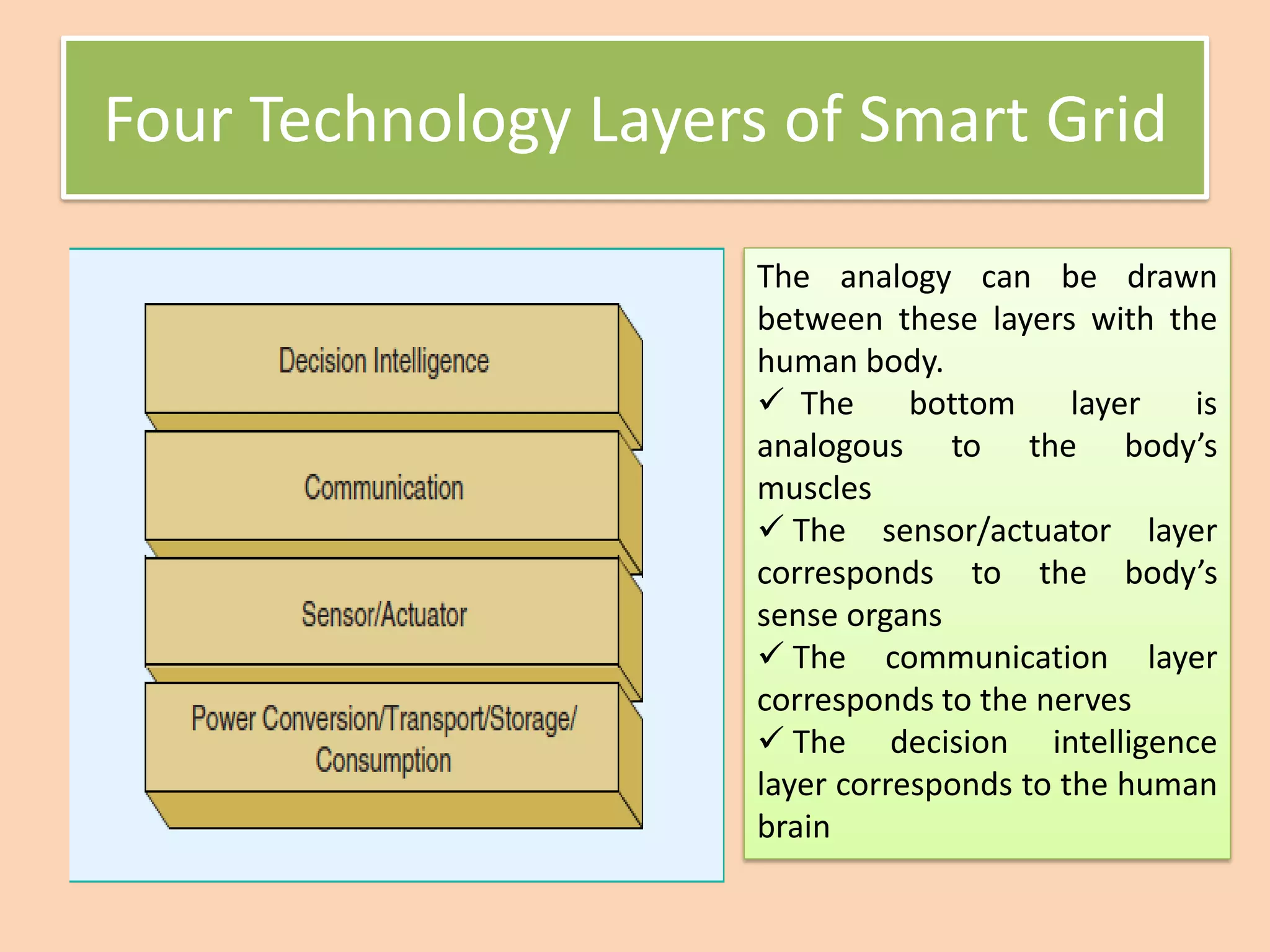
Four Technology Layersof Smart Grid
The analogy can be drawn
between these layers with the
human body.
✓ The bottom layer is
analogous to the body’s
muscles
✓ The sensor/actuator layer
corresponds to the body’s
sense organs
✓ The communication layer
corresponds to the nerves
✓ The decision intelligence
layer corresponds to the human
brain
30.
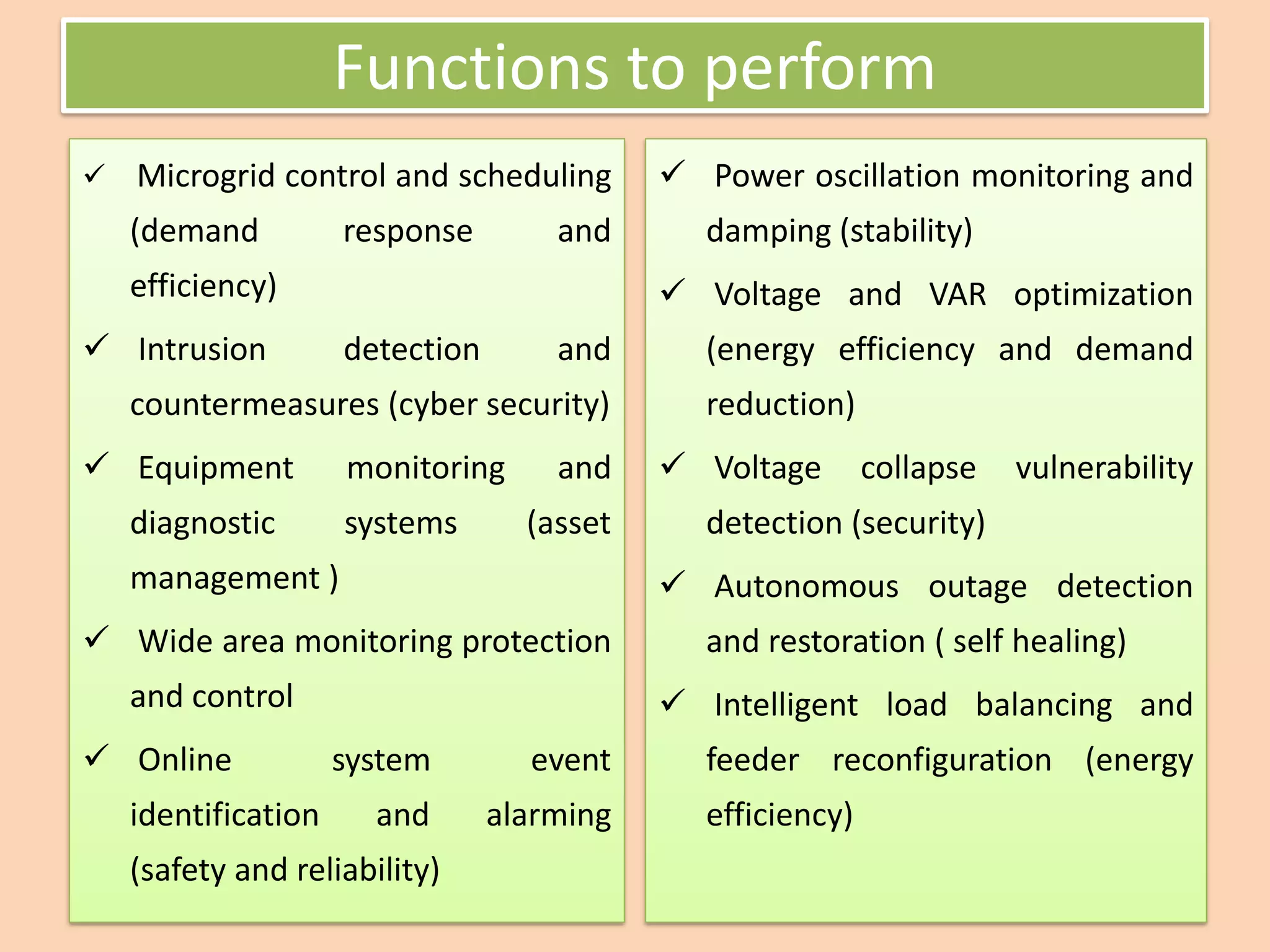
Functions to perform
✓Microgrid control and scheduling
(demand response and
efficiency)
✓ Intrusion detection and
countermeasures (cyber security)
✓ Equipment monitoring and
diagnostic systems (asset
management )
✓ Wide area monitoring protection
and control
✓ Online system event
identification and alarming
(safety and reliability)
✓ Power oscillation monitoring and
damping (stability)
✓ Voltage and VAR optimization
(energy efficiency and demand
reduction)
✓ Voltage collapse vulnerability
detection (security)
✓ Autonomous outage detection
and restoration ( self healing)
✓ Intelligent load balancing and
feeder reconfiguration (energy
efficiency)
31.
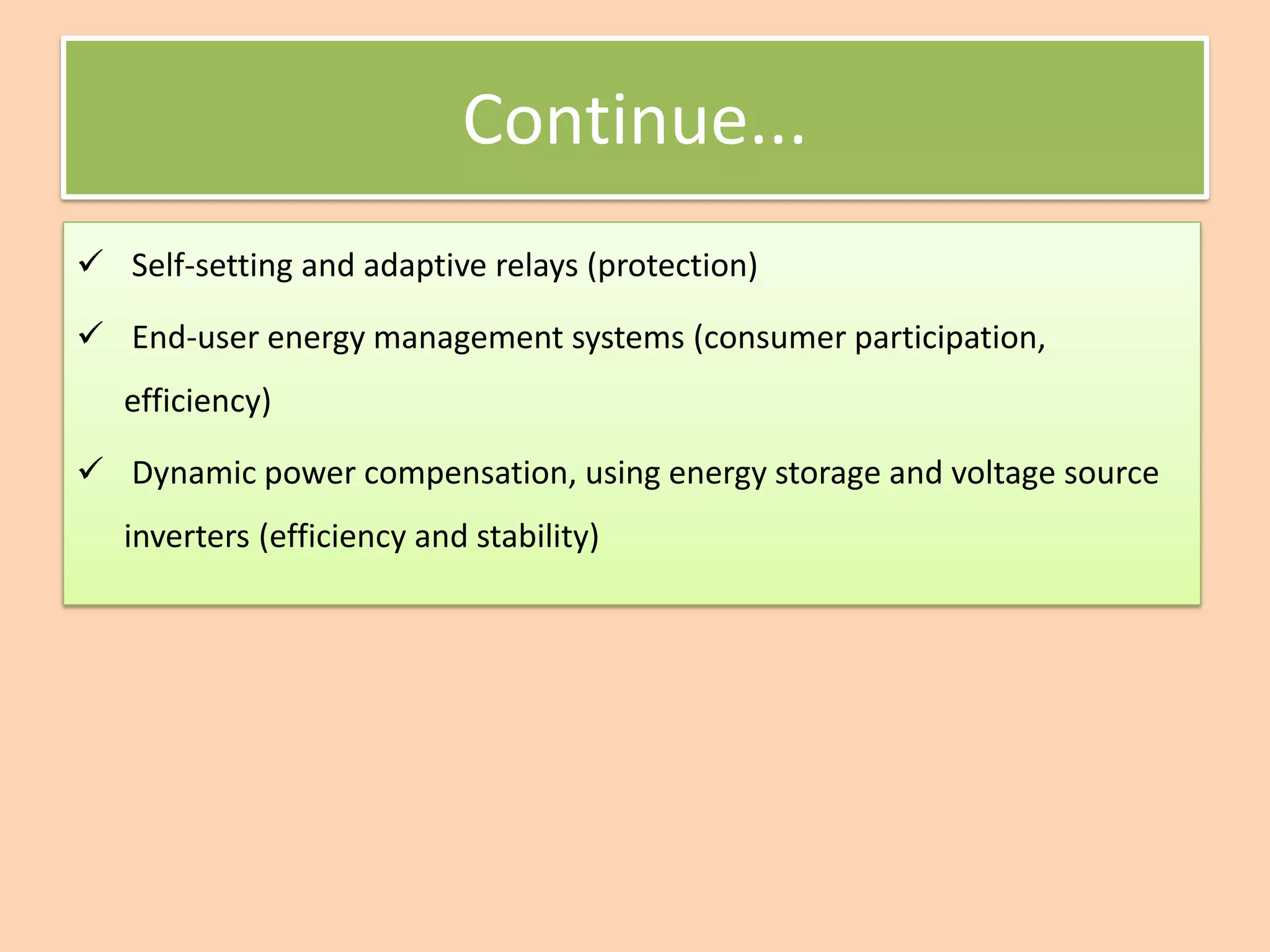
Continue...
✓ Self-setting andadaptive relays (protection)
✓ End-user energy management systems (consumer participation,
efficiency)
✓ Dynamic power compensation, using energy storage and voltage source
inverters (efficiency and stability)
32.
✓ Farhangi, H.(2009). The path of the smart grid. IEEE power and energy
magazine, 8(1), 18-28.
✓ Amin, S. M., & Wollenberg, B. F. (2005). Toward a smart grid: power
delivery for the 21st century. IEEE power and energy magazine, 3(5), 34-
41.
✓ Fang, X., Misra, S., Xue, G., & Yang, D. (2011). Smart grid—The new and
improved power grid: A survey. IEEE communications surveys &
tutorials, 14(4), 944-980.
References
33.
Continue...
✓ Ipakchi, A.,& Albuyeh, F. (2009). Grid of the future. IEEE power and energy
magazine, 7(2), 52-62.
✓ Yu, X., Cecati, C., Dillon, T., & Simoes, M. G. (2011). The new frontier of
smart grids. IEEE Industrial Electronics Magazine, 5(3), 49-63.
✓ Wang, J., Huang, A. Q., Sung, W., Liu, Y., & Baliga, B. J. (2009). Smart grid
technologies. IEEE Industrial Electronics Magazine, 3(2), 16-23.
✓ Arnold, G. W. (2011). Challenges and opportunities in smart grid: A
position article. Proceedings of the IEEE, 99(6), 922-927.
34.
Possible Questions
✓ Whatare the major drivers for looking Smart Grid as an possible up-
gradation to Traditional Grid system?
✓ What are the major technology involved in Smart Grid design and
infrastructure?
✓ Differentiate between Smart and Traditional Grid System?
✓ Mention the key characteristics of Smart Grid?