A PPT ON SMART GRID
BY
K.SRAVANI S.LALITHA
III EEE III EEE
INTRODUCTION
Utilization of power increased day
by day due to large power
utilization.
The power distribution in huge
computing environment need to
be control.
SMART GRIDS
“A smart grid delivers
electricity from suppliers to
consumers using digital
technology to save energy,
reduce cost and increase
reliability.”
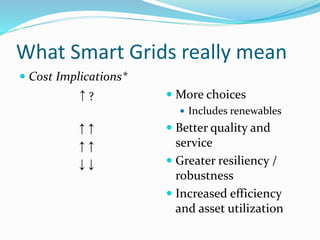
What Smart Grids really mean
 Cost Implications*
↑ ?
↑ ↑
↑ ↑
↓ ↓
 More choices
 Includes renewables
 Better quality and
service
 Greater resiliency /
robustness
 Increased efficiency
and asset utilization
 A Smart Grid is a Transformation of the power system based
on harnessing digital communications and control
 Utilities will be able to:
 Know what power is going where, and when
 Charge “appropriately” for it
 Control the use of (if not flow) power
 Although Advanced Metering Infrastructure (AMI) is
considered to be the basic building block for a Smart Grid,
the Smart Grid is not just AMI!
 The Smart Grid is a much broader set of technologies and
solutions
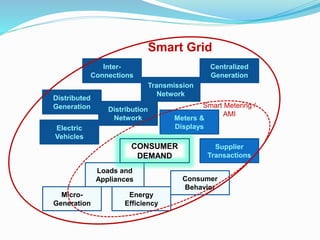
Centralized
Generation
Transmission
Network
Supplier
Transactions
Inter-
Connections
Distribution
Network Meters &
Displays
Distributed
Generation
Electric
Vehicles
Loads and
Appliances
Energy
Efficiency
Micro-
Generation
Consumer
Behavior
CONSUMER
DEMAND
Smart Grid
Smart Metering /
AMI
The Future will be Different
 Consumers may become generators
 Possibly with distributed and/or renevables
 IT has improved to the point where even smaller consumers
(residences) can meaningfully participate in utility load control
schemes
 Residences are a major part of the Indian peak
 The future should have ZERO load-shedding (at a feeder level, at
least)
 Discrimination across and within categories of consumers is
present today and may remain
 Let’s do it more intelligently
 Incentivize behavior at the margin
 Provide a minimum assured supply 24/7
Buying Peaking Power
Peak power is always more expensive than the
average
 Plants operate at only 500 or 1000 hours per year
 Ignores 15% target spinning reserves, today articulated
as 5% by GoI
Blending such peak power today is what the West
does
 Raises the costs for ALL users for ALL kWh
 KN example – Raises purchase cost for utilities by Rs.
1/kWh!
Alternative – peaking tariff – let those who
contribute to the peak pay for it
 Requires appropriate metering
10
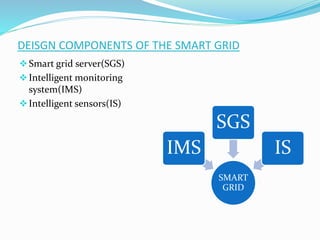
DEISGN COMPONENTS OF THE SMART GRID
Smart grid server(SGS)
Intelligent monitoring
system(IMS)
Intelligent sensors(IS)
SMART
GRID
IMS
SGS
IS
BENEFITS OF SMART GRID
CONSISTENCY
LOAD ADGESTMENTS
ADVANCED SERVICES
COMPETENCE
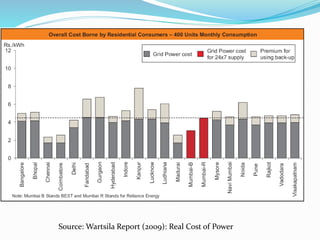
Cost by utility
Source: Wartsila Report (2009): Real Cost of Power
Thinking of the Future…We need
Smart Grids
Business as usual (BAU) will not be sustainable
o Adding supply is necessary but not sufficient – must make
consumption smarter
Consumers must see and behave based on not just their
average costs but their incremental impact on the grid
o This will create a few losers but (hopefully) more
winners
Appliances and consumption will become smarter
o Whirlpool announced that by 2015 ALL their selected
household appliances will be smart grid capable
(worldwide)
o It’s not a question of when, not if…
CONCLUSION
Implementation o smart grid will basically
change the way of power utilization in
could computing environment.
THANQ
?

Ppt on smart grid

  • 1.
    A PPT ONSMART GRID BY K.SRAVANI S.LALITHA III EEE III EEE
  • 3.
    INTRODUCTION Utilization of powerincreased day by day due to large power utilization. The power distribution in huge computing environment need to be control.
  • 4.
    SMART GRIDS “A smartgrid delivers electricity from suppliers to consumers using digital technology to save energy, reduce cost and increase reliability.”
  • 5.
    What Smart Gridsreally mean  Cost Implications* ↑ ? ↑ ↑ ↑ ↑ ↓ ↓  More choices  Includes renewables  Better quality and service  Greater resiliency / robustness  Increased efficiency and asset utilization
  • 6.
     A SmartGrid is a Transformation of the power system based on harnessing digital communications and control  Utilities will be able to:  Know what power is going where, and when  Charge “appropriately” for it  Control the use of (if not flow) power  Although Advanced Metering Infrastructure (AMI) is considered to be the basic building block for a Smart Grid, the Smart Grid is not just AMI!  The Smart Grid is a much broader set of technologies and solutions
  • 7.
    Centralized Generation Transmission Network Supplier Transactions Inter- Connections Distribution Network Meters & Displays Distributed Generation Electric Vehicles Loadsand Appliances Energy Efficiency Micro- Generation Consumer Behavior CONSUMER DEMAND Smart Grid Smart Metering / AMI
  • 8.
    The Future willbe Different  Consumers may become generators  Possibly with distributed and/or renevables  IT has improved to the point where even smaller consumers (residences) can meaningfully participate in utility load control schemes  Residences are a major part of the Indian peak  The future should have ZERO load-shedding (at a feeder level, at least)  Discrimination across and within categories of consumers is present today and may remain  Let’s do it more intelligently  Incentivize behavior at the margin  Provide a minimum assured supply 24/7
  • 9.
    Buying Peaking Power Peakpower is always more expensive than the average  Plants operate at only 500 or 1000 hours per year  Ignores 15% target spinning reserves, today articulated as 5% by GoI Blending such peak power today is what the West does  Raises the costs for ALL users for ALL kWh  KN example – Raises purchase cost for utilities by Rs. 1/kWh! Alternative – peaking tariff – let those who contribute to the peak pay for it  Requires appropriate metering
  • 10.
  • 11.
    DEISGN COMPONENTS OFTHE SMART GRID Smart grid server(SGS) Intelligent monitoring system(IMS) Intelligent sensors(IS) SMART GRID IMS SGS IS
  • 12.
    BENEFITS OF SMARTGRID CONSISTENCY LOAD ADGESTMENTS ADVANCED SERVICES COMPETENCE
  • 13.
    Cost by utility Source:Wartsila Report (2009): Real Cost of Power
  • 14.
    Thinking of theFuture…We need Smart Grids Business as usual (BAU) will not be sustainable o Adding supply is necessary but not sufficient – must make consumption smarter Consumers must see and behave based on not just their average costs but their incremental impact on the grid o This will create a few losers but (hopefully) more winners Appliances and consumption will become smarter o Whirlpool announced that by 2015 ALL their selected household appliances will be smart grid capable (worldwide) o It’s not a question of when, not if…
  • 15.
    CONCLUSION Implementation o smartgrid will basically change the way of power utilization in could computing environment.
  • 16.