PROJECT GUIDE:               GROUP MEMBERS:
MR. RAJIV RANJAN             VIVEK KUMAR SINGH
                             VANDANA AGRAWAL
                             UTKARSH MAURYA
                             UTTAM JALAN


               GROUP NO. 5
The Smart Grid is the integration of Electrical &
Digital Technologies, Information and communication
which facilitates integration of business processes and
systems to yield real measurable value across the power
delivery chain. It is an intelligent future electricity
system that connects all supply, grid and demand
elements through a communication system. Smart grid
delivers electricity to consumers using two-way digital
technology that enable the efficient management of
consumers, efficient use of the grid to identify and
correct supply- demand imbalances.
The Smart Grid is the integration of Electrical & Digital
Technologies, Information and communication which facilitates
integration of business processes and systems to yield real
measurable value across the power delivery chain. It is an intelligent
future electricity system that connects all supply, grid and demand
elements through a communication system. Smart grid delivers
electricity to consumers using two-way digital technology that
enable the efficient management of consumers, efficient use of the
grid to identify and correct supply- demand imbalances. Smart Grid
solutions enable utilities to increase energy productivity and power
reliability while allowing the customers to manage the usage and
costs through real time information exchange. It impacts all the
components of the power system like Generation, Transmission and
Distribution.
   The Smart Grid focuses in four key areas:-
   Generation
   Transmission
   Distribution
   Consumer
   Smart Power Meters
   Smart Substations
   Smart Distribution
   Smart Generation
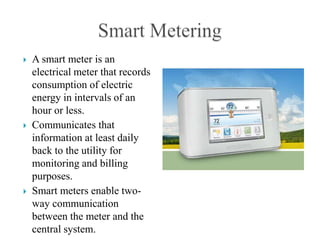
   A smart meter is an
    electrical meter that records
    consumption of electric
    energy in intervals of an
    hour or less.
   Communicates that
    information at least daily
    back to the utility for
    monitoring and billing
    purposes.
   Smart meters enable two-
    way communication
    between the meter and the
    central system.
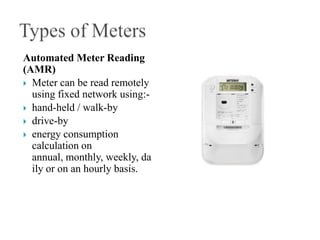
Automated Meter Reading
(AMR)
 Meter can be read remotely
  using fixed network using:-
 hand-held / walk-by
 drive-by
 energy consumption
  calculation on
  annual, monthly, weekly, da
  ily or on an hourly basis.
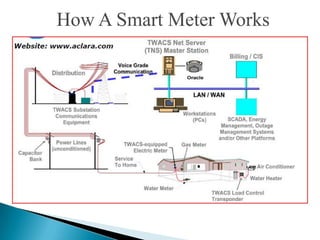
How A Smart Meter Works
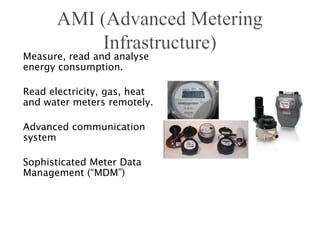
Measure, read and analyse
energy consumption.

Read electricity, gas, heat
and water meters remotely.

Advanced communication
system

Sophisticated Meter Data
Management (“MDM”)
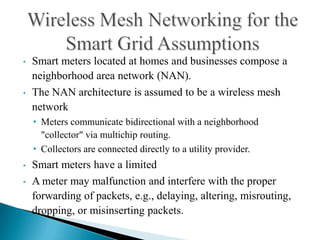
•   Smart meters located at homes and businesses compose a
    neighborhood area network (NAN).
•   The NAN architecture is assumed to be a wireless mesh
    network
    • Meters communicate bidirectional with a neighborhood
      "collector" via multichip routing.
    • Collectors are connected directly to a utility provider.
•   Smart meters have a limited
•   A meter may malfunction and interfere with the proper
    forwarding of packets, e.g., delaying, altering, misrouting,
    dropping, or misinserting packets.
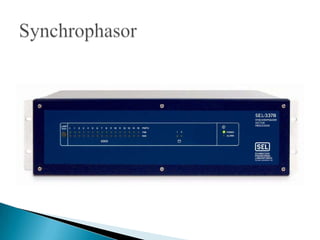
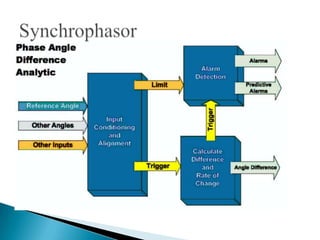
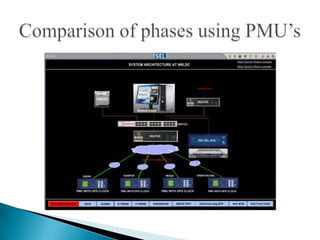
1. Based on the new data acquisition
  technology of phasor measurement.

2. WAM systems acquire current, voltage and frequency
 phasor measurements, and are taken to PMU(Phasor
 measurement Unit).

3. The measured quantities include both magnitudes and
  phase angles, and are time-synchronised via GPS
  receivers with an accuracy of one microsecond.
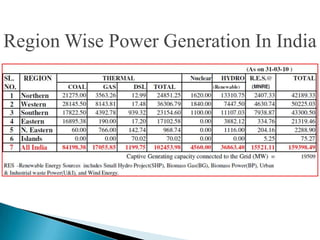
Region Wise Power Generation In India
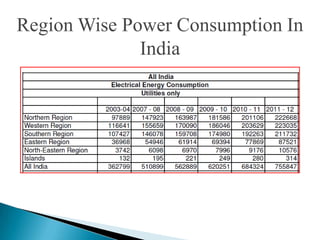
Region Wise Power Consumption In
              India
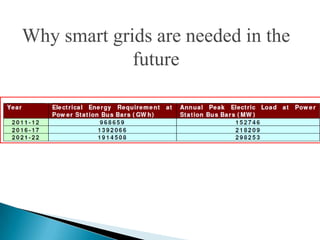
Why smart grids are needed in the
             future
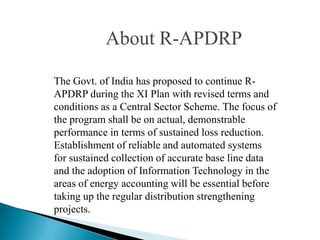
About R-APDRP

The Govt. of India has proposed to continue R-
APDRP during the XI Plan with revised terms and
conditions as a Central Sector Scheme. The focus of
the program shall be on actual, demonstrable
performance in terms of sustained loss reduction.
Establishment of reliable and automated systems
for sustained collection of accurate base line data
and the adoption of Information Technology in the
areas of energy accounting will be essential before
taking up the regular distribution strengthening
projects.
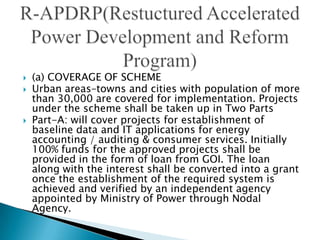
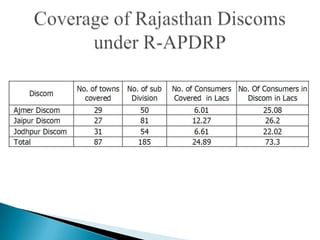
   (a) COVERAGE OF SCHEME
   Urban areas–towns and cities with population of more
    than 30,000 are covered for implementation. Projects
    under the scheme shall be taken up in Two Parts
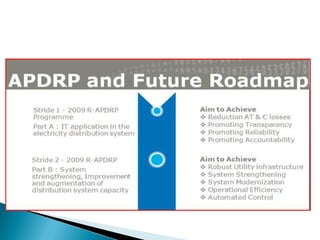
   Part-A: will cover projects for establishment of
    baseline data and IT applications for energy
    accounting / auditing & consumer services. Initially
    100% funds for the approved projects shall be
    provided in the form of loan from GOI. The loan
    along with the interest shall be converted into a grant
    once the establishment of the required system is
    achieved and verified by an independent agency
    appointed by Ministry of Power through Nodal
    Agency.
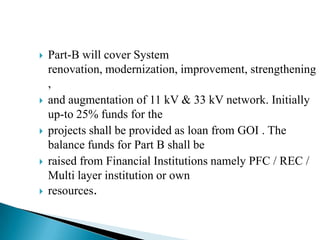
   Part-B will cover System
    renovation, modernization, improvement, strengthening
    ,
   and augmentation of 11 kV & 33 kV network. Initially
    up-to 25% funds for the
   projects shall be provided as loan from GOI . The
    balance funds for Part B shall be
   raised from Financial Institutions namely PFC / REC /
    Multi layer institution or own
   resources.
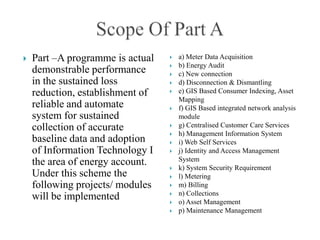
   Part –A programme is actual      a) Meter Data Acquisition
                                     b) Energy Audit
    demonstrable performance         c) New connection
    in the sustained loss            d) Disconnection & Dismantling
    reduction, establishment of      e) GIS Based Consumer Indexing, Asset
                                      Mapping
    reliable and automate            f) GIS Based integrated network analysis
    system for sustained              module
    collection of accurate           g) Centralised Customer Care Services
                                     h) Management Information System
    baseline data and adoption       i) Web Self Services
    of Information Technology I      j) Identity and Access Management
    the area of energy account.       System
                                     k) System Security Requirement
    Under this scheme the            l) Metering
    following projects/ modules      m) Billing
                                     n) Collections
    will be implemented              o) Asset Management
                                     p) Maintenance Management
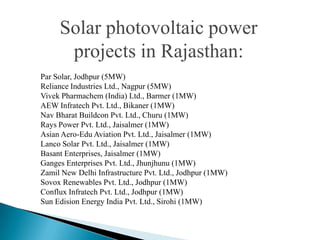
Solar photovoltaic power
      projects in Rajasthan:
Par Solar, Jodhpur (5MW)
Reliance Industries Ltd., Nagpur (5MW)
Vivek Pharmachem (India) Ltd., Barmer (1MW)
AEW Infratech Pvt. Ltd., Bikaner (1MW)
Nav Bharat Buildcon Pvt. Ltd., Churu (1MW)
Rays Power Pvt. Ltd., Jaisalmer (1MW)
Asian Aero-Edu Aviation Pvt. Ltd., Jaisalmer (1MW)
Lanco Solar Pvt. Ltd., Jaisalmer (1MW)
Basant Enterprises, Jaisalmer (1MW)
Ganges Enterprises Pvt. Ltd., Jhunjhunu (1MW)
Zamil New Delhi Infrastructure Pvt. Ltd., Jodhpur (1MW)
Sovox Renewables Pvt. Ltd., Jodhpur (1MW)
Conflux Infratech Pvt. Ltd., Jodhpur (1MW)
Sun Edision Energy India Pvt. Ltd., Sirohi (1MW)
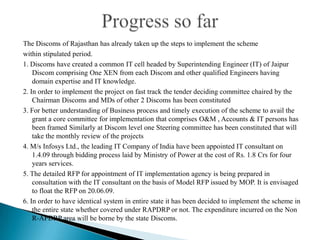
The Discoms of Rajasthan has already taken up the steps to implement the scheme
within stipulated period.
1. Discoms have created a common IT cell headed by Superintending Engineer (IT) of Jaipur
    Discom comprising One XEN from each Discom and other qualified Engineers having
    domain expertise and IT knowledge.
2. In order to implement the project on fast track the tender deciding committee chaired by the
    Chairman Discoms and MDs of other 2 Discoms has been constituted
3. For better understanding of Business process and timely execution of the scheme to avail the
    grant a core committee for implementation that comprises O&M , Accounts & IT persons has
    been framed Similarly at Discom level one Steering committee has been constituted that will
    take the monthly review of the projects
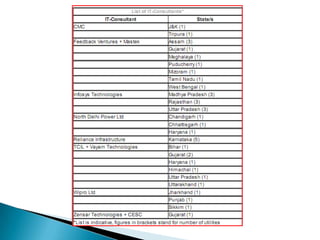
4. M/s Infosys Ltd., the leading IT Company of India have been appointed IT consultant on
    1.4.09 through bidding process laid by Ministry of Power at the cost of Rs. 1.8 Crs for four
    years services.
5. The detailed RFP for appointment of IT implementation agency is being prepared in
    consultation with the IT consultant on the basis of Model RFP issued by MOP. It is envisaged
    to float the RFP on 20.06.09.
6. In order to have identical system in entire state it has been decided to implement the scheme in
    the entire state whether covered under RAPDRP or not. The expenditure incurred on the Non
    R-APDRP area will be borne by the state Discoms.
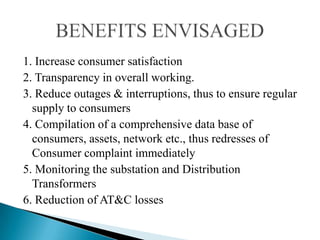
1. Increase consumer satisfaction
2. Transparency in overall working.
3. Reduce outages & interruptions, thus to ensure regular
  supply to consumers
4. Compilation of a comprehensive data base of
  consumers, assets, network etc., thus redresses of
  Consumer complaint immediately
5. Monitoring the substation and Distribution
  Transformers
6. Reduction of AT&C losses
   APDRP, R-APDRP initiative for distribution reform

   DRUM India – Distribution Reform Upgrade, Management
   Four pilot sites (North
    Delhi, Bangalore, Gujarat, Maharashtra)
   Smart Grid Task Force – Headed by Sam Pitroda
   BESCOM project – Bangalore – Integration of renewable and
    distributed energy resources into the grid
   KEPCO project in Kerala India - $10 Billion initiative for
    Smart-Grid
   SA Habitat and Valence Energy – Hyderabad (2009) .
   Distributed generation via roof-top solar for 40% in a micro-
    grid
   Aggressive deployment of Phasor Measurement Units
    (PMUs)
   Northern grid – already installed 4 PMUs, 20 more
    in progress
   Western grid – 25 PMUs
   Eastern grid – 70-80 PMUs

   Control schemes, Software for data visualization,
   In 21st century, if India dreams to emerge out as a
    developed nation, energy efficiency and energy
    conservation integrated with IT infrastructure is required to
    be implemented. Smart Grids is one such option which can
    drive India an inch closer to be a developed nation and
    achieve energy security. Energy Automation will also play a
    vital role in achieving the targets. The trend of Smart Grid
    in US had turned out to be a huge success. The country’s
    economy has improved drastically after implementation and
    power losses have been reduced to around 12-15% in
    US, and in future we hope to achieve the same and if
    possible then much better that the other countries.
QUERIES?
ppt on Smart Grid

ppt on Smart Grid

  • 1.
    PROJECT GUIDE: GROUP MEMBERS: MR. RAJIV RANJAN VIVEK KUMAR SINGH VANDANA AGRAWAL UTKARSH MAURYA UTTAM JALAN GROUP NO. 5
  • 2.
    The Smart Gridis the integration of Electrical & Digital Technologies, Information and communication which facilitates integration of business processes and systems to yield real measurable value across the power delivery chain. It is an intelligent future electricity system that connects all supply, grid and demand elements through a communication system. Smart grid delivers electricity to consumers using two-way digital technology that enable the efficient management of consumers, efficient use of the grid to identify and correct supply- demand imbalances.
  • 3.
    The Smart Gridis the integration of Electrical & Digital Technologies, Information and communication which facilitates integration of business processes and systems to yield real measurable value across the power delivery chain. It is an intelligent future electricity system that connects all supply, grid and demand elements through a communication system. Smart grid delivers electricity to consumers using two-way digital technology that enable the efficient management of consumers, efficient use of the grid to identify and correct supply- demand imbalances. Smart Grid solutions enable utilities to increase energy productivity and power reliability while allowing the customers to manage the usage and costs through real time information exchange. It impacts all the components of the power system like Generation, Transmission and Distribution.
  • 4.
    The Smart Grid focuses in four key areas:-  Generation  Transmission  Distribution  Consumer
  • 5.
    Smart Power Meters  Smart Substations  Smart Distribution  Smart Generation
  • 6.
    A smart meter is an electrical meter that records consumption of electric energy in intervals of an hour or less.  Communicates that information at least daily back to the utility for monitoring and billing purposes.  Smart meters enable two- way communication between the meter and the central system.
  • 7.
    Automated Meter Reading (AMR) Meter can be read remotely using fixed network using:-  hand-held / walk-by  drive-by  energy consumption calculation on annual, monthly, weekly, da ily or on an hourly basis.
  • 8.
    How A SmartMeter Works
  • 9.
    Measure, read andanalyse energy consumption. Read electricity, gas, heat and water meters remotely. Advanced communication system Sophisticated Meter Data Management (“MDM”)
  • 10.
    Smart meters located at homes and businesses compose a neighborhood area network (NAN). • The NAN architecture is assumed to be a wireless mesh network • Meters communicate bidirectional with a neighborhood "collector" via multichip routing. • Collectors are connected directly to a utility provider. • Smart meters have a limited • A meter may malfunction and interfere with the proper forwarding of packets, e.g., delaying, altering, misrouting, dropping, or misinserting packets.
  • 12.
    1. Based onthe new data acquisition technology of phasor measurement. 2. WAM systems acquire current, voltage and frequency phasor measurements, and are taken to PMU(Phasor measurement Unit). 3. The measured quantities include both magnitudes and phase angles, and are time-synchronised via GPS receivers with an accuracy of one microsecond.
  • 16.
    Region Wise PowerGeneration In India
  • 17.
    Region Wise PowerConsumption In India
  • 18.
    Why smart gridsare needed in the future
  • 19.
    About R-APDRP The Govt.of India has proposed to continue R- APDRP during the XI Plan with revised terms and conditions as a Central Sector Scheme. The focus of the program shall be on actual, demonstrable performance in terms of sustained loss reduction. Establishment of reliable and automated systems for sustained collection of accurate base line data and the adoption of Information Technology in the areas of energy accounting will be essential before taking up the regular distribution strengthening projects.
  • 20.
    (a) COVERAGE OF SCHEME  Urban areas–towns and cities with population of more than 30,000 are covered for implementation. Projects under the scheme shall be taken up in Two Parts  Part-A: will cover projects for establishment of baseline data and IT applications for energy accounting / auditing & consumer services. Initially 100% funds for the approved projects shall be provided in the form of loan from GOI. The loan along with the interest shall be converted into a grant once the establishment of the required system is achieved and verified by an independent agency appointed by Ministry of Power through Nodal Agency.
  • 21.
    Part-B will cover System renovation, modernization, improvement, strengthening ,  and augmentation of 11 kV & 33 kV network. Initially up-to 25% funds for the  projects shall be provided as loan from GOI . The balance funds for Part B shall be  raised from Financial Institutions namely PFC / REC / Multi layer institution or own  resources.
  • 22.
    Part –A programme is actual  a) Meter Data Acquisition  b) Energy Audit demonstrable performance  c) New connection in the sustained loss  d) Disconnection & Dismantling reduction, establishment of  e) GIS Based Consumer Indexing, Asset Mapping reliable and automate  f) GIS Based integrated network analysis system for sustained module collection of accurate  g) Centralised Customer Care Services  h) Management Information System baseline data and adoption  i) Web Self Services of Information Technology I  j) Identity and Access Management the area of energy account. System  k) System Security Requirement Under this scheme the  l) Metering following projects/ modules  m) Billing  n) Collections will be implemented  o) Asset Management  p) Maintenance Management
  • 23.
    Solar photovoltaic power projects in Rajasthan: Par Solar, Jodhpur (5MW) Reliance Industries Ltd., Nagpur (5MW) Vivek Pharmachem (India) Ltd., Barmer (1MW) AEW Infratech Pvt. Ltd., Bikaner (1MW) Nav Bharat Buildcon Pvt. Ltd., Churu (1MW) Rays Power Pvt. Ltd., Jaisalmer (1MW) Asian Aero-Edu Aviation Pvt. Ltd., Jaisalmer (1MW) Lanco Solar Pvt. Ltd., Jaisalmer (1MW) Basant Enterprises, Jaisalmer (1MW) Ganges Enterprises Pvt. Ltd., Jhunjhunu (1MW) Zamil New Delhi Infrastructure Pvt. Ltd., Jodhpur (1MW) Sovox Renewables Pvt. Ltd., Jodhpur (1MW) Conflux Infratech Pvt. Ltd., Jodhpur (1MW) Sun Edision Energy India Pvt. Ltd., Sirohi (1MW)
  • 26.
    The Discoms ofRajasthan has already taken up the steps to implement the scheme within stipulated period. 1. Discoms have created a common IT cell headed by Superintending Engineer (IT) of Jaipur Discom comprising One XEN from each Discom and other qualified Engineers having domain expertise and IT knowledge. 2. In order to implement the project on fast track the tender deciding committee chaired by the Chairman Discoms and MDs of other 2 Discoms has been constituted 3. For better understanding of Business process and timely execution of the scheme to avail the grant a core committee for implementation that comprises O&M , Accounts & IT persons has been framed Similarly at Discom level one Steering committee has been constituted that will take the monthly review of the projects 4. M/s Infosys Ltd., the leading IT Company of India have been appointed IT consultant on 1.4.09 through bidding process laid by Ministry of Power at the cost of Rs. 1.8 Crs for four years services. 5. The detailed RFP for appointment of IT implementation agency is being prepared in consultation with the IT consultant on the basis of Model RFP issued by MOP. It is envisaged to float the RFP on 20.06.09. 6. In order to have identical system in entire state it has been decided to implement the scheme in the entire state whether covered under RAPDRP or not. The expenditure incurred on the Non R-APDRP area will be borne by the state Discoms.
  • 30.
    1. Increase consumersatisfaction 2. Transparency in overall working. 3. Reduce outages & interruptions, thus to ensure regular supply to consumers 4. Compilation of a comprehensive data base of consumers, assets, network etc., thus redresses of Consumer complaint immediately 5. Monitoring the substation and Distribution Transformers 6. Reduction of AT&C losses
  • 35.
    APDRP, R-APDRP initiative for distribution reform  DRUM India – Distribution Reform Upgrade, Management  Four pilot sites (North Delhi, Bangalore, Gujarat, Maharashtra)  Smart Grid Task Force – Headed by Sam Pitroda  BESCOM project – Bangalore – Integration of renewable and distributed energy resources into the grid  KEPCO project in Kerala India - $10 Billion initiative for Smart-Grid  SA Habitat and Valence Energy – Hyderabad (2009) .  Distributed generation via roof-top solar for 40% in a micro- grid
  • 37.
    Aggressive deployment of Phasor Measurement Units (PMUs)  Northern grid – already installed 4 PMUs, 20 more in progress  Western grid – 25 PMUs  Eastern grid – 70-80 PMUs  Control schemes, Software for data visualization,
  • 40.
    In 21st century, if India dreams to emerge out as a developed nation, energy efficiency and energy conservation integrated with IT infrastructure is required to be implemented. Smart Grids is one such option which can drive India an inch closer to be a developed nation and achieve energy security. Energy Automation will also play a vital role in achieving the targets. The trend of Smart Grid in US had turned out to be a huge success. The country’s economy has improved drastically after implementation and power losses have been reduced to around 12-15% in US, and in future we hope to achieve the same and if possible then much better that the other countries.
  • 41.