TOPIC:
Smart Grid
SELF STUDY COURSE-1
(An Autonomous institute)
ABSTRACT
• A smart grid is a digitally enabled electrical
grid.
• It gathers, distributes, and acts on information
about the behavior of all participants.
• An electrical grid is not a single entity.
• Smart grids increase the connectivity,
automation and coordination
• Perform either long distance transmission or
local distribution tasks.
SMART GRID
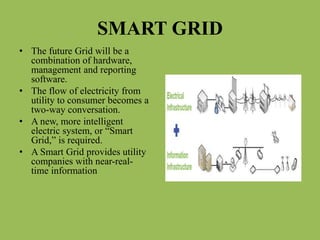
• The future Grid will be a
combination of hardware,
management and reporting
software.
• The flow of electricity from
utility to consumer becomes a
two-way conversation.
• A new, more intelligent
electric system, or “Smart
Grid,” is required.
• A Smart Grid provides utility
companies with near-real-
time information
COMPONENTS OF A SMART GRID
A Smart Grid comprises three major components:
1) Demand management
2) Distributed electricity generation
3) Transmission and Distribution grid management.
4) Advanced software& hardware, advanced
materials
5) Communication systems
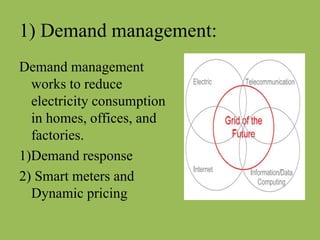
1) Demand management:
Demand management
works to reduce
electricity consumption
in homes, offices, and
factories.
1)Demand response
2) Smart meters and
Dynamic pricing
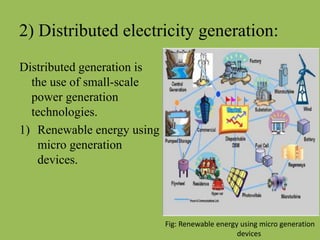
2) Distributed electricity generation:
Distributed generation is
the use of small-scale
power generation
technologies.
1) Renewable energy using
micro generation
devices.
Fig: Renewable energy using micro generation
devices
3) Transmission and Distribution grid management:
Utility companies are turning to IT solutions to
monitor and control the electrical grid in real
time.
1) Grid monitoring and control
2) Grid security and surveillance
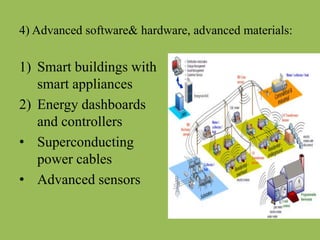
4) Advanced software& hardware, advanced materials:
1) Smart buildings with
smart appliances
2) Energy dashboards
and controllers
• Superconducting
power cables
• Advanced sensors
5) Communication systems:
• Intelligent Network Agent gathers data, makes
decision about local switching of control
functions
• Communicates with control centers Integrated
Enterprise Software will have Custom-built
applications
• Energy Management System processes Load
analysis and forecasting.
• Wireless Mesh Networking for the Smart Grid
SMART GRID BENEFITS
A Smart Grid will:
• Enable consumers to manage their own energy consumption
through dashboards and electronic energy advisories.
• Broadcast demand-response alerts to lower peak energy
demand
• A Smart Grid will encourage home and building owners
• Ex: The introduction of PHEVs to act as temporary
electricity storage devices,
• Utility companies can implement smart electric meters
• Underground transmission and distribution lines can control
the meter theft
Benefits
Remedial ways:
• Increase distributed solar and wind power generation
• Use demand management
• Monitor and control the energy grid in near-real time
Examples:
• Rooftop solar panels need to notify backup power
generators
• Utility companies need to communicate with and
control appliances
• Factory operators must know the cost of electric power
every few minutes
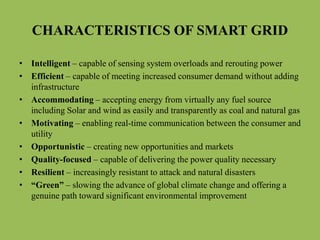
CHARACTERISTICS OF SMART GRID
• Intelligent – capable of sensing system overloads and rerouting power
• Efficient – capable of meeting increased consumer demand without adding
infrastructure
• Accommodating – accepting energy from virtually any fuel source
including Solar and wind as easily and transparently as coal and natural gas
• Motivating – enabling real-time communication between the consumer and
utility
• Opportunistic – creating new opportunities and markets
• Quality-focused – capable of delivering the power quality necessary
• Resilient – increasingly resistant to attack and natural disasters
• “Green” – slowing the advance of global climate change and offering a
genuine path toward significant environmental improvement
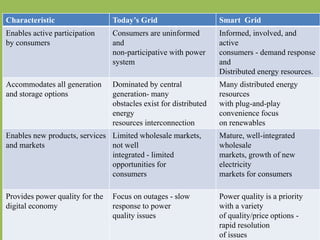
Characteristic Today’s Grid Smart Grid
Enables active participation
by consumers
Consumers are uninformed
and
non-participative with power
system
Informed, involved, and
active
consumers - demand response
and
Distributed energy resources.
Accommodates all generation
and storage options
Dominated by central
generation- many
obstacles exist for distributed
energy
resources interconnection
Many distributed energy
resources
with plug-and-play
convenience focus
on renewables
Enables new products, services
and markets
Limited wholesale markets,
not well
integrated - limited
opportunities for
consumers
Mature, well-integrated
wholesale
markets, growth of new
electricity
markets for consumers
Provides power quality for the
digital economy
Focus on outages - slow
response to power
quality issues
Power quality is a priority
with a variety
of quality/price options -
rapid resolution
of issues
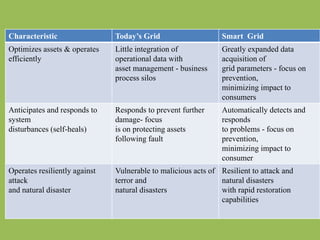
Characteristic Today’s Grid Smart Grid
Optimizes assets & operates
efficiently
Little integration of
operational data with
asset management - business
process silos
Greatly expanded data
acquisition of
grid parameters - focus on
prevention,
minimizing impact to
consumers
Anticipates and responds to
system
disturbances (self-heals)
Responds to prevent further
damage- focus
is on protecting assets
following fault
Automatically detects and
responds
to problems - focus on
prevention,
minimizing impact to
consumer
Operates resiliently against
attack
and natural disaster
Vulnerable to malicious acts of
terror and
natural disasters
Resilient to attack and
natural disasters
with rapid restoration
capabilities
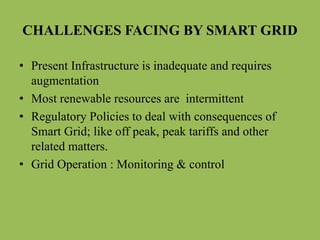
CHALLENGES FACING BY SMART GRID
• Present Infrastructure is inadequate and requires
augmentation
• Most renewable resources are intermittent
• Regulatory Policies to deal with consequences of
Smart Grid; like off peak, peak tariffs and other
related matters.
• Grid Operation : Monitoring & control
CONCLUSION
• To make the Smart Grid a Reality, there is a growing consensus in
governments, regulators, utility companies, and businesses.
• Rising fuel costs, underinvestment in an infrastructure, and climate
change are all converging.
• The core technology and communications standards required to
develop the Smart Grid are currently being developed.
• To accelerate development, state, county, and local governments,
electric utility companies, public electricity regulators, and IT
companies must all come together and work toward a common
goal.
• Prepare for an electric system that is Cleaner and more efficient,
reliable and responsive –A smarter grid.
THANKYOU

Smart grid

  • 1.
    TOPIC: Smart Grid SELF STUDYCOURSE-1 (An Autonomous institute)
  • 2.
    ABSTRACT • A smartgrid is a digitally enabled electrical grid. • It gathers, distributes, and acts on information about the behavior of all participants. • An electrical grid is not a single entity. • Smart grids increase the connectivity, automation and coordination • Perform either long distance transmission or local distribution tasks.
  • 3.
    SMART GRID • Thefuture Grid will be a combination of hardware, management and reporting software. • The flow of electricity from utility to consumer becomes a two-way conversation. • A new, more intelligent electric system, or “Smart Grid,” is required. • A Smart Grid provides utility companies with near-real- time information
  • 4.
    COMPONENTS OF ASMART GRID A Smart Grid comprises three major components: 1) Demand management 2) Distributed electricity generation 3) Transmission and Distribution grid management. 4) Advanced software& hardware, advanced materials 5) Communication systems
  • 5.
    1) Demand management: Demandmanagement works to reduce electricity consumption in homes, offices, and factories. 1)Demand response 2) Smart meters and Dynamic pricing
  • 6.
    2) Distributed electricitygeneration: Distributed generation is the use of small-scale power generation technologies. 1) Renewable energy using micro generation devices. Fig: Renewable energy using micro generation devices
  • 7.
    3) Transmission andDistribution grid management: Utility companies are turning to IT solutions to monitor and control the electrical grid in real time. 1) Grid monitoring and control 2) Grid security and surveillance
  • 8.
    4) Advanced software&hardware, advanced materials: 1) Smart buildings with smart appliances 2) Energy dashboards and controllers • Superconducting power cables • Advanced sensors
  • 9.
    5) Communication systems: •Intelligent Network Agent gathers data, makes decision about local switching of control functions • Communicates with control centers Integrated Enterprise Software will have Custom-built applications • Energy Management System processes Load analysis and forecasting. • Wireless Mesh Networking for the Smart Grid
  • 10.
    SMART GRID BENEFITS ASmart Grid will: • Enable consumers to manage their own energy consumption through dashboards and electronic energy advisories. • Broadcast demand-response alerts to lower peak energy demand • A Smart Grid will encourage home and building owners • Ex: The introduction of PHEVs to act as temporary electricity storage devices, • Utility companies can implement smart electric meters • Underground transmission and distribution lines can control the meter theft
  • 11.
    Benefits Remedial ways: • Increasedistributed solar and wind power generation • Use demand management • Monitor and control the energy grid in near-real time Examples: • Rooftop solar panels need to notify backup power generators • Utility companies need to communicate with and control appliances • Factory operators must know the cost of electric power every few minutes
  • 12.
    CHARACTERISTICS OF SMARTGRID • Intelligent – capable of sensing system overloads and rerouting power • Efficient – capable of meeting increased consumer demand without adding infrastructure • Accommodating – accepting energy from virtually any fuel source including Solar and wind as easily and transparently as coal and natural gas • Motivating – enabling real-time communication between the consumer and utility • Opportunistic – creating new opportunities and markets • Quality-focused – capable of delivering the power quality necessary • Resilient – increasingly resistant to attack and natural disasters • “Green” – slowing the advance of global climate change and offering a genuine path toward significant environmental improvement
  • 13.
    Characteristic Today’s GridSmart Grid Enables active participation by consumers Consumers are uninformed and non-participative with power system Informed, involved, and active consumers - demand response and Distributed energy resources. Accommodates all generation and storage options Dominated by central generation- many obstacles exist for distributed energy resources interconnection Many distributed energy resources with plug-and-play convenience focus on renewables Enables new products, services and markets Limited wholesale markets, not well integrated - limited opportunities for consumers Mature, well-integrated wholesale markets, growth of new electricity markets for consumers Provides power quality for the digital economy Focus on outages - slow response to power quality issues Power quality is a priority with a variety of quality/price options - rapid resolution of issues
  • 14.
    Characteristic Today’s GridSmart Grid Optimizes assets & operates efficiently Little integration of operational data with asset management - business process silos Greatly expanded data acquisition of grid parameters - focus on prevention, minimizing impact to consumers Anticipates and responds to system disturbances (self-heals) Responds to prevent further damage- focus is on protecting assets following fault Automatically detects and responds to problems - focus on prevention, minimizing impact to consumer Operates resiliently against attack and natural disaster Vulnerable to malicious acts of terror and natural disasters Resilient to attack and natural disasters with rapid restoration capabilities
  • 15.
    CHALLENGES FACING BYSMART GRID • Present Infrastructure is inadequate and requires augmentation • Most renewable resources are intermittent • Regulatory Policies to deal with consequences of Smart Grid; like off peak, peak tariffs and other related matters. • Grid Operation : Monitoring & control
  • 16.
    CONCLUSION • To makethe Smart Grid a Reality, there is a growing consensus in governments, regulators, utility companies, and businesses. • Rising fuel costs, underinvestment in an infrastructure, and climate change are all converging. • The core technology and communications standards required to develop the Smart Grid are currently being developed. • To accelerate development, state, county, and local governments, electric utility companies, public electricity regulators, and IT companies must all come together and work toward a common goal. • Prepare for an electric system that is Cleaner and more efficient, reliable and responsive –A smarter grid.
  • 17.