Presented by Guided by
USN: 2SA12EE005 Prof. Abdul Munaf
Jenifer . P. Samuel
Contents of Discussion
 Introduction
 Different types of systems in Smart Grid
 Smart Infrastructure system
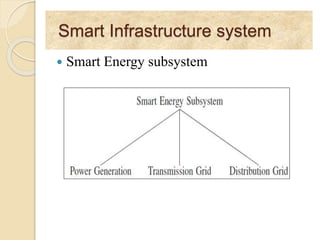
1. Smart Energy subsystem
2. Smart Information subsystem
 Smart Metering
 Smart Monitoring and Measurement
3. Smart Communication subsystem
• Benefits of Smart Grid
• Conclusion and Future scope
Introduction
 What is a smart Grid ?
 Why we need a smart grid ?
 Comparison with Existing grid
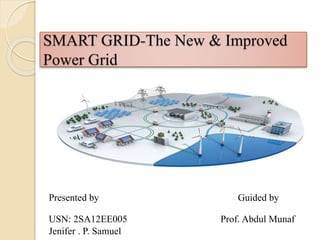
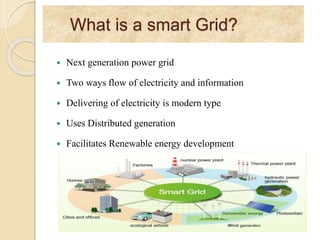
What is a smart Grid?
 Next generation power grid
 Two ways flow of electricity and information
 Delivering of electricity is modern type
 Uses Distributed generation
 Facilitates Renewable energy development
Why we need a smart grid?
 Ever Increasing demand for electricity
 Power outage & quality concerns
 Depleting Fossil fuels
 Environmental concerns
 Energy storage problem
 No Consumer participation in energy conservation
To overcome all the above listed difficulties we need
Smart grid.
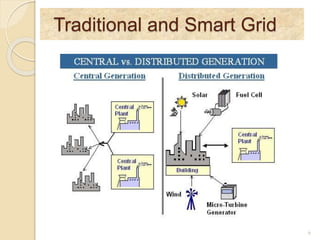
Traditional and Smart Grid
6
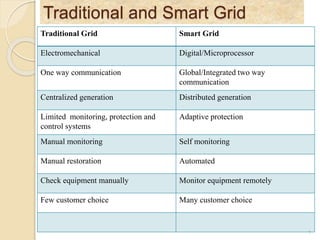
Traditional and Smart Grid
Traditional Grid Smart Grid
Electromechanical Digital/Microprocessor
One way communication Global/Integrated two way
communication
Centralized generation Distributed generation
Limited monitoring, protection and
control systems
Adaptive protection
Manual monitoring Self monitoring
Manual restoration Automated
Check equipment manually Monitor equipment remotely
Few customer choice Many customer choice
7
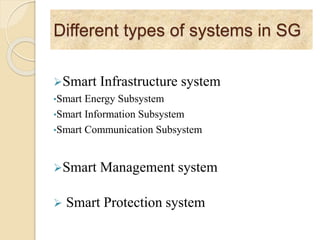
Different types of systems in SG
Smart Infrastructure system
•Smart Energy Subsystem
•Smart Information Subsystem
•Smart Communication Subsystem
Smart Management system
 Smart Protection system
Smart Infrastructure system
 Smart Energy subsystem
1. Power Generation:
 Distributed generation(DG)- Solar panels, 3KW
Small scale wind turbines to
Fuel Cells etc.. 10MW
Group of DGs form “Virtual Power Plant”
+ves:
 Reduced dependency on main grid
 Increased reliability and power quality
 Environment friendly
-ves:
 Inconsistent yield
 High Cost/unit since installation is costly.
“Research work is in full swing to reduce cost”
Smart Energy Subsystem
2. Transmission Grid
 Smart transmission networks incorporate advance
sensing , communication technologies, digitalization,
automatic responses to monitor operating conditions of
transmission lines.
 Smart transmission grid is an integrated system that
consists of three interactive components: smart control
system, smart power transmission networks, smart
substation.
Smart Energy Subsystem
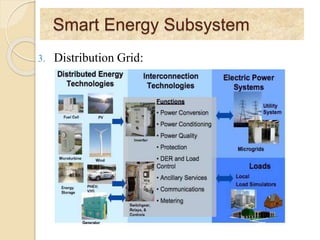
3. Distribution Grid:
 Small-scale power generation technologies that produce electricity at a site
close to customers or that are tied to an electric distribution system. Thus
connected at distribution voltage levels.
 Connected close to loads being served.
 Typically 1 kW – 50 MW capacity or less.
 Can also be called on-site generation, dispersed generation or decentralized
generation.
Smart Energy Subsystem
3. Distribution Grid:
Smart Energy Subsystem
4. New Grid Paradigms:
 G2V & V2G technology :
 Hybrid cars can generate electricity with the fuel when parked
 Excess Charge of Electrical vehicle serves as Electric storage
 Solar Hybrid Vehicles----Generate & store when Parked
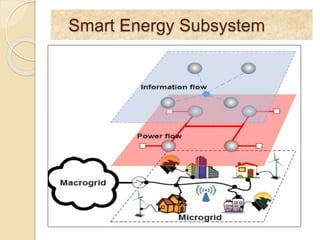
 Micro-grid :
 Localized group of Generation , Energy storage & loads
 Can be connected to Macro-grid or can be islanded
Smart Energy Subsystem
 The single point of common coupling with the macro
grid can be disconnected and the microgrid functions
automatically. This operation is called as islanded
microgrid.
Islanding
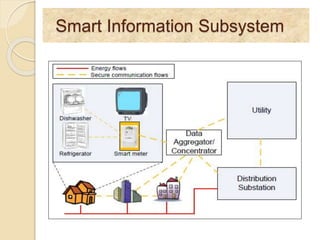
Smart Information Subsystem
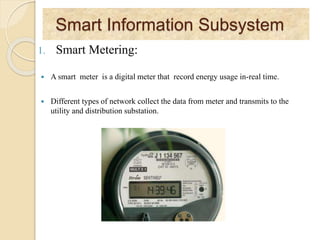
1. Smart Metering:
 A smart meter is a digital meter that record energy usage in-real time.
 Different types of network collect the data from meter and transmits to the
utility and distribution substation.
Smart Information Subsystem
2. Smart Monitoring & measurements
 Smart Sensors:
 Detects mechanical failures like conductor breakage, hotspots, insulator
damage
 Real time mechanical & electrical stress measurement& identification of
permanent faults & suggest control measures to operators
 WSNs (Wireless sensor network)
Smart Communication
Subsystem
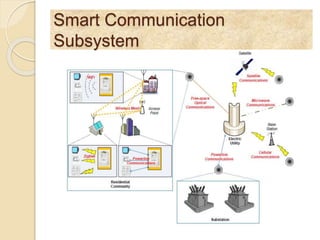
 Communication is needed for data transmission between
smart meters and electric utilities.
 The two main communication medias are
 Wired
 Wireless
Smart Communication
Subsystem
Benefits Of Smart Grid
 Improving power reliability and quality.
 Automatic maintenance and operation.
 Reducing green house gas emissions by
enabling electric vehicles and new power
sources.
 The manufacture, installation operation and
maintenance of the smart grid and its
components will create new jobs.
 Increases consumer choice.
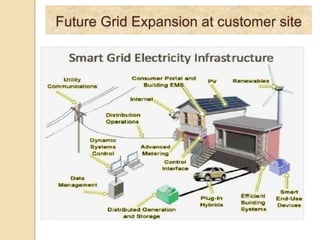
Future Grid Expansion at customer site
Future scope
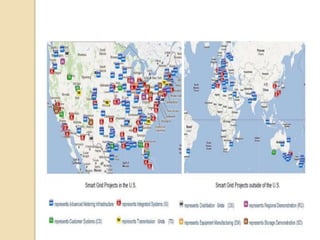
 Smart Grid is implemented in various countries. But
Germany being the first to use.
 Current Smart Grid activities in India are:
 First smart grid pilot project is started in Mysore, Karnataka.
 SMART GRID Project BESCOM (Bangalore) integration of
renewable and decentralized energy sources in power grid.
 Four pilot sites (North Delhi, Bangalore, Gujarat,
Maharashtra).
Conclusion
 A Smart Grid impact on a power system and generation is likely to
drive towards more renewable generation.
 Usage of DG, reduces Green house gases.
 The pressure on the existing conventional resources will also
decrease.
 The Smart Grid accommodates generation and storage options; it
also provides reliable power that is relatively interruption-free. ƒ
 Thus Smart Grid is the future grid with intelligence embedded in it,
with self-healing capabilities.
Reference
 [1] I. F. Akyildiz, W. Su, Y. Sankarasubramaniam, and E. Cayirci. A survey
on sensor networks. IEEE Commun. Mag., 40(8):102–114, 2002.
 [2] I. F. Akyildiz and X. Wang. A survey on wireless mesh networks. IEEE
Radio Communications, pages 23–30, 2005.
 [3] B. Akyol, H. Kirkham, S. Clements, and M. Hadley. A survey of
wireless communications for the electric power system. Prepared for the
U.S. Department of Energy, 2010.
 [4] H. Al-Nasseri and M. A. Redfern. A new voltage based relay scheme to
protect micro-grids dominated by embedded generation using solid state
converters. 19th International Conference Electricity Distribution, 2007.
 [5] American Transmission Company. American Transmission Company
Phasor Measurement Unit Project Description, http://www.smartgrid.
gov/sites/default/files/09-0282-atc-project-description-07-11-11.pdf.
 [6] P. B. Andersen, B. Poulsen, M. Decker, C. Træholt, and J. Østergaard.
Evaluation of a generic virtual power plant framework using service
oriented architecture. IEEE PECon’08, pages 1212–1217, 2008.
THANK YOU

Smart grid jenifer 120316

  • 1.
    Presented by Guidedby USN: 2SA12EE005 Prof. Abdul Munaf Jenifer . P. Samuel
  • 2.
    Contents of Discussion Introduction  Different types of systems in Smart Grid  Smart Infrastructure system 1. Smart Energy subsystem 2. Smart Information subsystem  Smart Metering  Smart Monitoring and Measurement 3. Smart Communication subsystem • Benefits of Smart Grid • Conclusion and Future scope
  • 3.
    Introduction  What isa smart Grid ?  Why we need a smart grid ?  Comparison with Existing grid
  • 4.
    What is asmart Grid?  Next generation power grid  Two ways flow of electricity and information  Delivering of electricity is modern type  Uses Distributed generation  Facilitates Renewable energy development
  • 5.
    Why we needa smart grid?  Ever Increasing demand for electricity  Power outage & quality concerns  Depleting Fossil fuels  Environmental concerns  Energy storage problem  No Consumer participation in energy conservation To overcome all the above listed difficulties we need Smart grid.
  • 6.
  • 7.
    Traditional and SmartGrid Traditional Grid Smart Grid Electromechanical Digital/Microprocessor One way communication Global/Integrated two way communication Centralized generation Distributed generation Limited monitoring, protection and control systems Adaptive protection Manual monitoring Self monitoring Manual restoration Automated Check equipment manually Monitor equipment remotely Few customer choice Many customer choice 7
  • 8.
    Different types ofsystems in SG Smart Infrastructure system •Smart Energy Subsystem •Smart Information Subsystem •Smart Communication Subsystem Smart Management system  Smart Protection system
  • 9.
    Smart Infrastructure system Smart Energy subsystem
  • 10.
    1. Power Generation: Distributed generation(DG)- Solar panels, 3KW Small scale wind turbines to Fuel Cells etc.. 10MW Group of DGs form “Virtual Power Plant” +ves:  Reduced dependency on main grid  Increased reliability and power quality  Environment friendly -ves:  Inconsistent yield  High Cost/unit since installation is costly. “Research work is in full swing to reduce cost” Smart Energy Subsystem
  • 11.
    Smart Energy Subsystem 2.Transmission Grid  Smart transmission networks incorporate advance sensing , communication technologies, digitalization, automatic responses to monitor operating conditions of transmission lines.  Smart transmission grid is an integrated system that consists of three interactive components: smart control system, smart power transmission networks, smart substation.
  • 12.
    Smart Energy Subsystem 3.Distribution Grid:  Small-scale power generation technologies that produce electricity at a site close to customers or that are tied to an electric distribution system. Thus connected at distribution voltage levels.  Connected close to loads being served.  Typically 1 kW – 50 MW capacity or less.  Can also be called on-site generation, dispersed generation or decentralized generation.
  • 13.
    Smart Energy Subsystem 3.Distribution Grid:
  • 14.
    Smart Energy Subsystem 4.New Grid Paradigms:  G2V & V2G technology :  Hybrid cars can generate electricity with the fuel when parked  Excess Charge of Electrical vehicle serves as Electric storage  Solar Hybrid Vehicles----Generate & store when Parked  Micro-grid :  Localized group of Generation , Energy storage & loads  Can be connected to Macro-grid or can be islanded
  • 15.
  • 16.
     The singlepoint of common coupling with the macro grid can be disconnected and the microgrid functions automatically. This operation is called as islanded microgrid. Islanding
  • 17.
    Smart Information Subsystem 1.Smart Metering:  A smart meter is a digital meter that record energy usage in-real time.  Different types of network collect the data from meter and transmits to the utility and distribution substation.
  • 18.
  • 19.
    Smart Information Subsystem 2.Smart Monitoring & measurements  Smart Sensors:  Detects mechanical failures like conductor breakage, hotspots, insulator damage  Real time mechanical & electrical stress measurement& identification of permanent faults & suggest control measures to operators  WSNs (Wireless sensor network)
  • 20.
    Smart Communication Subsystem  Communicationis needed for data transmission between smart meters and electric utilities.  The two main communication medias are  Wired  Wireless
  • 21.
  • 22.
    Benefits Of SmartGrid  Improving power reliability and quality.  Automatic maintenance and operation.  Reducing green house gas emissions by enabling electric vehicles and new power sources.  The manufacture, installation operation and maintenance of the smart grid and its components will create new jobs.  Increases consumer choice.
  • 23.
    Future Grid Expansionat customer site
  • 24.
    Future scope  SmartGrid is implemented in various countries. But Germany being the first to use.  Current Smart Grid activities in India are:  First smart grid pilot project is started in Mysore, Karnataka.  SMART GRID Project BESCOM (Bangalore) integration of renewable and decentralized energy sources in power grid.  Four pilot sites (North Delhi, Bangalore, Gujarat, Maharashtra).
  • 25.
    Conclusion  A SmartGrid impact on a power system and generation is likely to drive towards more renewable generation.  Usage of DG, reduces Green house gases.  The pressure on the existing conventional resources will also decrease.  The Smart Grid accommodates generation and storage options; it also provides reliable power that is relatively interruption-free. ƒ  Thus Smart Grid is the future grid with intelligence embedded in it, with self-healing capabilities.
  • 28.
    Reference  [1] I.F. Akyildiz, W. Su, Y. Sankarasubramaniam, and E. Cayirci. A survey on sensor networks. IEEE Commun. Mag., 40(8):102–114, 2002.  [2] I. F. Akyildiz and X. Wang. A survey on wireless mesh networks. IEEE Radio Communications, pages 23–30, 2005.  [3] B. Akyol, H. Kirkham, S. Clements, and M. Hadley. A survey of wireless communications for the electric power system. Prepared for the U.S. Department of Energy, 2010.  [4] H. Al-Nasseri and M. A. Redfern. A new voltage based relay scheme to protect micro-grids dominated by embedded generation using solid state converters. 19th International Conference Electricity Distribution, 2007.  [5] American Transmission Company. American Transmission Company Phasor Measurement Unit Project Description, http://www.smartgrid. gov/sites/default/files/09-0282-atc-project-description-07-11-11.pdf.  [6] P. B. Andersen, B. Poulsen, M. Decker, C. Træholt, and J. Østergaard. Evaluation of a generic virtual power plant framework using service oriented architecture. IEEE PECon’08, pages 1212–1217, 2008.
  • 29.