Smart Grid
Technologies
M.Tech, III Semester
Course Teacher:
Dr. MAHABOOB SHAREEF SYED
Professor
UNIT – 1: INTRODUCTION TO SMART GRID
UNIT – 2 : SMART GRID TECHNOLOGIES: PART 1
UNIT – 3 : SMART GRID TECHNOLOGIES: PART 2
UNIT – 4 : MICRO GRIDS AND DISTRIBUTED
ENERGY RESOURCES
UNIT – 5 : POWER QUALITY MANAGEMENT IN
SMART GRID
Syllabus
Students should able to
Students Should be able to
 Understand smart grids and analyze the smart grid
policies and developments in smart grids.
 Develop concepts of smart grid technologies in hybrid
electrical vehicles etc..
 Understand smart substations, feeder automation, gis
etc..
 Analyze micro grids and distributed generation
systems.
 Analyze the effect of power quality in smart grid and to
understand latest developments in ICT for smart grid.
Course Outcomes
Students should able to
 Evolution of Electric Grid
 Concept of Smart Grid, Definitions
 Need of Smart Grid
 Functions of Smart Grid
 Opportunities & Barriers of Smart Grid
 Difference between conventional & smart grid
 Concept of Resilient & Self-Healing Grid
 Present development & International policies on Smart
Grid.
 Case study of Smart Grid.
Unit – 1: Introduction
to Smart Grid
Students should able to
 A Smart Grid is an electricity Network based on
Digital Technology that is used to supply
electricity to consumers via Two-Way Digital
Communication.
 This system allows for monitoring, analysis,
control and communication within the supply
chain to help improve efficiency, reduce the
energy consumption and cost and maximize the
transparency and reliability of the energy supply
chain.
What is SMART
GRID ?
Students should able to
The areas of application of smart grids include:
 Smart meters integration
 Demand management
 Smart integration of generated energy
 Administration of storage and renewable
resources.
What is SMART
GRID ?
Students should able to
 Reduction in AT & C losses (Aggregate Technical & Commercial losses)
 Reduction in CO2 Emission
 Enabling Energy Audit
 Reduction in Cost Billing
 Remote Load Control
 Shifting of Peak requirement to non-peak time [Peak Shaving]
 Integration of Renewable Energy
 Clean Energy Development
 Provides Power Quality
 Optimizes Assets and Operates Efficiently
 Safety, Reliable and Efficient
 Improved National Security
 Improved Environmental Conditions
 Improved Economic Growth
Benefits of SMART
GRID
Students should able to
 While everyone generally agrees that the term “smart grid”
implies a modernization of the existing electric system,
there are divergent opinions on how modernization
translates into specific policy actions or resource decisions.
 The Smart Grid is a system of information and
communication applications integrated with electric
generator, transmission, distribution and end use
technologies.
 Enable consumers to manage their usage and choose the
most economically efficient offering. – Promote Customer
Choice.
SMART GRID
Definition
Students should able to
 Use automation and alternative resources to maintain
delivery system reliability and stability – Improve
reliability.
 Utilize the most environmentally gentle renewable, storage
and generation alternatives – Integrate renewables.
The need to integrate all of the systems that generate and
supply energy with customer usage is one of the very certain
design principles of smart grid.
System integration will be accomplished using information
and communication systems .
SMART GRID
Definition
Students should able to
 The existing utility grid is a centralized system where
power flows in one direction, from generation resources
through the transmission-distribution system to the
customer.
 Generation may or may not be located in the same
geographic area as the load being served, which can often
require transmission from distant locations.
The existing utility
Grid
Students should able to
 Existing utility grids may or may not include
 Supervisory Control and Data Acquisition (SCADA)
sensors, computing, and communications to monitor grid
performance.
 Utility systems may depend instead on separate reporting
systems, periodic studies, and standalone outage
management applications.
 Information to the customer is generally limited to a periodic bill
for services consumed in a prior time period or billing cycle.
Utility web sites may or may not provide customers access to
their usage data.
 Energy usage is usually presented as an aggregate kWh value for
a specific billing cycle, which may or may not align with monthly
calendar boundaries.
The existing utility
Grid
Students should able to
 Generator alternatives added through the system.
 Power flow in both the directions between the utility and
the customer.
 T&D system instrumented with sensors and switches.
 Customers enabled with smart appliances.
How Smart Grid is
different ?
Students should able to
 The first step to transform the existing grid into a smart
grid requires the addition of generation options throughout
the grid at bulk power transfer points, substations, other
distribution locations and on the customer side of the
meter.
 Adding generation throughout the grid allows power
sources to be located closer to their point of use, reducing
investment in transmission and distribution, and in many
cases reducing energy losses.
 Implementation of widespread, smaller generation
resources diversifies supply, reduces risks of major
outages, and improves overall reliability
How Smart Grid is
different ?
Students should able to
 Sensors, remote monitoring, automated switches,
reclosers, upgraded capacitor banks and other equipment
may be integrated into the grid to provide end-to-end
monitoring and control of the transmission and
distribution network.
 Equivalent additions on the customer side of the meter
would include automated control systems and smart
appliances with embedded price and event-sensing and
energy management capability.
 Sensors provide the information to better understand grid
operation, while control devices provide options to better
manage system operation.
How Smart Grid is
different ?
Students should able to How Smart Grid is
different ?
Students should able to
 It is necessary to transform and create a smart grid is the
addition of communication systems to support information
flows that fully link both the utility and customer sides of
the grid.
 On the utility side of the grid, sensors will be integrated
with high speed switches and expert systems to
automatically balance power flows, isolate and re-route
power around disturbances , report outages, and
continuously update system operators with weather,
demand, and performance data from throughout the system.
Need of Smart Grid
Students should able to
 On the customer side of the grid, near real-time meter data
will be available so customers can better understand how
individual appliances and behavior impact their energy
usage and costs.
 Broadcast price, reliability and event signals may be
monitored directly by smart appliances or through home
automation gateways, responding automatically to
customer preferences to defer or reduce usage during high-
priced or constrained reliability periods.
 Third-party service providers may also provide customers with a
range of information and energy management services.
Need of Smart Grid
Students should able to
1. Utility Business Model
2. Obligation to Serve
3. Generation Resources
4. Transmission / Distribution
5. Metering-Measurement
6. Rates (Pricing)
7. Customer Role
Need of Smart Grid
(Advantages)
Students should able to Functions of Smart
Grid
1 Advanced Metering Infrastructure
2 Smart Distribution
. Self-Healing . Outage Management
. Peak Management . LT Network Control
3 Two way communication
4 Network Operations
5 Business Process
6 Regulatory Policies
7 Smart Pricing
8 Demand Side Management
9 Energy Efficient Process & Appliances
10 Home Area Networking
11 Renewable sources
. Plug in Electric Vehicles . Storage Batteries
Students should able to Challenges of Smart
Grid
Technical Challenges
1 Inadequacies in grid infra structure
2 Cyber security
3 Storage concerns
4 Data management
5 Communication issues
6 Stability concerns
7 Energy management and electric vehicle
Students should able to Challenges of Smart
Grid
Socio-economic challenges
1 High capital investment
2 Stakeholder’s engagement
3 System operation aspects
4 Lack of awareness
5 Privacy
6 Fear of obsolescence
7 Fear of electricity charge increase
8 New tariff
9 Radio frequency (RF) signal and health issues
Students should able to Challenges of Smart
Grid
Miscellaneous challenges
1 Regulation and policies
2 Power theft
3 Work force
4 Co-ordination
Students should able to Opportunities of
Smart Grid
The basic Research and Development and Fundamental
Technologies that will move the Smart Grid forward
1 Integrated Communications
2 Sensing and Measurement Technologies
3 Advanced Components
4 Advanced Control Methods
Before looking at the particular technologies for moving forward,
the government and utilities have shared input about basic
functions they require of the smarter grid SG (Regional & National)
Opportunities.
1 Be self-healing
2 Resist attack
3 Provide higher quality power that will save money lost on
outages
Students should able to Opportunities of
Smart Grid
4 Motivate consumers to actively participate in grid operations
5 Accommodate all generation and energy storage options
SG Analysis Objectives for Global Opportunities
1 Run the grid more efficiently
2 Enable electricity markets to flourish
3 Enable higher penetration of intermittent power generations
sources
Students should able to Barriers of Smart
Grid
Economic
1 Higher Investment
2 Higher Running Cost
3 Poor financial Health of utilities
Social
1 Lack of awareness among stake holders
2 Violation of Privacy
3 Illiteracy in terms of technical knowledge
Technical Barrier
1 Malfunctioning of Appliances
2 Difficulties of integration of various types of energies
Regulatory Barriers
1 Data handling difficulties
2 Limited multi tasking difficulties
Students should able to
 The capability of a strained body to recover its size and
shape after deformation caused especially by compressive
stress.
 An ability to recover from or adjust easily to misfortune or
change.
 Resilience is the property of a material to absorb energy
when it is deformed elastically and then, upon unloading
to have this energy recovered.
 In other words, it is the maximum energy per volume that
can be elastically stored.
 It is represented by the area under the curve in the elastic
region in the Stress‐Strain diagram.
Resilience
Students should able to
 Self-heal ability is the property that enables a system to
perceive that it is not operating correctly and, without
human intervention, make the necessary adjustments to
restore itself to normality.
 Self-healability aims at correcting or put right undesirable
system situations.
 A self-healing grid is expected to respond to threats,
material failures, andother destabilizing influences by
preventing or containing the spread of disturbances. This
requires the following capabilities:
1. Timely recognition of impending problems
2. Redeployment of resources to minimize adverse impacts
3. A fast and coordinated response to evolving disturbances
4. Minimization of loss of service under any circumstances
5. Minimization of time to reconfigure and restore service.
Self-healing
Students should able to
 A smart self healing grid can provide a number of benefits
that lead to a more stable and efficient system.
The primary functions includes:
1. Real-time monitoring and reaction : This allows the
system to constantly tune itself to an optimal state.
2. Anticipation : This enables the system to automatically
look for problems that could trigger larger disturbance.
3. Rapid isolation : This allows the system to isolate that
part of the network that experience the failure to avoid the
spread of disruption and enable a more rapid restoration.
Self-healing
Students should able to
 The international smart grid policies in case of
United states
European Union
East Asia
are clearly described in the below link:
https://onlinelibrary.wiley.com/doi/abs/10.1002/wene.53
Present Development &
International Policies on
Smart Grid
Students should able to
 Solar PV awareness survey in area of SG pilot project
Puducherry
 The potential for solar power generation is enormous in
India, which is strategically located near the Equator inthe
so-called solar belt that exposes the Indian land mass to
sunshine equivalent to 5000 trillion kWh of energy.
 The entire description is given in :
https://www.sciencedirect.com/science/article/pii/S2314
717218300175
Case Study of
Smart Grid
Students should able to
Introduction to Smart Meters
Real Time Pricing
Smart Appliances
Automatic Meter Reading (AMR)
Outage Management System (OMS)
Plug in Hybrid Electric Vehicles (PHEV)
Vehicle to Grid
Smart Sensors
Home & Building Automation
Phase Shifting Transformers
UNIT-2 : Smart Grid
Technologies: Part 1
Students should able to
 A smart meter is an electronic measurement device
installed by the utility to maintain a two-way
communication between the consumer and the utility and
also manage the electrical system of the consumer.
 A smart meter is capable of communicating the real time
energy-consumption of an electrical system in very short
intervals of time to the connected utility.
 In the electronic meters/electromechanical meters, the
cumulative number of electricity units was recorded at the
end of a month (or more) whereas a smart reader is
connected to the utility which is capable of transmitting
the electricity usage on a real-time basis.
 Smart meters thus facilitate real-time pricing, automated
recording of the electricity consumption and a complete
eradication of errors due to manual readings and reduce
labor cost and enable instant fault detection.
Introduction to
Smart Meters
Students should able to
 Advantages of Smart Meters are:
1. Accuracy in meter reading
2. Data Recording:
3. Real time tracking
4. Automatic outage detection
5. Better service
Introduction to
Smart Meters
Students should able to
 A new method of electricity pricing has been
introduced, which is commonly known as Real time
pricing where the electricity rates vary hour-to-hour
and are based on the electricity demands.
 Real time pricing requires the installation of a smart
electricity meter that can send and receive
information about electricity usage and electricity
costs and give consumer more information about
their own usage.
The benefits of real time pricing can be maximized by:
Real Time Pricing
Students should able to
 The smart appliances are electronic devices in the
household environment, which are applicable to smart grid
services like so-called demand response activities, remote
monitoring, scheduling, energy consumption adaptation
programs, etc
 The interactive communication to the smart grid service is
provided via various (wireless) protocols like Bluetooth,
NFC , WiFi, 3G, etc.
 The automated control of the smart appliance energy
consumption is provided by the service.
 It provides the minimum influence on the consumers’
comfort and daily routines.
 It will be like create consumer gains the incentives and
utility gets the grid balancing capacity.
Smart Appliances
Students should able to
 Household electrical loads relevant to become smart
appliances may be typical white goods such as
refrigerators, freezers, dishwashers, ovens, stoves, washing
machines and air conditioners, circulation pumps for
heating systems, electric storage heating systems and
water heaters.
Smart appliances basically operate on two principles
 a) Modification of the starting time of an appliance cycle
 b) interruption of regular appliance operation.
In the first principle the user selects the finish time and the
appliance selects the operation shift within this constraint.
In the second option a normal operation is interrupted for a
limited period of time which still conserves the consumer
comfort – e.g. room temperature does not fall below the 20˚C
for more than 4 hours.
Smart Appliances
Students should able to
The most common effects of the control are:
 The completion of the load operation is delayed for a couple
of hours (in the case of washing machine or dishwasher for
example)
 The building temperature has minor variations (for about a
1 or 2 degree maximum)
 The temperature of refrigerators and freezers deviates away
from optimal for short (several hours) interval, while their
content is kept intact.
With the inclusion of the smart appliances the service
provider wants to perform certain grid stability actions or
make profit on the electricity market by peak levelling,
shifting the energy consumption, more efficient integration of
RES, etc.
Smart Appliances
Students should able to
Recommended smart appliance functionalities to cover those
requirements are:
 Consumption: to display information to the consumers
about their energy consumption (e.g. used energy, instant
power consumption, etc.) together with additional features
such as dispatching such information through Home Area
Network (HAN) to in house display.
 Price: to communicate on energy price with the service
provider through the smart meters, if dynamic tariffs are
offered by the service provider.
 Cooperation: to operate cooperatively with service provider
in order to optimize the energy usage through load shifting
and/or load shedding.
 For example, to reduce the overall peak consumption the
consumer may implement the consumption power limit.
Smart Appliances
Students should able to
 This will result in the smart appliance shifting the load to the off-
peak time interval.
 Connectivity: Built in wireless connectivity (WiFi) to avoid
construction work for wiring.
 Schedule the appliance when the energy is cheaper. The
consumption follows the flexible pricing of the service provider.
 Schedule the appliance when the energy is greener. The
consumption follows the production of (the consumer’s own) RES
 Integration of the smart appliances requires consideration of
various economical and technical issues, Which are:
 1. Business model
 2. Contract , it should cover the following aspects:
a. Incentives (financial and non-financial);
b. Calculation procedure (for the incentive amount calculation);
c. Authorization to install the control unit. In addition, permission to
collect and store measured data.
Smart Appliances
Students should able to
 AMR stands for Automated Meter Reading device.
 An AMR meter works by creating a connection channel
between a business customer and its energy supplier.
 For an AMR meter, the communication only goes in one
direction, to the supplier.
 The energy supplier will receive meter reads once per
month, so there is no need for manual meter reads. This
ensures accurate billing and allows the customer to
analyse their energy usage data
The advantages of AMR are:
 They send accurate meter readings to the energy supplier
so there are no more estimated bills
 Improved security and tamper detection for equipment
Automatic Meter
Reading (AMR)
Students should able to
 Smart meters are the more technologically advanced
version of AMR meters.
 An AMR smart meter is required to be produced to an
industry standard, referred to as the Smart Metering
Equipment Technical Standard (SMETS).
 The latest generation of the AMR smart meters is SMETS2,
which features many benefits over both conventional and
AMR meters.
 They share the same functionality of AMR meters by
automatically sending a meter reading and diagnostic data
to your energy supplier; however, they use a centralised
data communication company (DCC) for their
communications to the supplier. This allows them to both
send and receive messages from their energy provider.
 The AMR smart meter also comes with an optional Smart Energy Display, which
shows you exactly how much energy you’re using in real time. This allows
businesses to gain more control over their energy consumption and bills.
Automatic Meter
Reading (AMR)
Students should able to
 The OMS is a system which combines the trouble call centre and
DMS tools to identify, diagnose and locate faults, then isolate the
faults and restore supply.
 It provides feedback to customers that are affected. It also
analyses the event and maintains historical records of the outage
as well as calculating statistical indices of interruptions. The
information flow of an OMS is shown in figure.
 Outage management is important in distribution networks with
goals to restore the supply to a faulted section of the network
within a period of time.
Outage Management
System (OMS)
Students should able to
The main functions of each part of OMS are as
follows:
 Fault identification
 Fault diagnosis and fault location
 Supply restoration
 Event analysis and recording
Outage Management
System (OMS)
Students should able to
 Fault identification:
 Fault identification is based on customer calls
through telephone voice communication.
 It may also use automatic voice response
systems (Computer Telephony Integration – CTI),
automatic outage detection/reporting system, or
SCADA detection of circuit breaker trip/lockout.
Outage Management
System (OMS)
Students should able to
 Fault diagnosis and fault location:
 Fault diagnosis and fault location are carried out
based on the grouping of customer trouble calls using
reverse tracing of the electrical network topology.
 It determines the protective device that is suspected
to be open, for example, fuse, sectionaliser, recloser,
or substation circuit breaker.
 Automatic feeder switching is also taken into
account.
 The extent of the suspected outage will be calculated
including the number of customers affected and the
priority of the affected customers.
 Confirmation or modification of the fault diagnosis
and its location is based on feedback from field crews.
Outage Management
System (OMS)
Students should able to
 Fault diagnosis and fault location:
 Utilities with limited penetration of real-time control but good
customer and network records use a trouble call approach.
 whereas those with good real-time systems are able to use direct
measurements from automated devices.
 The trouble call solution is widely used in the United States for
medium voltage networks.
 The lower voltage (secondary) feeder system is limited with, on the
average, less than 6 and 10 customers being supplied from one
distribution transformer.
 In contrast, European systems with very extensive secondary
systems (up to 400 consumers per distribution transformer)
concentrate on implementing SCADA.
 Any MV fault would be cleared by protection and knowledge of
the affected feeder known before any customer calls could be
correlated.
Outage Management
System (OMS)
Students should able to
 Supply restoration:
 Remedial action depends on the severity of the problem.
 If the fault is a simple problem, the field crew can make the repair
and restore supplies in a short time.
 If the fault causes a major outage, after the isolation of the
faulted area, the un-faulted portions will be restored using
normally open points.
 The OMS tracks partial restorations. Automated fault detection,
isolation, restoration schemes with feeder automation are widely
used.
 Computer-aided modelling of crews is also used to help to analyse
the capabilities, tools, equipment and workload.
Outage Management
System (OMS)
Students should able to
Event analysis and recording:
 Any outage event will be analysed and the information kept
as a historical record to record the cause, number of
customers affected and duration.
 Such information is used for calculating performance
statistics, for example, Customer Interruptions (CI) and
Customer Minutes Lost (CML) as well as for
planning/budgeting maintenance activities, for example,
condition-based maintenance.
 It is anticipated that smart metering will enhance the OMS
function.
 The benefits from integrating smart metering and outage
management are derived from crew and dispatcher
efficiency savings, reduction in restoration costs and
reduction of outage durations.
Outage Management
System (OMS)
Students should able to
Event analysis and recording:
Outage Management
System (OMS)
Students should able to
Event analysis and recording:
 The last gasp messages from smart meters can be used as an
input to the OMS.
 Fault diagnosis and fault location algorithms will operate more
efficiently and effectively with such additional information.
 An OMS should consider a last gasp message in the same way as
a customer phone call.
 Many OMS systems today require calls from less than 15 per cent
of customers affected by an outage to predict the interruption
device location accurately.
 Therefore, a 15– 20 per cent success rate of last gasp messages is
thought to be adequate.
Outage Management
System (OMS)
Students should able to
 Plug-In Hybrid Electric vehicles (PHEVs) are being introduced in
the market as an option for transportation.
 With HEV the range (the distance that can be travelled with one
charging cycle) is not adequate.
 For HEVs, the impact on the grid is not a matter of concern, since
HEVs are charged from their internal combustion engine by
regenerative braking, whenever the driver applies a brake. As a
result batteries in HEVs maintain a certain amount charge (70–
80%).
 PHEVs have started penetrating the market, in which the
batteries can be charged at any point where a charging outlet is
available.
Plug in Hybrid Electric
Vehicles (PHEV)
Students should able to
 In the case of PHEVs the car batteries are used steadily while
driving in order to maximize fuel efficiency and the battery charge
decreases over time.
 PHEVs–combine a gasoline or diesel engine with an electric motor
and a large rechargeable battery.
 Unlike conventional hybrids, PHEVS can be plugged-in and
recharged from an outlet, allowing them to drive extended
distances using just electricity.
 When the battery is emptied, the conventional engine turns on
and the vehicle operates as a conventional, non-plug-in hybrid.
Plug in Hybrid Electric
Vehicles (PHEV)
Students should able to
 Because they can run on electricity from the grid—and because
electricity is often a cleaner energy source than gasoline or
diesel—plug-in hybrids can produce significantly less global
warming pollution than their gas-only counterparts.
 They don't emit any tailpipe pollution when driving on electricity,
and they gain fuel efficiency benefits from having an electric
motor and battery.
 Since they use less gas, they also cost less to fuel: driving a PHEV
can save hundreds of dollars a year in gasoline and diesel costs.
Plug in Hybrid Electric
Vehicles (PHEV)
Students should able to
 The vehicle thus needs to be connected to the power grid to
charge its batteries when the vehicle is not in use.
 For PHEVs, a major concern is the impact on the grid, since
they can be plugged in for charging at any point in the
distribution network regardless of time.
 PHEVs will be posed as a new load on the primary and
secondary distribution network, where many of these circuits
are already being operated at their maximum capacity.
 With the increase in the number of PHEVs, the additional load
has the potential to disrupt the grid stability and significantly
affect the power system dynamics.
Plug in Hybrid Electric
Vehicles (PHEV)
Students should able to
Types of PHEVs:
1. Series PHEV‘s or Extended Range Electric Vehicles
(EREV‘s):
 Series PHEV‘s can run solely on electricity.
 Only the electric motor turns the wheels, the ICE is only used
to generate electricity needed to power the electric motor.
2. Parallel or Blended PHEV‘s:
 Both the engine and electric motor are mechanically
connected to the wheels, and both propel the vehicle under
most driving conditions. Electric only operation usually
occurs at low speed.
Plug in Hybrid Electric
Vehicles (PHEV)
Students should able to
Types of PHEVs:
1. Series PHEV‘s or Extended Range Electric Vehicles
(EREV‘s):
 Series PHEV‘s can run solely on electricity.
 Only the electric motor turns the wheels, the ICE is only used
to generate electricity needed to power the electric motor.
2. Parallel or Blended PHEV‘s:
 Both the engine and electric motor are mechanically
connected to the wheels, and both propel the vehicle under
most driving conditions. Electric only operation usually
occurs at low speed.
Plug in Hybrid Electric
Vehicles (PHEV)
Students should able to
 ‘Vehicle to grid’ technology, also referred to as 'V2G' enables energy
stored in electric vehicles to be fed back into the national electricity
network (or 'grid') to help supply energy at times of peak demand.
 It’s just one technological advancement in a slew of new initiatives
like ‘smart charging’ and ‘demand side response’ that are aimed at
changing the way individuals, and businesses, use energy in the
future.
 An electrical vehicle can also be worked as distributed generation
resource.
 Since most of the vehicles are parked an average of 95% of the time,
their batteries could be used to let electrcity flow from the car to the
power lines and back. V2G involves onboard battery.
Vehicle to Grid
(V2G)
Students should able to
The requirements for V2G are:
The system consists of six major subsystems:
 1. Energy resources and an electric utility
 2. An independent system operator and aggregator
 3. Charging infrastructure and locations
 4. Two-way electrical energy flow and communication
between each PEV and ISO or aggregator
 5. On-board and off-board intelligent metering and control
 6. The PEV itself with its battery charger and management.
Vehicle to Grid
(V2G)
Students should able to
Peak level loading:
 The concept allows V2G vehicles to provide power to help
balance loads by "valley filling" (charging at night when
demand is low) and "peak shaving" (sending power back to
the grid when demand is high).
 Peak load leveling can enable utilities new ways to provide
regulation services (keeping voltage and freq uency
stable) and provide spinning reserves (meet sudden
demands for power).
Applications of
V2G:
Students should able to
Peak power:
 V2G can provide peak power. generally the peak time will
be 3-5 hours per day.
 Electric vehicles can afford to provide power in peak period
while consume power during the off peak period.
 This reduces the gap between the energy demand and
balance in the power systems.
 Secondary advantages of peak shaving include reducing
transmission congestion, line losses, delay transmission
investments and reduce stressed operation of a power
system.
Applications of
V2G:
Students should able to
Spinning Reserves:
 Spinning reserves refer to the additional generating
capacity that can provide power quickly to the grid
operator generally within 1O minutes upon the operators
req uest .
 If the spinning reserve is called, the generator is paid an
additional amount of money to energy that is actually
delivered.
 The Electric vehicles normally incur only short periods of
generating power typically 2 to 3 hours per day.
Applications of
V2G:
Students should able to
Frequency Regulation services:
 To regulate the freq uency of the grid by matching
generation to load demand.
 Regulation must be under direct real-time control of the
grid operator, with the generating unit capable of receiving
signals from the grid operator's computer and responding
within a minute or less by increasing or decreasing the
output of the generator.
 The Electric vehicle is required to continue running for
shorter durations (typically few minutes).
Applications of
V2G:
Students should able to
Ancillary Services:
 Ancillary services support the electricity transfer from the
production to the loads with the aim of assuring power
system reliability and enhancing power quality.
 The best-known ancillary services are regulation, voltage
control, spinning and standing reserve
 Individual country around the world wide providing
INCENTIVES for the V2G technology.
Applications of
V2G:
Students should able to
 A smart grid sensor is a small, lightweight node that serves
as a detection station in a sensor network.
 Smart grid sensors enable the remote monitoring of
equipment such as transformers and power lines and the
demand-side management of resources on an energy smart
grid. Smart grid sensors can be used to monitor weather
conditions and power line temperature, which can then be
used to calculate the line’s carrying capacity.
 This process is called dynamic line rating and it enables
power companies to increase the power flow of existing
transmission lines.
Smart Sensors
Students should able to
 Smart grid sensors can also be used within homes and
businesses to increase energy efficiency.
 A smart grid sensor has four parts: a transducer, a
microcomputer, a transceiver and a power source.
 The transducer generates electrical signals based on
phenomena such as power-line voltage.
 The microcomputer processes and stores the sensor
output.
 The transceiver, which can be hard-wired or wireless,
receives commands from a central computer and transmits
data to that computer.
Smart Sensors
Students should able to
 The power for each sensor is derived from the electric
utility or from a battery.
 Smart grid sensors will link the appliances with smart
meters, providing visibility into real-time power
consumption.
 Power companies can use this information to develop real-
time pricing and consumers can use the information to
lower their power consumption at peak times.
Smart Sensors
Students should able to
 A smart home is a residence that uses internet-connected devices
to enable the remote monitoring and management of appliances
and systems, such as lighting and heating.
 Smart home technology, also often referred to as home
automation.
 It provides homeowners security, comfort, convenience and
energy efficiency by allowing them to control smart devices, often
by a smart home app on their smartphone or other networked
device.
 Smart home systems and devices often operate together, sharing
consumer usage data among themselves and automating actions
based on the homeowners' preferences.
Home & Building
Automation
Students should able to
 Nearly every aspect of life where technology has entered the
domestic space has seen the introduction of a smart home
alternative.
 In addition to being able to be controlled remotely and
customized, smart lighting systems, such as Hue from Philips
Lighting Holding B.V., can detect when occupants are in the room
and adjust lighting as needed.
 Smart thermostats, such as Nest from Nest Labs Inc., come with
integrated Wi-Fi, allowing users to schedule, monitor and
remotely control home temperatures. These devices also learn
homeowners' behaviors and automatically modify settings to
provide residents with maximum comfort and efficiency.
Home & Building
Automation
Students should able to
 Smart light bulbs can also regulate themselves based on daylight
availability.
 Using smart locks and garage-door openers, users can grant or deny
access to visitors.Smart locks can also detect when residents are near
and unlock the doors for them.
 With smart security cameras, residents can monitor their homes when
they are away or on vacation. Smart motion sensors are also able to
identify the difference between residents, visitors, pets and burglars, and
can notify authorities if suspicious behavior is detected.
 Kitchen appliances of all sorts are available, including smart coffee
makers, smart refrigerators, make shopping lists or even create recipes
based on ingredients currently on hand; slower cookers and toasters;
and, in the laundry room, washing machines and dryers.
Home & Building
Automation
Students should able to
 Every smart home is a smart building, not every smart
building is a smart home.
 Enterprise, commercial, industrial and residential
buildings of all shapes and sizes -- including offices,
skyscrapers, apartment buildings, and multi-tenant offices
and residences -- improve building efficiency, reduce
energy costs and environmental impact, and ensure
security, as well as improve occupant satisfaction.
 Many of the same smart technologies used in the smart home
are deployed in smart buildings, including lighting, energy,
heating and air conditioning, and security and building access
systems.
Home & Building
Automation
Students should able to
 A smart building can reduce energy costs using sensors that
detect how many occupants are in a room. The temperature can
automatically adjust, putting cool air on if sensors detect a full
conference room, or turning the heat down if everyone in the
office has gone home for the day.
 Smart buildings can also connect to the smart grid. Here, smart
building components and the electric grid can "talk" and "listen"
to each other. With this technology, energy distribution can be
managed efficiently, maintenance can be handled proactively
and power outages can be responded to more quickly.
 Beyond these benefits, smart buildings can provide building
owners and managers the benefit of predictive maintenance.
Home & Building
Automation
Students should able to
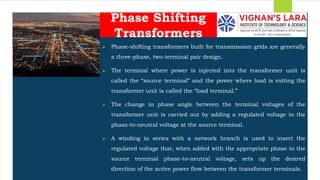
 Phase-shifting transformers are often used in power systems
to control the active power flow (MW) in branches in meshed
networks or to control the active power flow at the interface
between two large and stiff independent grids.
 The control of MW flow is achieved by adjusting the phase
angle of the voltages at the phase-shifting transformer
terminals.
 Phase-shifting transformers are also known as phase angle
regulating (PAR) transformers.
 Phase shifters can be used to prevent inadvertent "loop flow"
and to prevent line overloads.
Phase Shifting
Transformers
Students should able to
 Phase-shifting transformers built for transmission grids are generally
a three-phase, two-terminal pair design.
 The terminal where power is injected into the transformer unit is
called the “source terminal” and the power where load is exiting the
transformer unit is called the “load terminal.”
 The change in phase angle between the terminal voltages of the
transformer unit is carried out by adding a regulated voltage to the
phase-to-neutral voltage at the source terminal.
 A winding in series with a network branch is used to insert the
regulated voltage that, when added with the appropriate phase to the
source terminal phase-to-neutral voltage, sets up the desired
direction of the active power flow between the transformer terminals.
Phase Shifting
Transformers
Students should able to
Two phase-shifting transformer designs are the most prevalent in power
systems applications:
 Symmetric phase-shifting transformers
 Asymmetric phase-shifting transformers.
 Symmetric phase-shifting transformers are designed such that the
amplitudes of the no-load winding voltages do not change during the
phase shifting operation.
 The complex transformer voltage ratio for this type of transformer is then
1.0 ejФ.
 The IEEE model for phase-shifting transformers is based on the
symmetric phase-shifting transformer where the no-load phase angle Φ is
the angle by which the winding 1 voltage (source side) leads the winding 2
voltage (load side).
Phase Shifting
Transformers
Students should able to Phase Shifting
Transformers
Students should able to
 The asymmetric phase-shifting transformer can add an
in-phase and quadrature regulating voltage with a winding
connection angle α to the phase-to-neutral voltage at the
source terminal.
 When the winding connection angle α is 0º or +,- 180º, the
quadrature regulating voltage is zero and the phase-
shifting transformer operates as a conventional voltage or
reactive power control transformer.
 For any winding connection angle α where the quadrature
regulating voltage is not zero, the phase-shifting transformer
will control both active and reactive power flows.
Phase Shifting
Transformers
Students should able to
 This transformer type controls mostly active power flow but,
because of its asymmetry, it also exerts a small control action
on reactive power flow.
 Asymmetric phase-shifting transformers change not only the
phase angle between the winding 1 and winding 2 voltages,
but also their magnitudes.
Phase Shifting
Transformers
Students should able to
 The smart substation plays an important and crucial role in
the smart grid.
 Smart substations are based on the overall station
information digitalization, communication platform
networking, and information-sharing standardization.
 Automatically completing the basic functions of information
collection, measurement, control, protection, computation,
and monitoring.
 The smart substations also support advanced functions, such
as real-time automatic control of power grids, intelligent
regulation, online analysis, and decisions so as to interact
with adjacent substations and power dispatching.
Unit – 3
Smart Substations
Students should able to
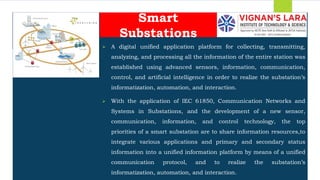
 A digital unified application platform for collecting, transmitting,
analyzing, and processing all the information of the entire station was
established using advanced sensors, information, communication,
control, and artificial intelligence in order to realize the substation’s
informatization, automation, and interaction.
 With the application of IEC 61850, Communication Networks and
Systems in Substations, and the development of a new sensor,
communication, information, and control technology, the top
priorities of a smart substation are to share information resources,to
integrate various applications and primary and secondary status
information into a unified information platform by means of a unified
communication protocol, and to realize the substation’s
informatization, automation, and interaction.
Smart
Substations
Students should able to
 With the implementation of advanced applications of the
digitalization and networks in substations,smart substations
achieves intelligent primary equipment, station-level protection
and control system, self-diagnosis of equipment, intelligent
operation and maintenance systems, and intelligent power
dispatching technologies.
 The development and building a smart substation is safe and
reliable in operation, highly integrated in system, rational in
structure and layout, equipped with
 advanced equipment, economical, energy saving, and
environment friendly so as to optimize substation technology and
equipment and greatly reduce the floor space and significantly
improve the safety, reliability, and economy.
Smart
Substations
Students should able to
 Automation within substations involves monitoring and
controlling equipment in distribution substations to enhance
power system reliability and efficiency.
 The present hard wired substation is becoming networked with
IEDs (intelligent electronic device) based in IEC (International
Electrotechnical Commission's) 61850 standard. This standard
enables interoperability.
 Over the past decade, automation of the distribution system has
increased in order to improve the quality of supply and allow the
connection of more distributed generation.
 The connection and management of distributed generation are
accelerating the shift from passive to active management of the
distribution network.
Substation
Automation
Students should able to
 Network voltage changes and fault levels are increasing due to
the connection of distributed generation.
 Without active management of the network, the costs of
connection of distributed generation will rise and the
connection of additional distributed generation may be
limited.
 The connection of large intermittent energy sources and plug-
in electric vehicles will lead to an increase in the use of
Demand-Side Integration and distribution system automation.
Substation
Automation
Students should able to
The Substation automation equipment consists of
 Current transformers
 Voltage transformers
 Intelligent electronic devices
Relay IED
Meter IED
Recording IED
 Bay controller
 Remote terminal units
Substation
Automation
Students should able to
Current transformers:
 When fault occurs on a system, the fault current rises to 20 times of
the normal load current. Current transformers (CTs) are used to
transform the primary current to a lower value (typically 1 or 5 A
maximum) suitable for use by the IEDs or interfacing units.
 Measurement CTs are used to drive ammeters, power and energy
meters. They provide accurate measurements up to 120 per cent of
their rated current.
 In contrast, protection CTs provide measurement of the much greater
fault current and their accuracy for load current is generally less
important.
Substation
Automation
Students should able to
 Measurement CTs are specified by IEC 60044-1 according
to their accuracy classes, of 0.1, 0.2, 0.5 and 1 per cent at
up to 120 per cent of rated current.
 Protection CTs are normally described for example, as ‘10
VA Class 10P 20’.
 The first term (10 VA) is the rated burden of the CT that
can have a value of 2.5, 5, 10, 15 or 30 VA.
 The accuracy class (10P) defines the specified percentage
accuracy.
 The last term (20) is the accuracy limit.
Substation
Automation
Students should able to
 The accuracy limit can be 5, 10, 20 or 30.
 Class 10P is designated in ANSI/IEEE C57.13 as class C
where the CT is classified by ‘C’ followed by a number.
 This number indicates the secondary terminal voltage that
the transformer can deliver to a standard burden at 20
times the rated current without exceeding an accuracy of
10 per cent.
 There are other classes of CTs such as Class T and X of
IEEE C57.13, and Classes 3, 5 and PX of IEC 60044-1.
Substation
Automation
Students should able to
Voltage transformers:
 It is necessary to transform the power system primary voltage down to
a lower voltage to be transferred through process bus to IEDs, bay
controller and station computer.
 The secondary voltage used is usually 110 V. At primary voltages up to
66 kV, electromagnetic voltage transformers are used but at 132 kV
and above, it is common to use a capacitor voltage transformers (CVT).
 As the accuracy of voltage measurements may be important during a
fault, protection and measuring equipment are often fed from the same
voltage transformer (VT).
 IEC 60044-2 and ANSI/IEEE C57.13 define the accuracy classes of
VTs. Accuracy classes such as 0.1, 0.2, 0.5, 1.0 and 3.0 are commonly
available..
Substation
Automation
Students should able to
 For example, Class 0.1 means the percentage voltage ratio
error should not exceed 0.1 per cent at any voltage
between 80 and 120 per cent of rated voltage and with a
burden of between 25 and 100 per cent of rated burden.
Substation
Automation
• The basic arrangement of a high voltage CVT is
a capacitor divider, a series reactor (to
compensate for the phase shift introduced by
the capacitor divider) and a step-down
transformer (for reducing the voltage to 110 V).
• The voltage is first stepped down to a high value
by a capacitor divider and further reduced by
the transformer, as shown in Figure
Students should able to
 Due to the lower voltage involved the inductor and transformer are
replaced by an opto-electronic circuit mounted on the base tank.
 In this arrangement there is no L-C circuit to resonate, and hence
no oscillations, over-voltages or any possibility of ferro-resonance.
 Some VTs use a similar technique to optical CTs based on the
Faraday effect.
 In this case, an optical fibre is situated inside the insulator running
from top to bottom and is fed by a circular polarised light signal.
 Due to the magnetic field between the HV terminal and the base
tank, the polarisation of the light signal changes and that deflection
is used to obtain the HV terminal voltage.
Substation
Automation
Students should able to
Intelligent electronic devices:
 The name Intelligent Electronic Device (IED) describes a
range of devices that perform one or more of functions of
protection, measurement, fault recording and control.
 An IED consists of a signal processing unit, a
microprocessor with input and output devices, and a
communication interface.
 Communication interfaces such as EIA 232/EIA 483,
Ethernet, Modbus and DNP3 are available in many IEDs.
Substation
Automation
Students should able to
Relay IED :
 Modern relay IEDs combine a number of different protection
functions with measurement, recording and monitoring.
 The relay IED generally has the following protection functions:
 Three-phase instantaneous over-current: Type 50 (IEEE/ANSI
designation)
 Three-phase time-delayed over-current (IDMT): Type 51
 Three-phase voltage controlled or voltage restrained
instantaneous or time-delayed overcurrent Types 50V and 51V;
 Earth fault instantaneous or time-delayed over-current: Types
50N and 51N.
Substation
Automation
Students should able to
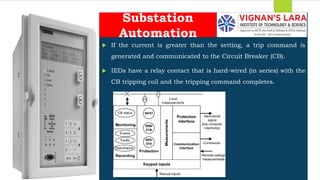
 The local measurements are first processed and made available to
all the processors within the protection IED.
 A user may be able to read these digitized measurements through
a small LED display.
 Furthermore, a keypad is available to input settings or override
commands.
 Various algorithms for different protection functions are stored in
a ROM.
 For example, the algorithm corresponding to Type 50
continuously checks the local current measurements against a
set value to determine whether there is an over-current on the
feeder to which the circuit breaker is connected.
Substation
Automation
Students should able to
 If the current is greater than the setting, a trip command is
generated and communicated to the Circuit Breaker (CB).
 IEDs have a relay contact that is hard-wired (in series) with the
CB tripping coil and the tripping command completes.
Substation
Automation
Students should able to
Meter IED:
 A meter IED provides a comprehensive range of
functions and features for measuring three phase
and single-phase parameters.
 A typical meter IED measures voltage, current,
power, power factor, energy over a period,
maximum demand, maximum and minimum
values, total harmonic distortion and harmonic
components.
Substation
Automation
Students should able to
Recording IED:
 Even though meter and protection IEDs provide different parameters,
separate recording IEDs are used to monitor and record status
changes in the substation and outgoing feeders.
 Continuous event recording up to a resolution of 1 ms is available in
some IEDs.
 These records are sometimes interrogated by an expert to analyze a
past event.
 This fault recorder records the pre-fault and fault values for currents
and voltages.
 The disturbance records are used to understand the system behaviour
and performance of related primary and secondary equipment during
and after a disturbance.
Substation
Automation
Students should able to
Bay controller:
 Bay controllers are employed for control and monitoring of
switchgear, transformers and other bay equipment.
 The bay controller facilitates the remote control actions
and local control actions.
The functionalities available in a bay controller can vary, but
typically include:
Substation
Automation
Students should able to
Remote terminal units (RTUs):
 The distribution SCADA system acquires data of the distribution
network from Remote Terminal Units (RTU).
 This data is received by an RTU situated in the substation, from
the remote terminal units situated in other parts of the
distribution network.
 The field RTUs act as the interface between the sensors in the
field and the station RTU.
 The main functions of the field RTU are to: Monitor both the
analogue and digital sensor signals and actuator signals, and
convert the analogue signals coming from the sensors and
actuators into digital form.
Substation
Automation
Students should able to
 The station RTU acquires the data from the field RTUs at a
predefined interval by polling.
 However, any status changes are reported by the field RTUs
whenever they occur.
 Modern RTUs, which are microprocessor-based, are capable of
performing control functions in addition to data processing and
communication.
 The software stored in the microprocessor sets the monitoring
parameters and sample time; executes control laws; sends the
control actions to final circuits; sets off calling alarms and assists
communications functions. Some modern RTUs have the
capability to time-stamp events down to a millisecond resolution.
Substation
Automation
Students should able to
 Feeder Automation Solution reduces capital investment in the
distribution network by limiting the replacement of legacy
devices.
 It contributes to more direct cost savings by facilitating
preventative maintenance.
 It enables remote control of these devices and further extends
the life cycle of the disconnectors themselves.
 Feeder Automation Solution provides means for the utilities to
reduce the frequency of power outages and faster restoration
time by remote monitoring and control of medium voltage
network assets such as disconnectors, load break switches
and ring main units in energy distribution networks.
Feeder
Automation
Students should able to
 It provides an always-on wireless connectivity together with
the intelligence needed for disconnector control and
monitoring.
 Wireless connectivity is implemented via commercial
mobile networks, thus reducing investment and
operational costs.
 Used in conjunction with always-on communication from a
SCADA system, this method achieves an ideal combination
of local and centralized intelligence for real time systems in
a cost-efficient way.
Feeder
Automation
Students should able to
The devices and their features used for feeder automation
 Ultra High-speed Automatic Transfer Scheme (ATS) for Critical
Loads
 Fault Location, Isolation and Service Restoration (FLISR)
 Communication and Networking Technology
 Remote Terminal Unit
 Remotely Operable Switch
 Application Specific Integrated Circuit (ASIC)
 DA software
 Distribution Network Simulator
Feeder
Automation
Students should able to
 Flexible configuration Quick and automated restoration,
 Multiple communication options,
 Use of any standard recloser,
 Integrated automation controller for local control and
 Protects critical loads
 Safety & Security: Proven & reliable solution with high degree
of safety (Limited skilled staff) and data security.
 Reduce outage & improve consumer satisfaction: Introduce
redundancies and reduce the down time during faults.
 Create infrastructure to implement Automated Outage
Management System.
 Low operational cost: Low operational cost in terms of
Communication rentals, Maintenance & Troubleshooting.
 Least or no reflection on tariff.
Feeder
Automation
Students should able to
 A method to visualize, manipulate, analyze and display spatial
data “SMART MAPS” linking a database to the map, creating
dynamic displays.
 The GIS technology integrates common database operations
such as query and statistical analysis with unique
visualization and geographic analysis offered by maps.
 GIS readily converts data between different data models.
 These abilities distinguish GIS from other information
systems and make it valuable to a wide range of public and
private enterprises for explaining events, predecting outcomes
and planning strategies.
Geographic Information
System (GIS)
Students should able to
Properties of Geographic Data:
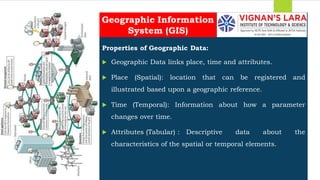
 Geographic Data links place, time and attributes.
 Place (Spatial): location that can be registered and
illustrated based upon a geographic reference.
 Time (Temporal): Information about how a parameter
changes over time.
 Attributes (Tabular) : Descriptive data about the
characteristics of the spatial or temporal elements.
Geographic Information
System (GIS)
Students should able to
 Utility operators will need GIS to make the best decisions
about key issues such as collecting data, managing smart
meter and sensor installation, analyzing customer behavior,
and incorporating renewable energy.
 When viewed in the context of geography, data is quickly
understood and easily shared.
 Furthermore, GIS technology can be integrated into any
enterprise information system framework.
 Simply put, GIS makes it possible for utilities to build and
operate a smart grid.
Geographic Information
System (GIS)
Students should able to
Data Management
 Utilities already rely on GIS to manage assets and outages
and map the location of overhead and underground circuits.
 GIS links utility asset data with customer information to
streamline the rollout of smart grid work orders.
 With GIS, utilities can capture the mash up of information
related to the smart grid, from customer behavior and the
placement of smart meters to the location of electric vehicle
chargers and renewable resources.
 Managing data within GIS ensures the degree of accuracy
required for smart grid functionality.
Geographic Information
System (GIS)
Students should able to
Planning and Analysis
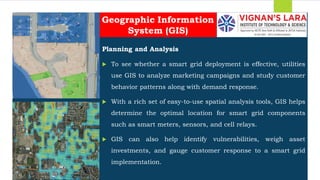
 To see whether a smart grid deployment is effective, utilities
use GIS to analyze marketing campaigns and study customer
behavior patterns along with demand response.
 With a rich set of easy-to-use spatial analysis tools, GIS helps
determine the optimal location for smart grid components
such as smart meters, sensors, and cell relays.
 GIS can also help identify vulnerabilities, weigh asset
investments, and gauge customer response to a smart grid
implementation.
Geographic Information
System (GIS)
Students should able to
Workforce Automation
 A smart grid relies on accurate data.
 Mobile GIS is the surest way to move data quickly to and from
the field and the office.
 The productivity of a smart grid implementation can be
increased by using GIS to schedule and dispatch utility crews.
 A GIS allows utilities to monitor the location and status of
fieldwork.
 From the field, crews have access to a set of application
templates for recording and reporting the progress of smart
grid hardware installation.
Geographic Information
System (GIS)
Students should able to
Situational Awareness
 Utilities bring it all together with GIS to view and track smart
grid deployment and operation.
 Through GIS-based graphic outputs and Web-based reporting,
they are able to quickly monitor and demonstrate how the
organization is progressing on smart grid activities.
 GIS provides a Web-based dashboard that shows the status of
any project, alerts staff to variances in the schedule, monitors
investments, and locates new work orders.
Geographic Information
System (GIS)
Students should able to
 Any Electronic device that possess or have some type of local
Intelligence can be known as IED.
 In power system, information is received by IEDs from the
power apparatus installed or from the sensors.
 The IEDs generate control commands in case of any voltage,
current or frequency disturbance.
 These control commands trip the circuit breakers in order to
move the system back to normal operation.
Intelligent Electronic
Devices (IED)
Students should able to Intelligent Electronic
Devices (IED)
Functions of IEDs are
as follow:
• Protection
• Control
• Monitoring
• Metering
• Communication
Protective Devices of IEDs
• Controllers of load tap changer
• Controllers of Recloser
• Controllers of Circuit Breakers
• Capacitor Bank Switches
• Voltage Regulators
Students should able to Intelligent Electronic
Devices (IED)
Communication devices of IEDs
• RS-485 a special interface that provides bi directional
multi drop communication interfacing over a double
twisted cable or single cable.
Control
• Control function spreads over the local and remote control
and is fully programmed and also controls the sequence
(voltage or current).
• It covers up to about 12 switching tries for circuit
breakers.
Students should able to Intelligent Electronic
Devices (IED)
Protection: Protection function covers the following areas
Directional three phase over
current protection
Three-phase thermal overload
protection
Non directional three phase
over current protection
Non directional earth fault
protection
Residual overvoltage
protection
Auto-re closure protection
Three-phase transformer or
motor start up protection
Three-phase under voltage
protection
Under frequency protection Over frequency protection
Synchro-check protection Directional earth fault protection
Students should able to Intelligent Electronic
Devices (IED)
Monitoring function covers the following area;
a) Circuit-breaker condition monitoring which includes;
i) operation time counter
ii) electric wear
iii) breaker travel time
iv) scheduled maintenance
b) Trip circuit supervision c) Internal self-supervision
d) Gas density monitoring for
SF6 switchgear
e) Event recording
f) Other monitoring functions like auxiliary power, relay
temperature, etc.
Students should able to Intelligent Electronic
Devices (IED)
Metering function includes following measurements
a) Three-phase currents b) Neutral current
c) Three-phase voltages d) Residual voltage
e) Frequency f) Active power
g) Reactive power h) Power factor
(i) Energy j) Harmonics
k) Transient disturbance recorder l) Up to 12 analog channels
Students should able to Intelligent Electronic
Devices (IED)
Students should able to
 Due to the variability of renewable energy and
the disjoint between peak availability and peak
consumption, it is important to find ways to
store the generated energy for later use.
 Options for energy storage technologies include
Smart Storage
Pumped hydro Super capacitors
Advance batteries Super-conducting magnetic
energy storage
Flow batteries Flywheels
Compressed air
Students should able to
 Energy storage technologies are broadly classified into
mechanical, electrochemical, chemical, electrical and
thermal energy storage systems as shown in the figure
below.
Smart Storage
Students should able to
Pumped Hydro Storage:
 The most successful energy storage systems due to their fast
response and storage capacity, pumped storage hydro have
been proven to be excellent reserves.
 Conventionally, two water reservoirs at different elevations are
used to pump water during off peak hours from the lower to
the upper reservoir (charging) and the water flows back to
move a turbine and generate electricity (discharging) when
required.
 Their long lifetimes and stability are what makes them ideal
storage systems. However technical and commercial issues
have prevented their large scale adoption.
Smart Storage
Students should able to
Smart Storage
Students should able to
Smart Storage
Students should able to
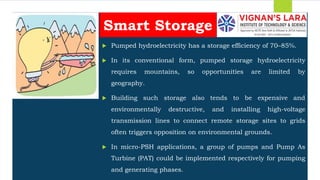
 Pumped hydroelectricity has a storage efficiency of 70–85%.
 In its conventional form, pumped storage hydroelectricity
requires mountains, so opportunities are limited by
geography.
 Building such storage also tends to be expensive and
environmentally destructive, and installing high-voltage
transmission lines to connect remote storage sites to grids
often triggers opposition on environmental grounds.
 In micro-PSH applications, a group of pumps and Pump As
Turbine (PAT) could be implemented respectively for pumping
and generating phases.
Smart Storage
Students should able to
 The same pump could be used in both modes by changing
rotational direction and speed.
 The operation point in pumping usually differs by operation
point in PAT mode.
Smart Storage
Students should able to
 The same pump could be used in both modes by changing
rotational direction and speed.
 The operation point in pumping usually differs by operation
point in PAT mode.
Smart Storage
Students should able to
Battery Energy Storage System (BESS):
 The battery energy storage systems (BESSs) are ideally
suited for smart grid purposes.
 When renewable electricity generation surges on windy
days or hours of peak sunshine, BESSs charge by drawing
the excess power.
 For sudden drops in supply or spikes in demand, power is
injected back into the grid to instantly smooth out
fluctuations.
 Finally, the smart digital technology connecting these
networks makes these processes close to automatic.
Smart Storage
Students should able to
 Batteries store energy in chemical form during charging
and discharge electrical energy when connected to a load.
 In its simplest form a battery consists of two electrodes, a
positive and a negative placed in an electrolyte.
 The electrodes exchange ions with the electrolyte and
electrons with the external circuit.
 Lead acid and Sodium Sulfur (NaS) batteries are used at
present for large utility applications in comparable
numbers.
Smart Storage
Students should able to
 Lithium Ion (Li-ion), Nickel Cadmium (NiCd) and Nickel metal
hydrides (NiMH) are also thought to be promising future
options.
 The capacity of a battery is rated in ampere - hours (Ah).
 The Ah measures the capacity of a battery to hold energy: 1
Ah means that a battery can deliver one amp for 1 hour.
 Battery performance also varies with temperature, battery
type, and age.
 Recent advances in the design of the deep - cycle lead - acid
battery have promoted the use of battery storage systems
when rapid discharge and charging are required.
Smart Storage
Students should able to
 For example, if the load requires a 900 Ah bank, a number of
battery storage systems can be designed. As a fi rst design,
three parallel strings of deep - cycle batteries rated 300 Ah
can be implemented.
 The second design can be based on two strings of deep - cycle
450 Ah batteries.
 Finally, the design can be based on a single large industrial
battery.
Smart Storage
Students should able to
Superconducting magnetic energy storage systems (SMES) :
 In a SMES system, a magnetic field is created by direct
current passing through a superconducting coil.
 In a superconducting coil, resistive losses are negligible and
so the energy stored in the magnetic field (equal to LI2/2
where L is the inductance of the coil and I is the current
passing through the coil) does not reduce with time.
 The optimum operating temperature of high temperature
superconductors, that are favored for energy storage
applications, is around 50–70 K.
Smart Storage
Students should able to
 In order to maintain the superconductivity of the SMES coil, a
cryostat which can keep the temperature of the coil below the
superconductor temperature limit is required.
 Further, as the magnetic field produced by a SMES is large, a strong
supporting structure is needed to contain the electromagnetic forces.
 The stored energy in the SMES is retrieved when required by a power
conditioning system that is connected to the AC network as shown in
Figure.
Smart Storage
Students should able to
 The increase in decentralised renewable energy, the advent of
smart grids, smart micro-grids and smart houses, the
electrification of transport, the increasing demand on the ageing
electricity infrastructure and climate change targets are all helping
to drive the energy storage market.
 Research and development, innovation and commercialisation of
energy storage continues to grow.
 SMES utilizes a simple concept; energy is stored in a magnetic field
created by the flow of direct current (DC) in a superconducting coil,
which has been cryogenically cooled below its critical temperature.
 The stored energy can be quickly and efficiently released by
discharging the coil into a connected power system.
Smart Storage
Students should able to
 To convert the AC supply to DC for charging and DC to AC for
discharging a SMES requires a power conditioning system
connected to the coil.
 Thus, a typical SMES is made up of four parts: superconducting
coil, power conditioning system, cryogenically cooled refrigerator
and a protection system.
 There are a number of superconducting materialsthat are either
low temperature superconductors (LTS) or high temperature
superconductors (HTS) and fall into either the ceramic, organic
materials or metals categories, only a handful are currently
commercial such as NbTi (LTS), Nb3Sn (LTS), YBCO (HTS) and
MgB2.
Smart Storage
Students should able to
 Two main characteristics of SMES are its high power and fast
response time this makes it ideal for power management applications
such as power quality and system stability enhancement and this is
where SMES could really make a difference.
 With the rapid increase in decentralised renewable energy into the
worlds electricity grids, ageing grid infrastructure and other energy
costs and constraints, the world’s electricity grids are operating with
reduced stability margins.
 Thus, energy storage systems capable of stability applications in
power, voltage and frequency are becoming an ideal solution. SMES
can reduce system frequency oscillations in power systems, it can
modulate both real and reactive power, increase voltage stability and
balance fluctuating loads.
Smart Storage
Students should able to
 An application commonly linked with SMES is flexible AC transmission
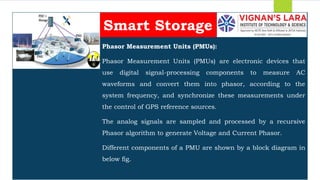
systems (FACTS) and it was this application that was the first
superconducting application installed in a real power grid.
 However, there are also challenges to having SMES in the system; firstly,
there is only a small installation base and thus limited understanding in
installation requirements and operational capabilities of SMES systems.
 Secondly, this leads to the fact that SMES is a relatively unproven
technology giving concerns about its long-term reliability and operation.
 Thirdly, SMES systems require constant refrigeration, which requires
energy and maintenance and again this raises concerns with long term
reliability.
 Finally, a SMES needs to be in constant use discharging and charging as
there are standby losses due to the cooling requirement.
Smart Storage
Students should able to
Smart Storage
Students should able to
Smart Storage
Students should able to
Wide Area Measurement System(WAMS):
 Wide-Area Measurement Systems (WAMS) are being installed on
many transmission systems to supplement traditional SCADA.
 They measure the magnitudes and phase angle of busbar
voltages as well as current flows through transmission circuits.
 This information, measured over a wide area, is transmitted to
the Control Centre and is used for:
1. Power system state estimation:
2. Power system monitoring and warning:
3. Power system event analysis:
Smart Storage
Students should able to
A configuration of the WAMPAC is shown in Figure.
Smart Storage
Students should able to
 The PMU (or synchrophasor) measurements collected from the
different part of the network and state estimation are used for online
stability analysis.
 When an event occurs, its location, time, magnitude (total capacity of
generator or transmission lines outage) and type (generator outage or
transmission line outage) are first identified.
 Real-time visualization of the event allows it to be replayed several
seconds after it occurs.
 The future system condition is then analyzed using the information
that has been gathered.
 An on-line stability assessment algorithm continuously assesses the
system to check whether the system is still stable and how quickly
the system would collapse if it became unstable.
Smart Storage
Students should able to
 If instability is predicted, then the necessary corrective actions to
correct the problem or to avert system collapse are taken.
 On-line transient stability controller
 An on-line Transient Stability Controller was discussed that would
trip a number of generator units when a fault occurs on extra high
voltage transmission lines (500 kV and275 kV) in order to prevent
transient instability.
 The operation of the on-line Transient Stability Controllers is
described in Figure.
Smart Storage
Students should able to
 Using PMU data and results from the state estimator, transient stability
analysis is carried out repeatedly (typically every 5minutes) and the
generator units to be shed if a fault occurs are determined.
 After a fault occurs, the fault is compared with those of the
contingencies identified pre-fault and it determines the generator units
to be shed.
 Then a signal is sent to the local control units to shed the identified
generator units.
Pole-slipping preventive controller:
 When a severe fault occurs in a power system, this controller would
predict unstable conditions of the power system and rapidly trips an
appropriate number of enerator units or splits the system into two
subsystems in order to prevent pole slipping.
Smart Storage
Students should able to
Smart Storage
 To illustrate the operation of this controller,
two areas, the Western and the Eastern
systems, interconnected through a 500 kV
transmission lines are shown in Figure.
 Due to a fault, line DE was tripped and it was
found that the phase angle between the
Western and Eastern areas had increased.
 It was predicted by the WAMPAC that the
large phase angle swing might cause
synchronism between the two areas to be lost.
 Therefore, a control signal was sent to trip
generator G1 (or G2).
Students should able to
Phasor Measurement Units (PMUs):
Phasor Measurement Units (PMUs) are electronic devices that
use digital signal-processing components to measure AC
waveforms and convert them into phasor, according to the
system frequency, and synchronize these measurements under
the control of GPS reference sources.
The analog signals are sampled and processed by a recursive
Phasor algorithm to generate Voltage and Current Phasor.
Different components of a PMU are shown by a block diagram in
below fig.
Smart Storage
Students should able to
 A Phasor network consists of Phasor measurement units (PMUs)
dispersed throughout the electricity system, Phasor Data
Concentrators (PDC) to collect the information and a Supervisory
Control And Data Acquisition (SCADA) system at the central control
facility.
Smart Storage
Students should able to S
).
 From the voltage and current samples, the magnitudes and
phase angles of the voltage and current signals are calculated
in the Phasor microprocessor of the PMU.
 As the PMUs use the clock signal of the Global Positioning
System (GPS) to provide synchronised phase angle
measurements at all their measurement points, the measured
Phasor are often referred to as synchrophasors.
 The data from different PMUs distributed in the grid is
transmitted to a Phasor Data Concentrator (PDC) located at
the control centre.
 The PDC collects and sorts the data by time stamp until the
arrival of the slowest data.
Smart Storage
Students should able to
 The data concentrated by the PDC is then utilised for different
applications at the control centre.
 Data collected from several PDCs distributed over a particular
area may then be transmitted to a super PDC.
Smart Storage
Students should able to
 A PDC collects phasor data from multiple PMUs or other PDCs,
aligns the data by time tag to create a synchronized dataset, and
then passes the data on to applications processors.
 For applications that process PMU data from across the grid, it is
vital that the measurements are time aligned based on their
original time tag to create a system-wide, synchronized snapshot
of grid conditions.
 To accommodate the varying latencies in data delivery from
individual PMUs, and to take into account delayed data packets
over the communications system, PDCs typically buffer the input
data streams and include a certain ―wait time‖ before outputting
the aggregated data stream.
Smart Storage
Students should able to
 PMUs often use phone lines to connect to PDCs, which then send
data to the SCADA or Wide Area Measurement System (WAMS)
server.
 Additionally, PMUs can use mobile (cellular) networks for data
transfer (GPRS, UMTS, etc.,), which allows potential savings in
infrastructure and deployment costs, at the expense of a larger
data reporting latency.
Applications:
 Phasor Measurement Technology and synchronized time stamping can be
used for Security improvement through synchronized encryptions like
trusted sensing base.
 Cyber attack recognition by verifying data between the SCADA system
and the PMU data.
Smart Storage
Students should able to
 Around the world, conventional power system is facing the problems of
gradual depletion of fossil fuel resources, poor energy efficiency and
environmental pollution.
 These problems have led to a new trend of generating power locally at
distribution voltage level by using non-conventional/renewable energy
sources like natural gas, biogas, wind power, solar photovoltaic cells, fuel
cells, combined heat and power (CHP) systems, micro turbines, and
Stirling engines and their integration into the utility distribution network.
 This type of power generation is termed as distributed generation (DG)
and the energy sources are termed as distributed energy resources
(DERs).
 The term ‘Distributed Generation’ has been devised to distinguish this
concept of generation from centralized conventional generation.
 The distribution network becomes active with the integration of DG and
hence is termed as active distribution network.
UNIT – 4: MICRO GRIDS AND
DISTRIBUTED ENERGY
RESOURCES
Students should able to
According to several research studies, some
universally accepted common attributes of DG are as
follows:
 It is not centrally planned by the power utility, nor
centrally dispatched.
 It is normally smaller than 50 MW.
 The power sources or distributed generators are
usually connected to the distribution system, which
are typically of voltages 230/415 V up to 145 kV.
Introduction
Students should able to
In spite of several advantages provided by conventional power
systems, the following technical, economic and environmental
benefits have led to gradual development and integration of DG
systems:
 Due to rapid load growth, the need for augmentation of
conventional generation brings about a continuous depletion of
fossil fuel reserve. Therefore, most of the countries are looking for
non-conventional/renewable energy resources as an alternative.
 Reduction of environmental pollution and global warming acts as a
key factor in preferring renewable resources over fossil fuels.
 As part of the Kyoto Protocol, the EU, the UK and many other
countries are planning to cut down greenhouse gas emissions in
order to counter climate change and global warming.
Why Integration of
Distributed Generation?
Students should able to
 Therefore, they are working on new energy generation and
utilization policies to support proper utilization of these energy
sources.
 It is expected that exploitation of DERs would help to generate
ecofriendly clean power with much lesser environmental impact.
 DG provides better scope for setting up co-generation, trigeneration
or CHP plants for utilizing the waste heat for
industrial/domestic/commercial applications.
 This increases the overall energy efficiency of the plant and also
reduces thermal pollution of the environment.
 Due to lower energy density and dependence on geographical conditions
of a region, DERs are generally modular units of small capacity.
Why Integration of
Distributed Generation?
Students should able to
 These are geographically widespread and usually located close to
loads.
 This is required for technical and economic viability of the plants.
 Physical proximity of load and source also reduces the transmission
and distribution (T&D) losses.
 Since power is generated at low voltage (LV), it is possible to connect
a DER separately to the utility distribution network or they may be
interconnected in the form of Micro grids.
 The Micro grid can again be connected to the utility as a separate
semi-autonomous entity.
 Stand-alone and grid-connected operations of DERs help in
generation augmentation, thereby improving overall power quality.
Why Integration of
Distributed Generation?
Students should able to
 Microgrids are small-scale, LV CHP supply networks designed
to supply electrical and heat loads for a small community,
such as a housing estate or a suburban locality, or an
academic or public community such as a university or school,
a commercial area, an industrial site, a trading estate or a
municipal region.
 Microgrid is essentially an active distribution network because
it is the conglomerate of DG systems and different loads at
distribution voltage level.
 The generators or micro sources employed in a Microgrid are
usually renewable/non-conventional DERs integrated together
to generate power at distribution voltage.
Concept of
Microgrid
Students should able to
 From operational point of view, the micro sources must be
equipped with power electronic interfaces (PEIs) and controls
to provide the required flexibility to ensure operation as a
single aggregated system and to maintain the specified power
quality and energy output.
 This control flexibility would allow the Microgrid to present
itself to the main utility power system as a single controlled
unit that meets local energy needs for reliability and security.
Concept of
Microgrid
Students should able to
The key differences between a Microgrid and a conventional
power plant are as follows:
 Microsources are of much smaller capacity with respect to
the large generators in conventional power plants.
 Power generated at distribution voltage can be directly fed
to the utility distribution network.
 Microsources are normally installed close to the customers’
premises so that the electrical/heat loads can be efficiently
supplied with satisfactory voltage and frequency profile
and negligible line losses.
Concept of
Microgrid
Students should able to
 The technical features of a Microgrid make it suitable for
supplying power to remote areas of a country where supply
from the national grid system is either difficult to avail due to
the topology or frequently disrupted due to severe climatic
conditions or man-made disturbances.
 From grid point of view, the main advantage of a Microgrid is
that it is treated as a controlled entity within the power
system.
 It can be operated as a single aggregated load.
 From customers’ point of view, Microgrids are beneficial for
locally meeting their electrical/heat requirements.
Concept of
Microgrid
Students should able to
 They can supply uninterruptible power, improve local reliability,
reduce feeder losses and provide local voltage support.
 From environmental point of view, Microgrids reduce
environmental pollution and global warming through utilization
of low-carbon technology.
 However, to achieve a stable and secure operation, a number of
technical, regulatory and economic issues have to be resolved
before Microgrids can become commonplace.
 Some problem areas that would require due attention are the
intermittent and climate-dependent nature of generation of the DERs,
low energy content of the fuels and lack of standards and regulations
for operating the Microgrids in synchronism with the power utility.
Concept of
Microgrid
Students should able to
 To Provide Affordable Energy for Community
Resiliency and Economic Development
 Microgrid could be the answer to our energy crisis.
 Transmission losses gets highly reduced.
 Microgrid results in substantial savings and cuts
emissions without major changes to lifestyles.
 Provide high quality and reliable energy supply to
critical loads.
Why Do We Need
Microgrids?
Students should able to
 Modern cooking appliances and fuels.
 Distributed electricity solutions.
 Grid infrastructure and supply efficiency
 Large-scale renewable power.
 Industrial and agricultural processes.
 Transportation.
 Buildings and appliances.
 Integrated electric, water, building location.
Applications of
Microgrids?
Students should able to
 A typical Microgrid configuration is shown in Figure.
 It consists of electrical / heat loads and microsources
connected through an LV distribution network.
 The loads and the sources are placed close together to
minimise heat loss during heat transmission.
 The microsources have plug-and-play features.
 They are provided with PEIs to implement the control,
metering and protection functions during stand-alone and
grid-connected modes of operation.
 These features also help seamless transition of Microgrid from
one mode to another.
Formation of
microgrid
Students should able to Formation of
microgrid
Students should able to
 The Microgrid consists of three radial feeders (A, B and C) to supply
the electrical and heat loads.
 It also has two CHP and two non-CHP microsources and storage
devices.
 Microsources and storage devices are connected to feeders A and C
through microsource controllers (MCs).
 Some loads on feeders A and C are assumed to be priority loads (i.e.
requiring uninterrupted power supply), while others are non-priority
loads. Feeder B, however, contains only non-priority electrical loads.
 The Microgrid is coupled with the main medium voltage (MV) utility
grid (denoted as ‘main grid’) through the PCC (point of common
coupling) circuit breaker CB4 as per standard interface regulations.
Formation of
microgrid
Students should able to
 CB4 is operated to connect and disconnect the entire Microgrid
from the main grid as per the selected mode of operation.
 Feeders A, B and C can however be connected and disconnected
by operating breakers CB1, CB2 and CB3, respectively.
 The micro sources on feeders A and C are placed quite apart from
the Microgrid bus to ensure reduction in line losses, good voltage
profile and optimal use of waste heat.
 Although the control of power flow and voltage profile along radial
feeders is quite complicated when several microsources are
connected to a common radial feeder and not to a common
generator bus, this configuration is necessary to avail the plug-
and-play feature of the micro sources.
Formation of
microgrid
Students should able to
 The Microgrid is operated in two modes: (1) grid-connected
and (2) standalone.
 In grid-connected mode, the Microgrid remains connected to
the main grid either totally or partially, and imports or exports
power from or to the main grid.
 In case of any disturbance in the main grid, the Microgrid
switches over to stand-alone mode while still feeding power to
the priority loads.
 This can be achieved by either (i) disconnecting the entire
Microgrid by opening CB4 or (ii) disconnecting feeders A and
C by opening CB1 and CB3.
Formation of
microgrid
Students should able to
 For option (i), the Microgrid will operate as an autonomous
system with all the microsources feeding all the loads in
feeders A, B and C, whereas for option (ii), feeders A and C
will supply only the priority loads while feeder B will be left to
ride through the disturbance.
 The operation and management of Microgrid in different
modes is controlled and co-ordinated through local MCs and
the central controller (CC) whose functions are enlisted as
follows:
(1) Microsource controller - The main function of MC is to
independently control the power flow and load-end voltage profile of the
microsource in response to any disturbance and load changes.
Formation of
microgrid
Students should able to
 MC also participates in economic generation scheduling, load
tracking/management and demand side management by controlling the storage
devices.
 It must also ensure that each microsource rapidly picks up its generation to
supply its share of load in stand-alone mode and automatically comes back to the
grid-connected mode with the help of CC.
 The most significant aspect of MC is its quickness in responding to the locally
monitored voltages and currents irrespective of the data from the neighbouring
MCs.
 This control feature enables microsources to act as plug-and-play devices and
facilitates the addition of new microsources at any point of Microgrid without
affecting the control and protection of the existing units.
 Two other key features are that an MC will not interact independently with other
MCs in the Microgrid and that it will override the CC directives that may seem
dangerous for its microsource.
Formation of
microgrid
Students should able to
(2) Central controller - The CC executes the overall control of Microgrid
operation and protection through the MCs. Its objectives are
 To maintain specified voltage and frequency at the load end through
power-frequency (P-f ) and voltage control and
 To ensure energy optimisation for the Microgrid.
 The CC also performs protection co-ordination and provides the power
dispatch and voltage set points for all the MCs.
 CC is designed to operate in automatic mode with provision for manual
intervention as and when necessary.
Two main functional modules of CC are
 Energy Management Module (EMM)
 Protection Co-ordination Module (PCM).
Formation of
microgrid
Students should able to
(i) Energy Management Module – EMM provides the set points for active
and reactive power output, voltage and frequency to each MC.
 This function is co-ordinated through state-of-the-art communication and
artificial intelligence techniques.
 The values of the set points are decided according to the operational
needs of the Microgrid.
 The EMM must see that (a) Microsources supply heat and electrical loads
to customer satisfaction.
 (b) Microgrids operate satisfactorily as per the operational a priori
contracts with main grid.
 (c) Microgrids satisfy its obligatory bindings in minimising system losses
and emissions of greenhouse gases and particulates.
 (d) Microsources operate at their highest possible efficiencies.
Formation of
microgrid
Students should able to
(ii) Protection Co-ordination Module – PCM responds to Microgrid and
main grid faults and loss of grid (LOG) scenarios in a way so as to ensure
correct protection co-ordination of the Microgrid.
 It also adapts to the change in fault current levels during changeover
from grid-connected to stand-alone mode.
 For achieving this, there is proper communication between the PCM and
the MCs and upstream main grid controllers.
 For main grid fault, PCM immediately switches over the Microgrid to
stand-alone mode for supplying power to the priority loads at a
significantly lower incremental cost.
 However, for some minor faults, the PCM allows the Microgrid to ride
through in the grid-connected mode for some time and it continues if any
temporary fault is removed.
Formation of
microgrid
Students should able to
 Besides, if the grid fault endangers the stability of the Microgrid,
then PCM may disconnect the Microgrid fully from all main grid
loads (e.g. feeder B), although in that case, effective utilisation of
the Microgrid would be lost in exporting power.
 If a fault occurs within a portion of the Microgrid feeder (e.g.
feeder A or C), the smallest possible feeder zone is eliminated to
maintain supply to the healthy parts of the feeder.
 Under-frequency and undervoltage protection schemes with bus
voltage support are normally used for protecting the sensitive
loads.
 PCM also helps to re-synchronise the Microgrid to the main grid after the
initiation of switchover to the grid connected mode of operation through
suitable reclosing schemes.
Formation of
microgrid
Students should able to
The functions of the CC in the grid-connected mode are as
follows:
(1) Monitoring system diagnostics by collecting information from
the microsources and loads.
(2) Performing state estimation and security assessment
evaluation, economic generation scheduling and active and
reactive power control of the microsources and
demand side management functions by using collected
information.
(3) Ensuring synchronised operation with the main grid
maintaining the power exchange at priori contract points.
Formation of
microgrid
Students should able to
The functions of the CC in the stand-alone mode are as follows:
(1) Performing active and reactive power control of the
microsources in order to maintain stable voltage and frequency
at load ends.
(2) Adopting load interruption/load shedding strategies using
demand side management with storage device support for
maintaining power balance and bus voltage.
(3) Initiating a local black start to ensure improved reliability and
continuity of service.
(4) Switching over the Microgrid to grid-connected mode after main
grid supply is restored without hampering the stability of either grid.
Formation of
microgrid
Students should able to
 Microgrids are designed to generate power at
distribution voltage level along with utilization of waste
heat, they have restricted energy handling capability.
 Therefore, their maximum capacity is normally
restricted to approximately 10 MVA as per IEEE
recommendations.
 Hence, it is possible to supply a large load pocket from
several Microgrids through a common distribution
network, by splitting the load pocket into several
controllable load units, with each unit being supplied by
one Microgrid.
ISSUES OF INTERCONNECTION,
PROTECTION & CONTROL OF
MICROGRID
Students should able to
Protection issues of microgrid, when it is grid connected mode and
islanded mode of operation are as follows:
A. Events or Faults During Grid Connected Mode :
 For a fault within microgrid, the response of line or feeder protection
must be to disconnect the faulty portion from the rest of the system
as quick as possible and how it is done depends on the features and
complexity of microgrid and protection strategy is used.
 There may be some non fault cases which are resulting in low
voltages at PCC like voltage unbalance and non fault open phases
which are difficult to be detected and it may create hazards for
sensitive loads, microsources etc.
 Therefore, some protection mechanisms must be developed to avoid
such situations.
ISSUES OF INTERCONNECTION,
PROTECTION & CONTROL OF
MICROGRID
Students should able to
B. Events or Faults During Islanded Mode : The nature of problems are different in
islanded mode than grid connected mode.
 In grid connected mode, the fault currents of higher magnitude (10-50 times the
full load current) which are available from the utility grid for activate conventional
OC protection devices.
 For islanded mode of microgrid, fault current is five times the full load current.
 When a large number of converter based DERs are connected in microgrid, the
fault currents are 2-3 times the full load current or even less depending on the
control method of converter.
 The conventional OC protection devices are usually set at 2- 10 times the full load
current.
 Hence, due to this drastic reduction in fault level, the time current coordination
of OC protective devices is disturbed, the high set instantaneous OC devices and
extremely inverse characteristics OC devices like fuses are most likely to be
affected.
ISSUES OF INTERCONNECTION,
PROTECTION & CONTROL OF
MICROGRID
Students should able to
The other major issues in microgrid protection and control include :
 Bidirectional power flows: The power flow in a conventional distribution system
is unidirectional, i.e. from the substation to the loads. Reverse power flows
when integration of DGs on the distribution side of the grid . As a result, the
conventional protection coordination schemes are no longer valid.
 Stability issues: As a result of the interaction of the control system of
microgenerators local oscillations may arise. Hence, small signal stability
analysis and transientstability analysis are required to ensure proper operation
in a microgrid.
 For maintaining power quality, active and reactive power balance must be
maintained within the Microgrid on a short-term basis.
 Intermittent Output: Renewable energy resources in microgrid as distributed
generation are intermittent in their power output because of the availability of
sources. Hence, coordination between DGs and storage devices is essential.
ISSUES OF INTERCONNECTION,
PROTECTION & CONTROL OF
MICROGRID
Students should able to
 A solar cell is a device that converts the light energy into
electrical energy.
 Usually light from the sun is used to generate electricity from
such a device hence the name solar cell.
 Conventional Solar cells are built from semiconductors.
 Usually mono-crystalline or poly-crystalline materials are
needed for higher efficiency.
 The advantage of Solar cell is High efficiency -up to 30% has
been reached.
 Elaborate and very expensive method required to produce the
material is main drawback of solar cells.
Plastic solar
cells
Students should able to
 When p-doped and n-doped semiconductors are brought
together, a depletion layer is formed. The depletion layer sets
up an electric field.
 Any charge in the field experiences a force that sweeps it to
the end of the depletion layer.
Plastic solar
cells
A photon excites an electron from the valence band to
the conduction band creating an electron-hole pair.
The excited electrons in the depletion layer move
towards the n-type end while the holes move to the p-
type end.
This flow of charge drives the external load.
Students should able to
The advantages of Plastic Solar Cells includes
 Low production cost.
 Easy manufacturing technique and cheap process
 Can be built on various substrates i.e. flexible substrate
First introduced by Dr. Ching Tang at Kodak research labaratory in
1986.
 Plastic solar cells help in exploiting the infrared radiation from the
sun’s rays.
 They are more effective when compared to the conventional solar cell.
 The major advantage that they can even work on cloudy days.
 They are more compact and less bulkier.
Plastic solar
cells
Students should able to
Plastic Solar Cells_
Device Architectures
 Simplest design uses
organic semiconductor,
metal-insulator metal
(MIM) tunnel diode.
 The insulator typically is
a conjugated polymer.
 A more complicated
design uses two
conducting polymers
differing in electron
affinities forming hetero
junction.
Students should able to
Plastic solar cells_
Working Principle
 Like in the semiconductors
the electrons are excited by
the photons creating
electron-hole pair.
 Unlike in the
semiconductors the
electrons and the holes are
not free to move.
 They form excitons and
move together.
 The paired charges are
splitted at the interface
using electrodes of suitable
work functions.
Students should able to
 Holes get collected at the high work function electrode and the electrons
get collected at the low work function electrode.
 Conjugated polymers are analogous to inorganic semiconductors.
 The overlap of atomic pi orbitals gives rise to delocalized bonding and anti
bonding pi orbital analogous to the valence band and the conduction
band.
 Energy gap between the bands is typically 1.5 – 3 eV which lies in the
range of the visible light.
 The paired charges are splitted at the interface using electrodes of
suitable work functions.
 Holes get collected at the high work function electrode and the electrons
get collected at the low work function electrode.
 At present, cost is a major draw back, it is bound be solved in the future.
Plastic solar cells_
Working Principle
Students should able to
 Organic Photovoltaic (OPV) devices convert solar energy to
electrical energy.
 OPV is a rapidly emerging PV technology with improving cell
efficiency (currently ~13.2%), encouraging initial lifetime
(>5,000 hours), and potential for roll-to-roll manufacturing
processes.
 The building-integrated PV market may find OPV especially
attractive because of the availability of absorbers in different
colors and the ability to make efficient transparent devices.
 OPV's great strength lies in the diversity of organic materials
that can be designed and synthesized for the absorber,
acceptor, and interfaces.
Organic solar
cells
Students should able to Organic solar
cells
 A typical OPV device consists of
one or several photoactive
materials sandwiched between two
electrodes.
 Figure depicts a typical bilayer
organic photovoltaic device.
Organic solar cells offers unique
opportunities in future
 Low-cost high volume production
 Distributed production
 Environmentally benign devices
Students should able to Organic solar
cells
 In a bilayer OPV cell, sunlight is absorbed in the photoactive
layers composed of donor and acceptor semiconducting organic
materials to generate photocurrents.
 The donor material (D) donates electrons and mainly transports
holes and the acceptor material (A) withdraws electrons and
mainly transports electrons.
 As depicted in Figure, those photoactive materials harvest
photons from sunlight to form excitons, in which electrons are
excited from the valence band into the conduction band (Light
Absorption).  Due to the concentration gradient, the
excitons diffuse to the donor/acceptor
interface (Exciton Diffusion) and separate
into free holes (positive charge carriers)
and electrons (negative charge carriers)
(Charge Separation).
 A photovoltaic is generated when the holes
and electrons move to the corresponding
electrodes by following either donor or
acceptor phase (Charge Extraction).
Students should able to
 A primary advantage of OPV technology over inorganic
counterparts is its ability to be utilized in large area and
flexible solar modules, specially facilitating roll-to-roll (R2R)
production.
 Additionally, manufacturing cost can be reduced for organic
solar cells due to their lower cost compared to silicon-based
materials and the ease of device manufacturing.
 However, to catch up with the performance of silicon based
solar cells, both donor and acceptor materials in an OPV need
to have good extinction coefficients, high stabilities and good
film morphologies.
Organic solar
cells
Students should able to Organic solar
cells
 Since the donor plays a critical role as the absorber to solar
photon flux, donor materials require wide optical absorption to
match the solar spectrum.
 Another basic requirement for ideal donor/acceptor is a large
hole/electron mobility to maximize charge transport.
 The significant improvement of OPV device performance has been
accomplished by introducing various OPV architectures, such as
bulk-heterojuction (BHJ) and inverted device structures, and
developing low band gap conjugated polymers and innovative
organic small molecules as donor materials.
Students should able to
There are mainly four different types of PV cells, which are as follows:
(1) Monocrystalline silicon
(2) Multicrystalline silicon
(3) Thin-film silicon
(4) Hybrid
 Thin-film solar cell, type of device that is designed to convert
lightenergy into electrical energy (through the photovoltaic effect) and
is composed of micron-thick photon-absorbing material layers
deposited over a flexible substrate.
 Thin-film solar cells were originally introduced in the 1970s. Several
types of thin-film solar cells are widely used because of their
relatively low cost and their efficiency in producing electricity.
Thin Film Solar
Cells
Students should able to
 Cadmium telluride thin-film solar cells are the most common
type available.
 They are less expensive than the more standard silicon thin-film
cells.
 Cadmium telluride thin-films have a peak recorded efficiency of
more than 22.1 percent (the percentage of photons hitting the
surface of the cell that are transformed into an electric current).
 By 2014 cadmium telluride thin-film technologies had the
smallest carbon footprint and quickest payback time of any thin-
film solar cell technology on the market (payback time being the
time it takes for the solar panel’s electricity generation to cover
the cost of purchase and installation).
Types Of Thin-
Film Solar Cells
Students should able to
 Copper indium gallium selenide (CIGS) is another type of
semiconductor used to manufacture thin-film solar cells. CIGS
thin-film solar cells have reached 21.7 percent efficiency in
laboratory settings and 18.7 percent efficiency in the field,
making CIGS a leader among alternative cell materials and a
promising semiconducting material in thin-film technologies.
CIGS cells traditionally have been more costly than other types of
cells on the market, and for that reason they are not widely used.
 Gallium arsenide (GaAs) thin-film solar cells have reached
nearly 30 percent efficiency in laboratory environments, but they
are very expensive to manufacture. Cost has been a major factor
in limiting the market for GaAs solar cells; their main use has
been for spacecraft and satellites.
Types Of Thin-
Film Solar Cells
Students should able to
 Amorphous silicon thin-film cells are the oldest and
most mature type of thin-film. They are made of non
crystalline silicon, unlike typical solar-cell wafers.
Amorphous silicon is cheaper to manufacture than
crystalline silicon and most other semiconducting
materials. Amorphous silicon is also popular because it is
abundant, nontoxic, and relatively inexpensive. However,
the average efficiency is very low, less than 10 percent.
Types Of Thin-
Film Solar Cells
Students should able to
 Wind turbines convert the kinetic energy present in the
wind into mechanical energy by means of producing
torque.
 A variable speed wind turbine is one which is specifically
designed to operate over a wide range of rotor speeds.
 It is in direct contrast to fixed speed wind turbine where
the rotor speed is approximately constant.
 The reason to vary the rotor speed is to capture the
maximum aerodynamic power in the wind, as the wind
speed varies.
Variable Speed
Wind Generators
Students should able to
 Variable speed generators need a power electronic converter
interface for interconnection with the grid.
 Variable speed generation is preferred over fixed speed
generation. Comparing with fixed-speed wind turbines,
variable-speed WECSs based on a doubly-fed induction
generator (DFIG) offer a number of merits such as simple
control, four-quadrant active and reactive power regulation,
and low cost converter.
 With a DFIG-based wind system, the stator side is directly
connected to the grid, whereas the rotor side is connected to a
back-to-back voltage source inverter. The stator outputs
power into the grid.
Variable Speed
Wind Generators
Students should able to
 The rotor is capable of delivering or absorbing power to/from the
grid, depending on the rotor speed.
 With a PMSG-based wind system, the generator output voltage
and frequency are proportional to the rotor speed and the current
is proportional to the torque on the shaft.
 The output is rectified and fed through a buck-boost regulator to
an inverter which generates the required fixed amplitude and
frequency AC voltage.
 In adjustable speed systems, the turbines rotor absorbs the
mechanical power fluctuations by changing its speed.
 So the output power curve is smoother which greatly enhances
the quality of power.
Variable Speed
Wind Generators
Students should able to
 However, since adjustable speed operation produces a variable
frequency voltage, so a power electronic converter must be
connected to the constant frequency grid.
It can be achieved by using:
 Direct-in-Line ASG System
 Doubly Fed Induction Generator ASG System
Types of WECS
Students should able to
 In this set up the stator of the induction generator will be
connected to the grid by the means of back to back connected
power electronic converter bridges.
 Since the power converter has to convert all the stator power,
the converter size depends on the stator power rating.
Direct-in-Line
ASG System
Students should able to
Doubly Fed Induction
Generator ASG System
Students should able to
 Fuel cells are electrochemical cells consisting of two
electrodes and an electrolyte which convert the chemical
energy of chemical reaction between fuel and oxidant
directly into electrical energy.
 They convert chemical energy directly into electrical
energy.
 In contrary to battery, fuel cells requires a fuel to flow in
order to produce electricity.
 Heat is produced from chemical reaction and not from
combustion.
Fuel Cells
Students should able to
The types of fuel cells are :
 Proton exchange membrane (PEMFC)
 Direct Methanol fuel cell (DMFC)
 Alkaline fuel cell (AFC)
 Phosphoric acid fuel cell (PAFC)
 Molten-carbonate fuel cell (MCFC)
 Solid-oxide fuel cell (SOFC)
Types Fuel
Cells
Students should able to
Working Principle
 In fuel cell, it directly
converts chemical energy
to electrical energy.
 The efficiency of energy
conversion in fuel cell
approaches 70%.
Students should able to
Working Principle
The parts of Fuel cell are:
Anode Cathode
Electrolyte Catalyst
Students should able to
Anode & Cathode
 Materials which have high electron conductivity &
zero proton conductivity in the form of porous
catalyst (porous catalyst or carbon).
Catalyst
 Platinum
Electrolyte
 High proton conductivity & zero electron conductivity
Working Principle
Students should able to
Working Principle
• Pressurized hydrogen gas (H2) enters cell on anode side.
• Gas is forced through catalyst by pressure.
When H2 molecule comes contacts platinum catalyst, it splits into
two H+ ions and two electrons (e-).
• Electrons are conducted through the anode
Make their way through the external circuit (doing useful work
such as turning a motor) and return to the cathode side of the
fuel cell.
• On the cathode side, oxygen gas (O2) is forced through the
catalyst
• Forms two oxygen atoms, each with a strong negative charge.
• Negative charge attracts the two H+ ions through the
membrane.
• Combine with an oxygen atom and two electrons from the
external circuit to form a water molecule (H2O).
Students should able to
At Anode:
2H2 → 4H+ + 4e-
At Cathode:
O2 + 4H+ + 4e- → 2H2O
Overall Reaction:
2H2 + O2 → 2H2O
 Large number of these cells are stacked together in
series to make a battery called as fuel cell battery or
fuel battery.
Working Principle
Students should able to
1. High efficiency of energy conversion (approaching 70%) from
chemical energy to electrical energy.
2. Low noise pollution & low thermal pollution.
3. Fuel cell power can reduce expensive transmission lines &
minimize transmission loses for a disturbed system.
4. Fuel cells gives excellent method for efficient use of fossil
fuels hence saves fossil fuels.
5. Fuel cells are less polluting. The chemical process involved in
it is clean. It does not produce polluting exhaust. Mostly the
byproducts are water & waste heat, which are environmentally
acceptable when hydrogen & air are used as reactants.
Advantages of
Fuel Cells
Students should able to
6. Low maintenance cost.
7. . Designing is modular, therefore the parts are exchangeable.
8.Hydrogen-Oxygen fuel cells produce drinking water of potable
quality.
9. Fuel cell performance is independent of power plant size.
10. Fast start up time for low temperature system.
11. The heat is cogenerated hence increases efficiency of hig
temperature system.
12. Fuel cells automotive batteries can render electric vehicles,
efficient & refillable.
Advantages of
Fuel Cells
Students should able to
1. High initial cost.
2. Life times of the cells are not accurately known.
3. Large weight and volume of gas fuel storage system.
4. High cost of pure hydrogen.
5. Hydrogen can be stored in lesser volume by
liquefaction but liquefaction itself require 30% of the
stored energy.
6. Lack of infrastructure for distributing hydrogen.
DisAdvantages of
Fuel Cells
Students should able to
1. The first commercial use of fuel cell was in NAS space
program to generate power for satellites and space
capsules.
2. Fuels are used for primary and backup power for
commercial, industrial and residential buildings in
remote and inaccessible area.
3. They are used to power fuel cell vehicles including
automobiles, aeroplanes, boats and submarines.
Applications of
Fuel Cells
Students should able to
 Micro turbines are a relatively new type of combustion
turbine that used for stationary energy generation and
produces both heat and electricity on a small scale.
 Micro turbines offer an efficient and clean solution to
direct mechanical drive markets such as compression
and air-conditioning.
 The concept is evolved from automotive and truck
turbochargers, auxiliary power units (APU) for airplanes.
 Approximately the size of a refrigerator with outputs of
25 kW to 500 kW.
Micro Turbines
Students should able to
 Micro turbine generator systems are considered as distributed energy
resources which are interfaced with the electric power distribution
system.
 They are most suitable for small to medium-sized commercial and
industrial loads.
 The microturbine provides input mechanical energy for the generator
system, which is converted by the generator to electrical energy.
 The generator nominal frequency is usually in the range of 1.4-4 kHz.
 This frequency is converted to the supply frequency of 50 Hz by a
converter.
 The electrical energy, passing through the transformer, is delivered to
the distribution system and the local load.
Micro Turbines
Students should able to
The components of Micro turbines are:
 Turbo Compressor
 Combustor
 Generator
 Recuperator (Internal Heat Exchanger)
 Turbine
 Power Electronics (Rectifier & Inverter)
Components of
Micro Turbines
Students should able to Combined Heat &
Power (CHP) Diagram
Students should able to
 Micro turbines are small gas turbines, most of which
feature an internal heat exchanger called a
recuperator.
 In a micro turbine, a radial flow (centrifugal)
compressor compresses the inlet air that is then
preheated in the recuperator using heat from the
turbine exhaust.
 Next, the heated air from the recuperator mixes with
fuel in the combustor and hot combustion gas expands
through the expansion and power turbines.
Working
Principle
Students should able to
 The expansion turbine turns the compressor and, in single-
shaft models, turns the generator as well.
 Finally, the recuperator uses the exhaust of the power
turbine to preheat the air from the compressor.
 Single-shaft models generally operate at speeds over 60,000
revolutions per minute (rpm) and the permanent magnet
generator generates electrical power of high frequency, and of
variable frequency (alternating current --AC).
 This power is rectified to direct current (DC) and then
inverted to 50/60 Hz for commercial use.
Working
Principle
Students should able to Working
Principle
Students should able to
Types of Micro turbines are:
 Unrecuperated Microturbine
 Recuperated Microturbine
Types of Micro
Turbines
Unrecuperated Recuperated
Compressed air is mixed
with fuel and burned under
constant pressure
conditions.
A sheet metal heat exchanger
(recuperator) recovers
temperature of the air stream
supplied to the combustor.
Efficiency 15%. Efficiency 20~30%
Students should able to
The following are the advantages derived through Micro
turbine utilization:
 Small number of moving parts
 Compact size
 Lightweight
 Good efficiencies in cogeneration
 Low emission
 Can utilize waste fuels
 Long maintenance interval
 No vibration
 Less noise than reciprocating engines
Advantages of
Micro Turbines
Students should able to
The following are the applications of Micro turbine
utilization:
 Peak shaving and base load power (grid parallel)
 Combined heat and power (co-generation)
 Distributed power generation
 Stand-alone power
 Backup/standby power
 Primary power with grid as backup
 Micro grid
 Resource recovery
 Transportation applications
Applications of
Micro Turbines
Students should able to
The challenges posed by the micro grid implementation
are:
 Heat loss due to the high surface to volume ratio
 Cooling problems
 manufacturing the components (turbine blades)
 Generation of thermal stresses
 Design of air bearings
Challenges
Students should able to
 A captive power plant, also called auto producer or embedded
generation, is an electricity generation facility used and
managed by an industrial or commercial energy user for their
own energy consumption.
 Captive power plants can operate off-grid or they can be
connected to the electric grid to exchange excess generation.
 Generate electricity primarily for their own use.
 A generation plant is considered captive only if more than
51% of its electricity generated is used by the owner for their
own consumption and the minimum aggregate ownership of
the captive generating plant is at least 26%.
Captive Power
Plants
Students should able to
 Electricity is one of the major inputs for any industry
and industries require a consistent and reliable supply
of electricity.
 For some industries, the quality of electricity is quite
important.
 Further, reliable and quality supply at reasonable costs
is another important factor for industries.
 Sometimes, these requirements cannot be fulfilled by
the state utilities.
Why Captive
Generation ?
Students should able to
 In such cases, going for captive power is the more
feasible option.
 Captive power reduces dependability on the grid,
reduces the cost of electricity which is an input to
production processes and surplus electricity can also
be sold to the grid, thus bringing in multiple benefits.
 Captive power plants have not only benefited the
owners, but also the electricity utilities by supplying
extra power when there has been a deficit in the power
supply.
Why Captive
Generation ?
Students should able to

 Captive power plants can be classified on the
basis of various parameters. A typical
classification is shown in the figure below.
Types of Captive
Generation
Students should able to
 For energy-intensive industries, captive power provides a cheaper option
than power from discoms, since the discoms charge additional surcharges
and cross-subsidies from industries.
 The Electricity Act of 2003 is an enabler for a captive generation. Section 9(2)
gives the right to open access to the captive generator and Sections 38, 39
and 42 provide that open access cross-subsidies and surcharge are not
applicable to captive projects. Thus, this can be huge savings for the
industries for which power is a major cost input.
 Captive power is also beneficial for the grid, especially in a power deficit
scenario.
 The government has encouraged captive power generation to address the
situation of power deficit which has considerably reduced.
 Captive power can also be used when there is no power supply from the
distribution utilities.
 Hence, in case of load shedding, backup diesel generators can be used to
supply captive power.
 For captive generators based on renewable sources, other benefits are also
available such as Renewable Energy Certificates, discounted wheeling and
banking charges, net metering and carbon credits under the CDM
Mechanism.
Benefits of Captive
Generation
Students should able to
While deciding to go for setting up a captive generation plant
for a factory, the following aspects should be considered:
Key factors for consideration
while setting up captive
generation plant
Type of load PoC charges and losses
Land requirement Banking charges
Financing Clearances and approvals
Connectivity /Open Access Environmental Clearance
Charges to be paid for open
access
STU losses
Wheeling Charge Fuel availability
State Transmission Utility (STU)
charges
Efficiency
Electrical Inspector approval Human Resources
Students should able to
 Generating electricity using renewable energy resources (such as solar, wind,
geothermal, and hydroelectric energy) rather than fossil fuels (coal, oil, and natural gas)
reduces greenhouse gas emissions from the power sector and helps address climate
change.
 While renewables are preferable to fossil fuel generators from an emissions standpoint,
power output from renewable sources depends on variable natural resources, which
makes these plants more difficult to control and presents challenges for grid operators.
 To properly balance electricity supply and demand on the power grid, grid operators
must have a sense of how much renewable energy is being generated at any given
moment, how much renewable energy generation is expected, and how to respond to
changing generation.
 All of this information can be difficult for grid operators to know due to the intermittent
nature of renewable power and the wide variety in the size and locations of renewable
energy resources across the power grid.
 As the proportion of renewable energy capacity on the grid grows, these issues are
becoming increasingly important to understand.
Integration of Renewable
Energy Sources
Students should able to
 There are two main types of renewable energy generation resources:
distributed generation, which refers to small renewables on the
distribution grid where electricity load is served; and centralized,
utility-scale generation, which refers to larger projects that connect
to the grid through transmission lines.
Utility-Scale Generation
 Centralized, utility-scale renewable energy plants are comparable to
fossil-fueled power plants and can generate between several and
hundreds of megawatts (MW) of power.
 Like natural gas, coal, and nuclear plants, large renewable plants
produce power that is sent across transmission lines, converted to
lower voltage, and transmitted across distribution lines to buildings
and homes.
How Is Renewable Energy
Integrated into the Grid?
Students should able to
How Is Renewable Energy
Integrated into the Grid?
Students should able to
 Unlike conventional, fossil-fuel plants, however, renewable energy
plants are typically not dispatchable, because they depend on variable
resources like the sun and wind that change over the course of a day.
 Additionally, since wind and solar power have zero fuel costs, they get
first priority in the dispatch order, meaning that their production is
used before other generator types.
Distributed Generation
 On the other end of the spectrum, small residential and commercial
renewables typically range between 5 and 500 kilowatts (kW).
 Most of these small renewables are solar panels, which are easily
customizable in size.
 These distributed resources are typically located on-site at homes or
businesses.
How Is Renewable Energy
Integrated into the Grid?
Students should able to
 Unlike large, centralized renewable plants that connect to the grid
through high-voltage transmission lines, distributed resources like
these are connected to the grid through electrical lines on the lower
voltage distribution network, which are the same lines that deliver
electricity to customers.
 Oftentimes, these projects occur “behind the meter,” which means that
the electricity is generated for on-site use.
 These small, distributed projects typically lower the demand for
electricity at the source rather than increasing the supply of power on
the grid.
 For example, when the sun is shining, a house that has solar panels
on its roof may not need electricity from the grid because its solar
panels are generating enough electricity to meet the residents’ needs.
How Is Renewable Energy
Integrated into the Grid?
Students should able to
 Community-scale renewables, which are larger than rooftop
projects but smaller than utility-scale, are also connected to
the grid through distribution lines and are therefore also
considered to be distributed generation.
 Unlike small rooftop renewables, however, community-scale
renewables reside “in front of the meter,” meaning that the
power they generate is not used on-site but rather flows onto
the distribution grid to be used by homes and businesses in
the near vicinity.
How Is Renewable Energy
Integrated into the Grid?
Students should able to
 Regardless of where renewable energy generation is located on the
grid, it impacts how the grid operator dispatches resources in the
same way.
 Most of the time, the grid will absorb all of the electricity produced
by renewables because there is sufficient demand for electricity.
 Consequently, grid operators only need to use other sources to
make up the difference between the amount of electricity
demanded and the amount of electricity produced by renewables
on the grid.
 This is known as net load, which is equal to the difference between
the forecasted load, and the production of all renewables on the
system.
How Does Renewable
Energy Affect the Grid?
Students should able to
 Utilities are responsible for meeting the net load and typically use
conventional fossil-fuel resources, like natural gas plants, to do so.
 As a result, the more renewable energy resources present on the
grid, the less electricity must be generated using conventional
fossil-fuel plants.
 However, as more renewables are integrated into the grid, their
intermittent nature can pose problems for grid operators in terms
of forecasting and meeting load.
 A growing proportion of renewables on the grid makes weather
increasingly important for forecasting net load.
 Since weather can change quickly and unpredictably, high
renewables penetration requires grid operators to be flexible.
How Does Renewable
Energy Affect the Grid?
Students should able to
 Failure to do so could potentially lead to power shortages and
blackouts.
 Even if the weather is predictable, grid operators face the
issue of how to quickly respond to dwindling production from
solar energy when the sun goes down but the demand for
electricity stays the same.
How Does Renewable
Energy Affect the Grid?
Students should able to
There are several ways to increase grid flexibility and
improve the integration of renewable resources:
 Energy storage
 Building more transmission lines
 Combining different renewable sources
 Demand-side management
 Placing value on generator flexibility
Implications for the
Grid of the Future
Students should able to UNIT –5: Power Quality
Management in Smart
Grid

SMG.pdf

  • 1.
    Smart Grid Technologies M.Tech, IIISemester Course Teacher: Dr. MAHABOOB SHAREEF SYED Professor
  • 2.
    UNIT – 1:INTRODUCTION TO SMART GRID UNIT – 2 : SMART GRID TECHNOLOGIES: PART 1 UNIT – 3 : SMART GRID TECHNOLOGIES: PART 2 UNIT – 4 : MICRO GRIDS AND DISTRIBUTED ENERGY RESOURCES UNIT – 5 : POWER QUALITY MANAGEMENT IN SMART GRID Syllabus
  • 3.
    Students should ableto Students Should be able to  Understand smart grids and analyze the smart grid policies and developments in smart grids.  Develop concepts of smart grid technologies in hybrid electrical vehicles etc..  Understand smart substations, feeder automation, gis etc..  Analyze micro grids and distributed generation systems.  Analyze the effect of power quality in smart grid and to understand latest developments in ICT for smart grid. Course Outcomes
  • 4.
    Students should ableto  Evolution of Electric Grid  Concept of Smart Grid, Definitions  Need of Smart Grid  Functions of Smart Grid  Opportunities & Barriers of Smart Grid  Difference between conventional & smart grid  Concept of Resilient & Self-Healing Grid  Present development & International policies on Smart Grid.  Case study of Smart Grid. Unit – 1: Introduction to Smart Grid
  • 5.
    Students should ableto  A Smart Grid is an electricity Network based on Digital Technology that is used to supply electricity to consumers via Two-Way Digital Communication.  This system allows for monitoring, analysis, control and communication within the supply chain to help improve efficiency, reduce the energy consumption and cost and maximize the transparency and reliability of the energy supply chain. What is SMART GRID ?
  • 6.
    Students should ableto The areas of application of smart grids include:  Smart meters integration  Demand management  Smart integration of generated energy  Administration of storage and renewable resources. What is SMART GRID ?
  • 7.
    Students should ableto  Reduction in AT & C losses (Aggregate Technical & Commercial losses)  Reduction in CO2 Emission  Enabling Energy Audit  Reduction in Cost Billing  Remote Load Control  Shifting of Peak requirement to non-peak time [Peak Shaving]  Integration of Renewable Energy  Clean Energy Development  Provides Power Quality  Optimizes Assets and Operates Efficiently  Safety, Reliable and Efficient  Improved National Security  Improved Environmental Conditions  Improved Economic Growth Benefits of SMART GRID
  • 8.
    Students should ableto  While everyone generally agrees that the term “smart grid” implies a modernization of the existing electric system, there are divergent opinions on how modernization translates into specific policy actions or resource decisions.  The Smart Grid is a system of information and communication applications integrated with electric generator, transmission, distribution and end use technologies.  Enable consumers to manage their usage and choose the most economically efficient offering. – Promote Customer Choice. SMART GRID Definition
  • 9.
    Students should ableto  Use automation and alternative resources to maintain delivery system reliability and stability – Improve reliability.  Utilize the most environmentally gentle renewable, storage and generation alternatives – Integrate renewables. The need to integrate all of the systems that generate and supply energy with customer usage is one of the very certain design principles of smart grid. System integration will be accomplished using information and communication systems . SMART GRID Definition
  • 10.
    Students should ableto  The existing utility grid is a centralized system where power flows in one direction, from generation resources through the transmission-distribution system to the customer.  Generation may or may not be located in the same geographic area as the load being served, which can often require transmission from distant locations. The existing utility Grid
  • 11.
    Students should ableto  Existing utility grids may or may not include  Supervisory Control and Data Acquisition (SCADA) sensors, computing, and communications to monitor grid performance.  Utility systems may depend instead on separate reporting systems, periodic studies, and standalone outage management applications.  Information to the customer is generally limited to a periodic bill for services consumed in a prior time period or billing cycle. Utility web sites may or may not provide customers access to their usage data.  Energy usage is usually presented as an aggregate kWh value for a specific billing cycle, which may or may not align with monthly calendar boundaries. The existing utility Grid
  • 12.
    Students should ableto  Generator alternatives added through the system.  Power flow in both the directions between the utility and the customer.  T&D system instrumented with sensors and switches.  Customers enabled with smart appliances. How Smart Grid is different ?
  • 13.
    Students should ableto  The first step to transform the existing grid into a smart grid requires the addition of generation options throughout the grid at bulk power transfer points, substations, other distribution locations and on the customer side of the meter.  Adding generation throughout the grid allows power sources to be located closer to their point of use, reducing investment in transmission and distribution, and in many cases reducing energy losses.  Implementation of widespread, smaller generation resources diversifies supply, reduces risks of major outages, and improves overall reliability How Smart Grid is different ?
  • 14.
    Students should ableto  Sensors, remote monitoring, automated switches, reclosers, upgraded capacitor banks and other equipment may be integrated into the grid to provide end-to-end monitoring and control of the transmission and distribution network.  Equivalent additions on the customer side of the meter would include automated control systems and smart appliances with embedded price and event-sensing and energy management capability.  Sensors provide the information to better understand grid operation, while control devices provide options to better manage system operation. How Smart Grid is different ?
  • 15.
    Students should ableto How Smart Grid is different ?
  • 16.
    Students should ableto  It is necessary to transform and create a smart grid is the addition of communication systems to support information flows that fully link both the utility and customer sides of the grid.  On the utility side of the grid, sensors will be integrated with high speed switches and expert systems to automatically balance power flows, isolate and re-route power around disturbances , report outages, and continuously update system operators with weather, demand, and performance data from throughout the system. Need of Smart Grid
  • 17.
    Students should ableto  On the customer side of the grid, near real-time meter data will be available so customers can better understand how individual appliances and behavior impact their energy usage and costs.  Broadcast price, reliability and event signals may be monitored directly by smart appliances or through home automation gateways, responding automatically to customer preferences to defer or reduce usage during high- priced or constrained reliability periods.  Third-party service providers may also provide customers with a range of information and energy management services. Need of Smart Grid
  • 18.
    Students should ableto 1. Utility Business Model 2. Obligation to Serve 3. Generation Resources 4. Transmission / Distribution 5. Metering-Measurement 6. Rates (Pricing) 7. Customer Role Need of Smart Grid (Advantages)
  • 19.
    Students should ableto Functions of Smart Grid 1 Advanced Metering Infrastructure 2 Smart Distribution . Self-Healing . Outage Management . Peak Management . LT Network Control 3 Two way communication 4 Network Operations 5 Business Process 6 Regulatory Policies 7 Smart Pricing 8 Demand Side Management 9 Energy Efficient Process & Appliances 10 Home Area Networking 11 Renewable sources . Plug in Electric Vehicles . Storage Batteries
  • 20.
    Students should ableto Challenges of Smart Grid Technical Challenges 1 Inadequacies in grid infra structure 2 Cyber security 3 Storage concerns 4 Data management 5 Communication issues 6 Stability concerns 7 Energy management and electric vehicle
  • 21.
    Students should ableto Challenges of Smart Grid Socio-economic challenges 1 High capital investment 2 Stakeholder’s engagement 3 System operation aspects 4 Lack of awareness 5 Privacy 6 Fear of obsolescence 7 Fear of electricity charge increase 8 New tariff 9 Radio frequency (RF) signal and health issues
  • 22.
    Students should ableto Challenges of Smart Grid Miscellaneous challenges 1 Regulation and policies 2 Power theft 3 Work force 4 Co-ordination
  • 23.
    Students should ableto Opportunities of Smart Grid The basic Research and Development and Fundamental Technologies that will move the Smart Grid forward 1 Integrated Communications 2 Sensing and Measurement Technologies 3 Advanced Components 4 Advanced Control Methods Before looking at the particular technologies for moving forward, the government and utilities have shared input about basic functions they require of the smarter grid SG (Regional & National) Opportunities. 1 Be self-healing 2 Resist attack 3 Provide higher quality power that will save money lost on outages
  • 24.
    Students should ableto Opportunities of Smart Grid 4 Motivate consumers to actively participate in grid operations 5 Accommodate all generation and energy storage options SG Analysis Objectives for Global Opportunities 1 Run the grid more efficiently 2 Enable electricity markets to flourish 3 Enable higher penetration of intermittent power generations sources
  • 25.
    Students should ableto Barriers of Smart Grid Economic 1 Higher Investment 2 Higher Running Cost 3 Poor financial Health of utilities Social 1 Lack of awareness among stake holders 2 Violation of Privacy 3 Illiteracy in terms of technical knowledge Technical Barrier 1 Malfunctioning of Appliances 2 Difficulties of integration of various types of energies Regulatory Barriers 1 Data handling difficulties 2 Limited multi tasking difficulties
  • 26.
    Students should ableto  The capability of a strained body to recover its size and shape after deformation caused especially by compressive stress.  An ability to recover from or adjust easily to misfortune or change.  Resilience is the property of a material to absorb energy when it is deformed elastically and then, upon unloading to have this energy recovered.  In other words, it is the maximum energy per volume that can be elastically stored.  It is represented by the area under the curve in the elastic region in the Stress‐Strain diagram. Resilience
  • 27.
    Students should ableto  Self-heal ability is the property that enables a system to perceive that it is not operating correctly and, without human intervention, make the necessary adjustments to restore itself to normality.  Self-healability aims at correcting or put right undesirable system situations.  A self-healing grid is expected to respond to threats, material failures, andother destabilizing influences by preventing or containing the spread of disturbances. This requires the following capabilities: 1. Timely recognition of impending problems 2. Redeployment of resources to minimize adverse impacts 3. A fast and coordinated response to evolving disturbances 4. Minimization of loss of service under any circumstances 5. Minimization of time to reconfigure and restore service. Self-healing
  • 28.
    Students should ableto  A smart self healing grid can provide a number of benefits that lead to a more stable and efficient system. The primary functions includes: 1. Real-time monitoring and reaction : This allows the system to constantly tune itself to an optimal state. 2. Anticipation : This enables the system to automatically look for problems that could trigger larger disturbance. 3. Rapid isolation : This allows the system to isolate that part of the network that experience the failure to avoid the spread of disruption and enable a more rapid restoration. Self-healing
  • 29.
    Students should ableto  The international smart grid policies in case of United states European Union East Asia are clearly described in the below link: https://onlinelibrary.wiley.com/doi/abs/10.1002/wene.53 Present Development & International Policies on Smart Grid
  • 30.
    Students should ableto  Solar PV awareness survey in area of SG pilot project Puducherry  The potential for solar power generation is enormous in India, which is strategically located near the Equator inthe so-called solar belt that exposes the Indian land mass to sunshine equivalent to 5000 trillion kWh of energy.  The entire description is given in : https://www.sciencedirect.com/science/article/pii/S2314 717218300175 Case Study of Smart Grid
  • 31.
    Students should ableto Introduction to Smart Meters Real Time Pricing Smart Appliances Automatic Meter Reading (AMR) Outage Management System (OMS) Plug in Hybrid Electric Vehicles (PHEV) Vehicle to Grid Smart Sensors Home & Building Automation Phase Shifting Transformers UNIT-2 : Smart Grid Technologies: Part 1
  • 32.
    Students should ableto  A smart meter is an electronic measurement device installed by the utility to maintain a two-way communication between the consumer and the utility and also manage the electrical system of the consumer.  A smart meter is capable of communicating the real time energy-consumption of an electrical system in very short intervals of time to the connected utility.  In the electronic meters/electromechanical meters, the cumulative number of electricity units was recorded at the end of a month (or more) whereas a smart reader is connected to the utility which is capable of transmitting the electricity usage on a real-time basis.  Smart meters thus facilitate real-time pricing, automated recording of the electricity consumption and a complete eradication of errors due to manual readings and reduce labor cost and enable instant fault detection. Introduction to Smart Meters
  • 33.
    Students should ableto  Advantages of Smart Meters are: 1. Accuracy in meter reading 2. Data Recording: 3. Real time tracking 4. Automatic outage detection 5. Better service Introduction to Smart Meters
  • 34.
    Students should ableto  A new method of electricity pricing has been introduced, which is commonly known as Real time pricing where the electricity rates vary hour-to-hour and are based on the electricity demands.  Real time pricing requires the installation of a smart electricity meter that can send and receive information about electricity usage and electricity costs and give consumer more information about their own usage. The benefits of real time pricing can be maximized by: Real Time Pricing
  • 35.
    Students should ableto  The smart appliances are electronic devices in the household environment, which are applicable to smart grid services like so-called demand response activities, remote monitoring, scheduling, energy consumption adaptation programs, etc  The interactive communication to the smart grid service is provided via various (wireless) protocols like Bluetooth, NFC , WiFi, 3G, etc.  The automated control of the smart appliance energy consumption is provided by the service.  It provides the minimum influence on the consumers’ comfort and daily routines.  It will be like create consumer gains the incentives and utility gets the grid balancing capacity. Smart Appliances
  • 36.
    Students should ableto  Household electrical loads relevant to become smart appliances may be typical white goods such as refrigerators, freezers, dishwashers, ovens, stoves, washing machines and air conditioners, circulation pumps for heating systems, electric storage heating systems and water heaters. Smart appliances basically operate on two principles  a) Modification of the starting time of an appliance cycle  b) interruption of regular appliance operation. In the first principle the user selects the finish time and the appliance selects the operation shift within this constraint. In the second option a normal operation is interrupted for a limited period of time which still conserves the consumer comfort – e.g. room temperature does not fall below the 20˚C for more than 4 hours. Smart Appliances
  • 37.
    Students should ableto The most common effects of the control are:  The completion of the load operation is delayed for a couple of hours (in the case of washing machine or dishwasher for example)  The building temperature has minor variations (for about a 1 or 2 degree maximum)  The temperature of refrigerators and freezers deviates away from optimal for short (several hours) interval, while their content is kept intact. With the inclusion of the smart appliances the service provider wants to perform certain grid stability actions or make profit on the electricity market by peak levelling, shifting the energy consumption, more efficient integration of RES, etc. Smart Appliances
  • 38.
    Students should ableto Recommended smart appliance functionalities to cover those requirements are:  Consumption: to display information to the consumers about their energy consumption (e.g. used energy, instant power consumption, etc.) together with additional features such as dispatching such information through Home Area Network (HAN) to in house display.  Price: to communicate on energy price with the service provider through the smart meters, if dynamic tariffs are offered by the service provider.  Cooperation: to operate cooperatively with service provider in order to optimize the energy usage through load shifting and/or load shedding.  For example, to reduce the overall peak consumption the consumer may implement the consumption power limit. Smart Appliances
  • 39.
    Students should ableto  This will result in the smart appliance shifting the load to the off- peak time interval.  Connectivity: Built in wireless connectivity (WiFi) to avoid construction work for wiring.  Schedule the appliance when the energy is cheaper. The consumption follows the flexible pricing of the service provider.  Schedule the appliance when the energy is greener. The consumption follows the production of (the consumer’s own) RES  Integration of the smart appliances requires consideration of various economical and technical issues, Which are:  1. Business model  2. Contract , it should cover the following aspects: a. Incentives (financial and non-financial); b. Calculation procedure (for the incentive amount calculation); c. Authorization to install the control unit. In addition, permission to collect and store measured data. Smart Appliances
  • 40.
    Students should ableto  AMR stands for Automated Meter Reading device.  An AMR meter works by creating a connection channel between a business customer and its energy supplier.  For an AMR meter, the communication only goes in one direction, to the supplier.  The energy supplier will receive meter reads once per month, so there is no need for manual meter reads. This ensures accurate billing and allows the customer to analyse their energy usage data The advantages of AMR are:  They send accurate meter readings to the energy supplier so there are no more estimated bills  Improved security and tamper detection for equipment Automatic Meter Reading (AMR)
  • 41.
    Students should ableto  Smart meters are the more technologically advanced version of AMR meters.  An AMR smart meter is required to be produced to an industry standard, referred to as the Smart Metering Equipment Technical Standard (SMETS).  The latest generation of the AMR smart meters is SMETS2, which features many benefits over both conventional and AMR meters.  They share the same functionality of AMR meters by automatically sending a meter reading and diagnostic data to your energy supplier; however, they use a centralised data communication company (DCC) for their communications to the supplier. This allows them to both send and receive messages from their energy provider.  The AMR smart meter also comes with an optional Smart Energy Display, which shows you exactly how much energy you’re using in real time. This allows businesses to gain more control over their energy consumption and bills. Automatic Meter Reading (AMR)
  • 42.
    Students should ableto  The OMS is a system which combines the trouble call centre and DMS tools to identify, diagnose and locate faults, then isolate the faults and restore supply.  It provides feedback to customers that are affected. It also analyses the event and maintains historical records of the outage as well as calculating statistical indices of interruptions. The information flow of an OMS is shown in figure.  Outage management is important in distribution networks with goals to restore the supply to a faulted section of the network within a period of time. Outage Management System (OMS)
  • 43.
    Students should ableto The main functions of each part of OMS are as follows:  Fault identification  Fault diagnosis and fault location  Supply restoration  Event analysis and recording Outage Management System (OMS)
  • 44.
    Students should ableto  Fault identification:  Fault identification is based on customer calls through telephone voice communication.  It may also use automatic voice response systems (Computer Telephony Integration – CTI), automatic outage detection/reporting system, or SCADA detection of circuit breaker trip/lockout. Outage Management System (OMS)
  • 45.
    Students should ableto  Fault diagnosis and fault location:  Fault diagnosis and fault location are carried out based on the grouping of customer trouble calls using reverse tracing of the electrical network topology.  It determines the protective device that is suspected to be open, for example, fuse, sectionaliser, recloser, or substation circuit breaker.  Automatic feeder switching is also taken into account.  The extent of the suspected outage will be calculated including the number of customers affected and the priority of the affected customers.  Confirmation or modification of the fault diagnosis and its location is based on feedback from field crews. Outage Management System (OMS)
  • 46.
    Students should ableto  Fault diagnosis and fault location:  Utilities with limited penetration of real-time control but good customer and network records use a trouble call approach.  whereas those with good real-time systems are able to use direct measurements from automated devices.  The trouble call solution is widely used in the United States for medium voltage networks.  The lower voltage (secondary) feeder system is limited with, on the average, less than 6 and 10 customers being supplied from one distribution transformer.  In contrast, European systems with very extensive secondary systems (up to 400 consumers per distribution transformer) concentrate on implementing SCADA.  Any MV fault would be cleared by protection and knowledge of the affected feeder known before any customer calls could be correlated. Outage Management System (OMS)
  • 47.
    Students should ableto  Supply restoration:  Remedial action depends on the severity of the problem.  If the fault is a simple problem, the field crew can make the repair and restore supplies in a short time.  If the fault causes a major outage, after the isolation of the faulted area, the un-faulted portions will be restored using normally open points.  The OMS tracks partial restorations. Automated fault detection, isolation, restoration schemes with feeder automation are widely used.  Computer-aided modelling of crews is also used to help to analyse the capabilities, tools, equipment and workload. Outage Management System (OMS)
  • 48.
    Students should ableto Event analysis and recording:  Any outage event will be analysed and the information kept as a historical record to record the cause, number of customers affected and duration.  Such information is used for calculating performance statistics, for example, Customer Interruptions (CI) and Customer Minutes Lost (CML) as well as for planning/budgeting maintenance activities, for example, condition-based maintenance.  It is anticipated that smart metering will enhance the OMS function.  The benefits from integrating smart metering and outage management are derived from crew and dispatcher efficiency savings, reduction in restoration costs and reduction of outage durations. Outage Management System (OMS)
  • 49.
    Students should ableto Event analysis and recording: Outage Management System (OMS)
  • 50.
    Students should ableto Event analysis and recording:  The last gasp messages from smart meters can be used as an input to the OMS.  Fault diagnosis and fault location algorithms will operate more efficiently and effectively with such additional information.  An OMS should consider a last gasp message in the same way as a customer phone call.  Many OMS systems today require calls from less than 15 per cent of customers affected by an outage to predict the interruption device location accurately.  Therefore, a 15– 20 per cent success rate of last gasp messages is thought to be adequate. Outage Management System (OMS)
  • 51.
    Students should ableto  Plug-In Hybrid Electric vehicles (PHEVs) are being introduced in the market as an option for transportation.  With HEV the range (the distance that can be travelled with one charging cycle) is not adequate.  For HEVs, the impact on the grid is not a matter of concern, since HEVs are charged from their internal combustion engine by regenerative braking, whenever the driver applies a brake. As a result batteries in HEVs maintain a certain amount charge (70– 80%).  PHEVs have started penetrating the market, in which the batteries can be charged at any point where a charging outlet is available. Plug in Hybrid Electric Vehicles (PHEV)
  • 52.
    Students should ableto  In the case of PHEVs the car batteries are used steadily while driving in order to maximize fuel efficiency and the battery charge decreases over time.  PHEVs–combine a gasoline or diesel engine with an electric motor and a large rechargeable battery.  Unlike conventional hybrids, PHEVS can be plugged-in and recharged from an outlet, allowing them to drive extended distances using just electricity.  When the battery is emptied, the conventional engine turns on and the vehicle operates as a conventional, non-plug-in hybrid. Plug in Hybrid Electric Vehicles (PHEV)
  • 53.
    Students should ableto  Because they can run on electricity from the grid—and because electricity is often a cleaner energy source than gasoline or diesel—plug-in hybrids can produce significantly less global warming pollution than their gas-only counterparts.  They don't emit any tailpipe pollution when driving on electricity, and they gain fuel efficiency benefits from having an electric motor and battery.  Since they use less gas, they also cost less to fuel: driving a PHEV can save hundreds of dollars a year in gasoline and diesel costs. Plug in Hybrid Electric Vehicles (PHEV)
  • 54.
    Students should ableto  The vehicle thus needs to be connected to the power grid to charge its batteries when the vehicle is not in use.  For PHEVs, a major concern is the impact on the grid, since they can be plugged in for charging at any point in the distribution network regardless of time.  PHEVs will be posed as a new load on the primary and secondary distribution network, where many of these circuits are already being operated at their maximum capacity.  With the increase in the number of PHEVs, the additional load has the potential to disrupt the grid stability and significantly affect the power system dynamics. Plug in Hybrid Electric Vehicles (PHEV)
  • 55.
    Students should ableto Types of PHEVs: 1. Series PHEV‘s or Extended Range Electric Vehicles (EREV‘s):  Series PHEV‘s can run solely on electricity.  Only the electric motor turns the wheels, the ICE is only used to generate electricity needed to power the electric motor. 2. Parallel or Blended PHEV‘s:  Both the engine and electric motor are mechanically connected to the wheels, and both propel the vehicle under most driving conditions. Electric only operation usually occurs at low speed. Plug in Hybrid Electric Vehicles (PHEV)
  • 56.
    Students should ableto Types of PHEVs: 1. Series PHEV‘s or Extended Range Electric Vehicles (EREV‘s):  Series PHEV‘s can run solely on electricity.  Only the electric motor turns the wheels, the ICE is only used to generate electricity needed to power the electric motor. 2. Parallel or Blended PHEV‘s:  Both the engine and electric motor are mechanically connected to the wheels, and both propel the vehicle under most driving conditions. Electric only operation usually occurs at low speed. Plug in Hybrid Electric Vehicles (PHEV)
  • 57.
    Students should ableto  ‘Vehicle to grid’ technology, also referred to as 'V2G' enables energy stored in electric vehicles to be fed back into the national electricity network (or 'grid') to help supply energy at times of peak demand.  It’s just one technological advancement in a slew of new initiatives like ‘smart charging’ and ‘demand side response’ that are aimed at changing the way individuals, and businesses, use energy in the future.  An electrical vehicle can also be worked as distributed generation resource.  Since most of the vehicles are parked an average of 95% of the time, their batteries could be used to let electrcity flow from the car to the power lines and back. V2G involves onboard battery. Vehicle to Grid (V2G)
  • 58.
    Students should ableto The requirements for V2G are: The system consists of six major subsystems:  1. Energy resources and an electric utility  2. An independent system operator and aggregator  3. Charging infrastructure and locations  4. Two-way electrical energy flow and communication between each PEV and ISO or aggregator  5. On-board and off-board intelligent metering and control  6. The PEV itself with its battery charger and management. Vehicle to Grid (V2G)
  • 59.
    Students should ableto Peak level loading:  The concept allows V2G vehicles to provide power to help balance loads by "valley filling" (charging at night when demand is low) and "peak shaving" (sending power back to the grid when demand is high).  Peak load leveling can enable utilities new ways to provide regulation services (keeping voltage and freq uency stable) and provide spinning reserves (meet sudden demands for power). Applications of V2G:
  • 60.
    Students should ableto Peak power:  V2G can provide peak power. generally the peak time will be 3-5 hours per day.  Electric vehicles can afford to provide power in peak period while consume power during the off peak period.  This reduces the gap between the energy demand and balance in the power systems.  Secondary advantages of peak shaving include reducing transmission congestion, line losses, delay transmission investments and reduce stressed operation of a power system. Applications of V2G:
  • 61.
    Students should ableto Spinning Reserves:  Spinning reserves refer to the additional generating capacity that can provide power quickly to the grid operator generally within 1O minutes upon the operators req uest .  If the spinning reserve is called, the generator is paid an additional amount of money to energy that is actually delivered.  The Electric vehicles normally incur only short periods of generating power typically 2 to 3 hours per day. Applications of V2G:
  • 62.
    Students should ableto Frequency Regulation services:  To regulate the freq uency of the grid by matching generation to load demand.  Regulation must be under direct real-time control of the grid operator, with the generating unit capable of receiving signals from the grid operator's computer and responding within a minute or less by increasing or decreasing the output of the generator.  The Electric vehicle is required to continue running for shorter durations (typically few minutes). Applications of V2G:
  • 63.
    Students should ableto Ancillary Services:  Ancillary services support the electricity transfer from the production to the loads with the aim of assuring power system reliability and enhancing power quality.  The best-known ancillary services are regulation, voltage control, spinning and standing reserve  Individual country around the world wide providing INCENTIVES for the V2G technology. Applications of V2G:
  • 64.
    Students should ableto  A smart grid sensor is a small, lightweight node that serves as a detection station in a sensor network.  Smart grid sensors enable the remote monitoring of equipment such as transformers and power lines and the demand-side management of resources on an energy smart grid. Smart grid sensors can be used to monitor weather conditions and power line temperature, which can then be used to calculate the line’s carrying capacity.  This process is called dynamic line rating and it enables power companies to increase the power flow of existing transmission lines. Smart Sensors
  • 65.
    Students should ableto  Smart grid sensors can also be used within homes and businesses to increase energy efficiency.  A smart grid sensor has four parts: a transducer, a microcomputer, a transceiver and a power source.  The transducer generates electrical signals based on phenomena such as power-line voltage.  The microcomputer processes and stores the sensor output.  The transceiver, which can be hard-wired or wireless, receives commands from a central computer and transmits data to that computer. Smart Sensors
  • 66.
    Students should ableto  The power for each sensor is derived from the electric utility or from a battery.  Smart grid sensors will link the appliances with smart meters, providing visibility into real-time power consumption.  Power companies can use this information to develop real- time pricing and consumers can use the information to lower their power consumption at peak times. Smart Sensors
  • 67.
    Students should ableto  A smart home is a residence that uses internet-connected devices to enable the remote monitoring and management of appliances and systems, such as lighting and heating.  Smart home technology, also often referred to as home automation.  It provides homeowners security, comfort, convenience and energy efficiency by allowing them to control smart devices, often by a smart home app on their smartphone or other networked device.  Smart home systems and devices often operate together, sharing consumer usage data among themselves and automating actions based on the homeowners' preferences. Home & Building Automation
  • 68.
    Students should ableto  Nearly every aspect of life where technology has entered the domestic space has seen the introduction of a smart home alternative.  In addition to being able to be controlled remotely and customized, smart lighting systems, such as Hue from Philips Lighting Holding B.V., can detect when occupants are in the room and adjust lighting as needed.  Smart thermostats, such as Nest from Nest Labs Inc., come with integrated Wi-Fi, allowing users to schedule, monitor and remotely control home temperatures. These devices also learn homeowners' behaviors and automatically modify settings to provide residents with maximum comfort and efficiency. Home & Building Automation
  • 69.
    Students should ableto  Smart light bulbs can also regulate themselves based on daylight availability.  Using smart locks and garage-door openers, users can grant or deny access to visitors.Smart locks can also detect when residents are near and unlock the doors for them.  With smart security cameras, residents can monitor their homes when they are away or on vacation. Smart motion sensors are also able to identify the difference between residents, visitors, pets and burglars, and can notify authorities if suspicious behavior is detected.  Kitchen appliances of all sorts are available, including smart coffee makers, smart refrigerators, make shopping lists or even create recipes based on ingredients currently on hand; slower cookers and toasters; and, in the laundry room, washing machines and dryers. Home & Building Automation
  • 70.
    Students should ableto  Every smart home is a smart building, not every smart building is a smart home.  Enterprise, commercial, industrial and residential buildings of all shapes and sizes -- including offices, skyscrapers, apartment buildings, and multi-tenant offices and residences -- improve building efficiency, reduce energy costs and environmental impact, and ensure security, as well as improve occupant satisfaction.  Many of the same smart technologies used in the smart home are deployed in smart buildings, including lighting, energy, heating and air conditioning, and security and building access systems. Home & Building Automation
  • 71.
    Students should ableto  A smart building can reduce energy costs using sensors that detect how many occupants are in a room. The temperature can automatically adjust, putting cool air on if sensors detect a full conference room, or turning the heat down if everyone in the office has gone home for the day.  Smart buildings can also connect to the smart grid. Here, smart building components and the electric grid can "talk" and "listen" to each other. With this technology, energy distribution can be managed efficiently, maintenance can be handled proactively and power outages can be responded to more quickly.  Beyond these benefits, smart buildings can provide building owners and managers the benefit of predictive maintenance. Home & Building Automation
  • 72.
    Students should ableto  Phase-shifting transformers are often used in power systems to control the active power flow (MW) in branches in meshed networks or to control the active power flow at the interface between two large and stiff independent grids.  The control of MW flow is achieved by adjusting the phase angle of the voltages at the phase-shifting transformer terminals.  Phase-shifting transformers are also known as phase angle regulating (PAR) transformers.  Phase shifters can be used to prevent inadvertent "loop flow" and to prevent line overloads. Phase Shifting Transformers
  • 73.
    Students should ableto  Phase-shifting transformers built for transmission grids are generally a three-phase, two-terminal pair design.  The terminal where power is injected into the transformer unit is called the “source terminal” and the power where load is exiting the transformer unit is called the “load terminal.”  The change in phase angle between the terminal voltages of the transformer unit is carried out by adding a regulated voltage to the phase-to-neutral voltage at the source terminal.  A winding in series with a network branch is used to insert the regulated voltage that, when added with the appropriate phase to the source terminal phase-to-neutral voltage, sets up the desired direction of the active power flow between the transformer terminals. Phase Shifting Transformers
  • 74.
    Students should ableto Two phase-shifting transformer designs are the most prevalent in power systems applications:  Symmetric phase-shifting transformers  Asymmetric phase-shifting transformers.  Symmetric phase-shifting transformers are designed such that the amplitudes of the no-load winding voltages do not change during the phase shifting operation.  The complex transformer voltage ratio for this type of transformer is then 1.0 ejФ.  The IEEE model for phase-shifting transformers is based on the symmetric phase-shifting transformer where the no-load phase angle Φ is the angle by which the winding 1 voltage (source side) leads the winding 2 voltage (load side). Phase Shifting Transformers
  • 75.
    Students should ableto Phase Shifting Transformers
  • 76.
    Students should ableto  The asymmetric phase-shifting transformer can add an in-phase and quadrature regulating voltage with a winding connection angle α to the phase-to-neutral voltage at the source terminal.  When the winding connection angle α is 0º or +,- 180º, the quadrature regulating voltage is zero and the phase- shifting transformer operates as a conventional voltage or reactive power control transformer.  For any winding connection angle α where the quadrature regulating voltage is not zero, the phase-shifting transformer will control both active and reactive power flows. Phase Shifting Transformers
  • 77.
    Students should ableto  This transformer type controls mostly active power flow but, because of its asymmetry, it also exerts a small control action on reactive power flow.  Asymmetric phase-shifting transformers change not only the phase angle between the winding 1 and winding 2 voltages, but also their magnitudes. Phase Shifting Transformers
  • 78.
    Students should ableto  The smart substation plays an important and crucial role in the smart grid.  Smart substations are based on the overall station information digitalization, communication platform networking, and information-sharing standardization.  Automatically completing the basic functions of information collection, measurement, control, protection, computation, and monitoring.  The smart substations also support advanced functions, such as real-time automatic control of power grids, intelligent regulation, online analysis, and decisions so as to interact with adjacent substations and power dispatching. Unit – 3 Smart Substations
  • 79.
    Students should ableto  A digital unified application platform for collecting, transmitting, analyzing, and processing all the information of the entire station was established using advanced sensors, information, communication, control, and artificial intelligence in order to realize the substation’s informatization, automation, and interaction.  With the application of IEC 61850, Communication Networks and Systems in Substations, and the development of a new sensor, communication, information, and control technology, the top priorities of a smart substation are to share information resources,to integrate various applications and primary and secondary status information into a unified information platform by means of a unified communication protocol, and to realize the substation’s informatization, automation, and interaction. Smart Substations
  • 80.
    Students should ableto  With the implementation of advanced applications of the digitalization and networks in substations,smart substations achieves intelligent primary equipment, station-level protection and control system, self-diagnosis of equipment, intelligent operation and maintenance systems, and intelligent power dispatching technologies.  The development and building a smart substation is safe and reliable in operation, highly integrated in system, rational in structure and layout, equipped with  advanced equipment, economical, energy saving, and environment friendly so as to optimize substation technology and equipment and greatly reduce the floor space and significantly improve the safety, reliability, and economy. Smart Substations
  • 81.
    Students should ableto  Automation within substations involves monitoring and controlling equipment in distribution substations to enhance power system reliability and efficiency.  The present hard wired substation is becoming networked with IEDs (intelligent electronic device) based in IEC (International Electrotechnical Commission's) 61850 standard. This standard enables interoperability.  Over the past decade, automation of the distribution system has increased in order to improve the quality of supply and allow the connection of more distributed generation.  The connection and management of distributed generation are accelerating the shift from passive to active management of the distribution network. Substation Automation
  • 82.
    Students should ableto  Network voltage changes and fault levels are increasing due to the connection of distributed generation.  Without active management of the network, the costs of connection of distributed generation will rise and the connection of additional distributed generation may be limited.  The connection of large intermittent energy sources and plug- in electric vehicles will lead to an increase in the use of Demand-Side Integration and distribution system automation. Substation Automation
  • 83.
    Students should ableto The Substation automation equipment consists of  Current transformers  Voltage transformers  Intelligent electronic devices Relay IED Meter IED Recording IED  Bay controller  Remote terminal units Substation Automation
  • 84.
    Students should ableto Current transformers:  When fault occurs on a system, the fault current rises to 20 times of the normal load current. Current transformers (CTs) are used to transform the primary current to a lower value (typically 1 or 5 A maximum) suitable for use by the IEDs or interfacing units.  Measurement CTs are used to drive ammeters, power and energy meters. They provide accurate measurements up to 120 per cent of their rated current.  In contrast, protection CTs provide measurement of the much greater fault current and their accuracy for load current is generally less important. Substation Automation
  • 85.
    Students should ableto  Measurement CTs are specified by IEC 60044-1 according to their accuracy classes, of 0.1, 0.2, 0.5 and 1 per cent at up to 120 per cent of rated current.  Protection CTs are normally described for example, as ‘10 VA Class 10P 20’.  The first term (10 VA) is the rated burden of the CT that can have a value of 2.5, 5, 10, 15 or 30 VA.  The accuracy class (10P) defines the specified percentage accuracy.  The last term (20) is the accuracy limit. Substation Automation
  • 86.
    Students should ableto  The accuracy limit can be 5, 10, 20 or 30.  Class 10P is designated in ANSI/IEEE C57.13 as class C where the CT is classified by ‘C’ followed by a number.  This number indicates the secondary terminal voltage that the transformer can deliver to a standard burden at 20 times the rated current without exceeding an accuracy of 10 per cent.  There are other classes of CTs such as Class T and X of IEEE C57.13, and Classes 3, 5 and PX of IEC 60044-1. Substation Automation
  • 87.
    Students should ableto Voltage transformers:  It is necessary to transform the power system primary voltage down to a lower voltage to be transferred through process bus to IEDs, bay controller and station computer.  The secondary voltage used is usually 110 V. At primary voltages up to 66 kV, electromagnetic voltage transformers are used but at 132 kV and above, it is common to use a capacitor voltage transformers (CVT).  As the accuracy of voltage measurements may be important during a fault, protection and measuring equipment are often fed from the same voltage transformer (VT).  IEC 60044-2 and ANSI/IEEE C57.13 define the accuracy classes of VTs. Accuracy classes such as 0.1, 0.2, 0.5, 1.0 and 3.0 are commonly available.. Substation Automation
  • 88.
    Students should ableto  For example, Class 0.1 means the percentage voltage ratio error should not exceed 0.1 per cent at any voltage between 80 and 120 per cent of rated voltage and with a burden of between 25 and 100 per cent of rated burden. Substation Automation • The basic arrangement of a high voltage CVT is a capacitor divider, a series reactor (to compensate for the phase shift introduced by the capacitor divider) and a step-down transformer (for reducing the voltage to 110 V). • The voltage is first stepped down to a high value by a capacitor divider and further reduced by the transformer, as shown in Figure
  • 89.
    Students should ableto  Due to the lower voltage involved the inductor and transformer are replaced by an opto-electronic circuit mounted on the base tank.  In this arrangement there is no L-C circuit to resonate, and hence no oscillations, over-voltages or any possibility of ferro-resonance.  Some VTs use a similar technique to optical CTs based on the Faraday effect.  In this case, an optical fibre is situated inside the insulator running from top to bottom and is fed by a circular polarised light signal.  Due to the magnetic field between the HV terminal and the base tank, the polarisation of the light signal changes and that deflection is used to obtain the HV terminal voltage. Substation Automation
  • 90.
    Students should ableto Intelligent electronic devices:  The name Intelligent Electronic Device (IED) describes a range of devices that perform one or more of functions of protection, measurement, fault recording and control.  An IED consists of a signal processing unit, a microprocessor with input and output devices, and a communication interface.  Communication interfaces such as EIA 232/EIA 483, Ethernet, Modbus and DNP3 are available in many IEDs. Substation Automation
  • 91.
    Students should ableto Relay IED :  Modern relay IEDs combine a number of different protection functions with measurement, recording and monitoring.  The relay IED generally has the following protection functions:  Three-phase instantaneous over-current: Type 50 (IEEE/ANSI designation)  Three-phase time-delayed over-current (IDMT): Type 51  Three-phase voltage controlled or voltage restrained instantaneous or time-delayed overcurrent Types 50V and 51V;  Earth fault instantaneous or time-delayed over-current: Types 50N and 51N. Substation Automation
  • 92.
    Students should ableto  The local measurements are first processed and made available to all the processors within the protection IED.  A user may be able to read these digitized measurements through a small LED display.  Furthermore, a keypad is available to input settings or override commands.  Various algorithms for different protection functions are stored in a ROM.  For example, the algorithm corresponding to Type 50 continuously checks the local current measurements against a set value to determine whether there is an over-current on the feeder to which the circuit breaker is connected. Substation Automation
  • 93.
    Students should ableto  If the current is greater than the setting, a trip command is generated and communicated to the Circuit Breaker (CB).  IEDs have a relay contact that is hard-wired (in series) with the CB tripping coil and the tripping command completes. Substation Automation
  • 94.
    Students should ableto Meter IED:  A meter IED provides a comprehensive range of functions and features for measuring three phase and single-phase parameters.  A typical meter IED measures voltage, current, power, power factor, energy over a period, maximum demand, maximum and minimum values, total harmonic distortion and harmonic components. Substation Automation
  • 95.
    Students should ableto Recording IED:  Even though meter and protection IEDs provide different parameters, separate recording IEDs are used to monitor and record status changes in the substation and outgoing feeders.  Continuous event recording up to a resolution of 1 ms is available in some IEDs.  These records are sometimes interrogated by an expert to analyze a past event.  This fault recorder records the pre-fault and fault values for currents and voltages.  The disturbance records are used to understand the system behaviour and performance of related primary and secondary equipment during and after a disturbance. Substation Automation
  • 96.
    Students should ableto Bay controller:  Bay controllers are employed for control and monitoring of switchgear, transformers and other bay equipment.  The bay controller facilitates the remote control actions and local control actions. The functionalities available in a bay controller can vary, but typically include: Substation Automation
  • 97.
    Students should ableto Remote terminal units (RTUs):  The distribution SCADA system acquires data of the distribution network from Remote Terminal Units (RTU).  This data is received by an RTU situated in the substation, from the remote terminal units situated in other parts of the distribution network.  The field RTUs act as the interface between the sensors in the field and the station RTU.  The main functions of the field RTU are to: Monitor both the analogue and digital sensor signals and actuator signals, and convert the analogue signals coming from the sensors and actuators into digital form. Substation Automation
  • 98.
    Students should ableto  The station RTU acquires the data from the field RTUs at a predefined interval by polling.  However, any status changes are reported by the field RTUs whenever they occur.  Modern RTUs, which are microprocessor-based, are capable of performing control functions in addition to data processing and communication.  The software stored in the microprocessor sets the monitoring parameters and sample time; executes control laws; sends the control actions to final circuits; sets off calling alarms and assists communications functions. Some modern RTUs have the capability to time-stamp events down to a millisecond resolution. Substation Automation
  • 99.
    Students should ableto  Feeder Automation Solution reduces capital investment in the distribution network by limiting the replacement of legacy devices.  It contributes to more direct cost savings by facilitating preventative maintenance.  It enables remote control of these devices and further extends the life cycle of the disconnectors themselves.  Feeder Automation Solution provides means for the utilities to reduce the frequency of power outages and faster restoration time by remote monitoring and control of medium voltage network assets such as disconnectors, load break switches and ring main units in energy distribution networks. Feeder Automation
  • 100.
    Students should ableto  It provides an always-on wireless connectivity together with the intelligence needed for disconnector control and monitoring.  Wireless connectivity is implemented via commercial mobile networks, thus reducing investment and operational costs.  Used in conjunction with always-on communication from a SCADA system, this method achieves an ideal combination of local and centralized intelligence for real time systems in a cost-efficient way. Feeder Automation
  • 101.
    Students should ableto The devices and their features used for feeder automation  Ultra High-speed Automatic Transfer Scheme (ATS) for Critical Loads  Fault Location, Isolation and Service Restoration (FLISR)  Communication and Networking Technology  Remote Terminal Unit  Remotely Operable Switch  Application Specific Integrated Circuit (ASIC)  DA software  Distribution Network Simulator Feeder Automation
  • 102.
    Students should ableto  Flexible configuration Quick and automated restoration,  Multiple communication options,  Use of any standard recloser,  Integrated automation controller for local control and  Protects critical loads  Safety & Security: Proven & reliable solution with high degree of safety (Limited skilled staff) and data security.  Reduce outage & improve consumer satisfaction: Introduce redundancies and reduce the down time during faults.  Create infrastructure to implement Automated Outage Management System.  Low operational cost: Low operational cost in terms of Communication rentals, Maintenance & Troubleshooting.  Least or no reflection on tariff. Feeder Automation
  • 103.
    Students should ableto  A method to visualize, manipulate, analyze and display spatial data “SMART MAPS” linking a database to the map, creating dynamic displays.  The GIS technology integrates common database operations such as query and statistical analysis with unique visualization and geographic analysis offered by maps.  GIS readily converts data between different data models.  These abilities distinguish GIS from other information systems and make it valuable to a wide range of public and private enterprises for explaining events, predecting outcomes and planning strategies. Geographic Information System (GIS)
  • 104.
    Students should ableto Properties of Geographic Data:  Geographic Data links place, time and attributes.  Place (Spatial): location that can be registered and illustrated based upon a geographic reference.  Time (Temporal): Information about how a parameter changes over time.  Attributes (Tabular) : Descriptive data about the characteristics of the spatial or temporal elements. Geographic Information System (GIS)
  • 105.
    Students should ableto  Utility operators will need GIS to make the best decisions about key issues such as collecting data, managing smart meter and sensor installation, analyzing customer behavior, and incorporating renewable energy.  When viewed in the context of geography, data is quickly understood and easily shared.  Furthermore, GIS technology can be integrated into any enterprise information system framework.  Simply put, GIS makes it possible for utilities to build and operate a smart grid. Geographic Information System (GIS)
  • 106.
    Students should ableto Data Management  Utilities already rely on GIS to manage assets and outages and map the location of overhead and underground circuits.  GIS links utility asset data with customer information to streamline the rollout of smart grid work orders.  With GIS, utilities can capture the mash up of information related to the smart grid, from customer behavior and the placement of smart meters to the location of electric vehicle chargers and renewable resources.  Managing data within GIS ensures the degree of accuracy required for smart grid functionality. Geographic Information System (GIS)
  • 107.
    Students should ableto Planning and Analysis  To see whether a smart grid deployment is effective, utilities use GIS to analyze marketing campaigns and study customer behavior patterns along with demand response.  With a rich set of easy-to-use spatial analysis tools, GIS helps determine the optimal location for smart grid components such as smart meters, sensors, and cell relays.  GIS can also help identify vulnerabilities, weigh asset investments, and gauge customer response to a smart grid implementation. Geographic Information System (GIS)
  • 108.
    Students should ableto Workforce Automation  A smart grid relies on accurate data.  Mobile GIS is the surest way to move data quickly to and from the field and the office.  The productivity of a smart grid implementation can be increased by using GIS to schedule and dispatch utility crews.  A GIS allows utilities to monitor the location and status of fieldwork.  From the field, crews have access to a set of application templates for recording and reporting the progress of smart grid hardware installation. Geographic Information System (GIS)
  • 109.
    Students should ableto Situational Awareness  Utilities bring it all together with GIS to view and track smart grid deployment and operation.  Through GIS-based graphic outputs and Web-based reporting, they are able to quickly monitor and demonstrate how the organization is progressing on smart grid activities.  GIS provides a Web-based dashboard that shows the status of any project, alerts staff to variances in the schedule, monitors investments, and locates new work orders. Geographic Information System (GIS)
  • 110.
    Students should ableto  Any Electronic device that possess or have some type of local Intelligence can be known as IED.  In power system, information is received by IEDs from the power apparatus installed or from the sensors.  The IEDs generate control commands in case of any voltage, current or frequency disturbance.  These control commands trip the circuit breakers in order to move the system back to normal operation. Intelligent Electronic Devices (IED)
  • 111.
    Students should ableto Intelligent Electronic Devices (IED) Functions of IEDs are as follow: • Protection • Control • Monitoring • Metering • Communication Protective Devices of IEDs • Controllers of load tap changer • Controllers of Recloser • Controllers of Circuit Breakers • Capacitor Bank Switches • Voltage Regulators
  • 112.
    Students should ableto Intelligent Electronic Devices (IED) Communication devices of IEDs • RS-485 a special interface that provides bi directional multi drop communication interfacing over a double twisted cable or single cable. Control • Control function spreads over the local and remote control and is fully programmed and also controls the sequence (voltage or current). • It covers up to about 12 switching tries for circuit breakers.
  • 113.
    Students should ableto Intelligent Electronic Devices (IED) Protection: Protection function covers the following areas Directional three phase over current protection Three-phase thermal overload protection Non directional three phase over current protection Non directional earth fault protection Residual overvoltage protection Auto-re closure protection Three-phase transformer or motor start up protection Three-phase under voltage protection Under frequency protection Over frequency protection Synchro-check protection Directional earth fault protection
  • 114.
    Students should ableto Intelligent Electronic Devices (IED) Monitoring function covers the following area; a) Circuit-breaker condition monitoring which includes; i) operation time counter ii) electric wear iii) breaker travel time iv) scheduled maintenance b) Trip circuit supervision c) Internal self-supervision d) Gas density monitoring for SF6 switchgear e) Event recording f) Other monitoring functions like auxiliary power, relay temperature, etc.
  • 115.
    Students should ableto Intelligent Electronic Devices (IED) Metering function includes following measurements a) Three-phase currents b) Neutral current c) Three-phase voltages d) Residual voltage e) Frequency f) Active power g) Reactive power h) Power factor (i) Energy j) Harmonics k) Transient disturbance recorder l) Up to 12 analog channels
  • 116.
    Students should ableto Intelligent Electronic Devices (IED)
  • 117.
    Students should ableto  Due to the variability of renewable energy and the disjoint between peak availability and peak consumption, it is important to find ways to store the generated energy for later use.  Options for energy storage technologies include Smart Storage Pumped hydro Super capacitors Advance batteries Super-conducting magnetic energy storage Flow batteries Flywheels Compressed air
  • 118.
    Students should ableto  Energy storage technologies are broadly classified into mechanical, electrochemical, chemical, electrical and thermal energy storage systems as shown in the figure below. Smart Storage
  • 119.
    Students should ableto Pumped Hydro Storage:  The most successful energy storage systems due to their fast response and storage capacity, pumped storage hydro have been proven to be excellent reserves.  Conventionally, two water reservoirs at different elevations are used to pump water during off peak hours from the lower to the upper reservoir (charging) and the water flows back to move a turbine and generate electricity (discharging) when required.  Their long lifetimes and stability are what makes them ideal storage systems. However technical and commercial issues have prevented their large scale adoption. Smart Storage
  • 120.
    Students should ableto Smart Storage
  • 121.
    Students should ableto Smart Storage
  • 122.
    Students should ableto  Pumped hydroelectricity has a storage efficiency of 70–85%.  In its conventional form, pumped storage hydroelectricity requires mountains, so opportunities are limited by geography.  Building such storage also tends to be expensive and environmentally destructive, and installing high-voltage transmission lines to connect remote storage sites to grids often triggers opposition on environmental grounds.  In micro-PSH applications, a group of pumps and Pump As Turbine (PAT) could be implemented respectively for pumping and generating phases. Smart Storage
  • 123.
    Students should ableto  The same pump could be used in both modes by changing rotational direction and speed.  The operation point in pumping usually differs by operation point in PAT mode. Smart Storage
  • 124.
    Students should ableto  The same pump could be used in both modes by changing rotational direction and speed.  The operation point in pumping usually differs by operation point in PAT mode. Smart Storage
  • 125.
    Students should ableto Battery Energy Storage System (BESS):  The battery energy storage systems (BESSs) are ideally suited for smart grid purposes.  When renewable electricity generation surges on windy days or hours of peak sunshine, BESSs charge by drawing the excess power.  For sudden drops in supply or spikes in demand, power is injected back into the grid to instantly smooth out fluctuations.  Finally, the smart digital technology connecting these networks makes these processes close to automatic. Smart Storage
  • 126.
    Students should ableto  Batteries store energy in chemical form during charging and discharge electrical energy when connected to a load.  In its simplest form a battery consists of two electrodes, a positive and a negative placed in an electrolyte.  The electrodes exchange ions with the electrolyte and electrons with the external circuit.  Lead acid and Sodium Sulfur (NaS) batteries are used at present for large utility applications in comparable numbers. Smart Storage
  • 127.
    Students should ableto  Lithium Ion (Li-ion), Nickel Cadmium (NiCd) and Nickel metal hydrides (NiMH) are also thought to be promising future options.  The capacity of a battery is rated in ampere - hours (Ah).  The Ah measures the capacity of a battery to hold energy: 1 Ah means that a battery can deliver one amp for 1 hour.  Battery performance also varies with temperature, battery type, and age.  Recent advances in the design of the deep - cycle lead - acid battery have promoted the use of battery storage systems when rapid discharge and charging are required. Smart Storage
  • 128.
    Students should ableto  For example, if the load requires a 900 Ah bank, a number of battery storage systems can be designed. As a fi rst design, three parallel strings of deep - cycle batteries rated 300 Ah can be implemented.  The second design can be based on two strings of deep - cycle 450 Ah batteries.  Finally, the design can be based on a single large industrial battery. Smart Storage
  • 129.
    Students should ableto Superconducting magnetic energy storage systems (SMES) :  In a SMES system, a magnetic field is created by direct current passing through a superconducting coil.  In a superconducting coil, resistive losses are negligible and so the energy stored in the magnetic field (equal to LI2/2 where L is the inductance of the coil and I is the current passing through the coil) does not reduce with time.  The optimum operating temperature of high temperature superconductors, that are favored for energy storage applications, is around 50–70 K. Smart Storage
  • 130.
    Students should ableto  In order to maintain the superconductivity of the SMES coil, a cryostat which can keep the temperature of the coil below the superconductor temperature limit is required.  Further, as the magnetic field produced by a SMES is large, a strong supporting structure is needed to contain the electromagnetic forces.  The stored energy in the SMES is retrieved when required by a power conditioning system that is connected to the AC network as shown in Figure. Smart Storage
  • 131.
    Students should ableto  The increase in decentralised renewable energy, the advent of smart grids, smart micro-grids and smart houses, the electrification of transport, the increasing demand on the ageing electricity infrastructure and climate change targets are all helping to drive the energy storage market.  Research and development, innovation and commercialisation of energy storage continues to grow.  SMES utilizes a simple concept; energy is stored in a magnetic field created by the flow of direct current (DC) in a superconducting coil, which has been cryogenically cooled below its critical temperature.  The stored energy can be quickly and efficiently released by discharging the coil into a connected power system. Smart Storage
  • 132.
    Students should ableto  To convert the AC supply to DC for charging and DC to AC for discharging a SMES requires a power conditioning system connected to the coil.  Thus, a typical SMES is made up of four parts: superconducting coil, power conditioning system, cryogenically cooled refrigerator and a protection system.  There are a number of superconducting materialsthat are either low temperature superconductors (LTS) or high temperature superconductors (HTS) and fall into either the ceramic, organic materials or metals categories, only a handful are currently commercial such as NbTi (LTS), Nb3Sn (LTS), YBCO (HTS) and MgB2. Smart Storage
  • 133.
    Students should ableto  Two main characteristics of SMES are its high power and fast response time this makes it ideal for power management applications such as power quality and system stability enhancement and this is where SMES could really make a difference.  With the rapid increase in decentralised renewable energy into the worlds electricity grids, ageing grid infrastructure and other energy costs and constraints, the world’s electricity grids are operating with reduced stability margins.  Thus, energy storage systems capable of stability applications in power, voltage and frequency are becoming an ideal solution. SMES can reduce system frequency oscillations in power systems, it can modulate both real and reactive power, increase voltage stability and balance fluctuating loads. Smart Storage
  • 134.
    Students should ableto  An application commonly linked with SMES is flexible AC transmission systems (FACTS) and it was this application that was the first superconducting application installed in a real power grid.  However, there are also challenges to having SMES in the system; firstly, there is only a small installation base and thus limited understanding in installation requirements and operational capabilities of SMES systems.  Secondly, this leads to the fact that SMES is a relatively unproven technology giving concerns about its long-term reliability and operation.  Thirdly, SMES systems require constant refrigeration, which requires energy and maintenance and again this raises concerns with long term reliability.  Finally, a SMES needs to be in constant use discharging and charging as there are standby losses due to the cooling requirement. Smart Storage
  • 135.
    Students should ableto Smart Storage
  • 136.
    Students should ableto Smart Storage
  • 137.
    Students should ableto Wide Area Measurement System(WAMS):  Wide-Area Measurement Systems (WAMS) are being installed on many transmission systems to supplement traditional SCADA.  They measure the magnitudes and phase angle of busbar voltages as well as current flows through transmission circuits.  This information, measured over a wide area, is transmitted to the Control Centre and is used for: 1. Power system state estimation: 2. Power system monitoring and warning: 3. Power system event analysis: Smart Storage
  • 138.
    Students should ableto A configuration of the WAMPAC is shown in Figure. Smart Storage
  • 139.
    Students should ableto  The PMU (or synchrophasor) measurements collected from the different part of the network and state estimation are used for online stability analysis.  When an event occurs, its location, time, magnitude (total capacity of generator or transmission lines outage) and type (generator outage or transmission line outage) are first identified.  Real-time visualization of the event allows it to be replayed several seconds after it occurs.  The future system condition is then analyzed using the information that has been gathered.  An on-line stability assessment algorithm continuously assesses the system to check whether the system is still stable and how quickly the system would collapse if it became unstable. Smart Storage
  • 140.
    Students should ableto  If instability is predicted, then the necessary corrective actions to correct the problem or to avert system collapse are taken.  On-line transient stability controller  An on-line Transient Stability Controller was discussed that would trip a number of generator units when a fault occurs on extra high voltage transmission lines (500 kV and275 kV) in order to prevent transient instability.  The operation of the on-line Transient Stability Controllers is described in Figure. Smart Storage
  • 141.
    Students should ableto  Using PMU data and results from the state estimator, transient stability analysis is carried out repeatedly (typically every 5minutes) and the generator units to be shed if a fault occurs are determined.  After a fault occurs, the fault is compared with those of the contingencies identified pre-fault and it determines the generator units to be shed.  Then a signal is sent to the local control units to shed the identified generator units. Pole-slipping preventive controller:  When a severe fault occurs in a power system, this controller would predict unstable conditions of the power system and rapidly trips an appropriate number of enerator units or splits the system into two subsystems in order to prevent pole slipping. Smart Storage
  • 142.
    Students should ableto Smart Storage  To illustrate the operation of this controller, two areas, the Western and the Eastern systems, interconnected through a 500 kV transmission lines are shown in Figure.  Due to a fault, line DE was tripped and it was found that the phase angle between the Western and Eastern areas had increased.  It was predicted by the WAMPAC that the large phase angle swing might cause synchronism between the two areas to be lost.  Therefore, a control signal was sent to trip generator G1 (or G2).
  • 143.
    Students should ableto Phasor Measurement Units (PMUs): Phasor Measurement Units (PMUs) are electronic devices that use digital signal-processing components to measure AC waveforms and convert them into phasor, according to the system frequency, and synchronize these measurements under the control of GPS reference sources. The analog signals are sampled and processed by a recursive Phasor algorithm to generate Voltage and Current Phasor. Different components of a PMU are shown by a block diagram in below fig. Smart Storage
  • 144.
    Students should ableto  A Phasor network consists of Phasor measurement units (PMUs) dispersed throughout the electricity system, Phasor Data Concentrators (PDC) to collect the information and a Supervisory Control And Data Acquisition (SCADA) system at the central control facility. Smart Storage
  • 145.
    Students should ableto S ).  From the voltage and current samples, the magnitudes and phase angles of the voltage and current signals are calculated in the Phasor microprocessor of the PMU.  As the PMUs use the clock signal of the Global Positioning System (GPS) to provide synchronised phase angle measurements at all their measurement points, the measured Phasor are often referred to as synchrophasors.  The data from different PMUs distributed in the grid is transmitted to a Phasor Data Concentrator (PDC) located at the control centre.  The PDC collects and sorts the data by time stamp until the arrival of the slowest data. Smart Storage
  • 146.
    Students should ableto  The data concentrated by the PDC is then utilised for different applications at the control centre.  Data collected from several PDCs distributed over a particular area may then be transmitted to a super PDC. Smart Storage
  • 147.
    Students should ableto  A PDC collects phasor data from multiple PMUs or other PDCs, aligns the data by time tag to create a synchronized dataset, and then passes the data on to applications processors.  For applications that process PMU data from across the grid, it is vital that the measurements are time aligned based on their original time tag to create a system-wide, synchronized snapshot of grid conditions.  To accommodate the varying latencies in data delivery from individual PMUs, and to take into account delayed data packets over the communications system, PDCs typically buffer the input data streams and include a certain ―wait time‖ before outputting the aggregated data stream. Smart Storage
  • 148.
    Students should ableto  PMUs often use phone lines to connect to PDCs, which then send data to the SCADA or Wide Area Measurement System (WAMS) server.  Additionally, PMUs can use mobile (cellular) networks for data transfer (GPRS, UMTS, etc.,), which allows potential savings in infrastructure and deployment costs, at the expense of a larger data reporting latency. Applications:  Phasor Measurement Technology and synchronized time stamping can be used for Security improvement through synchronized encryptions like trusted sensing base.  Cyber attack recognition by verifying data between the SCADA system and the PMU data. Smart Storage
  • 149.
    Students should ableto  Around the world, conventional power system is facing the problems of gradual depletion of fossil fuel resources, poor energy efficiency and environmental pollution.  These problems have led to a new trend of generating power locally at distribution voltage level by using non-conventional/renewable energy sources like natural gas, biogas, wind power, solar photovoltaic cells, fuel cells, combined heat and power (CHP) systems, micro turbines, and Stirling engines and their integration into the utility distribution network.  This type of power generation is termed as distributed generation (DG) and the energy sources are termed as distributed energy resources (DERs).  The term ‘Distributed Generation’ has been devised to distinguish this concept of generation from centralized conventional generation.  The distribution network becomes active with the integration of DG and hence is termed as active distribution network. UNIT – 4: MICRO GRIDS AND DISTRIBUTED ENERGY RESOURCES
  • 150.
    Students should ableto According to several research studies, some universally accepted common attributes of DG are as follows:  It is not centrally planned by the power utility, nor centrally dispatched.  It is normally smaller than 50 MW.  The power sources or distributed generators are usually connected to the distribution system, which are typically of voltages 230/415 V up to 145 kV. Introduction
  • 151.
    Students should ableto In spite of several advantages provided by conventional power systems, the following technical, economic and environmental benefits have led to gradual development and integration of DG systems:  Due to rapid load growth, the need for augmentation of conventional generation brings about a continuous depletion of fossil fuel reserve. Therefore, most of the countries are looking for non-conventional/renewable energy resources as an alternative.  Reduction of environmental pollution and global warming acts as a key factor in preferring renewable resources over fossil fuels.  As part of the Kyoto Protocol, the EU, the UK and many other countries are planning to cut down greenhouse gas emissions in order to counter climate change and global warming. Why Integration of Distributed Generation?
  • 152.
    Students should ableto  Therefore, they are working on new energy generation and utilization policies to support proper utilization of these energy sources.  It is expected that exploitation of DERs would help to generate ecofriendly clean power with much lesser environmental impact.  DG provides better scope for setting up co-generation, trigeneration or CHP plants for utilizing the waste heat for industrial/domestic/commercial applications.  This increases the overall energy efficiency of the plant and also reduces thermal pollution of the environment.  Due to lower energy density and dependence on geographical conditions of a region, DERs are generally modular units of small capacity. Why Integration of Distributed Generation?
  • 153.
    Students should ableto  These are geographically widespread and usually located close to loads.  This is required for technical and economic viability of the plants.  Physical proximity of load and source also reduces the transmission and distribution (T&D) losses.  Since power is generated at low voltage (LV), it is possible to connect a DER separately to the utility distribution network or they may be interconnected in the form of Micro grids.  The Micro grid can again be connected to the utility as a separate semi-autonomous entity.  Stand-alone and grid-connected operations of DERs help in generation augmentation, thereby improving overall power quality. Why Integration of Distributed Generation?
  • 154.
    Students should ableto  Microgrids are small-scale, LV CHP supply networks designed to supply electrical and heat loads for a small community, such as a housing estate or a suburban locality, or an academic or public community such as a university or school, a commercial area, an industrial site, a trading estate or a municipal region.  Microgrid is essentially an active distribution network because it is the conglomerate of DG systems and different loads at distribution voltage level.  The generators or micro sources employed in a Microgrid are usually renewable/non-conventional DERs integrated together to generate power at distribution voltage. Concept of Microgrid
  • 155.
    Students should ableto  From operational point of view, the micro sources must be equipped with power electronic interfaces (PEIs) and controls to provide the required flexibility to ensure operation as a single aggregated system and to maintain the specified power quality and energy output.  This control flexibility would allow the Microgrid to present itself to the main utility power system as a single controlled unit that meets local energy needs for reliability and security. Concept of Microgrid
  • 156.
    Students should ableto The key differences between a Microgrid and a conventional power plant are as follows:  Microsources are of much smaller capacity with respect to the large generators in conventional power plants.  Power generated at distribution voltage can be directly fed to the utility distribution network.  Microsources are normally installed close to the customers’ premises so that the electrical/heat loads can be efficiently supplied with satisfactory voltage and frequency profile and negligible line losses. Concept of Microgrid
  • 157.
    Students should ableto  The technical features of a Microgrid make it suitable for supplying power to remote areas of a country where supply from the national grid system is either difficult to avail due to the topology or frequently disrupted due to severe climatic conditions or man-made disturbances.  From grid point of view, the main advantage of a Microgrid is that it is treated as a controlled entity within the power system.  It can be operated as a single aggregated load.  From customers’ point of view, Microgrids are beneficial for locally meeting their electrical/heat requirements. Concept of Microgrid
  • 158.
    Students should ableto  They can supply uninterruptible power, improve local reliability, reduce feeder losses and provide local voltage support.  From environmental point of view, Microgrids reduce environmental pollution and global warming through utilization of low-carbon technology.  However, to achieve a stable and secure operation, a number of technical, regulatory and economic issues have to be resolved before Microgrids can become commonplace.  Some problem areas that would require due attention are the intermittent and climate-dependent nature of generation of the DERs, low energy content of the fuels and lack of standards and regulations for operating the Microgrids in synchronism with the power utility. Concept of Microgrid
  • 159.
    Students should ableto  To Provide Affordable Energy for Community Resiliency and Economic Development  Microgrid could be the answer to our energy crisis.  Transmission losses gets highly reduced.  Microgrid results in substantial savings and cuts emissions without major changes to lifestyles.  Provide high quality and reliable energy supply to critical loads. Why Do We Need Microgrids?
  • 160.
    Students should ableto  Modern cooking appliances and fuels.  Distributed electricity solutions.  Grid infrastructure and supply efficiency  Large-scale renewable power.  Industrial and agricultural processes.  Transportation.  Buildings and appliances.  Integrated electric, water, building location. Applications of Microgrids?
  • 161.
    Students should ableto  A typical Microgrid configuration is shown in Figure.  It consists of electrical / heat loads and microsources connected through an LV distribution network.  The loads and the sources are placed close together to minimise heat loss during heat transmission.  The microsources have plug-and-play features.  They are provided with PEIs to implement the control, metering and protection functions during stand-alone and grid-connected modes of operation.  These features also help seamless transition of Microgrid from one mode to another. Formation of microgrid
  • 162.
    Students should ableto Formation of microgrid
  • 163.
    Students should ableto  The Microgrid consists of three radial feeders (A, B and C) to supply the electrical and heat loads.  It also has two CHP and two non-CHP microsources and storage devices.  Microsources and storage devices are connected to feeders A and C through microsource controllers (MCs).  Some loads on feeders A and C are assumed to be priority loads (i.e. requiring uninterrupted power supply), while others are non-priority loads. Feeder B, however, contains only non-priority electrical loads.  The Microgrid is coupled with the main medium voltage (MV) utility grid (denoted as ‘main grid’) through the PCC (point of common coupling) circuit breaker CB4 as per standard interface regulations. Formation of microgrid
  • 164.
    Students should ableto  CB4 is operated to connect and disconnect the entire Microgrid from the main grid as per the selected mode of operation.  Feeders A, B and C can however be connected and disconnected by operating breakers CB1, CB2 and CB3, respectively.  The micro sources on feeders A and C are placed quite apart from the Microgrid bus to ensure reduction in line losses, good voltage profile and optimal use of waste heat.  Although the control of power flow and voltage profile along radial feeders is quite complicated when several microsources are connected to a common radial feeder and not to a common generator bus, this configuration is necessary to avail the plug- and-play feature of the micro sources. Formation of microgrid
  • 165.
    Students should ableto  The Microgrid is operated in two modes: (1) grid-connected and (2) standalone.  In grid-connected mode, the Microgrid remains connected to the main grid either totally or partially, and imports or exports power from or to the main grid.  In case of any disturbance in the main grid, the Microgrid switches over to stand-alone mode while still feeding power to the priority loads.  This can be achieved by either (i) disconnecting the entire Microgrid by opening CB4 or (ii) disconnecting feeders A and C by opening CB1 and CB3. Formation of microgrid
  • 166.
    Students should ableto  For option (i), the Microgrid will operate as an autonomous system with all the microsources feeding all the loads in feeders A, B and C, whereas for option (ii), feeders A and C will supply only the priority loads while feeder B will be left to ride through the disturbance.  The operation and management of Microgrid in different modes is controlled and co-ordinated through local MCs and the central controller (CC) whose functions are enlisted as follows: (1) Microsource controller - The main function of MC is to independently control the power flow and load-end voltage profile of the microsource in response to any disturbance and load changes. Formation of microgrid
  • 167.
    Students should ableto  MC also participates in economic generation scheduling, load tracking/management and demand side management by controlling the storage devices.  It must also ensure that each microsource rapidly picks up its generation to supply its share of load in stand-alone mode and automatically comes back to the grid-connected mode with the help of CC.  The most significant aspect of MC is its quickness in responding to the locally monitored voltages and currents irrespective of the data from the neighbouring MCs.  This control feature enables microsources to act as plug-and-play devices and facilitates the addition of new microsources at any point of Microgrid without affecting the control and protection of the existing units.  Two other key features are that an MC will not interact independently with other MCs in the Microgrid and that it will override the CC directives that may seem dangerous for its microsource. Formation of microgrid
  • 168.
    Students should ableto (2) Central controller - The CC executes the overall control of Microgrid operation and protection through the MCs. Its objectives are  To maintain specified voltage and frequency at the load end through power-frequency (P-f ) and voltage control and  To ensure energy optimisation for the Microgrid.  The CC also performs protection co-ordination and provides the power dispatch and voltage set points for all the MCs.  CC is designed to operate in automatic mode with provision for manual intervention as and when necessary. Two main functional modules of CC are  Energy Management Module (EMM)  Protection Co-ordination Module (PCM). Formation of microgrid
  • 169.
    Students should ableto (i) Energy Management Module – EMM provides the set points for active and reactive power output, voltage and frequency to each MC.  This function is co-ordinated through state-of-the-art communication and artificial intelligence techniques.  The values of the set points are decided according to the operational needs of the Microgrid.  The EMM must see that (a) Microsources supply heat and electrical loads to customer satisfaction.  (b) Microgrids operate satisfactorily as per the operational a priori contracts with main grid.  (c) Microgrids satisfy its obligatory bindings in minimising system losses and emissions of greenhouse gases and particulates.  (d) Microsources operate at their highest possible efficiencies. Formation of microgrid
  • 170.
    Students should ableto (ii) Protection Co-ordination Module – PCM responds to Microgrid and main grid faults and loss of grid (LOG) scenarios in a way so as to ensure correct protection co-ordination of the Microgrid.  It also adapts to the change in fault current levels during changeover from grid-connected to stand-alone mode.  For achieving this, there is proper communication between the PCM and the MCs and upstream main grid controllers.  For main grid fault, PCM immediately switches over the Microgrid to stand-alone mode for supplying power to the priority loads at a significantly lower incremental cost.  However, for some minor faults, the PCM allows the Microgrid to ride through in the grid-connected mode for some time and it continues if any temporary fault is removed. Formation of microgrid
  • 171.
    Students should ableto  Besides, if the grid fault endangers the stability of the Microgrid, then PCM may disconnect the Microgrid fully from all main grid loads (e.g. feeder B), although in that case, effective utilisation of the Microgrid would be lost in exporting power.  If a fault occurs within a portion of the Microgrid feeder (e.g. feeder A or C), the smallest possible feeder zone is eliminated to maintain supply to the healthy parts of the feeder.  Under-frequency and undervoltage protection schemes with bus voltage support are normally used for protecting the sensitive loads.  PCM also helps to re-synchronise the Microgrid to the main grid after the initiation of switchover to the grid connected mode of operation through suitable reclosing schemes. Formation of microgrid
  • 172.
    Students should ableto The functions of the CC in the grid-connected mode are as follows: (1) Monitoring system diagnostics by collecting information from the microsources and loads. (2) Performing state estimation and security assessment evaluation, economic generation scheduling and active and reactive power control of the microsources and demand side management functions by using collected information. (3) Ensuring synchronised operation with the main grid maintaining the power exchange at priori contract points. Formation of microgrid
  • 173.
    Students should ableto The functions of the CC in the stand-alone mode are as follows: (1) Performing active and reactive power control of the microsources in order to maintain stable voltage and frequency at load ends. (2) Adopting load interruption/load shedding strategies using demand side management with storage device support for maintaining power balance and bus voltage. (3) Initiating a local black start to ensure improved reliability and continuity of service. (4) Switching over the Microgrid to grid-connected mode after main grid supply is restored without hampering the stability of either grid. Formation of microgrid
  • 174.
    Students should ableto  Microgrids are designed to generate power at distribution voltage level along with utilization of waste heat, they have restricted energy handling capability.  Therefore, their maximum capacity is normally restricted to approximately 10 MVA as per IEEE recommendations.  Hence, it is possible to supply a large load pocket from several Microgrids through a common distribution network, by splitting the load pocket into several controllable load units, with each unit being supplied by one Microgrid. ISSUES OF INTERCONNECTION, PROTECTION & CONTROL OF MICROGRID
  • 175.
    Students should ableto Protection issues of microgrid, when it is grid connected mode and islanded mode of operation are as follows: A. Events or Faults During Grid Connected Mode :  For a fault within microgrid, the response of line or feeder protection must be to disconnect the faulty portion from the rest of the system as quick as possible and how it is done depends on the features and complexity of microgrid and protection strategy is used.  There may be some non fault cases which are resulting in low voltages at PCC like voltage unbalance and non fault open phases which are difficult to be detected and it may create hazards for sensitive loads, microsources etc.  Therefore, some protection mechanisms must be developed to avoid such situations. ISSUES OF INTERCONNECTION, PROTECTION & CONTROL OF MICROGRID
  • 176.
    Students should ableto B. Events or Faults During Islanded Mode : The nature of problems are different in islanded mode than grid connected mode.  In grid connected mode, the fault currents of higher magnitude (10-50 times the full load current) which are available from the utility grid for activate conventional OC protection devices.  For islanded mode of microgrid, fault current is five times the full load current.  When a large number of converter based DERs are connected in microgrid, the fault currents are 2-3 times the full load current or even less depending on the control method of converter.  The conventional OC protection devices are usually set at 2- 10 times the full load current.  Hence, due to this drastic reduction in fault level, the time current coordination of OC protective devices is disturbed, the high set instantaneous OC devices and extremely inverse characteristics OC devices like fuses are most likely to be affected. ISSUES OF INTERCONNECTION, PROTECTION & CONTROL OF MICROGRID
  • 177.
    Students should ableto The other major issues in microgrid protection and control include :  Bidirectional power flows: The power flow in a conventional distribution system is unidirectional, i.e. from the substation to the loads. Reverse power flows when integration of DGs on the distribution side of the grid . As a result, the conventional protection coordination schemes are no longer valid.  Stability issues: As a result of the interaction of the control system of microgenerators local oscillations may arise. Hence, small signal stability analysis and transientstability analysis are required to ensure proper operation in a microgrid.  For maintaining power quality, active and reactive power balance must be maintained within the Microgrid on a short-term basis.  Intermittent Output: Renewable energy resources in microgrid as distributed generation are intermittent in their power output because of the availability of sources. Hence, coordination between DGs and storage devices is essential. ISSUES OF INTERCONNECTION, PROTECTION & CONTROL OF MICROGRID
  • 178.
    Students should ableto  A solar cell is a device that converts the light energy into electrical energy.  Usually light from the sun is used to generate electricity from such a device hence the name solar cell.  Conventional Solar cells are built from semiconductors.  Usually mono-crystalline or poly-crystalline materials are needed for higher efficiency.  The advantage of Solar cell is High efficiency -up to 30% has been reached.  Elaborate and very expensive method required to produce the material is main drawback of solar cells. Plastic solar cells
  • 179.
    Students should ableto  When p-doped and n-doped semiconductors are brought together, a depletion layer is formed. The depletion layer sets up an electric field.  Any charge in the field experiences a force that sweeps it to the end of the depletion layer. Plastic solar cells A photon excites an electron from the valence band to the conduction band creating an electron-hole pair. The excited electrons in the depletion layer move towards the n-type end while the holes move to the p- type end. This flow of charge drives the external load.
  • 180.
    Students should ableto The advantages of Plastic Solar Cells includes  Low production cost.  Easy manufacturing technique and cheap process  Can be built on various substrates i.e. flexible substrate First introduced by Dr. Ching Tang at Kodak research labaratory in 1986.  Plastic solar cells help in exploiting the infrared radiation from the sun’s rays.  They are more effective when compared to the conventional solar cell.  The major advantage that they can even work on cloudy days.  They are more compact and less bulkier. Plastic solar cells
  • 181.
    Students should ableto Plastic Solar Cells_ Device Architectures  Simplest design uses organic semiconductor, metal-insulator metal (MIM) tunnel diode.  The insulator typically is a conjugated polymer.  A more complicated design uses two conducting polymers differing in electron affinities forming hetero junction.
  • 182.
    Students should ableto Plastic solar cells_ Working Principle  Like in the semiconductors the electrons are excited by the photons creating electron-hole pair.  Unlike in the semiconductors the electrons and the holes are not free to move.  They form excitons and move together.  The paired charges are splitted at the interface using electrodes of suitable work functions.
  • 183.
    Students should ableto  Holes get collected at the high work function electrode and the electrons get collected at the low work function electrode.  Conjugated polymers are analogous to inorganic semiconductors.  The overlap of atomic pi orbitals gives rise to delocalized bonding and anti bonding pi orbital analogous to the valence band and the conduction band.  Energy gap between the bands is typically 1.5 – 3 eV which lies in the range of the visible light.  The paired charges are splitted at the interface using electrodes of suitable work functions.  Holes get collected at the high work function electrode and the electrons get collected at the low work function electrode.  At present, cost is a major draw back, it is bound be solved in the future. Plastic solar cells_ Working Principle
  • 184.
    Students should ableto  Organic Photovoltaic (OPV) devices convert solar energy to electrical energy.  OPV is a rapidly emerging PV technology with improving cell efficiency (currently ~13.2%), encouraging initial lifetime (>5,000 hours), and potential for roll-to-roll manufacturing processes.  The building-integrated PV market may find OPV especially attractive because of the availability of absorbers in different colors and the ability to make efficient transparent devices.  OPV's great strength lies in the diversity of organic materials that can be designed and synthesized for the absorber, acceptor, and interfaces. Organic solar cells
  • 185.
    Students should ableto Organic solar cells  A typical OPV device consists of one or several photoactive materials sandwiched between two electrodes.  Figure depicts a typical bilayer organic photovoltaic device. Organic solar cells offers unique opportunities in future  Low-cost high volume production  Distributed production  Environmentally benign devices
  • 186.
    Students should ableto Organic solar cells  In a bilayer OPV cell, sunlight is absorbed in the photoactive layers composed of donor and acceptor semiconducting organic materials to generate photocurrents.  The donor material (D) donates electrons and mainly transports holes and the acceptor material (A) withdraws electrons and mainly transports electrons.  As depicted in Figure, those photoactive materials harvest photons from sunlight to form excitons, in which electrons are excited from the valence band into the conduction band (Light Absorption).  Due to the concentration gradient, the excitons diffuse to the donor/acceptor interface (Exciton Diffusion) and separate into free holes (positive charge carriers) and electrons (negative charge carriers) (Charge Separation).  A photovoltaic is generated when the holes and electrons move to the corresponding electrodes by following either donor or acceptor phase (Charge Extraction).
  • 187.
    Students should ableto  A primary advantage of OPV technology over inorganic counterparts is its ability to be utilized in large area and flexible solar modules, specially facilitating roll-to-roll (R2R) production.  Additionally, manufacturing cost can be reduced for organic solar cells due to their lower cost compared to silicon-based materials and the ease of device manufacturing.  However, to catch up with the performance of silicon based solar cells, both donor and acceptor materials in an OPV need to have good extinction coefficients, high stabilities and good film morphologies. Organic solar cells
  • 188.
    Students should ableto Organic solar cells  Since the donor plays a critical role as the absorber to solar photon flux, donor materials require wide optical absorption to match the solar spectrum.  Another basic requirement for ideal donor/acceptor is a large hole/electron mobility to maximize charge transport.  The significant improvement of OPV device performance has been accomplished by introducing various OPV architectures, such as bulk-heterojuction (BHJ) and inverted device structures, and developing low band gap conjugated polymers and innovative organic small molecules as donor materials.
  • 189.
    Students should ableto There are mainly four different types of PV cells, which are as follows: (1) Monocrystalline silicon (2) Multicrystalline silicon (3) Thin-film silicon (4) Hybrid  Thin-film solar cell, type of device that is designed to convert lightenergy into electrical energy (through the photovoltaic effect) and is composed of micron-thick photon-absorbing material layers deposited over a flexible substrate.  Thin-film solar cells were originally introduced in the 1970s. Several types of thin-film solar cells are widely used because of their relatively low cost and their efficiency in producing electricity. Thin Film Solar Cells
  • 190.
    Students should ableto  Cadmium telluride thin-film solar cells are the most common type available.  They are less expensive than the more standard silicon thin-film cells.  Cadmium telluride thin-films have a peak recorded efficiency of more than 22.1 percent (the percentage of photons hitting the surface of the cell that are transformed into an electric current).  By 2014 cadmium telluride thin-film technologies had the smallest carbon footprint and quickest payback time of any thin- film solar cell technology on the market (payback time being the time it takes for the solar panel’s electricity generation to cover the cost of purchase and installation). Types Of Thin- Film Solar Cells
  • 191.
    Students should ableto  Copper indium gallium selenide (CIGS) is another type of semiconductor used to manufacture thin-film solar cells. CIGS thin-film solar cells have reached 21.7 percent efficiency in laboratory settings and 18.7 percent efficiency in the field, making CIGS a leader among alternative cell materials and a promising semiconducting material in thin-film technologies. CIGS cells traditionally have been more costly than other types of cells on the market, and for that reason they are not widely used.  Gallium arsenide (GaAs) thin-film solar cells have reached nearly 30 percent efficiency in laboratory environments, but they are very expensive to manufacture. Cost has been a major factor in limiting the market for GaAs solar cells; their main use has been for spacecraft and satellites. Types Of Thin- Film Solar Cells
  • 192.
    Students should ableto  Amorphous silicon thin-film cells are the oldest and most mature type of thin-film. They are made of non crystalline silicon, unlike typical solar-cell wafers. Amorphous silicon is cheaper to manufacture than crystalline silicon and most other semiconducting materials. Amorphous silicon is also popular because it is abundant, nontoxic, and relatively inexpensive. However, the average efficiency is very low, less than 10 percent. Types Of Thin- Film Solar Cells
  • 193.
    Students should ableto  Wind turbines convert the kinetic energy present in the wind into mechanical energy by means of producing torque.  A variable speed wind turbine is one which is specifically designed to operate over a wide range of rotor speeds.  It is in direct contrast to fixed speed wind turbine where the rotor speed is approximately constant.  The reason to vary the rotor speed is to capture the maximum aerodynamic power in the wind, as the wind speed varies. Variable Speed Wind Generators
  • 194.
    Students should ableto  Variable speed generators need a power electronic converter interface for interconnection with the grid.  Variable speed generation is preferred over fixed speed generation. Comparing with fixed-speed wind turbines, variable-speed WECSs based on a doubly-fed induction generator (DFIG) offer a number of merits such as simple control, four-quadrant active and reactive power regulation, and low cost converter.  With a DFIG-based wind system, the stator side is directly connected to the grid, whereas the rotor side is connected to a back-to-back voltage source inverter. The stator outputs power into the grid. Variable Speed Wind Generators
  • 195.
    Students should ableto  The rotor is capable of delivering or absorbing power to/from the grid, depending on the rotor speed.  With a PMSG-based wind system, the generator output voltage and frequency are proportional to the rotor speed and the current is proportional to the torque on the shaft.  The output is rectified and fed through a buck-boost regulator to an inverter which generates the required fixed amplitude and frequency AC voltage.  In adjustable speed systems, the turbines rotor absorbs the mechanical power fluctuations by changing its speed.  So the output power curve is smoother which greatly enhances the quality of power. Variable Speed Wind Generators
  • 196.
    Students should ableto  However, since adjustable speed operation produces a variable frequency voltage, so a power electronic converter must be connected to the constant frequency grid. It can be achieved by using:  Direct-in-Line ASG System  Doubly Fed Induction Generator ASG System Types of WECS
  • 197.
    Students should ableto  In this set up the stator of the induction generator will be connected to the grid by the means of back to back connected power electronic converter bridges.  Since the power converter has to convert all the stator power, the converter size depends on the stator power rating. Direct-in-Line ASG System
  • 198.
    Students should ableto Doubly Fed Induction Generator ASG System
  • 199.
    Students should ableto  Fuel cells are electrochemical cells consisting of two electrodes and an electrolyte which convert the chemical energy of chemical reaction between fuel and oxidant directly into electrical energy.  They convert chemical energy directly into electrical energy.  In contrary to battery, fuel cells requires a fuel to flow in order to produce electricity.  Heat is produced from chemical reaction and not from combustion. Fuel Cells
  • 200.
    Students should ableto The types of fuel cells are :  Proton exchange membrane (PEMFC)  Direct Methanol fuel cell (DMFC)  Alkaline fuel cell (AFC)  Phosphoric acid fuel cell (PAFC)  Molten-carbonate fuel cell (MCFC)  Solid-oxide fuel cell (SOFC) Types Fuel Cells
  • 201.
    Students should ableto Working Principle  In fuel cell, it directly converts chemical energy to electrical energy.  The efficiency of energy conversion in fuel cell approaches 70%.
  • 202.
    Students should ableto Working Principle The parts of Fuel cell are: Anode Cathode Electrolyte Catalyst
  • 203.
    Students should ableto Anode & Cathode  Materials which have high electron conductivity & zero proton conductivity in the form of porous catalyst (porous catalyst or carbon). Catalyst  Platinum Electrolyte  High proton conductivity & zero electron conductivity Working Principle
  • 204.
    Students should ableto Working Principle • Pressurized hydrogen gas (H2) enters cell on anode side. • Gas is forced through catalyst by pressure. When H2 molecule comes contacts platinum catalyst, it splits into two H+ ions and two electrons (e-). • Electrons are conducted through the anode Make their way through the external circuit (doing useful work such as turning a motor) and return to the cathode side of the fuel cell. • On the cathode side, oxygen gas (O2) is forced through the catalyst • Forms two oxygen atoms, each with a strong negative charge. • Negative charge attracts the two H+ ions through the membrane. • Combine with an oxygen atom and two electrons from the external circuit to form a water molecule (H2O).
  • 205.
    Students should ableto At Anode: 2H2 → 4H+ + 4e- At Cathode: O2 + 4H+ + 4e- → 2H2O Overall Reaction: 2H2 + O2 → 2H2O  Large number of these cells are stacked together in series to make a battery called as fuel cell battery or fuel battery. Working Principle
  • 206.
    Students should ableto 1. High efficiency of energy conversion (approaching 70%) from chemical energy to electrical energy. 2. Low noise pollution & low thermal pollution. 3. Fuel cell power can reduce expensive transmission lines & minimize transmission loses for a disturbed system. 4. Fuel cells gives excellent method for efficient use of fossil fuels hence saves fossil fuels. 5. Fuel cells are less polluting. The chemical process involved in it is clean. It does not produce polluting exhaust. Mostly the byproducts are water & waste heat, which are environmentally acceptable when hydrogen & air are used as reactants. Advantages of Fuel Cells
  • 207.
    Students should ableto 6. Low maintenance cost. 7. . Designing is modular, therefore the parts are exchangeable. 8.Hydrogen-Oxygen fuel cells produce drinking water of potable quality. 9. Fuel cell performance is independent of power plant size. 10. Fast start up time for low temperature system. 11. The heat is cogenerated hence increases efficiency of hig temperature system. 12. Fuel cells automotive batteries can render electric vehicles, efficient & refillable. Advantages of Fuel Cells
  • 208.
    Students should ableto 1. High initial cost. 2. Life times of the cells are not accurately known. 3. Large weight and volume of gas fuel storage system. 4. High cost of pure hydrogen. 5. Hydrogen can be stored in lesser volume by liquefaction but liquefaction itself require 30% of the stored energy. 6. Lack of infrastructure for distributing hydrogen. DisAdvantages of Fuel Cells
  • 209.
    Students should ableto 1. The first commercial use of fuel cell was in NAS space program to generate power for satellites and space capsules. 2. Fuels are used for primary and backup power for commercial, industrial and residential buildings in remote and inaccessible area. 3. They are used to power fuel cell vehicles including automobiles, aeroplanes, boats and submarines. Applications of Fuel Cells
  • 210.
    Students should ableto  Micro turbines are a relatively new type of combustion turbine that used for stationary energy generation and produces both heat and electricity on a small scale.  Micro turbines offer an efficient and clean solution to direct mechanical drive markets such as compression and air-conditioning.  The concept is evolved from automotive and truck turbochargers, auxiliary power units (APU) for airplanes.  Approximately the size of a refrigerator with outputs of 25 kW to 500 kW. Micro Turbines
  • 211.
    Students should ableto  Micro turbine generator systems are considered as distributed energy resources which are interfaced with the electric power distribution system.  They are most suitable for small to medium-sized commercial and industrial loads.  The microturbine provides input mechanical energy for the generator system, which is converted by the generator to electrical energy.  The generator nominal frequency is usually in the range of 1.4-4 kHz.  This frequency is converted to the supply frequency of 50 Hz by a converter.  The electrical energy, passing through the transformer, is delivered to the distribution system and the local load. Micro Turbines
  • 212.
    Students should ableto The components of Micro turbines are:  Turbo Compressor  Combustor  Generator  Recuperator (Internal Heat Exchanger)  Turbine  Power Electronics (Rectifier & Inverter) Components of Micro Turbines
  • 213.
    Students should ableto Combined Heat & Power (CHP) Diagram
  • 214.
    Students should ableto  Micro turbines are small gas turbines, most of which feature an internal heat exchanger called a recuperator.  In a micro turbine, a radial flow (centrifugal) compressor compresses the inlet air that is then preheated in the recuperator using heat from the turbine exhaust.  Next, the heated air from the recuperator mixes with fuel in the combustor and hot combustion gas expands through the expansion and power turbines. Working Principle
  • 215.
    Students should ableto  The expansion turbine turns the compressor and, in single- shaft models, turns the generator as well.  Finally, the recuperator uses the exhaust of the power turbine to preheat the air from the compressor.  Single-shaft models generally operate at speeds over 60,000 revolutions per minute (rpm) and the permanent magnet generator generates electrical power of high frequency, and of variable frequency (alternating current --AC).  This power is rectified to direct current (DC) and then inverted to 50/60 Hz for commercial use. Working Principle
  • 216.
    Students should ableto Working Principle
  • 217.
    Students should ableto Types of Micro turbines are:  Unrecuperated Microturbine  Recuperated Microturbine Types of Micro Turbines Unrecuperated Recuperated Compressed air is mixed with fuel and burned under constant pressure conditions. A sheet metal heat exchanger (recuperator) recovers temperature of the air stream supplied to the combustor. Efficiency 15%. Efficiency 20~30%
  • 218.
    Students should ableto The following are the advantages derived through Micro turbine utilization:  Small number of moving parts  Compact size  Lightweight  Good efficiencies in cogeneration  Low emission  Can utilize waste fuels  Long maintenance interval  No vibration  Less noise than reciprocating engines Advantages of Micro Turbines
  • 219.
    Students should ableto The following are the applications of Micro turbine utilization:  Peak shaving and base load power (grid parallel)  Combined heat and power (co-generation)  Distributed power generation  Stand-alone power  Backup/standby power  Primary power with grid as backup  Micro grid  Resource recovery  Transportation applications Applications of Micro Turbines
  • 220.
    Students should ableto The challenges posed by the micro grid implementation are:  Heat loss due to the high surface to volume ratio  Cooling problems  manufacturing the components (turbine blades)  Generation of thermal stresses  Design of air bearings Challenges
  • 221.
    Students should ableto  A captive power plant, also called auto producer or embedded generation, is an electricity generation facility used and managed by an industrial or commercial energy user for their own energy consumption.  Captive power plants can operate off-grid or they can be connected to the electric grid to exchange excess generation.  Generate electricity primarily for their own use.  A generation plant is considered captive only if more than 51% of its electricity generated is used by the owner for their own consumption and the minimum aggregate ownership of the captive generating plant is at least 26%. Captive Power Plants
  • 222.
    Students should ableto  Electricity is one of the major inputs for any industry and industries require a consistent and reliable supply of electricity.  For some industries, the quality of electricity is quite important.  Further, reliable and quality supply at reasonable costs is another important factor for industries.  Sometimes, these requirements cannot be fulfilled by the state utilities. Why Captive Generation ?
  • 223.
    Students should ableto  In such cases, going for captive power is the more feasible option.  Captive power reduces dependability on the grid, reduces the cost of electricity which is an input to production processes and surplus electricity can also be sold to the grid, thus bringing in multiple benefits.  Captive power plants have not only benefited the owners, but also the electricity utilities by supplying extra power when there has been a deficit in the power supply. Why Captive Generation ?
  • 224.
    Students should ableto   Captive power plants can be classified on the basis of various parameters. A typical classification is shown in the figure below. Types of Captive Generation
  • 225.
    Students should ableto  For energy-intensive industries, captive power provides a cheaper option than power from discoms, since the discoms charge additional surcharges and cross-subsidies from industries.  The Electricity Act of 2003 is an enabler for a captive generation. Section 9(2) gives the right to open access to the captive generator and Sections 38, 39 and 42 provide that open access cross-subsidies and surcharge are not applicable to captive projects. Thus, this can be huge savings for the industries for which power is a major cost input.  Captive power is also beneficial for the grid, especially in a power deficit scenario.  The government has encouraged captive power generation to address the situation of power deficit which has considerably reduced.  Captive power can also be used when there is no power supply from the distribution utilities.  Hence, in case of load shedding, backup diesel generators can be used to supply captive power.  For captive generators based on renewable sources, other benefits are also available such as Renewable Energy Certificates, discounted wheeling and banking charges, net metering and carbon credits under the CDM Mechanism. Benefits of Captive Generation
  • 226.
    Students should ableto While deciding to go for setting up a captive generation plant for a factory, the following aspects should be considered: Key factors for consideration while setting up captive generation plant Type of load PoC charges and losses Land requirement Banking charges Financing Clearances and approvals Connectivity /Open Access Environmental Clearance Charges to be paid for open access STU losses Wheeling Charge Fuel availability State Transmission Utility (STU) charges Efficiency Electrical Inspector approval Human Resources
  • 227.
    Students should ableto  Generating electricity using renewable energy resources (such as solar, wind, geothermal, and hydroelectric energy) rather than fossil fuels (coal, oil, and natural gas) reduces greenhouse gas emissions from the power sector and helps address climate change.  While renewables are preferable to fossil fuel generators from an emissions standpoint, power output from renewable sources depends on variable natural resources, which makes these plants more difficult to control and presents challenges for grid operators.  To properly balance electricity supply and demand on the power grid, grid operators must have a sense of how much renewable energy is being generated at any given moment, how much renewable energy generation is expected, and how to respond to changing generation.  All of this information can be difficult for grid operators to know due to the intermittent nature of renewable power and the wide variety in the size and locations of renewable energy resources across the power grid.  As the proportion of renewable energy capacity on the grid grows, these issues are becoming increasingly important to understand. Integration of Renewable Energy Sources
  • 228.
    Students should ableto  There are two main types of renewable energy generation resources: distributed generation, which refers to small renewables on the distribution grid where electricity load is served; and centralized, utility-scale generation, which refers to larger projects that connect to the grid through transmission lines. Utility-Scale Generation  Centralized, utility-scale renewable energy plants are comparable to fossil-fueled power plants and can generate between several and hundreds of megawatts (MW) of power.  Like natural gas, coal, and nuclear plants, large renewable plants produce power that is sent across transmission lines, converted to lower voltage, and transmitted across distribution lines to buildings and homes. How Is Renewable Energy Integrated into the Grid?
  • 229.
    Students should ableto How Is Renewable Energy Integrated into the Grid?
  • 230.
    Students should ableto  Unlike conventional, fossil-fuel plants, however, renewable energy plants are typically not dispatchable, because they depend on variable resources like the sun and wind that change over the course of a day.  Additionally, since wind and solar power have zero fuel costs, they get first priority in the dispatch order, meaning that their production is used before other generator types. Distributed Generation  On the other end of the spectrum, small residential and commercial renewables typically range between 5 and 500 kilowatts (kW).  Most of these small renewables are solar panels, which are easily customizable in size.  These distributed resources are typically located on-site at homes or businesses. How Is Renewable Energy Integrated into the Grid?
  • 231.
    Students should ableto  Unlike large, centralized renewable plants that connect to the grid through high-voltage transmission lines, distributed resources like these are connected to the grid through electrical lines on the lower voltage distribution network, which are the same lines that deliver electricity to customers.  Oftentimes, these projects occur “behind the meter,” which means that the electricity is generated for on-site use.  These small, distributed projects typically lower the demand for electricity at the source rather than increasing the supply of power on the grid.  For example, when the sun is shining, a house that has solar panels on its roof may not need electricity from the grid because its solar panels are generating enough electricity to meet the residents’ needs. How Is Renewable Energy Integrated into the Grid?
  • 232.
    Students should ableto  Community-scale renewables, which are larger than rooftop projects but smaller than utility-scale, are also connected to the grid through distribution lines and are therefore also considered to be distributed generation.  Unlike small rooftop renewables, however, community-scale renewables reside “in front of the meter,” meaning that the power they generate is not used on-site but rather flows onto the distribution grid to be used by homes and businesses in the near vicinity. How Is Renewable Energy Integrated into the Grid?
  • 233.
    Students should ableto  Regardless of where renewable energy generation is located on the grid, it impacts how the grid operator dispatches resources in the same way.  Most of the time, the grid will absorb all of the electricity produced by renewables because there is sufficient demand for electricity.  Consequently, grid operators only need to use other sources to make up the difference between the amount of electricity demanded and the amount of electricity produced by renewables on the grid.  This is known as net load, which is equal to the difference between the forecasted load, and the production of all renewables on the system. How Does Renewable Energy Affect the Grid?
  • 234.
    Students should ableto  Utilities are responsible for meeting the net load and typically use conventional fossil-fuel resources, like natural gas plants, to do so.  As a result, the more renewable energy resources present on the grid, the less electricity must be generated using conventional fossil-fuel plants.  However, as more renewables are integrated into the grid, their intermittent nature can pose problems for grid operators in terms of forecasting and meeting load.  A growing proportion of renewables on the grid makes weather increasingly important for forecasting net load.  Since weather can change quickly and unpredictably, high renewables penetration requires grid operators to be flexible. How Does Renewable Energy Affect the Grid?
  • 235.
    Students should ableto  Failure to do so could potentially lead to power shortages and blackouts.  Even if the weather is predictable, grid operators face the issue of how to quickly respond to dwindling production from solar energy when the sun goes down but the demand for electricity stays the same. How Does Renewable Energy Affect the Grid?
  • 236.
    Students should ableto There are several ways to increase grid flexibility and improve the integration of renewable resources:  Energy storage  Building more transmission lines  Combining different renewable sources  Demand-side management  Placing value on generator flexibility Implications for the Grid of the Future
  • 237.
    Students should ableto UNIT –5: Power Quality Management in Smart Grid