SMART GRID-THE
FUTURE GRID
PRESENTED BY:
SUBHANKAR DASH
(1241019177)
ELECTRICAL
ENGINEERING(SEC -D)
CONTENT
 INTRODUCTION TO SMART GRID
 BLOCK DIAGRAM OF SMART GRID
 NEED OF A SMART GRID
 COMPARISION BETWEEN SMART GRID AND CONVENTIONAL GRID
 COMPONENTS OF SMART GRID
 SMART METER
 APPLICATION
 ADVANTAGE
 DISADVANTAGE
 VARIOUS IMPACTS
 RESEARCH AND DEVELOPMENT
 CASE STUDY
 FUTURE SCOPE
 CONCLUSION
WHAT IS SMART GRID?
• Modernization of grid & digitalization.
• Two way communication & Prevention of blackouts.
• consumers and utility companies alike have tools to
manage, monitor and respond to energy issues.
• Combination of renewable energy sources.
Cntd…
 Adding sensing, embedded processing and digital
communications makes the grid:
Self healing
Interactive
Optimized
Secure
Predictable
Distributive
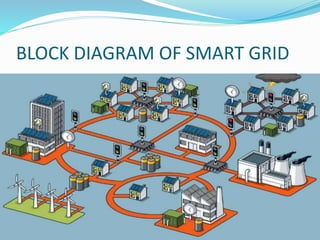
BLOCK DIAGRAM OF SMART GRID
NEED FOR A SMART GRID
 Conventional grid has electromechanical
arrangements ,which are highly inefficients .
 False tripping & Frequent power failure.
 Energy demand is increasing at a faster rate than
energy supply because of the increase in population.
 So no of grids increase to feed the demand.
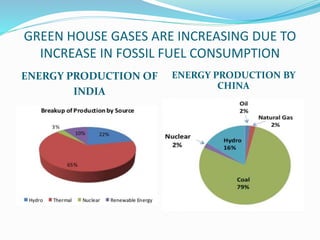
GREEN HOUSE GASES ARE INCREASING DUE TO
INCREASE IN FOSSIL FUEL CONSUMPTION
ENERGY PRODUCTION OF
INDIA
ENERGY PRODUCTION BY
CHINA
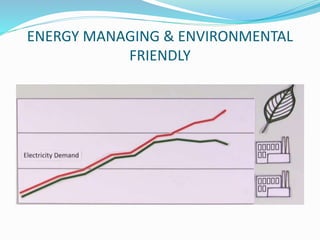
ENERGY MANAGING & ENVIRONMENTAL
FRIENDLY
WHAT SHOULD THE SMART GRID CAN DO WHICH
IS NOT BE POSSIBLE FOR CONVENTIONAL GRID
 Automatic fault restoration by using sensors in
transformers & transmission lines.
 No headache to call lineman to repair or reroute the
electricity from grid.
 The consumer can able to know his energy
consumption by viewing smart meter in real-time.
COMPARISION
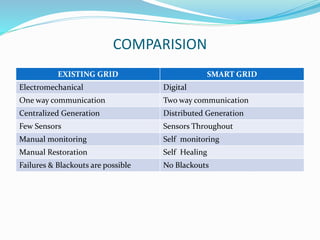
EXISTING GRID SMART GRID
Electromechanical Digital
One way communication Two way communication
Centralized Generation Distributed Generation
Few Sensors Sensors Throughout
Manual monitoring Self monitoring
Manual Restoration Self Healing
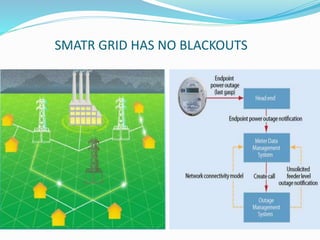
Failures & Blackouts are possible No Blackouts
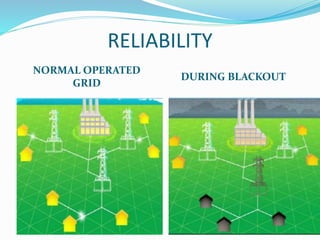
RELIABILITY
NORMAL OPERATED
GRID
DURING BLACKOUT
SMATR GRID HAS NO BLACKOUTS
MAJOR COMPONENT OF SMART GRID
 SENSING & MEASUREMENT
Its easy to cut our electricity bills if We know…
 Exactly how much electricity We are using.
 How much it is costing us in rupee per hour
 It can easily known from SMART METER.
CONCEPT OF SMART METER
o AUTOMATED METER INFRASTRUCTURE(AMI):
 REMOTE READING SYSTEM
 ANYTIME VIEWING ENERGY CONSUMPTION
 REAL TIME CONSUMPTION
 CARRY OUT CUSTOMER ORIENTED SERVICES.
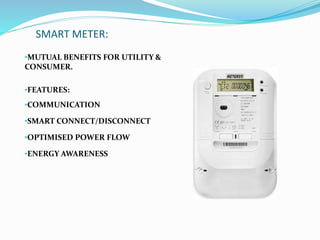
SMART METER:
•MUTUAL BENEFITS FOR UTILITY &
CONSUMER.
•FEATURES:
•COMMUNICATION
•SMART CONNECT/DISCONNECT
•OPTIMISED POWER FLOW
•ENERGY AWARENESS
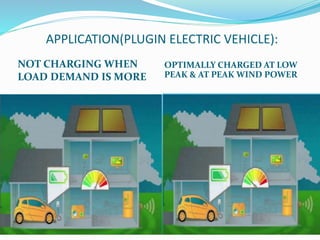
APPLICATION(PLUGIN ELECTRIC VEHICLE):
NOT CHARGING WHEN
LOAD DEMAND IS MORE
OPTIMALLY CHARGED AT LOW
PEAK & AT PEAK WIND POWER
ADVANTAGES:
 Better energy management.
 Proactive management of electrical network during
emergency situations.
 Better demand supply / demand response
management.
 Reduce carbon emissions.
DISADVANTAGES:
 PRESENT INFRASTRUCTURE IS INADEQUATE &
REQUIRES HIGH COST OF INSTALLATION.
 SMART GRID IS COMPUTER BASED IF IT IS
HACKED THEN WORST THING WILL HAPPEN.
 MOST RENEWABLEENERGY SOURCES ARE
INTERMITTENT & NOT RELIABLE.
VARIOUS IMPACTS
• GLOBAL EFFECT:
 IN G-20 CONFERENCE DEMAND MANAGEMENT & ENERGY , ENVIRONMENT
PROTECTION WAS MAJOR ISSUE.TO REDUCE IT SMART GRID WILL BE EFFECTIVE.
• ENVIRONMENT IMPACT:
 REDUCE GREEN HOUSE GASES
• ECONOMIC IMPACT:
 PREVENTS BLACKOUTS AS PARTICIPATION OF CONSUMERS
• SOCIAL IMPACT:
 REDUCE ELECTRIC BILL BY TRANSPARENT OPERATION IN AUTOMATED WAY
 SO IT IS CUSTOMER FRIENDLY & SOCIEO-ECONOMIC.
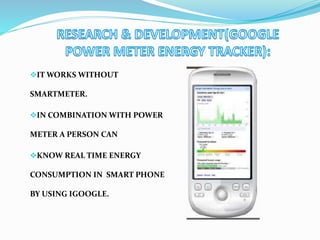
IT WORKS WITHOUT
SMARTMETER.
IN COMBINATION WITH POWER
METER A PERSON CAN
KNOW REAL TIME ENERGY
CONSUMPTION IN SMART PHONE
BY USING IGOOGLE.
CASE STUDY(PILOT PROJECTS BY POWER GRID):
 Pondicherry Smart Grid Pilot Project :
 POWERGRID has taken a pioneering initiative to develop Smart Grid Pilot
Project at Pondecherry through collaborative efforts jointly with Electricity
Departments, Govt. of Pondecherry for demonstration of efficacy.
 More than 50 organization has participated with POWERGRID for this unique
initative.
 Four pilot sites: (North Delhi, Bangalore, Gujurat, Maharastra)
 BESCOM Project: Bangalore – Integratation of renewable and
distributed energy resources to the grid.
 KEPCO PROJECT IN KERALA: $10b initiatives for smart grid.
FUTURE SCOPE:
 Our honorable prime minister of INDIA SHRI
NARENDRA MODI initiated ‘DIGITAL INDIA ‘scheme
where some cities will be converted into smart cities where
smart grid will be implemented to materialize the smart
city into reality.
 It is risky because of financial developments and
regulations.
 But in the long run, attitudes will change, wide spread
usage of the smart grid from every business to every home
just like the internet.
CONCLUSION:
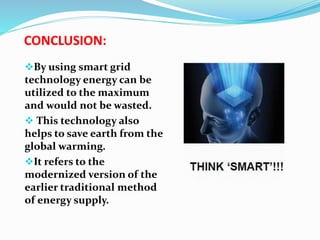
By using smart grid
technology energy can be
utilized to the maximum
and would not be wasted.
 This technology also
helps to save earth from the
global warming.
It refers to the
modernized version of the
earlier traditional method
of energy supply.
CODE OF CODUCTS:
This PPT:-
 Treats everyone fairly.
 Does not engage in spreading of any malicious rumors,
defamation or any other verbal or physical abuses, against
an IEEE member.
 Does not retaliate against any IEEE member, employee or
other person in any form of misconduct.
 Complies with applicable laws in all countries where IEEE
does business and with the IEEE policies and procedures.
 Rejects bribery in all forms.
ANY QUERIES
REFERENCES:
 Internet
 “The Green Grid: Energy Savings and Carbon Emissions Reductions
Enabled by a Smart Grid,”‘ EPRI Palo Alto, CA: 2008
 Frederic Butler, “A Call to order – A regulatory perspective on the smart
grid,” IEEE Power & Energy Magazine, April 2009:
 Sohal, G.S., “Glimpses of Power Sector”, Ist Edition, Confluence
International, New Delhi, 2004
 Shahi, R V, “Indian Power Sector: Challenge & Response”, Excel, New
Delhi, 2006
 “Overview of Power Sector in India 2005 (revised edition)”, India Core
Publishing, New Delhi, 2005
 ‘The Indian Electricity Market: Country Study and Investment Context”
P.M. Lamb. , July.2006
Smart grid the future grid

Smart grid the future grid

  • 1.
    SMART GRID-THE FUTURE GRID PRESENTEDBY: SUBHANKAR DASH (1241019177) ELECTRICAL ENGINEERING(SEC -D)
  • 2.
    CONTENT  INTRODUCTION TOSMART GRID  BLOCK DIAGRAM OF SMART GRID  NEED OF A SMART GRID  COMPARISION BETWEEN SMART GRID AND CONVENTIONAL GRID  COMPONENTS OF SMART GRID  SMART METER  APPLICATION  ADVANTAGE  DISADVANTAGE  VARIOUS IMPACTS  RESEARCH AND DEVELOPMENT  CASE STUDY  FUTURE SCOPE  CONCLUSION
  • 3.
    WHAT IS SMARTGRID? • Modernization of grid & digitalization. • Two way communication & Prevention of blackouts. • consumers and utility companies alike have tools to manage, monitor and respond to energy issues. • Combination of renewable energy sources.
  • 4.
    Cntd…  Adding sensing,embedded processing and digital communications makes the grid: Self healing Interactive Optimized Secure Predictable Distributive
  • 5.
    BLOCK DIAGRAM OFSMART GRID
  • 6.
    NEED FOR ASMART GRID  Conventional grid has electromechanical arrangements ,which are highly inefficients .  False tripping & Frequent power failure.  Energy demand is increasing at a faster rate than energy supply because of the increase in population.  So no of grids increase to feed the demand.
  • 7.
    GREEN HOUSE GASESARE INCREASING DUE TO INCREASE IN FOSSIL FUEL CONSUMPTION ENERGY PRODUCTION OF INDIA ENERGY PRODUCTION BY CHINA
  • 8.
    ENERGY MANAGING &ENVIRONMENTAL FRIENDLY
  • 9.
    WHAT SHOULD THESMART GRID CAN DO WHICH IS NOT BE POSSIBLE FOR CONVENTIONAL GRID  Automatic fault restoration by using sensors in transformers & transmission lines.  No headache to call lineman to repair or reroute the electricity from grid.  The consumer can able to know his energy consumption by viewing smart meter in real-time.
  • 10.
    COMPARISION EXISTING GRID SMARTGRID Electromechanical Digital One way communication Two way communication Centralized Generation Distributed Generation Few Sensors Sensors Throughout Manual monitoring Self monitoring Manual Restoration Self Healing Failures & Blackouts are possible No Blackouts
  • 11.
  • 12.
    SMATR GRID HASNO BLACKOUTS
  • 13.
    MAJOR COMPONENT OFSMART GRID  SENSING & MEASUREMENT Its easy to cut our electricity bills if We know…  Exactly how much electricity We are using.  How much it is costing us in rupee per hour  It can easily known from SMART METER.
  • 14.
    CONCEPT OF SMARTMETER o AUTOMATED METER INFRASTRUCTURE(AMI):  REMOTE READING SYSTEM  ANYTIME VIEWING ENERGY CONSUMPTION  REAL TIME CONSUMPTION  CARRY OUT CUSTOMER ORIENTED SERVICES.
  • 15.
    SMART METER: •MUTUAL BENEFITSFOR UTILITY & CONSUMER. •FEATURES: •COMMUNICATION •SMART CONNECT/DISCONNECT •OPTIMISED POWER FLOW •ENERGY AWARENESS
  • 16.
    APPLICATION(PLUGIN ELECTRIC VEHICLE): NOTCHARGING WHEN LOAD DEMAND IS MORE OPTIMALLY CHARGED AT LOW PEAK & AT PEAK WIND POWER
  • 17.
    ADVANTAGES:  Better energymanagement.  Proactive management of electrical network during emergency situations.  Better demand supply / demand response management.  Reduce carbon emissions.
  • 18.
    DISADVANTAGES:  PRESENT INFRASTRUCTUREIS INADEQUATE & REQUIRES HIGH COST OF INSTALLATION.  SMART GRID IS COMPUTER BASED IF IT IS HACKED THEN WORST THING WILL HAPPEN.  MOST RENEWABLEENERGY SOURCES ARE INTERMITTENT & NOT RELIABLE.
  • 19.
    VARIOUS IMPACTS • GLOBALEFFECT:  IN G-20 CONFERENCE DEMAND MANAGEMENT & ENERGY , ENVIRONMENT PROTECTION WAS MAJOR ISSUE.TO REDUCE IT SMART GRID WILL BE EFFECTIVE. • ENVIRONMENT IMPACT:  REDUCE GREEN HOUSE GASES • ECONOMIC IMPACT:  PREVENTS BLACKOUTS AS PARTICIPATION OF CONSUMERS • SOCIAL IMPACT:  REDUCE ELECTRIC BILL BY TRANSPARENT OPERATION IN AUTOMATED WAY  SO IT IS CUSTOMER FRIENDLY & SOCIEO-ECONOMIC.
  • 20.
    IT WORKS WITHOUT SMARTMETER. INCOMBINATION WITH POWER METER A PERSON CAN KNOW REAL TIME ENERGY CONSUMPTION IN SMART PHONE BY USING IGOOGLE.
  • 21.
    CASE STUDY(PILOT PROJECTSBY POWER GRID):  Pondicherry Smart Grid Pilot Project :  POWERGRID has taken a pioneering initiative to develop Smart Grid Pilot Project at Pondecherry through collaborative efforts jointly with Electricity Departments, Govt. of Pondecherry for demonstration of efficacy.  More than 50 organization has participated with POWERGRID for this unique initative.  Four pilot sites: (North Delhi, Bangalore, Gujurat, Maharastra)  BESCOM Project: Bangalore – Integratation of renewable and distributed energy resources to the grid.  KEPCO PROJECT IN KERALA: $10b initiatives for smart grid.
  • 22.
    FUTURE SCOPE:  Ourhonorable prime minister of INDIA SHRI NARENDRA MODI initiated ‘DIGITAL INDIA ‘scheme where some cities will be converted into smart cities where smart grid will be implemented to materialize the smart city into reality.  It is risky because of financial developments and regulations.  But in the long run, attitudes will change, wide spread usage of the smart grid from every business to every home just like the internet.
  • 23.
    CONCLUSION: By using smartgrid technology energy can be utilized to the maximum and would not be wasted.  This technology also helps to save earth from the global warming. It refers to the modernized version of the earlier traditional method of energy supply.
  • 24.
    CODE OF CODUCTS: ThisPPT:-  Treats everyone fairly.  Does not engage in spreading of any malicious rumors, defamation or any other verbal or physical abuses, against an IEEE member.  Does not retaliate against any IEEE member, employee or other person in any form of misconduct.  Complies with applicable laws in all countries where IEEE does business and with the IEEE policies and procedures.  Rejects bribery in all forms.
  • 25.
  • 26.
    REFERENCES:  Internet  “TheGreen Grid: Energy Savings and Carbon Emissions Reductions Enabled by a Smart Grid,”‘ EPRI Palo Alto, CA: 2008  Frederic Butler, “A Call to order – A regulatory perspective on the smart grid,” IEEE Power & Energy Magazine, April 2009:  Sohal, G.S., “Glimpses of Power Sector”, Ist Edition, Confluence International, New Delhi, 2004  Shahi, R V, “Indian Power Sector: Challenge & Response”, Excel, New Delhi, 2006  “Overview of Power Sector in India 2005 (revised edition)”, India Core Publishing, New Delhi, 2005  ‘The Indian Electricity Market: Country Study and Investment Context” P.M. Lamb. , July.2006