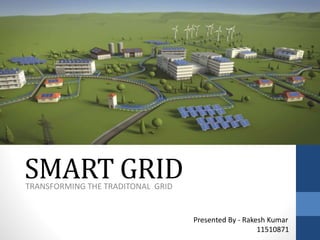
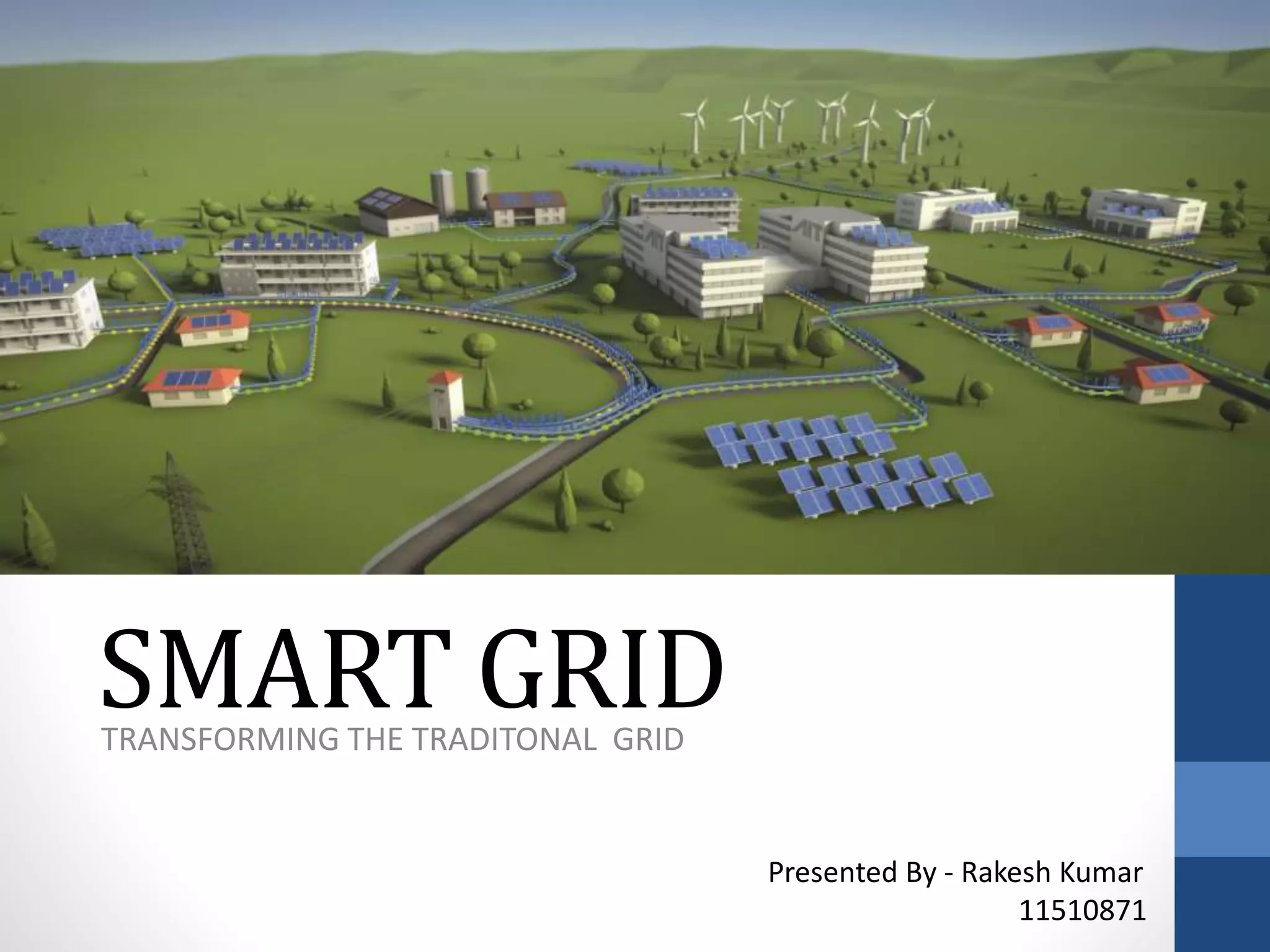


SMART GRIDTRANSFORMING THE TRADITONAL GRID
Presented By - Rakesh Kumar
11510871
Contents
1. Introduction
2. What is smart grid?
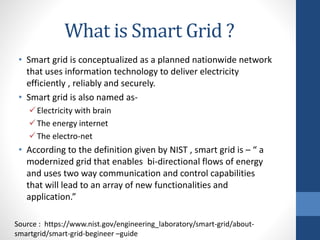
3. Comparison in existing grid and smart grid
4. Benefits of smart grids
5. Smart Grid architecture
6. Smart grid communication
7. Components of smart grid
8. Advantages & Disadvantages
9. Projects in India
10. Conclusion
Introduction
• Advancement of traditional grid
• Traditional electrical grid
Energy generation is done in centralized power plants.
Energy distribution is one directional- from power plants to
the consumers
Monitoring and restoration of grid is done manually
Unidirectional communication
• Smart Grid-
Achieve high reliability in power systems
A cyber physical system equipped with sustainable models of energy
production, distribution and usage
What is Smart Grid ?
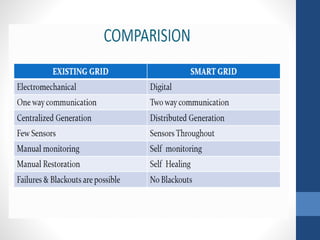
• Smart grid is conceptualized as a planned nationwide network
that uses information technology to deliver electricity
efficiently , reliably and securely.
• Smart grid is also named as-
Electricity with brain
The energy internet
The electro-net
• According to the definition given by NIST , smart grid is – “ a
modernized grid that enables bi-directional flows of energy
and uses two way communication and control capabilities
that will lead to an array of new functionalities and
application.”
Source : https://www.nist.gov/engineering_laboratory/smart-grid/about-
smartgrid/smart-grid-begineer –guide
Benefits of Smart Grid
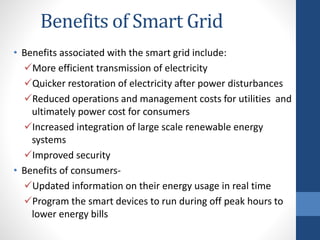
• Benefits associated with the smart grid include:
More efficient transmission of electricity
Quicker restoration of electricity after power disturbances
Reduced operations and management costs for utilities and
ultimately power cost for consumers
Increased integration of large scale renewable energy
systems
Improved security
• Benefits of consumers-
Updated information on their energy usage in real time
Program the smart devices to run during off peak hours to
lower energy bills
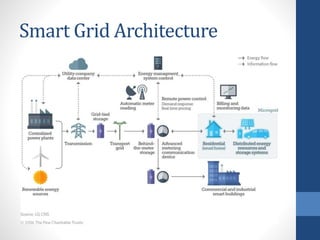
Smart Grid Architecture
Smart Grid Communication
• Components for smart grid communication –
Smart home appliance
Smart meters
Gateways
Data aggregator units (DAUs)
Meter Data Management systems
• Different network associated with smart grid communication
Home area network
Neighbourhood area networks
Wide area networks
Sensors and actuators networks
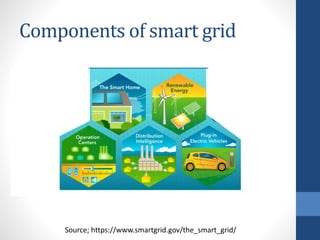
Components of smart grid
Source; https://www.smartgrid.gov/the_smart_grid/
 SMART HOME
• Smart homes depend on
Smart meters and home energy
management systems
Smart appliances
Home power generation
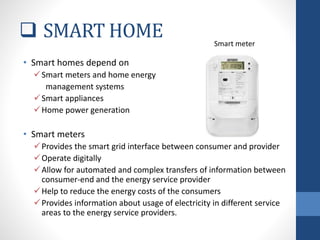
• Smart meters
Provides the smart grid interface between consumer and provider
Operate digitally
Allow for automated and complex transfers of information between
consumer-end and the energy service provider
Help to reduce the energy costs of the consumers
Provides information about usage of electricity in different service
areas to the energy service providers.
Smart meter
 PLUG-IN-EV
• Smart grid have the infrastructure needed to enable the
efficient use of plug-in-electrical vehicles(PEVs)
• Using PEVs-
Reduced dependency on oil
No pollution when running on electricity
• PEVs rely on power plants to charge their batteries
• PEVs get incentives from energy service provider for providing
energy to the grid through discharging
• Energy service providers encourages the consumers to charge
batteries of PEVs in off peak hours
• PEVs also can be used as an energy source in on peak hours.
 Operation Centre
• Drawbacks of traditional operation centre
Tries to make sure the amount of generated energy is getting used
If the grid voltage drops due to excess energy generation, the grid
becomes unstable
No means to detect oscillation which leads to blackout
Limited information about the energy flow through the grid
• Smart grid –
For monitoring and controlling on the transmission system in smart
grid Phasor measurement unit (PMU) is used
PMU samples the voltage and current with a fixed sample rate
By increasing sampling rate PMU provides the dynamic scenario of
the distribution system
Multiple PMUs form a phasor network , collected information by the
phasor network is analyized by SCADA system
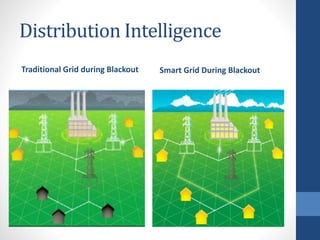
Distribution Intelligence
Traditional Grid during Blackout Smart Grid During Blackout
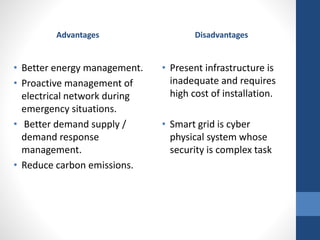
Advantages
• Better energy management.
• Proactive management of
electrical network during
emergency situations.
• Better demand supply /
demand response
management.
• Reduce carbon emissions.
Disadvantages
• Present infrastructure is
inadequate and requires
high cost of installation.
• Smart grid is cyber
physical system whose
security is complex task
PROJECTS BY POWER GRID
• Pondicherry Smart Grid Pilot Project :
• POWERGRID has taken a pioneering initiative to develop Smart Grid Pilot
• Project at Pondicherry through collaborative efforts jointly with Electricity
Departments, Govt. of Pondicherry for demonstration of efficacy.
• More than 50 organization has participated with POWERGRID for this unique
initiative.
• Four pilot sites: (North Delhi, Bangalore,Gujrat,Maharastra)
• BESCOM Project: Bangalore – Integration of renewable and
distributed energy resources to the grid.
• KEPCO PROJECT IN KERALA: $10b initiatives for smart grid.
Conclusion
By using smart grid technology
energy canbe utilized to the maximum
and would not bewasted.
This technology also helpstosaveearth
from the global warming.
It refers to the modernized version of
the earlier traditionalmethod of energy
supply.
Thank You

Smartgrid

  • 1.
    SMART GRIDTRANSFORMING THETRADITONAL GRID Presented By - Rakesh Kumar 11510871
  • 2.
    Contents 1. Introduction 2. Whatis smart grid? 3. Comparison in existing grid and smart grid 4. Benefits of smart grids 5. Smart Grid architecture 6. Smart grid communication 7. Components of smart grid 8. Advantages & Disadvantages 9. Projects in India 10. Conclusion
  • 3.
    Introduction • Advancement oftraditional grid • Traditional electrical grid Energy generation is done in centralized power plants. Energy distribution is one directional- from power plants to the consumers Monitoring and restoration of grid is done manually Unidirectional communication • Smart Grid- Achieve high reliability in power systems A cyber physical system equipped with sustainable models of energy production, distribution and usage
  • 4.
    What is SmartGrid ? • Smart grid is conceptualized as a planned nationwide network that uses information technology to deliver electricity efficiently , reliably and securely. • Smart grid is also named as- Electricity with brain The energy internet The electro-net • According to the definition given by NIST , smart grid is – “ a modernized grid that enables bi-directional flows of energy and uses two way communication and control capabilities that will lead to an array of new functionalities and application.” Source : https://www.nist.gov/engineering_laboratory/smart-grid/about- smartgrid/smart-grid-begineer –guide
  • 6.
    Benefits of SmartGrid • Benefits associated with the smart grid include: More efficient transmission of electricity Quicker restoration of electricity after power disturbances Reduced operations and management costs for utilities and ultimately power cost for consumers Increased integration of large scale renewable energy systems Improved security • Benefits of consumers- Updated information on their energy usage in real time Program the smart devices to run during off peak hours to lower energy bills
  • 7.
  • 8.
    Smart Grid Communication •Components for smart grid communication – Smart home appliance Smart meters Gateways Data aggregator units (DAUs) Meter Data Management systems • Different network associated with smart grid communication Home area network Neighbourhood area networks Wide area networks Sensors and actuators networks
  • 9.
    Components of smartgrid Source; https://www.smartgrid.gov/the_smart_grid/
  • 10.
     SMART HOME •Smart homes depend on Smart meters and home energy management systems Smart appliances Home power generation • Smart meters Provides the smart grid interface between consumer and provider Operate digitally Allow for automated and complex transfers of information between consumer-end and the energy service provider Help to reduce the energy costs of the consumers Provides information about usage of electricity in different service areas to the energy service providers. Smart meter
  • 11.
     PLUG-IN-EV • Smartgrid have the infrastructure needed to enable the efficient use of plug-in-electrical vehicles(PEVs) • Using PEVs- Reduced dependency on oil No pollution when running on electricity • PEVs rely on power plants to charge their batteries • PEVs get incentives from energy service provider for providing energy to the grid through discharging • Energy service providers encourages the consumers to charge batteries of PEVs in off peak hours • PEVs also can be used as an energy source in on peak hours.
  • 12.
     Operation Centre •Drawbacks of traditional operation centre Tries to make sure the amount of generated energy is getting used If the grid voltage drops due to excess energy generation, the grid becomes unstable No means to detect oscillation which leads to blackout Limited information about the energy flow through the grid • Smart grid – For monitoring and controlling on the transmission system in smart grid Phasor measurement unit (PMU) is used PMU samples the voltage and current with a fixed sample rate By increasing sampling rate PMU provides the dynamic scenario of the distribution system Multiple PMUs form a phasor network , collected information by the phasor network is analyized by SCADA system
  • 13.
    Distribution Intelligence Traditional Gridduring Blackout Smart Grid During Blackout
  • 14.
    Advantages • Better energymanagement. • Proactive management of electrical network during emergency situations. • Better demand supply / demand response management. • Reduce carbon emissions. Disadvantages • Present infrastructure is inadequate and requires high cost of installation. • Smart grid is cyber physical system whose security is complex task
  • 15.
    PROJECTS BY POWERGRID • Pondicherry Smart Grid Pilot Project : • POWERGRID has taken a pioneering initiative to develop Smart Grid Pilot • Project at Pondicherry through collaborative efforts jointly with Electricity Departments, Govt. of Pondicherry for demonstration of efficacy. • More than 50 organization has participated with POWERGRID for this unique initiative. • Four pilot sites: (North Delhi, Bangalore,Gujrat,Maharastra) • BESCOM Project: Bangalore – Integration of renewable and distributed energy resources to the grid. • KEPCO PROJECT IN KERALA: $10b initiatives for smart grid.
  • 17.
    Conclusion By using smartgrid technology energy canbe utilized to the maximum and would not bewasted. This technology also helpstosaveearth from the global warming. It refers to the modernized version of the earlier traditionalmethod of energy supply.
  • 18.