GEOSPATIAL MISSION
GIS CERTIFIED TRAINING INSTITUTE
REMOTE SENSING
• “Remote Sensing is defined as the acquisition of information about
an object without being in physical contact with it."
• In order to study large areas of the Earth’s surface geographers use
devices known as remote sensors. Thesesensors are mounted on
platforms such as helicopters, planes,and satellites that make it
possible for the sensors to observethe Earth from above.

• Remote sensing has been used for earthquake research from the 70s,
with the first appearance of satellite images. First of all it was used
in structural geological and geomorphological research.
• Active faults and structures were mapped on the base ofsatellite
images. This method is very limited in time series analysis.
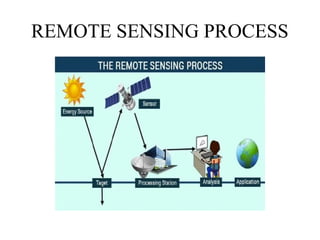
REMOTE SENSING PROCESS
SOURCE OF ENERGY
• In the process of the remote sensing first requirement is the
source of energy, inour solar system sun is the main source of
energy and it produces EMR(electromagnetic rays).
• As we know electromagnetic spectrum is very broad and not all
the rays(wavelength) are effective for the purpose of remote
sensing because most of thevery shortest wavelengths are
absorbed/scattered by the atmosphere while someglass lenses of
sensor also absorb the shorter wavelength, for instance U.V rays.
• In the electromagnetic spectrum only, visible spectrum can be
sensed by humaneye.
• The other electromagnetic rays such as infrared, U.V rays, X
rays, radio waveare invisible to human eyes.
HISTORY OF REMOTE SENSING
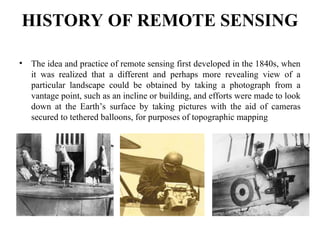
• The idea and practice of remote sensing first developed in the 1840s, when
it was realized that a different and perhaps more revealing view of a
particular landscape could be obtained by taking a photograph from a
vantage point, such as an incline or building, and efforts were made to look
down at the Earth’s surface by taking pictures with the aid of cameras
secured to tethered balloons, for purposes of topographic mapping
PRINCIPLES OF REMOTE
SENSING
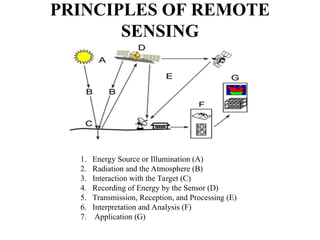
1. Energy Source or Illumination (A)
2. Radiation and the Atmosphere (B)
3. Interaction with the Target (C)
4. Recording of Energy by the Sensor (D)
5. Transmission, Reception, and Processing (E)
6. Interpretation and Analysis (F)
7. Application (G)
ELECTROMAGNETIC RADIATION
(EMR)
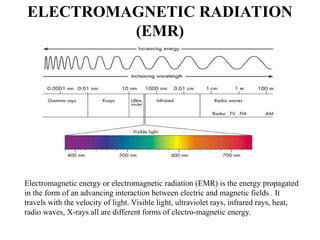
Electromagnetic energy or electromagnetic radiation (EMR) is the energy propagated
in the form of an advancing interaction between electric and magnetic fields . It
travels with the velocity of light. Visible light, ultraviolet rays, infrared rays, heat,
radio waves, X-rays all are different forms of electro-magnetic energy.
INTERACTION OF EMR WITH
EARTH'S SURFACE
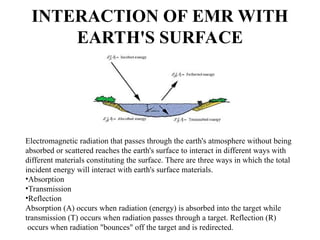
Electromagnetic radiation that passes through the earth's atmosphere without being
absorbed or scattered reaches the earth's surface to interact in different ways with
different materials constituting the surface. There are three ways in which the total
incident energy will interact with earth's surface materials.
•Absorption
•Transmission
•Reflection
Absorption (A) occurs when radiation (energy) is absorbed into the target while
transmission (T) occurs when radiation passes through a target. Reflection (R)
occurs when radiation "bounces" off the target and is redirected.
SPECTRAL REFLECTANCE OF
VEGETATION, SOIL, AND WATER
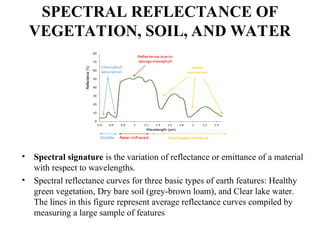
• Spectral signature is the variation of reflectance or emittance of a material
with respect to wavelengths.
• Spectral reflectance curves for three basic types of earth features: Healthy
green vegetation, Dry bare soil (grey-brown loam), and Clear lake water.
The lines in this figure represent average reflectance curves compiled by
measuring a large sample of features
TYPES OF REMOTE SENSING
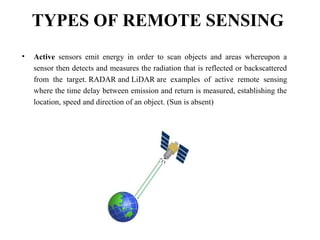
• Active sensors emit energy in order to scan objects and areas whereupon a
sensor then detects and measures the radiation that is reflected or backscattered
from the target. RADAR and LiDAR are examples of active remote sensing
where the time delay between emission and return is measured, establishing the
location, speed and direction of an object. (Sun is absent)
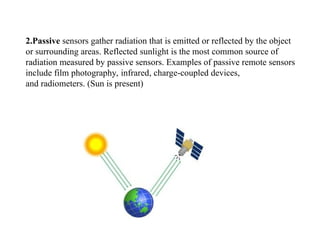
2.Passive sensors gather radiation that is emitted or reflected by the object
or surrounding areas. Reflected sunlight is the most common source of
radiation measured by passive sensors. Examples of passive remote sensors
include film photography, infrared, charge-coupled devices,
and radiometers. (Sun is present)
TYPES OF PLATFORMS IN REMOTE
SENSING
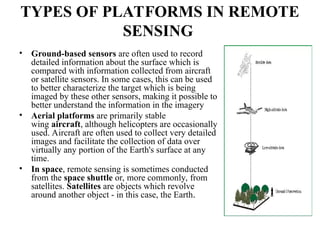
• Ground-based sensors are often used to record
detailed information about the surface which is
compared with information collected from aircraft
or satellite sensors. In some cases, this can be used
to better characterize the target which is being
imaged by these other sensors, making it possible to
better understand the information in the imagery
• Aerial platforms are primarily stable
wing aircraft, although helicopters are occasionally
used. Aircraft are often used to collect very detailed
images and facilitate the collection of data over
virtually any portion of the Earth's surface at any
time.
• In space, remote sensing is sometimes conducted
from the space shuttle or, more commonly, from
satellites. Satellites are objects which revolve
around another object - in this case, the Earth.
ELEMENT OF IMAGE
INTERPRETATION IN REMOTE
SENSING
• Tone refers to the relative brightness or colour of objects in an image
• Shape refers to the general form, structure, or outline of individual objects.
• Size of objects in an image is a function of scale.
• Pattern refers to the spatial arrangement of visibly discernible objects.
• Texture refers to the arrangement and frequency of tonal variation in
particular areas of an image.
• Shadow is also helpful in interpretation as it may provide an idea of the
profile and relative height of a target or targets which may make
identification easier
• Association takes into account the relationship between other recognizable
objects or features in proximity to the target of interest.
Advantages of Remote Sensing
• Remotely sensed imaging systems have several advantages over
camera photography, from which it differs significantly in the
following two ways:
(i) It is not just restricted to the visible part of the electromagnetic
spectrum (from about 0.4 to 0.7 micrometers in wavelength), but
can also measure energy at wavelengths invisible to the eye, such as
near-infrared, thermal infrared and radio wavelengths.
(ii) Most remote sensing instruments can record different wavelengths
at the same time, yielding not one but numerous images of the same
location on the ground, each corresponding to a different range of
wavelengths called a band.
Limitations of Remote Sensing
• Although remote sensing has many advantages over
ground-based survey, yet remote sensing has not totally
replaced ground-based survey methods, largely because
of some limitations with this technology, which still exist.
(i) Cost of data collection and data purchase.
(ii) Problems with data analysis and interpretation.
(iii) Potential limitations with spatial, spectral and temporal
resolutions of the various sensors.
(iv) Problems with all weather capability as some sensors
cannot ‘see’ through cloud.
GENERAL REMOTE SENSING
APPLICATIONS
• Agriculture
• Geography
• Forestry
• Geology
• Hydrology
• Sea ice
• Land cover and land use
• Mapping
• Oceans and coastal monitoring
Applications of Remote Sensing
• Assessment and monitoring of vegetation types and their status.
• Agricultural property management planning and crop yield
assessment.
• Soil surveys including mineral and petroleum exploration.
• Monitoring and planning of water resources and groundwater
exploration.
• Urban planning.
• Forest Resource Management:
• Biodiversity Mapping
• Land use land cover
APPLICATION OF REMOTE
SENSING IN CIVIL ENGINEERING
• Regional planning and Site investigations
• Terrain mapping and analysis
• Water resources and Hydrological engineering
• Town planning and Urban development
• Mining and Mineral exploration
• Transportation network analysis
• Landslide studies
MODERN ADVANTAGE OF
REMOTE SENSING
• Its satellite data are used as basic inputs for the inventory of natural
resources and development processes like agriculture,soil, forestry, and
geology .

• There are other important technologies that are available togeographers as
well, such as
• Maps,
• Aerial photography/photogrammetry/pictometry,
• SAR (Synthetic Aperture Radar)
• LiDAR (Light Detection and Ranging)
• SONAR
• GIS (GEOGRAPHIC INFORMATION SYSTEM)
THANK YOU

REMOTE-SENSING-PART-1-Geospatial Mission .ppt

  • 1.
  • 2.
    REMOTE SENSING • “RemoteSensing is defined as the acquisition of information about an object without being in physical contact with it." • In order to study large areas of the Earth’s surface geographers use devices known as remote sensors. Thesesensors are mounted on platforms such as helicopters, planes,and satellites that make it possible for the sensors to observethe Earth from above.  • Remote sensing has been used for earthquake research from the 70s, with the first appearance of satellite images. First of all it was used in structural geological and geomorphological research. • Active faults and structures were mapped on the base ofsatellite images. This method is very limited in time series analysis.
  • 3.
  • 4.
    SOURCE OF ENERGY •In the process of the remote sensing first requirement is the source of energy, inour solar system sun is the main source of energy and it produces EMR(electromagnetic rays). • As we know electromagnetic spectrum is very broad and not all the rays(wavelength) are effective for the purpose of remote sensing because most of thevery shortest wavelengths are absorbed/scattered by the atmosphere while someglass lenses of sensor also absorb the shorter wavelength, for instance U.V rays. • In the electromagnetic spectrum only, visible spectrum can be sensed by humaneye. • The other electromagnetic rays such as infrared, U.V rays, X rays, radio waveare invisible to human eyes.
  • 5.
    HISTORY OF REMOTESENSING • The idea and practice of remote sensing first developed in the 1840s, when it was realized that a different and perhaps more revealing view of a particular landscape could be obtained by taking a photograph from a vantage point, such as an incline or building, and efforts were made to look down at the Earth’s surface by taking pictures with the aid of cameras secured to tethered balloons, for purposes of topographic mapping
  • 6.
    PRINCIPLES OF REMOTE SENSING 1.Energy Source or Illumination (A) 2. Radiation and the Atmosphere (B) 3. Interaction with the Target (C) 4. Recording of Energy by the Sensor (D) 5. Transmission, Reception, and Processing (E) 6. Interpretation and Analysis (F) 7. Application (G)
  • 7.
    ELECTROMAGNETIC RADIATION (EMR) Electromagnetic energyor electromagnetic radiation (EMR) is the energy propagated in the form of an advancing interaction between electric and magnetic fields . It travels with the velocity of light. Visible light, ultraviolet rays, infrared rays, heat, radio waves, X-rays all are different forms of electro-magnetic energy.
  • 8.
    INTERACTION OF EMRWITH EARTH'S SURFACE Electromagnetic radiation that passes through the earth's atmosphere without being absorbed or scattered reaches the earth's surface to interact in different ways with different materials constituting the surface. There are three ways in which the total incident energy will interact with earth's surface materials. •Absorption •Transmission •Reflection Absorption (A) occurs when radiation (energy) is absorbed into the target while transmission (T) occurs when radiation passes through a target. Reflection (R) occurs when radiation "bounces" off the target and is redirected.
  • 9.
    SPECTRAL REFLECTANCE OF VEGETATION,SOIL, AND WATER • Spectral signature is the variation of reflectance or emittance of a material with respect to wavelengths. • Spectral reflectance curves for three basic types of earth features: Healthy green vegetation, Dry bare soil (grey-brown loam), and Clear lake water. The lines in this figure represent average reflectance curves compiled by measuring a large sample of features
  • 10.
    TYPES OF REMOTESENSING • Active sensors emit energy in order to scan objects and areas whereupon a sensor then detects and measures the radiation that is reflected or backscattered from the target. RADAR and LiDAR are examples of active remote sensing where the time delay between emission and return is measured, establishing the location, speed and direction of an object. (Sun is absent)
  • 11.
    2.Passive sensors gatherradiation that is emitted or reflected by the object or surrounding areas. Reflected sunlight is the most common source of radiation measured by passive sensors. Examples of passive remote sensors include film photography, infrared, charge-coupled devices, and radiometers. (Sun is present)
  • 12.
    TYPES OF PLATFORMSIN REMOTE SENSING • Ground-based sensors are often used to record detailed information about the surface which is compared with information collected from aircraft or satellite sensors. In some cases, this can be used to better characterize the target which is being imaged by these other sensors, making it possible to better understand the information in the imagery • Aerial platforms are primarily stable wing aircraft, although helicopters are occasionally used. Aircraft are often used to collect very detailed images and facilitate the collection of data over virtually any portion of the Earth's surface at any time. • In space, remote sensing is sometimes conducted from the space shuttle or, more commonly, from satellites. Satellites are objects which revolve around another object - in this case, the Earth.
  • 13.
    ELEMENT OF IMAGE INTERPRETATIONIN REMOTE SENSING • Tone refers to the relative brightness or colour of objects in an image • Shape refers to the general form, structure, or outline of individual objects. • Size of objects in an image is a function of scale. • Pattern refers to the spatial arrangement of visibly discernible objects. • Texture refers to the arrangement and frequency of tonal variation in particular areas of an image. • Shadow is also helpful in interpretation as it may provide an idea of the profile and relative height of a target or targets which may make identification easier • Association takes into account the relationship between other recognizable objects or features in proximity to the target of interest.
  • 14.
    Advantages of RemoteSensing • Remotely sensed imaging systems have several advantages over camera photography, from which it differs significantly in the following two ways: (i) It is not just restricted to the visible part of the electromagnetic spectrum (from about 0.4 to 0.7 micrometers in wavelength), but can also measure energy at wavelengths invisible to the eye, such as near-infrared, thermal infrared and radio wavelengths. (ii) Most remote sensing instruments can record different wavelengths at the same time, yielding not one but numerous images of the same location on the ground, each corresponding to a different range of wavelengths called a band.
  • 15.
    Limitations of RemoteSensing • Although remote sensing has many advantages over ground-based survey, yet remote sensing has not totally replaced ground-based survey methods, largely because of some limitations with this technology, which still exist. (i) Cost of data collection and data purchase. (ii) Problems with data analysis and interpretation. (iii) Potential limitations with spatial, spectral and temporal resolutions of the various sensors. (iv) Problems with all weather capability as some sensors cannot ‘see’ through cloud.
  • 16.
    GENERAL REMOTE SENSING APPLICATIONS •Agriculture • Geography • Forestry • Geology • Hydrology • Sea ice • Land cover and land use • Mapping • Oceans and coastal monitoring
  • 17.
    Applications of RemoteSensing • Assessment and monitoring of vegetation types and their status. • Agricultural property management planning and crop yield assessment. • Soil surveys including mineral and petroleum exploration. • Monitoring and planning of water resources and groundwater exploration. • Urban planning. • Forest Resource Management: • Biodiversity Mapping • Land use land cover
  • 18.
    APPLICATION OF REMOTE SENSINGIN CIVIL ENGINEERING • Regional planning and Site investigations • Terrain mapping and analysis • Water resources and Hydrological engineering • Town planning and Urban development • Mining and Mineral exploration • Transportation network analysis • Landslide studies
  • 19.
    MODERN ADVANTAGE OF REMOTESENSING • Its satellite data are used as basic inputs for the inventory of natural resources and development processes like agriculture,soil, forestry, and geology .  • There are other important technologies that are available togeographers as well, such as • Maps, • Aerial photography/photogrammetry/pictometry, • SAR (Synthetic Aperture Radar) • LiDAR (Light Detection and Ranging) • SONAR • GIS (GEOGRAPHIC INFORMATION SYSTEM)
  • 20.