Nuclear Magnetic
Resonance
Spectroscopy
SAHANA
1
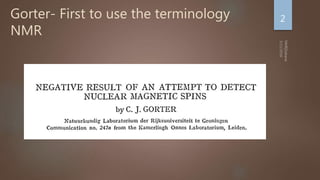
Gorter- First to use the terminology
NMR
2
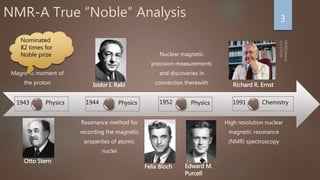
NMR-A True “Noble” Analysis
Magnetic moment of
the proton
Resonance method for
recording the magnetic
properties of atomic
nuclei
Nuclear magnetic
precision measurements
and discoveries in
connection therewith
High resolution nuclear
magnetic resonance
(NMR) spectroscopy
1991195219441943
Richard R. Ernst
Chemistry
Felix Bloch Edward M.
Purcell
Physics
Isidor I. Rabi
Physics
Otto Stern
Physics
3
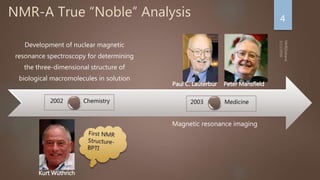
NMR-A True “Noble” Analysis
Development of nuclear magnetic
resonance spectroscopy for determining
the three-dimensional structure of
biological macromolecules in solution
Magnetic resonance imaging
2002 2003
Kurt Wüthrich
Chemistry Medicine
Paul C. Lauterbur Peter Mansfield
4
Why NMR? [Applications]
• Identification
• Analysis of
material
• Protein
Structure
• Kinetics
• Condensed
Matter Physics
• MRI
Medical Physics
ChemistryBiology
5
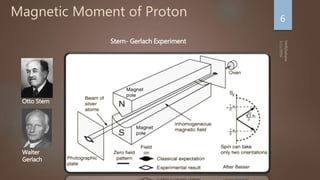
Magnetic Moment of Proton
Otto Stern
Walter
Gerlach
Stern- Gerlach Experiment
6
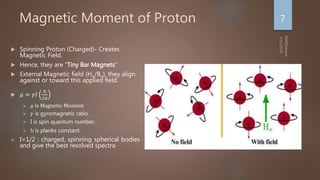
Magnetic Moment of Proton
 Spinning Proton (Charged)- Creates
Magnetic Field.
 Hence, they are “Tiny Bar Magnets”
 External Magnetic field (Ho/Bo), they align
against or toward this applied field.
 𝜇 = 𝛾𝐼
ℎ
2𝜋
 𝜇 is Magnetic Moment
 𝛾 is gyromagnetic ratio.
 I is spin quantum number.
 h is planks constant
 I=1/2 : charged, spinning spherical bodies
and give the best resolved spectra
7
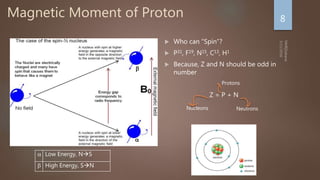
Magnetic Moment of Proton
 Who can “Spin”?
 P31, F19, N15, C13, H1
 Because, Z and N should be odd in
number
Z = P + N
Nucleons
Protons
Neutrons


 Low Energy, NS
 High Energy, SN
8
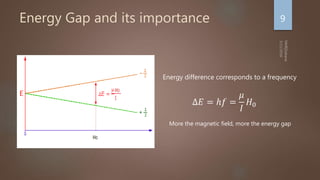
Energy Gap and its importance 9
∆𝐸 = ℎ𝑓 =
𝜇
𝐼
𝐻0
Energy difference corresponds to a frequency
More the magnetic field, more the energy gap
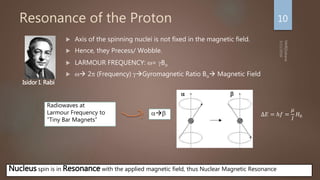
Resonance of the Proton
 Axis of the spinning nuclei is not fixed in the magnetic field.
 Hence, they Precess/ Wobble.
 LARMOUR FREQUENCY: = Bo
  2 (Frequency) Gyromagnetic Ratio Bo Magnetic Field
Isidor I. Rabi
Radiowaves at
Larmour Frequency to
“Tiny Bar Magnets”

 
10
∆𝐸 = ℎ𝑓 =
𝜇
𝐼
𝐻0
Nucleus spin is in Resonance with the applied magnetic field, thus Nuclear Magnetic Resonance
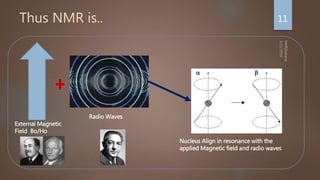
Thus NMR is.. 11
 
External Magnetic
Field Bo/Ho
Radio Waves
Nucleus Align in resonance with the
applied Magnetic field and radio waves
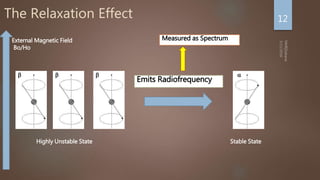
The Relaxation Effect 12
 
Highly Unstable State Stable State
External Magnetic Field
Bo/Ho
Emits Radiofrequency
Measured as Spectrum
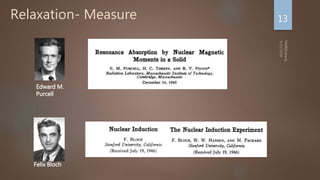
Relaxation- Measure 13
Felix Bloch
Edward M.
Purcell
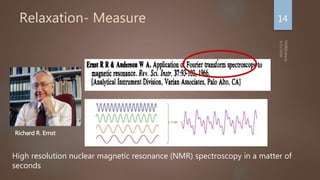
14Relaxation- Measure
Richard R. Ernst
High resolution nuclear magnetic resonance (NMR) spectroscopy in a matter of
seconds
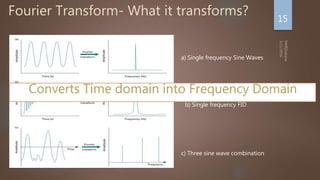
Fourier Transform- What it transforms? 15
a) Single frequency Sine Waves
b) Single frequency FID
c) Three sine wave combination
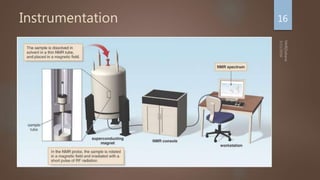
Instrumentation 16
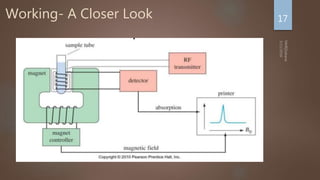
Working- A Closer Look 17
Instrumentation- Sample Holder 18
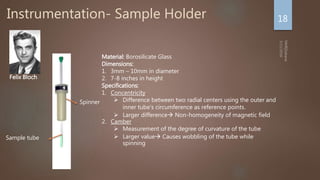
Material: Borosilicate Glass
Dimensions:
1. 3mm – 10mm in diameter
2. 7-8 inches in height
Specifications:
1. Concentricity
 Difference between two radial centers using the outer and
inner tube's circumference as reference points.
 Larger difference Non-homogeneity of magnetic field
2. Camber
 Measurement of the degree of curvature of the tube
 Larger value Causes wobbling of the tube while
spinning
Felix Bloch
Spinner
Sample tube
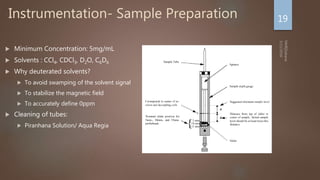
 Minimum Concentration: 5mg/mL
 Solvents : CCl4, CDCl3, D2O, C6D6
 Why deuterated solvents?
 To avoid swamping of the solvent signal
 To stabilize the magnetic field
 To accurately define 0ppm
 Cleaning of tubes:
 Piranhana Solution/ Aqua Regia
19Instrumentation- Sample Preparation
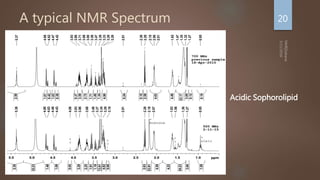
A typical NMR Spectrum 20
Acidic Sophorolipid
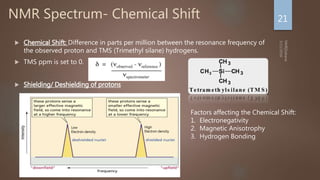
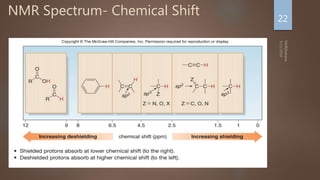
NMR Spectrum- Chemical Shift
 Chemical Shift: Difference in parts per million between the resonance frequency of
the observed proton and TMS (Trimethyl silane) hydrogens.
 TMS ppm is set to 0.
 Shielding/ Deshielding of protons
21
Factors affecting the Chemical Shift:
1. Electronegativity
2. Magnetic Anisotrophy
3. Hydrogen Bonding
High
Electron density
Low
Electron density
NMR Spectrum- Chemical Shift 22
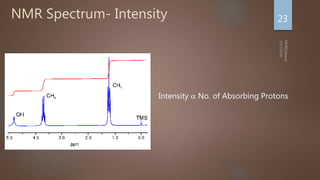
NMR Spectrum- Intensity 23
Intensity  No. of Absorbing Protons
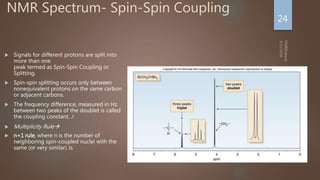
NMR Spectrum- Spin-Spin Coupling
 Signals for different protons are split into
more than one
peak termed as Spin-Spin Coupling or
Splitting.
 Spin-spin splitting occurs only between
nonequivalent protons on the same carbon
or adjacent carbons.
 The frequency difference, measured in Hz
between two peaks of the doublet is called
the coupling constant, J
 Multiplicity Rule
 n+1 rule, where n is the number of
neighboring spin-coupled nuclei with the
same (or very similar) Js
24
NMR Spectrum- Interpretation
 Number of signals: Indicates how many different kinds of
protons are present
 Position of signals: Indicates Magnetic environment of the
signal
 Relative Intensity: Proportional to number of protons present
 Splitting: Indicates number of splitting Nuclei [Usually
Protons]
25
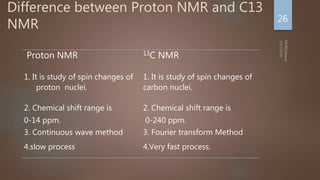
Difference between Proton NMR and C13
NMR 26
Proton NMR 13C NMR
1. It is study of spin changes of
proton nuclei.
1. It is study of spin changes of
carbon nuclei.
2. Chemical shift range is
0-14 ppm.
2. Chemical shift range is
0-240 ppm.
3. Continuous wave method 3. Fourier transform Method
4.slow process 4.Very fast process.
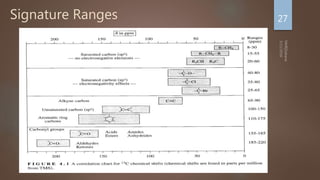
Signature Ranges 27
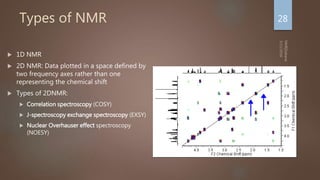
Types of NMR
 1D NMR
 2D NMR: Data plotted in a space defined by
two frequency axes rather than one
representing the chemical shift
 Types of 2DNMR:
 Correlation spectroscopy (COSY)
 J-spectroscopy exchange spectroscopy (EXSY)
 Nuclear Overhauser effect spectroscopy
(NOESY)
28
Take Away Messages 29
Without Passion,
Life Becomes
Senseless

Introduction to NMR

  • 1.
  • 2.
    Gorter- First touse the terminology NMR 2
  • 3.
    NMR-A True “Noble”Analysis Magnetic moment of the proton Resonance method for recording the magnetic properties of atomic nuclei Nuclear magnetic precision measurements and discoveries in connection therewith High resolution nuclear magnetic resonance (NMR) spectroscopy 1991195219441943 Richard R. Ernst Chemistry Felix Bloch Edward M. Purcell Physics Isidor I. Rabi Physics Otto Stern Physics 3
  • 4.
    NMR-A True “Noble”Analysis Development of nuclear magnetic resonance spectroscopy for determining the three-dimensional structure of biological macromolecules in solution Magnetic resonance imaging 2002 2003 Kurt Wüthrich Chemistry Medicine Paul C. Lauterbur Peter Mansfield 4
  • 5.
    Why NMR? [Applications] •Identification • Analysis of material • Protein Structure • Kinetics • Condensed Matter Physics • MRI Medical Physics ChemistryBiology 5
  • 6.
    Magnetic Moment ofProton Otto Stern Walter Gerlach Stern- Gerlach Experiment 6
  • 7.
    Magnetic Moment ofProton  Spinning Proton (Charged)- Creates Magnetic Field.  Hence, they are “Tiny Bar Magnets”  External Magnetic field (Ho/Bo), they align against or toward this applied field.  𝜇 = 𝛾𝐼 ℎ 2𝜋  𝜇 is Magnetic Moment  𝛾 is gyromagnetic ratio.  I is spin quantum number.  h is planks constant  I=1/2 : charged, spinning spherical bodies and give the best resolved spectra 7
  • 8.
    Magnetic Moment ofProton  Who can “Spin”?  P31, F19, N15, C13, H1  Because, Z and N should be odd in number Z = P + N Nucleons Protons Neutrons    Low Energy, NS  High Energy, SN 8
  • 9.
    Energy Gap andits importance 9 ∆𝐸 = ℎ𝑓 = 𝜇 𝐼 𝐻0 Energy difference corresponds to a frequency More the magnetic field, more the energy gap
  • 10.
    Resonance of theProton  Axis of the spinning nuclei is not fixed in the magnetic field.  Hence, they Precess/ Wobble.  LARMOUR FREQUENCY: = Bo   2 (Frequency) Gyromagnetic Ratio Bo Magnetic Field Isidor I. Rabi Radiowaves at Larmour Frequency to “Tiny Bar Magnets”    10 ∆𝐸 = ℎ𝑓 = 𝜇 𝐼 𝐻0 Nucleus spin is in Resonance with the applied magnetic field, thus Nuclear Magnetic Resonance
  • 11.
    Thus NMR is..11   External Magnetic Field Bo/Ho Radio Waves Nucleus Align in resonance with the applied Magnetic field and radio waves
  • 12.
    The Relaxation Effect12   Highly Unstable State Stable State External Magnetic Field Bo/Ho Emits Radiofrequency Measured as Spectrum
  • 13.
    Relaxation- Measure 13 FelixBloch Edward M. Purcell
  • 14.
    14Relaxation- Measure Richard R.Ernst High resolution nuclear magnetic resonance (NMR) spectroscopy in a matter of seconds
  • 15.
    Fourier Transform- Whatit transforms? 15 a) Single frequency Sine Waves b) Single frequency FID c) Three sine wave combination
  • 16.
  • 17.
  • 18.
    Instrumentation- Sample Holder18 Material: Borosilicate Glass Dimensions: 1. 3mm – 10mm in diameter 2. 7-8 inches in height Specifications: 1. Concentricity  Difference between two radial centers using the outer and inner tube's circumference as reference points.  Larger difference Non-homogeneity of magnetic field 2. Camber  Measurement of the degree of curvature of the tube  Larger value Causes wobbling of the tube while spinning Felix Bloch Spinner Sample tube
  • 19.
     Minimum Concentration:5mg/mL  Solvents : CCl4, CDCl3, D2O, C6D6  Why deuterated solvents?  To avoid swamping of the solvent signal  To stabilize the magnetic field  To accurately define 0ppm  Cleaning of tubes:  Piranhana Solution/ Aqua Regia 19Instrumentation- Sample Preparation
  • 20.
    A typical NMRSpectrum 20 Acidic Sophorolipid
  • 21.
    NMR Spectrum- ChemicalShift  Chemical Shift: Difference in parts per million between the resonance frequency of the observed proton and TMS (Trimethyl silane) hydrogens.  TMS ppm is set to 0.  Shielding/ Deshielding of protons 21 Factors affecting the Chemical Shift: 1. Electronegativity 2. Magnetic Anisotrophy 3. Hydrogen Bonding High Electron density Low Electron density
  • 22.
  • 23.
    NMR Spectrum- Intensity23 Intensity  No. of Absorbing Protons
  • 24.
    NMR Spectrum- Spin-SpinCoupling  Signals for different protons are split into more than one peak termed as Spin-Spin Coupling or Splitting.  Spin-spin splitting occurs only between nonequivalent protons on the same carbon or adjacent carbons.  The frequency difference, measured in Hz between two peaks of the doublet is called the coupling constant, J  Multiplicity Rule  n+1 rule, where n is the number of neighboring spin-coupled nuclei with the same (or very similar) Js 24
  • 25.
    NMR Spectrum- Interpretation Number of signals: Indicates how many different kinds of protons are present  Position of signals: Indicates Magnetic environment of the signal  Relative Intensity: Proportional to number of protons present  Splitting: Indicates number of splitting Nuclei [Usually Protons] 25
  • 26.
    Difference between ProtonNMR and C13 NMR 26 Proton NMR 13C NMR 1. It is study of spin changes of proton nuclei. 1. It is study of spin changes of carbon nuclei. 2. Chemical shift range is 0-14 ppm. 2. Chemical shift range is 0-240 ppm. 3. Continuous wave method 3. Fourier transform Method 4.slow process 4.Very fast process.
  • 27.
  • 28.
    Types of NMR 1D NMR  2D NMR: Data plotted in a space defined by two frequency axes rather than one representing the chemical shift  Types of 2DNMR:  Correlation spectroscopy (COSY)  J-spectroscopy exchange spectroscopy (EXSY)  Nuclear Overhauser effect spectroscopy (NOESY) 28
  • 29.
    Take Away Messages29 Without Passion, Life Becomes Senseless