NMR Spectroscopy
Presented by
Rajesh Shridhar Tale
M.Pharm. 2nd Sem. Pharmaceutical Chemistry,
University Department Of Pharmaceutical Sciences(U.D.P.S.).
Rashtrasant Tukadoji Maharaj Nagpur University,
Nagpur-440 033.
Contents
• Introduction
• Principle
• Instrumentation
• NMR spectrum
• Signal Pattern
• FT-NMR
• 13C-NMR
• Chemical shift and factors affecting chemical shift
• Spin spin coupling and Coupling constant
• Proton decoupled mode
• 2-D NMR
• COSY
• NOESY
• HETCOR
1/30/2020 2
University Department of Pharmaceutical
Sciences,R.T.M.University,Nagpur.
NMR:- Nuclear Magnetic
Resonance
Spin:-Many atomic nuclei have a property known
as spin.
Spin angular momentum:-A spinning
charge generates a magnetic field, the resulting
spin-magnet has a magnetic moment (μ)
proportional to the spin (I)
Principle of NMR
1/30/2020 4
• The principle is based on the spinning of nucleus and generating a magnetic field.
• Without external magnetic (Bo) – field nuclear spin are random in direction.
• With Bo ,nuclei align themselves either with or against field of external magnetic
field.
University Department of Pharmaceutical
Sciences,R.T.M.University,Nagpur.
• magnetic moment m = g p where g is the gyromagnetic ratio, and it is a
constant for a given nucleus.
• In the presence of an external magnetic field (B0), two spin states exist,
+1/2 and -1/2 (For I=1/2).
• The magnetic moment of the lower energy +1/2 state is aligned with the
external field, and that of the higher energy -1/2 spin state is opposed to
the external field.
1/30/2020 5
University Department of Pharmaceutical
Sciences,R.T.M.University,Nagpur.
Spin Quantum Number (I)
• It is physical constant.(2I + I)
• Odd mass nuclei with an odd number of nucleons have fractional spins.
• Even mass nuclei with odd numbers of protons and neutrons have integral
spins.
• Even mass nuclei composed of even numbers of protons and neutrons have
zero spin.
1/30/2020 6
University Department of Pharmaceutical
Sciences,R.T.M.University,Nagpur.
Instrumentation
1/30/2020 7
University Department of Pharmaceutical
Sciences,R.T.M.University,Nagpur.
NMR Spectrum
• NMR spectrum is a plot of intensity of NMR signals VS magnetic field (frequency)
in reference to TMS.
1/30/2020 8
University Department of Pharmaceutical
Sciences,R.T.M.University,Nagpur.
• 1H nuclei are shielded by the magnetic field produced by the surrounding
• electrons. The higher the electron density around the nucleus, the higher the
magnetic field required to cause resonance.
• Information from 1H-nmr spectra:
• 1. Number of signals: How many different types of hydrogens in the
molecule.
• 2. Position of signals (chemical shift): What types of hydrogens.
• 3. Relative areas under signals (integration): How many hydrogens of each
type.
• 4. Splitting pattern: How many neighboring hydrogens
1/30/2020 9
University Department of Pharmaceutical
Sciences,R.T.M.University,Nagpur.
• note: n must be equivalent neighboring hydrogens to give rise to
a Pascal splitting pattern. If the neighbors are not equivalent, then you will see a
complex pattern (aka complex multiplet).
• note: the alcohol hydrogen –OH usually does not split neighboring hydrogen
signals nor is it split. Normally a singlet of integration 1 between 1 – 5.5 ppm
(variable).
1/30/2020 10
University Department of Pharmaceutical
Sciences,R.T.M.University,Nagpur.
Numbers of Signals
• Magnetically equivalent hydrogens resonate at the same applied field.
• Magnetically equivalent hydrogens are also chemically equivalent.
1/30/2020 11
University Department of Pharmaceutical
Sciences,R.T.M.University,Nagpur.
•Position of signals (chemical shift):
what types of hydrogens.
• primary 0.9 ppm
• secondary 1.3
• tertiary 1.5
• aromatic 6-8.5
• allyl 1.7
• benzyl 2.2-3
• chlorides 3-4 H-C-Cl
• Bromides 2.5-4 H-C-Br
• iodides 2-4 H-C-I
• alcohols 3.4-4 H-C-O
• alcohols 1-5.5 H-O-
1/30/2020 12
University Department of Pharmaceutical
Sciences,R.T.M.University,Nagpur.
1/30/2020 13
University Department of Pharmaceutical
Sciences,R.T.M.University,Nagpur.
Fourrier
Transform
FT-NMR
1/30/2020 14
University Department of Pharmaceutical
Sciences,R.T.M.University,Nagpur.
13C – nmr13C ~ 1.1% of carbons
1) number of signals: how many different types of carbons.
2) splitting: number of hydrogens on the carbon
3) chemical shift: hybridization of carbon sp, sp2, sp3
4) chemical shift: evironment
Chemical Shift-δ
• The electron density around each nucleus in a molecule varies according to the
types of nuclei and bonds in the molecule.
• The opposing field and therefore the effective field at each nucleus will vary. This
is called the chemical shift
1/30/2020 16
University Department of Pharmaceutical
Sciences,R.T.M.University,Nagpur.
1/30/2020 17
University Department of Pharmaceutical
Sciences,R.T.M.University,Nagpur.
• reference compound = tetramethylsilane (CH3)4Si @ 0.0 ppm.
1/30/2020 18
Magnetic Field->
<-Chemical Shift
University Department of Pharmaceutical
Sciences,R.T.M.University,Nagpur.
• The term chemical shift was developed to avoid this problem.
• The chemical shift of a nucleus is the difference between the resonance
frequency of the nucleus and a standard, relative to the standard.
• This quantity is reported in ppm and given the symbol delta(δ).
• In NMR spectroscopy, the standard is often tetramethylsilane, Si(CH3)4,
abbreviated TMS.
• Tetramethyl silane (TMS) is used as reference because it is soluble in most
organic solvents, is inert, volatile, and has 12 equivalent 1H and 4 equivalent 13C.
TMS signal is set to 0.
1/30/2020 19
University Department of Pharmaceutical
Sciences,R.T.M.University,Nagpur.
•Chemical shift depends on :
• Electronegativity of nearby atoms
• Hybridization of adjacent atoms
• Diamagnetic effects
• Paramagnetic effects
• Solvent effect
1/30/2020 20
University Department of Pharmaceutical
Sciences,R.T.M.University,Nagpur.
• Chemical shift : (1) electronegativity of nearby atoms, (2) hybridization of
adjacent atoms, and (3) diamagnetic effects Electronegativity
1/30/2020 21
University Department of Pharmaceutical
Sciences,R.T.M.University,Nagpur.
• A carbon-carbon triple bond shields an acetylenic hydrogen and shifts its
signal to lower frequency (to the right) to a smaller value.
1/30/2020 22
University Department of Pharmaceutical
Sciences,R.T.M.University,Nagpur.
• Carbon-Carbon Double Bond Effect
• Magnetic induction in the p bond of a carbon-carbon double bond deshields
vinylic hydrogens and shifts their signal higher frequency
1/30/2020 23
University Department of Pharmaceutical
Sciences,R.T.M.University,Nagpur.
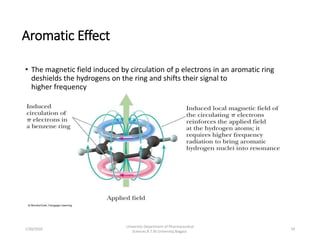
Aromatic Effect
• The magnetic field induced by circulation of p electrons in an aromatic ring
deshields the hydrogens on the ring and shifts their signal to
higher frequency
1/30/2020 24
University Department of Pharmaceutical
Sciences,R.T.M.University,Nagpur.
Chemical Shift - 13C-NMR
1/30/2020 25
University Department of Pharmaceutical
Sciences,R.T.M.University,Nagpur.
Coupling constant (J):
• The separation on an NMR
• spectrum (in hertz) between
• adjacent peaks in a multiplet.
1/30/2020 26
University Department of Pharmaceutical
Sciences,R.T.M.University,Nagpur.
• Spin-spin coupling:
• The coupling of the intrinsic angular momentum of different particles.
• Such coupling between pairs of nuclear spins is an important feature of
nuclear magnetic resonance (NMR) spectroscopy .
• As it can provide detailed information about the structure and conformation
of molecules. Spin-spin coupling between nuclear spin and electronic spin is
responsible for hyperfine structure in atomic spectra.
1/30/2020 27
University Department of Pharmaceutical
Sciences,R.T.M.University,Nagpur.
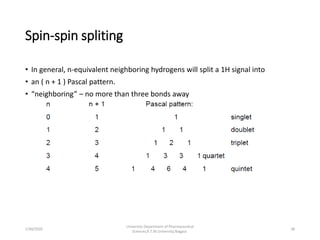
Spin-spin spliting
• In general, n-equivalent neighboring hydrogens will split a 1H signal into
• an ( n + 1 ) Pascal pattern.
• “neighboring” – no more than three bonds away
1/30/2020 28
University Department of Pharmaceutical
Sciences,R.T.M.University,Nagpur.
•J-coupling: also called indirect spin-spin coupling, is the
coupling between two nuclear spins due to the influence of bonding
electrons on the magnetic field running between the two nuclei.
• J-coupling provides information about dihedral angles, which can be
estimated using the Karplus equation. It is an important observable effect in
1D NMR spectroscopy.
• The coupling constant, J (usually in frequency units, Hz) is a measure of the
interaction between a pair of nuclei.
1/30/2020 29
University Department of Pharmaceutical
Sciences,R.T.M.University,Nagpur.
1/30/2020 30
University Department of Pharmaceutical
Sciences,R.T.M.University,Nagpur.
Proton-decoupled mode
• a sample is irradiated with two different radiofrequencies.
• One to excite all 13C nuclei, a second to cause all protons in the molecule to
undergo rapid transitions between their nuclear spin states.
• On the time scale of a 13C-NMR spectrum, each proton is in an average or
effectively constant nuclear spin state, with the result that 1H-13C spin-spin
interactions are not observed and they are decoupled.
1/30/2020 31
University Department of Pharmaceutical
Sciences,R.T.M.University,Nagpur.
2-Dimensional NMR
• General Information
• More complicated to set-up than 1H and 13C experiments.
• Changes in pulses (#, length, angles, mixing times, etc.)
• Observe effect based on relationship of nuclei - can be homonuclear (same
nuclei – e.g. H-H) or heteronuclear (different nuclei – e.g. H-C, H-P)
• Focus on Interpretation of most commonly used experiments
• - COSY
• - HETCOR (HMQC)
• - HMBC
• - INADEQUATE
• - NOESY
• LOTS of other experiments (both 1D and 2D):
• - EXSY, TOCSY, HOHAHA, INEPT, WATERGATE, and many more …
1/30/2020 32
University Department of Pharmaceutical
Sciences,R.T.M.University,Nagpur.
Common 2-D NMR
• Structure Evaluation
• COSY (COrrelation SpectroscopY): 1H-1H correlation
• HETCOR (HETeronuclear CORrelation Spectroscopy): 1H-13C correlation
• HMQC (Heteronuclear Multiple Quantum Coherence): 1H-13C correlation!
• HMBC (Heteronuclear Multiple Bond Correlation): 1H-13C correlation over 2-3
bonds
• INADEQUATE (IncrediblE Natural Abundance DoublE QUAntum Transfer
Experiment): 13C-13C correlation
• NOESY(Nuclear Overhauser Effect SpectroscopY): spatial proximity
1/30/2020 33
University Department of Pharmaceutical
Sciences,R.T.M.University,Nagpur.
COSY
General Features
• • COrrelation SpectroscopY
• Allows correlation of all coupled protons (1H-1H correlation)
• Gives unequivical proof of proton assignments.
• Very useful when peaks overlap in 1H NMR and are unable to determine coupling
constants.
• Very useful when there are a lot of similar coupling constants.
• Cross peaks are coupled to each other.
• Use double quantum filtered experiment (DQF-COSY) to supress noise if needed.
1/30/2020 34
University Department of Pharmaceutical
Sciences,R.T.M.University,Nagpur.
• Cross peak due to pulse resonance:
1/30/2020
University Department of Pharmaceutical
Sciences,R.T.M.University,Nagpur.
35
Pulse resonance
1/30/2020 36
University Department of Pharmaceutical
Sciences,R.T.M.University,Nagpur.
1/30/2020 37
University Department of Pharmaceutical
Sciences,R.T.M.University,Nagpur.
COSY of isopentyl acetate
1/30/2020 38
University Department of Pharmaceutical
Sciences,R.T.M.University,Nagpur.
NOESY
• General Features
• Nuclear Overhauser Effect 2-D Correlation SpectroscopY
• Through space NOE relationships – not observed beyond ~ 5Å .
• Like COSY in that look for cross peaks
Warning: rapid exchange can also give cross peaks
1/30/2020 39
University Department of Pharmaceutical
Sciences,R.T.M.University,Nagpur.
1/30/2020
University Department of Pharmaceutical
Sciences,R.T.M.University,Nagpur.
40
5 4 3 2 1 0
1
2
3
4
5
CH3CH2CH2Cl
3 2 1
ppm
• ppm
1/30/2020 41
University Department of Pharmaceutical
Sciences,R.T.M.University,Nagpur.
HETCOR
• General Features
• HETeronuclear CORrelation Spectroscopy
• Allows correlation of protons and attatched carbons
• Takes advantage of JCH
• Compliments DEPT
• Particularly useful for identification of diastereotopic protons
• Direct correlation - no cross peaks!
• Largely relplaced by HMQC
1/30/2020 42
University Department of Pharmaceutical
Sciences,R.T.M.University,Nagpur.
NMR Spectra Of X nuclei
Isotopes Natural
Abundance
Spin (I) Gamma Relative sensitivity
1H 99.98 1/2 26.75 1
2H 0.016 1 4.11 0.01
13C 1.108 1/2 6.73 0.016
19F 100.00 1/2 25.18 0.83
1/30/2020
University Department of Pharmaceutical
Sciences,R.T.M.University,Nagpur.
43
Low gamma
Less NA Less sensitivity
Less favorable relaxation
• Peak due to polarization:
1/30/2020
University Department of Pharmaceutical
Sciences,R.T.M.University,Nagpur.
44
Polarization pulse transfer Coupling of J values
Polarization =(Nur-
Nl)/(Nu+Nl)
• Polarization transfer through space(NOESY).
• PT from proton to Carbon through bond
• 120-220Hz & INEPT (Insensitive nucleus enhancement by polarization transfer)
1/30/2020
University Department of Pharmaceutical
Sciences,R.T.M.University,Nagpur.
45
C H
wH
wC
1/30/2020 46
University Department of Pharmaceutical
Sciences,R.T.M.University,Nagpur.
References
1) Donald L. Pavia , Garry M. Lampman , George S. Kriz , Introduction to
Spectroscopy, third edition, page no.102-352.
1/30/2020
University Department of Pharmaceutical
Sciences,R.T.M.University,Nagpur.
47
1/30/2020 48
University Department of Pharmaceutical
Sciences,R.T.M.University,Nagpur.

NMR

  • 1.
    NMR Spectroscopy Presented by RajeshShridhar Tale M.Pharm. 2nd Sem. Pharmaceutical Chemistry, University Department Of Pharmaceutical Sciences(U.D.P.S.). Rashtrasant Tukadoji Maharaj Nagpur University, Nagpur-440 033.
  • 2.
    Contents • Introduction • Principle •Instrumentation • NMR spectrum • Signal Pattern • FT-NMR • 13C-NMR • Chemical shift and factors affecting chemical shift • Spin spin coupling and Coupling constant • Proton decoupled mode • 2-D NMR • COSY • NOESY • HETCOR 1/30/2020 2 University Department of Pharmaceutical Sciences,R.T.M.University,Nagpur.
  • 3.
    NMR:- Nuclear Magnetic Resonance Spin:-Manyatomic nuclei have a property known as spin. Spin angular momentum:-A spinning charge generates a magnetic field, the resulting spin-magnet has a magnetic moment (μ) proportional to the spin (I)
  • 4.
    Principle of NMR 1/30/20204 • The principle is based on the spinning of nucleus and generating a magnetic field. • Without external magnetic (Bo) – field nuclear spin are random in direction. • With Bo ,nuclei align themselves either with or against field of external magnetic field. University Department of Pharmaceutical Sciences,R.T.M.University,Nagpur.
  • 5.
    • magnetic momentm = g p where g is the gyromagnetic ratio, and it is a constant for a given nucleus. • In the presence of an external magnetic field (B0), two spin states exist, +1/2 and -1/2 (For I=1/2). • The magnetic moment of the lower energy +1/2 state is aligned with the external field, and that of the higher energy -1/2 spin state is opposed to the external field. 1/30/2020 5 University Department of Pharmaceutical Sciences,R.T.M.University,Nagpur.
  • 6.
    Spin Quantum Number(I) • It is physical constant.(2I + I) • Odd mass nuclei with an odd number of nucleons have fractional spins. • Even mass nuclei with odd numbers of protons and neutrons have integral spins. • Even mass nuclei composed of even numbers of protons and neutrons have zero spin. 1/30/2020 6 University Department of Pharmaceutical Sciences,R.T.M.University,Nagpur.
  • 7.
    Instrumentation 1/30/2020 7 University Departmentof Pharmaceutical Sciences,R.T.M.University,Nagpur.
  • 8.
    NMR Spectrum • NMRspectrum is a plot of intensity of NMR signals VS magnetic field (frequency) in reference to TMS. 1/30/2020 8 University Department of Pharmaceutical Sciences,R.T.M.University,Nagpur.
  • 9.
    • 1H nucleiare shielded by the magnetic field produced by the surrounding • electrons. The higher the electron density around the nucleus, the higher the magnetic field required to cause resonance. • Information from 1H-nmr spectra: • 1. Number of signals: How many different types of hydrogens in the molecule. • 2. Position of signals (chemical shift): What types of hydrogens. • 3. Relative areas under signals (integration): How many hydrogens of each type. • 4. Splitting pattern: How many neighboring hydrogens 1/30/2020 9 University Department of Pharmaceutical Sciences,R.T.M.University,Nagpur.
  • 10.
    • note: nmust be equivalent neighboring hydrogens to give rise to a Pascal splitting pattern. If the neighbors are not equivalent, then you will see a complex pattern (aka complex multiplet). • note: the alcohol hydrogen –OH usually does not split neighboring hydrogen signals nor is it split. Normally a singlet of integration 1 between 1 – 5.5 ppm (variable). 1/30/2020 10 University Department of Pharmaceutical Sciences,R.T.M.University,Nagpur.
  • 11.
    Numbers of Signals •Magnetically equivalent hydrogens resonate at the same applied field. • Magnetically equivalent hydrogens are also chemically equivalent. 1/30/2020 11 University Department of Pharmaceutical Sciences,R.T.M.University,Nagpur.
  • 12.
    •Position of signals(chemical shift): what types of hydrogens. • primary 0.9 ppm • secondary 1.3 • tertiary 1.5 • aromatic 6-8.5 • allyl 1.7 • benzyl 2.2-3 • chlorides 3-4 H-C-Cl • Bromides 2.5-4 H-C-Br • iodides 2-4 H-C-I • alcohols 3.4-4 H-C-O • alcohols 1-5.5 H-O- 1/30/2020 12 University Department of Pharmaceutical Sciences,R.T.M.University,Nagpur.
  • 13.
    1/30/2020 13 University Departmentof Pharmaceutical Sciences,R.T.M.University,Nagpur.
  • 14.
    Fourrier Transform FT-NMR 1/30/2020 14 University Departmentof Pharmaceutical Sciences,R.T.M.University,Nagpur.
  • 15.
    13C – nmr13C~ 1.1% of carbons 1) number of signals: how many different types of carbons. 2) splitting: number of hydrogens on the carbon 3) chemical shift: hybridization of carbon sp, sp2, sp3 4) chemical shift: evironment
  • 16.
    Chemical Shift-δ • Theelectron density around each nucleus in a molecule varies according to the types of nuclei and bonds in the molecule. • The opposing field and therefore the effective field at each nucleus will vary. This is called the chemical shift 1/30/2020 16 University Department of Pharmaceutical Sciences,R.T.M.University,Nagpur.
  • 17.
    1/30/2020 17 University Departmentof Pharmaceutical Sciences,R.T.M.University,Nagpur.
  • 18.
    • reference compound= tetramethylsilane (CH3)4Si @ 0.0 ppm. 1/30/2020 18 Magnetic Field-> <-Chemical Shift University Department of Pharmaceutical Sciences,R.T.M.University,Nagpur.
  • 19.
    • The termchemical shift was developed to avoid this problem. • The chemical shift of a nucleus is the difference between the resonance frequency of the nucleus and a standard, relative to the standard. • This quantity is reported in ppm and given the symbol delta(δ). • In NMR spectroscopy, the standard is often tetramethylsilane, Si(CH3)4, abbreviated TMS. • Tetramethyl silane (TMS) is used as reference because it is soluble in most organic solvents, is inert, volatile, and has 12 equivalent 1H and 4 equivalent 13C. TMS signal is set to 0. 1/30/2020 19 University Department of Pharmaceutical Sciences,R.T.M.University,Nagpur.
  • 20.
    •Chemical shift dependson : • Electronegativity of nearby atoms • Hybridization of adjacent atoms • Diamagnetic effects • Paramagnetic effects • Solvent effect 1/30/2020 20 University Department of Pharmaceutical Sciences,R.T.M.University,Nagpur.
  • 21.
    • Chemical shift: (1) electronegativity of nearby atoms, (2) hybridization of adjacent atoms, and (3) diamagnetic effects Electronegativity 1/30/2020 21 University Department of Pharmaceutical Sciences,R.T.M.University,Nagpur.
  • 22.
    • A carbon-carbontriple bond shields an acetylenic hydrogen and shifts its signal to lower frequency (to the right) to a smaller value. 1/30/2020 22 University Department of Pharmaceutical Sciences,R.T.M.University,Nagpur.
  • 23.
    • Carbon-Carbon DoubleBond Effect • Magnetic induction in the p bond of a carbon-carbon double bond deshields vinylic hydrogens and shifts their signal higher frequency 1/30/2020 23 University Department of Pharmaceutical Sciences,R.T.M.University,Nagpur.
  • 24.
    Aromatic Effect • Themagnetic field induced by circulation of p electrons in an aromatic ring deshields the hydrogens on the ring and shifts their signal to higher frequency 1/30/2020 24 University Department of Pharmaceutical Sciences,R.T.M.University,Nagpur.
  • 25.
    Chemical Shift -13C-NMR 1/30/2020 25 University Department of Pharmaceutical Sciences,R.T.M.University,Nagpur.
  • 26.
    Coupling constant (J): •The separation on an NMR • spectrum (in hertz) between • adjacent peaks in a multiplet. 1/30/2020 26 University Department of Pharmaceutical Sciences,R.T.M.University,Nagpur.
  • 27.
    • Spin-spin coupling: •The coupling of the intrinsic angular momentum of different particles. • Such coupling between pairs of nuclear spins is an important feature of nuclear magnetic resonance (NMR) spectroscopy . • As it can provide detailed information about the structure and conformation of molecules. Spin-spin coupling between nuclear spin and electronic spin is responsible for hyperfine structure in atomic spectra. 1/30/2020 27 University Department of Pharmaceutical Sciences,R.T.M.University,Nagpur.
  • 28.
    Spin-spin spliting • Ingeneral, n-equivalent neighboring hydrogens will split a 1H signal into • an ( n + 1 ) Pascal pattern. • “neighboring” – no more than three bonds away 1/30/2020 28 University Department of Pharmaceutical Sciences,R.T.M.University,Nagpur.
  • 29.
    •J-coupling: also calledindirect spin-spin coupling, is the coupling between two nuclear spins due to the influence of bonding electrons on the magnetic field running between the two nuclei. • J-coupling provides information about dihedral angles, which can be estimated using the Karplus equation. It is an important observable effect in 1D NMR spectroscopy. • The coupling constant, J (usually in frequency units, Hz) is a measure of the interaction between a pair of nuclei. 1/30/2020 29 University Department of Pharmaceutical Sciences,R.T.M.University,Nagpur.
  • 30.
    1/30/2020 30 University Departmentof Pharmaceutical Sciences,R.T.M.University,Nagpur.
  • 31.
    Proton-decoupled mode • asample is irradiated with two different radiofrequencies. • One to excite all 13C nuclei, a second to cause all protons in the molecule to undergo rapid transitions between their nuclear spin states. • On the time scale of a 13C-NMR spectrum, each proton is in an average or effectively constant nuclear spin state, with the result that 1H-13C spin-spin interactions are not observed and they are decoupled. 1/30/2020 31 University Department of Pharmaceutical Sciences,R.T.M.University,Nagpur.
  • 32.
    2-Dimensional NMR • GeneralInformation • More complicated to set-up than 1H and 13C experiments. • Changes in pulses (#, length, angles, mixing times, etc.) • Observe effect based on relationship of nuclei - can be homonuclear (same nuclei – e.g. H-H) or heteronuclear (different nuclei – e.g. H-C, H-P) • Focus on Interpretation of most commonly used experiments • - COSY • - HETCOR (HMQC) • - HMBC • - INADEQUATE • - NOESY • LOTS of other experiments (both 1D and 2D): • - EXSY, TOCSY, HOHAHA, INEPT, WATERGATE, and many more … 1/30/2020 32 University Department of Pharmaceutical Sciences,R.T.M.University,Nagpur.
  • 33.
    Common 2-D NMR •Structure Evaluation • COSY (COrrelation SpectroscopY): 1H-1H correlation • HETCOR (HETeronuclear CORrelation Spectroscopy): 1H-13C correlation • HMQC (Heteronuclear Multiple Quantum Coherence): 1H-13C correlation! • HMBC (Heteronuclear Multiple Bond Correlation): 1H-13C correlation over 2-3 bonds • INADEQUATE (IncrediblE Natural Abundance DoublE QUAntum Transfer Experiment): 13C-13C correlation • NOESY(Nuclear Overhauser Effect SpectroscopY): spatial proximity 1/30/2020 33 University Department of Pharmaceutical Sciences,R.T.M.University,Nagpur.
  • 34.
    COSY General Features • •COrrelation SpectroscopY • Allows correlation of all coupled protons (1H-1H correlation) • Gives unequivical proof of proton assignments. • Very useful when peaks overlap in 1H NMR and are unable to determine coupling constants. • Very useful when there are a lot of similar coupling constants. • Cross peaks are coupled to each other. • Use double quantum filtered experiment (DQF-COSY) to supress noise if needed. 1/30/2020 34 University Department of Pharmaceutical Sciences,R.T.M.University,Nagpur.
  • 35.
    • Cross peakdue to pulse resonance: 1/30/2020 University Department of Pharmaceutical Sciences,R.T.M.University,Nagpur. 35 Pulse resonance
  • 36.
    1/30/2020 36 University Departmentof Pharmaceutical Sciences,R.T.M.University,Nagpur.
  • 37.
    1/30/2020 37 University Departmentof Pharmaceutical Sciences,R.T.M.University,Nagpur.
  • 38.
    COSY of isopentylacetate 1/30/2020 38 University Department of Pharmaceutical Sciences,R.T.M.University,Nagpur.
  • 39.
    NOESY • General Features •Nuclear Overhauser Effect 2-D Correlation SpectroscopY • Through space NOE relationships – not observed beyond ~ 5Å . • Like COSY in that look for cross peaks Warning: rapid exchange can also give cross peaks 1/30/2020 39 University Department of Pharmaceutical Sciences,R.T.M.University,Nagpur.
  • 40.
    1/30/2020 University Department ofPharmaceutical Sciences,R.T.M.University,Nagpur. 40 5 4 3 2 1 0 1 2 3 4 5 CH3CH2CH2Cl 3 2 1 ppm • ppm
  • 41.
    1/30/2020 41 University Departmentof Pharmaceutical Sciences,R.T.M.University,Nagpur.
  • 42.
    HETCOR • General Features •HETeronuclear CORrelation Spectroscopy • Allows correlation of protons and attatched carbons • Takes advantage of JCH • Compliments DEPT • Particularly useful for identification of diastereotopic protons • Direct correlation - no cross peaks! • Largely relplaced by HMQC 1/30/2020 42 University Department of Pharmaceutical Sciences,R.T.M.University,Nagpur.
  • 43.
    NMR Spectra OfX nuclei Isotopes Natural Abundance Spin (I) Gamma Relative sensitivity 1H 99.98 1/2 26.75 1 2H 0.016 1 4.11 0.01 13C 1.108 1/2 6.73 0.016 19F 100.00 1/2 25.18 0.83 1/30/2020 University Department of Pharmaceutical Sciences,R.T.M.University,Nagpur. 43 Low gamma Less NA Less sensitivity Less favorable relaxation
  • 44.
    • Peak dueto polarization: 1/30/2020 University Department of Pharmaceutical Sciences,R.T.M.University,Nagpur. 44 Polarization pulse transfer Coupling of J values Polarization =(Nur- Nl)/(Nu+Nl)
  • 45.
    • Polarization transferthrough space(NOESY). • PT from proton to Carbon through bond • 120-220Hz & INEPT (Insensitive nucleus enhancement by polarization transfer) 1/30/2020 University Department of Pharmaceutical Sciences,R.T.M.University,Nagpur. 45 C H wH wC
  • 46.
    1/30/2020 46 University Departmentof Pharmaceutical Sciences,R.T.M.University,Nagpur.
  • 47.
    References 1) Donald L.Pavia , Garry M. Lampman , George S. Kriz , Introduction to Spectroscopy, third edition, page no.102-352. 1/30/2020 University Department of Pharmaceutical Sciences,R.T.M.University,Nagpur. 47
  • 48.
    1/30/2020 48 University Departmentof Pharmaceutical Sciences,R.T.M.University,Nagpur.