S A H A N A V
Fluorescence(Forster)
Resonance Energy Transfer
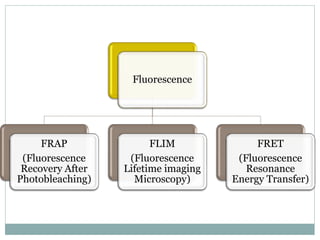
Fluorescence
FRAP
(Fluorescence
Recovery After
Photobleaching)
FLIM
(Fluorescence
Lifetime imaging
Microscopy)
FRET
(Fluorescence
Resonance
Energy Transfer)
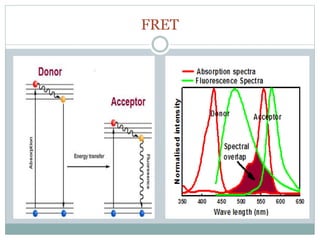
FRET
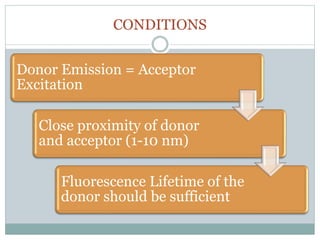
CONDITIONS
Donor Emission = Acceptor
Excitation
Close proximity of donor
and acceptor (1-10 nm)
Fluorescence Lifetime of the
donor should be sufficient
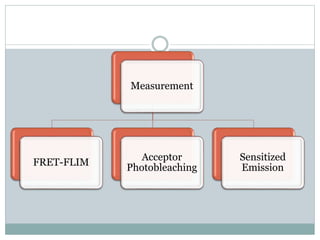
Measurement
FRET-FLIM
Acceptor
Photobleaching
Sensitized
Emission
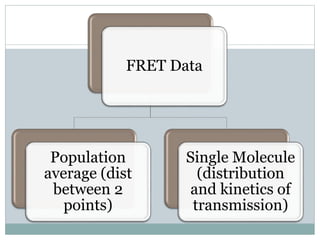
FRET Data
Population
average (dist
between 2
points)
Single Molecule
(distribution
and kinetics of
transmission)
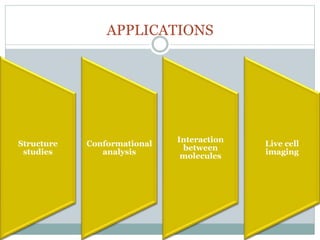
APPLICATIONS
Structure
studies
Conformational
analysis
Interaction
between
molecules
Live cell
imaging
V A D I M D E G T Y A R e t a l , .
J NEUROSCI. 2013; 33(13): 5507–
5523.
Dance of the SNAREs: Assembly
and rearrangements detected with
FRET at neural synapses
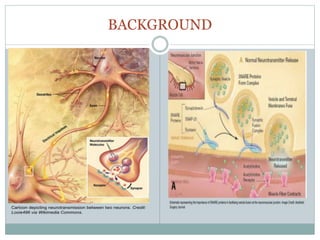
BACKGROUND
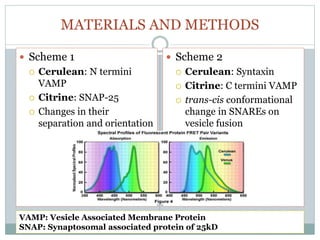
MATERIALS AND METHODS
 Scheme 1
 Cerulean: N termini
VAMP
 Citrine: SNAP-25
 Changes in their
separation and orientation
 Scheme 2
 Cerulean: Syntaxin
 Citrine: C termini VAMP
 trans-cis conformational
change in SNAREs on
vesicle fusion
VAMP: Vesicle Associated Membrane Protein
SNAP: Synaptosomal associated protein of 25kD
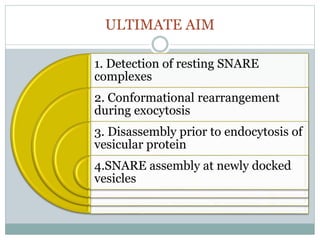
ULTIMATE AIM
1. Detection of resting SNARE
complexes
2. Conformational rearrangement
during exocytosis
3. Disassembly prior to endocytosis of
vesicular protein
4.SNARE assembly at newly docked
vesicles
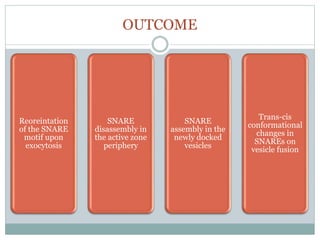
OUTCOME
Reoreintation
of the SNARE
motif upon
exocytosis
SNARE
disassembly in
the active zone
periphery
SNARE
assembly in the
newly docked
vesicles
Trans-cis
conformational
changes in
SNAREs on
vesicle fusion
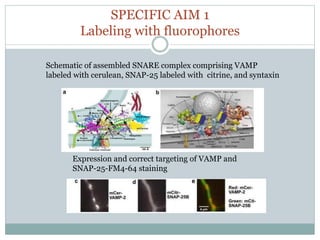
SPECIFIC AIM 1
Labeling with fluorophores
Expression and correct targeting of VAMP and
SNAP-25-FM4-64 staining
Schematic of assembled SNARE complex comprising VAMP
labeled with cerulean, SNAP-25 labeled with citrine, and syntaxin
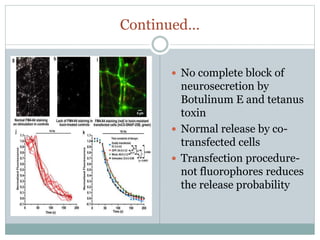
Continued…
 No complete block of
neurosecretion by
Botulinum E and tetanus
toxin
 Normal release by co-
transfected cells
 Transfection procedure-
not fluorophores reduces
the release probability
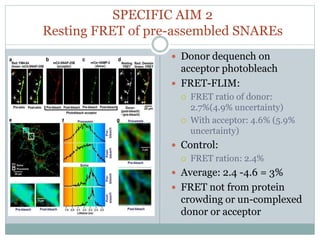
SPECIFIC AIM 2
Resting FRET of pre-assembled SNAREs
 Donor dequench on
acceptor photobleach
 FRET-FLIM:
 FRET ratio of donor:
2.7%(4.9% uncertainty)
 With acceptor: 4.6% (5.9%
uncertainty)
 Control:
 FRET ration: 2.4%
 Average: 2.4 -4.6 = 3%
 FRET not from protein
crowding or un-complexed
donor or acceptor
SPECIFIC AIM 3
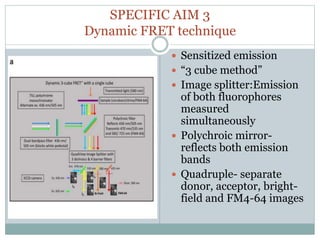
Dynamic FRET technique
 Sensitized emission
 “3 cube method”
 Image splitter:Emission
of both fluorophores
measured
simultaneously
 Polychroic mirror-
reflects both emission
bands
 Quadruple- separate
donor, acceptor, bright-
field and FM4-64 images
SPECIFIC AIM 4
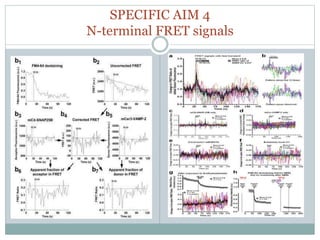
N-terminal FRET signals
Continued…
1
• Signals from non-transmitting boutons did not fit this pattern
2
• No consistent signals with donor or acceptor alone
3
• No signals, when exocytosis was blocked by omitting calcium-
signals dependency of the calcium
4
• Signals dependent on intact SNAREs- Botulinum toxin
5
• Signals also dependent on disassembly and reassembly of
SNAREs- Nethylmaleimide (NEM)
SPECIFIC AIM 5
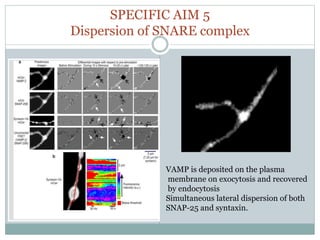
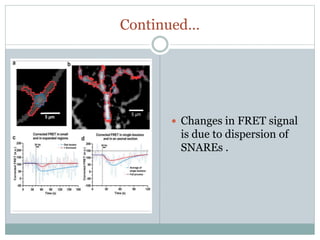
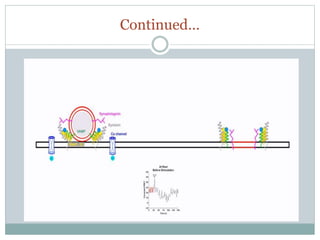
Dispersion of SNARE complex
VAMP is deposited on the plasma
membrane on exocytosis and recovered
by endocytosis
Simultaneous lateral dispersion of both
SNAP-25 and syntaxin.
Continued…
 Changes in FRET signal
is due to dispersion of
SNAREs .
SPECIFIC AIM 6
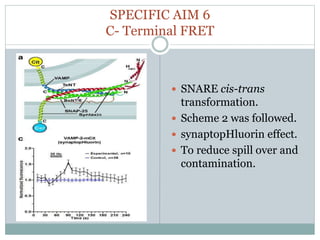
C- Terminal FRET
 SNARE cis-trans
transformation.
 Scheme 2 was followed.
 synaptopHluorin effect.
 To reduce spill over and
contamination.
Continued…
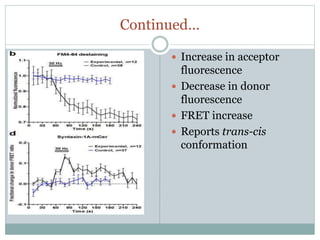
 Increase in acceptor
fluorescence
 Decrease in donor
fluorescence
 FRET increase
 Reports trans-cis
conformation
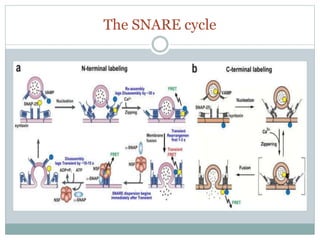
The SNARE cycle
Continued…
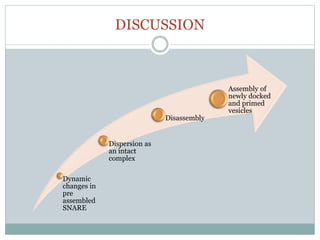
DISCUSSION
Dynamic
changes in
pre
assembled
SNARE
Dispersion as
an intact
complex
Disassembly
Assembly of
newly docked
and primed
vesicles
References
 S. R. Swift and L. Trinkle-Mulcahy. Basic
principles of FRAP, FLIM and FRET.
 S. A. Hussain et. al. An Introduction to
Fluorescence Resonance Energy Transfer
(FRET)
 Janos Szollosi et al. Application of Fluorescence
Resonance Energy Transfer in the Clinical
Laboratory: Routine and Research.
Thank you

Fluorescence(Forster) Resonance Energy Transfer