Presented By: 
Arif Iqbal Shahid 
Roll No.: 
108
Nuclear Magnetic Resonance 
concern the magnetic properties of 
certain atomic nuclei. It concern 
the atoms having Spin Quantum 
Number ( I ). 
1
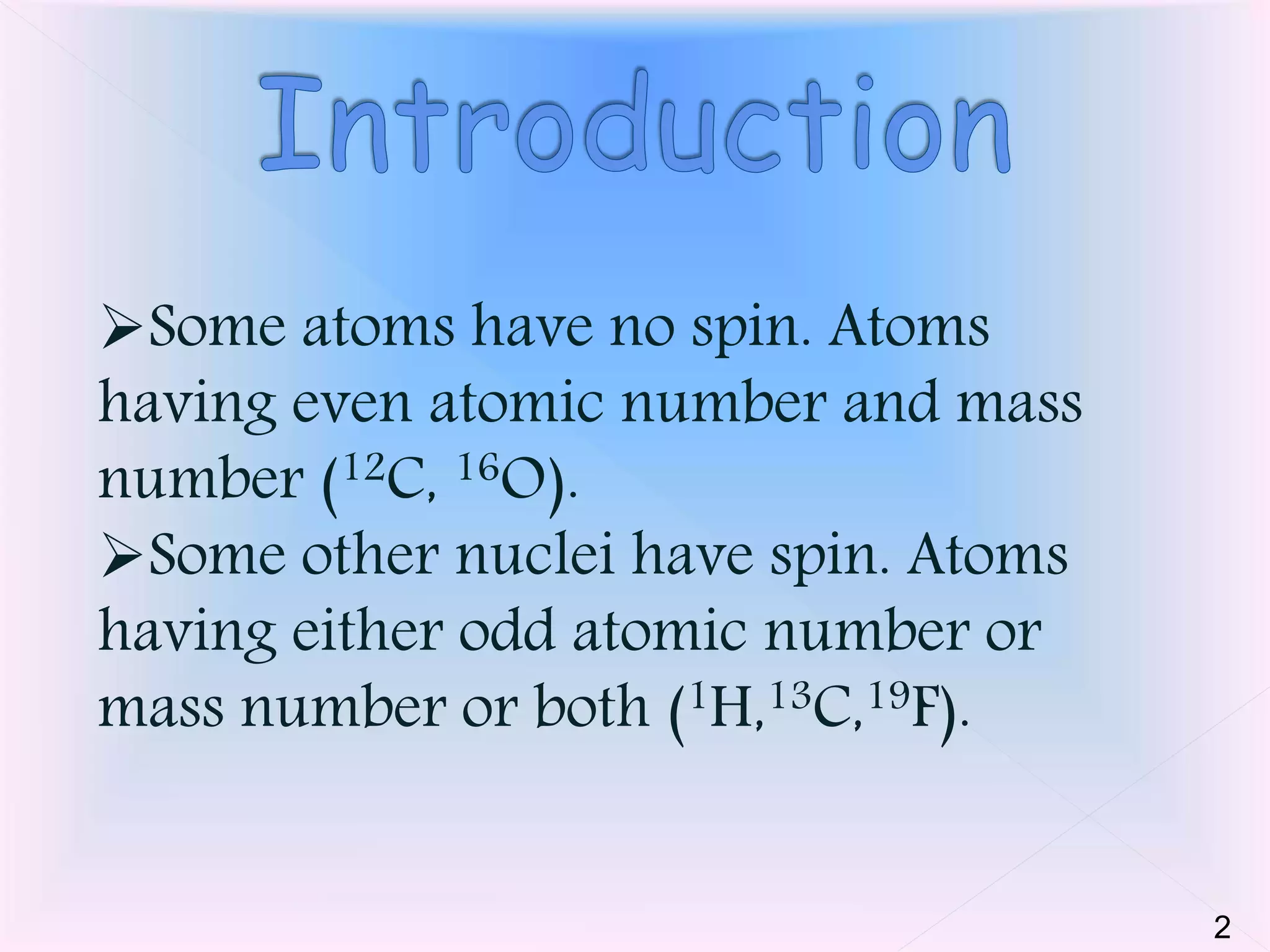
Some atoms have no spin. Atoms 
having even atomic number and mass 
number (12C, 16O). 
Some other nuclei have spin. Atoms 
having either odd atomic number or 
mass number or both (1H,13C,19F). 
2
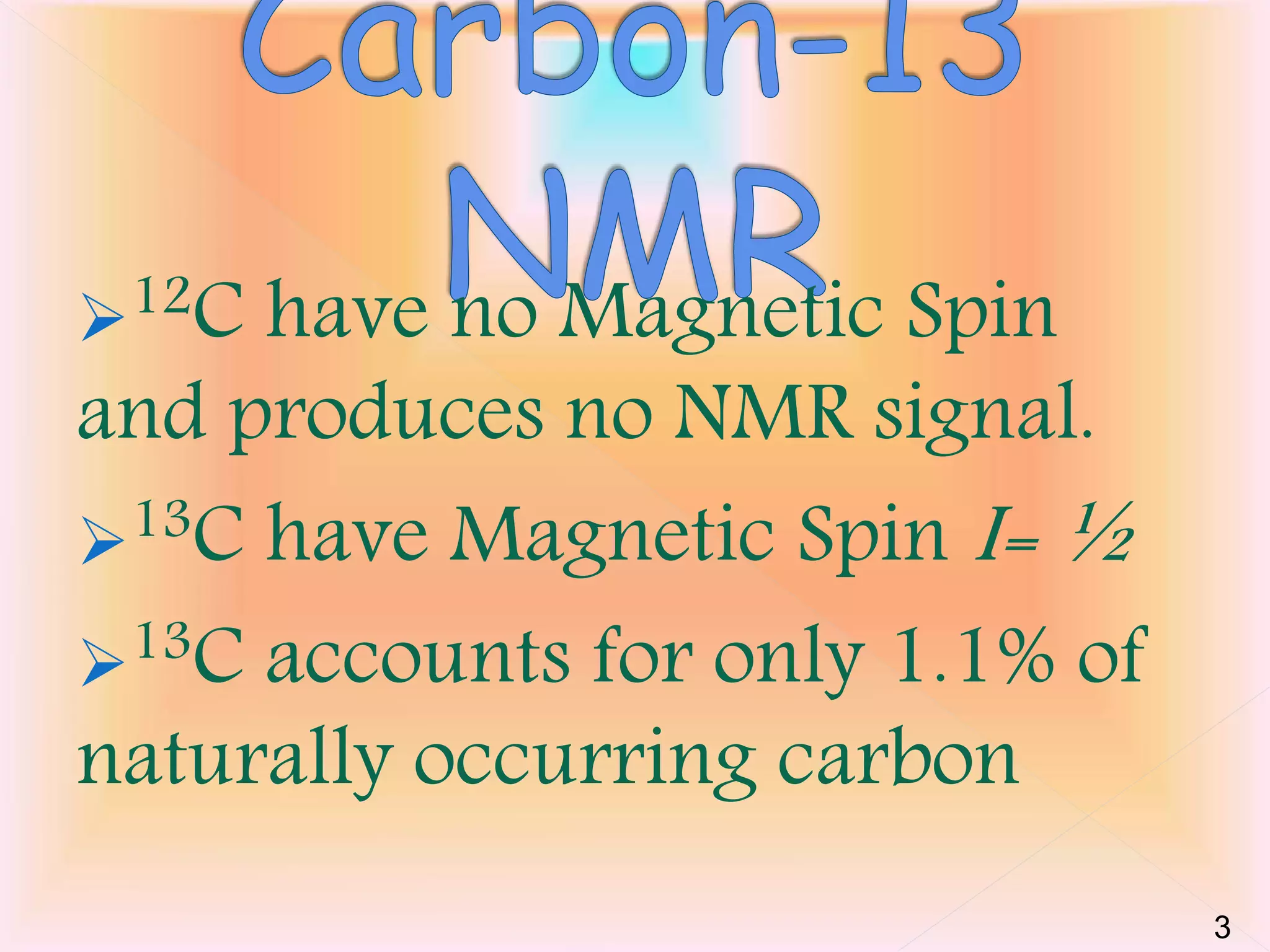
12C have no Magnetic Spin 
and produces no NMR signal. 
13C have Magnetic Spin I= ½ 
13C accounts for only 1.1% of 
naturally occurring carbon 
3
The low probability of adjacent 13C 
atoms leads to no detectable carbon-carbon 
splitting 
No coupling between 13C and C. 
 13C have weak signal 
13C have strong coupling with H 
 13C have weak coupling with C 
4
Two techniques have been developed 
to detect the 13C isotope in an organic 
sample by NMR: 
Signal averaging (increases instrument 
sensitivity) 
Fourier-transform NMR (increases 
instrument speed) 
5
increases instrument sensitivity. Any 
individual 13C NMR spectrum is 
extremely “noisy”, but when hundreds 
of individual runs are added together 
by computer and then averaged, a 
greatly improved spectrum results. 
6
7
increases instrument speed. 
In the FT-NMR technique, all 
signals are recorded simultaneously. 
All 1H and 13C in the sample 
resonate at once, and the complex 
composite signal is manipulated 
using so-called Fourier transforms 
before it can be displayed. 
8
9
The sensitivity of 13C is only 
1/5700 of 1H; 
This sensitivity problem is 
overcome with Fourier 
Transform (FT) 
NMR instrumentation 
10
It is unlikely that a 13C would be adjacent 
to another 13C, so splitting by carbon is 
negligible. 
13C will magnetically couple with 
attached protons and adjacent protons. 
These complex splitting patterns are 
difficult to interpret. 
11
The CMR Spectra is 
recorded in decoupling 
condition. 
The nuclei are decoupled 
by double irradiation 
12
Two Types of decoupling: 
Homonuclear decoupling: 
Decoupling of 
same nuclei (C and C) or (H and H). 
Heteronuclear decoupling: 
Decoupling of 
different nuclei C and H. 
Broad Band Decoupling 
Off resonance decoupling 
13
Broad Band 
Decoupling:  A sample is irradiated with two different radio frequencies. 
 One to excite all 13C nuclei. 
 A second broad spectrum of frequencies to cause all 
hydrogen in the molecule to undergo rapid transitions 
between their nuclear spin states. 
 On the time scale of a 13C-NMR spectrum, each hydrogen is 
in an average or effectively constant nuclear spin state, with 
the result that 1H-13C spin-spin interactions are not 
observed; they are decoupled. 
 Thus, each different kind of carbon gives a single, unsplit 
peak. 
14
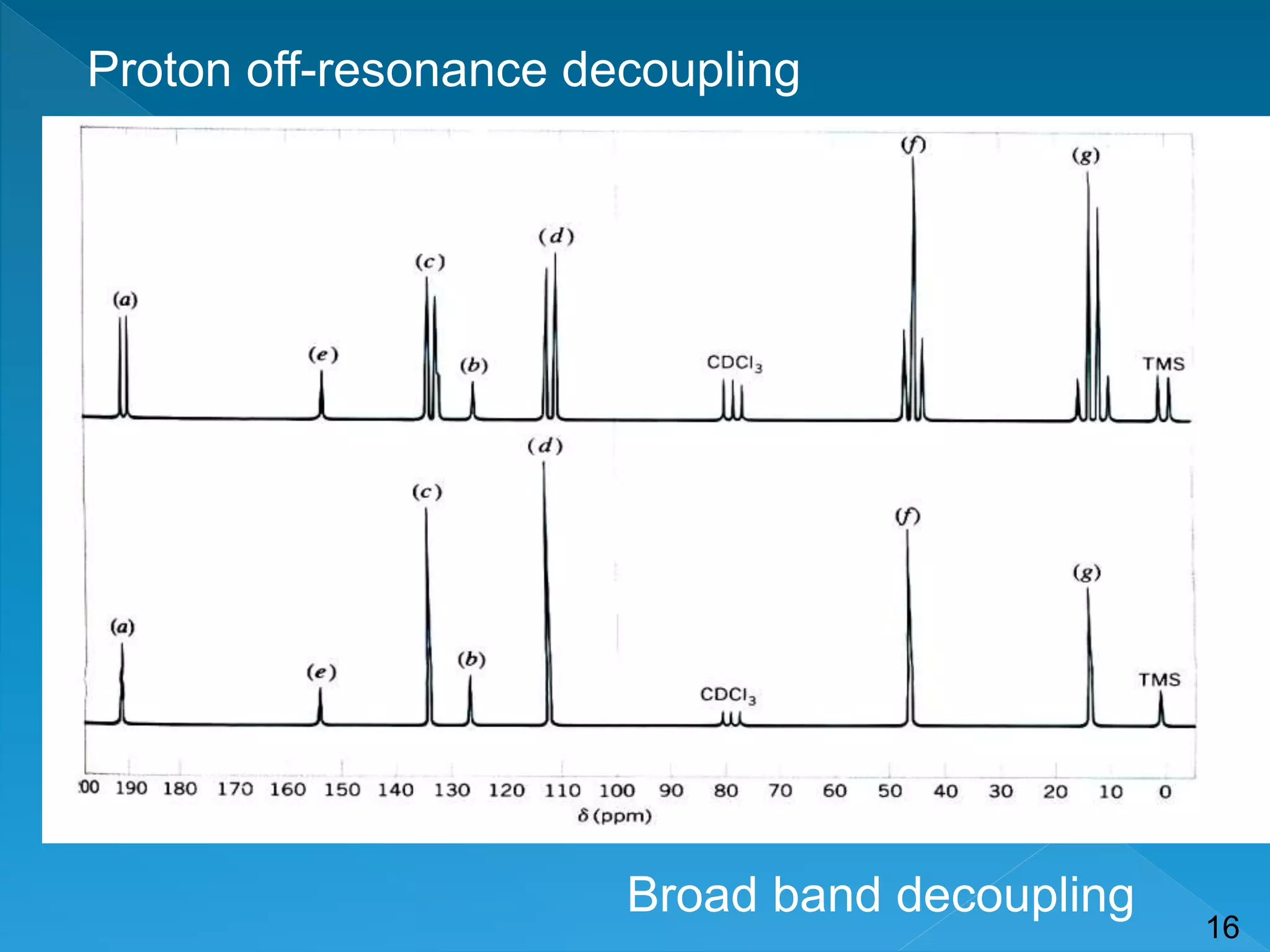
The Coupling can be achieved by off setting 
the high power proton decoupler by about 
1000-2000 Hz up field or about 2000-3000 
Hz downfield from the frequency of TMS 
without using the noise generator. 
Groups signals 
-CH3 quartets 
-CH2- triplets 
Doublets 
C H 
A quarternary Carbon Singlet 
15
Proton off-resonance decoupling 
Broad band decoupling 
16
The number of different signals 
indicates the number of different kinds 
of carbon. 
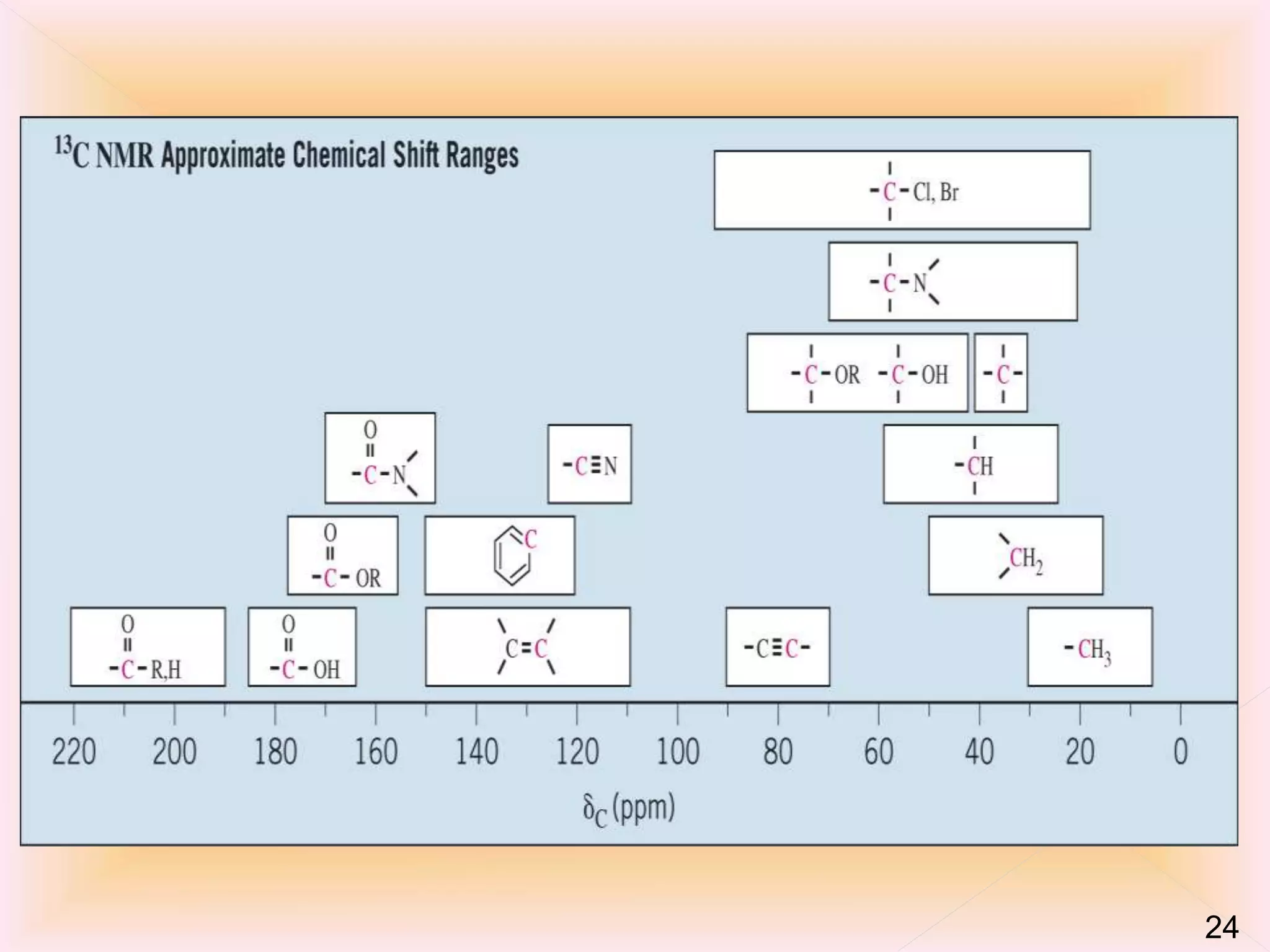
The location (chemical shift) 
indicates the type of functional group. 
The peak area indicates the numbers 
of carbons (if integrated). 
17
18
C-13 NMR has d 0 to 220 ppm (1HNMR 
d 0 to 12 ppm) 
CMR spectra is recorded under proton 
decoupling condition 
In the CMR multiplets, no need to 
determine area ratios. 
19
Hybridization of 13C atom: 
–sp3 C signal is in the range 0-90  
–sp2 C signal is in the range 110-220 
 
–C=O signal is at the low-field end, in 
the range 160-220  
20
Characteristic Carbon NMR Chemical Shifts (ppm) 
(CH3)4Si = TMS = 0.00 ppm (singlet) CDCl3 (solvent) = 77.0 ppm (triplet) 
RCH3 0 – 40 RCH2Cl 35 – 80 benzene ring 110 – 160 
RCH2R 15 – 55 R3COH 40 – 80 C=O ester 160 – 180 
R3CH 20 – 60 R3COR 40 - 80 C=O amide 165 – 180 
RCH2I 0 – 40 RCCR 65 – 85 C=O carboxylic acid 175 – 185 
RCH2Br 25 - 65 R2C=CR2 100 - 150 C=O aldehyde, ketone 180 – 210 
21
22
Electro negativity of nearby atoms: 
C bonded to O, N, 
or halogen absorb downfield because O, N, 
or halogen pull electrons away from 
nearby 13C atoms, decreasing their 
electron density and “deshielding” them. 
23
24
Example 
25
Example 
CH 
H 
H 
CCH2CH2CH2CH3 
H H 
200 180 160 140 120 100 80 60 40 20 H 
CH O 
CH 
C 
O 
C 
CH2 CH2 
CH3 CH2 
26
Thank You

Carbon 13

  • 2.
    Presented By: ArifIqbal Shahid Roll No.: 108
  • 3.
    Nuclear Magnetic Resonance concern the magnetic properties of certain atomic nuclei. It concern the atoms having Spin Quantum Number ( I ). 1
  • 4.
    Some atoms haveno spin. Atoms having even atomic number and mass number (12C, 16O). Some other nuclei have spin. Atoms having either odd atomic number or mass number or both (1H,13C,19F). 2
  • 5.
    12C have noMagnetic Spin and produces no NMR signal. 13C have Magnetic Spin I= ½ 13C accounts for only 1.1% of naturally occurring carbon 3
  • 6.
    The low probabilityof adjacent 13C atoms leads to no detectable carbon-carbon splitting No coupling between 13C and C.  13C have weak signal 13C have strong coupling with H  13C have weak coupling with C 4
  • 7.
    Two techniques havebeen developed to detect the 13C isotope in an organic sample by NMR: Signal averaging (increases instrument sensitivity) Fourier-transform NMR (increases instrument speed) 5
  • 8.
    increases instrument sensitivity.Any individual 13C NMR spectrum is extremely “noisy”, but when hundreds of individual runs are added together by computer and then averaged, a greatly improved spectrum results. 6
  • 9.
  • 10.
    increases instrument speed. In the FT-NMR technique, all signals are recorded simultaneously. All 1H and 13C in the sample resonate at once, and the complex composite signal is manipulated using so-called Fourier transforms before it can be displayed. 8
  • 11.
  • 12.
    The sensitivity of13C is only 1/5700 of 1H; This sensitivity problem is overcome with Fourier Transform (FT) NMR instrumentation 10
  • 13.
    It is unlikelythat a 13C would be adjacent to another 13C, so splitting by carbon is negligible. 13C will magnetically couple with attached protons and adjacent protons. These complex splitting patterns are difficult to interpret. 11
  • 14.
    The CMR Spectrais recorded in decoupling condition. The nuclei are decoupled by double irradiation 12
  • 15.
    Two Types ofdecoupling: Homonuclear decoupling: Decoupling of same nuclei (C and C) or (H and H). Heteronuclear decoupling: Decoupling of different nuclei C and H. Broad Band Decoupling Off resonance decoupling 13
  • 16.
    Broad Band Decoupling: A sample is irradiated with two different radio frequencies.  One to excite all 13C nuclei.  A second broad spectrum of frequencies to cause all hydrogen in the molecule to undergo rapid transitions between their nuclear spin states.  On the time scale of a 13C-NMR spectrum, each hydrogen is in an average or effectively constant nuclear spin state, with the result that 1H-13C spin-spin interactions are not observed; they are decoupled.  Thus, each different kind of carbon gives a single, unsplit peak. 14
  • 17.
    The Coupling canbe achieved by off setting the high power proton decoupler by about 1000-2000 Hz up field or about 2000-3000 Hz downfield from the frequency of TMS without using the noise generator. Groups signals -CH3 quartets -CH2- triplets Doublets C H A quarternary Carbon Singlet 15
  • 18.
    Proton off-resonance decoupling Broad band decoupling 16
  • 19.
    The number ofdifferent signals indicates the number of different kinds of carbon. The location (chemical shift) indicates the type of functional group. The peak area indicates the numbers of carbons (if integrated). 17
  • 20.
  • 21.
    C-13 NMR hasd 0 to 220 ppm (1HNMR d 0 to 12 ppm) CMR spectra is recorded under proton decoupling condition In the CMR multiplets, no need to determine area ratios. 19
  • 22.
    Hybridization of 13Catom: –sp3 C signal is in the range 0-90  –sp2 C signal is in the range 110-220  –C=O signal is at the low-field end, in the range 160-220  20
  • 23.
    Characteristic Carbon NMRChemical Shifts (ppm) (CH3)4Si = TMS = 0.00 ppm (singlet) CDCl3 (solvent) = 77.0 ppm (triplet) RCH3 0 – 40 RCH2Cl 35 – 80 benzene ring 110 – 160 RCH2R 15 – 55 R3COH 40 – 80 C=O ester 160 – 180 R3CH 20 – 60 R3COR 40 - 80 C=O amide 165 – 180 RCH2I 0 – 40 RCCR 65 – 85 C=O carboxylic acid 175 – 185 RCH2Br 25 - 65 R2C=CR2 100 - 150 C=O aldehyde, ketone 180 – 210 21
  • 24.
  • 25.
    Electro negativity ofnearby atoms: C bonded to O, N, or halogen absorb downfield because O, N, or halogen pull electrons away from nearby 13C atoms, decreasing their electron density and “deshielding” them. 23
  • 26.
  • 27.
  • 28.
    Example CH H H CCH2CH2CH2CH3 H H 200 180 160 140 120 100 80 60 40 20 H CH O CH C O C CH2 CH2 CH3 CH2 26
  • 29.