Quorum Sensing-
The “Bacterial” Talk
Sahana V
Department of Biosciences and Technology,
DIAT
1
The Hawaiian Bobtail
Squid
5
Why it does?
Ruby EG, McFall-Ngai MJ. 1992. A squid that glows in the night: development of an animal-bacterial mutualism. J. Bacteriol.
174:4865–70
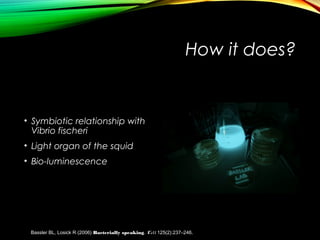
How it does?
• Symbiotic relationship with
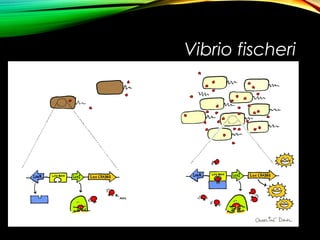
Vibrio fischeri
• Light organ of the squid
• Bio-luminescence
Bassler BL, Losick R (2006) Bacterially speaking. Cell 125(2):237–246.
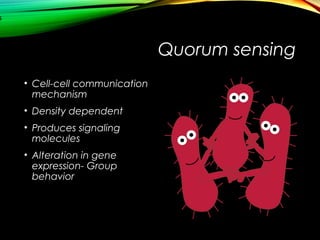
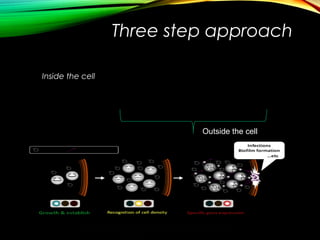
Quorum sensing
• Cell-cell communication
mechanism
• Density dependent
• Produces signaling
molecules
• Alteration in gene
expression- Group
behavior
5
Three step approach
Inside the cell
Outside the cell
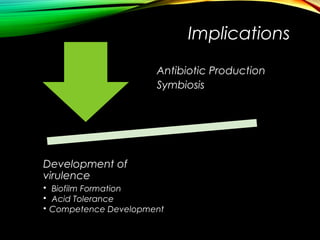
Development of
virulence
• Biofilm Formation
• Acid Tolerance
• Competence Development
Antibiotic Production
Symbiosis
Implications
Why it is important to us?
• Understand the pathogenicity of a bacterial species
• A potential target for targeting bacteria against
traditional antibiotic
• Understand the symbiosis of bacteria with human body
• Produce “Pro-quorum sensing” molecules- Enhance the
symbiosis
Category-1
• “Me” - Intraspecies
Signal 1 Signal 2
“You” - Interspecies
Miller MB, Bassler BL. Quorum sensing in bacteria. Ann Rev Microbiol 2001; 55:165-99
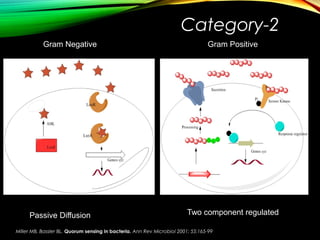
Category-2
Gram Negative
Passive Diffusion
Gram Positive
Two component regulated
Miller MB, Bassler BL. Quorum sensing in bacteria. Ann Rev Microbiol 2001; 55:165-99
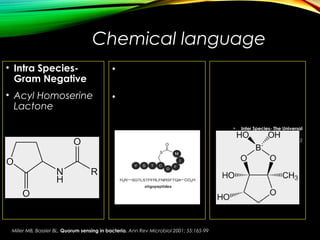
Chemical language
• Intra Species-
Gram Negative
• Acyl Homoserine
Lactone
• Inter Species- The Universal
• Auto Inducer peptide- 2
• Intra Species-
Gram Positive
• Auto Inducer
Peptide -1
Miller MB, Bassler BL. Quorum sensing in bacteria. Ann Rev Microbiol 2001; 55:165-99
Vibrio fischeri
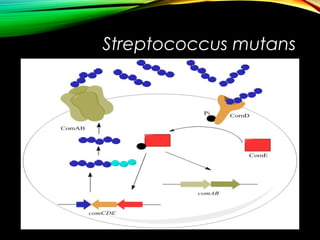
Streptococcus mutans
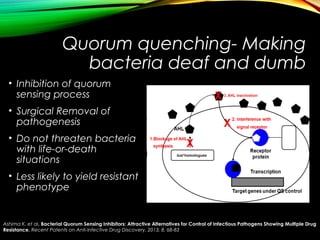
Quorum quenching- Making
bacteria deaf and dumb
• Inhibition of quorum
sensing process
• Surgical Removal of
pathogenesis
• Do not threaten bacteria
with life-or-death
situations
• Less likely to yield resistant
phenotype
Ashima K. et al. Bacterial Quorum Sensing Inhibitors: Attractive Alternatives for Control of Infectious Pathogens Showing Multiple Drug
Resistance. Recent Patents on Anti-Infective Drug Discovery, 2013, 8, 68-83
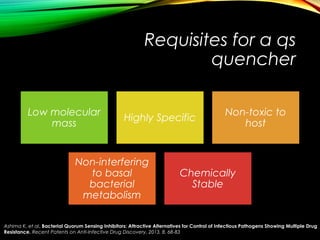
Low molecular
mass
Highly Specific
Non-toxic to
host
Non-interfering
to basal
bacterial
metabolism
Chemically
Stable
Requisites for a qs
quencher
Ashima K. et al. Bacterial Quorum Sensing Inhibitors: Attractive Alternatives for Control of Infectious Pathogens Showing Multiple Drug
Resistance. Recent Patents on Anti-Infective Drug Discovery, 2013, 8, 68-83
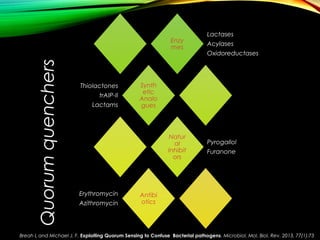
Enzy
mes
Lactases
Acylases
Oxidoreductases
Synth
etic
Analo
gues
Thiolactones
trAIP-II
Lactams
Natur
al
Inhibit
ors
Pyrogallol
Furanone
Antibi
otics
Erythromycin
Azithromycin
Quorumquenchers
Breah L and Michael J. F. Exploiting Quorum Sensing to Confuse Bacterial pathogens. Microbiol. Mol. Biol. Rev. 2013, 77(1):73
Synergistic Effect Of A Quorum Sensing
Blocker And Antibiotics To Control The Oral
Adhesion Of Streptococcus Mutans
Project member
Sahana V
Under supervision of
Dr. S. Adline Princy
Associate Professor,
Quorum Sensing Laboratory,
SASTRA Hub for Research and Innovation (SHRI),
SASTRA University.
17
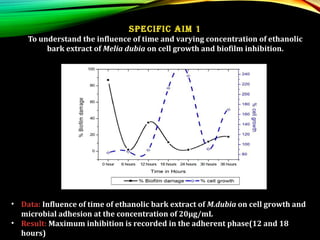
• Data: Influence of time of ethanolic bark extract of M.dubia on cell growth and
microbial adhesion at the concentration of 20μg/mL
• Result: Maximum inhibition is recorded in the adherent phase(12 and 18
hours)
Specific aim 1
To understand the influence of time and varying concentration of ethanolic
bark extract of Melia dubia on cell growth and biofilm inhibition.
• Data: Assessment of synergistic activity of the ethanolic bark extracts
(20μg/mL) and antibiotics [gentamycin and penicillin] on biofilm inhibition
• Result: Synergistic effect is positive in the case of penicillin
Specific aim 2
To understand the influence of time and varying concentration of ethanolic
bark extract of Melia dubia on the combinatorial action with antibiotics.
concerns
• Assumption 1:
• Quorum-sensing systems are actively utilized during infection and
are important for virulence.
• Assumption 2:
• QS is not essential for bacterial growth, inhibition of QS should not
exert selective pressure on the bacteria to develop resistance.
• Assumption 3:
• QS is a good therapeutic target is that the species specificity of
most QS systems should reduce the issues of broad-spectrum activity
and off-target effects traditionally associated with antibiotic
treatment.
1. Smith EE, et al. 2006. Genetic adaptation by Pseudomonas aeruginosa to the airways of cystic fibrosis patients. Proc. Natl.
Acad. Sci. U. S. A. 103:8487– 8492.
2. Schuster M et al. 2003. Identification, timing, and signal specificity of Pseudomonas aeruginosa quorum controlled genes: a
transcriptome analysis. J. Bacteriol. 185:2066-2079
3. Chugani S, et al. 2012. Strain-dependent diversity in the Pseudomonas aeruginosa quorum-sensing regulon. Proc. Natl. Acad.
Sci. U. S. A. 109:E2823–2831.
Success stories
• 1524 patents filed- QS Inhibitors.1
• Treatment of cholera infection was successful.2
• Enzymatic quorum quenching in treatment of plant
and pathogens.3
• Co-administering inhibitory synthetic AIPs along with
S. aureus bacteria, staphylococcal lesion formation in
the skin of mice was reduced or prevented.4
/15
1. Ashima K. et al. Bacterial Quorum Sensing Inhibitors: Attractive Alternatives for Control of Infectious Pathogens Showing Multiple
Drug Resistance. Recent Patents on Anti-Infective Drug Discovery, 2013, 8, 68-83
2. Duan F, March JC. 2010. Engineered bacterial communication prevents Vibrio cholerae virulence in an infant mouse model. Proc.
Natl. Acad. Sci. U. S. A. 107:11260 –11264.
3. Vanjildorj E,. 2009. Enhancement of tolerance to soft rot disease in the transgenic Chinese cabbage (Brassica rapa L. ssp.
pekinensis) inbred line, Kenshin. Plant Cell Rep. 28:1581–1591.
4. Mayville P,et al. 1999. Structure-activity analysis of synthetic autoinducing thiolactone peptides from Staphylococcus aureus
responsible for virulence. Proc. Natl. Acad. Sci. U. S. A. 96:1218 –1223.
Bonnie L. Bassler
Howard Hughes Medical Institute Investigator
Squibb Professor in Molecular Biology
Professor and Chair of Molecular Biology
Princeton University.
Thank you

Quorum Sensing- An Introduction

  • 1.
    Quorum Sensing- The “Bacterial”Talk Sahana V Department of Biosciences and Technology, DIAT 1
  • 2.
  • 3.
    Why it does? RubyEG, McFall-Ngai MJ. 1992. A squid that glows in the night: development of an animal-bacterial mutualism. J. Bacteriol. 174:4865–70
  • 4.
    How it does? •Symbiotic relationship with Vibrio fischeri • Light organ of the squid • Bio-luminescence Bassler BL, Losick R (2006) Bacterially speaking. Cell 125(2):237–246.
  • 5.
    Quorum sensing • Cell-cellcommunication mechanism • Density dependent • Produces signaling molecules • Alteration in gene expression- Group behavior 5
  • 6.
    Three step approach Insidethe cell Outside the cell
  • 7.
    Development of virulence • BiofilmFormation • Acid Tolerance • Competence Development Antibiotic Production Symbiosis Implications
  • 8.
    Why it isimportant to us? • Understand the pathogenicity of a bacterial species • A potential target for targeting bacteria against traditional antibiotic • Understand the symbiosis of bacteria with human body • Produce “Pro-quorum sensing” molecules- Enhance the symbiosis
  • 9.
    Category-1 • “Me” -Intraspecies Signal 1 Signal 2 “You” - Interspecies Miller MB, Bassler BL. Quorum sensing in bacteria. Ann Rev Microbiol 2001; 55:165-99
  • 10.
    Category-2 Gram Negative Passive Diffusion GramPositive Two component regulated Miller MB, Bassler BL. Quorum sensing in bacteria. Ann Rev Microbiol 2001; 55:165-99
  • 11.
    Chemical language • IntraSpecies- Gram Negative • Acyl Homoserine Lactone • Inter Species- The Universal • Auto Inducer peptide- 2 • Intra Species- Gram Positive • Auto Inducer Peptide -1 Miller MB, Bassler BL. Quorum sensing in bacteria. Ann Rev Microbiol 2001; 55:165-99
  • 12.
  • 13.
  • 14.
    Quorum quenching- Making bacteriadeaf and dumb • Inhibition of quorum sensing process • Surgical Removal of pathogenesis • Do not threaten bacteria with life-or-death situations • Less likely to yield resistant phenotype Ashima K. et al. Bacterial Quorum Sensing Inhibitors: Attractive Alternatives for Control of Infectious Pathogens Showing Multiple Drug Resistance. Recent Patents on Anti-Infective Drug Discovery, 2013, 8, 68-83
  • 15.
    Low molecular mass Highly Specific Non-toxicto host Non-interfering to basal bacterial metabolism Chemically Stable Requisites for a qs quencher Ashima K. et al. Bacterial Quorum Sensing Inhibitors: Attractive Alternatives for Control of Infectious Pathogens Showing Multiple Drug Resistance. Recent Patents on Anti-Infective Drug Discovery, 2013, 8, 68-83
  • 16.
  • 17.
    Synergistic Effect OfA Quorum Sensing Blocker And Antibiotics To Control The Oral Adhesion Of Streptococcus Mutans Project member Sahana V Under supervision of Dr. S. Adline Princy Associate Professor, Quorum Sensing Laboratory, SASTRA Hub for Research and Innovation (SHRI), SASTRA University. 17
  • 18.
    • Data: Influenceof time of ethanolic bark extract of M.dubia on cell growth and microbial adhesion at the concentration of 20μg/mL • Result: Maximum inhibition is recorded in the adherent phase(12 and 18 hours) Specific aim 1 To understand the influence of time and varying concentration of ethanolic bark extract of Melia dubia on cell growth and biofilm inhibition.
  • 19.
    • Data: Assessmentof synergistic activity of the ethanolic bark extracts (20μg/mL) and antibiotics [gentamycin and penicillin] on biofilm inhibition • Result: Synergistic effect is positive in the case of penicillin Specific aim 2 To understand the influence of time and varying concentration of ethanolic bark extract of Melia dubia on the combinatorial action with antibiotics.
  • 20.
    concerns • Assumption 1: •Quorum-sensing systems are actively utilized during infection and are important for virulence. • Assumption 2: • QS is not essential for bacterial growth, inhibition of QS should not exert selective pressure on the bacteria to develop resistance. • Assumption 3: • QS is a good therapeutic target is that the species specificity of most QS systems should reduce the issues of broad-spectrum activity and off-target effects traditionally associated with antibiotic treatment. 1. Smith EE, et al. 2006. Genetic adaptation by Pseudomonas aeruginosa to the airways of cystic fibrosis patients. Proc. Natl. Acad. Sci. U. S. A. 103:8487– 8492. 2. Schuster M et al. 2003. Identification, timing, and signal specificity of Pseudomonas aeruginosa quorum controlled genes: a transcriptome analysis. J. Bacteriol. 185:2066-2079 3. Chugani S, et al. 2012. Strain-dependent diversity in the Pseudomonas aeruginosa quorum-sensing regulon. Proc. Natl. Acad. Sci. U. S. A. 109:E2823–2831.
  • 21.
    Success stories • 1524patents filed- QS Inhibitors.1 • Treatment of cholera infection was successful.2 • Enzymatic quorum quenching in treatment of plant and pathogens.3 • Co-administering inhibitory synthetic AIPs along with S. aureus bacteria, staphylococcal lesion formation in the skin of mice was reduced or prevented.4 /15 1. Ashima K. et al. Bacterial Quorum Sensing Inhibitors: Attractive Alternatives for Control of Infectious Pathogens Showing Multiple Drug Resistance. Recent Patents on Anti-Infective Drug Discovery, 2013, 8, 68-83 2. Duan F, March JC. 2010. Engineered bacterial communication prevents Vibrio cholerae virulence in an infant mouse model. Proc. Natl. Acad. Sci. U. S. A. 107:11260 –11264. 3. Vanjildorj E,. 2009. Enhancement of tolerance to soft rot disease in the transgenic Chinese cabbage (Brassica rapa L. ssp. pekinensis) inbred line, Kenshin. Plant Cell Rep. 28:1581–1591. 4. Mayville P,et al. 1999. Structure-activity analysis of synthetic autoinducing thiolactone peptides from Staphylococcus aureus responsible for virulence. Proc. Natl. Acad. Sci. U. S. A. 96:1218 –1223.
  • 22.
    Bonnie L. Bassler HowardHughes Medical Institute Investigator Squibb Professor in Molecular Biology Professor and Chair of Molecular Biology Princeton University.
  • 23.

Editor's Notes

  • #2 <number>
  • #11 <number>
  • #22 <number>