NMR SPECTROSCOPY
ANUBHAV GUPTA
B. PHARM 4TH YEAR
INSTITUTE OF PHARMACY
VBS PURVANCHAL UNIVERSITY JUANPUR
INTRODUCTION
➢ NMR Spectroscopy or Nuclear Magnetic Resonance spectroscopy is a process whereby energy from an external source is
absorbed and brings about a change or resonance to an ‘excited’ or high energy state. The energy required for NMR lies in the
low energy or long wavelength radio-frequency end of the electromagnetic spectrum.
➢ NMR Spectroscopy deals with nuclear spin changes that’s why it is also known as Nuclear Spin Spectroscopy.
➢ NMR spectroscopy can be understood by the splitting of nuclei spin state in applied external magnetic field which is known as
Nuclear-zeeman effect.
➢ NMR spectroscopy follows Larmor equation. Its is given by ;
W(Angular Precessional Frequency) = ƴH
2ϖv = ƴH
Precessional Frequency(v) = ƴ / 2ϖ
where, H = Applied magnetic field
ƴ = Gyromagnetic Ratio = 2ϖμ / hI {where h is Plank constant and I is Spin Quantum Number.
μ is Magnetic moment of spinning nuclei.
Magnetic moment = ƴ * Spin angular moment
(h/2π *spin quantum number I)}
2
ANUBHAV GUPTA
➢ The NMR phenomenon is governed by following five aspects:
A. The Spinning Nucleus
B. The effect of an External Magnetic Field
C. The Precessional Motion
D. The Precessional Frequency
E. The Energy Transition
➢ Only those Nuclei show NMR absorption signal having spin quantum number (I) greater or equals to ..
1. Zero-spin (I = O)
If the number of neutrons and the number of protons are both even, then the nucleus has no spin.
Example:- 12C, 16O, and 32S
2. Half-Integral Spin
If the number of neutrons plus the number of protons is odd, then the nucleus has a half-integer spin (i.e., 1/2, 3/2, 5/2)
Example:- 1H ; 3H ;13C ; 19F ; 31P ; 15N ; 29S
3. Integral Spin (I = 1/2)
If the number of neutrons and the number of protons are both odd, then the nucleus has an integer spin (i.e., 1, 2, 3)
Example:- 10B ; 11B ; 35Cl ; 17O ; 27Al .
3
ANUBHAV GUPTA
PRINCIPLE
The NMR phenomenon is based on the fact that nuclei of atoms have magnetic properties that can be utilized to yield chemical
information. Quantum mechanically subatomic particles (protons, neutrons and electrons) have spin.
1-H NMR Spectroscopy
➢ Proton nuclear magnetic resonance (proton NMR, hydrogen-1 NMR, or 1H NMR) is the application of nuclear magnetic
resonance in NMR spectroscopy with respect to hydrogen-1 nuclei within the molecules of a substance, in order to determine
the structure of its molecules.
➢ 1H-NMR provides a number of valuable informations stated below, which are employed for the struc-tural elucidation as
well as assay of important pharmaceutical substances, namely :
(i) To record differences in the magnetic properties of the various nuclei present,
(ii) To deduce in large measure the exact locations of these nuclei within the molecule,
(iii) To deduce how many different types of hydrogen environments are present in the molecule,
(iv) To deduce which hydrogen atoms are present on neighbouring carbon atoms, and
(v) To measure exactly how many H-atoms are actually present in each of these environments.
4
ANUBHAV GUPTA
CHEMICAL SHIFTS
➢The chemical shift is the position on the δ (delta) scale (in ppm) where the peak occurs. OR,
➢The chemical shift (δ) is defined as the difference between the resonance position of a nucleus and that of a
standard reference compound.
where, ∆ν = Difference in frequency (Hz) between the observed signal and that of the standard (reference
compound).
Factors affecting Chemical Shifts
There are three major factors that influence chemical shifts:
1. Inductive effects by electronegative groups.
2. Deshielding due to reduced electron density (due to the presence of electronegative atoms).
3. Anisotrophy (due to magnetic fields generated by p bonds).
5
ANUBHAV GUPTA
SHIELDING and DESHIELDING
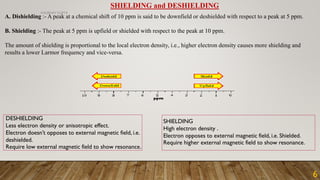
A. Dishielding :- A peak at a chemical shift of 10 ppm is said to be downfield or deshielded with respect to a peak at 5 ppm.
B. Shielding :- The peak at 5 ppm is upfield or shielded with respect to the peak at 10 ppm.
The amount of shielding is proportional to the local electron density, i.e., higher electron density causes more shielding and
results a lower Larmor frequency and vice-versa.
DESHIELDING
Less electron density or anisotropic effect.
Electron doesn’t opposes to external magnetic field, i.e.
deshielded.
Require low external magnetic field to show resonance.
SHIELDING
High electron density .
Electron opposes to external magnetic field, i.e. Shielded.
Require higher external magnetic field to show resonance.
6
ANUBHAV GUPTA
SPIN-SPIN COUPLING
• The interaction between the spin magnetic moments of the different sets of H atoms in the molecule under study, is
known as spin-spin coupling. The source of signal splitting is a phenomenon called spin-spin coupling.
• Splitting of signal
➢ The multiplicity of a multiplet is given by the number of equivalent protons in neighbouring atoms plus one,
i.e., the n + 1 rule
➢ Equivalent nuclei do not interact with each other.
• Coupling constant (J)
➢ Chemists quantify the spin-spin coupling effect using something called the coupling constant.
➢ Distance of centre of peaks in a given multiplet. It is expressed in Hz or cycle per second.
➢ Normal range 0–20. Ratio of J for trans to cis alkene is approximately 2.
7
ANUBHAV GUPTA
SPIN SPIN SPLITTING
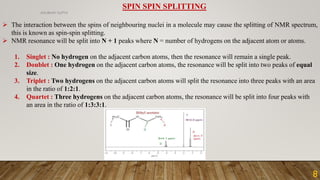
➢ The interaction between the spins of neighbouring nuclei in a molecule may cause the splitting of NMR spectrum,
this is known as spin-spin splitting.
➢ NMR resonance will be split into N + 1 peaks where N = number of hydrogens on the adjacent atom or atoms.
1. Singlet : No hydrogen on the adjacent carbon atoms, then the resonance will remain a single peak.
2. Doublet : One hydrogen on the adjacent carbon atoms, the resonance will be split into two peaks of equal
size.
3. Triplet : Two hydrogens on the adjacent carbon atoms will split the resonance into three peaks with an area
in the ratio of 1:2:1.
4. Quartet : Three hydrogens on the adjacent carbon atoms, the resonance will be split into four peaks with
an area in the ratio of 1:3:3:1.
8
ANUBHAV GUPTA
CHEMICAL SHIFT EQUIVALENCE
➢ If a set of nuclei exists in identical environments, they are expected to have the same chemical shift.
➢ Such nuclei are called chemical shift equivalent or chemically equivalent.
MAGNETIC EQUIVALENCE
➢ Also known as Spin Coupling Equivalence.
➢ If in a set of chemically equivalent nuclei, each member of the set has exactly the same interaction (J-coupling) to
every other magnetically active nucleus in the molecule, then the nuclei are also magnetically equivalent.
9
ANUBHAV GUPTA
INSTRUMENTATION
➢ Instruments that are used to obtain NMR spectra is called NMR spectrometer.
➢ NMR spectrometers are referred to as 300 MHz instruments, 500 MHz instruments, and so forth, depending on the
frequency of the RF radiation used for resonance.
➢ These spectrometers use very powerful magnets to create a small but measurable energy difference between two
possible spin states.
➢ Protons in different environments absorb at slightly different frequencies, so they are distinguishable by NMR.
➢ Modern NMR spectrometers use a constant magnetic field strength B0, and then a narrow range of frequencies is
applied to achieve the resonance of all protons.
10
ANUBHAV GUPTA
COMPONENTS OF NMR SPECTROMETER
NMR Spectrometer consists of following parts :
➢ MAGNET
➢ FIELD LOCK
➢ SHIM COILS
➢ PROBE UNIT
➢ Sample holder
➢ RF oscillator
➢ Sweep generator
➢ RF receiver
➢ DETECTOR
➢ AMPLIFIER & RECORDER
11
ANUBHAV GUPTA
1. MAGNET
➢ The NMR magnet is one of the most expensive components of the nuclear magnetic resonance spectrometer
system.
➢ Sensitivity and resolution are critically dependent on quality of magnet.
Feature:
➢ It should give homogenous magnetic field, i.e. the strength of the magnetic field should not change from point to
point.
➢ The magnet must be capable of producing a very strong magnetic field with strength at least 10,000 gauss.
N S
12
ANUBHAV GUPTA
TYPES OF MAGNET :
A- Permanent Magnet:
➢ It is simple and inexpensive to
operate but requires extensive
shielding and must be
thermostated to ± O.OO1o .
➢ They are operated up to 1.9 T.
➢ They provide field of good
homogeneity.
Disadvantage:-
➢ Field variation is not possible,
as it is required, because
different nuclei resonate at
different magnetic field.
B- Electro Magnets:
➢ They are more effective than
the permanent magnet because
of possibility of field
variation.
➢ They require power supply to
produce magnetic field and
cooling system to counter the
heat generated from the
electric power.
➢ They are operated at 14090,
12140, or 23490 Gauss.
C- Super conducting magnet:
➢ A super conducting magnet
has an electromagnet made of
superconducting wire.
➢ Superconducting wire has a
resistance approx. equal to
zero by immersing it in liquid
helium (at 00).
➢ The length of superconducting
wire in the magnet is typically
several miles.
13
ANUBHAV GUPTA
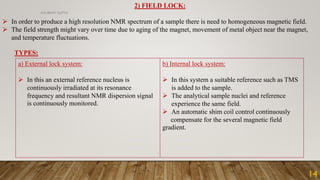
2) FIELD LOCK:
➢ In order to produce a high resolution NMR spectrum of a sample there is need to homogeneous magnetic field.
➢ The field strength might vary over time due to aging of the magnet, movement of metal object near the magnet,
and temperature fluctuations.
TYPES:
a) External lock system:
➢ In this an external reference nucleus is
continuously irradiated at its resonance
frequency and resultant NMR dispersion signal
is continuously monitored.
b) Internal lock system:
➢ In this system a suitable reference such as TMS
is added to the sample.
➢ The analytical sample nuclei and reference
experience the same field.
➢ An automatic shim coil control continuously
compensate for the several magnetic field
gradient.
14
ANUBHAV GUPTA
3) SHIM COILS:
➢ The purpose of shim coils on a spectrometer is to correct minor spatial
inhomogeneities in the magnetic field.
➢ These inhomogeneities could be caused by the magnet design, materials in the
probe, variations in the thickness of the sample tube, sample permeability, and
ferromagnetic materials around the magnet.
➢ A shim coil is designed to create a small magnetic field, which will oppose and
cancel out an inhomogeneity in the B0 magnetic field.
15
ANUBHAV GUPTA
4)PROBE UNIT:
➢ It contains following parts,
A) Sample holder:
➢ Sample should be held in holder, which should be chemically inert, durable and transparent to RF radiation.
➢ Glass tubes of about 8.5 cm long and 0.3 cm diameter are employed.
➢ Glass tube are amberized in order to protect UV sensitive sample.
➢ Quartz of polyfluoroethylene sample cells are also available for photochemical studies.
➢ A spinner is provided to spin the tube at several hundred rotation/min in order to make the sample experience
homogenous magnetic field.
Sample solvent: (sample preparation)
Few microgram and a few milligrams of sample is dissolved in a solvent such as CCL4 or CS2 or a solvent that
has had all the proton replaced by deuterium atoms.
E.g. Chloroform –d, acetone-d6, benzene-d6 etc.
B) Radiofrequency oscillator:
➢ To irradiate the sample with electromagnetic radiation a highly stable crystal controlled oscillator coil is imposed
at right angle to the applied magnetic field.
➢ To achieve maximum interaction of the RF radiation with the sample the oscillator coil is wound around the
sample cell.
16
ANUBHAV GUPTA
C) Sweep Generator:
➢ For a nucleus to resonate, the precession frequency should become equal to the frequency of the applied RF
radiation.
➢ This can be achieved by,
i. Frequency Sweep method:
This method is used to resonate the nucleus.
The frequency of the RF radiation is changed so that it become equal to resonance frequency or precession
frequency.
ii. Field sweep method:
In this method to resonate the nucleus the frequency of the RF radiation is kept constant and the precession
frequency is changed by changing the applied magnetic field.
D) Radiofrequency receiver:
➢ A few turns wire is wound around the sample tube tightly.
➢ This receiver coil is perpendicular to both the external magnetic field and radio frequency oscillator (transmitter).
➢ When RF radiation is passed through the magnetized sample, the resonance occurs, which cause the current
voltage across the coil to drop.
17
ANUBHAV GUPTA
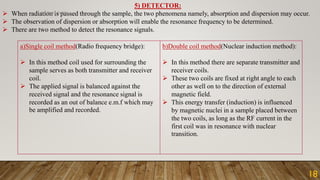
5) DETECTOR:
➢ When radiation is passed through the sample, the two phenomena namely, absorption and dispersion may occur.
➢ The observation of dispersion or absorption will enable the resonance frequency to be determined.
➢ There are two method to detect the resonance signals.
a)Single coil method(Radio frequency bridge):
➢ In this method coil used for surrounding the
sample serves as both transmitter and receiver
coil.
➢ The applied signal is balanced against the
received signal and the resonance signal is
recorded as an out of balance e.m.f which may
be amplified and recorded.
b)Double coil method(Nuclear induction method):
➢ In this method there are separate transmitter and
receiver coils.
➢ These two coils are fixed at right angle to each
other as well on to the direction of external
magnetic field.
➢ This energy transfer (induction) is influenced
by magnetic nuclei in a sample placed between
the two coils, as long as the RF current in the
first coil was in resonance with nuclear
transition.
18
ANUBHAV GUPTA
5). AMPLIFIER & RECORDER:
➢ The received signal is amplified by the help of amplifier.
➢ And it is recorded by using a computer device.
Schematic diagram of NMR Spectrometry.
19
ANUBHAV GUPTA
1H- NMR SPECTRUM OF ETHANOL
➢ The ethanol molecule has two carbon with one OH, bonded with single bond.
➢ Step 1 is to find the equivalent hydrogen in the molecule.
1. The first carbon has three hydrogen atom attached that are equivalent to each other. Since two hydrogen atoms are
attached to the adjacent carbon the peak will split twice., that means it will show three different peaks in the spectrum,
i.e. a Triplet
Acc,. To PASCAL’s triangle it will go into 1:2:1 pattern.
2. The second carbon has two hydrogen atom attached. For the second carbon the peak will split thrice since the
adjacent carbon has three hydrogen atoms attached to it., i.e. a Quartet.
Acc,. To PASCAL’s triangle it will go into 1:3:3:1 pattern.
3. The hydrogen atom on oxygen is not equivalent to any of the carbon it is on its own. The hydrogen in OH will not
split since there is only one hydrogen atom. i.e a Singlet
Note:- While drawing the spectrum the closer is the oxygen atom(say other than carbon) to adjacent carbon atom the
farther will go the spectrum., and drawn in between the carbon atoms.
20
ANUBHAV GUPTA
1H- NMR SPECTRUM
ETHANOL BENZALDEHYDE
21
ANUBHAV GUPTA
13C-NMR
➢ Carbon-13 (C13) nuclear magnetic resonance (most commonly known as carbon-13 NMR or 13C NMR or
sometimes simply referred to as carbon NMR) is the application of nuclear magnetic resonance (NMR)
spectroscopy to carbon.
➢ It is analogous to proton NMR (1H NMR) and allows the identification of carbon atoms in an organic
molecule just as proton NMR identifies hydrogen atoms.
➢ 13C NMR detects only the 13C isotope of carbon, whose natural abundance is only 1.1%, because the main carbon
isotope, 12C , is not detectable by NMR since its nucleus has zero spin.
➢ 13C- provides information about the backbone of molecules rather than the periphery.
➢ The chemical shifts range for 13C- NMR for most organic compounds is 200 ppm compared to 10 –15 ppm for H,
hence there is less overlap of peaks for 13C- NMR.
22
ANUBHAV GUPTA

Nmr spectroscopy

  • 1.
    NMR SPECTROSCOPY ANUBHAV GUPTA B.PHARM 4TH YEAR INSTITUTE OF PHARMACY VBS PURVANCHAL UNIVERSITY JUANPUR
  • 2.
    INTRODUCTION ➢ NMR Spectroscopyor Nuclear Magnetic Resonance spectroscopy is a process whereby energy from an external source is absorbed and brings about a change or resonance to an ‘excited’ or high energy state. The energy required for NMR lies in the low energy or long wavelength radio-frequency end of the electromagnetic spectrum. ➢ NMR Spectroscopy deals with nuclear spin changes that’s why it is also known as Nuclear Spin Spectroscopy. ➢ NMR spectroscopy can be understood by the splitting of nuclei spin state in applied external magnetic field which is known as Nuclear-zeeman effect. ➢ NMR spectroscopy follows Larmor equation. Its is given by ; W(Angular Precessional Frequency) = ƴH 2ϖv = ƴH Precessional Frequency(v) = ƴ / 2ϖ where, H = Applied magnetic field ƴ = Gyromagnetic Ratio = 2ϖμ / hI {where h is Plank constant and I is Spin Quantum Number. μ is Magnetic moment of spinning nuclei. Magnetic moment = ƴ * Spin angular moment (h/2π *spin quantum number I)} 2 ANUBHAV GUPTA
  • 3.
    ➢ The NMRphenomenon is governed by following five aspects: A. The Spinning Nucleus B. The effect of an External Magnetic Field C. The Precessional Motion D. The Precessional Frequency E. The Energy Transition ➢ Only those Nuclei show NMR absorption signal having spin quantum number (I) greater or equals to .. 1. Zero-spin (I = O) If the number of neutrons and the number of protons are both even, then the nucleus has no spin. Example:- 12C, 16O, and 32S 2. Half-Integral Spin If the number of neutrons plus the number of protons is odd, then the nucleus has a half-integer spin (i.e., 1/2, 3/2, 5/2) Example:- 1H ; 3H ;13C ; 19F ; 31P ; 15N ; 29S 3. Integral Spin (I = 1/2) If the number of neutrons and the number of protons are both odd, then the nucleus has an integer spin (i.e., 1, 2, 3) Example:- 10B ; 11B ; 35Cl ; 17O ; 27Al . 3 ANUBHAV GUPTA
  • 4.
    PRINCIPLE The NMR phenomenonis based on the fact that nuclei of atoms have magnetic properties that can be utilized to yield chemical information. Quantum mechanically subatomic particles (protons, neutrons and electrons) have spin. 1-H NMR Spectroscopy ➢ Proton nuclear magnetic resonance (proton NMR, hydrogen-1 NMR, or 1H NMR) is the application of nuclear magnetic resonance in NMR spectroscopy with respect to hydrogen-1 nuclei within the molecules of a substance, in order to determine the structure of its molecules. ➢ 1H-NMR provides a number of valuable informations stated below, which are employed for the struc-tural elucidation as well as assay of important pharmaceutical substances, namely : (i) To record differences in the magnetic properties of the various nuclei present, (ii) To deduce in large measure the exact locations of these nuclei within the molecule, (iii) To deduce how many different types of hydrogen environments are present in the molecule, (iv) To deduce which hydrogen atoms are present on neighbouring carbon atoms, and (v) To measure exactly how many H-atoms are actually present in each of these environments. 4 ANUBHAV GUPTA
  • 5.
    CHEMICAL SHIFTS ➢The chemicalshift is the position on the δ (delta) scale (in ppm) where the peak occurs. OR, ➢The chemical shift (δ) is defined as the difference between the resonance position of a nucleus and that of a standard reference compound. where, ∆ν = Difference in frequency (Hz) between the observed signal and that of the standard (reference compound). Factors affecting Chemical Shifts There are three major factors that influence chemical shifts: 1. Inductive effects by electronegative groups. 2. Deshielding due to reduced electron density (due to the presence of electronegative atoms). 3. Anisotrophy (due to magnetic fields generated by p bonds). 5 ANUBHAV GUPTA
  • 6.
    SHIELDING and DESHIELDING A.Dishielding :- A peak at a chemical shift of 10 ppm is said to be downfield or deshielded with respect to a peak at 5 ppm. B. Shielding :- The peak at 5 ppm is upfield or shielded with respect to the peak at 10 ppm. The amount of shielding is proportional to the local electron density, i.e., higher electron density causes more shielding and results a lower Larmor frequency and vice-versa. DESHIELDING Less electron density or anisotropic effect. Electron doesn’t opposes to external magnetic field, i.e. deshielded. Require low external magnetic field to show resonance. SHIELDING High electron density . Electron opposes to external magnetic field, i.e. Shielded. Require higher external magnetic field to show resonance. 6 ANUBHAV GUPTA
  • 7.
    SPIN-SPIN COUPLING • Theinteraction between the spin magnetic moments of the different sets of H atoms in the molecule under study, is known as spin-spin coupling. The source of signal splitting is a phenomenon called spin-spin coupling. • Splitting of signal ➢ The multiplicity of a multiplet is given by the number of equivalent protons in neighbouring atoms plus one, i.e., the n + 1 rule ➢ Equivalent nuclei do not interact with each other. • Coupling constant (J) ➢ Chemists quantify the spin-spin coupling effect using something called the coupling constant. ➢ Distance of centre of peaks in a given multiplet. It is expressed in Hz or cycle per second. ➢ Normal range 0–20. Ratio of J for trans to cis alkene is approximately 2. 7 ANUBHAV GUPTA
  • 8.
    SPIN SPIN SPLITTING ➢The interaction between the spins of neighbouring nuclei in a molecule may cause the splitting of NMR spectrum, this is known as spin-spin splitting. ➢ NMR resonance will be split into N + 1 peaks where N = number of hydrogens on the adjacent atom or atoms. 1. Singlet : No hydrogen on the adjacent carbon atoms, then the resonance will remain a single peak. 2. Doublet : One hydrogen on the adjacent carbon atoms, the resonance will be split into two peaks of equal size. 3. Triplet : Two hydrogens on the adjacent carbon atoms will split the resonance into three peaks with an area in the ratio of 1:2:1. 4. Quartet : Three hydrogens on the adjacent carbon atoms, the resonance will be split into four peaks with an area in the ratio of 1:3:3:1. 8 ANUBHAV GUPTA
  • 9.
    CHEMICAL SHIFT EQUIVALENCE ➢If a set of nuclei exists in identical environments, they are expected to have the same chemical shift. ➢ Such nuclei are called chemical shift equivalent or chemically equivalent. MAGNETIC EQUIVALENCE ➢ Also known as Spin Coupling Equivalence. ➢ If in a set of chemically equivalent nuclei, each member of the set has exactly the same interaction (J-coupling) to every other magnetically active nucleus in the molecule, then the nuclei are also magnetically equivalent. 9 ANUBHAV GUPTA
  • 10.
    INSTRUMENTATION ➢ Instruments thatare used to obtain NMR spectra is called NMR spectrometer. ➢ NMR spectrometers are referred to as 300 MHz instruments, 500 MHz instruments, and so forth, depending on the frequency of the RF radiation used for resonance. ➢ These spectrometers use very powerful magnets to create a small but measurable energy difference between two possible spin states. ➢ Protons in different environments absorb at slightly different frequencies, so they are distinguishable by NMR. ➢ Modern NMR spectrometers use a constant magnetic field strength B0, and then a narrow range of frequencies is applied to achieve the resonance of all protons. 10 ANUBHAV GUPTA
  • 11.
    COMPONENTS OF NMRSPECTROMETER NMR Spectrometer consists of following parts : ➢ MAGNET ➢ FIELD LOCK ➢ SHIM COILS ➢ PROBE UNIT ➢ Sample holder ➢ RF oscillator ➢ Sweep generator ➢ RF receiver ➢ DETECTOR ➢ AMPLIFIER & RECORDER 11 ANUBHAV GUPTA
  • 12.
    1. MAGNET ➢ TheNMR magnet is one of the most expensive components of the nuclear magnetic resonance spectrometer system. ➢ Sensitivity and resolution are critically dependent on quality of magnet. Feature: ➢ It should give homogenous magnetic field, i.e. the strength of the magnetic field should not change from point to point. ➢ The magnet must be capable of producing a very strong magnetic field with strength at least 10,000 gauss. N S 12 ANUBHAV GUPTA
  • 13.
    TYPES OF MAGNET: A- Permanent Magnet: ➢ It is simple and inexpensive to operate but requires extensive shielding and must be thermostated to ± O.OO1o . ➢ They are operated up to 1.9 T. ➢ They provide field of good homogeneity. Disadvantage:- ➢ Field variation is not possible, as it is required, because different nuclei resonate at different magnetic field. B- Electro Magnets: ➢ They are more effective than the permanent magnet because of possibility of field variation. ➢ They require power supply to produce magnetic field and cooling system to counter the heat generated from the electric power. ➢ They are operated at 14090, 12140, or 23490 Gauss. C- Super conducting magnet: ➢ A super conducting magnet has an electromagnet made of superconducting wire. ➢ Superconducting wire has a resistance approx. equal to zero by immersing it in liquid helium (at 00). ➢ The length of superconducting wire in the magnet is typically several miles. 13 ANUBHAV GUPTA
  • 14.
    2) FIELD LOCK: ➢In order to produce a high resolution NMR spectrum of a sample there is need to homogeneous magnetic field. ➢ The field strength might vary over time due to aging of the magnet, movement of metal object near the magnet, and temperature fluctuations. TYPES: a) External lock system: ➢ In this an external reference nucleus is continuously irradiated at its resonance frequency and resultant NMR dispersion signal is continuously monitored. b) Internal lock system: ➢ In this system a suitable reference such as TMS is added to the sample. ➢ The analytical sample nuclei and reference experience the same field. ➢ An automatic shim coil control continuously compensate for the several magnetic field gradient. 14 ANUBHAV GUPTA
  • 15.
    3) SHIM COILS: ➢The purpose of shim coils on a spectrometer is to correct minor spatial inhomogeneities in the magnetic field. ➢ These inhomogeneities could be caused by the magnet design, materials in the probe, variations in the thickness of the sample tube, sample permeability, and ferromagnetic materials around the magnet. ➢ A shim coil is designed to create a small magnetic field, which will oppose and cancel out an inhomogeneity in the B0 magnetic field. 15 ANUBHAV GUPTA
  • 16.
    4)PROBE UNIT: ➢ Itcontains following parts, A) Sample holder: ➢ Sample should be held in holder, which should be chemically inert, durable and transparent to RF radiation. ➢ Glass tubes of about 8.5 cm long and 0.3 cm diameter are employed. ➢ Glass tube are amberized in order to protect UV sensitive sample. ➢ Quartz of polyfluoroethylene sample cells are also available for photochemical studies. ➢ A spinner is provided to spin the tube at several hundred rotation/min in order to make the sample experience homogenous magnetic field. Sample solvent: (sample preparation) Few microgram and a few milligrams of sample is dissolved in a solvent such as CCL4 or CS2 or a solvent that has had all the proton replaced by deuterium atoms. E.g. Chloroform –d, acetone-d6, benzene-d6 etc. B) Radiofrequency oscillator: ➢ To irradiate the sample with electromagnetic radiation a highly stable crystal controlled oscillator coil is imposed at right angle to the applied magnetic field. ➢ To achieve maximum interaction of the RF radiation with the sample the oscillator coil is wound around the sample cell. 16 ANUBHAV GUPTA
  • 17.
    C) Sweep Generator: ➢For a nucleus to resonate, the precession frequency should become equal to the frequency of the applied RF radiation. ➢ This can be achieved by, i. Frequency Sweep method: This method is used to resonate the nucleus. The frequency of the RF radiation is changed so that it become equal to resonance frequency or precession frequency. ii. Field sweep method: In this method to resonate the nucleus the frequency of the RF radiation is kept constant and the precession frequency is changed by changing the applied magnetic field. D) Radiofrequency receiver: ➢ A few turns wire is wound around the sample tube tightly. ➢ This receiver coil is perpendicular to both the external magnetic field and radio frequency oscillator (transmitter). ➢ When RF radiation is passed through the magnetized sample, the resonance occurs, which cause the current voltage across the coil to drop. 17 ANUBHAV GUPTA
  • 18.
    5) DETECTOR: ➢ Whenradiation is passed through the sample, the two phenomena namely, absorption and dispersion may occur. ➢ The observation of dispersion or absorption will enable the resonance frequency to be determined. ➢ There are two method to detect the resonance signals. a)Single coil method(Radio frequency bridge): ➢ In this method coil used for surrounding the sample serves as both transmitter and receiver coil. ➢ The applied signal is balanced against the received signal and the resonance signal is recorded as an out of balance e.m.f which may be amplified and recorded. b)Double coil method(Nuclear induction method): ➢ In this method there are separate transmitter and receiver coils. ➢ These two coils are fixed at right angle to each other as well on to the direction of external magnetic field. ➢ This energy transfer (induction) is influenced by magnetic nuclei in a sample placed between the two coils, as long as the RF current in the first coil was in resonance with nuclear transition. 18 ANUBHAV GUPTA
  • 19.
    5). AMPLIFIER &RECORDER: ➢ The received signal is amplified by the help of amplifier. ➢ And it is recorded by using a computer device. Schematic diagram of NMR Spectrometry. 19 ANUBHAV GUPTA
  • 20.
    1H- NMR SPECTRUMOF ETHANOL ➢ The ethanol molecule has two carbon with one OH, bonded with single bond. ➢ Step 1 is to find the equivalent hydrogen in the molecule. 1. The first carbon has three hydrogen atom attached that are equivalent to each other. Since two hydrogen atoms are attached to the adjacent carbon the peak will split twice., that means it will show three different peaks in the spectrum, i.e. a Triplet Acc,. To PASCAL’s triangle it will go into 1:2:1 pattern. 2. The second carbon has two hydrogen atom attached. For the second carbon the peak will split thrice since the adjacent carbon has three hydrogen atoms attached to it., i.e. a Quartet. Acc,. To PASCAL’s triangle it will go into 1:3:3:1 pattern. 3. The hydrogen atom on oxygen is not equivalent to any of the carbon it is on its own. The hydrogen in OH will not split since there is only one hydrogen atom. i.e a Singlet Note:- While drawing the spectrum the closer is the oxygen atom(say other than carbon) to adjacent carbon atom the farther will go the spectrum., and drawn in between the carbon atoms. 20 ANUBHAV GUPTA
  • 21.
    1H- NMR SPECTRUM ETHANOLBENZALDEHYDE 21 ANUBHAV GUPTA
  • 22.
    13C-NMR ➢ Carbon-13 (C13)nuclear magnetic resonance (most commonly known as carbon-13 NMR or 13C NMR or sometimes simply referred to as carbon NMR) is the application of nuclear magnetic resonance (NMR) spectroscopy to carbon. ➢ It is analogous to proton NMR (1H NMR) and allows the identification of carbon atoms in an organic molecule just as proton NMR identifies hydrogen atoms. ➢ 13C NMR detects only the 13C isotope of carbon, whose natural abundance is only 1.1%, because the main carbon isotope, 12C , is not detectable by NMR since its nucleus has zero spin. ➢ 13C- provides information about the backbone of molecules rather than the periphery. ➢ The chemical shifts range for 13C- NMR for most organic compounds is 200 ppm compared to 10 –15 ppm for H, hence there is less overlap of peaks for 13C- NMR. 22 ANUBHAV GUPTA