Sunghyon Kyeong
sunghyon.kyeong@gmail.com
Institute of Behavioural Science in Medicine, 

Yonsei University College of Medicine
Introduction to Neuroimaging

-PET, fMRI, VBM, and DTI-
Sunghyon Kyeong (Yonsei Univ) Introduction to Neuroimaging: Methods and Preprocessing steps p 2
with Ctrl-key, 

select multiple regions
with Ctrl-key, 

select multiple regions
Outline
• Positron Emission Topography (PET) Imaging
• Principles of BOLD signal generation
• Review on fMRI preprocessing steps
• Functional Network Construction
• Morphometric Brain Network
• Network from Diffusion Tensor Imaging
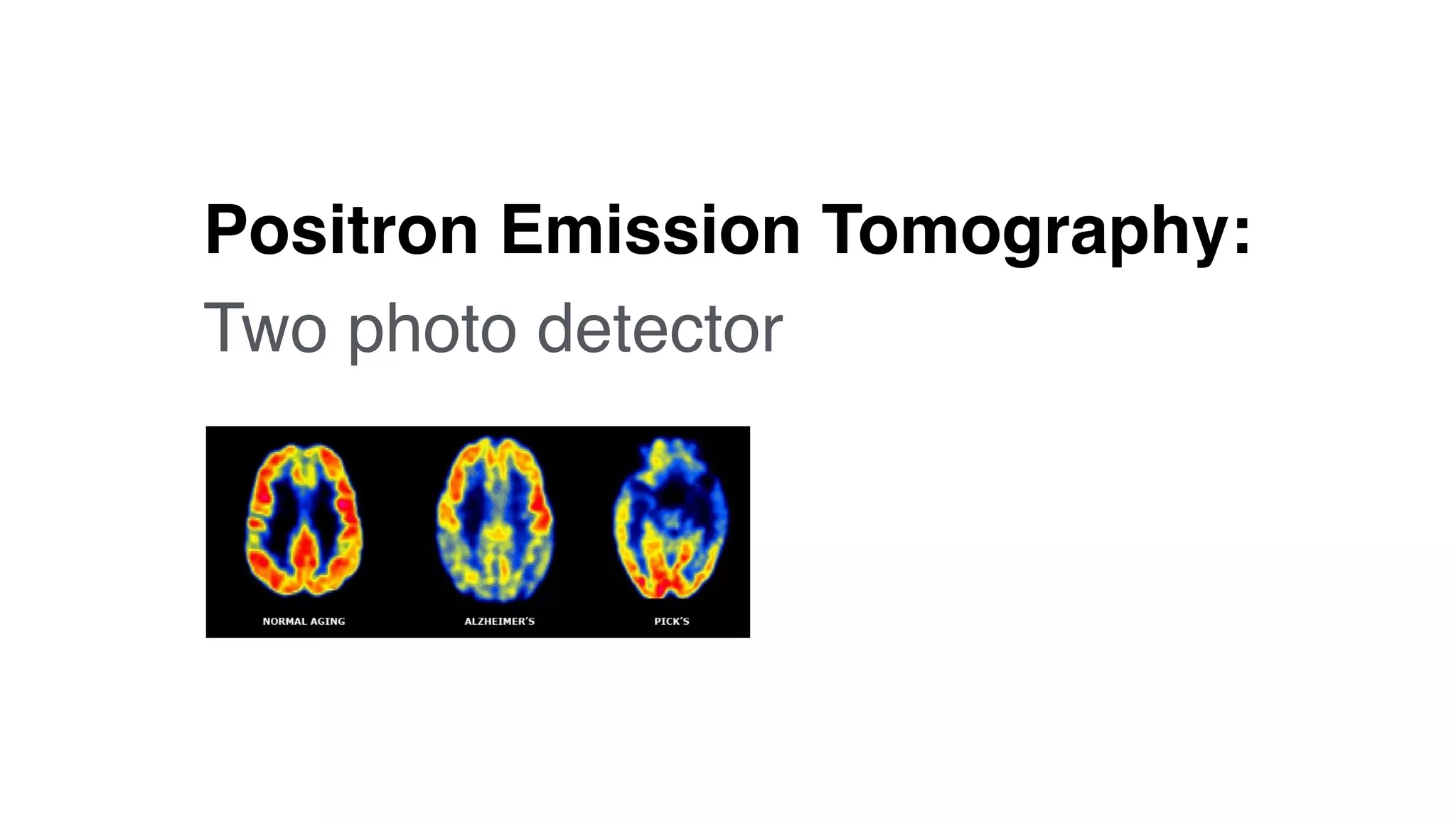
Positron Emission Tomography:

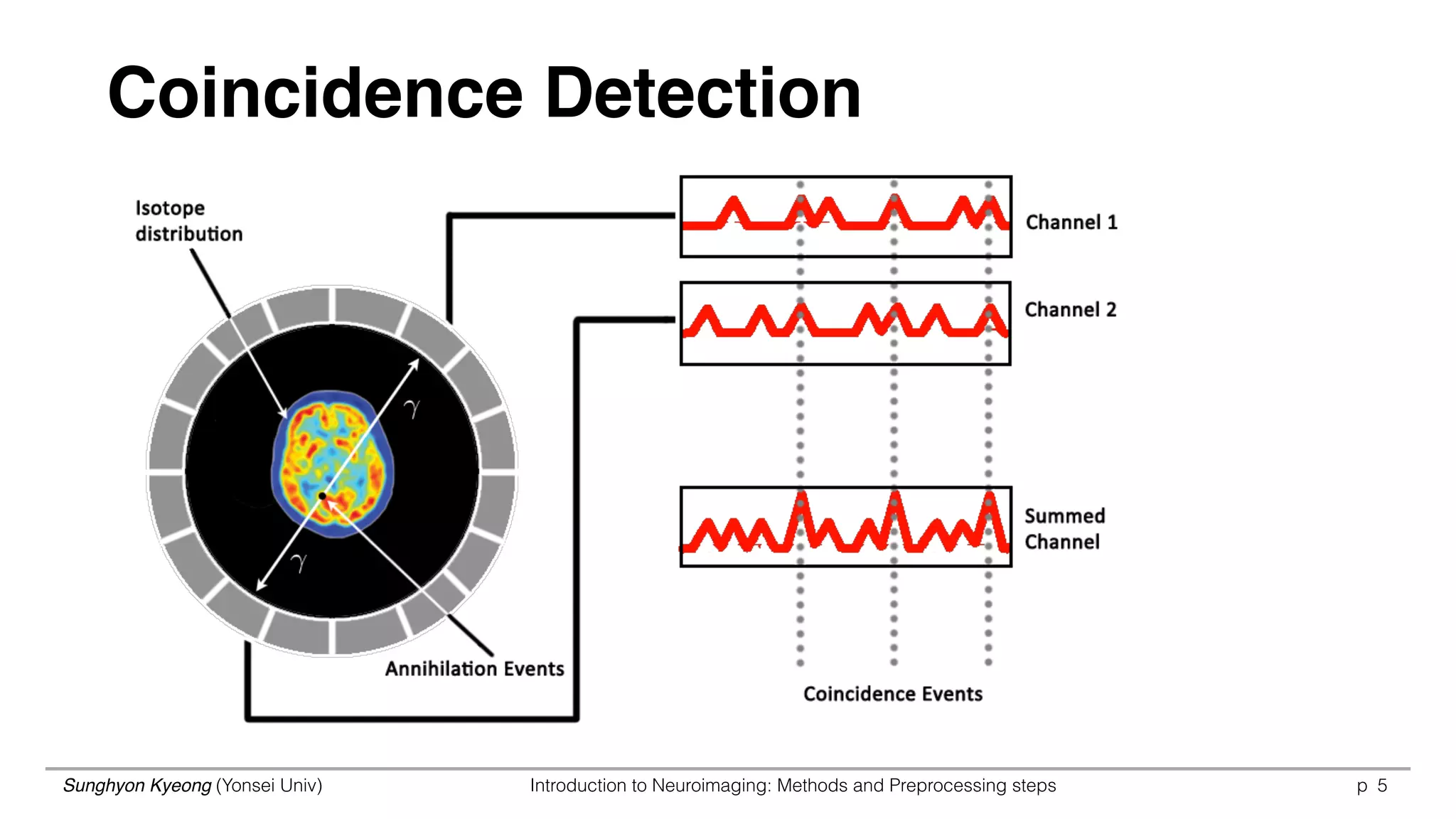
Two photo detector
Sunghyon Kyeong (Yonsei Univ) Introduction to Neuroimaging: Methods and Preprocessing steps p 4
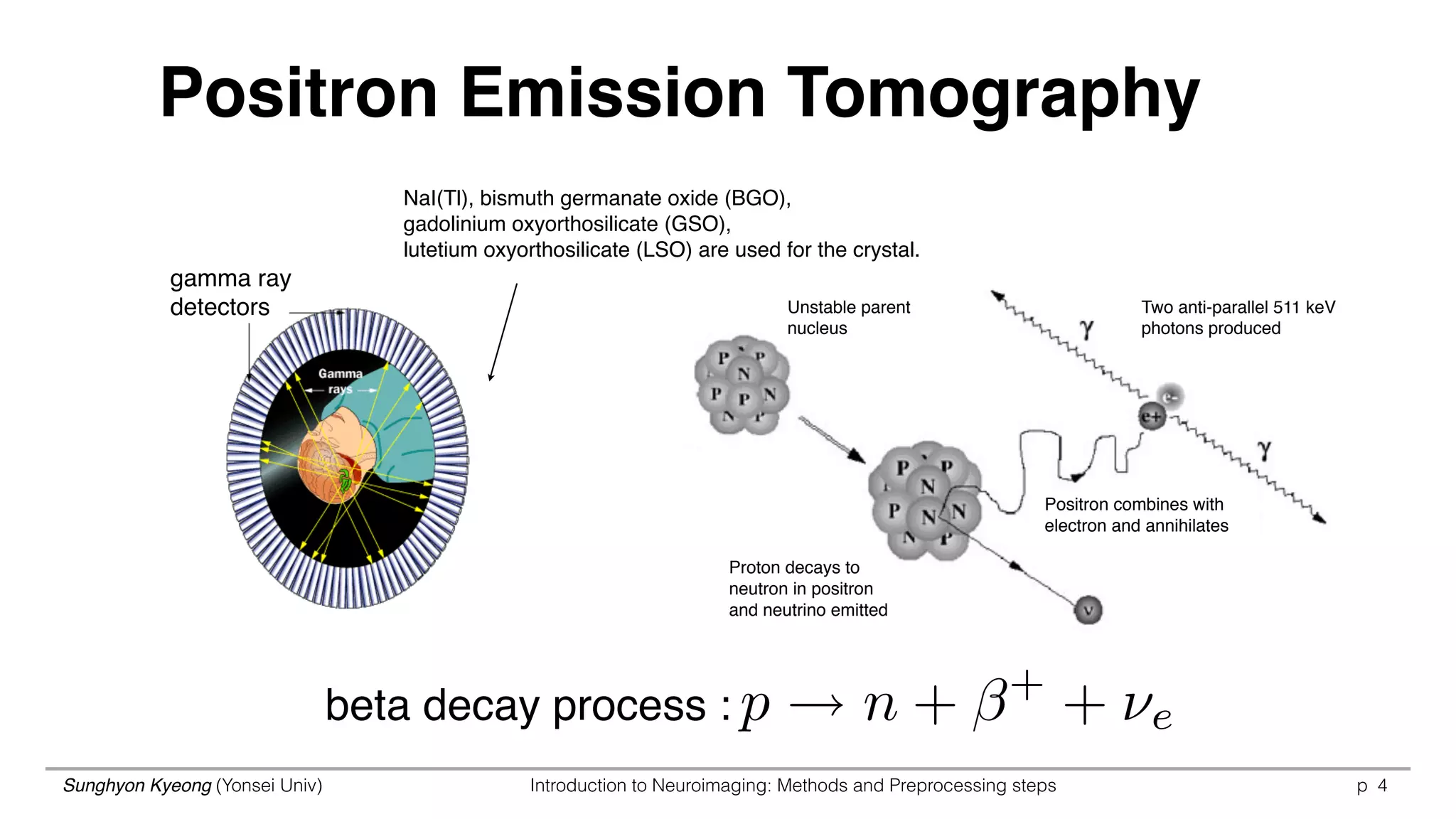
Positron Emission Tomography
gamma ray

detectors Unstable parent

nucleus
Proton decays to

neutron in positron 

and neutrino emitted
Positron combines with

electron and annihilates
Two anti-parallel 511 keV

photons produced
p n + +
+ ⇥ebeta decay process :
NaI(Tl), bismuth germanate oxide (BGO), 

gadolinium oxyorthosilicate (GSO), 

lutetium oxyorthosilicate (LSO) are used for the crystal.
Sunghyon Kyeong (Yonsei Univ) Introduction to Neuroimaging: Methods and Preprocessing steps p 5
Coincidence Detection
Sunghyon Kyeong (Yonsei Univ) Introduction to Neuroimaging: Methods and Preprocessing steps p 6
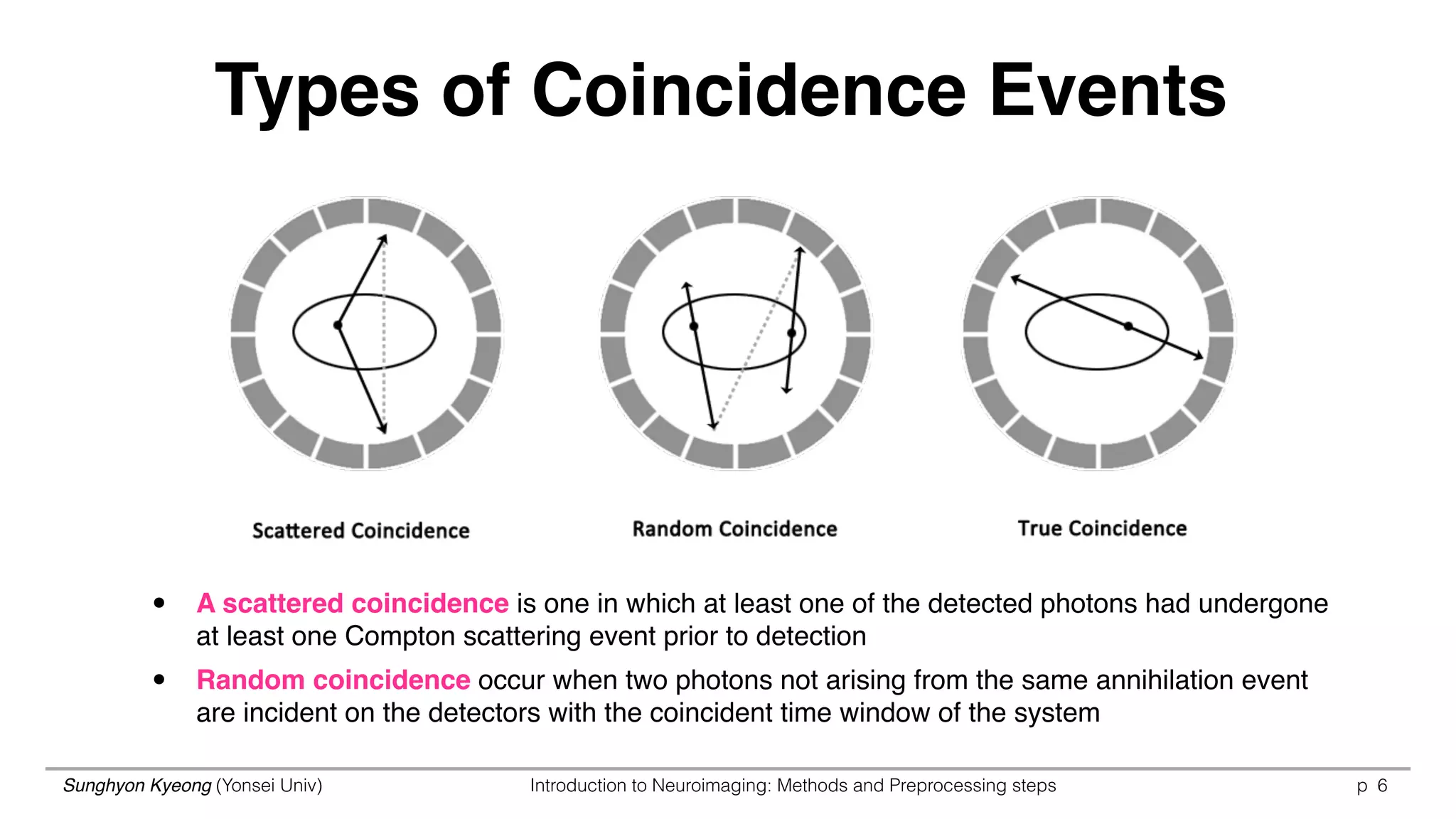
Types of Coincidence Events
• A scattered coincidence is one in which at least one of the detected photons had undergone
at least one Compton scattering event prior to detection
• Random coincidence occur when two photons not arising from the same annihilation event
are incident on the detectors with the coincident time window of the system
Sunghyon Kyeong (Yonsei Univ) Introduction to Neuroimaging: Methods and Preprocessing steps p 7
• Unstable positron-emitting isotopes are synthesised in a cyclotron
by bombarding elements such as oxygen, carbon, or fluorine with
protons.
• Isotopes : 15O(half-life 2min), 18F(110 min), 11C(20min)
• When the radio-labeled compounds are injected into the blood
stream, they distribute according to the physiological state of the
brain, accumulating preferentially in more metabolically active
areas.
• The structure of F-18-FDG is similar to the glucose, so it can used
to diagnosis the abnormality of glucose metabolism.
Isotope in PET imaging
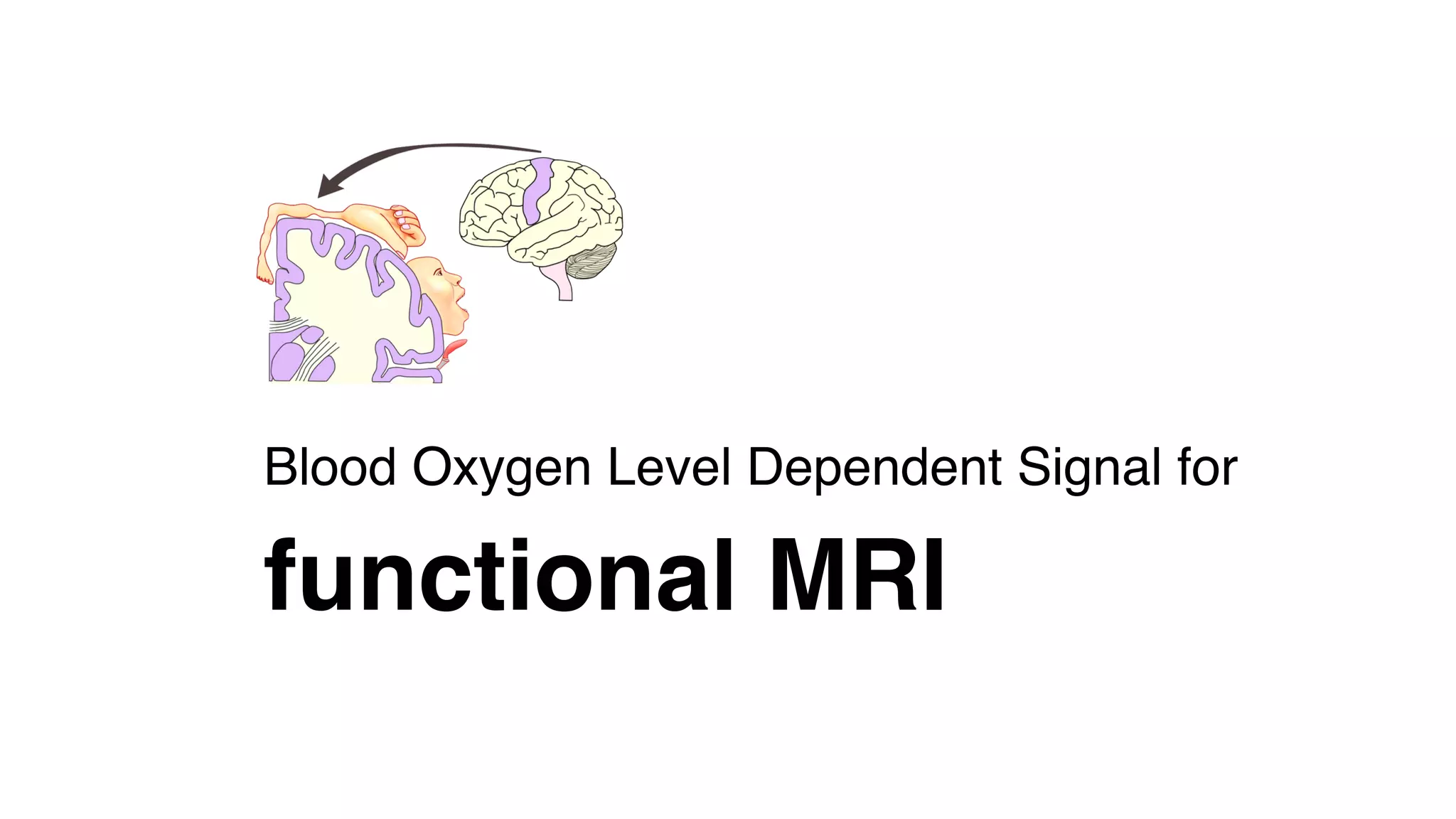
Blood Oxygen Level Dependent Signal for 

functional MRI
Sunghyon Kyeong (Yonsei Univ) Introduction to Neuroimaging: Methods and Preprocessing steps p 9
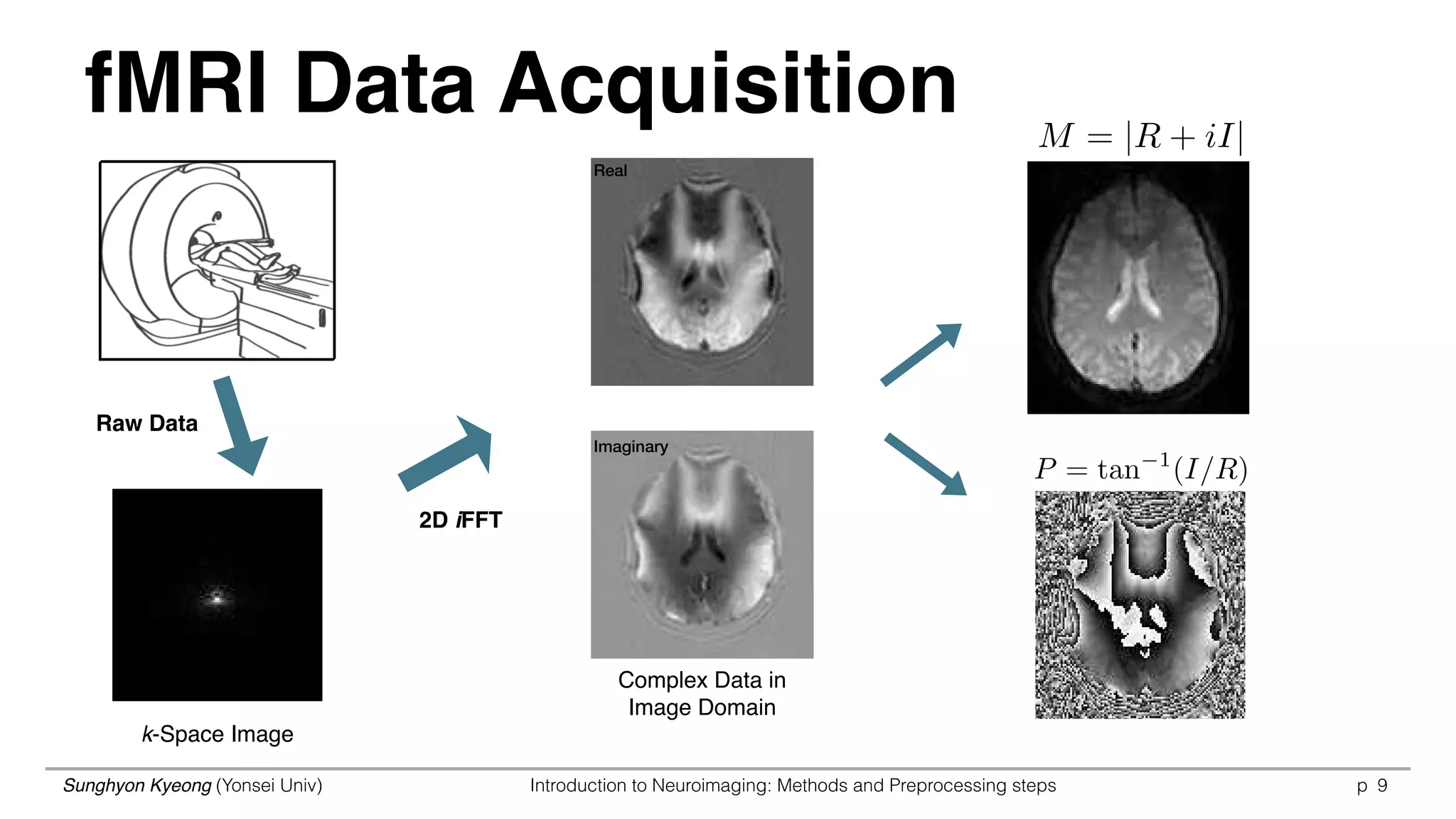
2D iFFT
Raw Data
k-Space Image
Complex Data in
Image Domain
M = |R + iI|
P = tan 1
(I/R)
fMRI Data Acquisition
Sunghyon Kyeong (Yonsei Univ) Introduction to Neuroimaging: Methods and Preprocessing steps p 10
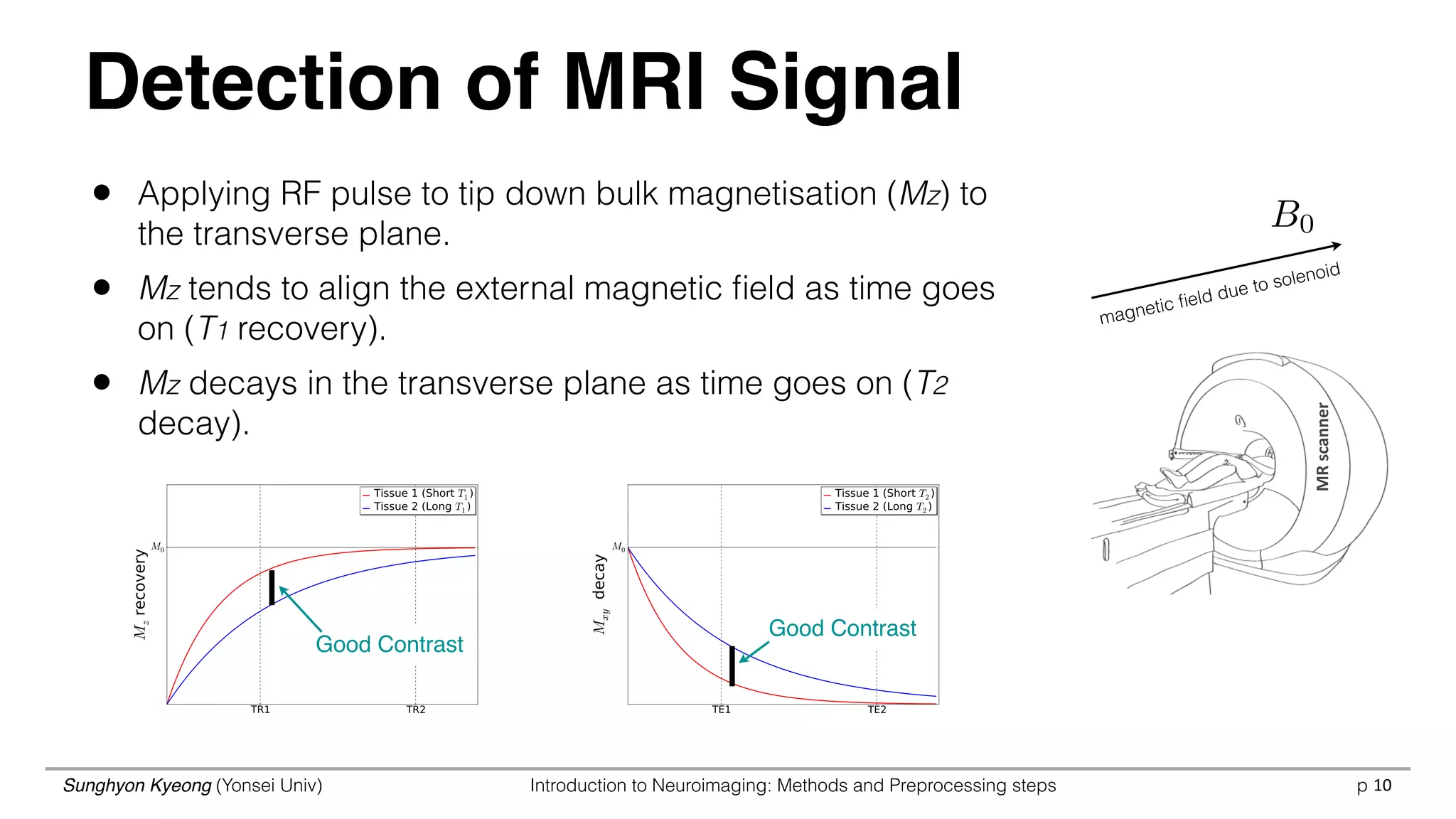
Detection of MRI Signal
• Applying RF pulse to tip down bulk magnetisation (Mz) to
the transverse plane.
• Mz tends to align the external magnetic field as time goes
on (T1 recovery).
• Mz decays in the transverse plane as time goes on (T2
decay).
Good Contrast
Good Contrast
B0
MR	
  scanner
magnetic field due to solenoid
Sunghyon Kyeong (Yonsei Univ) Introduction to Neuroimaging: Methods and Preprocessing steps p 11
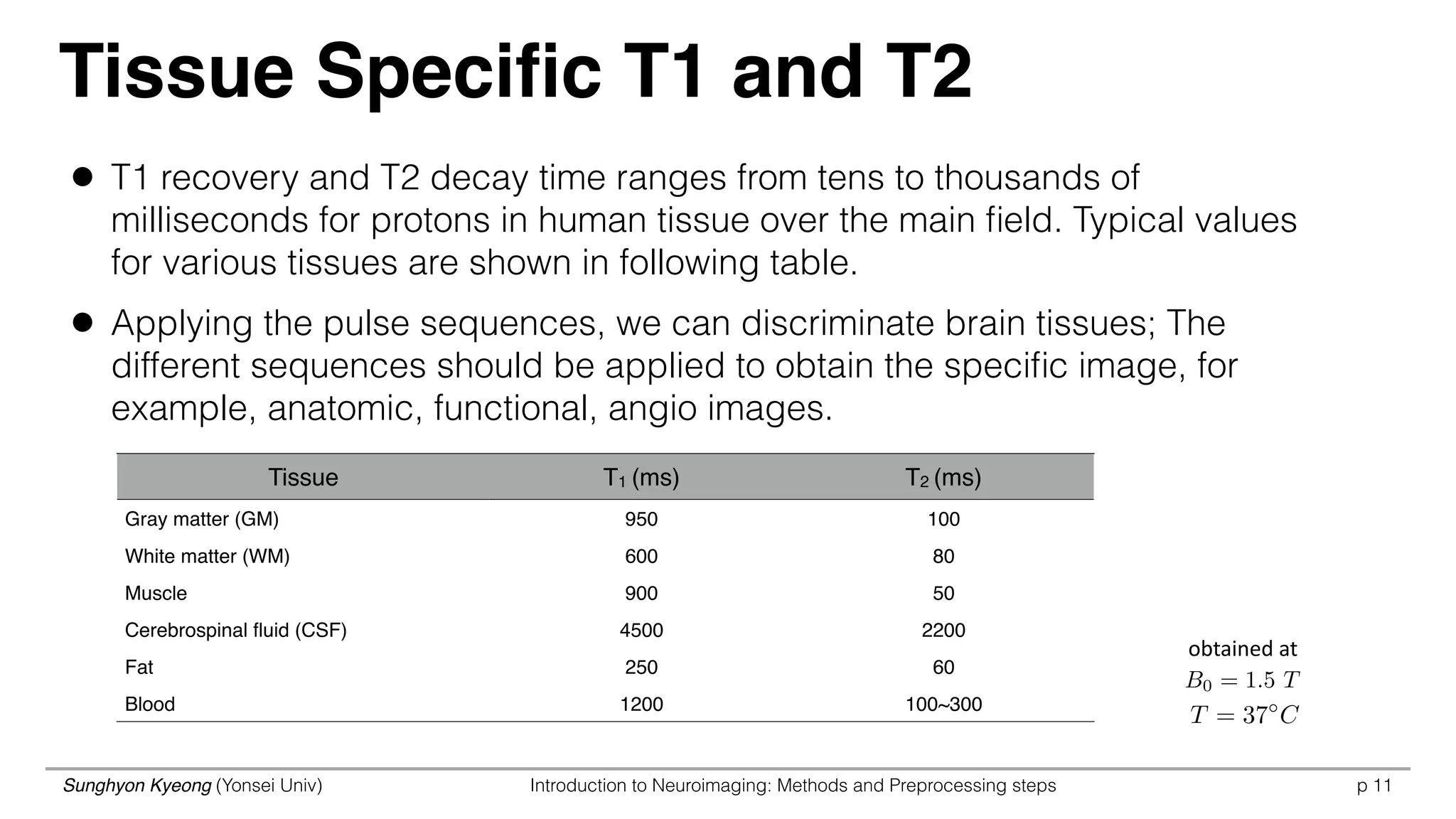
Tissue T1 (ms) T2 (ms)
Gray matter (GM) 950 100
White matter (WM) 600 80
Muscle 900 50
Cerebrospinal fluid (CSF) 4500 2200
Fat 250 60
Blood 1200 100~300
Tissue Specific T1 and T2
B0 = 1.5 T
T = 37 C
obtained	
  at
• T1 recovery and T2 decay time ranges from tens to thousands of
milliseconds for protons in human tissue over the main field. Typical values
for various tissues are shown in following table.
• Applying the pulse sequences, we can discriminate brain tissues; The
different sequences should be applied to obtain the specific image, for
example, anatomic, functional, angio images.
Sunghyon Kyeong (Yonsei Univ) Introduction to Neuroimaging: Methods and Preprocessing steps p 12
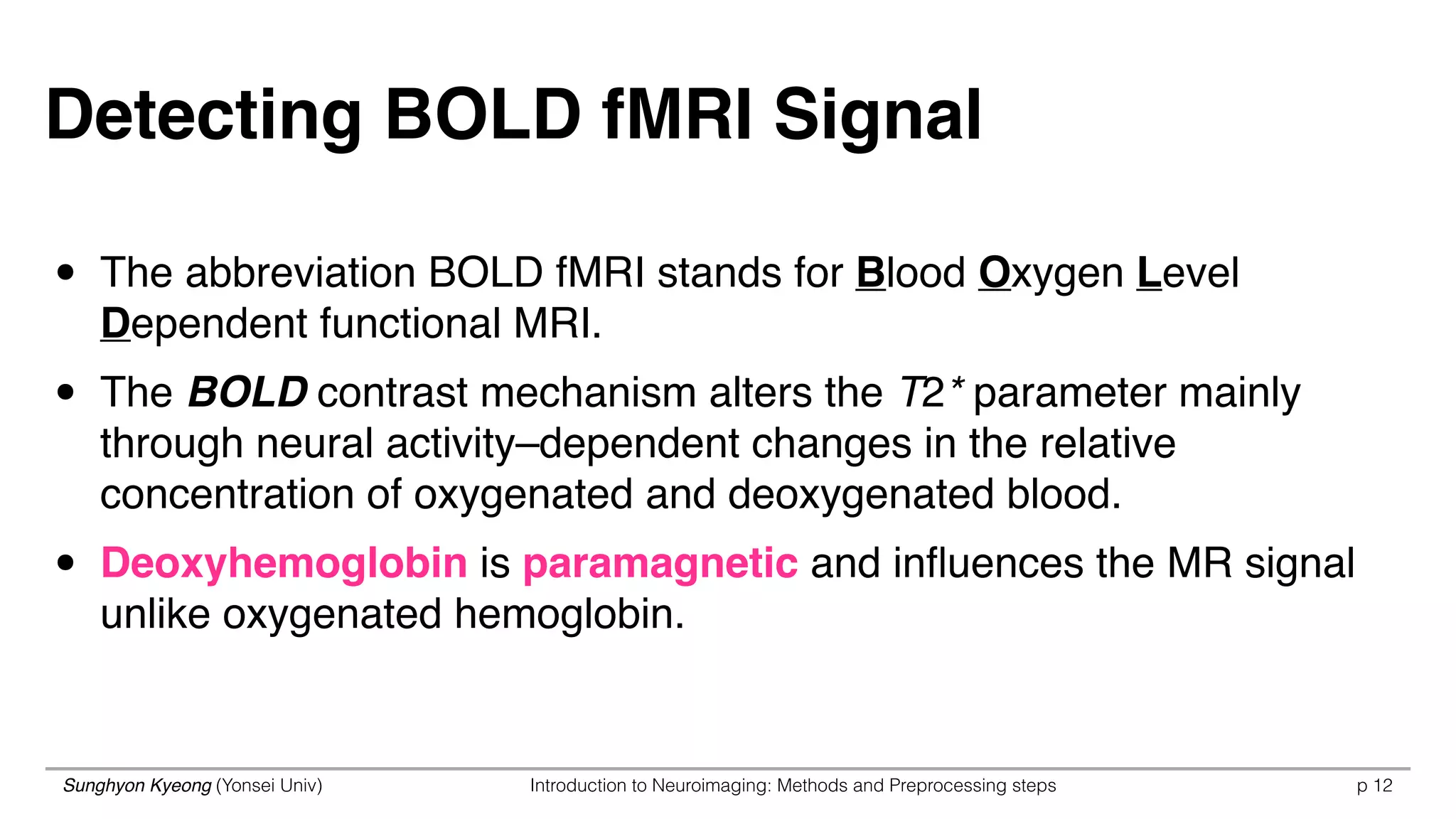
• The abbreviation BOLD fMRI stands for Blood Oxygen Level
Dependent functional MRI.
• The BOLD contrast mechanism alters the T2* parameter mainly
through neural activity–dependent changes in the relative
concentration of oxygenated and deoxygenated blood.
• Deoxyhemoglobin is paramagnetic and influences the MR signal
unlike oxygenated hemoglobin.
Detecting BOLD fMRI Signal
Sunghyon Kyeong (Yonsei Univ) Introduction to Neuroimaging: Methods and Preprocessing steps p 13
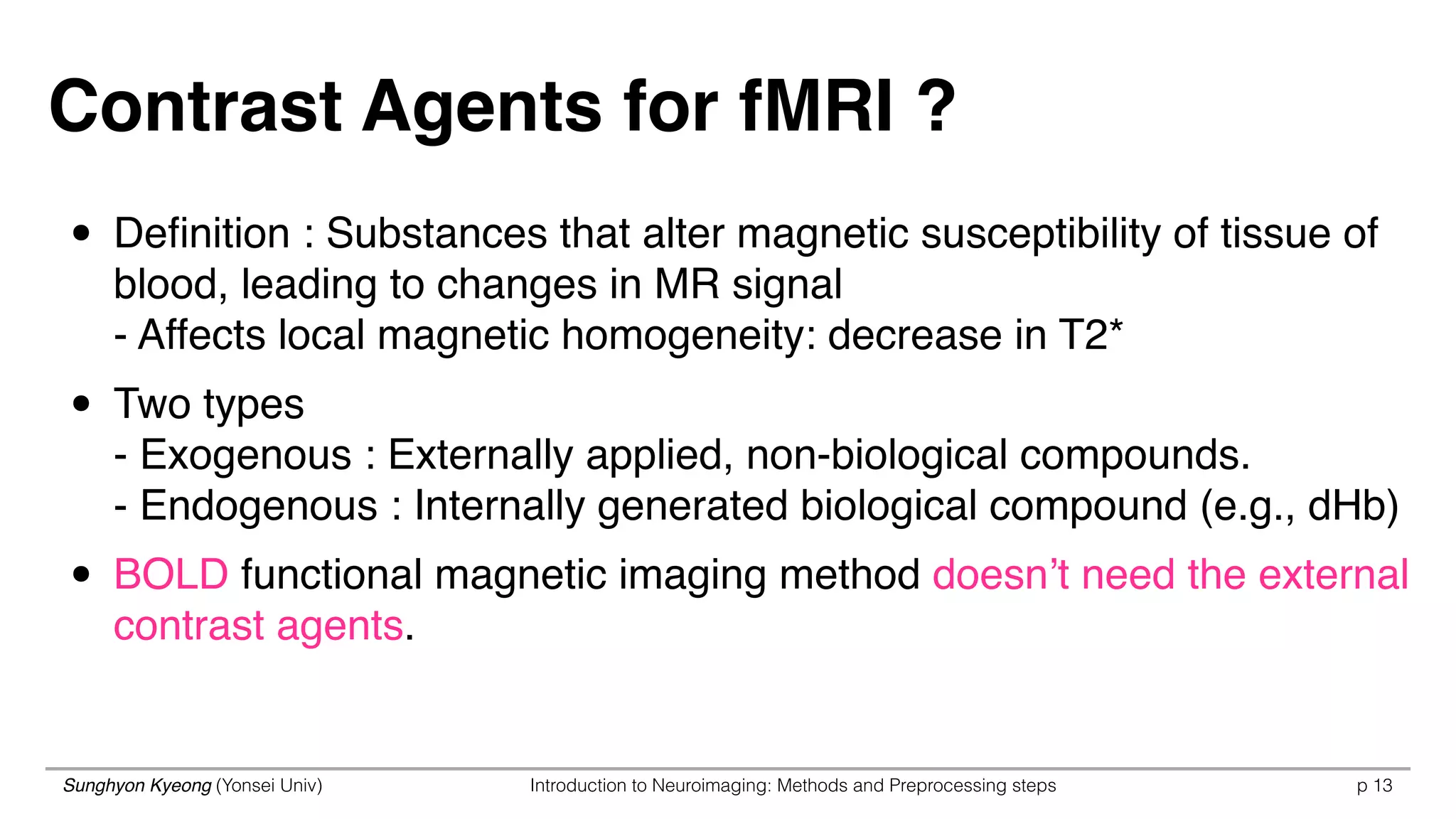
Contrast Agents for fMRI ?
• Definition : Substances that alter magnetic susceptibility of tissue of
blood, leading to changes in MR signal

- Affects local magnetic homogeneity: decrease in T2*
• Two types

- Exogenous : Externally applied, non-biological compounds.

- Endogenous : Internally generated biological compound (e.g., dHb)
• BOLD functional magnetic imaging method doesn’t need the external
contrast agents.

Sunghyon Kyeong (Yonsei Univ) Introduction to Neuroimaging: Methods and Preprocessing steps p 14
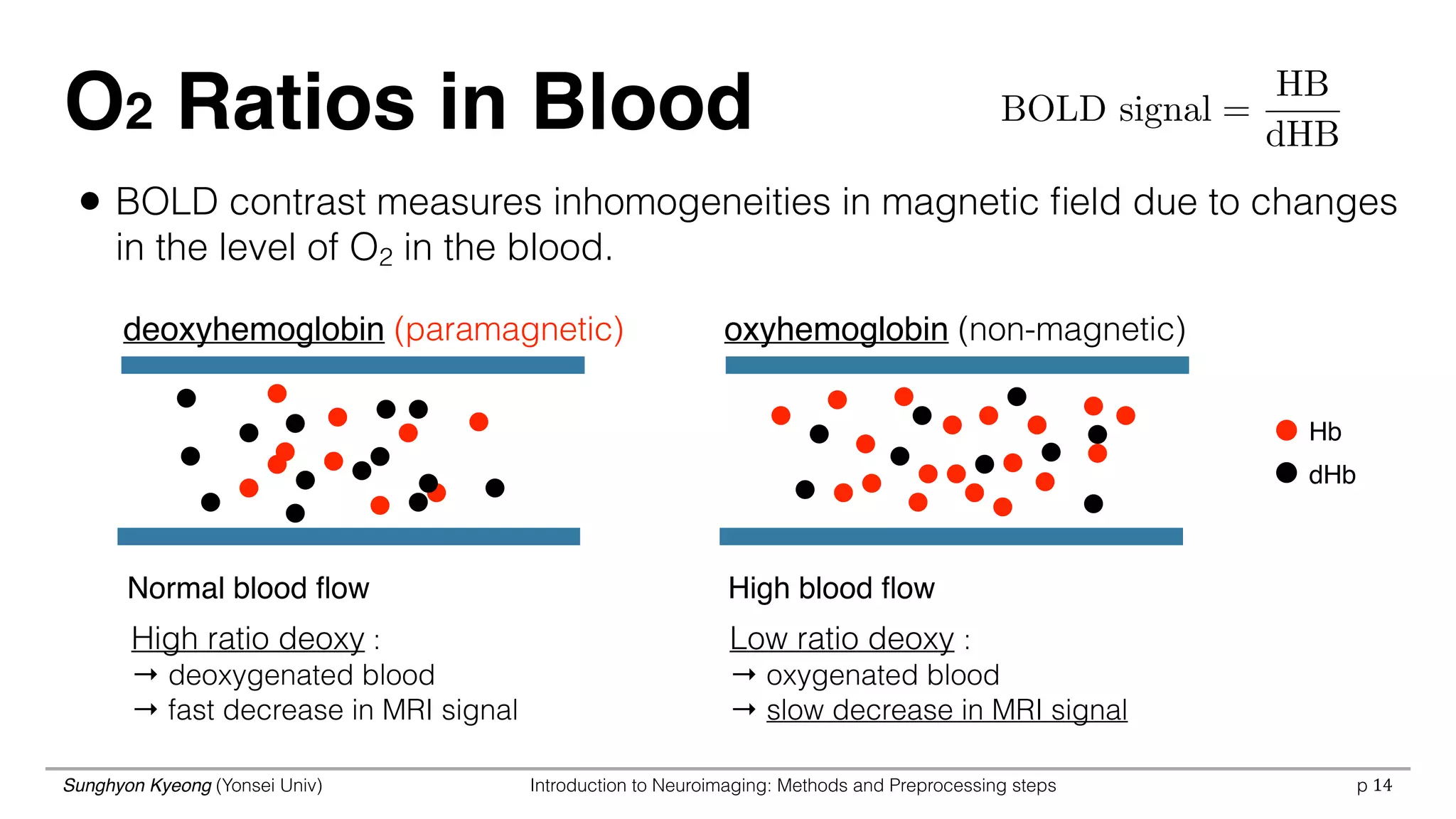
O2 Ratios in Blood
High ratio deoxy :

→ deoxygenated blood 

→ fast decrease in MRI signal
Low ratio deoxy :

→ oxygenated blood
→ slow decrease in MRI signal
Normal blood flow High blood flow
BOLD signal =
HB
dHB
dHb
Hb
deoxyhemoglobin (paramagnetic) oxyhemoglobin (non-magnetic)
• BOLD contrast measures inhomogeneities in magnetic field due to changes
in the level of O2 in the blood.
Sunghyon Kyeong (Yonsei Univ) Introduction to Neuroimaging: Methods and Preprocessing steps p 15
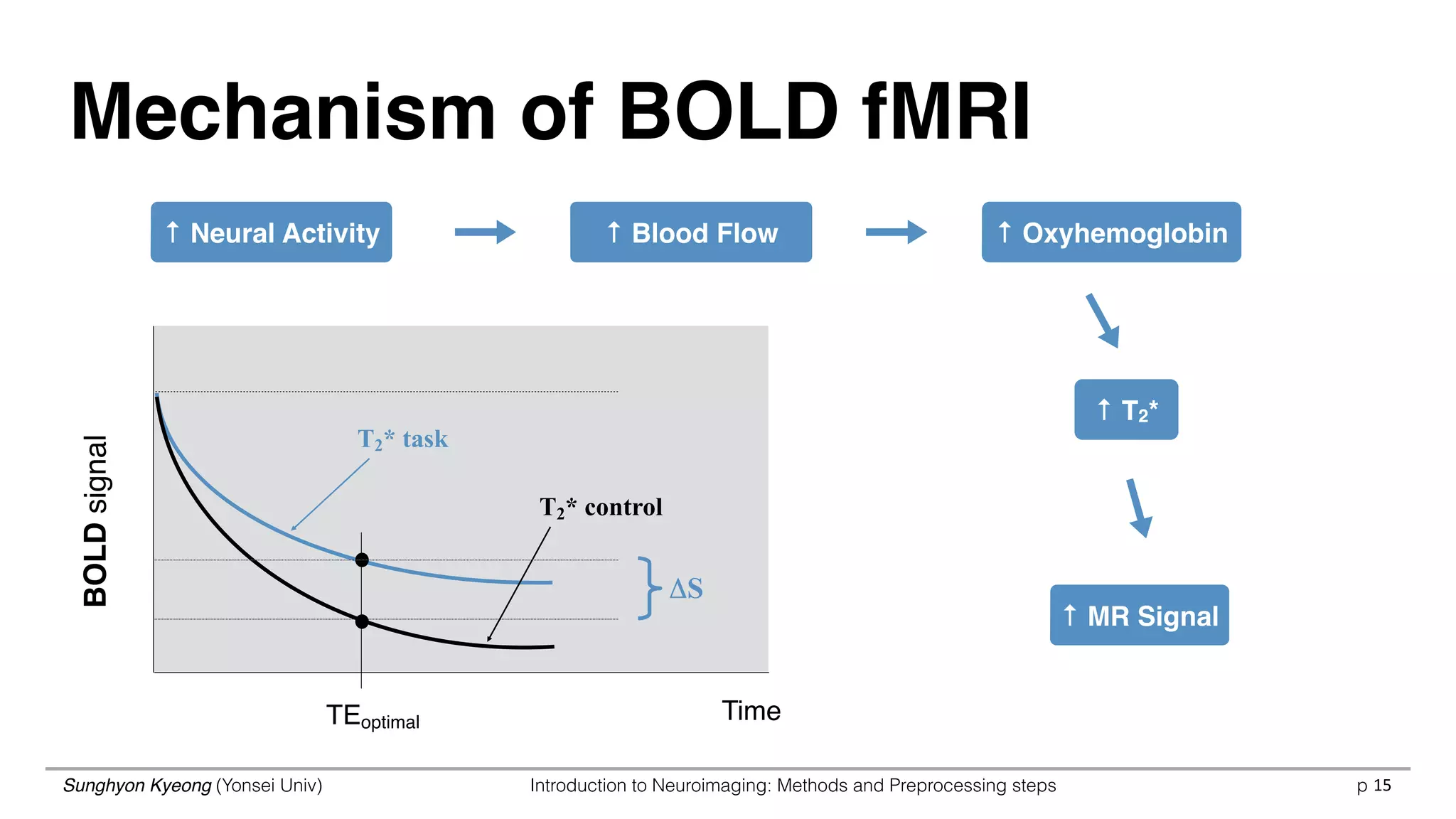
Mechanism of BOLD fMRI
Time
BOLDsignal
T2* task
T2* control
TEoptimal
ΔS
↑ Neural Activity ↑ Blood Flow ↑ Oxyhemoglobin
↑ T2*
↑ MR Signal
Sunghyon Kyeong (Yonsei Univ) Introduction to Neuroimaging: Methods and Preprocessing steps p
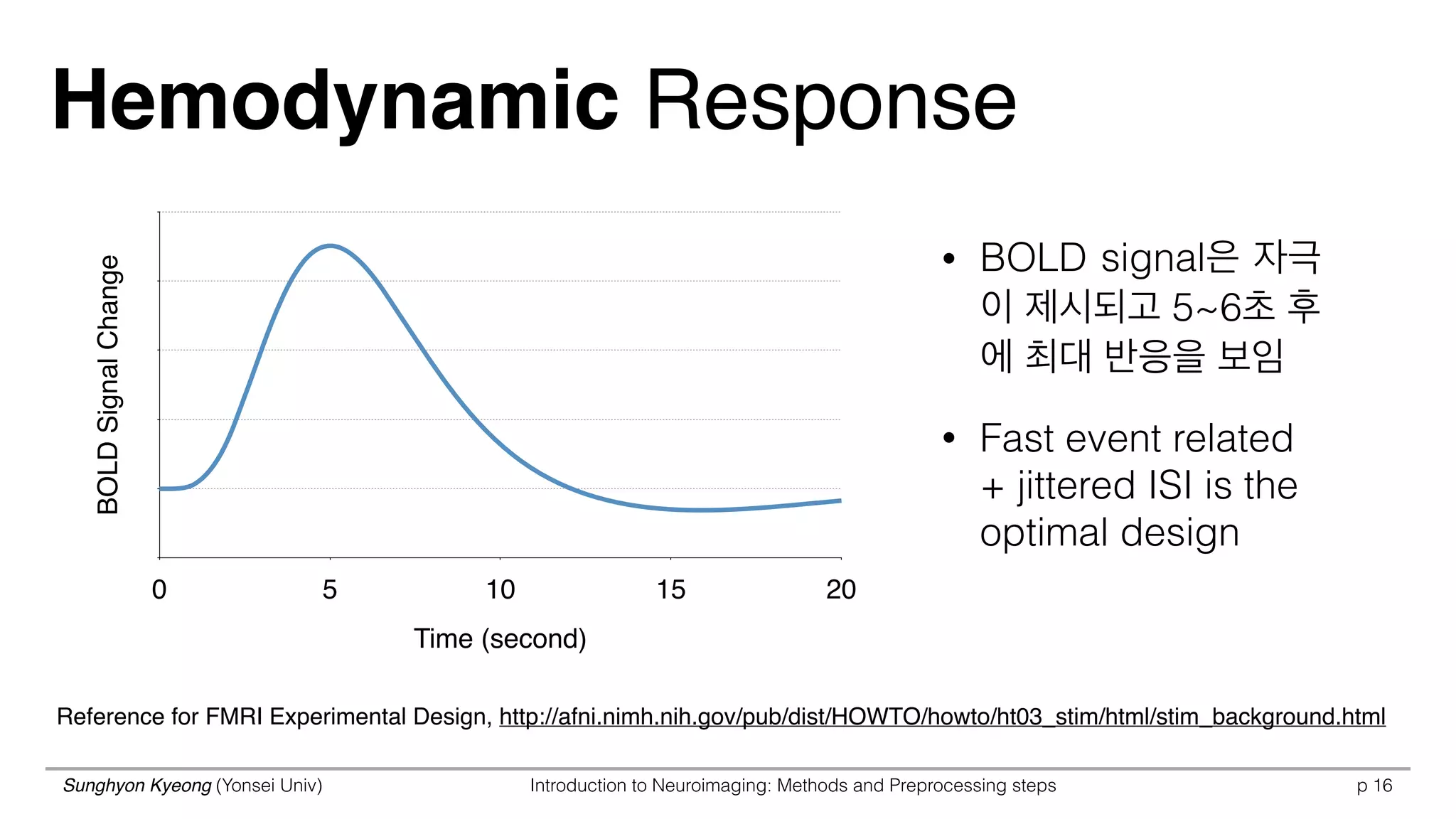
Hemodynamic Response
16
BOLDSignalChange
Time (second)
0 5 10 15 20
• BOLD signal은 자극
이 제시되고 5~6초 후
에 최대 반응을 보임
• Fast event related
+ jittered ISI is the
optimal design
Reference for FMRI Experimental Design, http://afni.nimh.nih.gov/pub/dist/HOWTO/howto/ht03_stim/html/stim_background.html
Sunghyon Kyeong (Yonsei Univ) Introduction to Neuroimaging: Methods and Preprocessing steps p 17
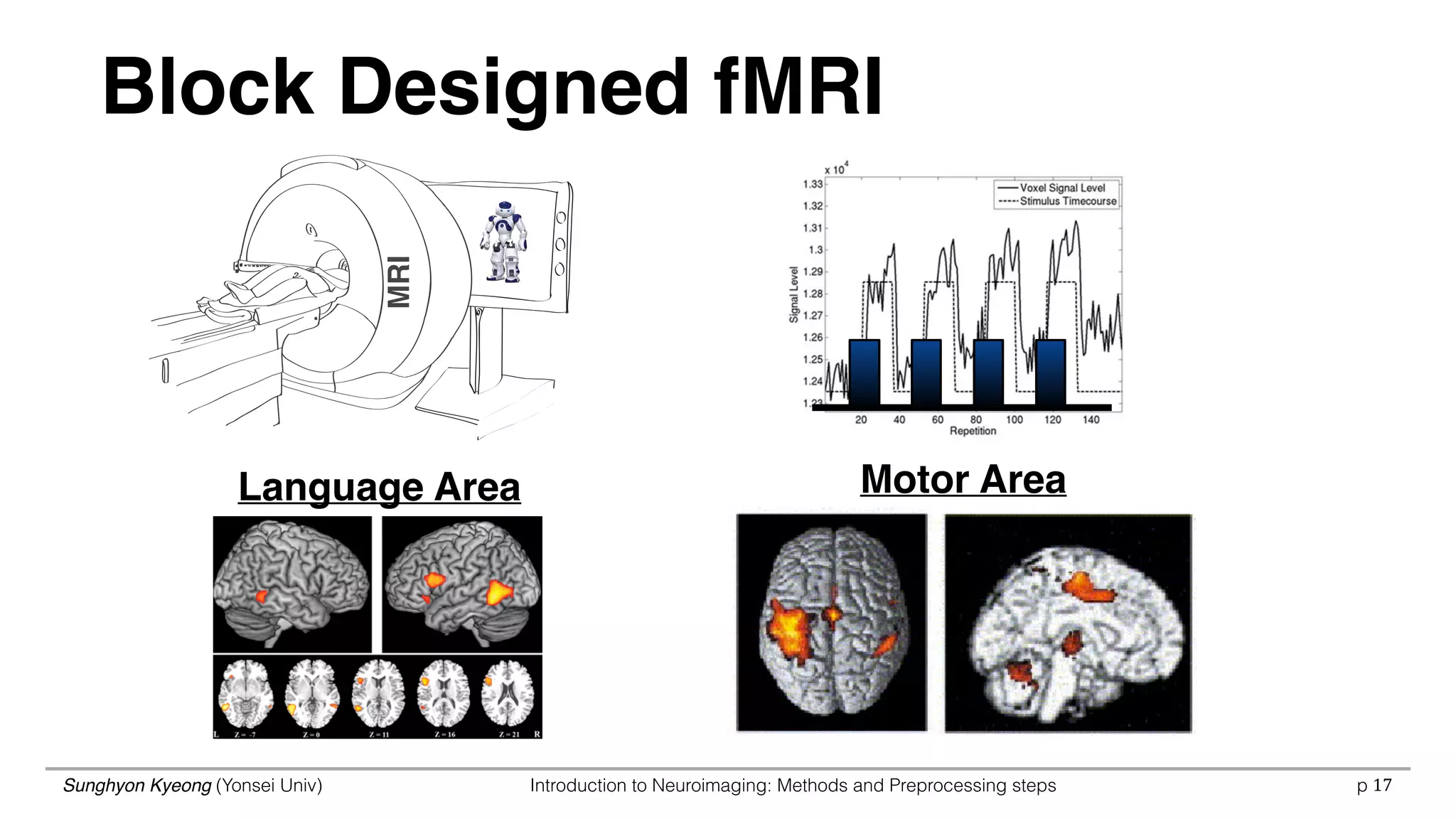
Block Designed fMRI
MRI
Language Area Motor Area
Sunghyon Kyeong (Yonsei Univ) Introduction to Neuroimaging: Methods and Preprocessing steps p
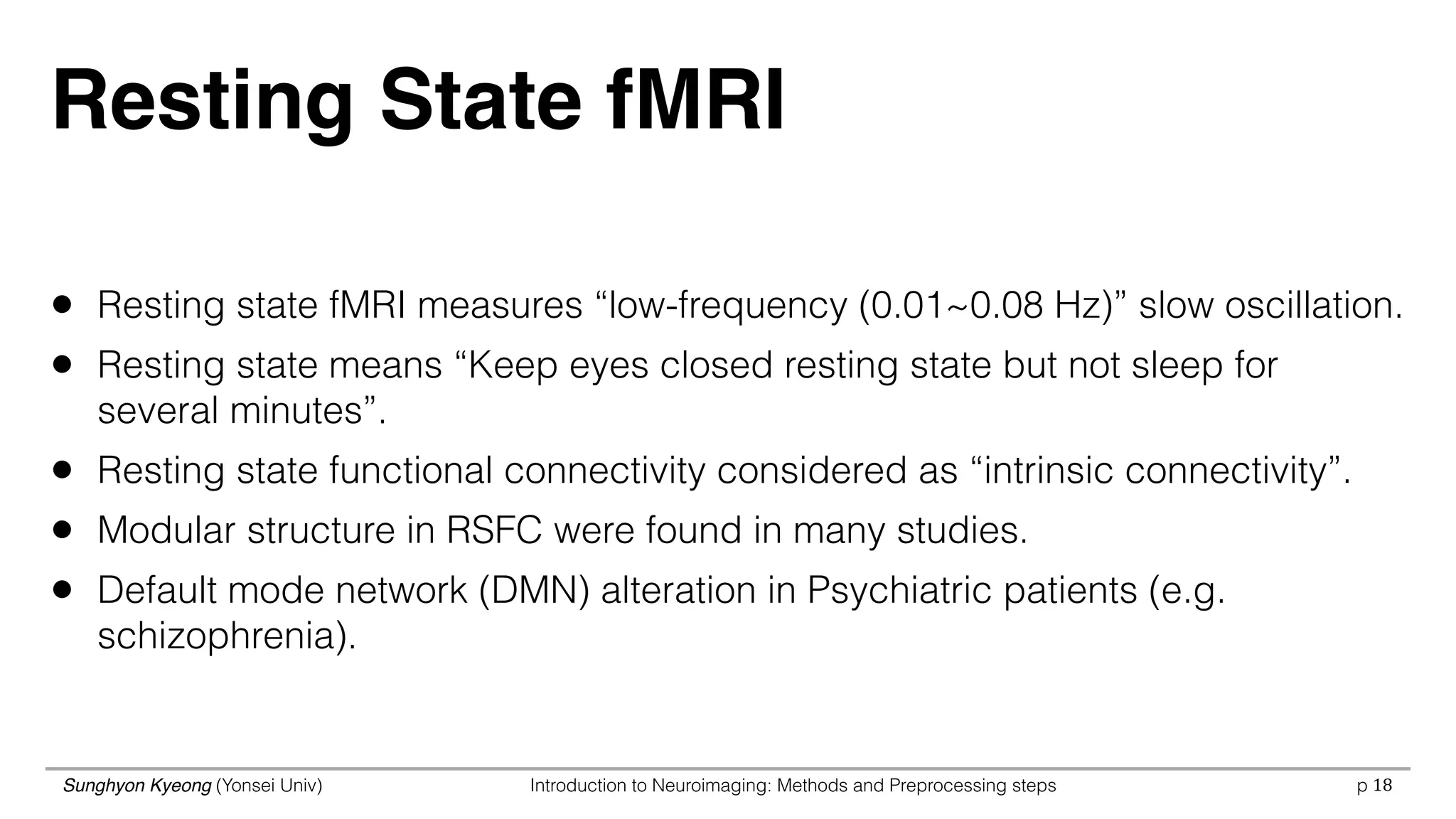
Resting State fMRI
• Resting state fMRI measures “low-frequency (0.01~0.08 Hz)” slow oscillation.
• Resting state means “Keep eyes closed resting state but not sleep for
several minutes”.
• Resting state functional connectivity considered as “intrinsic connectivity”.
• Modular structure in RSFC were found in many studies.
• Default mode network (DMN) alteration in Psychiatric patients (e.g.
schizophrenia).
18
steps in the spatial preprocessing
fMRI preprocessing
Sunghyon Kyeong (Yonsei Univ) Introduction to Neuroimaging: Methods and Preprocessing steps p 20
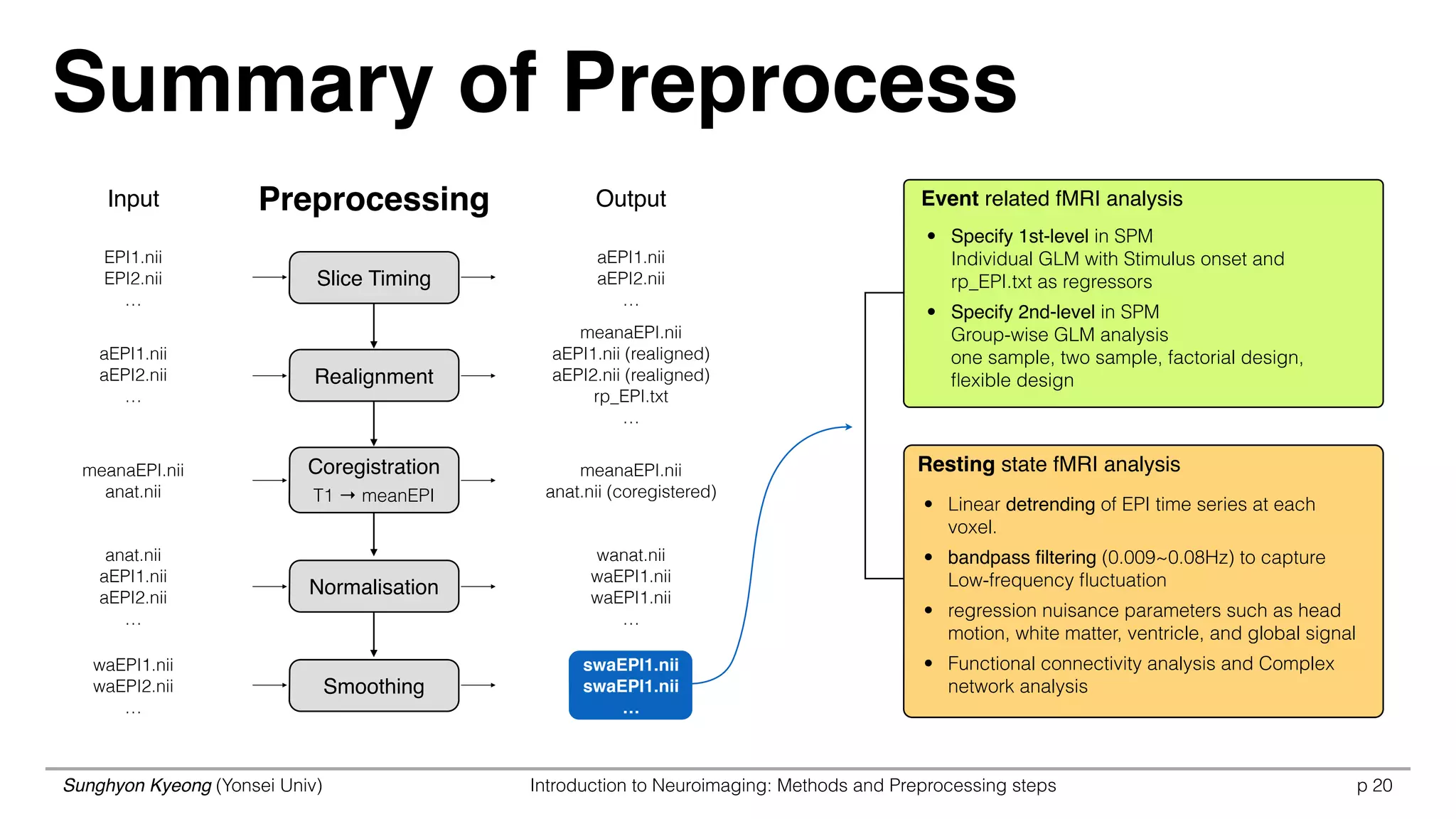
Summary of Preprocess
Input Output
EPI1.nii

EPI2.nii
…
aEPI1.nii

aEPI2.nii
…
aEPI1.nii

aEPI2.nii
…
meanaEPI.nii
aEPI1.nii (realigned)

aEPI2.nii (realigned)
rp_EPI.txt
…
meanaEPI.nii
anat.nii
meanaEPI.nii
anat.nii (coregistered)
anat.nii
aEPI1.nii

aEPI2.nii
…
wanat.nii
waEPI1.nii
waEPI1.nii
…
waEPI1.nii

waEPI2.nii
…
Slice Timing
Realignment
Coregistration

T1 → meanEPI
Normalisation
Smoothing
Event related fMRI analysis
Resting state fMRI analysis
Preprocessing
• Specify 1st-level in SPM

Individual GLM with Stimulus onset and
rp_EPI.txt as regressors
• Specify 2nd-level in SPM

Group-wise GLM analysis

one sample, two sample, factorial design,
flexible design
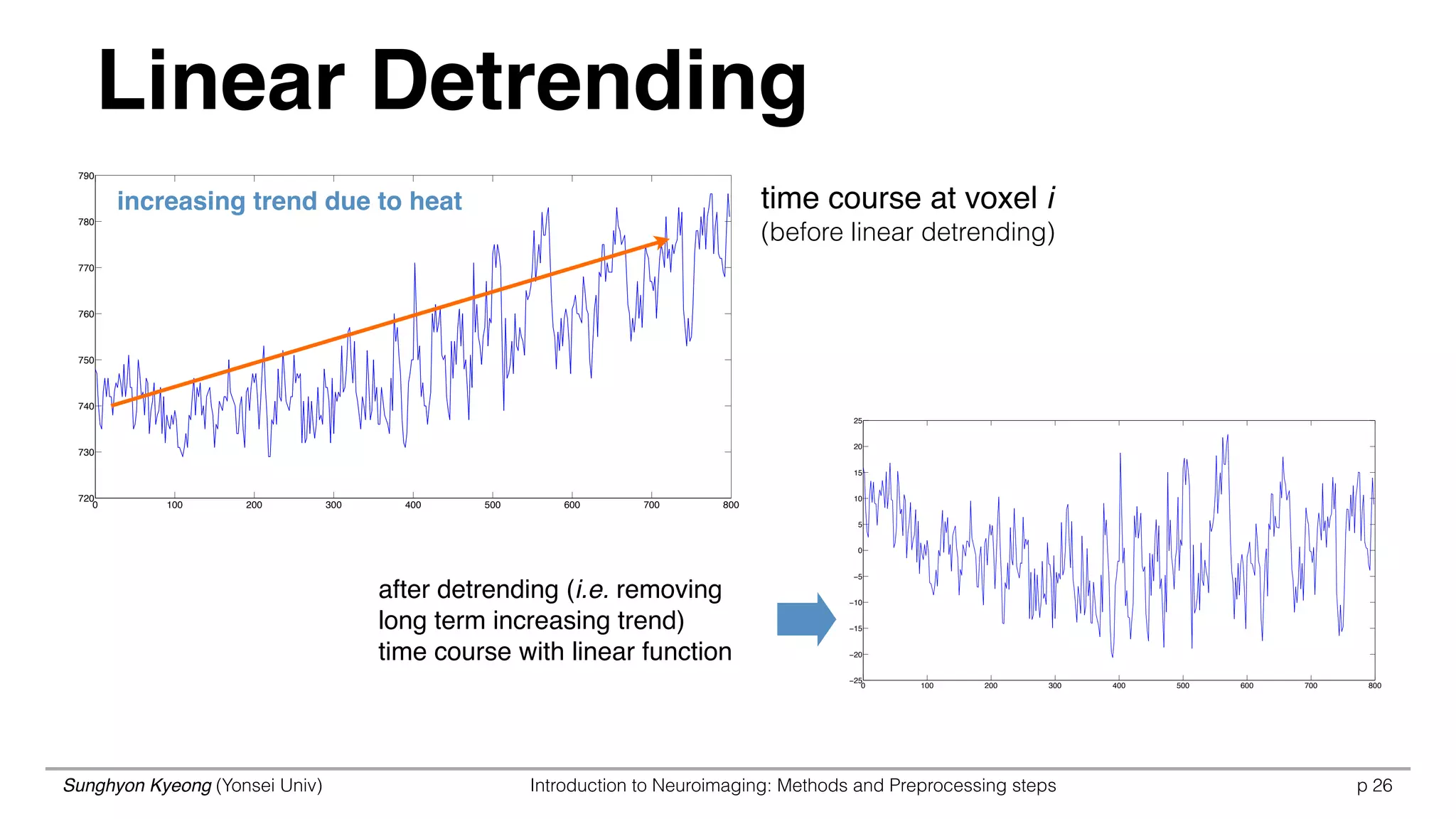
• Linear detrending of EPI time series at each
voxel.
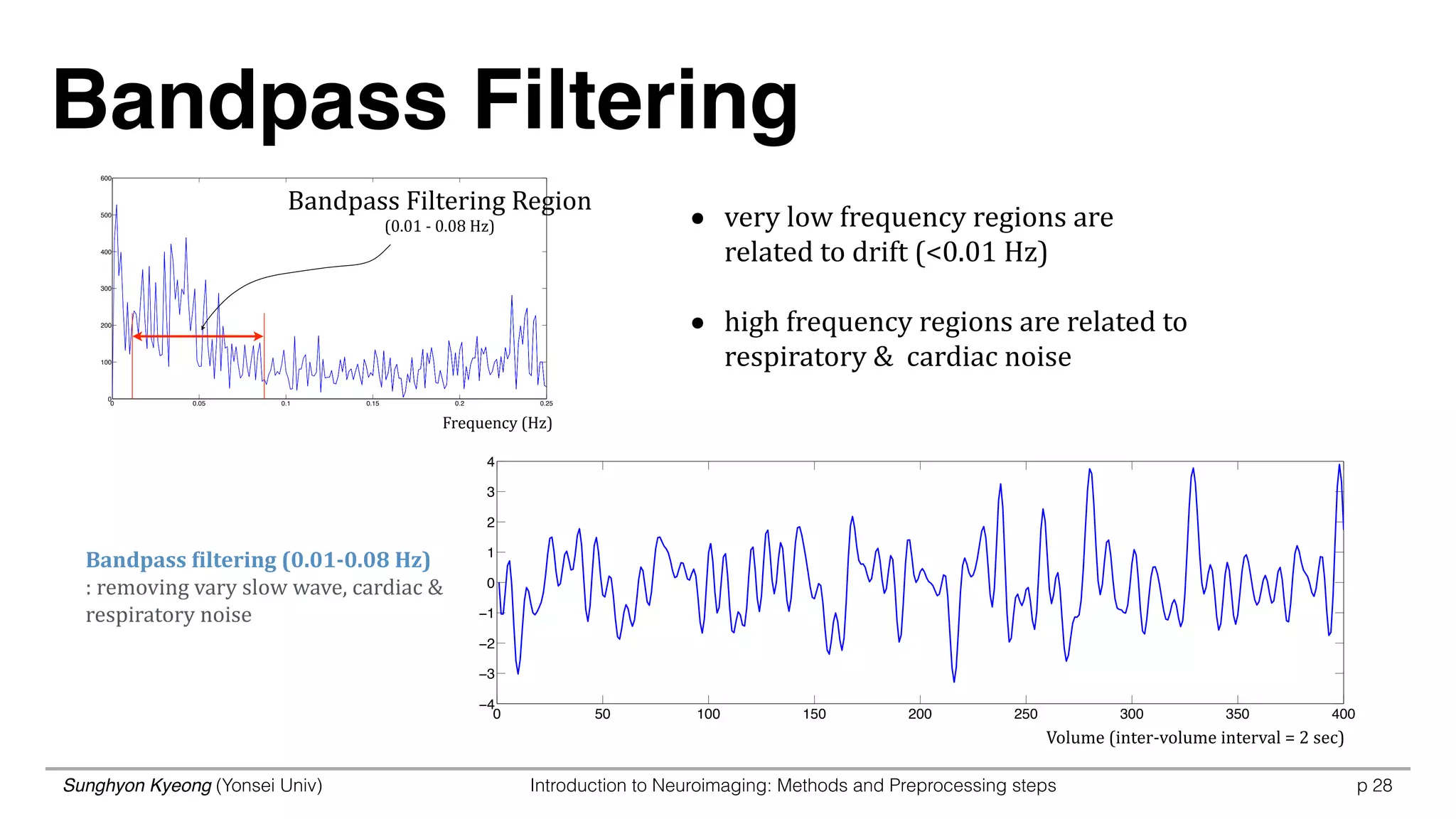
• bandpass filtering (0.009~0.08Hz) to capture
Low-frequency fluctuation
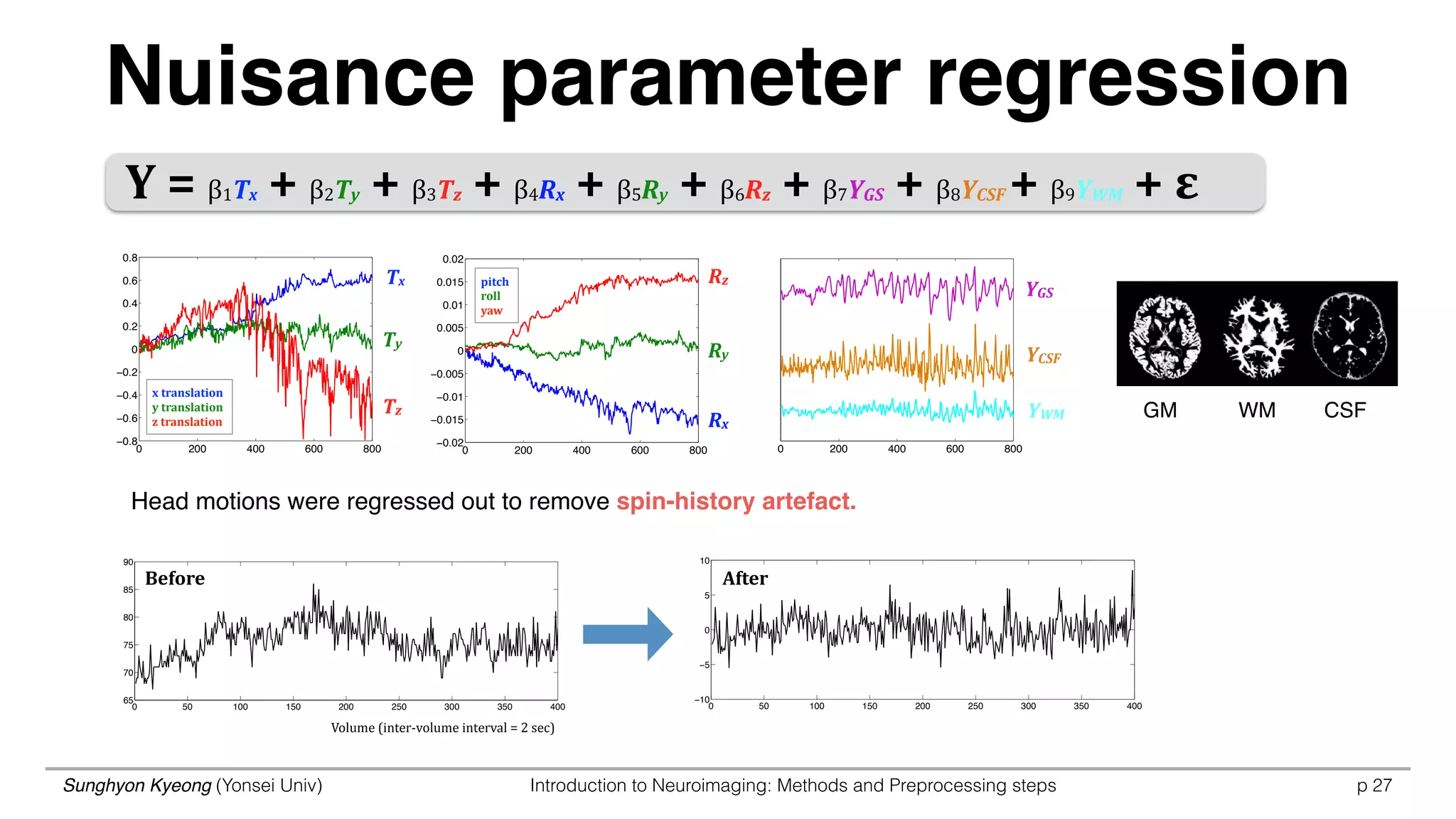
• regression nuisance parameters such as head
motion, white matter, ventricle, and global signal
• Functional connectivity analysis and Complex
network analysis
swaEPI1.nii
swaEPI1.nii
…
Sunghyon Kyeong (Yonsei Univ) Introduction to Neuroimaging: Methods and Preprocessing steps p
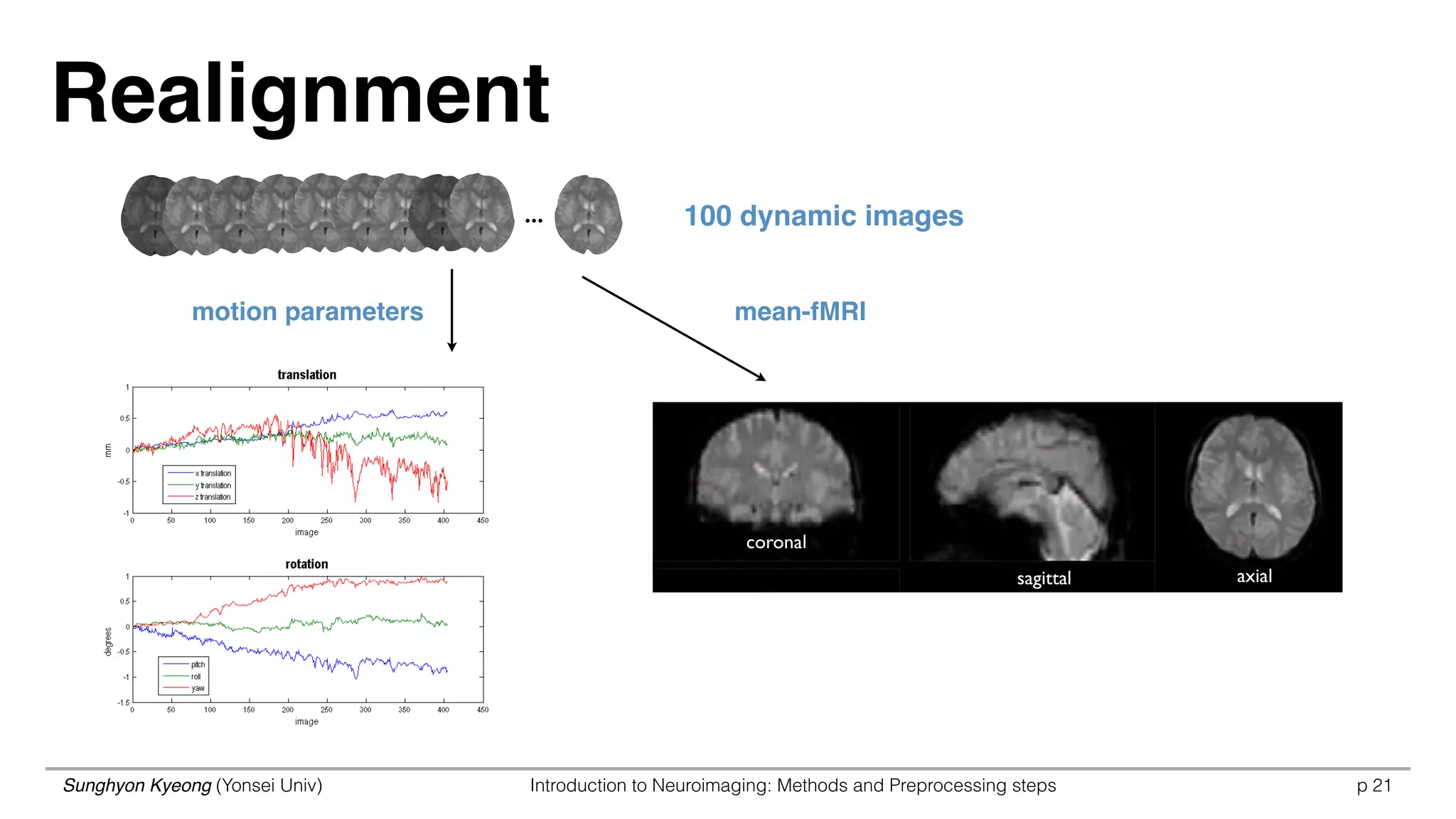
Realignment
21
...
motion parameters mean-fMRI
sagittal
coronal
axial
100 dynamic images
Sunghyon Kyeong (Yonsei Univ) Introduction to Neuroimaging: Methods and Preprocessing steps p
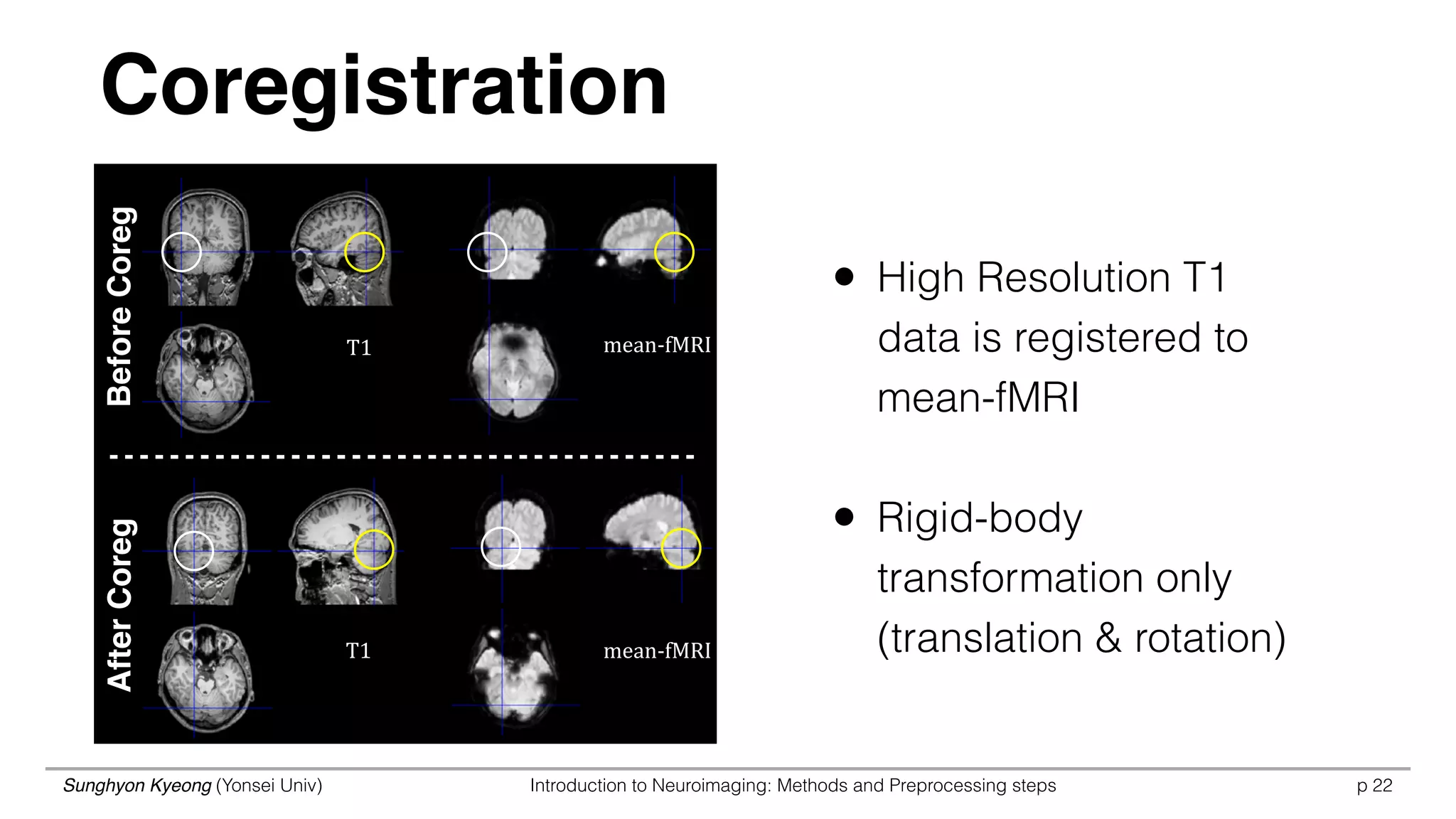
Coregistration
22
BeforeCoregAfterCoreg
• High Resolution T1
data is registered to
mean-fMRI
• Rigid-body
transformation only

(translation & rotation)
T1 mean-­‐fMRI
T1 mean-­‐fMRI
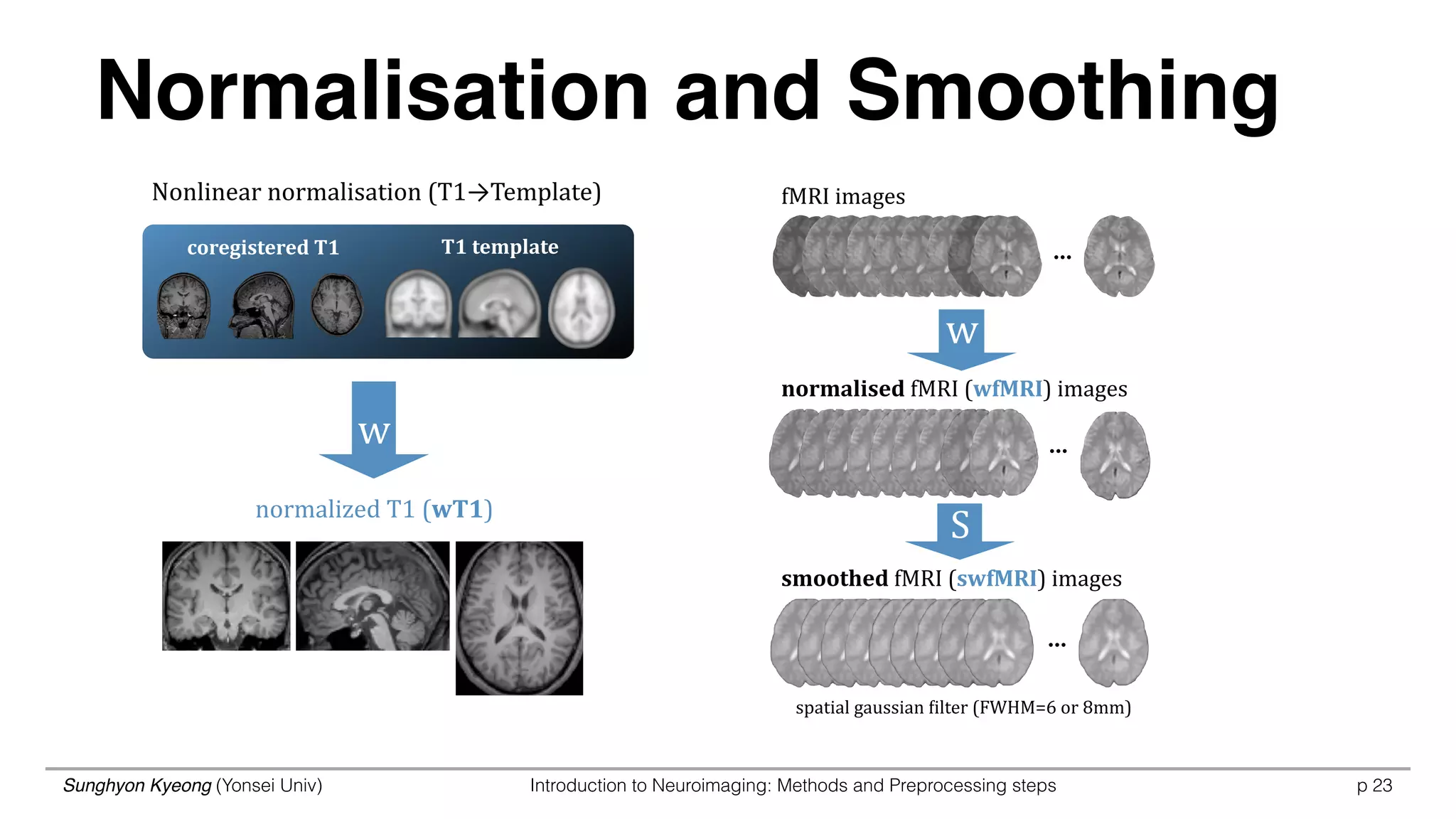
Sunghyon Kyeong (Yonsei Univ) Introduction to Neuroimaging: Methods and Preprocessing steps p 23
coregistered	
  T1 T1	
  template
normalized	
  T1	
  (wT1)
fMRI	
  images
...
...
normalised	
  fMRI	
  (wfMRI)	
  images
...
smoothed	
  fMRI	
  (swfMRI)	
  images
Nonlinear	
  normalisation	
  (T1→Template)
w
w
spatial	
  gaussian	
  ?ilter	
  (FWHM=6	
  or	
  8mm)
S
Normalisation and Smoothing
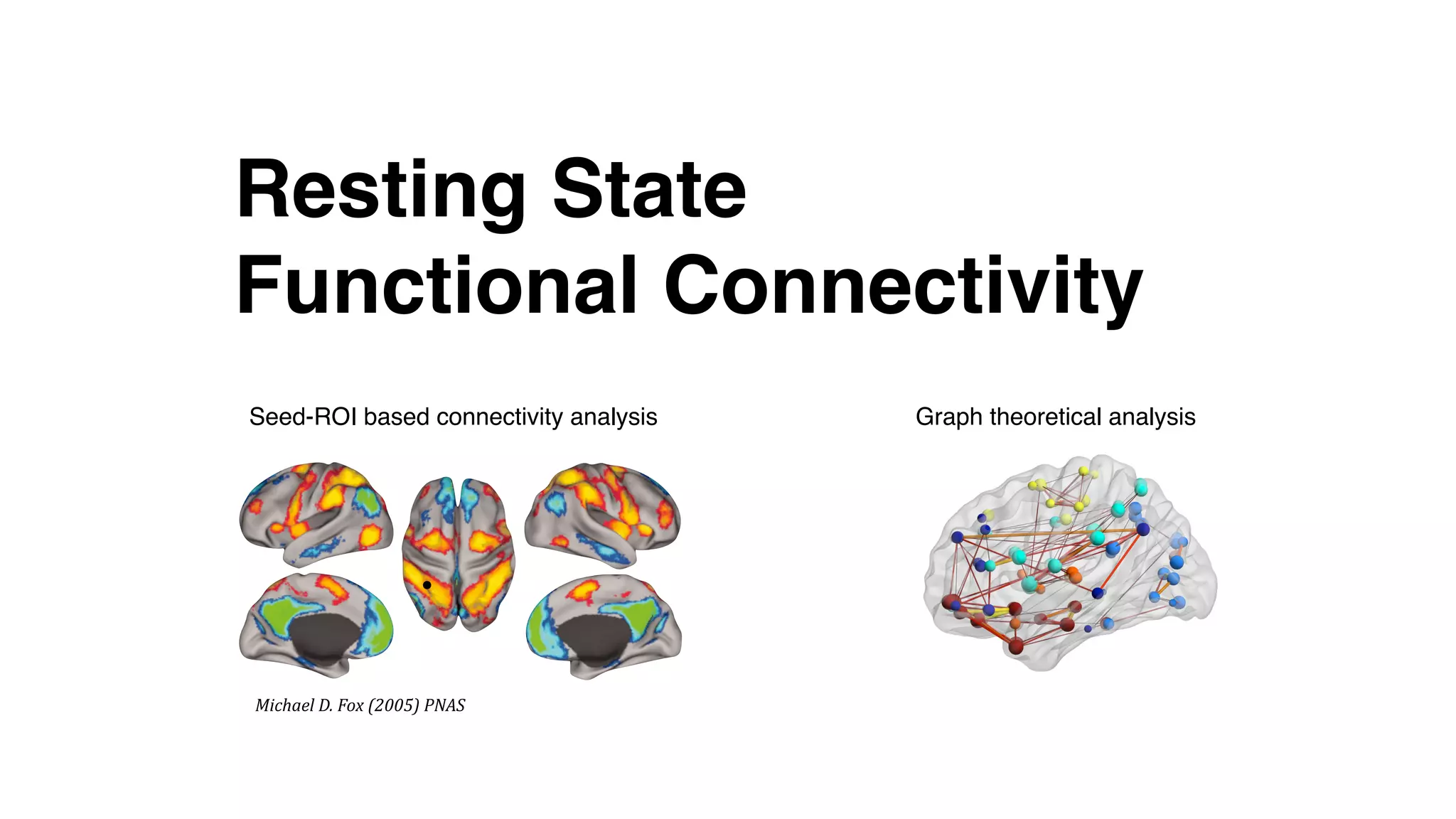
Resting State 

Functional Connectivity
Michael	
  D.	
  Fox	
  (2005)	
  PNAS	
  	
  
Seed-ROI based connectivity analysis Graph theoretical analysis
fMRI preprocessing
steps in the temporal preprocessing
Sunghyon Kyeong (Yonsei Univ) Introduction to Neuroimaging: Methods and Preprocessing steps p 26
0 100 200 300 400 500 600 700 800
720
730
740
750
760
770
780
790
time course at voxel i

(before linear detrending)
increasing trend due to heat
0 100 200 300 400 500 600 700 800
−25
−20
−15
−10
−5
0
5
10
15
20
25
after detrending (i.e. removing
long term increasing trend)
time course with linear function
Linear Detrending
Sunghyon Kyeong (Yonsei Univ) Introduction to Neuroimaging: Methods and Preprocessing steps p
Nuisance parameter regression
27
0 200 400 600 800
YGS
YCSF
YWM	
  
0 200 400 600 800
−0.8
−0.6
−0.4
−0.2
0
0.2
0.4
0.6
0.8
x	
  translation	
  
y	
  translation	
  
z	
  translation
0 200 400 600 800
−0.02
−0.015
−0.01
−0.005
0
0.005
0.01
0.015
0.02
pitch	
  
roll	
  
yaw
GM WM CSF
Tx
Ty
Tz
Rx
Ry
Rz
0 50 100 150 200 250 300 350 400
65
70
75
80
85
90
0 50 100 150 200 250 300 350 400
−10
−5
0
5
10
Volume	
  (inter-­‐volume	
  interval	
  =	
  2	
  sec)	
  
Y	
  =	
  β1Tx	
  +	
  β2Ty	
  +	
  β3Tz	
  +	
  β4Rx	
  +	
  β5Ry	
  +	
  β6Rz	
  +	
  β7YGS	
  +	
  β8YCSF	
  +	
  β9YWM	
  +	
  ε
Head motions were regressed out to remove spin-history artefact.
Before After
Sunghyon Kyeong (Yonsei Univ) Introduction to Neuroimaging: Methods and Preprocessing steps p
0 0.05 0.1 0.15 0.2 0.25
0
100
200
300
400
500
600
Bandpass	
  Filtering	
  Region

(0.01	
  -­‐	
  0.08	
  Hz)
Bandpass Filtering
28
0 50 100 150 200 250 300 350 400
−4
−3
−2
−1
0
1
2
3
4
Bandpass	
  Ailtering	
  (0.01-­‐0.08	
  Hz)	
  

:	
  removing	
  vary	
  slow	
  wave,	
  cardiac	
  &	
  
respiratory	
  noise
• very	
  low	
  frequency	
  regions	
  are	
  
related	
  to	
  drift	
  (<0.01	
  Hz)

• high	
  frequency	
  regions	
  are	
  related	
  to	
  
respiratory	
  &	
  	
  cardiac	
  noise
Frequency	
  (Hz)	
  
Volume	
  (inter-­‐volume	
  interval	
  =	
  2	
  sec)	
  
Sunghyon Kyeong (Yonsei Univ) Introduction to Neuroimaging: Methods and Preprocessing steps p
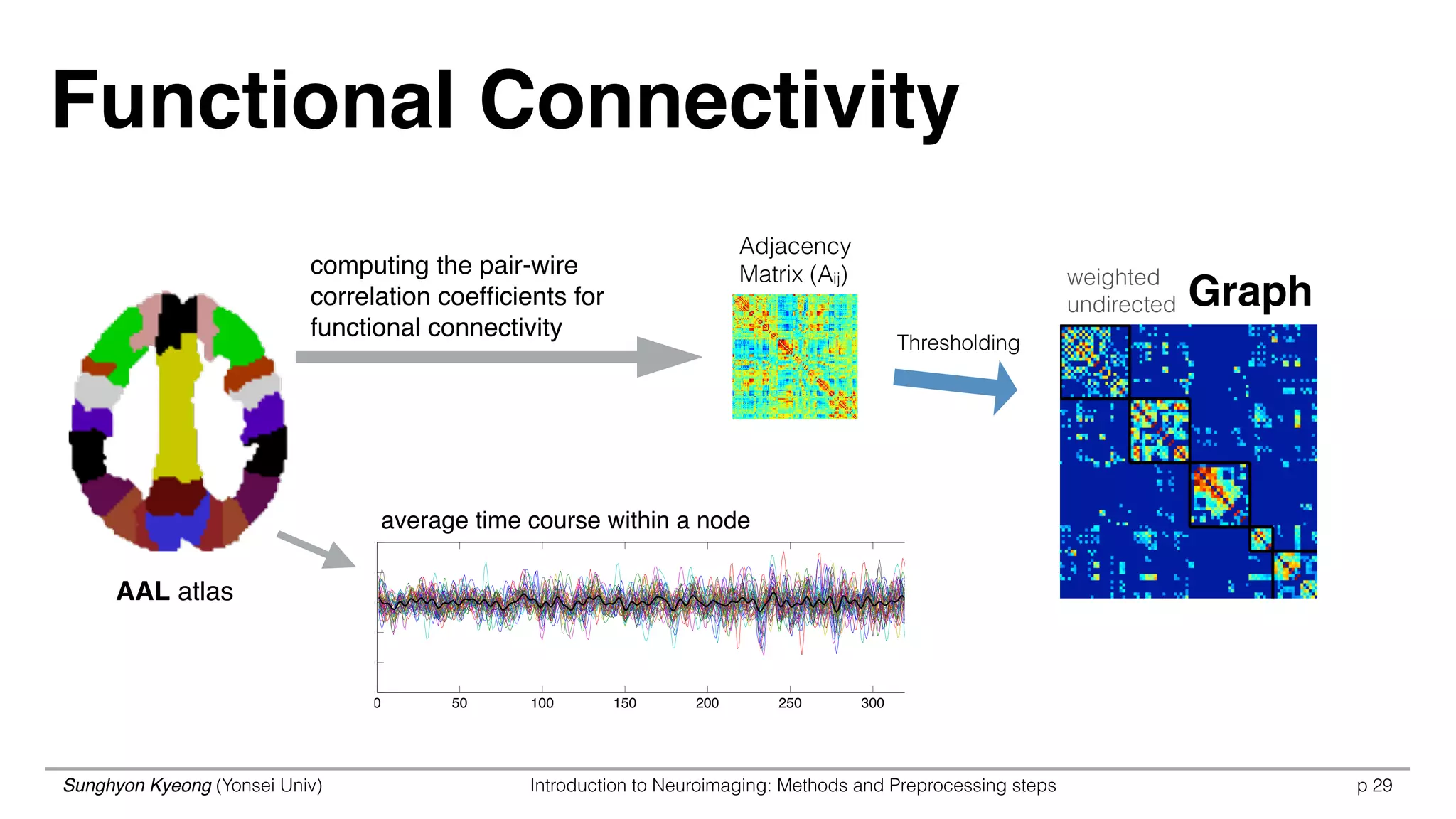
Functional Connectivity
29
0 50 100 150 200 250 300 350 400
−30
−20
−10
0
10
20
average time course within a node
computing the pair-wire
correlation coefficients for
functional connectivity
AAL atlas
weighted 

undirected
Adjacency 

Matrix (Aij)
Thresholding
Graph
Graph Theory and Matrix
Sunghyon Kyeong (Yonsei Univ) Introduction to Neuroimaging: Methods and Preprocessing steps p 31
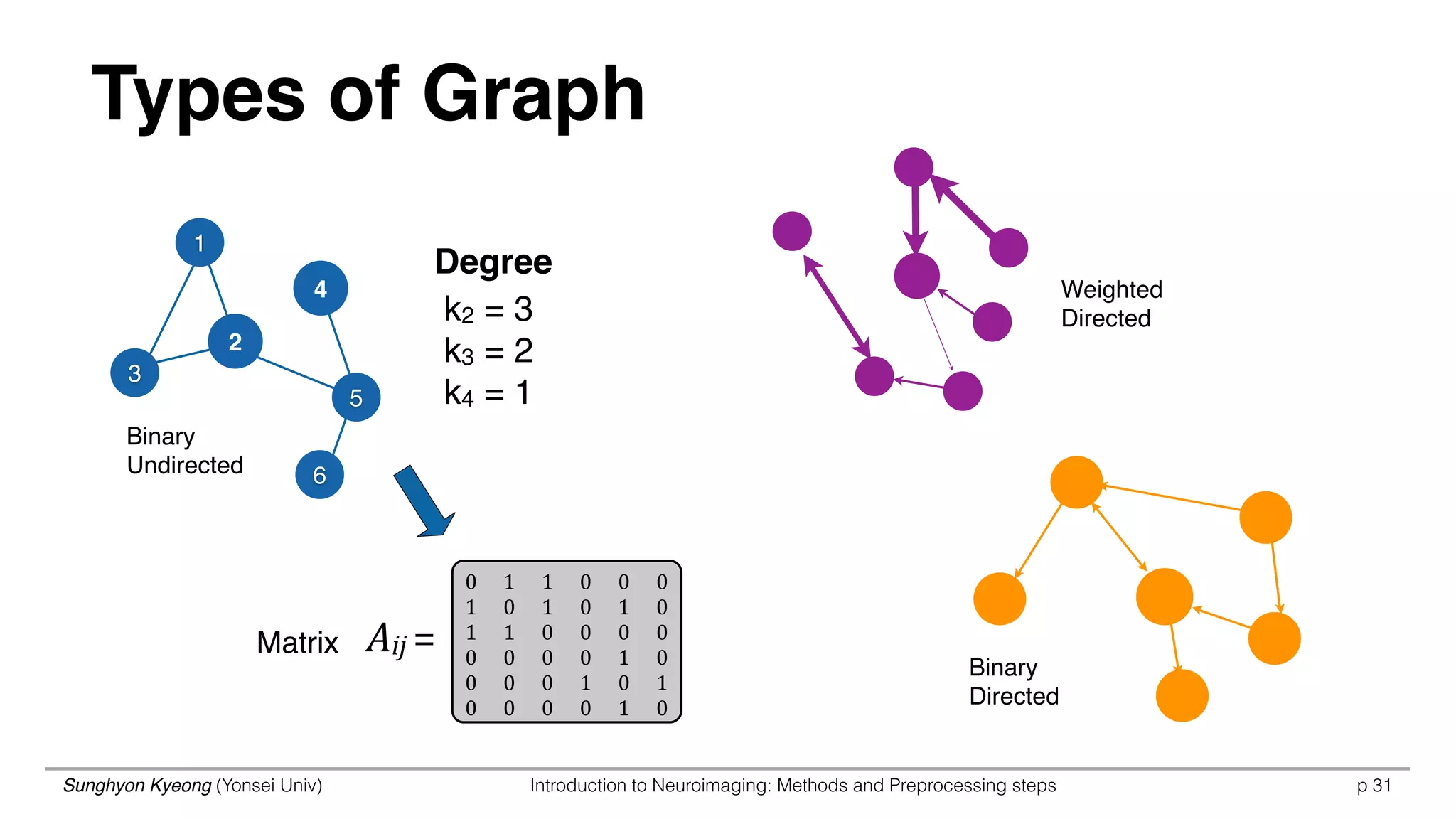
Types of Graph
Binary
Undirected
Binary
Directed
Weighted
Directed
1
3
6
5
2
4
0 1 1 0 0 0
1 0 1 0 1 0
1 1 0 0 0 0
0 0 0 0 1 0
0 0 0 1 0 1
0 0 0 0 1 0
Aij	
  =Matrix
k2 = 3
k3 = 2
k4 = 1
Degree
Sunghyon Kyeong (Yonsei Univ) Introduction to Neuroimaging: Methods and Preprocessing steps p 32
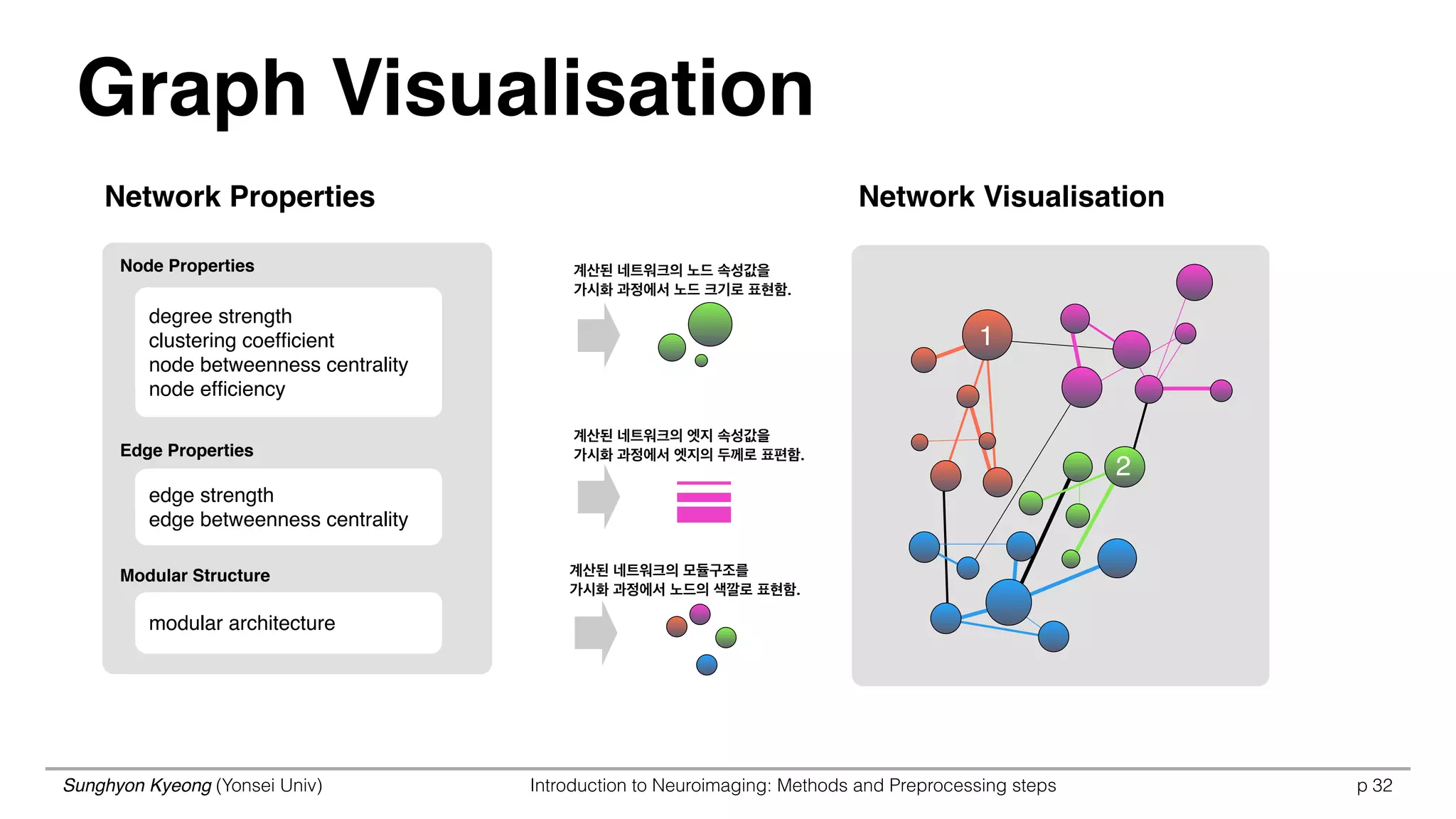
Graph Visualisation
degree strength
clustering coefficient
node betweenness centrality
node efficiency
edge strength
edge betweenness centrality
modular architecture
Network Properties
Node Properties
Edge Properties
Modular Structure
Network Visualisation
계산된 네트워크의 노드 속성값을

가시화 과정에서 노드 크기로 표현함.
계산된 네트워크의 엣지 속성값을

가시화 과정에서 엣지의 두께로 표편함.
계산된 네트워크의 모듈구조를

가시화 과정에서 노드의 색깔로 표현함.
1
2
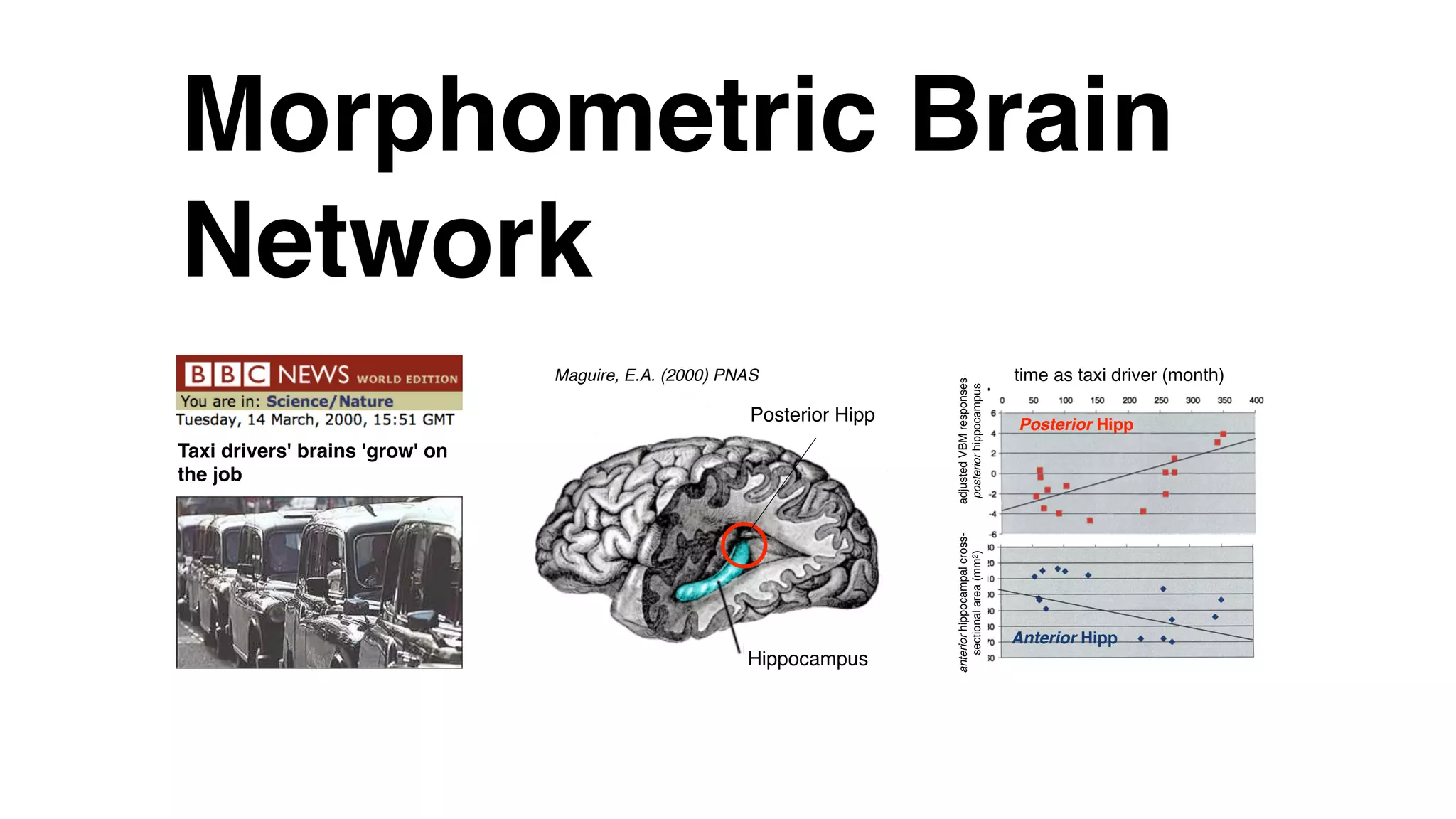
Morphometric Brain
Network
Hippocampus
Posterior Hipp
time as taxi driver (month)
adjustedVBMresponses

posteriorhippocampus
anteriorhippocampalcross-
sectionalarea(mm2)
Posterior Hipp
Anterior Hipp
Taxi drivers' brains 'grow' on
the job
Maguire, E.A. (2000) PNAS
Sunghyon Kyeong (Yonsei Univ) Introduction to Neuroimaging: Methods and Preprocessing steps p 34
1. Tissue segmentation
2. Create Template & Normalisation
3. Modulation
4. Smoothing
5. Network Construction
The data are pre-
processed to sensitise
the statistical tests to
*regional* tissue volumes
Analysis Steps
Voxel-based Morphometry (VBM)
Sunghyon Kyeong (Yonsei Univ) Introduction to Neuroimaging: Methods and Preprocessing steps p 35
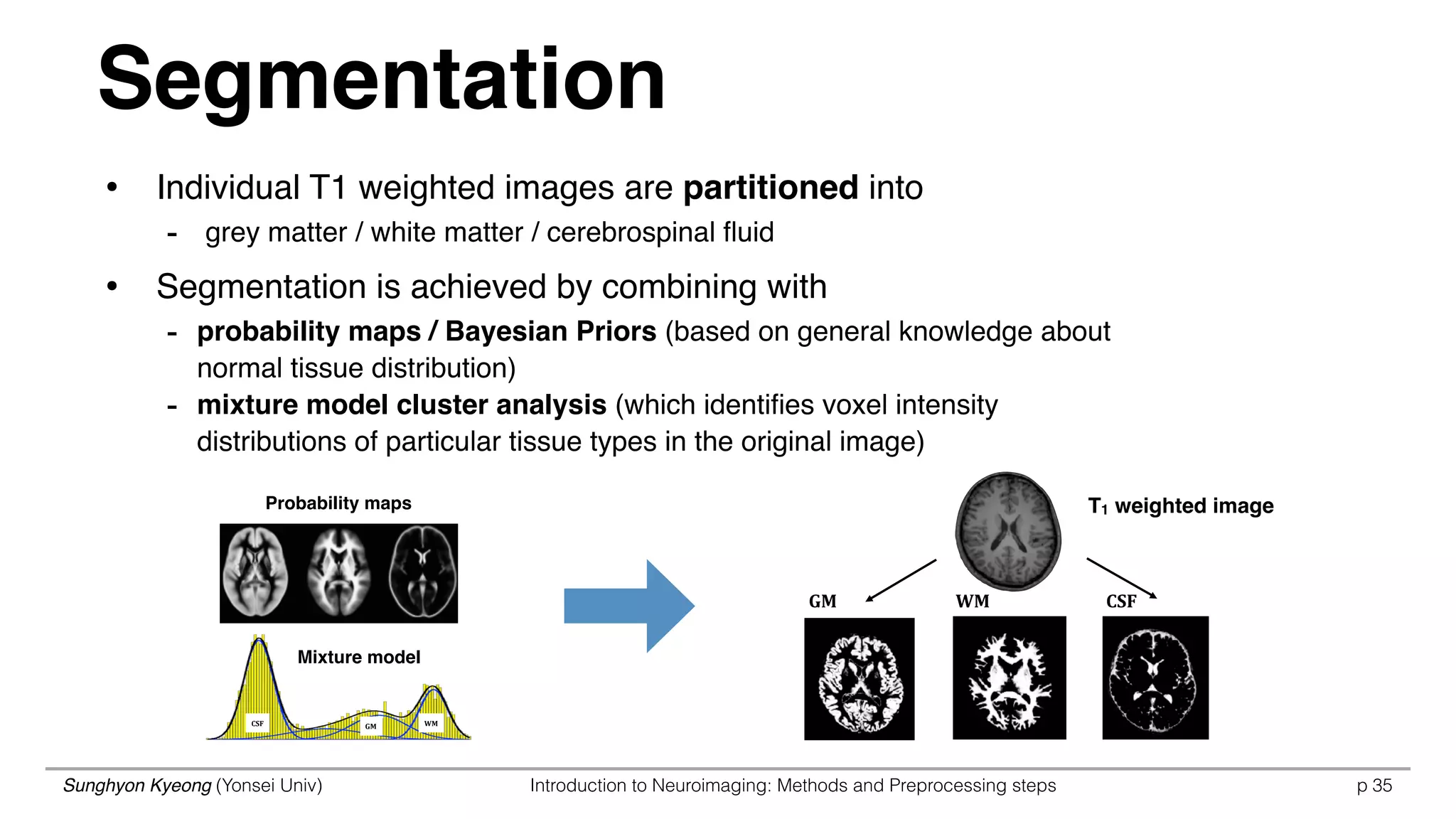
Segmentation
Probability maps
Mixture model
CSF GM WM
• Individual T1 weighted images are partitioned into
- grey matter / white matter / cerebrospinal fluid
• Segmentation is achieved by combining with
- probability maps / Bayesian Priors (based on general knowledge about
normal tissue distribution)
- mixture model cluster analysis (which identifies voxel intensity
distributions of particular tissue types in the original image)
GM WM CSF
T1 weighted image
Sunghyon Kyeong (Yonsei Univ) Introduction to Neuroimaging: Methods and Preprocessing steps p 36
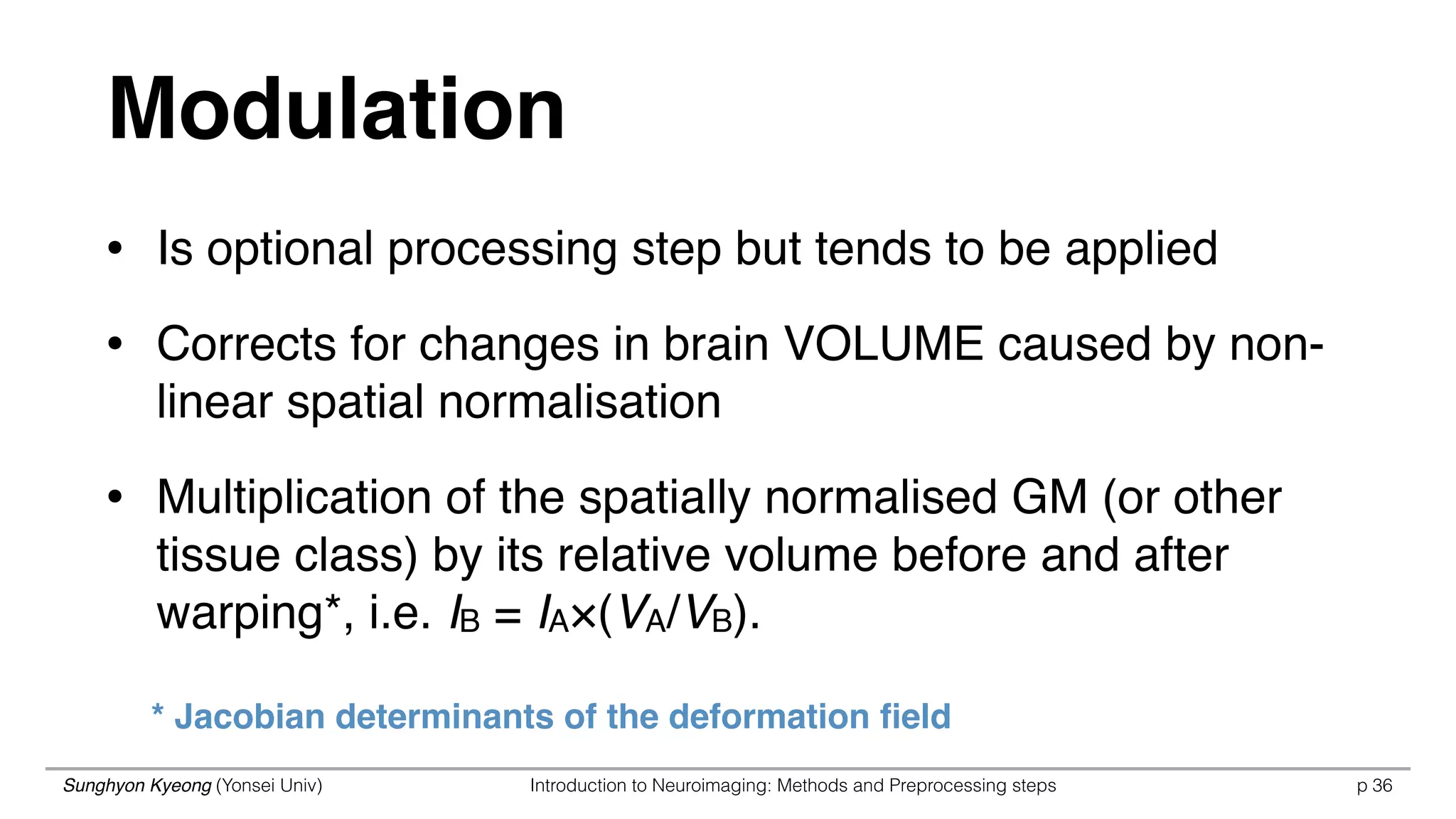
Modulation
* Jacobian determinants of the deformation field
• Is optional processing step but tends to be applied
• Corrects for changes in brain VOLUME caused by non-
linear spatial normalisation
• Multiplication of the spatially normalised GM (or other
tissue class) by its relative volume before and after
warping*, i.e. IB = IA×(VA/VB).
Sunghyon Kyeong (Yonsei Univ) Introduction to Neuroimaging: Methods and Preprocessing steps p 37
Example
IB	
  =	
  ?
IA	
  =	
  1	
  
VA	
  =	
  1 VB	
  =	
  2
IA	
  =	
  1	
  
VA	
  =	
  4
IB	
  =	
  ?VB	
  =	
  2
Template
Signal intensity ensures that total amount of GM in a subject’s temporal lobe is the
same before and after spatial normalisation and can be distinguished between subjects
Template
IB = 1 × [1 / 2] = 0.5
IB = 1 × [4 / 2] = 2
Modulation
ModulationNormalisation
Normalisation
IB = IA × [VA / VB]
Larger Brain
Smaller Brain
Sunghyon Kyeong (Yonsei Univ) Introduction to Neuroimaging: Methods and Preprocessing steps p 38
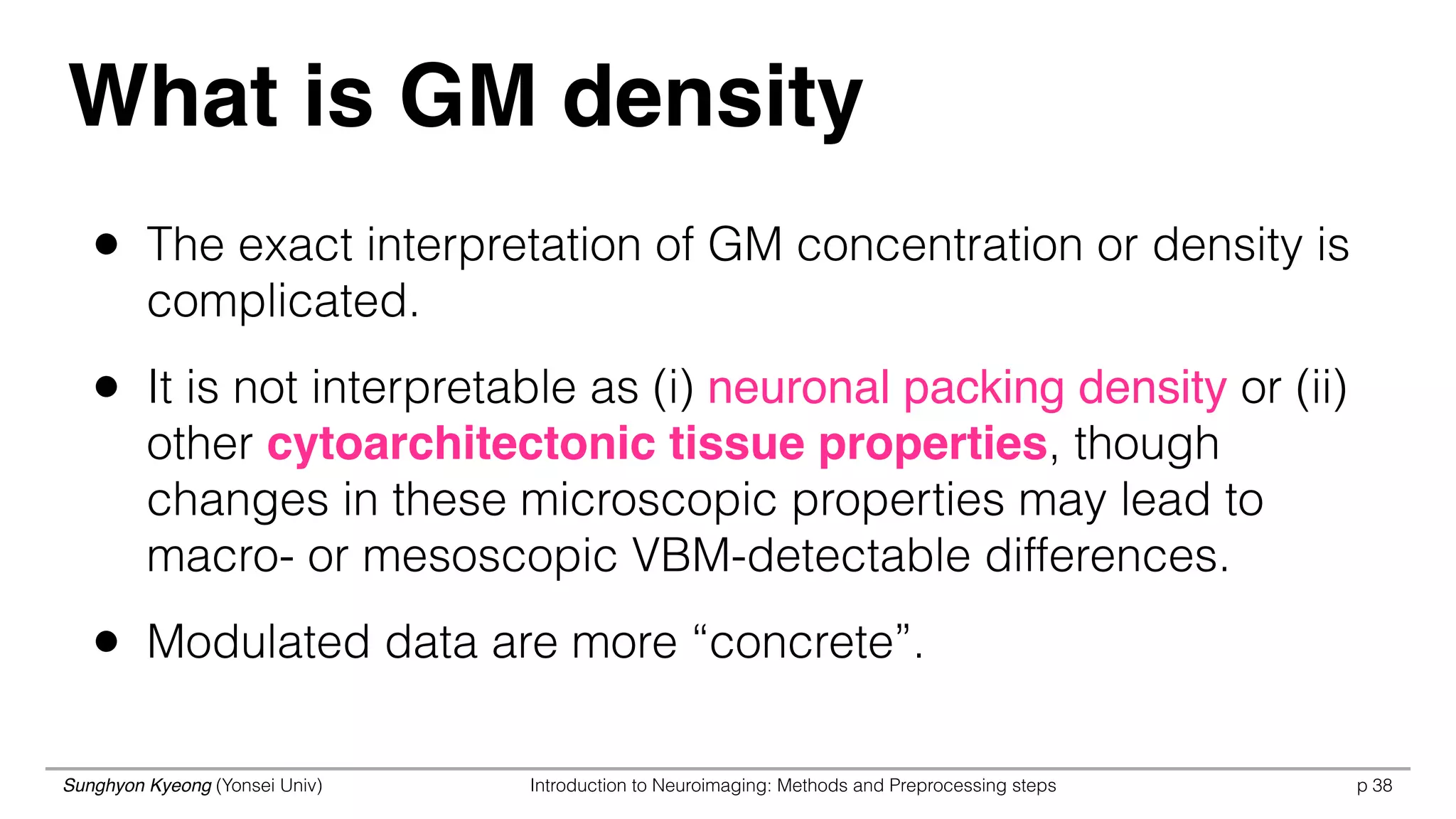
What is GM density
• The exact interpretation of GM concentration or density is
complicated.
• It is not interpretable as (i) neuronal packing density or (ii)
other cytoarchitectonic tissue properties, though
changes in these microscopic properties may lead to
macro- or mesoscopic VBM-detectable differences.
• Modulated data are more “concrete”.
Sunghyon Kyeong (Yonsei Univ) Introduction to Neuroimaging: Methods and Preprocessing steps p 39
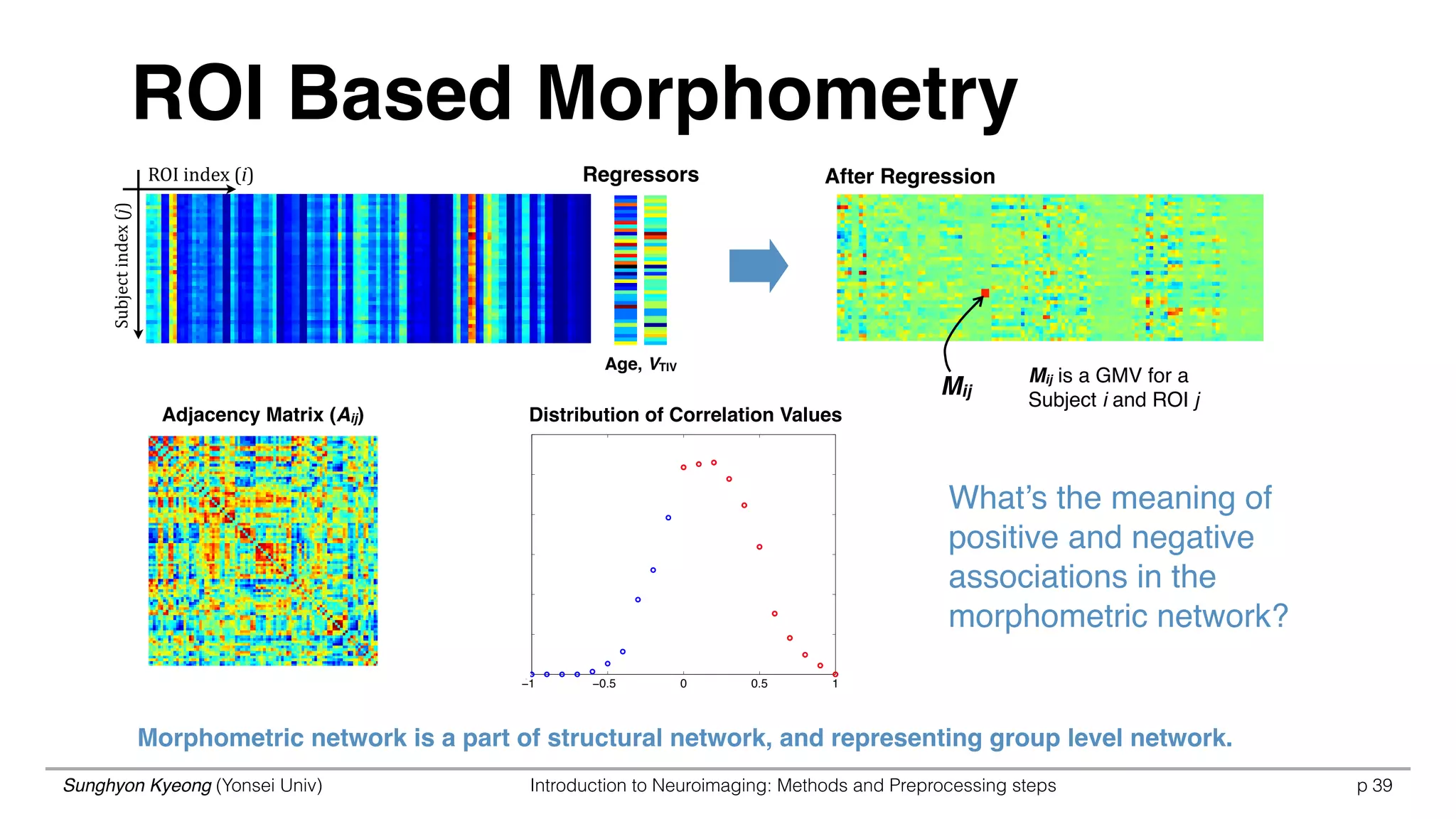
Age, VTIV
ROI	
  index	
  (i)
Subject	
  index	
  (j)
After Regression
Mij
Mij is a GMV for a
Subject i and ROI j
−1 −0.5 0 0.5 1
0
200
400
600
800
1000
1200
What’s the meaning of
positive and negative
associations in the
morphometric network?
ROI Based Morphometry
Regressors
Adjacency Matrix (Aij) Distribution of Correlation Values
Morphometric network is a part of structural network, and representing group level network.
Diffusion Tensor
Imaging
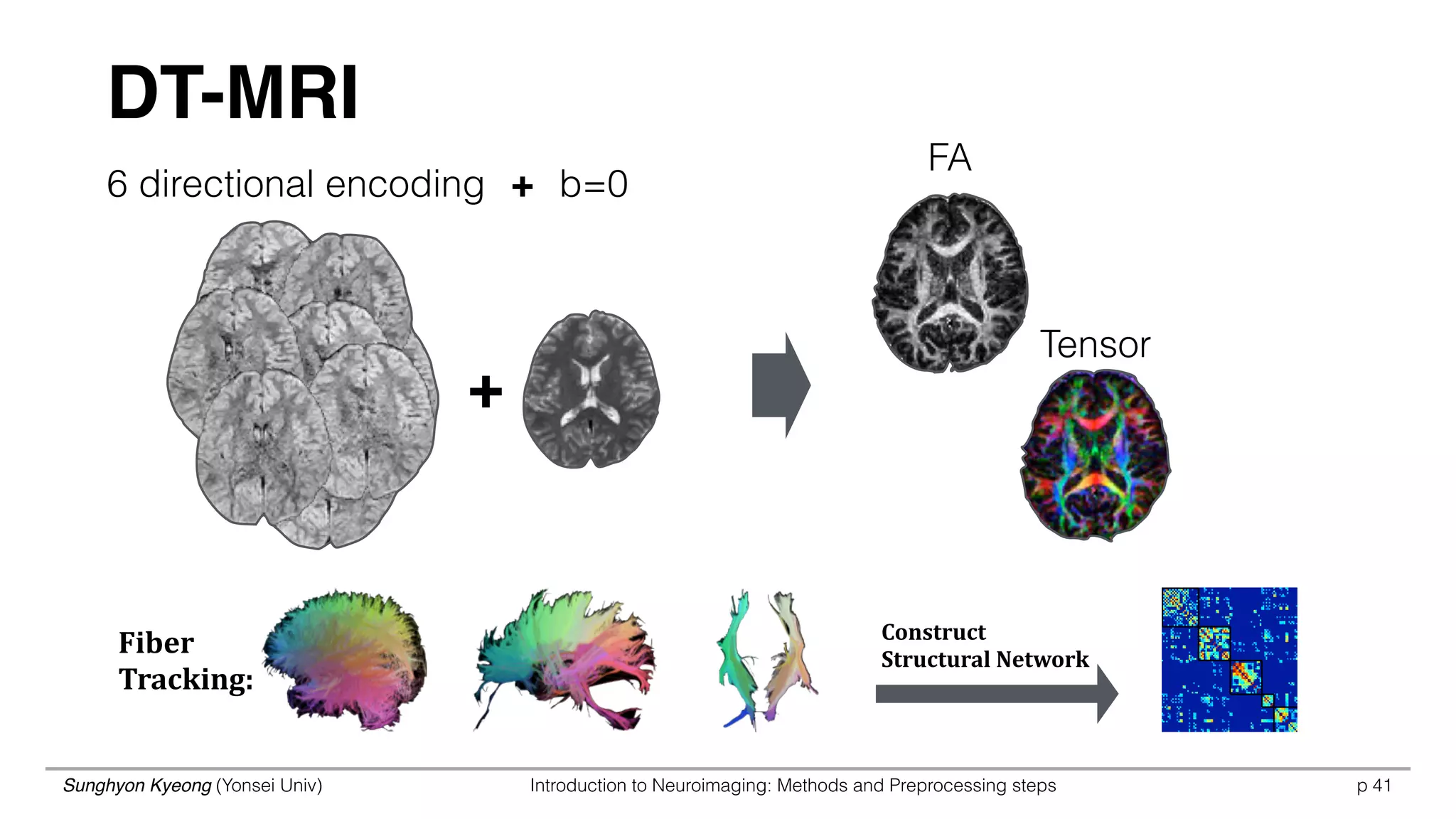
Sunghyon Kyeong (Yonsei Univ) Introduction to Neuroimaging: Methods and Preprocessing steps p 41
6 directional encoding b=0
Tensor
FA
Construct	
  
Structural	
  Network	
  
Fiber	
  

Tracking:
DT-MRI
+
+
Sunghyon Kyeong (Yonsei Univ) Introduction to Neuroimaging: Methods and Preprocessing steps p 42
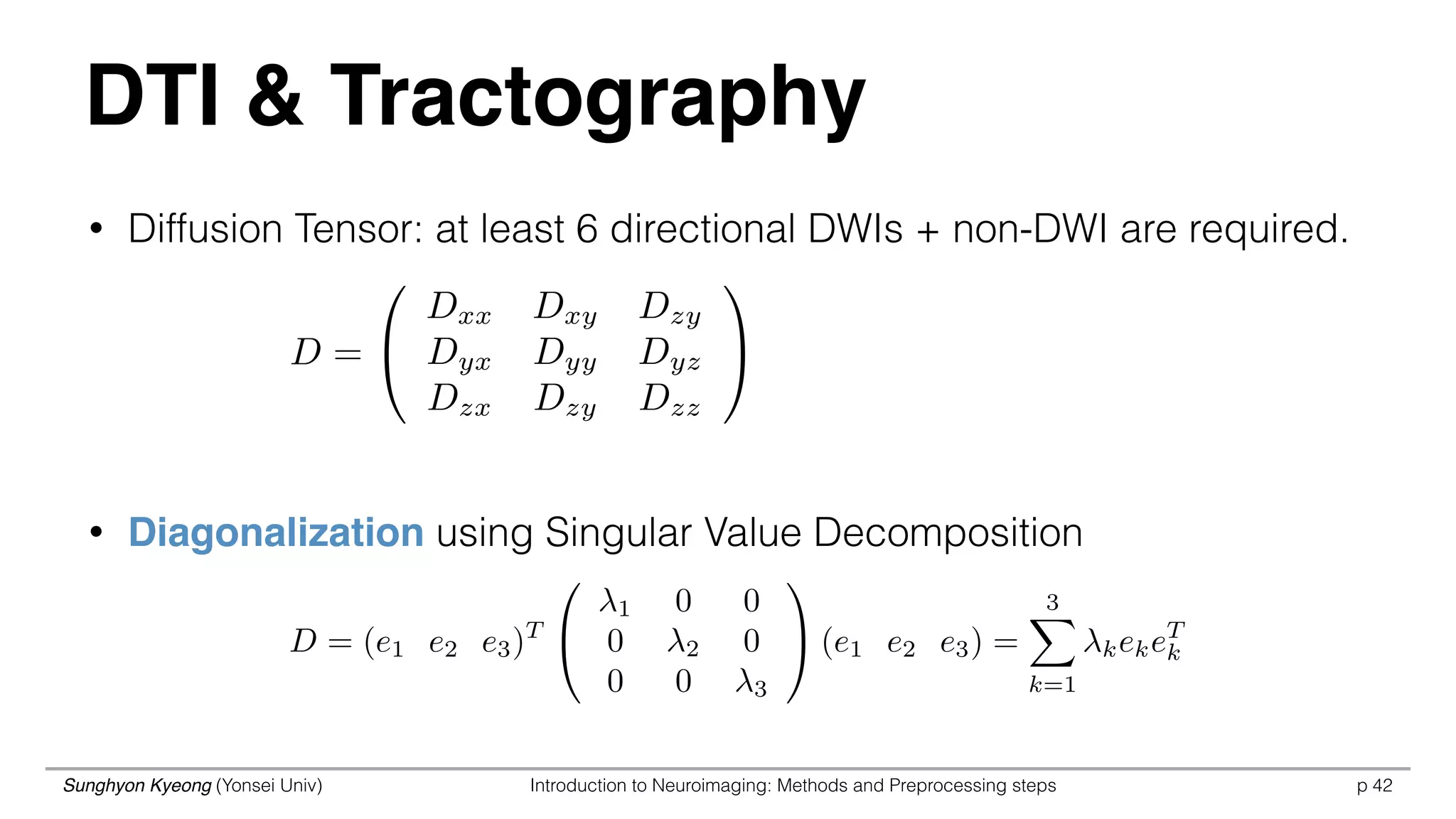
DTI & Tractography
• Diffusion Tensor: at least 6 directional DWIs + non-DWI are required.
• Diagonalization using Singular Value Decomposition
D =
0
@
Dxx Dxy Dzy
Dyx Dyy Dyz
Dzx Dzy Dzz
1
A
D = (e1 e2 e3)T
0
@
1 0 0
0 2 0
0 0 3
1
A (e1 e2 e3) =
3X
k=1
kekeT
k
Sunghyon Kyeong (Yonsei Univ) Introduction to Neuroimaging: Methods and Preprocessing steps p 43
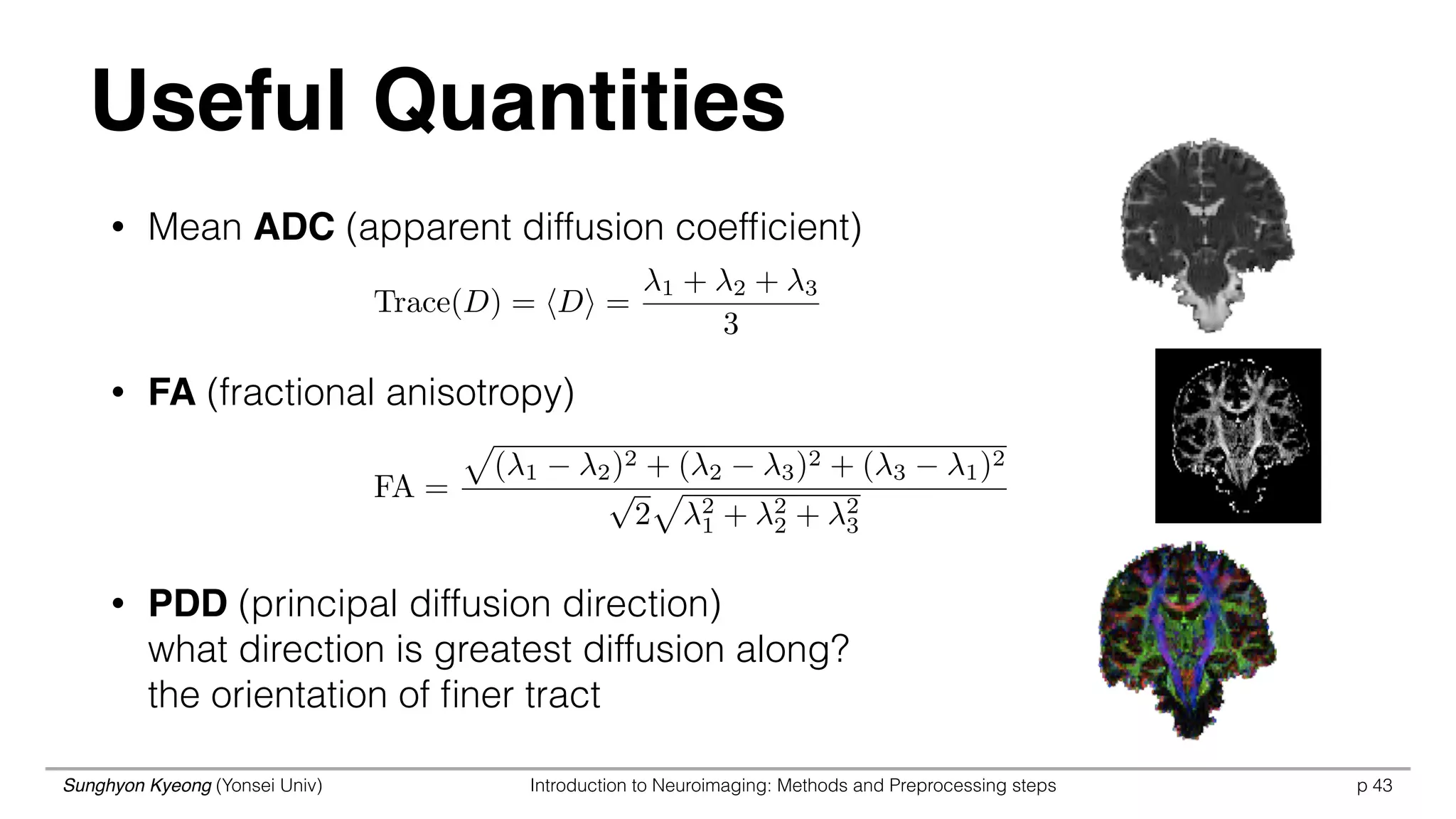
Useful Quantities
• Mean ADC (apparent diffusion coefficient)
• FA (fractional anisotropy)
• PDD (principal diffusion direction)

what direction is greatest diffusion along?

the orientation of finer tract
Trace(D) = hDi =
1 + 2 + 3
3
FA =
p
( 1 2)2 + ( 2 3)2 + ( 3 1)2
p
2
p
2
1 + 2
2 + 2
3

Introduction to Neuroimaging

  • 1.
    Sunghyon Kyeong sunghyon.kyeong@gmail.com Institute ofBehavioural Science in Medicine, 
 Yonsei University College of Medicine Introduction to Neuroimaging
 -PET, fMRI, VBM, and DTI-
  • 2.
    Sunghyon Kyeong (YonseiUniv) Introduction to Neuroimaging: Methods and Preprocessing steps p 2 with Ctrl-key, 
 select multiple regions with Ctrl-key, 
 select multiple regions Outline • Positron Emission Topography (PET) Imaging • Principles of BOLD signal generation • Review on fMRI preprocessing steps • Functional Network Construction • Morphometric Brain Network • Network from Diffusion Tensor Imaging
  • 3.
  • 4.
    Sunghyon Kyeong (YonseiUniv) Introduction to Neuroimaging: Methods and Preprocessing steps p 4 Positron Emission Tomography gamma ray
 detectors Unstable parent
 nucleus Proton decays to
 neutron in positron 
 and neutrino emitted Positron combines with
 electron and annihilates Two anti-parallel 511 keV
 photons produced p n + + + ⇥ebeta decay process : NaI(Tl), bismuth germanate oxide (BGO), 
 gadolinium oxyorthosilicate (GSO), 
 lutetium oxyorthosilicate (LSO) are used for the crystal.
  • 5.
    Sunghyon Kyeong (YonseiUniv) Introduction to Neuroimaging: Methods and Preprocessing steps p 5 Coincidence Detection
  • 6.
    Sunghyon Kyeong (YonseiUniv) Introduction to Neuroimaging: Methods and Preprocessing steps p 6 Types of Coincidence Events • A scattered coincidence is one in which at least one of the detected photons had undergone at least one Compton scattering event prior to detection • Random coincidence occur when two photons not arising from the same annihilation event are incident on the detectors with the coincident time window of the system
  • 7.
    Sunghyon Kyeong (YonseiUniv) Introduction to Neuroimaging: Methods and Preprocessing steps p 7 • Unstable positron-emitting isotopes are synthesised in a cyclotron by bombarding elements such as oxygen, carbon, or fluorine with protons. • Isotopes : 15O(half-life 2min), 18F(110 min), 11C(20min) • When the radio-labeled compounds are injected into the blood stream, they distribute according to the physiological state of the brain, accumulating preferentially in more metabolically active areas. • The structure of F-18-FDG is similar to the glucose, so it can used to diagnosis the abnormality of glucose metabolism. Isotope in PET imaging
  • 8.
    Blood Oxygen LevelDependent Signal for 
 functional MRI
  • 9.
    Sunghyon Kyeong (YonseiUniv) Introduction to Neuroimaging: Methods and Preprocessing steps p 9 2D iFFT Raw Data k-Space Image Complex Data in Image Domain M = |R + iI| P = tan 1 (I/R) fMRI Data Acquisition
  • 10.
    Sunghyon Kyeong (YonseiUniv) Introduction to Neuroimaging: Methods and Preprocessing steps p 10 Detection of MRI Signal • Applying RF pulse to tip down bulk magnetisation (Mz) to the transverse plane. • Mz tends to align the external magnetic field as time goes on (T1 recovery). • Mz decays in the transverse plane as time goes on (T2 decay). Good Contrast Good Contrast B0 MR  scanner magnetic field due to solenoid
  • 11.
    Sunghyon Kyeong (YonseiUniv) Introduction to Neuroimaging: Methods and Preprocessing steps p 11 Tissue T1 (ms) T2 (ms) Gray matter (GM) 950 100 White matter (WM) 600 80 Muscle 900 50 Cerebrospinal fluid (CSF) 4500 2200 Fat 250 60 Blood 1200 100~300 Tissue Specific T1 and T2 B0 = 1.5 T T = 37 C obtained  at • T1 recovery and T2 decay time ranges from tens to thousands of milliseconds for protons in human tissue over the main field. Typical values for various tissues are shown in following table. • Applying the pulse sequences, we can discriminate brain tissues; The different sequences should be applied to obtain the specific image, for example, anatomic, functional, angio images.
  • 12.
    Sunghyon Kyeong (YonseiUniv) Introduction to Neuroimaging: Methods and Preprocessing steps p 12 • The abbreviation BOLD fMRI stands for Blood Oxygen Level Dependent functional MRI. • The BOLD contrast mechanism alters the T2* parameter mainly through neural activity–dependent changes in the relative concentration of oxygenated and deoxygenated blood. • Deoxyhemoglobin is paramagnetic and influences the MR signal unlike oxygenated hemoglobin. Detecting BOLD fMRI Signal
  • 13.
    Sunghyon Kyeong (YonseiUniv) Introduction to Neuroimaging: Methods and Preprocessing steps p 13 Contrast Agents for fMRI ? • Definition : Substances that alter magnetic susceptibility of tissue of blood, leading to changes in MR signal
 - Affects local magnetic homogeneity: decrease in T2* • Two types
 - Exogenous : Externally applied, non-biological compounds.
 - Endogenous : Internally generated biological compound (e.g., dHb) • BOLD functional magnetic imaging method doesn’t need the external contrast agents.

  • 14.
    Sunghyon Kyeong (YonseiUniv) Introduction to Neuroimaging: Methods and Preprocessing steps p 14 O2 Ratios in Blood High ratio deoxy :
 → deoxygenated blood 
 → fast decrease in MRI signal Low ratio deoxy :
 → oxygenated blood → slow decrease in MRI signal Normal blood flow High blood flow BOLD signal = HB dHB dHb Hb deoxyhemoglobin (paramagnetic) oxyhemoglobin (non-magnetic) • BOLD contrast measures inhomogeneities in magnetic field due to changes in the level of O2 in the blood.
  • 15.
    Sunghyon Kyeong (YonseiUniv) Introduction to Neuroimaging: Methods and Preprocessing steps p 15 Mechanism of BOLD fMRI Time BOLDsignal T2* task T2* control TEoptimal ΔS ↑ Neural Activity ↑ Blood Flow ↑ Oxyhemoglobin ↑ T2* ↑ MR Signal
  • 16.
    Sunghyon Kyeong (YonseiUniv) Introduction to Neuroimaging: Methods and Preprocessing steps p Hemodynamic Response 16 BOLDSignalChange Time (second) 0 5 10 15 20 • BOLD signal은 자극 이 제시되고 5~6초 후 에 최대 반응을 보임 • Fast event related + jittered ISI is the optimal design Reference for FMRI Experimental Design, http://afni.nimh.nih.gov/pub/dist/HOWTO/howto/ht03_stim/html/stim_background.html
  • 17.
    Sunghyon Kyeong (YonseiUniv) Introduction to Neuroimaging: Methods and Preprocessing steps p 17 Block Designed fMRI MRI Language Area Motor Area
  • 18.
    Sunghyon Kyeong (YonseiUniv) Introduction to Neuroimaging: Methods and Preprocessing steps p Resting State fMRI • Resting state fMRI measures “low-frequency (0.01~0.08 Hz)” slow oscillation. • Resting state means “Keep eyes closed resting state but not sleep for several minutes”. • Resting state functional connectivity considered as “intrinsic connectivity”. • Modular structure in RSFC were found in many studies. • Default mode network (DMN) alteration in Psychiatric patients (e.g. schizophrenia). 18
  • 19.
    steps in thespatial preprocessing fMRI preprocessing
  • 20.
    Sunghyon Kyeong (YonseiUniv) Introduction to Neuroimaging: Methods and Preprocessing steps p 20 Summary of Preprocess Input Output EPI1.nii
 EPI2.nii … aEPI1.nii
 aEPI2.nii … aEPI1.nii
 aEPI2.nii … meanaEPI.nii aEPI1.nii (realigned)
 aEPI2.nii (realigned) rp_EPI.txt … meanaEPI.nii anat.nii meanaEPI.nii anat.nii (coregistered) anat.nii aEPI1.nii
 aEPI2.nii … wanat.nii waEPI1.nii waEPI1.nii … waEPI1.nii
 waEPI2.nii … Slice Timing Realignment Coregistration
 T1 → meanEPI Normalisation Smoothing Event related fMRI analysis Resting state fMRI analysis Preprocessing • Specify 1st-level in SPM
 Individual GLM with Stimulus onset and rp_EPI.txt as regressors • Specify 2nd-level in SPM
 Group-wise GLM analysis
 one sample, two sample, factorial design, flexible design • Linear detrending of EPI time series at each voxel. • bandpass filtering (0.009~0.08Hz) to capture Low-frequency fluctuation • regression nuisance parameters such as head motion, white matter, ventricle, and global signal • Functional connectivity analysis and Complex network analysis swaEPI1.nii swaEPI1.nii …
  • 21.
    Sunghyon Kyeong (YonseiUniv) Introduction to Neuroimaging: Methods and Preprocessing steps p Realignment 21 ... motion parameters mean-fMRI sagittal coronal axial 100 dynamic images
  • 22.
    Sunghyon Kyeong (YonseiUniv) Introduction to Neuroimaging: Methods and Preprocessing steps p Coregistration 22 BeforeCoregAfterCoreg • High Resolution T1 data is registered to mean-fMRI • Rigid-body transformation only
 (translation & rotation) T1 mean-­‐fMRI T1 mean-­‐fMRI
  • 23.
    Sunghyon Kyeong (YonseiUniv) Introduction to Neuroimaging: Methods and Preprocessing steps p 23 coregistered  T1 T1  template normalized  T1  (wT1) fMRI  images ... ... normalised  fMRI  (wfMRI)  images ... smoothed  fMRI  (swfMRI)  images Nonlinear  normalisation  (T1→Template) w w spatial  gaussian  ?ilter  (FWHM=6  or  8mm) S Normalisation and Smoothing
  • 24.
    Resting State 
 FunctionalConnectivity Michael  D.  Fox  (2005)  PNAS     Seed-ROI based connectivity analysis Graph theoretical analysis
  • 25.
    fMRI preprocessing steps inthe temporal preprocessing
  • 26.
    Sunghyon Kyeong (YonseiUniv) Introduction to Neuroimaging: Methods and Preprocessing steps p 26 0 100 200 300 400 500 600 700 800 720 730 740 750 760 770 780 790 time course at voxel i
 (before linear detrending) increasing trend due to heat 0 100 200 300 400 500 600 700 800 −25 −20 −15 −10 −5 0 5 10 15 20 25 after detrending (i.e. removing long term increasing trend) time course with linear function Linear Detrending
  • 27.
    Sunghyon Kyeong (YonseiUniv) Introduction to Neuroimaging: Methods and Preprocessing steps p Nuisance parameter regression 27 0 200 400 600 800 YGS YCSF YWM   0 200 400 600 800 −0.8 −0.6 −0.4 −0.2 0 0.2 0.4 0.6 0.8 x  translation   y  translation   z  translation 0 200 400 600 800 −0.02 −0.015 −0.01 −0.005 0 0.005 0.01 0.015 0.02 pitch   roll   yaw GM WM CSF Tx Ty Tz Rx Ry Rz 0 50 100 150 200 250 300 350 400 65 70 75 80 85 90 0 50 100 150 200 250 300 350 400 −10 −5 0 5 10 Volume  (inter-­‐volume  interval  =  2  sec)   Y  =  β1Tx  +  β2Ty  +  β3Tz  +  β4Rx  +  β5Ry  +  β6Rz  +  β7YGS  +  β8YCSF  +  β9YWM  +  ε Head motions were regressed out to remove spin-history artefact. Before After
  • 28.
    Sunghyon Kyeong (YonseiUniv) Introduction to Neuroimaging: Methods and Preprocessing steps p 0 0.05 0.1 0.15 0.2 0.25 0 100 200 300 400 500 600 Bandpass  Filtering  Region
 (0.01  -­‐  0.08  Hz) Bandpass Filtering 28 0 50 100 150 200 250 300 350 400 −4 −3 −2 −1 0 1 2 3 4 Bandpass  Ailtering  (0.01-­‐0.08  Hz)  
 :  removing  vary  slow  wave,  cardiac  &   respiratory  noise • very  low  frequency  regions  are   related  to  drift  (<0.01  Hz)
 • high  frequency  regions  are  related  to   respiratory  &    cardiac  noise Frequency  (Hz)   Volume  (inter-­‐volume  interval  =  2  sec)  
  • 29.
    Sunghyon Kyeong (YonseiUniv) Introduction to Neuroimaging: Methods and Preprocessing steps p Functional Connectivity 29 0 50 100 150 200 250 300 350 400 −30 −20 −10 0 10 20 average time course within a node computing the pair-wire correlation coefficients for functional connectivity AAL atlas weighted 
 undirected Adjacency 
 Matrix (Aij) Thresholding Graph
  • 30.
  • 31.
    Sunghyon Kyeong (YonseiUniv) Introduction to Neuroimaging: Methods and Preprocessing steps p 31 Types of Graph Binary Undirected Binary Directed Weighted Directed 1 3 6 5 2 4 0 1 1 0 0 0 1 0 1 0 1 0 1 1 0 0 0 0 0 0 0 0 1 0 0 0 0 1 0 1 0 0 0 0 1 0 Aij  =Matrix k2 = 3 k3 = 2 k4 = 1 Degree
  • 32.
    Sunghyon Kyeong (YonseiUniv) Introduction to Neuroimaging: Methods and Preprocessing steps p 32 Graph Visualisation degree strength clustering coefficient node betweenness centrality node efficiency edge strength edge betweenness centrality modular architecture Network Properties Node Properties Edge Properties Modular Structure Network Visualisation 계산된 네트워크의 노드 속성값을
 가시화 과정에서 노드 크기로 표현함. 계산된 네트워크의 엣지 속성값을
 가시화 과정에서 엣지의 두께로 표편함. 계산된 네트워크의 모듈구조를
 가시화 과정에서 노드의 색깔로 표현함. 1 2
  • 33.
    Morphometric Brain Network Hippocampus Posterior Hipp timeas taxi driver (month) adjustedVBMresponses
 posteriorhippocampus anteriorhippocampalcross- sectionalarea(mm2) Posterior Hipp Anterior Hipp Taxi drivers' brains 'grow' on the job Maguire, E.A. (2000) PNAS
  • 34.
    Sunghyon Kyeong (YonseiUniv) Introduction to Neuroimaging: Methods and Preprocessing steps p 34 1. Tissue segmentation 2. Create Template & Normalisation 3. Modulation 4. Smoothing 5. Network Construction The data are pre- processed to sensitise the statistical tests to *regional* tissue volumes Analysis Steps Voxel-based Morphometry (VBM)
  • 35.
    Sunghyon Kyeong (YonseiUniv) Introduction to Neuroimaging: Methods and Preprocessing steps p 35 Segmentation Probability maps Mixture model CSF GM WM • Individual T1 weighted images are partitioned into - grey matter / white matter / cerebrospinal fluid • Segmentation is achieved by combining with - probability maps / Bayesian Priors (based on general knowledge about normal tissue distribution) - mixture model cluster analysis (which identifies voxel intensity distributions of particular tissue types in the original image) GM WM CSF T1 weighted image
  • 36.
    Sunghyon Kyeong (YonseiUniv) Introduction to Neuroimaging: Methods and Preprocessing steps p 36 Modulation * Jacobian determinants of the deformation field • Is optional processing step but tends to be applied • Corrects for changes in brain VOLUME caused by non- linear spatial normalisation • Multiplication of the spatially normalised GM (or other tissue class) by its relative volume before and after warping*, i.e. IB = IA×(VA/VB).
  • 37.
    Sunghyon Kyeong (YonseiUniv) Introduction to Neuroimaging: Methods and Preprocessing steps p 37 Example IB  =  ? IA  =  1   VA  =  1 VB  =  2 IA  =  1   VA  =  4 IB  =  ?VB  =  2 Template Signal intensity ensures that total amount of GM in a subject’s temporal lobe is the same before and after spatial normalisation and can be distinguished between subjects Template IB = 1 × [1 / 2] = 0.5 IB = 1 × [4 / 2] = 2 Modulation ModulationNormalisation Normalisation IB = IA × [VA / VB] Larger Brain Smaller Brain
  • 38.
    Sunghyon Kyeong (YonseiUniv) Introduction to Neuroimaging: Methods and Preprocessing steps p 38 What is GM density • The exact interpretation of GM concentration or density is complicated. • It is not interpretable as (i) neuronal packing density or (ii) other cytoarchitectonic tissue properties, though changes in these microscopic properties may lead to macro- or mesoscopic VBM-detectable differences. • Modulated data are more “concrete”.
  • 39.
    Sunghyon Kyeong (YonseiUniv) Introduction to Neuroimaging: Methods and Preprocessing steps p 39 Age, VTIV ROI  index  (i) Subject  index  (j) After Regression Mij Mij is a GMV for a Subject i and ROI j −1 −0.5 0 0.5 1 0 200 400 600 800 1000 1200 What’s the meaning of positive and negative associations in the morphometric network? ROI Based Morphometry Regressors Adjacency Matrix (Aij) Distribution of Correlation Values Morphometric network is a part of structural network, and representing group level network.
  • 40.
  • 41.
    Sunghyon Kyeong (YonseiUniv) Introduction to Neuroimaging: Methods and Preprocessing steps p 41 6 directional encoding b=0 Tensor FA Construct   Structural  Network   Fiber  
 Tracking: DT-MRI + +
  • 42.
    Sunghyon Kyeong (YonseiUniv) Introduction to Neuroimaging: Methods and Preprocessing steps p 42 DTI & Tractography • Diffusion Tensor: at least 6 directional DWIs + non-DWI are required. • Diagonalization using Singular Value Decomposition D = 0 @ Dxx Dxy Dzy Dyx Dyy Dyz Dzx Dzy Dzz 1 A D = (e1 e2 e3)T 0 @ 1 0 0 0 2 0 0 0 3 1 A (e1 e2 e3) = 3X k=1 kekeT k
  • 43.
    Sunghyon Kyeong (YonseiUniv) Introduction to Neuroimaging: Methods and Preprocessing steps p 43 Useful Quantities • Mean ADC (apparent diffusion coefficient) • FA (fractional anisotropy) • PDD (principal diffusion direction)
 what direction is greatest diffusion along?
 the orientation of finer tract Trace(D) = hDi = 1 + 2 + 3 3 FA = p ( 1 2)2 + ( 2 3)2 + ( 3 1)2 p 2 p 2 1 + 2 2 + 2 3