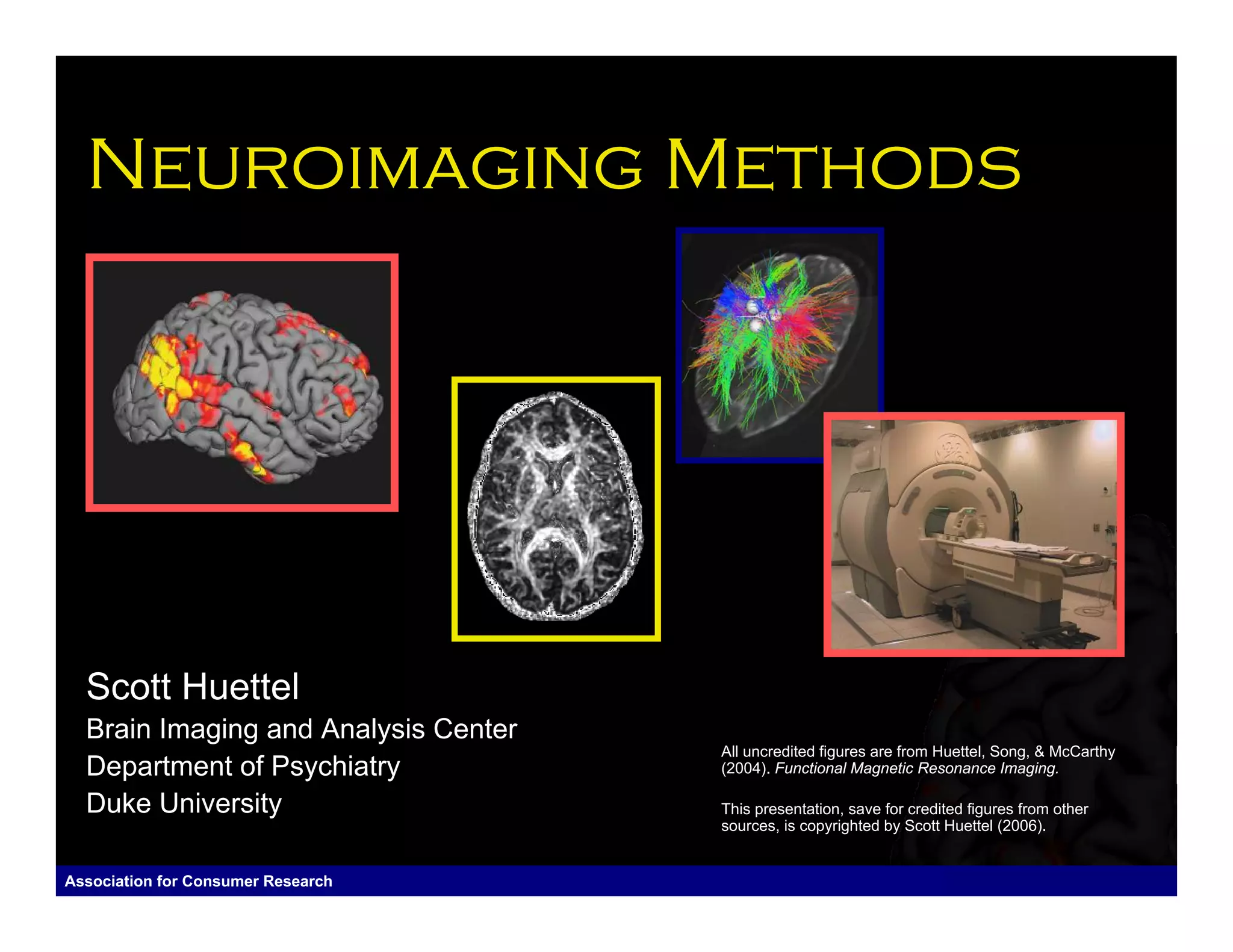
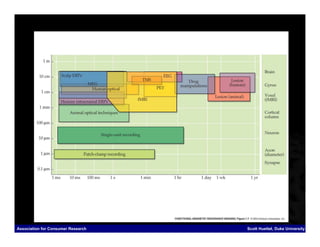
Neuroimaging Methods


  Scott Huettel
  Brain Imaging and Analysis Center
                                      All uncredited figures are from Huettel, Song, & McCarthy
  Department of Psychiatry            (2004). Functional Magnetic Resonance Imaging.

  Duke University                     This presentation, save for credited figures from other
                                      sources, is copyrighted by Scott Huettel (2006).


Association for Consumer Research                                       Scott Huettel, Duke University
Association for Consumer Research   Scott Huettel, Duke University
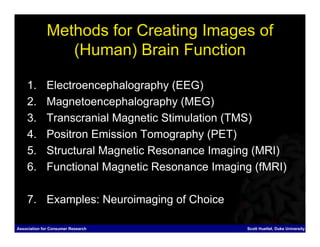
Methods for Creating Images of
                 (Human) Brain Function

    1.        Electroencephalography (EEG)
    2.        Magnetoencephalography (MEG)
    3.        Transcranial Magnetic Stimulation (TMS)
    4.        Positron Emission Tomography (PET)
    5.        Structural Magnetic Resonance Imaging (MRI)
    6.        Functional Magnetic Resonance Imaging (fMRI)

    7. Examples: Neuroimaging of Choice

Association for Consumer Research                 Scott Huettel, Duke University
Association for Consumer Research   Scott Huettel, Duke University
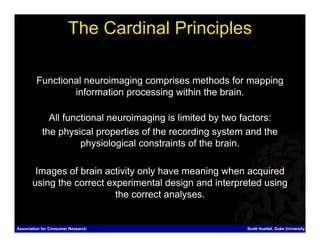
The Cardinal Principles

         Functional neuroimaging comprises methods for mapping
                 information processing within the brain.

              All functional neuroimaging is limited by two factors:
            the physical properties of the recording system and the
                      physiological constraints of the brain.

        Images of brain activity only have meaning when acquired
       using the correct experimental design and interpreted using
                           the correct analyses.


Association for Consumer Research                           Scott Huettel, Duke University
1. Electroencephalography
                                 (EEG)


Association for Consumer Research            Scott Huettel, Duke University
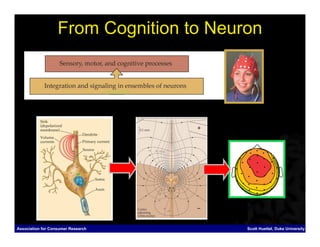
From Cognition to Neuron


Association for Consumer Research        Scott Huettel, Duke University
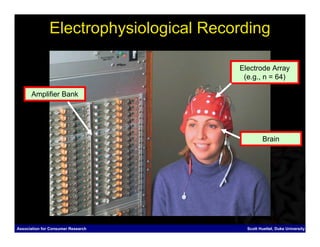
Electrophysiological Recording

                                        Electrode Array
                                         (e.g., n = 64)

      Amplifier Bank


                                                 Brain


Association for Consumer Research         Scott Huettel, Duke University
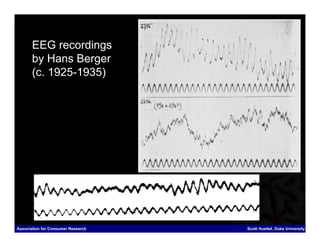
EEG recordings
       by Hans Berger
       (c. 1925-1935)


Association for Consumer Research   Scott Huettel, Duke University
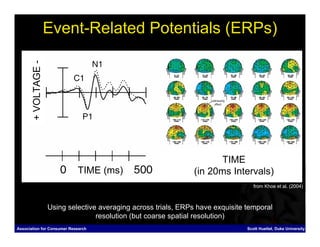
+ VOLTAGE -
                     Event-Related Potentials (ERPs)


                                                                        TIME
                              TIME (ms)                          (in 20ms Intervals)
                                                                                     from Khoe et al. (2004)


                     Using selective averaging across trials, ERPs have exquisite temporal
                                    resolution (but coarse spatial resolution)
Association for Consumer Research                                                 Scott Huettel, Duke University
2. Magnetoencephalography
                             (MEG)


Association for Consumer Research         Scott Huettel, Duke University
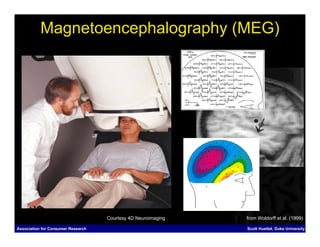
Magnetoencephalography (MEG)


                                    Courtesy 4D Neuroimaging   from Woldorff et al. (1999)

Association for Consumer Research                              Scott Huettel, Duke University
3. Transcranial Magnetic Stimulation
                     (TMS)


Association for Consumer Research   Scott Huettel, Duke University
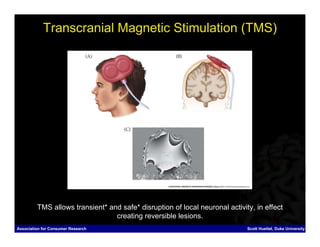
Transcranial Magnetic Stimulation (TMS)


         TMS allows transient* and safe* disruption of local neuronal activity, in effect
                                 creating reversible lesions.
Association for Consumer Research                                            Scott Huettel, Duke University
4. Positron Emission Tomography
                       (PET)


Association for Consumer Research   Scott Huettel, Duke University
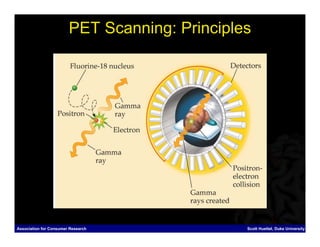
PET Scanning: Principles


Association for Consumer Research              Scott Huettel, Duke University
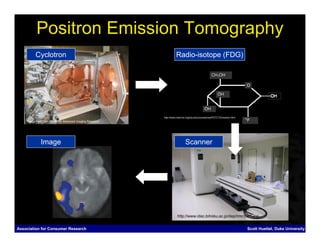
Positron Emission Tomography
          Cyclotron                                                  Radio-isotope (FDG)


                                                           http://www.med-ed.virginia.edu/courses/rad/PETCT/Emission.html
    Image from Utah Center for Advanced Imaging Research


             Image                                                           Scanner


                                                                      http://www.idac.tohoku.ac.jp/dep/nmr/pet1.jpg


Association for Consumer Research                                                                                           Scott Huettel, Duke University
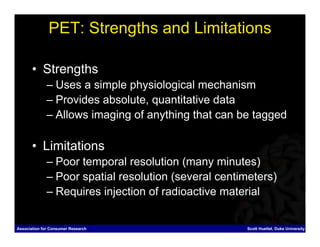
PET: Strengths and Limitations

       • Strengths
              – Uses a simple physiological mechanism
              – Provides absolute, quantitative data
              – Allows imaging of anything that can be tagged

       • Limitations
              – Poor temporal resolution (many minutes)
              – Poor spatial resolution (several centimeters)
              – Requires injection of radioactive material


Association for Consumer Research                     Scott Huettel, Duke University
5. Structural MRI


Association for Consumer Research                       Scott Huettel, Duke University
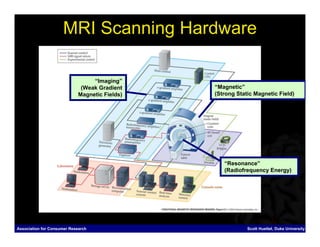
MRI Scanning Hardware

                                  “Imaging”
                              (Weak Gradient    “Magnetic”
                             Magnetic Fields)   (Strong Static Magnetic Field)


                                                   “Resonance”
                                                   (Radiofrequency Energy)


Association for Consumer Research                           Scott Huettel, Duke University
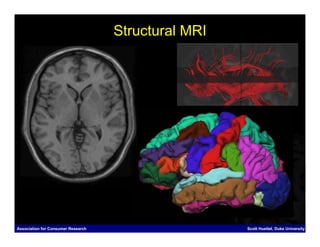
Structural MRI


Association for Consumer Research                    Scott Huettel, Duke University
6. Functional MRI (fMRI)


Association for Consumer Research     Scott Huettel, Duke University
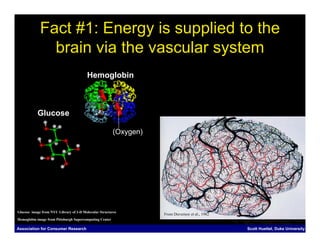
Fact #1: Energy is supplied to the
               brain via the vascular system
                                        Hemoglobin


           Glucose

                                                         (Oxygen)


Glucose image from NYU Library of 3-D Molecular Structures
                                                                    From Duvernoy et al., 1982
Hemoglobin image from Pittsburgh Supercomputing Center

Association for Consumer Research                                                                Scott Huettel, Duke University
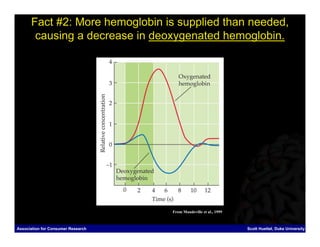
Fact #2: More hemoglobin is supplied than needed,
       causing a decrease in deoxygenated hemoglobin.


                                    From Mandeville et al., 1999


Association for Consumer Research                                  Scott Huettel, Duke University
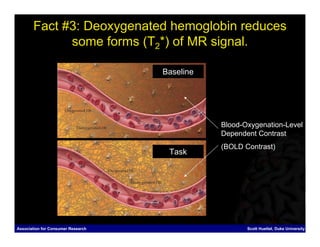
Fact #3: Deoxygenated hemoglobin reduces
             some forms (T2*) of MR signal.

                                    Baseline


                                               Blood-Oxygenation-Level
                                               Dependent Contrast
                                               (BOLD Contrast)
                                     Task


Association for Consumer Research                     Scott Huettel, Duke University
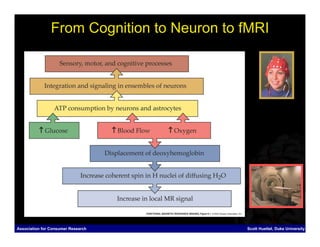
From Cognition to Neuron to fMRI


Association for Consumer Research           Scott Huettel, Duke University
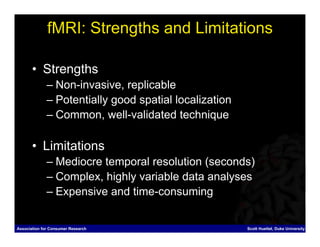
fMRI: Strengths and Limitations

       • Strengths
              – Non-invasive, replicable
              – Potentially good spatial localization
              – Common, well-validated technique

       • Limitations
              – Mediocre temporal resolution (seconds)
              – Complex, highly variable data analyses
              – Expensive and time-consuming


Association for Consumer Research                       Scott Huettel, Duke University
Neuroimaging of Decision Preferences


       1. Uncertainty: Risk vs. Ambiguity
       2. Probability: High vs. Low
       3. Choice: Safe vs. Risky

          In all of these cases, there is some
        derived parameter that is related to the
                 neuroimaging activation.

Association for Consumer Research        Scott Huettel, Duke University
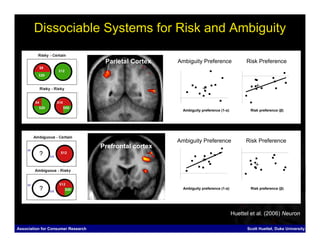
Dissociable Systems for Risk and Ambiguity

           Risky - Certain
                                     Parietal Cortex    Ambiguity Preference                 Risk Preference


            Risky - Risky


                                                          Ambiguity preference (1-α)           Risk preference (β)


                                                        Ambiguity Preference                 Risk Preference
                                    Prefrontal cortex


                                                          Ambiguity preference (1-α)           Risk preference (β)


                                                                                       Huettel et al. (2006) Neuron

Association for Consumer Research                                                            Scott Huettel, Duke University
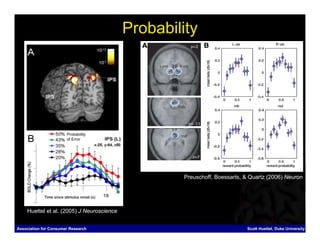
Probability


                       Probability
                       of Error


                                                    Preuschoff, Boessarts, & Quartz (2006) Neuron


    Huettel et al. (2005) J Neuroscience


Association for Consumer Research                                           Scott Huettel, Duke University
Safe vs. Risky Choice


      Insula activation predicts safe choice.
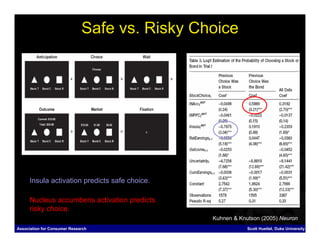
      Nucleus accumbens activation predicts
      risky choice.
                                                Kuhnen & Knutson (2005) Neuron
Association for Consumer Research                           Scott Huettel, Duke University
Summary

       • Neuroimaging techniques create maps of brain
         function.

       • The most common approaches measure
         neuronal activity (EEG, ERP, MEG) or brain
         hemodynamics (PET, FMRI).

       • The neuroimaging approaches relevant for
         consumer research involve relating
         neuroimaging data to economic parameters.

Association for Consumer Research               Scott Huettel, Duke University
Acknowledgments

    Recommended Readings:
    • Huettel, Song, & McCarthy (2004). Functional Magnetic Resonance Imaging.
    • Buxton (2002). Introduction to fMRI.
    • Luck (2005). An Introduction to the ERP Technique.
    • Purves et al. (2004). Neuroscience, 3rd Edition.

    FMRI education colleagues:
    • Allen Song (Duke University), Gregory McCarthy (Yale University)

    Laboratory members:
    • Bethany Weber, Dharol Tankersley, John Clithero, Luke Vicens, Lily Kinross-
       Wright, Parker Goyer, Jason Chen


                            neuroeconomics.duke.edu
Association for Consumer Research                                    Scott Huettel, Duke University

Neuroimaging methods

  • 1.
    Neuroimaging Methods Scott Huettel Brain Imaging and Analysis Center All uncredited figures are from Huettel, Song, & McCarthy Department of Psychiatry (2004). Functional Magnetic Resonance Imaging. Duke University This presentation, save for credited figures from other sources, is copyrighted by Scott Huettel (2006). Association for Consumer Research Scott Huettel, Duke University
  • 2.
    Association for ConsumerResearch Scott Huettel, Duke University
  • 3.
    Methods for CreatingImages of (Human) Brain Function 1. Electroencephalography (EEG) 2. Magnetoencephalography (MEG) 3. Transcranial Magnetic Stimulation (TMS) 4. Positron Emission Tomography (PET) 5. Structural Magnetic Resonance Imaging (MRI) 6. Functional Magnetic Resonance Imaging (fMRI) 7. Examples: Neuroimaging of Choice Association for Consumer Research Scott Huettel, Duke University
  • 4.
    Association for ConsumerResearch Scott Huettel, Duke University
  • 5.
    The Cardinal Principles Functional neuroimaging comprises methods for mapping information processing within the brain. All functional neuroimaging is limited by two factors: the physical properties of the recording system and the physiological constraints of the brain. Images of brain activity only have meaning when acquired using the correct experimental design and interpreted using the correct analyses. Association for Consumer Research Scott Huettel, Duke University
  • 6.
    1. Electroencephalography (EEG) Association for Consumer Research Scott Huettel, Duke University
  • 7.
    From Cognition toNeuron Association for Consumer Research Scott Huettel, Duke University
  • 8.
    Electrophysiological Recording Electrode Array (e.g., n = 64) Amplifier Bank Brain Association for Consumer Research Scott Huettel, Duke University
  • 9.
    EEG recordings by Hans Berger (c. 1925-1935) Association for Consumer Research Scott Huettel, Duke University
  • 10.
    + VOLTAGE - Event-Related Potentials (ERPs) TIME TIME (ms) (in 20ms Intervals) from Khoe et al. (2004) Using selective averaging across trials, ERPs have exquisite temporal resolution (but coarse spatial resolution) Association for Consumer Research Scott Huettel, Duke University
  • 11.
    2. Magnetoencephalography (MEG) Association for Consumer Research Scott Huettel, Duke University
  • 12.
    Magnetoencephalography (MEG) Courtesy 4D Neuroimaging from Woldorff et al. (1999) Association for Consumer Research Scott Huettel, Duke University
  • 13.
    3. Transcranial MagneticStimulation (TMS) Association for Consumer Research Scott Huettel, Duke University
  • 14.
    Transcranial Magnetic Stimulation(TMS) TMS allows transient* and safe* disruption of local neuronal activity, in effect creating reversible lesions. Association for Consumer Research Scott Huettel, Duke University
  • 15.
    4. Positron EmissionTomography (PET) Association for Consumer Research Scott Huettel, Duke University
  • 16.
    PET Scanning: Principles Associationfor Consumer Research Scott Huettel, Duke University
  • 17.
    Positron Emission Tomography Cyclotron Radio-isotope (FDG) http://www.med-ed.virginia.edu/courses/rad/PETCT/Emission.html Image from Utah Center for Advanced Imaging Research Image Scanner http://www.idac.tohoku.ac.jp/dep/nmr/pet1.jpg Association for Consumer Research Scott Huettel, Duke University
  • 18.
    PET: Strengths andLimitations • Strengths – Uses a simple physiological mechanism – Provides absolute, quantitative data – Allows imaging of anything that can be tagged • Limitations – Poor temporal resolution (many minutes) – Poor spatial resolution (several centimeters) – Requires injection of radioactive material Association for Consumer Research Scott Huettel, Duke University
  • 19.
    5. Structural MRI Associationfor Consumer Research Scott Huettel, Duke University
  • 20.
    MRI Scanning Hardware “Imaging” (Weak Gradient “Magnetic” Magnetic Fields) (Strong Static Magnetic Field) “Resonance” (Radiofrequency Energy) Association for Consumer Research Scott Huettel, Duke University
  • 21.
    Structural MRI Association forConsumer Research Scott Huettel, Duke University
  • 22.
    6. Functional MRI(fMRI) Association for Consumer Research Scott Huettel, Duke University
  • 23.
    Fact #1: Energyis supplied to the brain via the vascular system Hemoglobin Glucose (Oxygen) Glucose image from NYU Library of 3-D Molecular Structures From Duvernoy et al., 1982 Hemoglobin image from Pittsburgh Supercomputing Center Association for Consumer Research Scott Huettel, Duke University
  • 24.
    Fact #2: Morehemoglobin is supplied than needed, causing a decrease in deoxygenated hemoglobin. From Mandeville et al., 1999 Association for Consumer Research Scott Huettel, Duke University
  • 25.
    Fact #3: Deoxygenatedhemoglobin reduces some forms (T2*) of MR signal. Baseline Blood-Oxygenation-Level Dependent Contrast (BOLD Contrast) Task Association for Consumer Research Scott Huettel, Duke University
  • 26.
    From Cognition toNeuron to fMRI Association for Consumer Research Scott Huettel, Duke University
  • 27.
    fMRI: Strengths andLimitations • Strengths – Non-invasive, replicable – Potentially good spatial localization – Common, well-validated technique • Limitations – Mediocre temporal resolution (seconds) – Complex, highly variable data analyses – Expensive and time-consuming Association for Consumer Research Scott Huettel, Duke University
  • 28.
    Neuroimaging of DecisionPreferences 1. Uncertainty: Risk vs. Ambiguity 2. Probability: High vs. Low 3. Choice: Safe vs. Risky In all of these cases, there is some derived parameter that is related to the neuroimaging activation. Association for Consumer Research Scott Huettel, Duke University
  • 29.
    Dissociable Systems forRisk and Ambiguity Risky - Certain Parietal Cortex Ambiguity Preference Risk Preference Risky - Risky Ambiguity preference (1-α) Risk preference (β) Ambiguity Preference Risk Preference Prefrontal cortex Ambiguity preference (1-α) Risk preference (β) Huettel et al. (2006) Neuron Association for Consumer Research Scott Huettel, Duke University
  • 30.
    Probability Probability of Error Preuschoff, Boessarts, & Quartz (2006) Neuron Huettel et al. (2005) J Neuroscience Association for Consumer Research Scott Huettel, Duke University
  • 31.
    Safe vs. RiskyChoice Insula activation predicts safe choice. Nucleus accumbens activation predicts risky choice. Kuhnen & Knutson (2005) Neuron Association for Consumer Research Scott Huettel, Duke University
  • 32.
    Summary • Neuroimaging techniques create maps of brain function. • The most common approaches measure neuronal activity (EEG, ERP, MEG) or brain hemodynamics (PET, FMRI). • The neuroimaging approaches relevant for consumer research involve relating neuroimaging data to economic parameters. Association for Consumer Research Scott Huettel, Duke University
  • 33.
    Acknowledgments Recommended Readings: • Huettel, Song, & McCarthy (2004). Functional Magnetic Resonance Imaging. • Buxton (2002). Introduction to fMRI. • Luck (2005). An Introduction to the ERP Technique. • Purves et al. (2004). Neuroscience, 3rd Edition. FMRI education colleagues: • Allen Song (Duke University), Gregory McCarthy (Yale University) Laboratory members: • Bethany Weber, Dharol Tankersley, John Clithero, Luke Vicens, Lily Kinross- Wright, Parker Goyer, Jason Chen neuroeconomics.duke.edu Association for Consumer Research Scott Huettel, Duke University