Introduction to MRI/fMRI
PSY101 . Lab 3 . Fall 2014
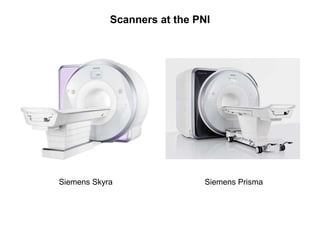
Scanners at the PNI
Siemens Skyra Siemens Prisma
The magnetic field
• MRI scanners create strong magnetic fields (between 1.5 and 7 Tesla)
• 1 Tesla = 10,000 Gauss
• The strength of the magnetic field of the earth ranges from 0.25 -0.65 Gauss
Risks associated with the magnetic field
• magnetic field can pick up even large magnetic objects and pull them into
the scanner bore with great velocity
• Rotation of metal objects that are located in the body
• Malfunction of electronic devices (e.g. pacemakers)
• Electric burns can arise from electrically conductive objects in the magenetic
field
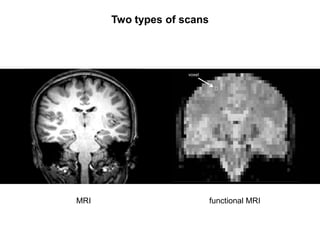
Two types of scans
MRI functional MRI
voxel
MRI physics (strongly oversimplified)
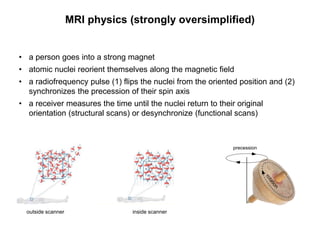
• a person goes into a strong magnet
• atomic nuclei reorient themselves along the magnetic field
• a radiofrequency pulse (1) flips the nuclei from the oriented position and (2)
synchronizes the precession of their spin axis
• a receiver measures the time until the nuclei return to their original
orientation (structural scans) or desynchronize (functional scans)
outside scanner inside scanner
precession
What is measured in fMRI?
• neurons consume oxygen and nutrients
• increased neural activity requires increased
supply of oxygen
• oxygen is bound to hemoglobin
(oxyhemoglobin vs. de-oxyhemoglobin)
• to supply neurons with oxygen and glucose,
blood flow is increased locally
• the local increase in blood flow leads to a
displacement of de-oxyhemoglobin
• MR signal is higher for oxygenated compared
to de-oxygenated blood
the blood oxygen level dependent (BOLD) response
300 10 20
0
time [s]
peak
undershoot
hemodynamic
lag
stimulus
time [s]
BOLD
stimulus
the BOLD response over time
A [BOLD] response is measured for every voxel
…
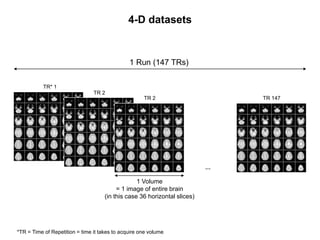
1 Volume
= 1 image of entire brain
(in this case 36 horizontal slices)
1 Run (147 TRs)
TR* 1
TR 2
TR 2 TR 147
*TR = Time of Repetition = time it takes to acquire one volume
4-D datasets
Outline of a scan session
1 Task instruction + safety screening
2 Put subject in the scanner
3 Localizer scan
4 Anatomical scan
5 Shimming
6 Test scan
7 Data collection
8 [Field map]
Today’s experiments
PSY101 . Lab 3 . Fall 2014
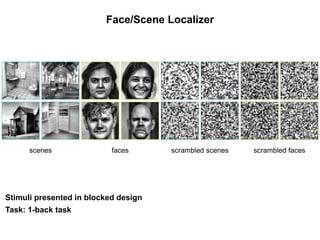
Face/Scene Localizer
scenes faces scrambled scenes scrambled faces
Stimuli presented in blocked design
Task: 1-back task
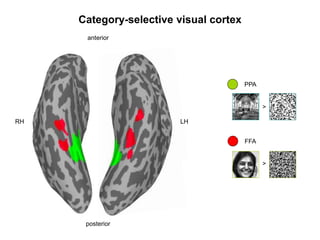
posterior
Category-selective visual cortex
anterior
LHRH
PPA
FFA
>
>
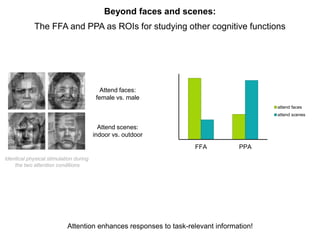
Beyond faces and scenes:
The FFA and PPA as ROIs for studying other cognitive functions
0
1
2
3
4
5
6
FFA PPA
attend faces
attend scenes
Attend faces:
female vs. male
Attend scenes:
indoor vs. outdoor
Attention enhances responses to task-relevant information!
Identical physical stimulation during
the two attention conditions
Introduction to fMRI analysis
PSY101 . Lab 3 . Fall 2014
Before we get started …
1. Log on to a Lab PC using the VMUser account
Username: .VMUser
Password: @psychLAB
2. Open VMWare Player
3. Within VMWare Player, open FSLVm6_64
Analysis occurs in two main steps
1 Preprocessing
2 Statistical analysis
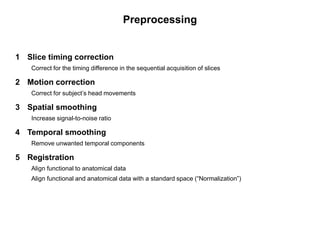
Preprocessing
1 Slice timing correction
Correct for the timing difference in the sequential acquisition of slices
2 Motion correction
Correct for subject’s head movements
3 Spatial smoothing
Increase signal-to-noise ratio
4 Temporal smoothing
Remove unwanted temporal components
5 Registration
Align functional to anatomical data
Align functional and anatomical data with a standard space (“Normalization”)
Slice-timing correction
• In our experiment we measured one
functional image (volume) of the brain every 2
seconds
• Each volume was acquired in 36 interleaved
horizontal slices
• This means that every slice was acquired at a
different time during the 2s TR
Space[slices]
time [s]
volume (TR) volume (TR)
1
36
18
Slice-timing correction
To correct for this difference in timing, time-
series in each slice is phase-shifted so that it
appears as if all slices were acquired at the
same time
Space[slices]
time [s]
volume (TR) volume (TR)
1
36
18
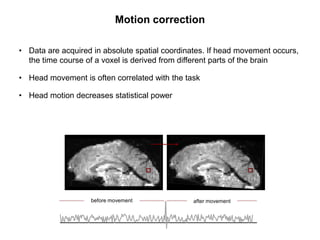
Motion correction
• Data are acquired in absolute spatial coordinates. If head movement occurs,
the time course of a voxel is derived from different parts of the brain
• Head movement is often correlated with the task
• Head motion decreases statistical power
before movement after movement
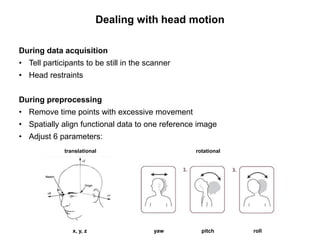
Dealing with head motion
During data acquisition
• Tell participants to be still in the scanner
• Head restraints
During preprocessing
• Remove time points with excessive movement
• Spatially align functional data to one reference image
• Adjust 6 parameters:
translational rotational
yaw pitch rollx, y, z
roll [°] pitch [°] yaw [°] I-S [mm] R-L [mm] A-P [mm]
Rotation Translation
Motion correction output
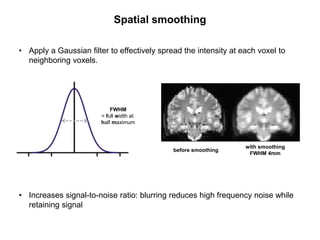
• Apply a Gaussian filter to effectively spread the intensity at each voxel to
neighboring voxels.
• Increases signal-to-noise ratio: blurring reduces high frequency noise while
retaining signal
Spatial smoothing
FWHM
= full width at
half maximum
before smoothing
with smoothing
FWHM 4mm
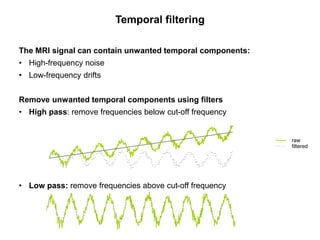
Temporal filtering
The MRI signal can contain unwanted temporal components:
• High-frequency noise
• Low-frequency drifts
Remove unwanted temporal components using filters
• High pass: remove frequencies below cut-off frequency
• Low pass: remove frequencies above cut-off frequency
raw
filtered
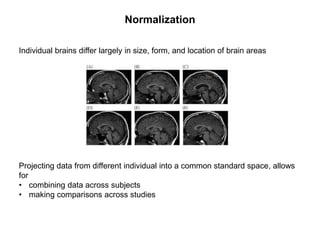
Normalization
Individual brains differ largely in size, form, and location of brain areas
Projecting data from different individual into a common standard space, allows
for
• combining data across subjects
• making comparisons across studies
Statistical analysis: regression
Core idea: observed data can be explained by a combination of weighted
regressors
Example: Explain miles per gallon (mpg) of a car, based on the car’s weight
and the driver’s height.
Observed data: mpg
Regressors: car’s weight, driver’s height
Weights: βcar’s weight = high; βdriver’s height = low
0
5
10
15
20
25
30
2 2.5 3 3.5 4 4.5 5
0
5
10
15
20
25
30
1.4 1.6 1.8 2 2.2
mpg
mpg
Driver’s height [m]Car’s weight [t]
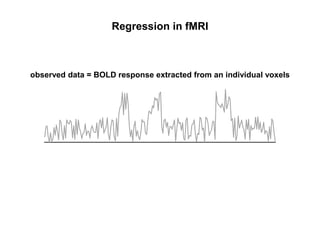
observed data = BOLD response extracted from an individual voxels
Regression in fMRI
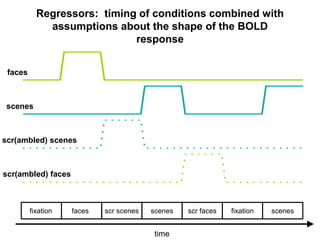
Regressors: timing of conditions combined with
assumptions about the shape of the BOLD
response
faces scenesscr scenes scr faces fixation scenesfixation
faces
scenes
scr(ambled) scenes
scr(ambled) faces
time
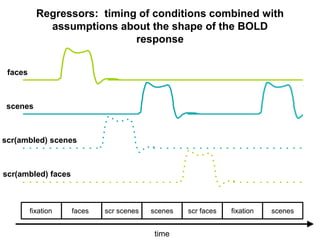
scr(ambled) scenes
scr(ambled) faces
faces scenesscr scenes scr faces fixation scenesfixation
faces
scenes
time
Regressors: timing of conditions combined with
assumptions about the shape of the BOLD
response
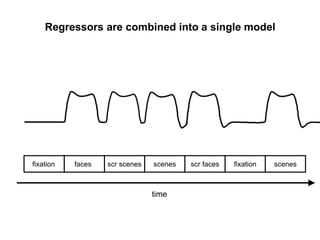
Regressors are combined into a single model
time
faces scenesscr scenes scr faces fixation scenesfixation
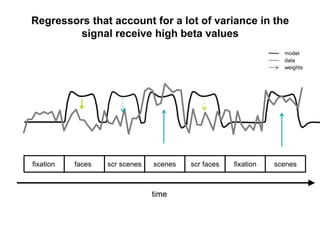
Regressors that account for a lot of variance in the
signal receive high beta values
time
faces scenesscr scenes scr faces fixation scenesfixation
model
data
weights
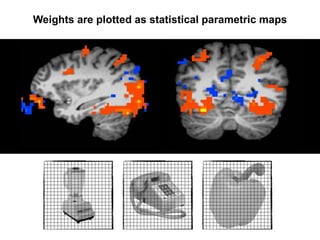
Weights are plotted as statistical parametric maps
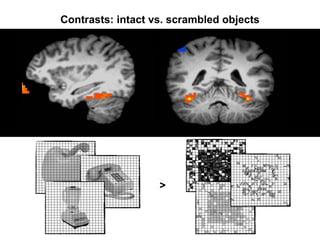
Contrasts: intact vs. scrambled objects
>
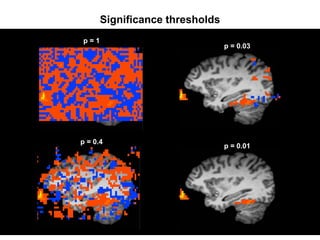
Significance thresholds
p = 1
p = 0.03
p = 0.4
p = 0.01
Before you leave …
1. Grab all the files you still need
2. Delete the firstlevel_R1.feat directory you created during your
analysis
3. Power off the virtual machine
4. Log off the Lab PC

Introduction to fMRI

  • 1.
  • 2.
    Scanners at thePNI Siemens Skyra Siemens Prisma
  • 3.
    The magnetic field •MRI scanners create strong magnetic fields (between 1.5 and 7 Tesla) • 1 Tesla = 10,000 Gauss • The strength of the magnetic field of the earth ranges from 0.25 -0.65 Gauss Risks associated with the magnetic field • magnetic field can pick up even large magnetic objects and pull them into the scanner bore with great velocity • Rotation of metal objects that are located in the body • Malfunction of electronic devices (e.g. pacemakers) • Electric burns can arise from electrically conductive objects in the magenetic field
  • 4.
    Two types ofscans MRI functional MRI voxel
  • 5.
    MRI physics (stronglyoversimplified) • a person goes into a strong magnet • atomic nuclei reorient themselves along the magnetic field • a radiofrequency pulse (1) flips the nuclei from the oriented position and (2) synchronizes the precession of their spin axis • a receiver measures the time until the nuclei return to their original orientation (structural scans) or desynchronize (functional scans) outside scanner inside scanner precession
  • 6.
    What is measuredin fMRI? • neurons consume oxygen and nutrients • increased neural activity requires increased supply of oxygen • oxygen is bound to hemoglobin (oxyhemoglobin vs. de-oxyhemoglobin) • to supply neurons with oxygen and glucose, blood flow is increased locally • the local increase in blood flow leads to a displacement of de-oxyhemoglobin • MR signal is higher for oxygenated compared to de-oxygenated blood
  • 7.
    the blood oxygenlevel dependent (BOLD) response 300 10 20 0 time [s] peak undershoot hemodynamic lag stimulus
  • 8.
  • 9.
    A [BOLD] responseis measured for every voxel
  • 10.
    … 1 Volume = 1image of entire brain (in this case 36 horizontal slices) 1 Run (147 TRs) TR* 1 TR 2 TR 2 TR 147 *TR = Time of Repetition = time it takes to acquire one volume 4-D datasets
  • 11.
    Outline of ascan session 1 Task instruction + safety screening 2 Put subject in the scanner 3 Localizer scan 4 Anatomical scan 5 Shimming 6 Test scan 7 Data collection 8 [Field map]
  • 12.
  • 13.
    Face/Scene Localizer scenes facesscrambled scenes scrambled faces Stimuli presented in blocked design Task: 1-back task
  • 14.
  • 15.
    Beyond faces andscenes: The FFA and PPA as ROIs for studying other cognitive functions 0 1 2 3 4 5 6 FFA PPA attend faces attend scenes Attend faces: female vs. male Attend scenes: indoor vs. outdoor Attention enhances responses to task-relevant information! Identical physical stimulation during the two attention conditions
  • 16.
    Introduction to fMRIanalysis PSY101 . Lab 3 . Fall 2014
  • 17.
    Before we getstarted … 1. Log on to a Lab PC using the VMUser account Username: .VMUser Password: @psychLAB 2. Open VMWare Player 3. Within VMWare Player, open FSLVm6_64
  • 18.
    Analysis occurs intwo main steps 1 Preprocessing 2 Statistical analysis
  • 19.
    Preprocessing 1 Slice timingcorrection Correct for the timing difference in the sequential acquisition of slices 2 Motion correction Correct for subject’s head movements 3 Spatial smoothing Increase signal-to-noise ratio 4 Temporal smoothing Remove unwanted temporal components 5 Registration Align functional to anatomical data Align functional and anatomical data with a standard space (“Normalization”)
  • 20.
    Slice-timing correction • Inour experiment we measured one functional image (volume) of the brain every 2 seconds • Each volume was acquired in 36 interleaved horizontal slices • This means that every slice was acquired at a different time during the 2s TR Space[slices] time [s] volume (TR) volume (TR) 1 36 18
  • 21.
    Slice-timing correction To correctfor this difference in timing, time- series in each slice is phase-shifted so that it appears as if all slices were acquired at the same time Space[slices] time [s] volume (TR) volume (TR) 1 36 18
  • 22.
    Motion correction • Dataare acquired in absolute spatial coordinates. If head movement occurs, the time course of a voxel is derived from different parts of the brain • Head movement is often correlated with the task • Head motion decreases statistical power before movement after movement
  • 23.
    Dealing with headmotion During data acquisition • Tell participants to be still in the scanner • Head restraints During preprocessing • Remove time points with excessive movement • Spatially align functional data to one reference image • Adjust 6 parameters: translational rotational yaw pitch rollx, y, z
  • 24.
    roll [°] pitch[°] yaw [°] I-S [mm] R-L [mm] A-P [mm] Rotation Translation Motion correction output
  • 25.
    • Apply aGaussian filter to effectively spread the intensity at each voxel to neighboring voxels. • Increases signal-to-noise ratio: blurring reduces high frequency noise while retaining signal Spatial smoothing FWHM = full width at half maximum before smoothing with smoothing FWHM 4mm
  • 26.
    Temporal filtering The MRIsignal can contain unwanted temporal components: • High-frequency noise • Low-frequency drifts Remove unwanted temporal components using filters • High pass: remove frequencies below cut-off frequency • Low pass: remove frequencies above cut-off frequency raw filtered
  • 27.
    Normalization Individual brains differlargely in size, form, and location of brain areas Projecting data from different individual into a common standard space, allows for • combining data across subjects • making comparisons across studies
  • 28.
    Statistical analysis: regression Coreidea: observed data can be explained by a combination of weighted regressors Example: Explain miles per gallon (mpg) of a car, based on the car’s weight and the driver’s height. Observed data: mpg Regressors: car’s weight, driver’s height Weights: βcar’s weight = high; βdriver’s height = low 0 5 10 15 20 25 30 2 2.5 3 3.5 4 4.5 5 0 5 10 15 20 25 30 1.4 1.6 1.8 2 2.2 mpg mpg Driver’s height [m]Car’s weight [t]
  • 29.
    observed data =BOLD response extracted from an individual voxels Regression in fMRI
  • 30.
    Regressors: timing ofconditions combined with assumptions about the shape of the BOLD response faces scenesscr scenes scr faces fixation scenesfixation faces scenes scr(ambled) scenes scr(ambled) faces time
  • 31.
    scr(ambled) scenes scr(ambled) faces facesscenesscr scenes scr faces fixation scenesfixation faces scenes time Regressors: timing of conditions combined with assumptions about the shape of the BOLD response
  • 32.
    Regressors are combinedinto a single model time faces scenesscr scenes scr faces fixation scenesfixation
  • 33.
    Regressors that accountfor a lot of variance in the signal receive high beta values time faces scenesscr scenes scr faces fixation scenesfixation model data weights
  • 34.
    Weights are plottedas statistical parametric maps
  • 35.
    Contrasts: intact vs.scrambled objects >
  • 36.
    Significance thresholds p =1 p = 0.03 p = 0.4 p = 0.01
  • 37.
    Before you leave… 1. Grab all the files you still need 2. Delete the firstlevel_R1.feat directory you created during your analysis 3. Power off the virtual machine 4. Log off the Lab PC

Editor's Notes

  • #6 Precession The movement of a rotating proton within a magnetic field is similar to the movement of a top in the earth’s gravitational field. In addition to the spinning motion, axis of spin itself moves around the main axis of the magnetic field. This motion is know as precession.
  • #7 Precession