Take a look inside! 
Electrical S+mula+on ‐ ESB 
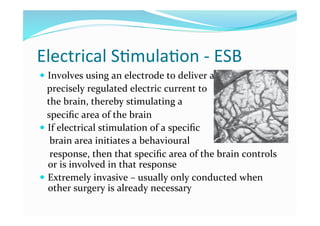
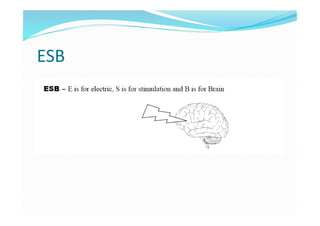
  Involves using an electrode to deliver a  
   precisely regulated electric current to  
   the brain, thereby stimulating a  
   specific area of the brain 
  If electrical stimulation of a specific  
    brain area initiates a behavioural  
    response, then that specific area of the brain controls 
   or is involved in that response 
  Extremely invasive – usually only conducted when 
   other surgery is already necessary  
Transcranial Magne+c S+mula+on TMS 
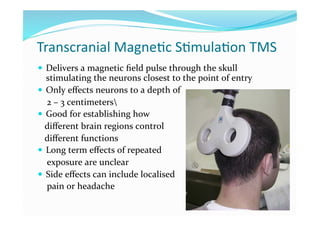
  Delivers a magnetic field pulse through the skull 
    stimulating the neurons closest to the point of entry 
  Only effects neurons to a depth of  
    2 – 3 centimeters 
  Good for establishing how  
   different brain regions control  
   different functions 
  Long term effects of repeated  
    exposure are unclear 
  Side effects can include localised  
    pain or headache 
Computerised axial tomography (CAT) Scan 
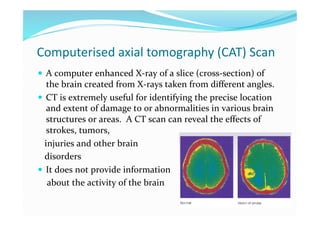
  A computer enhanced X‐ray of a slice (cross‐section) of 
    the brain created from X‐rays taken from different angles. 
  CT is extremely useful for identifying the precise location 
    and extent of damage to or abnormalities in various brain 
    structures or areas.  A CT scan can reveal the effects of 
    strokes, tumors, 
   injuries and other brain  
   disorders 
  It does not provide information  
    about the activity of the brain 
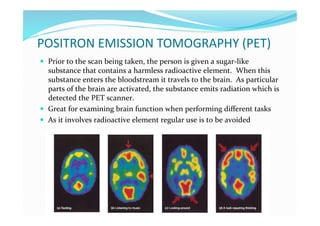
POSITRON EMISSION TOMOGRAPHY (PET) 
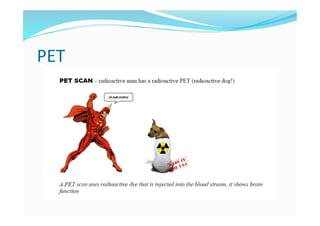
  Prior to the scan being taken, the person is given a sugar‐like 
   substance that contains a harmless radioactive element.  When this 
   substance enters the bloodstream it travels to the brain.  As particular 
   parts of the brain are activated, the substance emits radiation which is 
   detected the PET scanner. 
  Great for examining brain function when performing different tasks 
  As it involves radioactive element regular use is to be avoided 
Single photon emission cpmputed 
tomography (SPECT) 
  Similar to PET 
  Radioactive tracer lasts longer 
  Not as detailed as PET 
  Can be combined with CT images to increase 
   resolution 
  Much cheaper than PET 
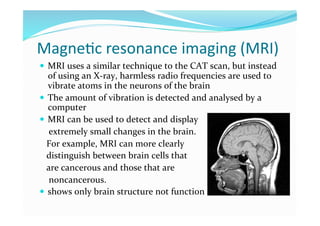
Magne+c resonance imaging (MRI) 
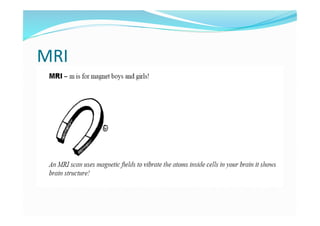
  MRI uses a similar technique to the CAT scan, but instead 
    of using an X‐ray, harmless radio frequencies are used to 
    vibrate atoms in the neurons of the brain 
  The amount of vibration is detected and analysed by a 
    computer  
  MRI can be used to detect and display  
    extremely small changes in the brain.  
   For example, MRI can more clearly  
   distinguish between brain cells that  
   are cancerous and those that are  
    noncancerous. 
  shows only brain structure not function 
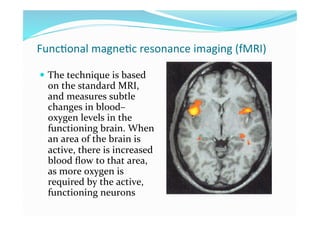
Func+onal magne+c resonance imaging (fMRI) 

  The technique is based 
  on the standard MRI, 
  and measures subtle 
  changes in blood–
  oxygen levels in the 
  functioning brain. When 
  an area of the brain is 
  active, there is increased 
  blood flow to that area, 
  as more oxygen is 
  required by the active, 
  functioning neurons 
X‐RAY CAT 
MRI 
F‐MRI 
PET  
ESB 

Brain imaging.pdf