Neuroimaging Introduction
Feature Group Meeting
August 16, 2012
Introduction
• The Human Brain
– What are we trying to look at?
• Modalities
– How do we measure?
• Data
• The Informatics Landscape
– Processing Pipeline
– Why?
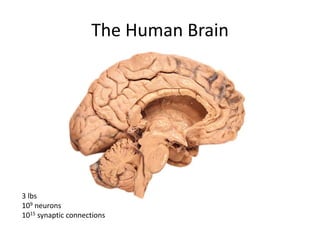
The Human Brain
3 lbs
109 neurons
1015 synaptic connections
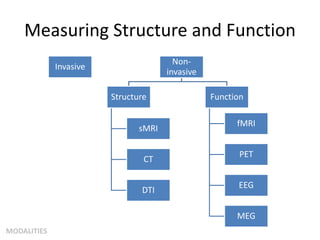
Measuring Structure and Function
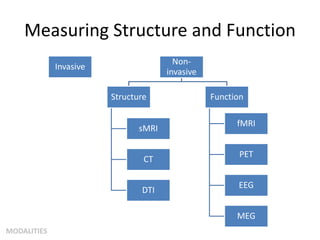
Invasive
Non-
invasive
Structure
sMRI
CT
DTI
Function
fMRI
PET
EEG
MEG
MODALITIES
Measuring Structure and Function
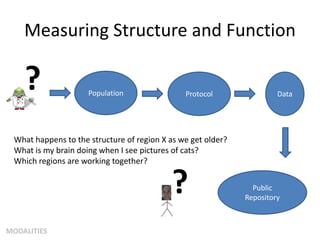
? Population Protocol Data
What happens to the structure of region X as we get older?
What is my brain doing when I see pictures of cats?
Which regions are working together?
? Public
Repository
MODALITIES
Measuring Structure and Function
Invasive
Non-
invasive
Structure
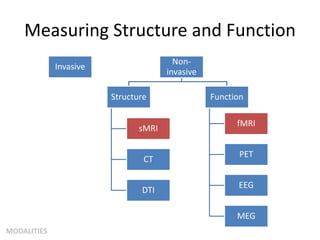
sMRI
CT
DTI
Function
fMRI
PET
EEG
MEG
MODALITIES
Measuring Structure and Function
Invasive
Non-
invasive
Structure
sMRI
CT
DTI
Function
fMRI
PET
EEG
MEG
MODALITIES
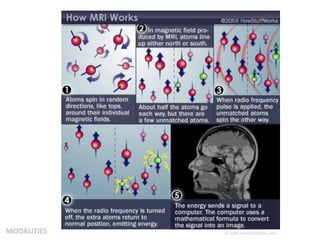
MODALITIES © 2008 HowStuffWorks.com
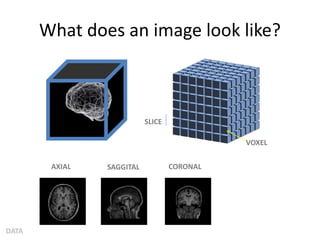
What does an image look like?
DATA
SLICE
VOXEL
AXIAL SAGGITAL CORONAL
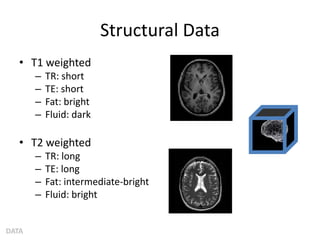
Structural Data
• T1 weighted
– TR: short
– TE: short
– Fat: bright
– Fluid: dark
• T2 weighted
– TR: long
– TE: long
– Fat: intermediate-bright
– Fluid: bright
DATA
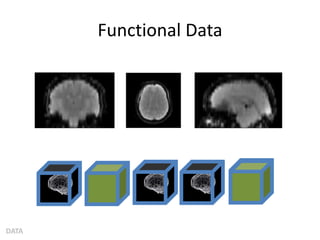
Functional Data
DATA
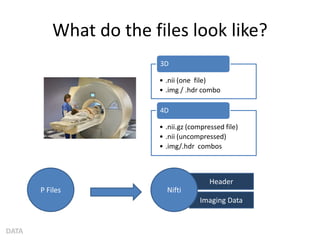
What do the files look like?
DATA
P Files
Imaging Data
Header
Nifti
• .nii (one file)
• .img / .hdr combo
3D
• .nii.gz (compressed file)
• .nii (uncompressed)
• .img/.hdr combos
4D
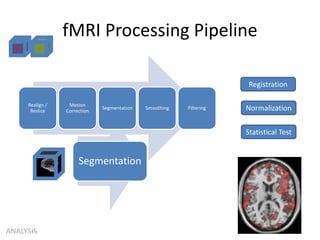
Segmentation
Realign /
Reslice
Motion
Correction
Segmentation Smoothing Filtering
fMRI Processing Pipeline
ANALYSIS
Registration
Normalization
Statistical Test
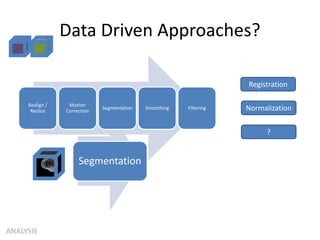
Segmentation
Realign /
Reslice
Motion
Correction
Segmentation Smoothing Filtering
Data Driven Approaches?
ANALYSIS
Registration
Normalization
?
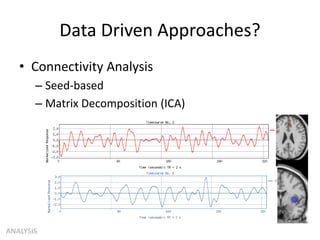
Data Driven Approaches?
ANALYSIS
• Connectivity Analysis
– Seed-based
– Matrix Decomposition (ICA)
Independent Component Analysis (ICA)
ANALYSIS
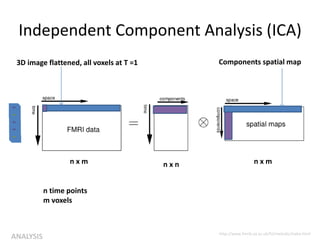
• One 3D image [ v1 v2 v3 v4… v4 ]
• 4D Image Matrix, M
v1 v2 v3 v4 v5 v6 v7 . . . vn
Voxels
Time
Independent Component Analysis (ICA)
http://www.fmrib.ox.ac.uk/fsl/melodic/index.html
ANALYSIS
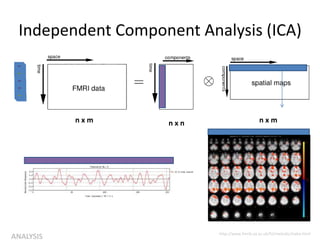
n x m n x n n x m
n time points
m voxels
3D image flattened, all voxels at T =1 Components spatial map
Independent Component Analysis (ICA)
http://www.fmrib.ox.ac.uk/fsl/melodic/index.html
ANALYSIS
n x m n x n n x m
Independent Component Analysis (ICA)
http://www.fmrib.ox.ac.uk/fsl/melodic/index.html
ANALYSIS
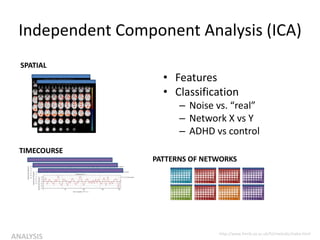
• Features
• Classification
– Noise vs. “real”
– Network X vs Y
– ADHD vs control
SPATIAL
TIMECOURSE
PATTERNS OF NETWORKS
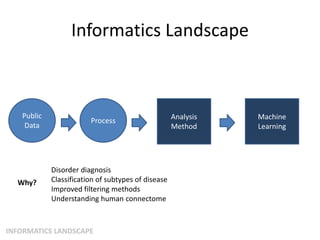
Informatics Landscape
INFORMATICS LANDSCAPE
Analysis
Method
Public
Data
Process Machine
Learning
Disorder diagnosis
Classification of subtypes of disease
Improved filtering methods
Understanding human connectome
Why?
Thank You!
vsochat@stanford.edu

Neuroimaging Introduction

Editor's Notes

  • #4 We have people in this room that study livers, breasts, eyes, and in terms of imaging, the human brain is just another body tissue that we can image. It has structure, different regions, and looks like it’s innervated by blood vessesls. It’s generally 3 pounds, and it’s basic unit is the neuron. You will hear of different types of matter, gray and white, gray is “where stuff happens, the important regions” and white matter is the connections between those regions. So given that we have interesting structure and function, like with any tissue inside of the body, we use imaging as a non-invasive tool to try and understand how it works. And the technology that we use is guided by the questions that we have about the tissue. Photo credit: http://www.flickr.com/photos/17657816@N05/1971827663/
  • #5 Arguably, the most salient questions that we ask are going to be related to structure and function. So step 1 – how do we measure it? Two broad buckets – invasive or non-invasive. Invasive is things like single or multicellular recording, histology, not interested! Non-invasive is what is feasible for research, and imaging allows us to do that. ( talk about each one ) And the data that I am going to be talking about today is general structural and functional MRI. Structure is getting at the composition and size of things, and function is getting at neural activity. So this is our toolkit of imaging modalities, what do we do next?
  • #6 If you are a researcher, you probably have a question related to structure of function, possibly looking at a difference between two groups, healthy and diseased, or even how something changes over time. I gather my population of interest. What next? Identify a population (disease and control) Scan protocol Population Protocol (mix structure and function based on questions we want to answer) Use data to answer question! These are examples of questions – the first is getting at structure, the second at function, and the third at what is called connectivity, idea of brain networks But what about me? This would take lots of money and lots of time, what if I have a question? This is where informatics comes in, and the importance of data sharing. Most researchers, given cost and time, protect data. Good news: Public repositories!
  • #7 To jump back to our toolkit of imaging modalities. The most common ones that we find that are publicly available, probably because they can answer the most questions, are structural and functional MRI
  • #8 To jump back to our toolkit of imaging modalities. The most common ones that we find that are publicly available, probably because they can answer the most questions, are structural and functional MRI. I will focus on these for the rest of the presentation.
  • #9 As a reminder, MRI stands for magnetic resonance imaging, and the idea is that you can measure how an atom responds when exposed to a magnetic field, and use differences in different types of tissues to produce an image.
  • #10 So now we are going to transition into talking about the data. What does an image look like? As a reminder, we are interested in structure and function. Basic image for either – 3D. It’s basically a bunch of 2D images stacked on top of one another. So typically when we have just raw data, we have a 3D matrix of numbers. Voxels (2-4 mm)
  • #11 You hear people talking about all these types of Ts! Namely, T1 and T2. These are both structural MRI, but they are referring to two different pulse sequences, or ways of collecting the data. Both are interested in that measure that we talked about: how quickly our atoms returned to their baseline position. The sequences differ at the rate at which the pulses are given (TR) and how often we listen (TE). For T1 weighted, we have a short TE and TR. So something like water has low magnetization after a pulse, so it emits a lot signal  dark For T2 weighted, we are emitting fewer pulses (a longer TR) and also listening less frequently (a longer TE) Most imaging studies like T1 because we don’t care as much about csf, and seems to be finer detail with regard to matter types. T1 weighted TR: short TE: short fat: bright fluid: dark T2 weighted (edema, blood) TR: long TE: long fat: intermediate-bright fluid: bright ONE 3D image
  • #12 For functional data, the idea is that we are measuring neural activity. Resolution is similar (voxels, 2-3 mm, collected frequently TR = 2 but we are looking at changes in neural activity reflected by the BOLD response, or changes in the amount of hemoglobin in blood. There are different scan protocols that are fine tuned to get at this measure, of which I am not an expert, but I typically see sense spiral. But it wouldn’t be enough to have a single 3D brain, and so this is where we expand our data to 4D. You can think of this like a string of brains. And we might have a particular task, like looking at cats, that is present in some timepoints but not others, so we could calculate a contrast, or the difference between these two conditions, an subtract one from the other to understand what regions are acting differently between experiment and control. the fact that when a region of the brain is active, blood rushes there, called the BOLD response. So let’s say that we have a region that is active when we look at pictures of cats. When we see a cat, blood will rush there to meet the energy demands, and the vascular system overcompensates and the amount of oxygenated hemoglogin increases relative to deoxygenated hemoglobin. The deoxygenated hemoglobin is what we are measuring. The lack of oxygen changes the magnetic properties that the eventual decay induced by MRI is different. fMRI data usually looks sort of fuzzy, and “The blood-flow change is localized to within 2 or 3 mm of where the neural activity is. Usually the brought-in oxygen is more than the oxygen consumed in burning glucose (it is not yet settled whether most glucose consumption is oxidative), and this causes a net decrease in dHb in that brain area's blood vessels. This changes the magnetic property of the blood, making it interfere less with the magnetization and its eventual decay induced by the MRI process.”
  • #13 There are many different software packages for looking at data, but like most things in informatics we’ve developed a standard, called the nifti image. There are different extensions for 3D vs 4D data, and the big player packages out there are pretty good at using most of these types.
  • #14 We have our data, and we have our questions. Now what? I’m going to show you the most basic of processing pipelines for functional and structural data. In this case we’ve collected functional data with a task, and a structural scan A typical pipeline would include, for a single subject: Single subject versus group analysis Task vs. resting bold You can think of this as the most basic neuroanalysis method – the meat and potatoes of the field.
  • #15 What if the person is just lying there and doing nothing? Well, we would want to process our data in the same way, and if we are going to make comparisons across a large group, we would still want this normalization step. But then what? How do we investigate connectivity, brain networks, especially when we aren’t sure what we are looking for?
  • #16 This is where it’s helpful to think of neuroimaging analysis like signal anaysis. Each voxel has a timecourse, or its change in signal over time. So if we are interested in something like connectivity between voxel A and B, that might be represented as two correlated timecourses. So commonly researchers will have a hypothesis about connectivity, and use “seed voxels” to see if there is correlation, and then they might use another structural method like DTI to see if there is an actual white matter tract between those two regions. But what if we don’t have seeds? Or we like data driven approaches? This next method, which is called independent component analysis, is what I am primarily interested in, and the core of it is PCA, primary component analysis, which is a matrix decomposition.
  • #17 So let’s go back to our functional data. At this point we have a bunch of those 3D images, over time, and each 3D image is just a matrix of numbers. So let’s say that I take one 3D image, an entire brain at one point in time, and flatten it into a row vector. I’m then going to have a really long row of voxels, the entire thing for one timepoint, each column is a different voxel But remember that we have many 3D images. So let’s just stack them one on top of the other into a matrix! Now this looks like something that matlab, or whatever analysis program that is used, will like :O)
  • #18 This graphic shows the idea of matrix decomposition applied to fMRI. Row in matrix A is a flattened 3D image for all voxels over one time point Then we do matrix decomposition, and decompose into an n x n and n x m matrix Where a row in this matrix times a column in this one, gives me the original value The idea is that the rows of this middle matrix describe interesting components, or patterns of correlated voxels The rows of this matrix would be the spatial map for a particular component, because we have one timepoint, across all voxels. We can reconstruct this back into a 3D image The columns of this matrix are like looking at one voxel over time.
  • #19 So from this second matrix we get the spatial map to visualize the components described in this inner matrix (rows) and we can also look at the columns of this inner matrix to get the “timecourse” of the entire component.
  • #20 So we start with preprocessed resting BOLD data, for one person, and we can derive all of that persons functional networks, and from there there are many possibilities, and again, this is what I’ll be talking about with you guys in future presentations: If the spatial maps and the timecourses have features, then we could use these features to distinguish noise from real network, or network X from network Y We could look for differences in a particular network between groups And what I am currently working on, looking at patterns of the networks themselves as a possibly way to diagnose disorder.
  • #21 In summary, I’m going to show everything that I’ve talked about in the context of an informatics landscape n summary – public repositories  data I get the data, I preprocess it how I like, so it is clean, filtered, normalized to a standard, and ready for something I then do a standard statistical analysis with block design, or another data driven approach to derive a significant difference in activation, or functional networks. I get out some maps that might represent functional networks, significant differences in structure of function between groups, and then I can use machine learning to do things like build a classifier to distinguish different types. This is useful for: Classifying subtypes of disease Disorder diagnosis