Outline
Understanding of keyterms
• Biochemistry
• Cell
• Metabolism
• Importance of metabolism
• Role of enzymes in metabolism
• Metabolic path way.
3.
What is Biochemistry
•Biochemistryis the application of chemistry to
the study of biological processes at the cellular
and molecular level.
•It emerged as a distinct discipline around the
beginning of the 20th century when scientists
combined chemistry, physiology and biology to
investigate the chemistry of living systems by:
4.
A. Studying thestructure and behavior of the
complex molecules found in biological
materials and
B. The ways these molecules interact to form
cells, tissues and whole organism
Biochemistry has become the foundation for
understanding all biological processes. It has
provided explanations for the causes of many
diseases in humans, animals and plants."
5.
Principles of Biochemistry
•Cells (basic structural units of living organisms) are highly organized
and constant source of energy is required to maintain the ordered
state.
• Living processes contains thousands of chemical reactions. Precise
regulation and integration of these reactions are required to maintain
life
• Certain important reactions E.g. Glycolysis is found in almost all
organisms.
• All organisms use the same type of molecules: CHO, proteins, lipids &
nucleic acids.
• Instructions for growth, reproduction and developments for each
organism is encoded in their DNA
6.
What is acell?
• The word cell comes from the Latin word "cella", meaning
"small room", and it was first coined by a microscopist
observing the structure of cork.
• The cell is the basic unit of all living things, and all organisms
are composed of one or more cells.
• Cells are so basic and critical to the study of life, in fact, that
they are often referred to as "the building blocks of life".
• Organisms - bacteria, amoebae and yeasts, for example -
may consist of as few as one cell, while a typical human body
contains about a trillion cells.
• Metabolism isa network of metabolic /biochemical
reactions.
• Carried out in living cells.
• In a well organized, integrated and regulated manner.
• Related to various biomolecules viz
• Carbohydrates
• Lipids
• Proteins
• Nucleoproteins
9.
•Metabolism involves
interconversions ofchemical
compounds in the body.
• Metabolite precursors are
transformed to end products via
many specific intermediates.
10.
•Metabolism is thesum of the
chemical changes that convert:
•Nutrients into energy.
•Chemically complex substances of
cells into simpler forms.
•Chemically simple substances into
functional complex biomolecules.
11.
The Sun isEnergy for Life
Phototrophs (Plants) use light to drive
synthesis of organic molecules.
Heterotrophs (Animals) use these as
building blocks.
CO2,O2 and H2O are recycled.
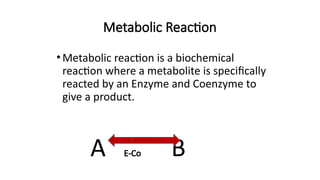
Metabolic Reaction
•Metabolic reactionis a biochemical
reaction where a metabolite is specifically
reacted by an Enzyme and Coenzyme to
give a product.
A E-Co B
20.
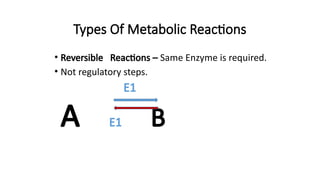
Types Of MetabolicReactions
• Reversible Reactions – Same Enzyme is required.
• Not regulatory steps.
E1
A E1 B
Metabolic Pathway
•Metabolic pathwayis a series of well
defined and significant biochemical
reactions followed one after another
giving intermediate products and
finally end product of the pathway.
25.
Types Of MetabolicPathway
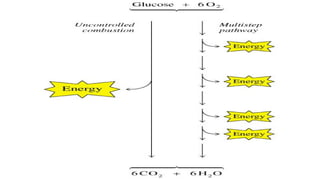
•Catabolic/Degradative /Energy
Generating/ATP producing
Pathways/Exothermic.
•Anabolic/Synthetic/Energy Utilizing/
ATP Using Pathways/Endothermic.
•Regulation means stimulationand
inhibition of pathways as per cellular
need.
•Hormones regulate the metabolic
pathways.
•Metabolic pathways are regulated to
allow the organism to respond to
changing conditions.
34.
•Every metabolic pathwayhas its
specific regulatory enzymes/key
enzymes.
•Hormones regulate by either
stimulating /inhibiting the
regulatory/key enzymes of the
pathway.
35.
•Knowledge of normalmetabolism
is essential for :
•Understanding adaptations of
Starvation
Exercise
Pregnancy and lactation.
•Understanding of metabolic
disorders.
36.
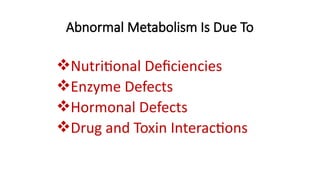
Abnormal Metabolism IsDue To
Nutritional Deficiencies
Enzyme Defects
Hormonal Defects
Drug and Toxin Interactions