• Metabolism isa network of metabolic /biochemical
reactions.
• Carried out in living cells.
• In a well organized, integrated and regulated manner.
• Related to various biomolecules viz
• Carbohydrates
• Lipids
• Proteins
• Nucleoproteins
4.
•Metabolism involves
interconversions ofchemical
compounds in the body.
• Metabolite precursors are
transformed to end products via
many specific intermediates.
5.
•Metabolism is thesum of the
chemical changes that convert:
•Nutrients into energy.
•Chemically complex substances of
cells into simpler forms.
•Chemically simple substances into
functional complex biomolecules.
6.
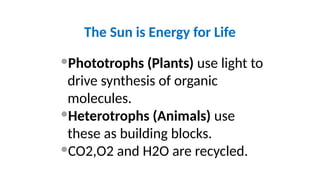
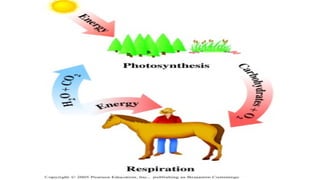
The Sun isEnergy for Life
Phototrophs (Plants) use light to
drive synthesis of organic
molecules.
Heterotrophs (Animals) use
these as building blocks.
CO2,O2 and H2O are recycled.
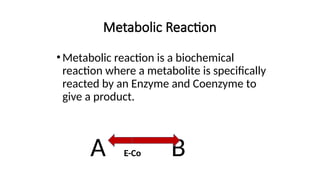
Metabolic Reaction
•Metabolic reactionis a biochemical
reaction where a metabolite is specifically
reacted by an Enzyme and Coenzyme to
give a product.
A E-Co B
15.
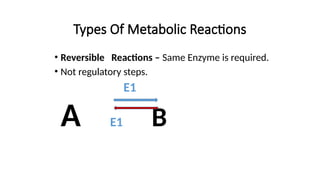
Types Of MetabolicReactions
• Reversible Reactions – Same Enzyme is required.
• Not regulatory steps.
E1
A E1 B
Metabolic Pathway
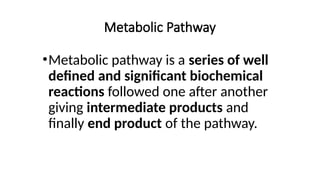
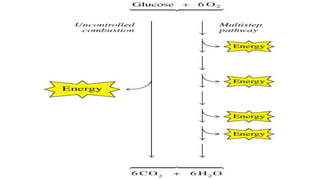
•Metabolic pathwayis a series of well
defined and significant biochemical
reactions followed one after another
giving intermediate products and
finally end product of the pathway.
21.
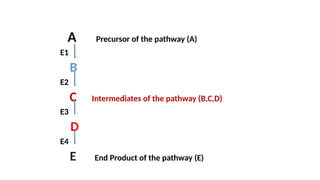
A Precursor ofthe pathway (A)
E1
B
E2
C Intermediates of the pathway (B,C,D)
E3
D
E4
E End Product of the pathway (E)
22.
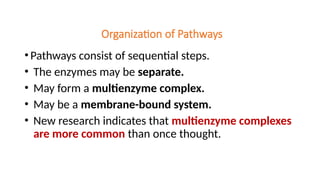
Organization of Pathways
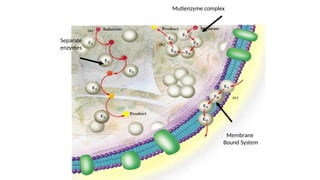
•Pathwaysconsist of sequential steps.
• The enzymes may be separate.
• May form a multienzyme complex.
• May be a membrane-bound system.
• New research indicates that multienzyme complexes
are more common than once thought.
Types Of MetabolicPathway
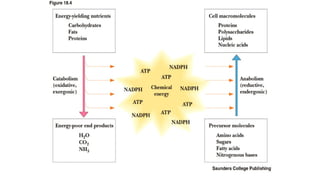
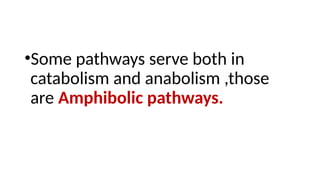
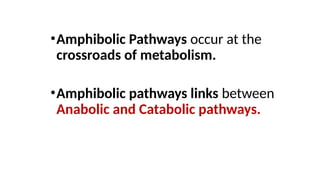
•Catabolic/Degradative /Energy
Generating/ATP producing
Pathways/Exothermic.
•Anabolic/Synthetic/Energy Utilizing/
ATP Using Pathways/Endothermic.
•Regulation means stimulationand
inhibition of pathways as per cellular
need.
•Hormones regulate the metabolic
pathways.
•Metabolic pathways are regulated to
allow the organism to respond to
changing conditions.
36.
•Every metabolic pathwayhas its
specific regulatory enzymes/key
enzymes.
•Hormones regulate by either
stimulating /inhibiting the
regulatory/key enzymes of the
pathway.
37.
Modes Of MetabolicRegulation
• Allosteric regulation
• Covalent modification
• Control of enzyme levels
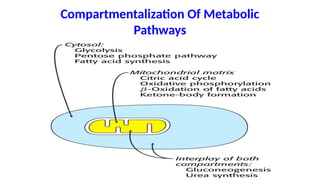
• Compartmentalization
• Metabolic specialization of organs
38.
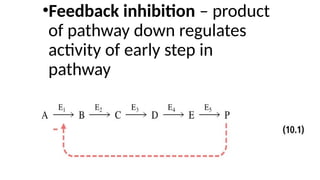
•Feedback inhibition –product
of pathway down regulates
activity of early step in
pathway
Regulating Related Catabolicand Anabolic Pathways
• Anabolic & catabolic pathways involving the
same compounds are not the same.
• Some steps may be common to both
• Others must be different - to ensure that each
pathway is spontaneous.
• This also allows regulation mechanisms to
turn one pathway onn and the other off.
41.
Modes Of EnzymesRegulation
•Alteration in membrane permeability.
•Conversion of Inactive to Active form.
•Stimulation of mRNA translation.
•Induction of new mRNA formation.
•Repression of mRNA formation.
42.
•Knowledge of normal
metabolismis essential for :
•Understanding adaptations of
Starvation
Exercise
Pregnancy and lactation.
•Understanding of metabolic
disorders.
43.
Abnormal Metabolism IsDue To
Nutritional Deficiencies
Enzyme Defects
Hormonal Defects
Drug and Toxin Interactions
44.
•Normal Enzyme andHormonal
activities gives normal
metabolism and health to
human body.
•Defect in Enzymes and
Hormones derange the normal
metabolism.
45.
Derangement in Metabolism
•Anydefect or derangement in normal pattern of
metabolism leads to metabolic disorders.
•Mutation in Genes of Enzymes, forms defective
Enzymes.
•Congenital defect of Enzyme leads to Inborn
Error Of Metabolism.
46.
Inborn Error OfMetabolism
•Congenital deficiency of any
single Enzyme of a metabolic
pathway leads to Inborn
Errors of Metabolism.
47.
Enzyme Deficiency ofa Metabolic Pathway
• Blocks the metabolic reaction.
• Blocks the metabolic pathway.
• Accumulates and excrete intermediate
product of the pathway.
• No formation of end product of the
pathway.
• Affects other interrelated metabolic
pathways.
48.
Methods Used toStudy Metabolism
•Metabolic Reactions/Metabolic
Pathways were studied :
•Using whole organism/Cellular
fractions
•Using Metabolic Probes.
•Using Radioisotopes.