Disaccharides
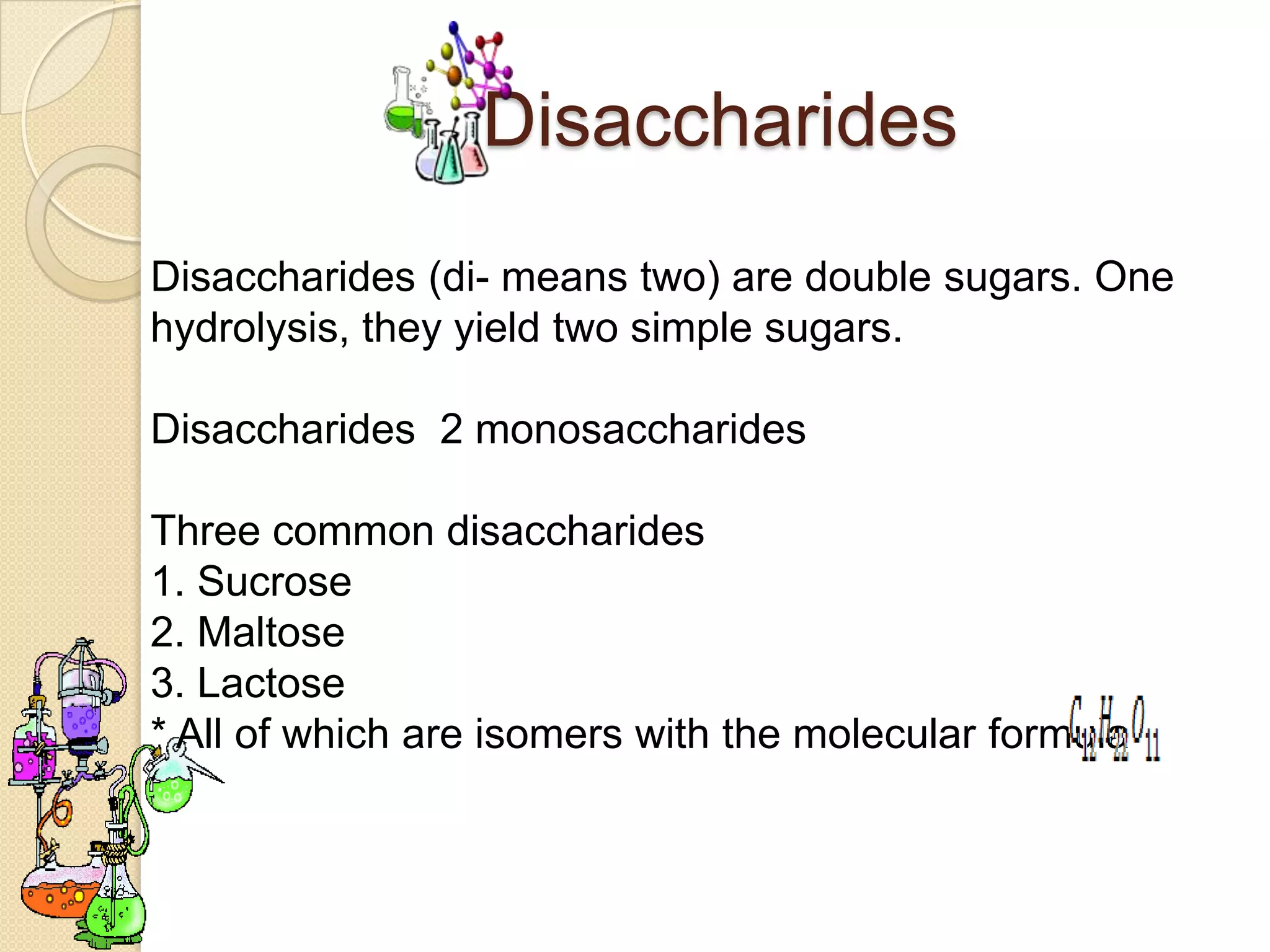
Disaccharides (di- means two) are double sugars. One
hydrolysis, they yield two simple sugars.

Disaccharides 2 monosaccharides

Three common disaccharides
1. Sucrose
2. Maltose
3. Lactose
* All of which are isomers with the molecular formula
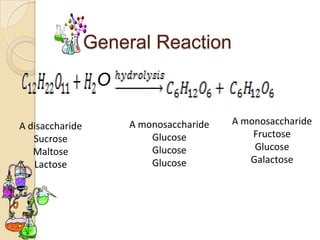
General Reaction
                  O

A disaccharide        A monosaccharide   A monosaccharide
   Sucrose                Glucose            Fructose
   Maltose                Glucose            Glucose
   Lactose                Glucose           Galactose
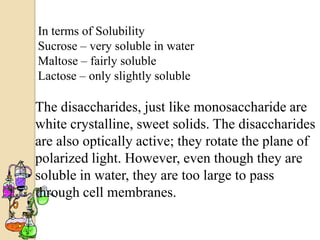
In terms of Solubility
Sucrose – very soluble in water
Maltose – fairly soluble
Lactose – only slightly soluble

The disaccharides, just like monosaccharide are
white crystalline, sweet solids. The disaccharides
are also optically active; they rotate the plane of
polarized light. However, even though they are
soluble in water, they are too large to pass
through cell membranes.
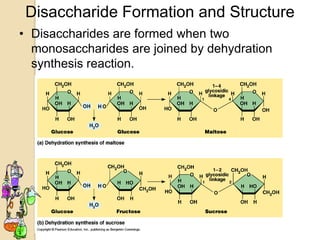
Disaccharide Formation and Structure
• Disaccharides are formed when two
  monosaccharides are joined by dehydration
  synthesis reaction.
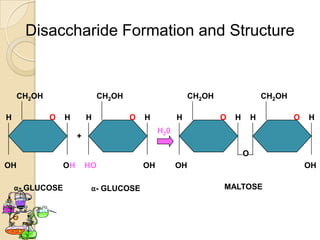
Disaccharide Formation and Structure


     CH2OH                     CH2OH                       CH2OH                   CH2OH

H            O   H        H            O   H          H            O   H       H           O   H
                                                H20
                      +

                                                                           O
OH               OH       HO               OH         OH                                       OH

    α- GLUCOSE             α- GLUCOSE                              MALTOSE
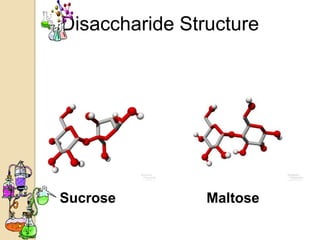
Disaccharide Structure


Sucrose         Maltose
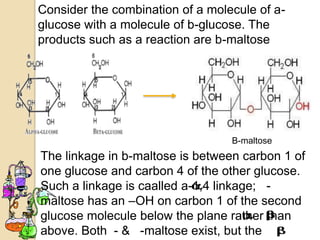
Consider the combination of a molecule of a-
glucose with a molecule of b-glucose. The
products such as a reaction are b-maltose


                                  B-maltose
The linkage in b-maltose is between carbon 1 of
one glucose and carbon 4 of the other glucose.
Such a linkage is caalled a-1,4 linkage; -
maltose has an –OH on carbon 1 of the second
glucose molecule below the plane rather than
above. Both - & -maltose exist, but the
 if a molecule of      -glucose combines with
another molecule of -glucose, cellobiose, a
compound with a        1-4 glycosidic linkage is
formed.
Enzymes are specific in the type of glycosidic
linkage ( or ) whose hydrolysis they can
catalyze.
Conversly, an enzyme that contains
catalyszes the hydrolysis of glycosidic linkages
catalyzes the hydrolysis of cellobiose. Such -
glycosidic linkage hydrolysis enzymes are not
found in the human digestive system. That is
why human cannot digest cellulose and
cellobiose, both of which have         glycosidic
linkages.
Reducing properties
In maltose
The aldehyde groups are at carbon 1 in each of the
original glucose molecules. Since the linkage is 1.4, one
free aldehyde group remains. Therefore, maltose acts as
a reducing sugar.

In sucrose
The glucose part had the aldehyde at carbon 1, and the
fructose part had the ketone group at carbon 2. since the
linkage is 1,2, neither group is free. Therefore, sucrose is
not a reducing sugar.

In lactose
Which has a 1,4-linkage, acts as a reducing sugar
because both of the original aldehyde group wre on
Fermentation
 Sucrose and maltose will ferment
  when yeast is added because
  yeast contains the enzyme sucrase
  and maltase.
 Lactose will not ferment because
  yeast does not contain lactase.
Testing for disaccharides

 The chemical reactions of these sugars
  can be used to distinguish them in the
  laboratory.
 If you have 2 test tubes containing a
  disaccharide,C12H22O11.To determine if
  it is sucrose lactose or maltose.
 We can use the alkaline Cu complex
  reaction of glucose and the principle of
  fermentation.
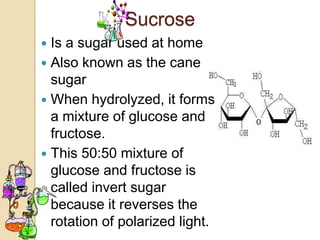
Sucrose
 Is a sugar used at home
 Also known as the cane
  sugar
 When hydrolyzed, it forms
  a mixture of glucose and
  fructose.
 This 50:50 mixture of
  glucose and fructose is
  called invert sugar
  because it reverses the
  rotation of polarized light.
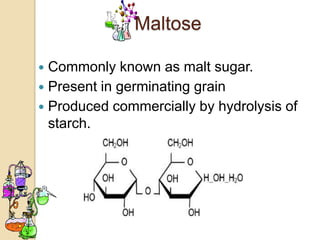
Maltose

 Commonly known as malt sugar.
 Present in germinating grain
 Produced commercially by hydrolysis of
  starch.
Lactose

 Commercially   known as milk
  sugar.
 Of animal origin
 Bacteria cause fermentation of
  lactose forming lactic acid.
 When these reaction occur ,it
  changes the taste to a sour one.

Disaccharides

  • 1.
    Disaccharides Disaccharides (di- meanstwo) are double sugars. One hydrolysis, they yield two simple sugars. Disaccharides 2 monosaccharides Three common disaccharides 1. Sucrose 2. Maltose 3. Lactose * All of which are isomers with the molecular formula
  • 2.
    General Reaction O A disaccharide A monosaccharide A monosaccharide Sucrose Glucose Fructose Maltose Glucose Glucose Lactose Glucose Galactose
  • 3.
    In terms ofSolubility Sucrose – very soluble in water Maltose – fairly soluble Lactose – only slightly soluble The disaccharides, just like monosaccharide are white crystalline, sweet solids. The disaccharides are also optically active; they rotate the plane of polarized light. However, even though they are soluble in water, they are too large to pass through cell membranes.
  • 4.
    Disaccharide Formation andStructure • Disaccharides are formed when two monosaccharides are joined by dehydration synthesis reaction.
  • 5.
    Disaccharide Formation andStructure CH2OH CH2OH CH2OH CH2OH H O H H O H H O H H O H H20 + O OH OH HO OH OH OH α- GLUCOSE α- GLUCOSE MALTOSE
  • 6.
  • 7.
    Consider the combinationof a molecule of a- glucose with a molecule of b-glucose. The products such as a reaction are b-maltose B-maltose The linkage in b-maltose is between carbon 1 of one glucose and carbon 4 of the other glucose. Such a linkage is caalled a-1,4 linkage; - maltose has an –OH on carbon 1 of the second glucose molecule below the plane rather than above. Both - & -maltose exist, but the
  • 8.
     if amolecule of -glucose combines with another molecule of -glucose, cellobiose, a compound with a 1-4 glycosidic linkage is formed. Enzymes are specific in the type of glycosidic linkage ( or ) whose hydrolysis they can catalyze. Conversly, an enzyme that contains catalyszes the hydrolysis of glycosidic linkages catalyzes the hydrolysis of cellobiose. Such - glycosidic linkage hydrolysis enzymes are not found in the human digestive system. That is why human cannot digest cellulose and cellobiose, both of which have glycosidic linkages.
  • 9.
    Reducing properties In maltose Thealdehyde groups are at carbon 1 in each of the original glucose molecules. Since the linkage is 1.4, one free aldehyde group remains. Therefore, maltose acts as a reducing sugar. In sucrose The glucose part had the aldehyde at carbon 1, and the fructose part had the ketone group at carbon 2. since the linkage is 1,2, neither group is free. Therefore, sucrose is not a reducing sugar. In lactose Which has a 1,4-linkage, acts as a reducing sugar because both of the original aldehyde group wre on
  • 10.
    Fermentation  Sucrose andmaltose will ferment when yeast is added because yeast contains the enzyme sucrase and maltase.  Lactose will not ferment because yeast does not contain lactase.
  • 11.
    Testing for disaccharides The chemical reactions of these sugars can be used to distinguish them in the laboratory.  If you have 2 test tubes containing a disaccharide,C12H22O11.To determine if it is sucrose lactose or maltose.  We can use the alkaline Cu complex reaction of glucose and the principle of fermentation.
  • 12.
    Sucrose  Is asugar used at home  Also known as the cane sugar  When hydrolyzed, it forms a mixture of glucose and fructose.  This 50:50 mixture of glucose and fructose is called invert sugar because it reverses the rotation of polarized light.
  • 13.
    Maltose  Commonly knownas malt sugar.  Present in germinating grain  Produced commercially by hydrolysis of starch.
  • 14.
    Lactose  Commercially known as milk sugar.  Of animal origin  Bacteria cause fermentation of lactose forming lactic acid.  When these reaction occur ,it changes the taste to a sour one.