Acid BaseAcid Base
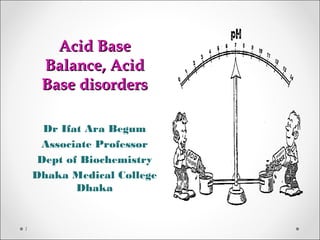
Balance, AcidBalance, Acid
Base disordersBase disorders
Dr Ifat Ara Begum
Associate Professor
Dept of Biochemistry
Dhaka Medical College
Dhaka
1
 
2
Some related
topics
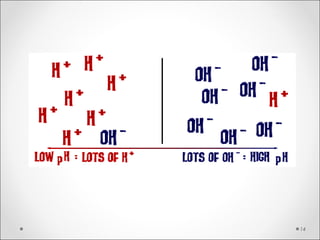
Acid & BaseAcid & Base
3
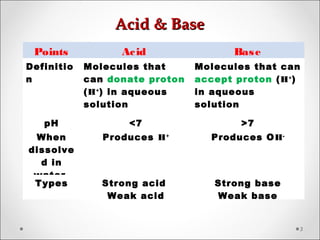
Points Acid Base
Definitio
n
Molecules that
can donate proton
(H+
) in aqueous
solution
Molecules that can
accept proton (H+
)
in aqueous
solution
pH <7 >7
When
dissolve
d in
water
Produces H+
Produces OH-
Types Strong acid
Weak acid
Strong base
Weak base
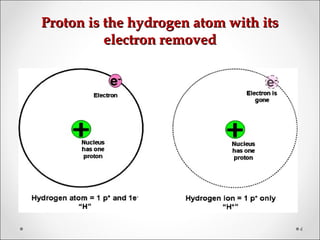
Proton is the hydrogen atom with itsProton is the hydrogen atom with its
electron removedelectron removed
4
5
6
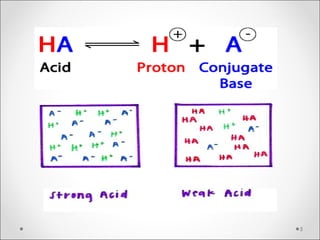
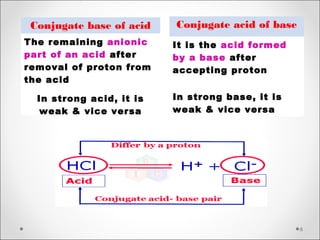
Conjugate base of acid
The remaining anionic
part of an acid after
removal of proton from
the acid
In strong acid, it is
weak & vice versa
Conjugate acid of base
It is the acid formed
by a base after
accepting proton
In strong base, it is
weak & vice versa
7
Strength of an acid / base
is defined in terms of the
tendency to donate (or
accept) the hydrogen ion to
(from) the solvent
(i.e. water in biological
systems)
Sources of Acid/Base in our bodySources of Acid/Base in our body
8
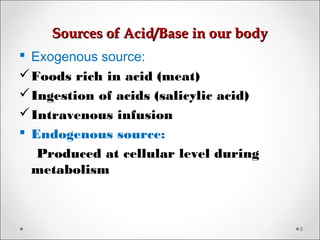
 Exogenous source:
Foods rich in acid (meat)
Ingestion of acids (salicylic acid)
Intravenous infusion
 Endogenous source:
Produced at cellular level during
metabolism
9
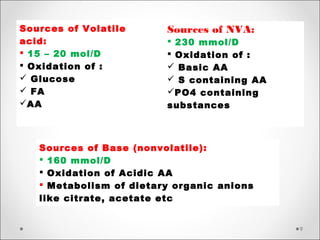
Sources of Volatile
acid:
 15 – 20 mol/D
 Oxidation of :
 Glucose
 FA
AA
Sources of NVA:
 230 mmol/D
 Oxidation of :
 Basic AA
 S containing AA
PO4 containing
substances
Sources of Base (nonvolatile):
 160 mmol/D
 Oxidation of Acidic AA
 Metabolism of dietary organic anions
like citrate, acetate etc
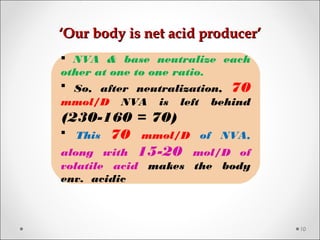
‘‘Our body is net acid producer’Our body is net acid producer’
10
 NVA & base neutralize each
other at one to one ratio.
 So, after neutralization, 70
mmol/D NVA is left behind
(230-160 = 70)
 This 70 mmol/D of NVA,
along with 15-20 mol/D of
volatile acid makes the body
env. acidic
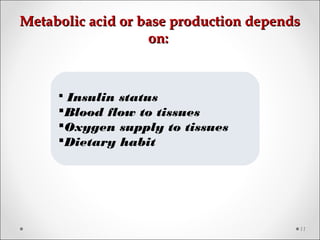
Metabolic acid or base production dependsMetabolic acid or base production depends
on:on:
11
 Insulin status
Blood flow to tissues
Oxygen supply to tissues
Dietary habit
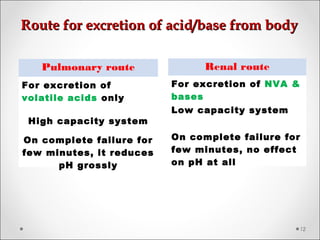
Route for excretion of acid/base from bodyRoute for excretion of acid/base from body
12
Pulmonary route
For excretion of
volatile acids only
High capacity system
On complete failure for
few minutes, it reduces
pH grossly
Renal route
For excretion of NVA &
bases
Low capacity system
On complete failure for
few minutes, no effect
on pH at all
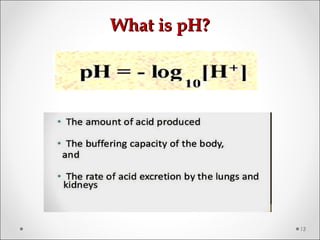
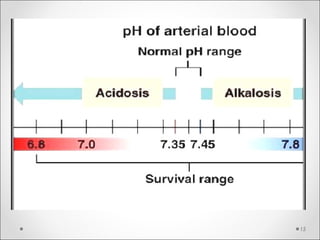
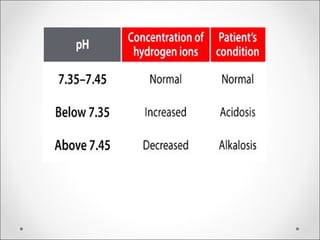
What is pH?What is pH?
13
14
15
How pH can be determined?How pH can be determined?
17
 Instrumentally by pH meter
 Using H-H Equation (From serum
HCO3 conc. & PCO2)
18
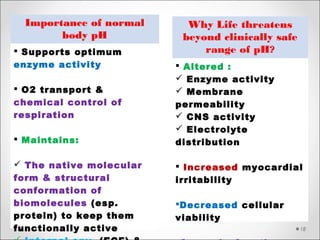
Importance of normal
body pH
 Supports optimum
enzyme activity
 O2 transport &
chemical control of
respiration
 Maintains:
 The native molecular
form & structural
conformation of
biomolecules (esp.
protein) to keep them
functionally active
Why Life threatens
beyond clinically safe
range of pH?
 Altered :
 Enzyme activity
 Membrane
permeability
 CNS activity
 Electrolyte
distribution
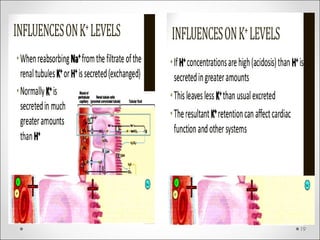
 Increased myocardial
irritability
Decreased cellular
viability
19
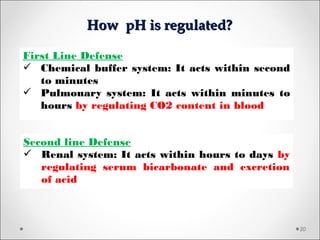
How pH is regulated?How pH is regulated?
20
First Line Defense
 Chemical buffer system: It acts within second
to minutes
 Pulmonary system: It acts within minutes to
hours by regulating CO2 content in blood
Second line Defense
 Renal system: It acts within hours to days by
regulating serum bicarbonate and excretion
of acid
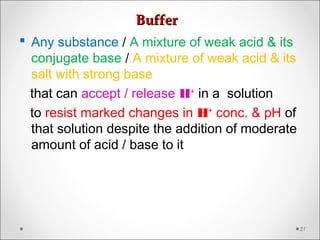
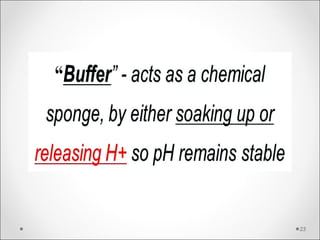
BufferBuffer
 Any substance / A mixture of weak acid & its
conjugate base / A mixture of weak acid & its
salt with strong base
that can accept / release H+
in a solution
to resist marked changes in H+
conc. & pH of
that solution despite the addition of moderate
amount of acid / base to it
21
 Principle of buffer action:
Conversion of strong acid in to weak acid
 Conversion of strong base in to weak base
22
23
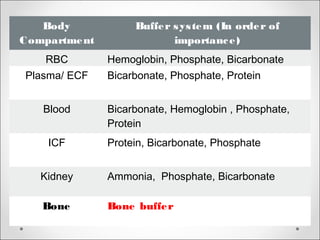
Body
Compartment
Buffer system (In order of
importance)
RBC Hemoglobin, Phosphate, Bicarbonate
Plasma/ ECF Bicarbonate, Phosphate, Protein
Blood Bicarbonate, Hemoglobin , Phosphate,
Protein
ICF Protein, Bicarbonate, Phosphate
Kidney Ammonia, Phosphate, Bicarbonate
Bone Bone buffer
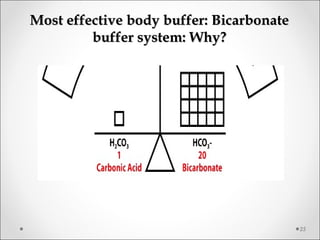
Most effective body buffer: BicarbonateMost effective body buffer: Bicarbonate
buffer system: Why?buffer system: Why?
25
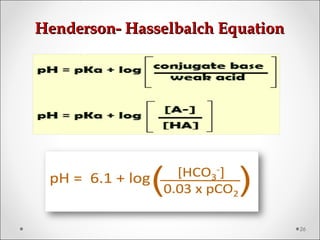
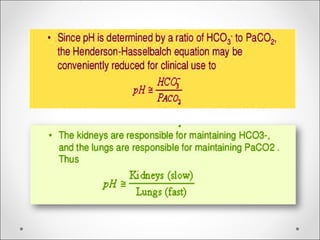
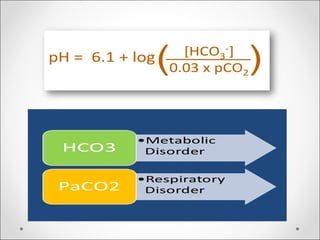
Henderson- Hasselbalch EquationHenderson- Hasselbalch Equation
26
 
28
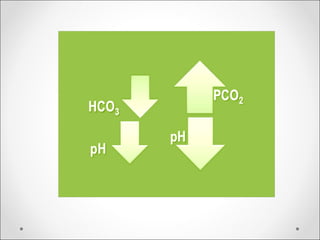
Acid Base
Disorders
32
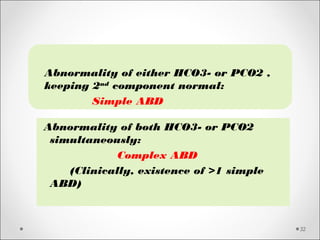
Abnormality of either HCO3- or PCO2 ,
keeping 2nd
component normal:
Simple ABD
Abnormality of both HCO3- or PCO2
simultaneously:
Complex ABD
(Clinically, existence of >1 simple
ABD)
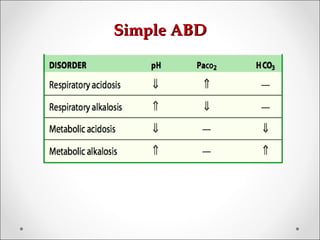
Simple ABDSimple ABD
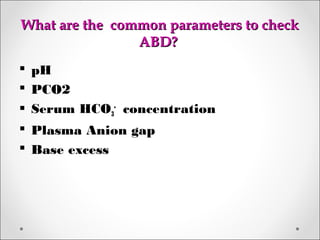
What are the common parameters to checkWhat are the common parameters to check
ABD?ABD?
 pH
 PCO2
 Serum HCO3
-
concentration
 Plasma Anion gap
 Base excess
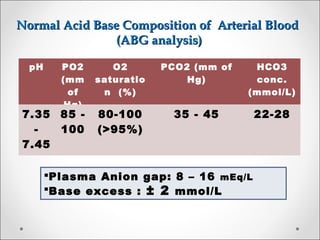
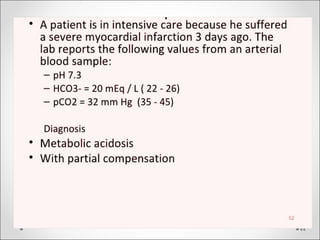
Normal Acid Base Composition of Arterial BloodNormal Acid Base Composition of Arterial Blood
(ABG analysis)(ABG analysis)
pH PO2
(mm
of
Hg)
O2
saturatio
n (%)
PCO2 (mm of
Hg)
HCO3
conc.
(mmol/L)
7.35
-
7.45
85 -
100
80-100
(>95%)
35 - 45 22-28
Plasma Anion gap: 8 – 16 mEq/L
Base excess : ± 2 mmol/L
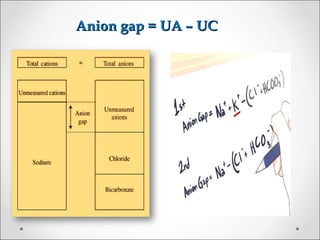
Anion gap = UA – UCAnion gap = UA – UC
BE = [HCOBE = [HCO33
--
] p – [HCO] p – [HCO33
--
]std]std
38
The PO2 reflects the amount of
oxygen gas dissolved in the blood. It
primarily measures the effectiveness
of the lungs in pulling oxygen into the
blood stream from the atmosphere
i.e. it provides a good index of
lung function. .
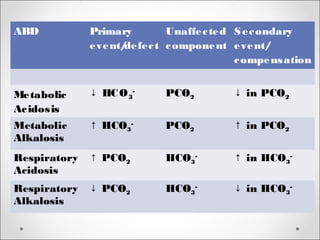
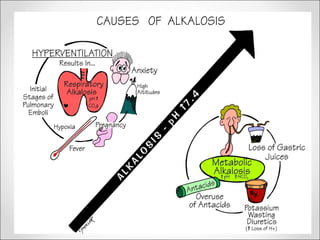
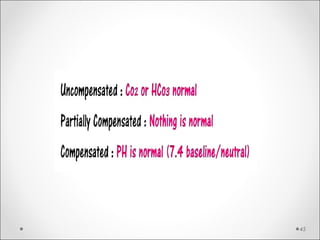
Compensation in ABDCompensation in ABD
ABD Primary
event/defect
Unaffected
component
Secondary
event/
compensation
Metabolic
Acidosis
↓ HCO3
-
PCO2 ↓ in PCO2
Metabolic
Alkalosis
↑ HCO3
-
PCO2 ↑ in PCO2
Respiratory
Acidosis
↑ PCO2 HCO3
-
↑ in HCO3
-
Respiratory
Alkalosis
↓ PCO2 HCO3
-
↓ in HCO3
-
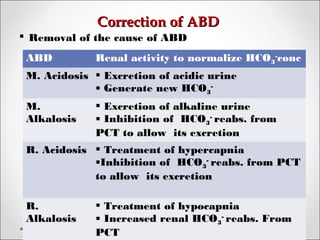
Correction of ABDCorrection of ABD
 Removal of the cause of ABD
ABD Renal activity to normalize HCO3
-
conc
M. Acidosis  Excretion of acidic urine
 Generate new HCO3
-
M.
Alkalosis
 Excretion of alkaline urine
 Inhibition of HCO3
-
reabs. from
PCT to allow its excretion
R. Acidosis  Treatment of hypercapnia
Inhibition of HCO3
-
reabs. from PCT
to allow its excretion
R.
Alkalosis
 Treatment of hypocapnia
 Increased renal HCO3
-
reabs. From
PCT
42
43
44
45
46

Acid base balance, acid base disorder

  • 1.
    Acid BaseAcid Base Balance,AcidBalance, Acid Base disordersBase disorders Dr Ifat Ara Begum Associate Professor Dept of Biochemistry Dhaka Medical College Dhaka 1
  • 2.
  • 3.
    Acid & BaseAcid& Base 3 Points Acid Base Definitio n Molecules that can donate proton (H+ ) in aqueous solution Molecules that can accept proton (H+ ) in aqueous solution pH <7 >7 When dissolve d in water Produces H+ Produces OH- Types Strong acid Weak acid Strong base Weak base
  • 4.
    Proton is thehydrogen atom with itsProton is the hydrogen atom with its electron removedelectron removed 4
  • 5.
  • 6.
    6 Conjugate base ofacid The remaining anionic part of an acid after removal of proton from the acid In strong acid, it is weak & vice versa Conjugate acid of base It is the acid formed by a base after accepting proton In strong base, it is weak & vice versa
  • 7.
    7 Strength of anacid / base is defined in terms of the tendency to donate (or accept) the hydrogen ion to (from) the solvent (i.e. water in biological systems)
  • 8.
    Sources of Acid/Basein our bodySources of Acid/Base in our body 8  Exogenous source: Foods rich in acid (meat) Ingestion of acids (salicylic acid) Intravenous infusion  Endogenous source: Produced at cellular level during metabolism
  • 9.
    9 Sources of Volatile acid: 15 – 20 mol/D  Oxidation of :  Glucose  FA AA Sources of NVA:  230 mmol/D  Oxidation of :  Basic AA  S containing AA PO4 containing substances Sources of Base (nonvolatile):  160 mmol/D  Oxidation of Acidic AA  Metabolism of dietary organic anions like citrate, acetate etc
  • 10.
    ‘‘Our body isnet acid producer’Our body is net acid producer’ 10  NVA & base neutralize each other at one to one ratio.  So, after neutralization, 70 mmol/D NVA is left behind (230-160 = 70)  This 70 mmol/D of NVA, along with 15-20 mol/D of volatile acid makes the body env. acidic
  • 11.
    Metabolic acid orbase production dependsMetabolic acid or base production depends on:on: 11  Insulin status Blood flow to tissues Oxygen supply to tissues Dietary habit
  • 12.
    Route for excretionof acid/base from bodyRoute for excretion of acid/base from body 12 Pulmonary route For excretion of volatile acids only High capacity system On complete failure for few minutes, it reduces pH grossly Renal route For excretion of NVA & bases Low capacity system On complete failure for few minutes, no effect on pH at all
  • 13.
    What is pH?Whatis pH? 13
  • 14.
  • 15.
  • 17.
    How pH canbe determined?How pH can be determined? 17  Instrumentally by pH meter  Using H-H Equation (From serum HCO3 conc. & PCO2)
  • 18.
    18 Importance of normal bodypH  Supports optimum enzyme activity  O2 transport & chemical control of respiration  Maintains:  The native molecular form & structural conformation of biomolecules (esp. protein) to keep them functionally active Why Life threatens beyond clinically safe range of pH?  Altered :  Enzyme activity  Membrane permeability  CNS activity  Electrolyte distribution  Increased myocardial irritability Decreased cellular viability
  • 19.
  • 20.
    How pH isregulated?How pH is regulated? 20 First Line Defense  Chemical buffer system: It acts within second to minutes  Pulmonary system: It acts within minutes to hours by regulating CO2 content in blood Second line Defense  Renal system: It acts within hours to days by regulating serum bicarbonate and excretion of acid
  • 21.
    BufferBuffer  Any substance/ A mixture of weak acid & its conjugate base / A mixture of weak acid & its salt with strong base that can accept / release H+ in a solution to resist marked changes in H+ conc. & pH of that solution despite the addition of moderate amount of acid / base to it 21
  • 22.
     Principle ofbuffer action: Conversion of strong acid in to weak acid  Conversion of strong base in to weak base 22
  • 23.
  • 24.
    Body Compartment Buffer system (Inorder of importance) RBC Hemoglobin, Phosphate, Bicarbonate Plasma/ ECF Bicarbonate, Phosphate, Protein Blood Bicarbonate, Hemoglobin , Phosphate, Protein ICF Protein, Bicarbonate, Phosphate Kidney Ammonia, Phosphate, Bicarbonate Bone Bone buffer
  • 25.
    Most effective bodybuffer: BicarbonateMost effective body buffer: Bicarbonate buffer system: Why?buffer system: Why? 25
  • 26.
  • 28.
  • 32.
    32 Abnormality of eitherHCO3- or PCO2 , keeping 2nd component normal: Simple ABD Abnormality of both HCO3- or PCO2 simultaneously: Complex ABD (Clinically, existence of >1 simple ABD)
  • 33.
  • 34.
    What are thecommon parameters to checkWhat are the common parameters to check ABD?ABD?  pH  PCO2  Serum HCO3 - concentration  Plasma Anion gap  Base excess
  • 35.
    Normal Acid BaseComposition of Arterial BloodNormal Acid Base Composition of Arterial Blood (ABG analysis)(ABG analysis) pH PO2 (mm of Hg) O2 saturatio n (%) PCO2 (mm of Hg) HCO3 conc. (mmol/L) 7.35 - 7.45 85 - 100 80-100 (>95%) 35 - 45 22-28 Plasma Anion gap: 8 – 16 mEq/L Base excess : ± 2 mmol/L
  • 36.
    Anion gap =UA – UCAnion gap = UA – UC
  • 37.
    BE = [HCOBE= [HCO33 -- ] p – [HCO] p – [HCO33 -- ]std]std
  • 38.
    38 The PO2 reflects theamount of oxygen gas dissolved in the blood. It primarily measures the effectiveness of the lungs in pulling oxygen into the blood stream from the atmosphere i.e. it provides a good index of lung function. .
  • 39.
  • 40.
    ABD Primary event/defect Unaffected component Secondary event/ compensation Metabolic Acidosis ↓ HCO3 - PCO2↓ in PCO2 Metabolic Alkalosis ↑ HCO3 - PCO2 ↑ in PCO2 Respiratory Acidosis ↑ PCO2 HCO3 - ↑ in HCO3 - Respiratory Alkalosis ↓ PCO2 HCO3 - ↓ in HCO3 -
  • 41.
    Correction of ABDCorrectionof ABD  Removal of the cause of ABD ABD Renal activity to normalize HCO3 - conc M. Acidosis  Excretion of acidic urine  Generate new HCO3 - M. Alkalosis  Excretion of alkaline urine  Inhibition of HCO3 - reabs. from PCT to allow its excretion R. Acidosis  Treatment of hypercapnia Inhibition of HCO3 - reabs. from PCT to allow its excretion R. Alkalosis  Treatment of hypocapnia  Increased renal HCO3 - reabs. From PCT
  • 42.
  • 43.
  • 44.
  • 45.
  • 46.