METABOLISM
• The sum of all the chemical processes
occurring in an organism at one time
• Concerned with the management of
material and energy resources within the
cell
• The chemistry of life is organized into metabolic
pathways.
• A metabolic pathway involves the step-by-step
modification of an initial molecule to form another
product.
• The resulting product can be used in one of three
ways:
1.Be used immediately,
2.Initiate another metabolic pathway, called a flux
generating step
3.Be stored by the cell
• A specific enzyme catalyzes each step of the pathway.
•Chemical reactions occurring within a cell.
•Principal chemical is modified by a series
of chemical reactions.
•Enzymes catalyze these reactions.
•Require dietary minerals, vitamins, and
other cofactors in order to function properly.
•Numerous distinct pathways co-exist within a
cell.
•This collection of pathways is called
the metabolic network.
• Important to the maintenance of homeostasis.
• Catabolic (break-down) and Anabolic (synthesis)
pathways work interdependently to create new
biomolecules as the final end-products
•A molecule called a substrate enters a
metabolic pathway depending on the needs
of the cell and the availability of the
substrate.
•An increase in concentration
of anabolic and catabolic intermediates
and/or end-products may influence the
metabolic rate for that particular pathway
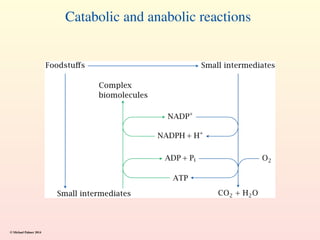
Catabolic and anabolic reactions
© Michael Palmer 2014
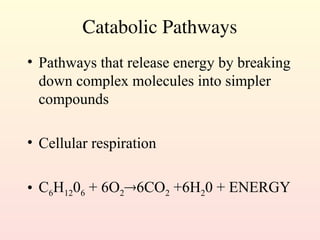
Catabolic Pathways
• Pathways that release energy by breaking
down complex molecules into simpler
compounds
• Cellular respiration
• C6H1206 + 6O26CO2 +6H20 + ENERGY
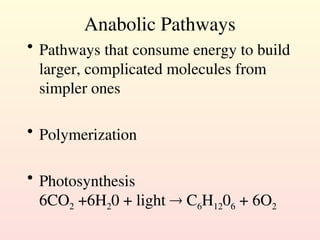
Anabolic Pathways
• Pathways that consume energy to build
larger, complicated molecules from
simpler ones
• Polymerization
• Photosynthesis
6CO2 +6H20 + light  C6H1206 + 6O2
• Catabolic pathways release energy by
breaking down complex molecules to simpler
compounds.
–A major pathway of catabolism is cellular
respiration, in which the sugar glucose is
broken down in the presence of oxygen to
carbon dioxide and water.
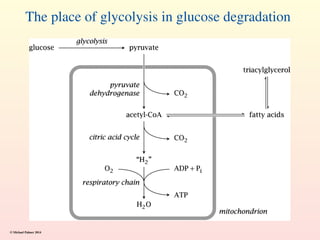
The place of glycolysis in glucose degradation
© Michael Palmer 2014
•Most of the structures that make up animals,
plants and microbes are made from three basic
classes of molecule:
•amino acids,
•Carbohydrates
• lipids (often called fats).
•Metabolic reactions either focus on making these
molecules during the construction of cells and
tissues,
•Breaking them down and using them as a source
of energy, by their digestion.
•These biochemicals can be joined together to
make polymers such as DNA and proteins,
essential macromolecules of life
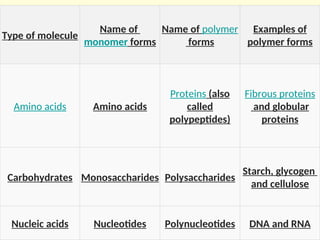
Type of molecule
Name of
monomer forms
Name of polymer
forms
Examples of
polymer forms
Amino acids Amino acids
Proteins (also
called
polypeptides)
Fibrous proteins
and globular
proteins
Carbohydrates Monosaccharides Polysaccharides
Starch, glycogen
and cellulose
Nucleic acids Nucleotides Polynucleotides DNA and RNA
•Catabolic reactions in animals can be
separated into three main stages.
•In the first, large organic molecules such
as proteins polysaccharides or lipids are
digested into their smaller components
outside cells.
• Smaller molecules are taken up by cells and
converted to yet smaller molecules, usually acetyl
coenzyme A (acetyl-CoA), which releases some
energy.
• Finally, the acetyl group on the CoA is oxidised to
water and carbon dioxide in the citric acid
cycle and electron transport chain, releasing the
energy that is stored by reducing the
coenzyme nicotinamide adenine
dinucleotide (NAD+
) into NADH
Stages of Catabolism
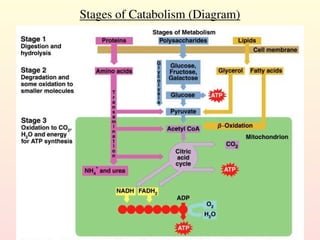
Catabolic reactions are organized into three stages:
• In Stage 1, digestion breaks down large molecules
into smaller ones that enter the bloodstream
• In Stage 2, molecules enter the cells and are broken
down into two- and three-carbon compounds
• In Stage 3, compounds are oxidized in the citric
acid cycle to provide energy (ATP) for anabolic
processes
Stages of Catabolism (Diagram)
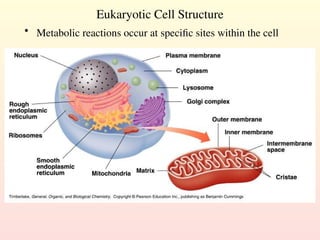
Eukaryotic Cell Structure
• Metabolic reactions occur at specific sites within the cell
•Anabolism is the set of constructive
metabolic processes where the energy
released by catabolism is used to synthesize
complex molecules.
•Complex molecules that make up cellular
structures are constructed step-by-step from
small and simple precursors.
Three basic stages.
• Firstly, the production of precursors such as amino
acids, monosaccharides, isoprenoids and nucleotide
s,
• Secondly, their activation into reactive forms using
energy from ATP,
• Thirdly, the assembly of these precursors into
complex molecules such
as proteins, polysaccharides, lipids and nucleic
acids
•In carbohydrate anabolism, simple organic acids can
be converted into monosaccharides
•Then used to assemble polysaccharides such
as starch.
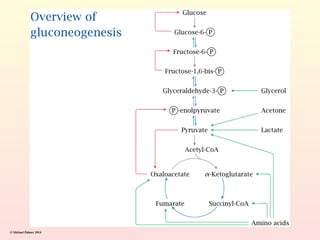
•The generation of glucose from compounds
like pyruvate, lactate, glycerol, glycerate 3-
phosphate and amino acids is called gluconeogenesis.
• Gluconeogenesis converts pyruvate to glucose-6-
phosphate through a series of intermediates, many of
which are shared with glycolysis
• However, this pathway is not simply glycolysis run
in reverse, as several steps are catalyzed by non-
glycolytic enzymes.
© Michael Palmer 2014
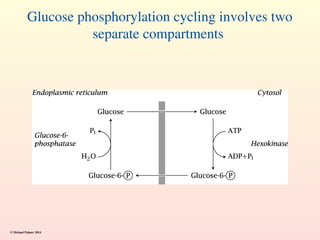
Glucose phosphorylation cycling involves two
separate compartments
© Michael Palmer 2014
• Metabolic Rate
• The amount of energy liberated by the catabolism of
food in the body is the same as the amount liberated
when food is burned outside the body.
• The energy liberated by catabolic processes in the
body is used for maintaining body functions
•
• Digesting and metabolizing food,
• thermoregulation, and physical activity.
• It appears as external work , heat, and
energy storage:
• The amount of energy liberated per unit of
time is the metabolic rate.
• Isotonic muscle contractions perform work
at a peak efficiency approximating 50%:
• Factors affecting the metabolic rate.
• Muscular exertion during or just before measurement
• Recent ingestion of food
• High or low environmental temperature
• Height, weight, and surface area
• Sex Age Growth Reproduction Lactation Emotional
state
• Body temperature
• Circulating levels of thyroid hormones
• Circulating epinephrine and norepinephrine levels
• The metabolic rate determined at rest in a room at a
comfortable temperature in the thermoneutral zone 12-14
hours after the last meal is called the basal metabolic rate
(BMR).
• This value falls about 10% during sleep and up to 40%
during prolonged starvation.
• The rate during normal daytime activities is, of course, higher
than the BMR because of muscular activity and food intake.
• The maximum metabolic rate reached during exercise is
often said to be ten times the BMR, but trained athletes can
increase their metabolic rate as much as 20-fold.
Metabolic Rate and Caloric
Requirements
• Metabolic rate is the total rate of body metabolism.
– Metabolic rate measured by the amount of oxygen
consumed by the body/min.
• BMR:
– Oxygen consumption of an awake relaxed person 12–14
hours after eating and at a comfortable temperature.
• BMR determined by:Age.
 Age.
 Gender.
 Body surface area.
 Thyroid secretion
Anabolic Requirements
• Anabolism:
– Food supplies raw materials for synthesis reactions.
• Synthesize:
– DNA and RNA.
– Proteins.
– Triglycerides.
– Glycogen.
• Must occur constantly to replace molecules that
are hydrolyzed.
Aerobic Requirements
• Catabolism:
– Hydrolysis (break down monomers down to
C02 and H20.):
• Hydrolysis reactions and cellular respiration.
• Gluconeogenesis.
• Glycogenolysis.
• Lipolysis.
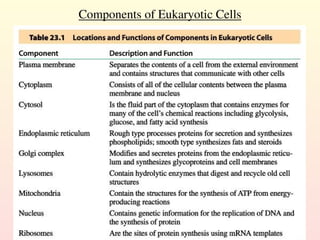
Components of Eukaryotic Cells
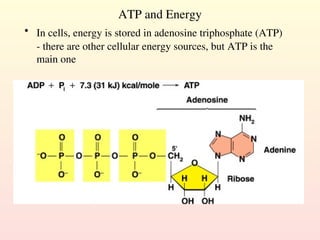
ATP and Energy
• In cells, energy is stored in adenosine triphosphate (ATP)
- there are other cellular energy sources, but ATP is the
main one
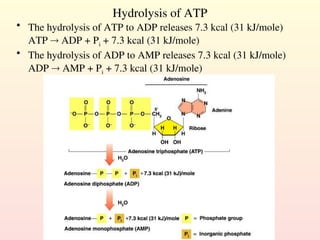
Hydrolysis of ATP
• The hydrolysis of ATP to ADP releases 7.3 kcal (31 kJ/mole)
ATP  ADP + Pi + 7.3 kcal (31 kJ/mole)
• The hydrolysis of ADP to AMP releases 7.3 kcal (31 kJ/mole)
ADP  AMP + Pi + 7.3 kcal (31 kJ/mole)
ATP and Muscle Contraction
• Muscle fibers contains
filaments of actin and
myosin
• When a nerve impulse
increases [Ca2
+], the
filaments slide closer
together to contract the
muscle
• The hydrolysis of ATP in
muscle provides the
energy for contraction
• As Ca2+
and ATP decrease,
the filaments return to the
relaxed position
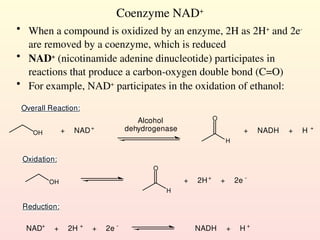
Coenzyme NAD+
• When a compound is oxidized by an enzyme, 2H as 2H+
and 2e-
are removed by a coenzyme, which is reduced
• NAD+
(nicotinamide adenine dinucleotide) participates in
reactions that produce a carbon-oxygen double bond (C=O)
• For example, NAD+
participates in the oxidation of ethanol:
Overall Reaction:
OH
H
O
+ NADH + H +
+ NAD+
Alcohol
dehydrogenase
Oxidation:
OH
H
O
+ 2H+
+ 2e -
Reduction:
NAD+
+ 2H +
+ 2e -
NADH + H +
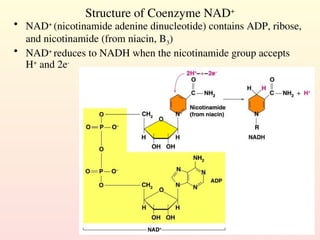
Structure of Coenzyme NAD+
• NAD+
(nicotinamide adenine dinucleotide) contains ADP, ribose,
and nicotinamide (from niacin, B3)
• NAD+
reduces to NADH when the nicotinamide group accepts
H+
and 2e-
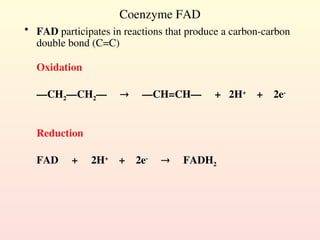
Coenzyme FAD
• FAD participates in reactions that produce a carbon-carbon
double bond (C=C)
Oxidation
—CH2—CH2—  —CH=CH— + 2H+
+ 2e-
Reduction
FAD + 2H+
+ 2e-
 FADH2
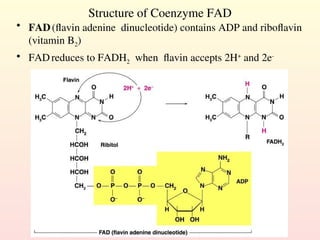
Structure of Coenzyme FAD
• FAD(flavin adenine dinucleotide) contains ADP and riboflavin
(vitamin B2)
• FADreduces to FADH2 when flavin accepts 2H+
and 2e-
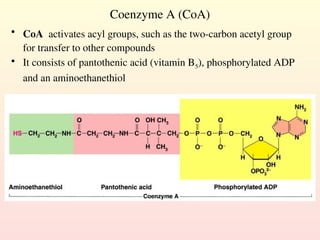
Coenzyme A (CoA)
• CoA activates acyl groups, such as the two-carbon acetyl group
for transfer to other compounds
• It consists of pantothenic acid (vitamin B5), phosphorylated ADP
and an aminoethanethiol
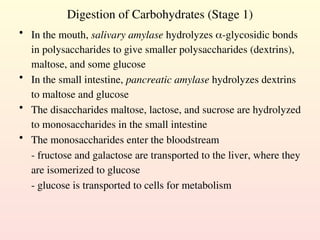
Digestion of Carbohydrates (Stage 1)
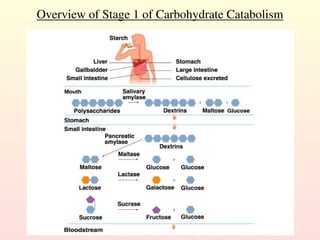
• In the mouth, salivary amylase hydrolyzes -glycosidic bonds
in polysaccharides to give smaller polysaccharides (dextrins),
maltose, and some glucose
• In the small intestine, pancreatic amylase hydrolyzes dextrins
to maltose and glucose
• The disaccharides maltose, lactose, and sucrose are hydrolyzed
to monosaccharides in the small intestine
• The monosaccharides enter the bloodstream
- fructose and galactose are transported to the liver, where they
are isomerized to glucose
- glucose is transported to cells for metabolism
Overview of Stage 1 of Carbohydrate Catabolism
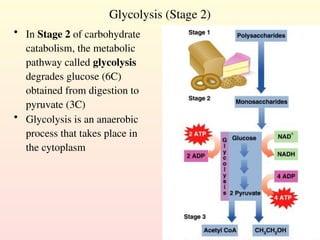
Glycolysis (Stage 2)
• In Stage 2 of carbohydrate
catabolism, the metabolic
pathway called glycolysis
degrades glucose (6C)
obtained from digestion to
pyruvate (3C)
• Glycolysis is an anaerobic
process that takes place in
the cytoplasm
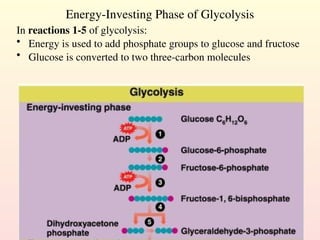
Energy-Investing Phase of Glycolysis
In reactions 1-5 of glycolysis:
• Energy is used to add phosphate groups to glucose and fructose
• Glucose is converted to two three-carbon molecules
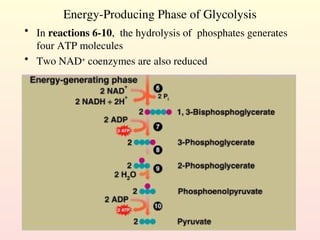
Energy-Producing Phase of Glycolysis
• In reactions 6-10, the hydrolysis of phosphates generates
four ATP molecules
• Two NAD+
coenzymes are also reduced
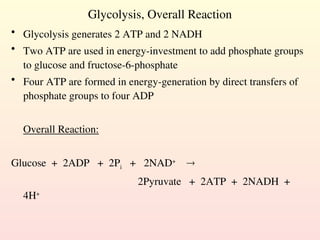
Glycolysis, Overall Reaction
• Glycolysis generates 2 ATP and 2 NADH
• Two ATP are used in energy-investment to add phosphate groups
to glucose and fructose-6-phosphate
• Four ATP are formed in energy-generation by direct transfers of
phosphate groups to four ADP
Overall Reaction:
Glucose + 2ADP + 2Pi + 2NAD+

2Pyruvate + 2ATP + 2NADH +
4H+
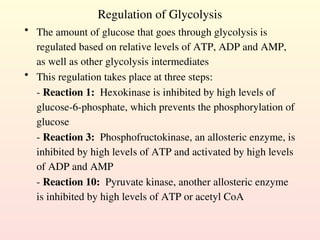
Regulation of Glycolysis
• The amount of glucose that goes through glycolysis is
regulated based on relative levels of ATP, ADP and AMP,
as well as other glycolysis intermediates
• This regulation takes place at three steps:
- Reaction 1: Hexokinase is inhibited by high levels of
glucose-6-phosphate, which prevents the phosphorylation of
glucose
- Reaction 3: Phosphofructokinase, an allosteric enzyme, is
inhibited by high levels of ATP and activated by high levels
of ADP and AMP
- Reaction 10: Pyruvate kinase, another allosteric enzyme
is inhibited by high levels of ATP or acetyl CoA

metabolism (3).ppt powerpoint presentation

  • 1.
    METABOLISM • The sumof all the chemical processes occurring in an organism at one time • Concerned with the management of material and energy resources within the cell
  • 2.
    • The chemistryof life is organized into metabolic pathways. • A metabolic pathway involves the step-by-step modification of an initial molecule to form another product. • The resulting product can be used in one of three ways: 1.Be used immediately, 2.Initiate another metabolic pathway, called a flux generating step 3.Be stored by the cell • A specific enzyme catalyzes each step of the pathway.
  • 3.
    •Chemical reactions occurringwithin a cell. •Principal chemical is modified by a series of chemical reactions. •Enzymes catalyze these reactions. •Require dietary minerals, vitamins, and other cofactors in order to function properly. •Numerous distinct pathways co-exist within a cell. •This collection of pathways is called the metabolic network.
  • 4.
    • Important tothe maintenance of homeostasis. • Catabolic (break-down) and Anabolic (synthesis) pathways work interdependently to create new biomolecules as the final end-products
  • 5.
    •A molecule calleda substrate enters a metabolic pathway depending on the needs of the cell and the availability of the substrate. •An increase in concentration of anabolic and catabolic intermediates and/or end-products may influence the metabolic rate for that particular pathway
  • 6.
    Catabolic and anabolicreactions © Michael Palmer 2014
  • 7.
    Catabolic Pathways • Pathwaysthat release energy by breaking down complex molecules into simpler compounds • Cellular respiration • C6H1206 + 6O26CO2 +6H20 + ENERGY
  • 8.
    Anabolic Pathways • Pathwaysthat consume energy to build larger, complicated molecules from simpler ones • Polymerization • Photosynthesis 6CO2 +6H20 + light  C6H1206 + 6O2
  • 9.
    • Catabolic pathwaysrelease energy by breaking down complex molecules to simpler compounds. –A major pathway of catabolism is cellular respiration, in which the sugar glucose is broken down in the presence of oxygen to carbon dioxide and water.
  • 10.
    The place ofglycolysis in glucose degradation © Michael Palmer 2014
  • 11.
    •Most of thestructures that make up animals, plants and microbes are made from three basic classes of molecule: •amino acids, •Carbohydrates • lipids (often called fats). •Metabolic reactions either focus on making these molecules during the construction of cells and tissues, •Breaking them down and using them as a source of energy, by their digestion. •These biochemicals can be joined together to make polymers such as DNA and proteins, essential macromolecules of life
  • 12.
    Type of molecule Nameof monomer forms Name of polymer forms Examples of polymer forms Amino acids Amino acids Proteins (also called polypeptides) Fibrous proteins and globular proteins Carbohydrates Monosaccharides Polysaccharides Starch, glycogen and cellulose Nucleic acids Nucleotides Polynucleotides DNA and RNA
  • 13.
    •Catabolic reactions inanimals can be separated into three main stages. •In the first, large organic molecules such as proteins polysaccharides or lipids are digested into their smaller components outside cells.
  • 14.
    • Smaller moleculesare taken up by cells and converted to yet smaller molecules, usually acetyl coenzyme A (acetyl-CoA), which releases some energy. • Finally, the acetyl group on the CoA is oxidised to water and carbon dioxide in the citric acid cycle and electron transport chain, releasing the energy that is stored by reducing the coenzyme nicotinamide adenine dinucleotide (NAD+ ) into NADH
  • 15.
    Stages of Catabolism Catabolicreactions are organized into three stages: • In Stage 1, digestion breaks down large molecules into smaller ones that enter the bloodstream • In Stage 2, molecules enter the cells and are broken down into two- and three-carbon compounds • In Stage 3, compounds are oxidized in the citric acid cycle to provide energy (ATP) for anabolic processes
  • 16.
  • 17.
    Eukaryotic Cell Structure •Metabolic reactions occur at specific sites within the cell
  • 18.
    •Anabolism is theset of constructive metabolic processes where the energy released by catabolism is used to synthesize complex molecules. •Complex molecules that make up cellular structures are constructed step-by-step from small and simple precursors.
  • 19.
    Three basic stages. •Firstly, the production of precursors such as amino acids, monosaccharides, isoprenoids and nucleotide s, • Secondly, their activation into reactive forms using energy from ATP, • Thirdly, the assembly of these precursors into complex molecules such as proteins, polysaccharides, lipids and nucleic acids
  • 20.
    •In carbohydrate anabolism,simple organic acids can be converted into monosaccharides •Then used to assemble polysaccharides such as starch. •The generation of glucose from compounds like pyruvate, lactate, glycerol, glycerate 3- phosphate and amino acids is called gluconeogenesis. • Gluconeogenesis converts pyruvate to glucose-6- phosphate through a series of intermediates, many of which are shared with glycolysis • However, this pathway is not simply glycolysis run in reverse, as several steps are catalyzed by non- glycolytic enzymes.
  • 21.
  • 22.
    Glucose phosphorylation cyclinginvolves two separate compartments © Michael Palmer 2014
  • 23.
    • Metabolic Rate •The amount of energy liberated by the catabolism of food in the body is the same as the amount liberated when food is burned outside the body. • The energy liberated by catabolic processes in the body is used for maintaining body functions •
  • 24.
    • Digesting andmetabolizing food, • thermoregulation, and physical activity. • It appears as external work , heat, and energy storage: • The amount of energy liberated per unit of time is the metabolic rate. • Isotonic muscle contractions perform work at a peak efficiency approximating 50%:
  • 25.
    • Factors affectingthe metabolic rate. • Muscular exertion during or just before measurement • Recent ingestion of food • High or low environmental temperature • Height, weight, and surface area • Sex Age Growth Reproduction Lactation Emotional state • Body temperature • Circulating levels of thyroid hormones • Circulating epinephrine and norepinephrine levels
  • 26.
    • The metabolicrate determined at rest in a room at a comfortable temperature in the thermoneutral zone 12-14 hours after the last meal is called the basal metabolic rate (BMR). • This value falls about 10% during sleep and up to 40% during prolonged starvation. • The rate during normal daytime activities is, of course, higher than the BMR because of muscular activity and food intake. • The maximum metabolic rate reached during exercise is often said to be ten times the BMR, but trained athletes can increase their metabolic rate as much as 20-fold.
  • 27.
    Metabolic Rate andCaloric Requirements • Metabolic rate is the total rate of body metabolism. – Metabolic rate measured by the amount of oxygen consumed by the body/min. • BMR: – Oxygen consumption of an awake relaxed person 12–14 hours after eating and at a comfortable temperature. • BMR determined by:Age.  Age.  Gender.  Body surface area.  Thyroid secretion
  • 28.
    Anabolic Requirements • Anabolism: –Food supplies raw materials for synthesis reactions. • Synthesize: – DNA and RNA. – Proteins. – Triglycerides. – Glycogen. • Must occur constantly to replace molecules that are hydrolyzed.
  • 29.
    Aerobic Requirements • Catabolism: –Hydrolysis (break down monomers down to C02 and H20.): • Hydrolysis reactions and cellular respiration. • Gluconeogenesis. • Glycogenolysis. • Lipolysis.
  • 30.
  • 31.
    ATP and Energy •In cells, energy is stored in adenosine triphosphate (ATP) - there are other cellular energy sources, but ATP is the main one
  • 32.
    Hydrolysis of ATP •The hydrolysis of ATP to ADP releases 7.3 kcal (31 kJ/mole) ATP  ADP + Pi + 7.3 kcal (31 kJ/mole) • The hydrolysis of ADP to AMP releases 7.3 kcal (31 kJ/mole) ADP  AMP + Pi + 7.3 kcal (31 kJ/mole)
  • 33.
    ATP and MuscleContraction • Muscle fibers contains filaments of actin and myosin • When a nerve impulse increases [Ca2 +], the filaments slide closer together to contract the muscle • The hydrolysis of ATP in muscle provides the energy for contraction • As Ca2+ and ATP decrease, the filaments return to the relaxed position
  • 34.
    Coenzyme NAD+ • Whena compound is oxidized by an enzyme, 2H as 2H+ and 2e- are removed by a coenzyme, which is reduced • NAD+ (nicotinamide adenine dinucleotide) participates in reactions that produce a carbon-oxygen double bond (C=O) • For example, NAD+ participates in the oxidation of ethanol: Overall Reaction: OH H O + NADH + H + + NAD+ Alcohol dehydrogenase Oxidation: OH H O + 2H+ + 2e - Reduction: NAD+ + 2H + + 2e - NADH + H +
  • 35.
    Structure of CoenzymeNAD+ • NAD+ (nicotinamide adenine dinucleotide) contains ADP, ribose, and nicotinamide (from niacin, B3) • NAD+ reduces to NADH when the nicotinamide group accepts H+ and 2e-
  • 36.
    Coenzyme FAD • FADparticipates in reactions that produce a carbon-carbon double bond (C=C) Oxidation —CH2—CH2—  —CH=CH— + 2H+ + 2e- Reduction FAD + 2H+ + 2e-  FADH2
  • 37.
    Structure of CoenzymeFAD • FAD(flavin adenine dinucleotide) contains ADP and riboflavin (vitamin B2) • FADreduces to FADH2 when flavin accepts 2H+ and 2e-
  • 38.
    Coenzyme A (CoA) •CoA activates acyl groups, such as the two-carbon acetyl group for transfer to other compounds • It consists of pantothenic acid (vitamin B5), phosphorylated ADP and an aminoethanethiol
  • 39.
    Digestion of Carbohydrates(Stage 1) • In the mouth, salivary amylase hydrolyzes -glycosidic bonds in polysaccharides to give smaller polysaccharides (dextrins), maltose, and some glucose • In the small intestine, pancreatic amylase hydrolyzes dextrins to maltose and glucose • The disaccharides maltose, lactose, and sucrose are hydrolyzed to monosaccharides in the small intestine • The monosaccharides enter the bloodstream - fructose and galactose are transported to the liver, where they are isomerized to glucose - glucose is transported to cells for metabolism
  • 40.
    Overview of Stage1 of Carbohydrate Catabolism
  • 41.
    Glycolysis (Stage 2) •In Stage 2 of carbohydrate catabolism, the metabolic pathway called glycolysis degrades glucose (6C) obtained from digestion to pyruvate (3C) • Glycolysis is an anaerobic process that takes place in the cytoplasm
  • 42.
    Energy-Investing Phase ofGlycolysis In reactions 1-5 of glycolysis: • Energy is used to add phosphate groups to glucose and fructose • Glucose is converted to two three-carbon molecules
  • 43.
    Energy-Producing Phase ofGlycolysis • In reactions 6-10, the hydrolysis of phosphates generates four ATP molecules • Two NAD+ coenzymes are also reduced
  • 44.
    Glycolysis, Overall Reaction •Glycolysis generates 2 ATP and 2 NADH • Two ATP are used in energy-investment to add phosphate groups to glucose and fructose-6-phosphate • Four ATP are formed in energy-generation by direct transfers of phosphate groups to four ADP Overall Reaction: Glucose + 2ADP + 2Pi + 2NAD+  2Pyruvate + 2ATP + 2NADH + 4H+
  • 45.
    Regulation of Glycolysis •The amount of glucose that goes through glycolysis is regulated based on relative levels of ATP, ADP and AMP, as well as other glycolysis intermediates • This regulation takes place at three steps: - Reaction 1: Hexokinase is inhibited by high levels of glucose-6-phosphate, which prevents the phosphorylation of glucose - Reaction 3: Phosphofructokinase, an allosteric enzyme, is inhibited by high levels of ATP and activated by high levels of ADP and AMP - Reaction 10: Pyruvate kinase, another allosteric enzyme is inhibited by high levels of ATP or acetyl CoA