Introduction to Ecology
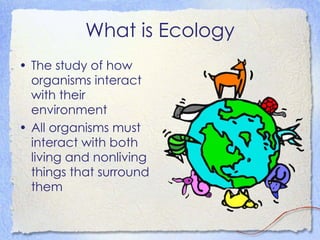
What is Ecology The study of how organisms interact with their environment All organisms must interact with both living and nonliving things that surround them
Levels of Organization To add to our list of the levels of organization: Cells    Tissues   Organs    Organ Systems    Organisms    Population    Community    Ecosystem    Biosphere
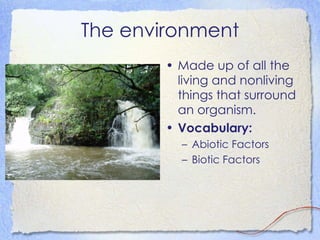
The environment Made up of all the living and nonliving things that surround an organism. Vocabulary: Abiotic Factors Biotic Factors
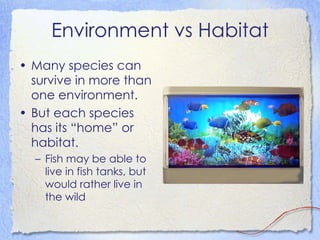
Environment vs Habitat Many species can survive in more than one environment. But each species has its “home” or habitat.  Fish may be able to live in fish tanks, but would rather live in the wild
Basic Concept of Ecology The fundamental idea behind the study of ecology is that all organisms are interdependent.  They interact with one another and the physical environment.
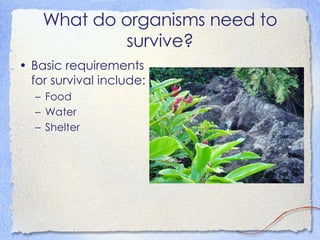
What do organisms need to survive? Basic requirements for survival include: Food  Water Shelter
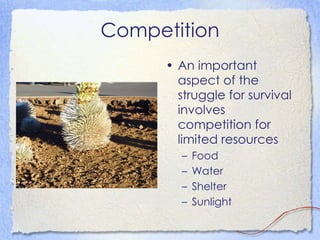
Competition An important aspect of the struggle for survival involves competition for limited resources Food Water  Shelter Sunlight
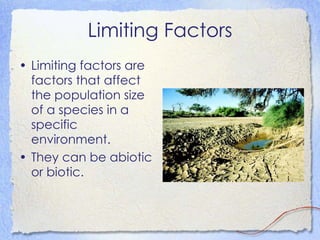
Limiting Factors Limiting factors are factors that affect the population size of a species in a specific environment. They can be abiotic or biotic.
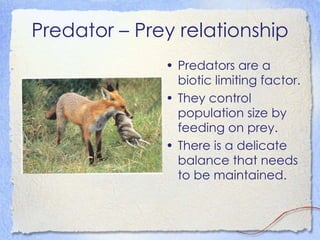
Predator – Prey relationship Predators are a biotic limiting factor. They control population size by feeding on prey. There is a delicate balance that needs to be maintained.
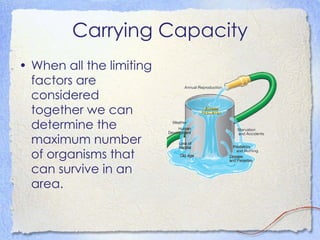
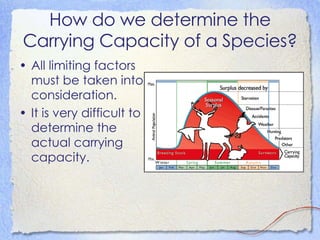
Carrying Capacity When all the limiting factors are considered together we can determine the maximum number of organisms that can survive in an area.
How do we determine the Carrying Capacity of a Species? All limiting factors must be taken into consideration. It is very difficult to determine the actual carrying capacity.
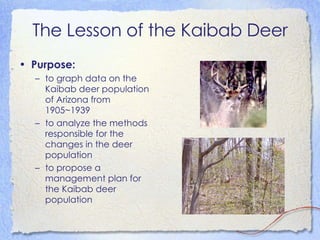
The Lesson of the Kaibab Deer Purpose:   to graph data on the Kaibab deer population of Arizona from 1905~1939  to analyze the methods responsible for the changes in the deer population  to propose a management plan for the Kaibab deer population
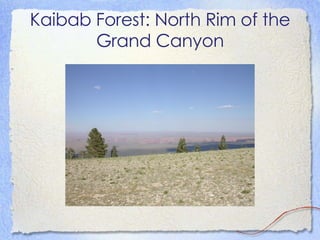
Kaibab Forest: North Rim of the Grand Canyon
Key Idea All organisms have the ability to produce populations of unlimited size But their environment keeps their numbers in check.
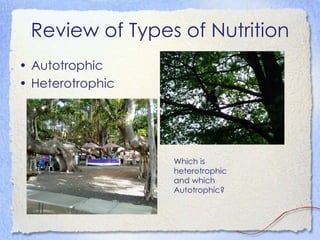
Review of Types of Nutrition Autotrophic Heterotrophic Which is heterotrophic and which Autotrophic?
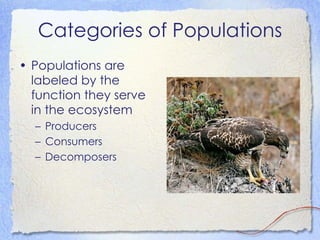
Categories of Populations Populations are labeled by the function they serve in the ecosystem  Producers Consumers Decomposers
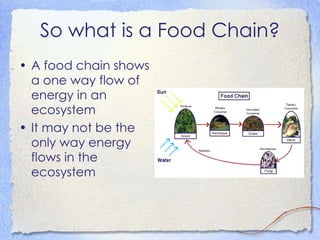
So what is a Food Chain? A food chain shows a one way flow of energy in an ecosystem It may not be the only way energy flows in the ecosystem
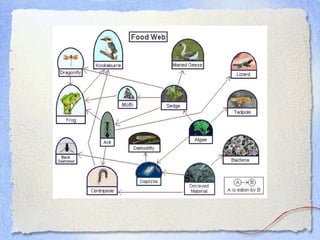
Food Webs When all of the food chains of an ecosystem are considered we can draw up a food web It shows all of the possible paths that energy can take in an ecosystem It also shows how organisms are dependant on each other in the ecosystem
 
 
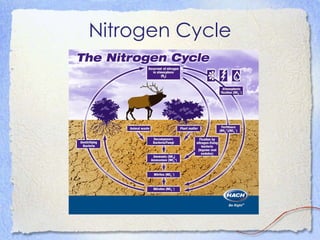
Recycling Who is ultimately responsible for the recycling of nutrients?  Decomposers What gets recycled? Minerals  Nutrients
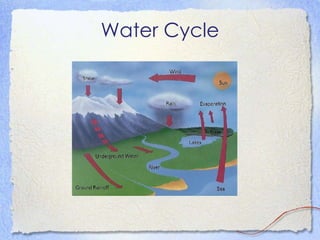
Recycling What else gets recycled? Carbon Dioxide Water Carbon The energy from the Sun keeps the cycle going
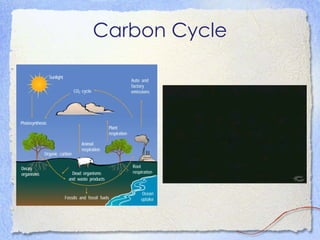
Carbon Cycle
Water Cycle
Nitrogen Cycle
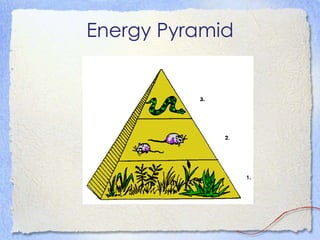
Energy Pyramid
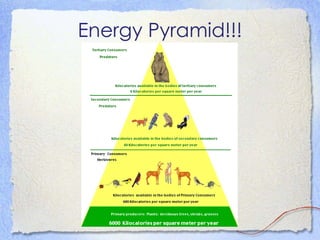
Energy Pyramid  There is more energy available at the bottom There are more organisms at the bottom There is less energy at the top There are less organisms at the top Energy is lost as you go up the pyramid, mostly as heat
Energy Pyramid!!!
 

Introduction To Ecology

  • 1.
  • 2.
    What is EcologyThe study of how organisms interact with their environment All organisms must interact with both living and nonliving things that surround them
  • 3.
    Levels of OrganizationTo add to our list of the levels of organization: Cells  Tissues  Organs  Organ Systems  Organisms  Population  Community  Ecosystem  Biosphere
  • 4.
    The environment Madeup of all the living and nonliving things that surround an organism. Vocabulary: Abiotic Factors Biotic Factors
  • 5.
    Environment vs HabitatMany species can survive in more than one environment. But each species has its “home” or habitat. Fish may be able to live in fish tanks, but would rather live in the wild
  • 6.
    Basic Concept ofEcology The fundamental idea behind the study of ecology is that all organisms are interdependent. They interact with one another and the physical environment.
  • 7.
    What do organismsneed to survive? Basic requirements for survival include: Food Water Shelter
  • 8.
    Competition An importantaspect of the struggle for survival involves competition for limited resources Food Water Shelter Sunlight
  • 9.
    Limiting Factors Limitingfactors are factors that affect the population size of a species in a specific environment. They can be abiotic or biotic.
  • 10.
    Predator – Preyrelationship Predators are a biotic limiting factor. They control population size by feeding on prey. There is a delicate balance that needs to be maintained.
  • 11.
    Carrying Capacity Whenall the limiting factors are considered together we can determine the maximum number of organisms that can survive in an area.
  • 12.
    How do wedetermine the Carrying Capacity of a Species? All limiting factors must be taken into consideration. It is very difficult to determine the actual carrying capacity.
  • 13.
    The Lesson ofthe Kaibab Deer Purpose: to graph data on the Kaibab deer population of Arizona from 1905~1939 to analyze the methods responsible for the changes in the deer population to propose a management plan for the Kaibab deer population
  • 14.
    Kaibab Forest: NorthRim of the Grand Canyon
  • 15.
    Key Idea Allorganisms have the ability to produce populations of unlimited size But their environment keeps their numbers in check.
  • 16.
    Review of Typesof Nutrition Autotrophic Heterotrophic Which is heterotrophic and which Autotrophic?
  • 17.
    Categories of PopulationsPopulations are labeled by the function they serve in the ecosystem Producers Consumers Decomposers
  • 18.
    So what isa Food Chain? A food chain shows a one way flow of energy in an ecosystem It may not be the only way energy flows in the ecosystem
  • 19.
    Food Webs Whenall of the food chains of an ecosystem are considered we can draw up a food web It shows all of the possible paths that energy can take in an ecosystem It also shows how organisms are dependant on each other in the ecosystem
  • 20.
  • 21.
  • 22.
    Recycling Who isultimately responsible for the recycling of nutrients? Decomposers What gets recycled? Minerals Nutrients
  • 23.
    Recycling What elsegets recycled? Carbon Dioxide Water Carbon The energy from the Sun keeps the cycle going
  • 24.
  • 25.
  • 26.
  • 27.
  • 28.
    Energy Pyramid There is more energy available at the bottom There are more organisms at the bottom There is less energy at the top There are less organisms at the top Energy is lost as you go up the pyramid, mostly as heat
  • 29.
  • 30.