PHYSICS
IN THE
HEALTH SCIENCES
A SCIENCE THAT DEALS WITH THE
APPLICATIONS OF MATTER, ENERGY, SPACE
AND TIME IN THE DIAGNOSIS, TREATMENT
AND PREVENTION OF DISEASE AND INJURY.
VITAL SIGNS
- Can be observed, measured, and monitored to
assess an individual's level of physical functioning.
* Blood pressure
* Temperature
* Pulse rate
* Respiratory rate
BLOOD PRESSURE
-Pressure of circulating blood against the walls of the arteries
-An important diagnostic index, especially of the circulatory
function
-Measured in two point: systole (high point) and diastole (low
point)
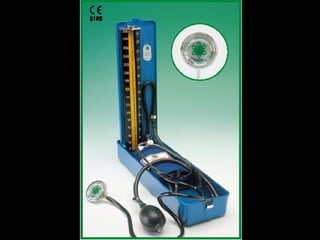
-Measured in terms of mm of Hg using the
sphygmomanometer
BLOOD PRESSURE
-Normal Values:
 80/45 (infants)
 120/80 (30 years old)
 140/85 ( 40 years old and over)
-Higher in men than in women and children
-Lowest during sleep
BLOOD PRESSURE
Physics Concepts:
 Ideal Gas Law
 Force pump
TEMPERATURE
-The degree of body heat
-Results from metabolism (the conversion of food into
protein, carbohydrates and fats with the release of
energy in the form of heat)
TEMPERATURE
-Temperature regulators in humans and other warm-
bloodied animals:
 Perspiring – evaporation through pores in the
skin
 Panting – evaporation through pores in the
mouth
 Shivering – activates certain muscles to increase
metabolism and thereby warms the body
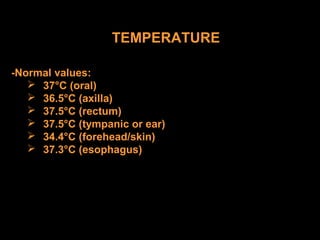
TEMPERATURE
-Normal values:
 37°C (oral)
 36.5°C (axilla)
 37.5°C (rectum)
 37.5°C (tympanic or ear)
 34.4°C (forehead/skin)
 37.3°C (esophagus)
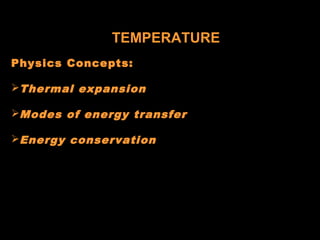
TEMPERATURE
Physics Concepts:
Thermal expansion
Modes of energy transfer
Energy conservation
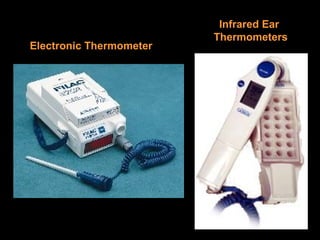
Electronic Thermometer
Infrared Ear
Thermometers
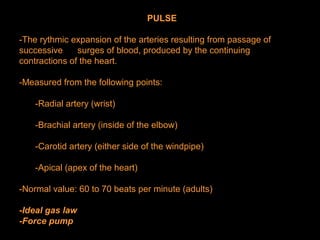
PULSE
-The rythmic expansion of the arteries resulting from passage of
successive surges of blood, produced by the continuing
contractions of the heart.
-Measured from the following points:
-Radial artery (wrist)
-Brachial artery (inside of the elbow)
-Carotid artery (either side of the windpipe)
-Apical (apex of the heart)
-Normal value: 60 to 70 beats per minute (adults)
-Ideal gas law
-Force pump
RESPIRATION
-The response of the body to cellular needs for oxygen and carbon dioxide elimination.
-One complete cycle is composed of one inhalation and one exhalation.
-Normal values:
12 to 20 cycles/minute (adults)
15 to 30 cycles/minute (children ages 1 -12 years)
25 to 50 cycles/minute (infant – birth to 1 year old)
-Boyle’s law
MEASUREMENT OF MEDICATION
-The correct amount of medication, oxygen concentration, electric stimulation or
x-ray radiation may make a difference between life and death.
-Measurement
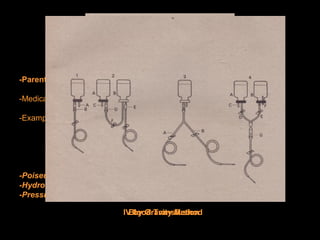
ADMINISTRATION OF PARENTERAL FLUIDS
-Parenteral Fluids
-Medication or nutrition administered other than by the mouth or the rectum.
-Examples:
Injections
Infusions
Implantations
-Poiseuille’s law
-Hydrodynamics
-Pressure
Blood TransfusionIV by Gravity Method
OXYGEN THERAPY
-Necessary for enough oxygen in the blood when the lungs cannot
any,ore transfer enough oxygen.
-Used for acute health care needs and chronic lung conditions.
-Diffusion
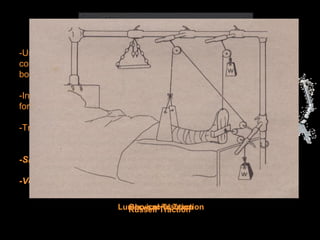
TRACTION
-Used in cases of fracture and spinal injuries to overcome muscle
contraction which would produce overriding and misalignment of
bones.
-Involves the aplication of regulated weight/s that will serve as pulling
force/s.
-Traction force is regulated between 0 and 200 pounds.
-Simple machines (pulley)
-Vectors
Cervical TractionLumbo-sacral TractionRussell Traction
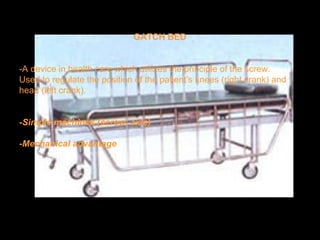
GATCH BED
-A device in health care which utilizes the principle of the screw.
Used to regulate the position of the patient’s knees (right crank) and
head (left crank).
-Simple machines (screw, axle)
-Mechanical advantage
EGG CRATE MATTRESS
-Designed for additional comfort and pressure relief
-Minimizes bed sores
-Promotes increased air circulation
-Pressure
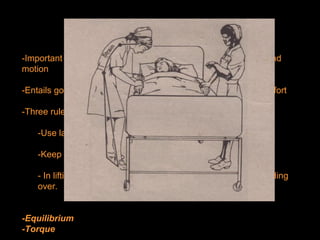
BODY MECHANICS
-Important in the everyday maintenance of posture, alignment and
motion
-Entails good use of the body to get the best results with least effort
-Three rules of good body mechanics:
-Use large muscles whenever possible.
-Keep feet apart for a broad base.
- In lifting, bend knees with the back straight, instead of bending
over.
-Equilibrium
-Torque
NUTRITION
-Concerned with the effect of food on health and the survival of the
human body
-Calorie - Unit for the energy value of food
- Equal to 1 kilocalorie in Physics
-Heat of combustion
-Energy
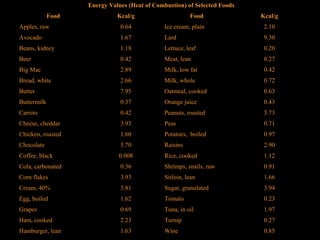
Energy Values (Heat of Combustion) of Selected Foods
Food Kcal/g Food Kcal/g
Apples, raw 0.64 Ice cream, plain 2.10
Avocado 1.67 Lard 9.30
Beans, kidney 1.18 Lettuce, leaf 0.20
Beer 0.42 Meat, lean 0.27
Big Mac 2.89 Milk, low fat 0.42
Bread, white 2.66 Milk, whole 0.72
Butter 7.95 Oatmeal, cooked 0.63
Buttermilk 0.37 Orange juice 0.43
Carrots 0.42 Peanuts, roasted 5.73
Cheese, cheddar 3.93 Peas 0.71
Chicken, roasted 1.60 Potatoes, boiled 0.97
Chocolate 5.70 Raisins 2.90
Coffee, black 0.008 Rice, cooked 1.12
Cola, carbonated 0.36 Shrimps, snails, raw 0.91
Corn flakes 3.93 Sirloin, lean 1.66
Cream, 40% 3.81 Sugar, granulated 3.94
Egg, boiled 1.62 Tomato 0.23
Grapes 0.69 Tuna, in oil 1.97
Ham, cooked 2.23 Turnip 0.27
Hamburger, lean 1.63 Wine 0.85
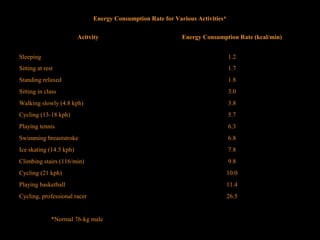
Energy Consumption Rate for Various Activities*
Acitvity Energy Consumption Rate (kcal/min)
Sleeping 1.2
Sitting at rest 1.7
Standing relaxed 1.8
Sitting in class 3.0
Walking slowly (4.8 kph) 3.8
Cycling (13-18 kph) 5.7
Playing tennis 6.3
Swimming breaststroke 6.8
Ice skating (14.5 kph) 7.8
Climbing stairs (116/min) 9.8
Cycling (21 kph) 10.0
Playing basketball 11.4
Cycling, professional racer 26.5
*Normal 76-kg male
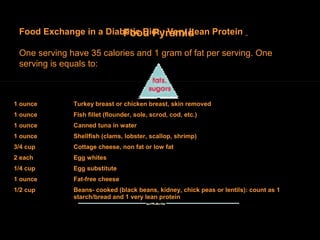
Food PyramidFood Exchange in a Diabetic Diet : Very Lean Protein
One serving have 35 calories and 1 gram of fat per serving. One
serving is equals to:
1 ounce Turkey breast or chicken breast, skin removed
1 ounce Fish fillet (flounder, sole, scrod, cod, etc.)
1 ounce Canned tuna in water
1 ounce Shellfish (clams, lobster, scallop, shrimp)
3/4 cup Cottage cheese, non fat or low fat
2 each Egg whites
1/4 cup Egg substitute
1 ounce Fat-free cheese
1/2 cup Beans- cooked (black beans, kidney, chick peas or lentils): count as 1
starch/bread and 1 very lean protein
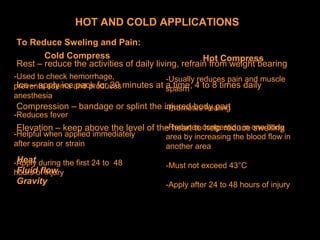
HOT AND COLD APPLICATIONS
Cold Compress
-Used to check hemorrhage,
prevents edema and produces
anesthesia
-Reduces fever
-Helpful when applied immediately
after sprain or strain
-Apply during the first 24 to 48
hours of injury
Hot Compress
-Usually reduces pain and muscle
spasm
-Promotes healing
-Reduces congestion in one body
area by increasing the blood flow in
another area
-Must not exceed 43°C
-Apply after 24 to 48 hours of injury
To Reduce Sweling and Pain:
Rest – reduce the activities of daily living, refrain from weight bearing
Ice – apply ice pack for 20 minutes at a time, 4 to 8 times daily
Compression – bandage or splint the injured body part
Elevation – keep above the level of the heart to help reduce swelling
Heat
Fluid flow
Gravity
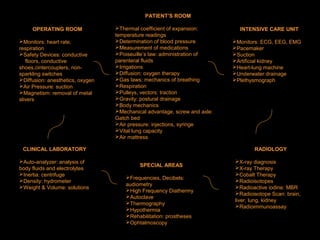
OPERATING ROOM
Monitors: heart rate,
respiration
Safety Devices: conductive
floors, conductive
shoes,cintercouplers, non-
sparkling switches
Diffusion: anesthetics, oxygen
Air Pressure: suction
Magnetism: removal of metal
slivers
PATIENT’S ROOM
Thermal coefficient of expansion:
temperature readings
Determination of blood pressure
Measurement of medications
Poiseuille’s law: administration of
parenteral fluids
Irrigations
Diffusion: oxygen therapy
Gas laws: mechanics of breathing
Respiration
Pulleys, vectors: traction
Gravity: postural drainage
Body mechanics
Mechanical advantage, screw and axle:
Gatch bed
Air pressure: injections, syringe
Vital lung capacity
Air mattress
INTENSIVE CARE UNIT
Monitors: ECG, EEG, EMG
Pacemaker
Suction
Artificial kidney
Heart-lung machine
Underwater drainage
Plethysmograph
CLINICAL LABORATORY
Auto-analyzer: analysis of
body fluids and electrolytes
Inertia: centrifuge
Density: hydrometer
Weight & Volume: solutions
SPECIAL AREAS
Frequencies, Decibels:
audiometry
High Frequency Diathermy
Autoclave
Thermography
Hypothermia
Rehabilitation: prostheses
Ophtalmoscopy
RADIOLOGY
X-ray diagnosis
X-ray Therapy
Cobalt Therapy
Radioisotopes
Radioactive iodine: MBR
Radioisotope Scan: brain,
liver, lung, kidney
Radioimmunoassay
REFERENCES:
Hademenos, George. Schaum’s Outline of Theory and Problems of
Physics for Pre-Med, Biology, and Allied Health Students. U.S.A.: McGraw-Hill
Companies, Inc., 1998.
Jensen, Trygve. Physics for the Health Professions. U.S.A.: Delmar
Publishers, Inc., 1992.
Nave, Carl and Brenda Nave. Physics for the Health Sciences.
Philippines: Elsevier (Singapore) Pte Ltd., 2004.
Urone, Paul Peter. Physics With Health Science Applications.
Canada: John Wiley & Sons, Inc., 2004.

Physics in the health sciences

  • 1.
    PHYSICS IN THE HEALTH SCIENCES ASCIENCE THAT DEALS WITH THE APPLICATIONS OF MATTER, ENERGY, SPACE AND TIME IN THE DIAGNOSIS, TREATMENT AND PREVENTION OF DISEASE AND INJURY.
  • 2.
    VITAL SIGNS - Canbe observed, measured, and monitored to assess an individual's level of physical functioning. * Blood pressure * Temperature * Pulse rate * Respiratory rate
  • 3.
    BLOOD PRESSURE -Pressure ofcirculating blood against the walls of the arteries -An important diagnostic index, especially of the circulatory function -Measured in two point: systole (high point) and diastole (low point) -Measured in terms of mm of Hg using the sphygmomanometer
  • 4.
    BLOOD PRESSURE -Normal Values: 80/45 (infants)  120/80 (30 years old)  140/85 ( 40 years old and over) -Higher in men than in women and children -Lowest during sleep
  • 5.
    BLOOD PRESSURE Physics Concepts: Ideal Gas Law  Force pump
  • 7.
    TEMPERATURE -The degree ofbody heat -Results from metabolism (the conversion of food into protein, carbohydrates and fats with the release of energy in the form of heat)
  • 8.
    TEMPERATURE -Temperature regulators inhumans and other warm- bloodied animals:  Perspiring – evaporation through pores in the skin  Panting – evaporation through pores in the mouth  Shivering – activates certain muscles to increase metabolism and thereby warms the body
  • 9.
    TEMPERATURE -Normal values:  37°C(oral)  36.5°C (axilla)  37.5°C (rectum)  37.5°C (tympanic or ear)  34.4°C (forehead/skin)  37.3°C (esophagus)
  • 10.
    TEMPERATURE Physics Concepts: Thermal expansion Modesof energy transfer Energy conservation
  • 11.
  • 12.
    PULSE -The rythmic expansionof the arteries resulting from passage of successive surges of blood, produced by the continuing contractions of the heart. -Measured from the following points: -Radial artery (wrist) -Brachial artery (inside of the elbow) -Carotid artery (either side of the windpipe) -Apical (apex of the heart) -Normal value: 60 to 70 beats per minute (adults) -Ideal gas law -Force pump
  • 13.
    RESPIRATION -The response ofthe body to cellular needs for oxygen and carbon dioxide elimination. -One complete cycle is composed of one inhalation and one exhalation. -Normal values: 12 to 20 cycles/minute (adults) 15 to 30 cycles/minute (children ages 1 -12 years) 25 to 50 cycles/minute (infant – birth to 1 year old) -Boyle’s law
  • 14.
    MEASUREMENT OF MEDICATION -Thecorrect amount of medication, oxygen concentration, electric stimulation or x-ray radiation may make a difference between life and death. -Measurement
  • 15.
    ADMINISTRATION OF PARENTERALFLUIDS -Parenteral Fluids -Medication or nutrition administered other than by the mouth or the rectum. -Examples: Injections Infusions Implantations -Poiseuille’s law -Hydrodynamics -Pressure Blood TransfusionIV by Gravity Method
  • 16.
    OXYGEN THERAPY -Necessary forenough oxygen in the blood when the lungs cannot any,ore transfer enough oxygen. -Used for acute health care needs and chronic lung conditions. -Diffusion
  • 17.
    TRACTION -Used in casesof fracture and spinal injuries to overcome muscle contraction which would produce overriding and misalignment of bones. -Involves the aplication of regulated weight/s that will serve as pulling force/s. -Traction force is regulated between 0 and 200 pounds. -Simple machines (pulley) -Vectors Cervical TractionLumbo-sacral TractionRussell Traction
  • 18.
    GATCH BED -A devicein health care which utilizes the principle of the screw. Used to regulate the position of the patient’s knees (right crank) and head (left crank). -Simple machines (screw, axle) -Mechanical advantage
  • 19.
    EGG CRATE MATTRESS -Designedfor additional comfort and pressure relief -Minimizes bed sores -Promotes increased air circulation -Pressure
  • 20.
    BODY MECHANICS -Important inthe everyday maintenance of posture, alignment and motion -Entails good use of the body to get the best results with least effort -Three rules of good body mechanics: -Use large muscles whenever possible. -Keep feet apart for a broad base. - In lifting, bend knees with the back straight, instead of bending over. -Equilibrium -Torque
  • 21.
    NUTRITION -Concerned with theeffect of food on health and the survival of the human body -Calorie - Unit for the energy value of food - Equal to 1 kilocalorie in Physics -Heat of combustion -Energy
  • 22.
    Energy Values (Heatof Combustion) of Selected Foods Food Kcal/g Food Kcal/g Apples, raw 0.64 Ice cream, plain 2.10 Avocado 1.67 Lard 9.30 Beans, kidney 1.18 Lettuce, leaf 0.20 Beer 0.42 Meat, lean 0.27 Big Mac 2.89 Milk, low fat 0.42 Bread, white 2.66 Milk, whole 0.72 Butter 7.95 Oatmeal, cooked 0.63 Buttermilk 0.37 Orange juice 0.43 Carrots 0.42 Peanuts, roasted 5.73 Cheese, cheddar 3.93 Peas 0.71 Chicken, roasted 1.60 Potatoes, boiled 0.97 Chocolate 5.70 Raisins 2.90 Coffee, black 0.008 Rice, cooked 1.12 Cola, carbonated 0.36 Shrimps, snails, raw 0.91 Corn flakes 3.93 Sirloin, lean 1.66 Cream, 40% 3.81 Sugar, granulated 3.94 Egg, boiled 1.62 Tomato 0.23 Grapes 0.69 Tuna, in oil 1.97 Ham, cooked 2.23 Turnip 0.27 Hamburger, lean 1.63 Wine 0.85
  • 23.
    Energy Consumption Ratefor Various Activities* Acitvity Energy Consumption Rate (kcal/min) Sleeping 1.2 Sitting at rest 1.7 Standing relaxed 1.8 Sitting in class 3.0 Walking slowly (4.8 kph) 3.8 Cycling (13-18 kph) 5.7 Playing tennis 6.3 Swimming breaststroke 6.8 Ice skating (14.5 kph) 7.8 Climbing stairs (116/min) 9.8 Cycling (21 kph) 10.0 Playing basketball 11.4 Cycling, professional racer 26.5 *Normal 76-kg male
  • 24.
    Food PyramidFood Exchangein a Diabetic Diet : Very Lean Protein One serving have 35 calories and 1 gram of fat per serving. One serving is equals to: 1 ounce Turkey breast or chicken breast, skin removed 1 ounce Fish fillet (flounder, sole, scrod, cod, etc.) 1 ounce Canned tuna in water 1 ounce Shellfish (clams, lobster, scallop, shrimp) 3/4 cup Cottage cheese, non fat or low fat 2 each Egg whites 1/4 cup Egg substitute 1 ounce Fat-free cheese 1/2 cup Beans- cooked (black beans, kidney, chick peas or lentils): count as 1 starch/bread and 1 very lean protein
  • 25.
    HOT AND COLDAPPLICATIONS Cold Compress -Used to check hemorrhage, prevents edema and produces anesthesia -Reduces fever -Helpful when applied immediately after sprain or strain -Apply during the first 24 to 48 hours of injury Hot Compress -Usually reduces pain and muscle spasm -Promotes healing -Reduces congestion in one body area by increasing the blood flow in another area -Must not exceed 43°C -Apply after 24 to 48 hours of injury To Reduce Sweling and Pain: Rest – reduce the activities of daily living, refrain from weight bearing Ice – apply ice pack for 20 minutes at a time, 4 to 8 times daily Compression – bandage or splint the injured body part Elevation – keep above the level of the heart to help reduce swelling Heat Fluid flow Gravity
  • 26.
    OPERATING ROOM Monitors: heartrate, respiration Safety Devices: conductive floors, conductive shoes,cintercouplers, non- sparkling switches Diffusion: anesthetics, oxygen Air Pressure: suction Magnetism: removal of metal slivers PATIENT’S ROOM Thermal coefficient of expansion: temperature readings Determination of blood pressure Measurement of medications Poiseuille’s law: administration of parenteral fluids Irrigations Diffusion: oxygen therapy Gas laws: mechanics of breathing Respiration Pulleys, vectors: traction Gravity: postural drainage Body mechanics Mechanical advantage, screw and axle: Gatch bed Air pressure: injections, syringe Vital lung capacity Air mattress INTENSIVE CARE UNIT Monitors: ECG, EEG, EMG Pacemaker Suction Artificial kidney Heart-lung machine Underwater drainage Plethysmograph CLINICAL LABORATORY Auto-analyzer: analysis of body fluids and electrolytes Inertia: centrifuge Density: hydrometer Weight & Volume: solutions SPECIAL AREAS Frequencies, Decibels: audiometry High Frequency Diathermy Autoclave Thermography Hypothermia Rehabilitation: prostheses Ophtalmoscopy RADIOLOGY X-ray diagnosis X-ray Therapy Cobalt Therapy Radioisotopes Radioactive iodine: MBR Radioisotope Scan: brain, liver, lung, kidney Radioimmunoassay
  • 28.
    REFERENCES: Hademenos, George. Schaum’sOutline of Theory and Problems of Physics for Pre-Med, Biology, and Allied Health Students. U.S.A.: McGraw-Hill Companies, Inc., 1998. Jensen, Trygve. Physics for the Health Professions. U.S.A.: Delmar Publishers, Inc., 1992. Nave, Carl and Brenda Nave. Physics for the Health Sciences. Philippines: Elsevier (Singapore) Pte Ltd., 2004. Urone, Paul Peter. Physics With Health Science Applications. Canada: John Wiley & Sons, Inc., 2004.