Structure and Function of  ATP
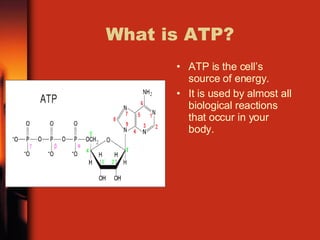
What is ATP? ATP is the cell’s source of energy. It is used by almost all biological reactions that occur in your body.
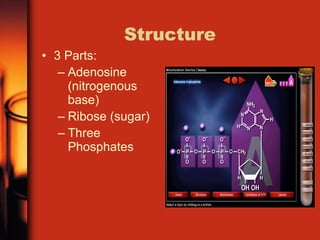
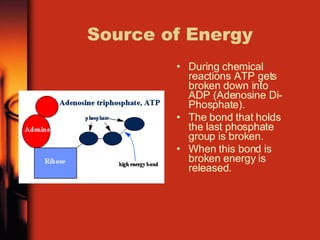
Structure 3 Parts: Adenosine (nitrogenous base) Ribose (sugar) Three Phosphates
Source of Energy During chemical reactions ATP gets broken down into ADP (Adenosine Di-Phosphate). The bond that holds the last phosphate group is broken. When this bond is broken energy is released.
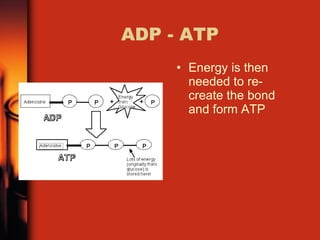
ADP - ATP Energy is then needed to re-create the bond and form ATP
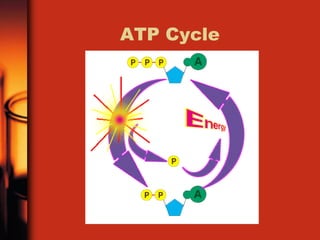
ATP Cycle
ATP Cycle
Summary Questions What is the biological importance of ATP? When ATP is broken down, what is it converted into? Where do we get the energy to make ATP from?

ATP

  • 1.
  • 2.
    What is ATP?ATP is the cell’s source of energy. It is used by almost all biological reactions that occur in your body.
  • 3.
    Structure 3 Parts:Adenosine (nitrogenous base) Ribose (sugar) Three Phosphates
  • 4.
    Source of EnergyDuring chemical reactions ATP gets broken down into ADP (Adenosine Di-Phosphate). The bond that holds the last phosphate group is broken. When this bond is broken energy is released.
  • 5.
    ADP - ATPEnergy is then needed to re-create the bond and form ATP
  • 6.
  • 7.
  • 8.
    Summary Questions Whatis the biological importance of ATP? When ATP is broken down, what is it converted into? Where do we get the energy to make ATP from?