
Human Impact on
    Biodiversity


            Presented by
         Dr. B. Victor., Ph. D
 Email : bonfiliusvictor@gmail.com
   Blog: bonvictor.blogspot.com
Presentation          outline
  Meaning and origin of biodiversity
  Earth-Nature-Human relationship
  Uniqueness of Biodiversity
  Global ratio of biodiversity
  What is biodiversity?
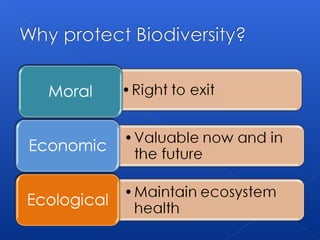
  Why protect biodiversity?
  Benefits of biodiversity
  Biodiversity concepts
  Biodiversity Threats
  Conservation of biodiversity
  Biodiversity crisis
  Closing thoughts
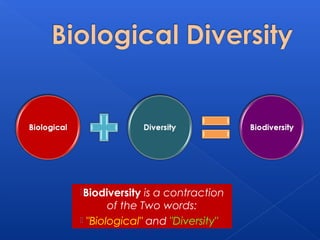
Biodiversity isa contraction
       of the Two words:
 "Biological" and "Diversity" 
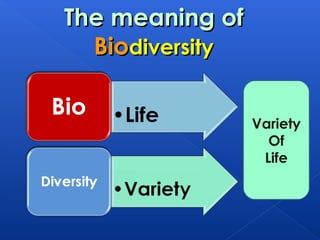
The meaning of
  Biodiversity


                 Variety
                   Of
                  Life
Life on Earth
 Earth is a complex interdependent
  system of life forms, habitats and
  fluxes (interactions).
 Biodiversity is the life-support system
  for our earth.
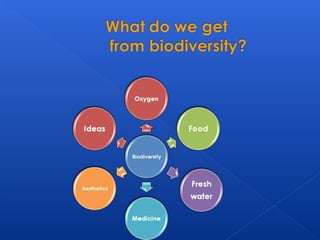
 The air we breathe , the water we
  drink and the food we eat all depend
  on the Earth’s rich biodiversity.
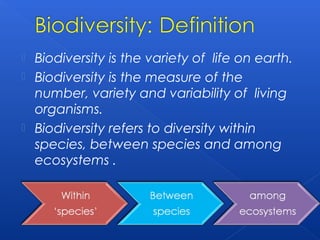
 Biodiversity is the variety of life on earth.
 Biodiversity is the measure of the
  number, variety and variability of living
  organisms.
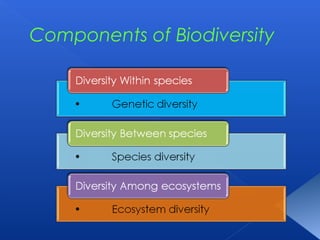
 Biodiversity refers to diversity within
  species, between species and among
  ecosystems .
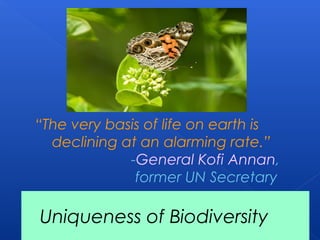
“The very basis of life on earth is
  declining at an alarming rate.”
             -General Kofi Annan,
              former UN Secretary

Uniqueness of Biodiversity
Bio-rich areas on Earth
The goods and services of biodiversity are
crucial for human survival and wellbeing.
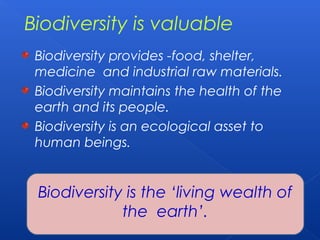
Biodiversity is valuable
 Biodiversity provides -food, shelter,
 medicine and industrial raw materials.
 Biodiversity maintains the health of the
 earth and its people.
 Biodiversity is an ecological asset to
 human beings.


 Biodiversity is the ‘living wealth of
             the earth’.
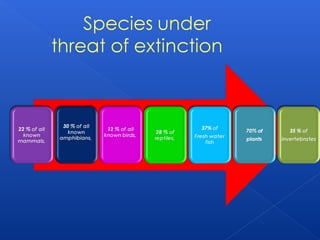
Biodiversity is under threat
    Biodiversity is a fragile thing, sensitive to all
     sorts of threats.
    Biodiversity is under threat globally,
     nationally and locally.
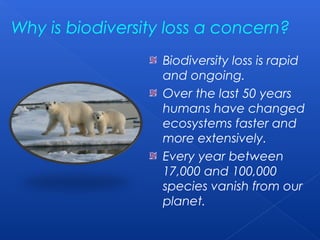
Why is biodiversity loss a concern?
                   Biodiversity loss is rapid
                   and ongoing.
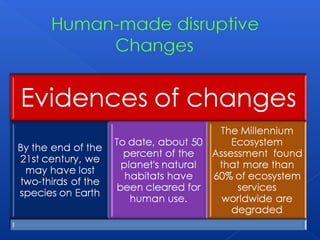
                   Over the last 50 years
                   humans have changed
                   ecosystems faster and
                   more extensively.
                   Every year between
                   17,000 and 100,000
                   species vanish from our
                   planet.
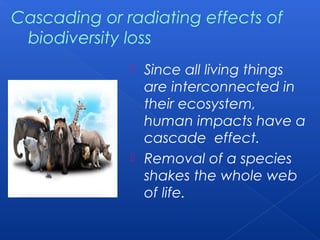
Cascading or radiating effects of
 biodiversity loss
               Since all living things
                are interconnected in
                their ecosystem,
                human impacts have a
                cascade effect.
               Removal of a species
                shakes the whole web
                of life.
Global Distribution of
Biodiversity
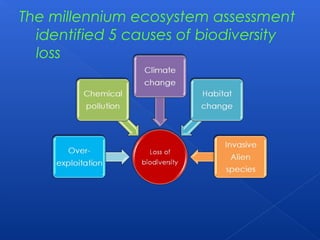
The millennium ecosystem assessment
  identified 5 causes of biodiversity
  loss
Components of Biodiversity
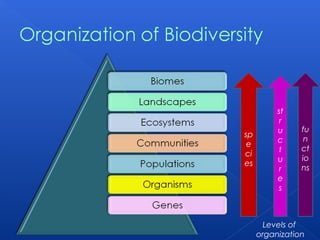
st
           r
          u     fu
sp
          c      n
 e
           t    ct
ci
          u     io
es
           r    ns
          e
          s


       Levels of
     organization
Levels of Biodiversity
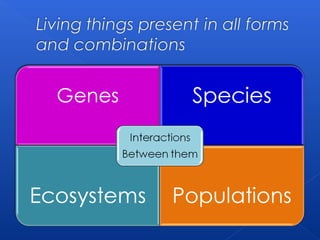
                Genetic diversity –
                variability in genetic
                makeup within a
                species
                Species diversity –
                Variety of species on
                earth
                Ecosystem (Habitat)
                diversity – the variety of
                biological communities
                and ecosystems on
                Earth.
Genetic Diversity
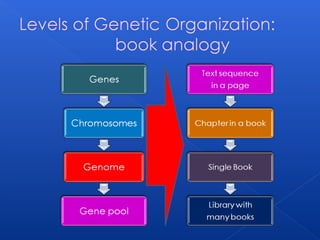
   Genes are the building blocks of life.
   Genes are the units of inheritance.
   Genes are made up of DNA.
   Genetic diversity is identified by the
    analysis of gene sequence, amount of
    DNA per cell and chromosome structure
    and number.
   Genetic divergence is the basis for
    evolution.
Species diversity

It represents the different types of plants,
animals and other life forms within a
region.
It is a dynamic property and changes
over space and time.
Species diversity is an indicator of the
biological richness/stress of an
ecosystem.
Ecosystem Diversity

It is the variety of different
habitats/ecosystems in a particular
area ( e.g.. wetland, woodland,
grassland).
Every ecosystem can be characterized
by its own species composition.
The ecosystems differ in features such as
physical structure, temperature, water
availability and food types.
Benefits of Biodiversity
   Biodiversity provides us with food, shelter
    Medicines and clothing.
   80% of our food supply comes from 20
    kinds of plants.
   About 80,000 edible wild plant species
    could be utilized by humans.
   Humans use at least 40,000 species of
    plants and animals a day.
   More than 50 % of all prescriptions
    contain natural products.
Industrial benefits

 A wide range of industrial materials are
  derived directly from bioresources.
 E.g., building materials, fibers, dyes,
  resins, gums, adhesives, rubber and oil.
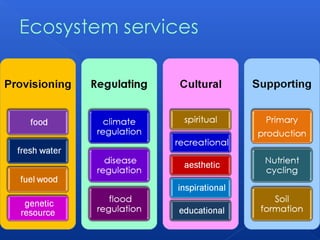
Ecological benefits

    Soil formation
    Waste disposal
    Air and water purification
    Nutrient cycling
    Solar energy absorption
    Food production
Biological benefits
Biodiversity helps biological
communities withstand stress better
and recover more quickly.
95% of the potential pests and
disease-carrying organisms in the
world are controlled by natural
predators and competitors.
Cultural and aesthetic benefits

 Cultural identity and spirituality
 Inspiration for musicians, painters,
  sculptors, writers and other artists.
 Leisure activities-bird watching, natural
  history programs.
 Aesthetic enjoyment and recreation.
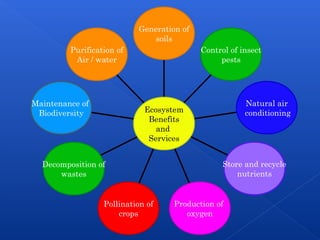
Generation of
                              soils
         Purification of                   Control of insect
          Air / water                           pests


Maintenance of                                         Natural air
 Biodiversity                Ecosystem                 conditioning
                              Benefits
                                and
                              Services


  Decomposition of                               Store and recycle
      wastes                                         nutrients


                  Pollination of    Production of
                      crops            oxygen
Threats to
biodiversity
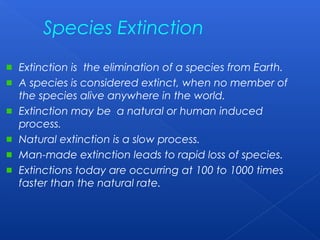
Species Extinction
Extinction is the elimination of a species from Earth.
A species is considered extinct, when no member of
the species alive anywhere in the world.
Extinction may be a natural or human induced
process.
Natural extinction is a slow process.
Man-made extinction leads to rapid loss of species.
Extinctions today are occurring at 100 to 1000 times
faster than the natural rate.
Causes of Species Extinction
Natural processes (e.g. fires, hurricanes,
droughts);
Excessive harvesting of particular species of
economic value;
Introduction of exotic invasive species
including diseases;
Impact of various environmental pollutants
changes in climate;
 knock-on effects from extinction of essential
companion species.
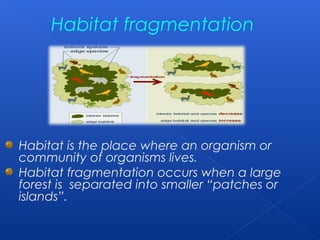
Habitat fragmentation


Habitat is the place where an organism or
community of organisms lives.
Habitat fragmentation occurs when a large
forest is separated into smaller “patches or
islands”.
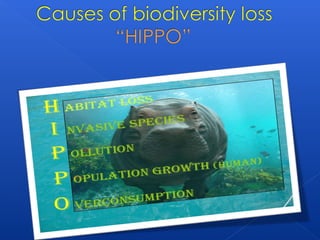
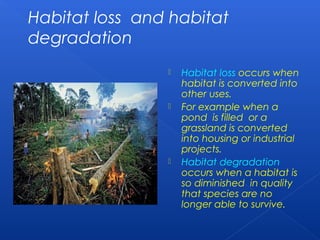
Habitat loss and habitat
degradation
                   Habitat loss occurs when
                    habitat is converted into
                    other uses.
                   For example when a
                    pond is filled or a
                    grassland is converted
                    into housing or industrial
                    projects.
                   Habitat degradation
                    occurs when a habitat is
                    so diminished in quality
                    that species are no
                    longer able to survive.
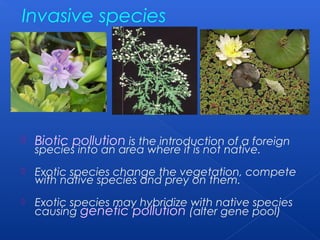
Invasive species


   Biotic pollution is the introduction of a foreign
    species into an area where it is not native.
   Exotic species change the vegetation, compete
    with native species and prey on them.
   Exotic species may hybridize with native species
    causing genetic pollution (alter gene pool)
Environmental Pollution
   Acid deposition
   Global warming
   Toxic discharges
   Bacterial contamination
   Nutrient buildup
   Plastics
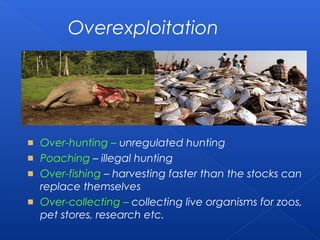
Overexploitation


Over-hunting – unregulated hunting
Poaching – illegal hunting
Over-fishing – harvesting faster than the stocks can
replace themselves
Over-collecting – collecting live organisms for zoos,
pet stores, research etc.
Conservation of Biodiversity
 Ex-situ conservation means “off-site”
  conservation.
 The species of plants and animals to
  be protected are removed from the
  natural habitats and are placed in the
  safer areas under the control of man.
 E.g.,Botanical gardens, zoos and
  Germplasm banks or Seed banks.
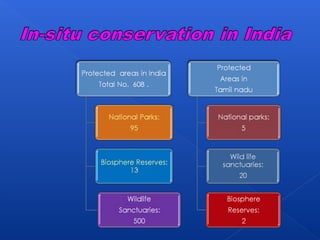
   In-situ conservation means “on-site”
    conservation.
   i.e. protection of species within the
    natural habitat of the species of
    animals and plants.
   E.g., wildlife sanctuaries, national
    parks and biosphere reserves etc.
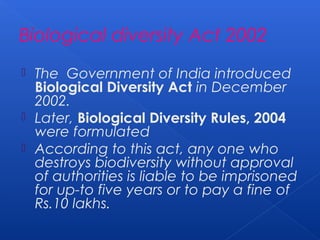
Biological diversity Act 2002
 The Government of India introduced
  Biological Diversity Act in December
  2002.
 Later, Biological Diversity Rules, 2004
  were formulated
 According to this act, any one who
  destroys biodiversity without approval
  of authorities is liable to be imprisoned
  for up-to five years or to pay a fine of
  Rs.10 lakhs.
How do we restore Ecological Balance/
      Biodiversity?

   Don’t deplete non-renewable resources
   Use renewable resources efficiently and
    sustainably
   Don’t create persistent toxicity
   Respect and protect biodiversity
   Follow Organic farming which provides
    the foundation for restorative agriculture.
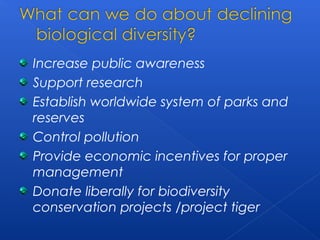
Increase public awareness
Support research
Establish worldwide system of parks and
reserves
Control pollution
Provide economic incentives for proper
management
Donate liberally for biodiversity
conservation projects /project tiger
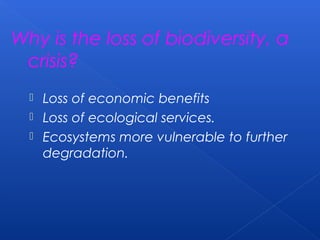
Why is the loss of biodiversity, a
 crisis?
   Loss of economic benefits
   Loss of ecological services.
   Ecosystems more vulnerable to further
    degradation.
World agencies of biodiversity
    conservation

 World Conservation Union
 World Resources Institute
 United Nations Environment Programme
 International Union for the Conservation
  of Nature and Natural Resources
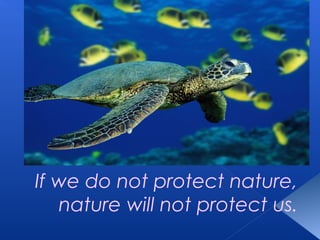
If we do not protect nature,
   nature will not protect us.
 Everything in the biosphere is
  interconnected.
 ‘If one strand is broken’
 ‘THEN THERE IS COLLAPSE OF THE
  BIOSPHERE.’
   ‘Diversity breeds Diversity’.
•   Dr.B.Victor is a highly experienced professor,
    recently retired from the reputed educational
    institution- St. Xavier’ s College(autonomous),
    Palayamkottai, India-627001.
   He was the dean of sciences, assistant
    controller of examinations and IQAC
    co-ordinater.
   He has more than 32 years of teaching and
    research experience
   He has taught a diversity of courses and he
    has supervised 12 Ph. D research scholars .
   Send your comments to :
    bonfiliusvictor@gmail.com
Thanks a lot

Human impact on biodiversity

  • 1.
    Human Impact on Biodiversity Presented by Dr. B. Victor., Ph. D Email : bonfiliusvictor@gmail.com Blog: bonvictor.blogspot.com
  • 2.
    Presentation outline Meaning and origin of biodiversity Earth-Nature-Human relationship Uniqueness of Biodiversity Global ratio of biodiversity What is biodiversity? Why protect biodiversity? Benefits of biodiversity Biodiversity concepts Biodiversity Threats Conservation of biodiversity Biodiversity crisis Closing thoughts
  • 3.
    Biodiversity isa contraction of the Two words:  "Biological" and "Diversity" 
  • 4.
    The meaning of Biodiversity Variety Of Life
  • 5.
    Life on Earth Earth is a complex interdependent system of life forms, habitats and fluxes (interactions).  Biodiversity is the life-support system for our earth.  The air we breathe , the water we drink and the food we eat all depend on the Earth’s rich biodiversity.
  • 8.
     Biodiversity isthe variety of life on earth.  Biodiversity is the measure of the number, variety and variability of living organisms.  Biodiversity refers to diversity within species, between species and among ecosystems .
  • 9.
    “The very basisof life on earth is declining at an alarming rate.” -General Kofi Annan, former UN Secretary Uniqueness of Biodiversity
  • 11.
  • 16.
    The goods andservices of biodiversity are crucial for human survival and wellbeing.
  • 17.
    Biodiversity is valuable Biodiversity provides -food, shelter, medicine and industrial raw materials. Biodiversity maintains the health of the earth and its people. Biodiversity is an ecological asset to human beings. Biodiversity is the ‘living wealth of the earth’.
  • 20.
    Biodiversity is underthreat  Biodiversity is a fragile thing, sensitive to all sorts of threats.  Biodiversity is under threat globally, nationally and locally.
  • 21.
    Why is biodiversityloss a concern? Biodiversity loss is rapid and ongoing. Over the last 50 years humans have changed ecosystems faster and more extensively. Every year between 17,000 and 100,000 species vanish from our planet.
  • 22.
    Cascading or radiatingeffects of biodiversity loss  Since all living things are interconnected in their ecosystem, human impacts have a cascade effect.  Removal of a species shakes the whole web of life.
  • 23.
  • 26.
    The millennium ecosystemassessment identified 5 causes of biodiversity loss
  • 31.
  • 33.
    st r u fu sp c n e t ct ci u io es r ns e s Levels of organization
  • 34.
    Levels of Biodiversity Genetic diversity – variability in genetic makeup within a species Species diversity – Variety of species on earth Ecosystem (Habitat) diversity – the variety of biological communities and ecosystems on Earth.
  • 36.
    Genetic Diversity  Genes are the building blocks of life.  Genes are the units of inheritance.  Genes are made up of DNA.  Genetic diversity is identified by the analysis of gene sequence, amount of DNA per cell and chromosome structure and number.  Genetic divergence is the basis for evolution.
  • 37.
    Species diversity It representsthe different types of plants, animals and other life forms within a region. It is a dynamic property and changes over space and time. Species diversity is an indicator of the biological richness/stress of an ecosystem.
  • 38.
    Ecosystem Diversity It isthe variety of different habitats/ecosystems in a particular area ( e.g.. wetland, woodland, grassland). Every ecosystem can be characterized by its own species composition. The ecosystems differ in features such as physical structure, temperature, water availability and food types.
  • 40.
    Benefits of Biodiversity  Biodiversity provides us with food, shelter Medicines and clothing.  80% of our food supply comes from 20 kinds of plants.  About 80,000 edible wild plant species could be utilized by humans.  Humans use at least 40,000 species of plants and animals a day.  More than 50 % of all prescriptions contain natural products.
  • 41.
    Industrial benefits  Awide range of industrial materials are derived directly from bioresources.  E.g., building materials, fibers, dyes, resins, gums, adhesives, rubber and oil.
  • 42.
    Ecological benefits  Soil formation  Waste disposal  Air and water purification  Nutrient cycling  Solar energy absorption  Food production
  • 43.
    Biological benefits Biodiversity helpsbiological communities withstand stress better and recover more quickly. 95% of the potential pests and disease-carrying organisms in the world are controlled by natural predators and competitors.
  • 44.
    Cultural and aestheticbenefits  Cultural identity and spirituality  Inspiration for musicians, painters, sculptors, writers and other artists.  Leisure activities-bird watching, natural history programs.  Aesthetic enjoyment and recreation.
  • 46.
    Generation of soils Purification of Control of insect Air / water pests Maintenance of Natural air Biodiversity Ecosystem conditioning Benefits and Services Decomposition of Store and recycle wastes nutrients Pollination of Production of crops oxygen
  • 47.
  • 50.
    Species Extinction Extinction isthe elimination of a species from Earth. A species is considered extinct, when no member of the species alive anywhere in the world. Extinction may be a natural or human induced process. Natural extinction is a slow process. Man-made extinction leads to rapid loss of species. Extinctions today are occurring at 100 to 1000 times faster than the natural rate.
  • 51.
    Causes of SpeciesExtinction Natural processes (e.g. fires, hurricanes, droughts); Excessive harvesting of particular species of economic value; Introduction of exotic invasive species including diseases; Impact of various environmental pollutants changes in climate; knock-on effects from extinction of essential companion species.
  • 52.
    Habitat fragmentation Habitat isthe place where an organism or community of organisms lives. Habitat fragmentation occurs when a large forest is separated into smaller “patches or islands”.
  • 53.
    Habitat loss andhabitat degradation  Habitat loss occurs when habitat is converted into other uses.  For example when a pond is filled or a grassland is converted into housing or industrial projects.  Habitat degradation occurs when a habitat is so diminished in quality that species are no longer able to survive.
  • 54.
    Invasive species  Biotic pollution is the introduction of a foreign species into an area where it is not native.  Exotic species change the vegetation, compete with native species and prey on them.  Exotic species may hybridize with native species causing genetic pollution (alter gene pool)
  • 55.
    Environmental Pollution Acid deposition Global warming Toxic discharges Bacterial contamination Nutrient buildup Plastics
  • 56.
    Overexploitation Over-hunting – unregulatedhunting Poaching – illegal hunting Over-fishing – harvesting faster than the stocks can replace themselves Over-collecting – collecting live organisms for zoos, pet stores, research etc.
  • 57.
  • 59.
     Ex-situ conservationmeans “off-site” conservation.  The species of plants and animals to be protected are removed from the natural habitats and are placed in the safer areas under the control of man.  E.g.,Botanical gardens, zoos and Germplasm banks or Seed banks.
  • 60.
    In-situ conservation means “on-site” conservation.  i.e. protection of species within the natural habitat of the species of animals and plants.  E.g., wildlife sanctuaries, national parks and biosphere reserves etc.
  • 62.
    Biological diversity Act2002  The Government of India introduced Biological Diversity Act in December 2002.  Later, Biological Diversity Rules, 2004 were formulated  According to this act, any one who destroys biodiversity without approval of authorities is liable to be imprisoned for up-to five years or to pay a fine of Rs.10 lakhs.
  • 64.
    How do werestore Ecological Balance/ Biodiversity?  Don’t deplete non-renewable resources  Use renewable resources efficiently and sustainably  Don’t create persistent toxicity  Respect and protect biodiversity  Follow Organic farming which provides the foundation for restorative agriculture.
  • 65.
    Increase public awareness Supportresearch Establish worldwide system of parks and reserves Control pollution Provide economic incentives for proper management Donate liberally for biodiversity conservation projects /project tiger
  • 66.
    Why is theloss of biodiversity, a crisis?  Loss of economic benefits  Loss of ecological services.  Ecosystems more vulnerable to further degradation.
  • 67.
    World agencies ofbiodiversity conservation  World Conservation Union  World Resources Institute  United Nations Environment Programme  International Union for the Conservation of Nature and Natural Resources
  • 68.
    If we donot protect nature, nature will not protect us.
  • 69.
     Everything inthe biosphere is interconnected.  ‘If one strand is broken’  ‘THEN THERE IS COLLAPSE OF THE BIOSPHERE.’  ‘Diversity breeds Diversity’.
  • 70.
    Dr.B.Victor is a highly experienced professor, recently retired from the reputed educational institution- St. Xavier’ s College(autonomous), Palayamkottai, India-627001.  He was the dean of sciences, assistant controller of examinations and IQAC co-ordinater.  He has more than 32 years of teaching and research experience  He has taught a diversity of courses and he has supervised 12 Ph. D research scholars .  Send your comments to : bonfiliusvictor@gmail.com
  • 71.