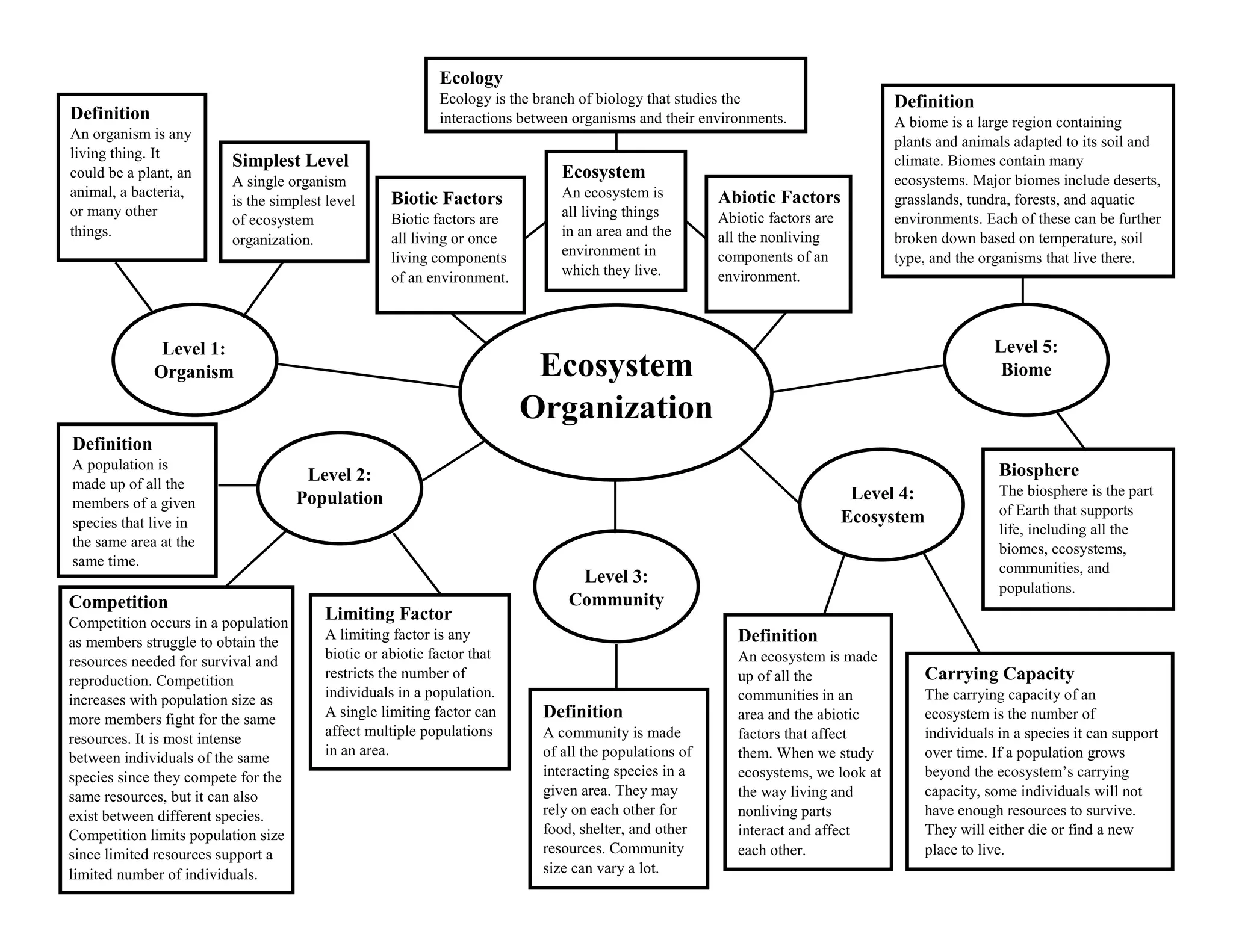
Ecosystem
Organization
Ecology
Ecology is the branch of biology that studies the
interactions between organisms and their environments.
Definition
A biome is a large region containing
plants and animals adapted to its soil and
climate. Biomes contain many
ecosystems. Major biomes include deserts,
grasslands, tundra, forests, and aquatic
environments. Each of these can be further
broken down based on temperature, soil
type, and the organisms that live there.
Biosphere
The biosphere is the part
of Earth that supports
life, including all the
biomes, ecosystems,
communities, and
populations.
Definition
An organism is any
living thing. It
could be a plant, an
animal, a bacteria,
or many other
things.
Simplest Level
A single organism
is the simplest level
of ecosystem
organization.
Carrying Capacity
The carrying capacity of an
ecosystem is the number of
individuals in a species it can support
over time. If a population grows
beyond the ecosystem’s carrying
capacity, some individuals will not
have enough resources to survive.
They will either die or find a new
place to live.
Definition
An ecosystem is made
up of all the
communities in an
area and the abiotic
factors that affect
them. When we study
ecosystems, we look at
the way living and
nonliving parts
interact and affect
each other.
Definition
A community is made
of all the populations of
interacting species in a
given area. They may
rely on each other for
food, shelter, and other
resources. Community
size can vary a lot.
Limiting Factor
A limiting factor is any
biotic or abiotic factor that
restricts the number of
individuals in a population.
A single limiting factor can
affect multiple populations
in an area.
Competition
Competition occurs in a population
as members struggle to obtain the
resources needed for survival and
reproduction. Competition
increases with population size as
more members fight for the same
resources. It is most intense
between individuals of the same
species since they compete for the
same resources, but it can also
exist between different species.
Competition limits population size
since limited resources support a
limited number of individuals.
Abiotic Factors
Abiotic factors are
all the nonliving
components of an
environment.
Ecosystem
An ecosystem is
all living things
in an area and the
environment in
which they live.
Biotic Factors
Biotic factors are
all living or once
living components
of an environment.
Definition
A population is
made up of all the
members of a given
species that live in
the same area at the
same time.
Level 1:
Organism
T
Level 2:
Population
Level 3:
Community
Level 4:
Ecosystem
Level 5:
Biome

Levels of Ecological Organization-1.pdf

  • 1.
    Ecosystem Organization Ecology Ecology is thebranch of biology that studies the interactions between organisms and their environments. Definition A biome is a large region containing plants and animals adapted to its soil and climate. Biomes contain many ecosystems. Major biomes include deserts, grasslands, tundra, forests, and aquatic environments. Each of these can be further broken down based on temperature, soil type, and the organisms that live there. Biosphere The biosphere is the part of Earth that supports life, including all the biomes, ecosystems, communities, and populations. Definition An organism is any living thing. It could be a plant, an animal, a bacteria, or many other things. Simplest Level A single organism is the simplest level of ecosystem organization. Carrying Capacity The carrying capacity of an ecosystem is the number of individuals in a species it can support over time. If a population grows beyond the ecosystem’s carrying capacity, some individuals will not have enough resources to survive. They will either die or find a new place to live. Definition An ecosystem is made up of all the communities in an area and the abiotic factors that affect them. When we study ecosystems, we look at the way living and nonliving parts interact and affect each other. Definition A community is made of all the populations of interacting species in a given area. They may rely on each other for food, shelter, and other resources. Community size can vary a lot. Limiting Factor A limiting factor is any biotic or abiotic factor that restricts the number of individuals in a population. A single limiting factor can affect multiple populations in an area. Competition Competition occurs in a population as members struggle to obtain the resources needed for survival and reproduction. Competition increases with population size as more members fight for the same resources. It is most intense between individuals of the same species since they compete for the same resources, but it can also exist between different species. Competition limits population size since limited resources support a limited number of individuals. Abiotic Factors Abiotic factors are all the nonliving components of an environment. Ecosystem An ecosystem is all living things in an area and the environment in which they live. Biotic Factors Biotic factors are all living or once living components of an environment. Definition A population is made up of all the members of a given species that live in the same area at the same time. Level 1: Organism T Level 2: Population Level 3: Community Level 4: Ecosystem Level 5: Biome