Food web is
an important ecological
concept. Basically, food
web represents feeding
relationships within a
community (Smith and Smith
2009)
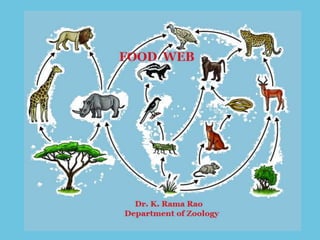
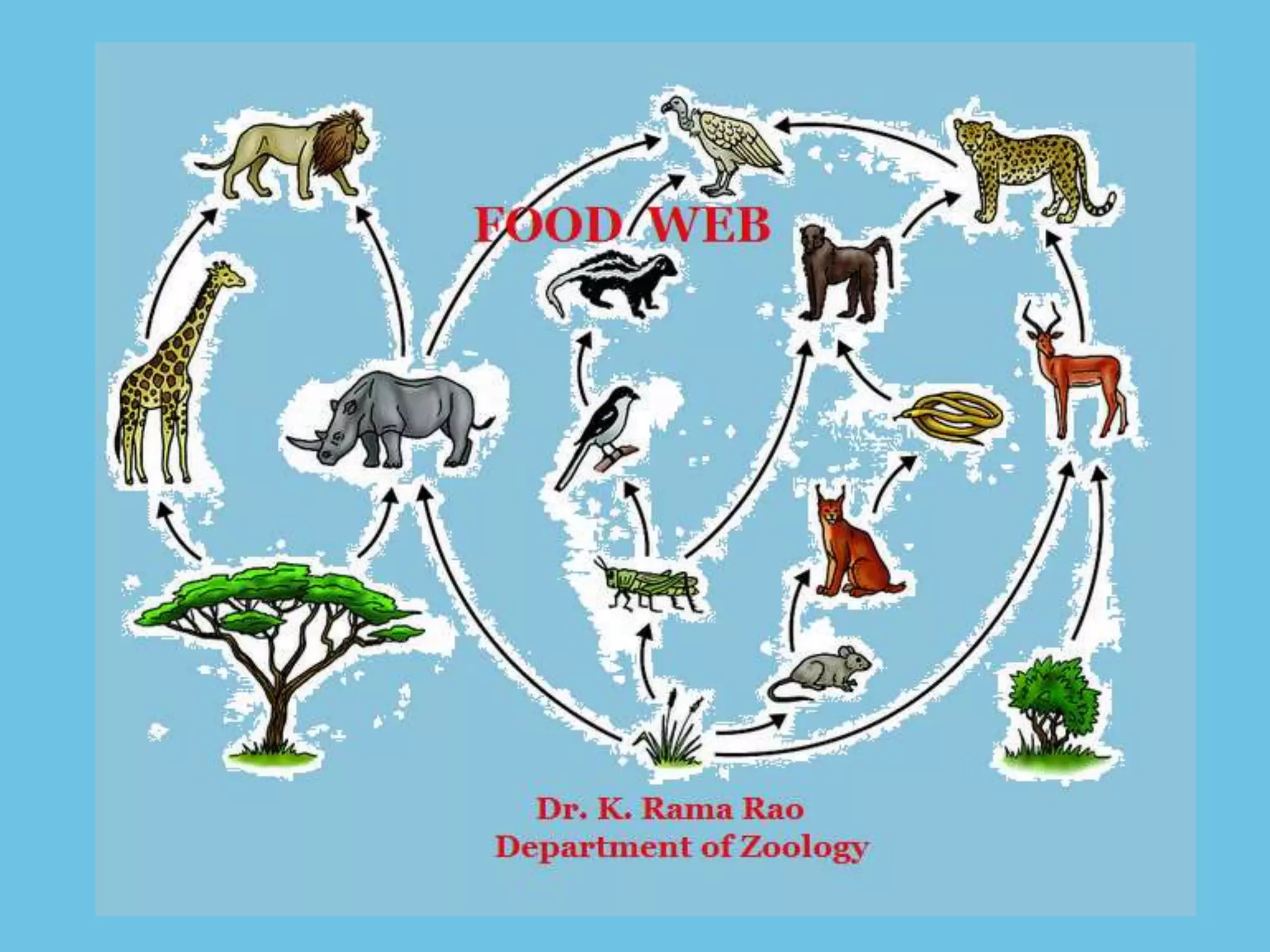
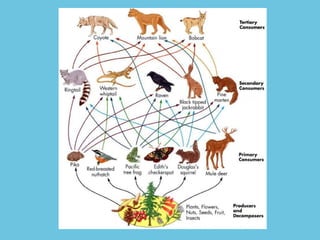
A food web is a more complex
network, graphical model
depicting the many food
chains linked together to
show the feeding
relationships of organisms in
an ecosystem.
The actual complex food habit of
different species in an ecosystem is
termed as the food web.
As a consequence of food chain
/food web, once a pollutant gets
absorbed in a species, it is
transmitted to the other species of
the higher trophic levels.
In a food web nutrients and
energy are passed on from one
species of living organisms to
another.
Sun is the ultimate source of
energy and energy is absorbed by
plants and then transferred
through all other organism in a
particular area, this transfer of
energy is called a food web.
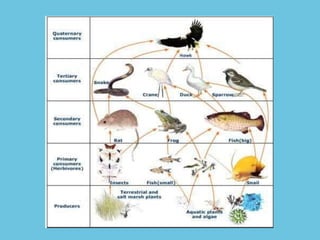
All of the interconnected and
overlapping food chains in an
ecosystem make up a food web.
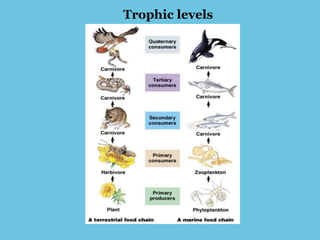
Organisms in food chains are
grouped into categories called
trophic levels.
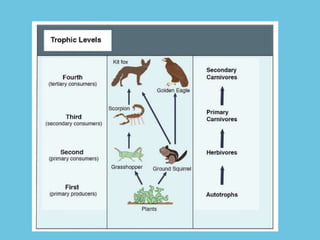
Trophic levels
Nearly all autotrophs use
a process called photosynthesis
to create “food” (a nutrient
called glucose) from sunlight,
carbon dioxide, and water.
Sometimes, a single organism
gets eaten by many predators or it
eats many other organisms.
This is when a food chain doesn’t
represent the energy flow in a
proper manner because there are
many trophic levels that
interconnect.
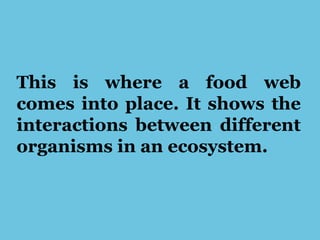
This is where a food web
comes into place. It shows the
interactions between different
organisms in an ecosystem.
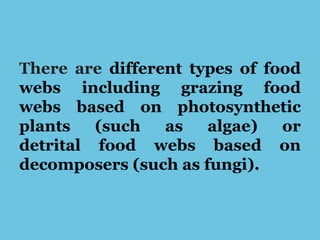
There are different types of food
webs including grazing food
webs based on photosynthetic
plants (such as algae) or
detrital food webs based on
decomposers (such as fungi).
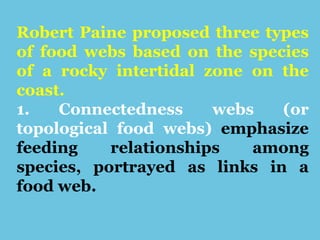
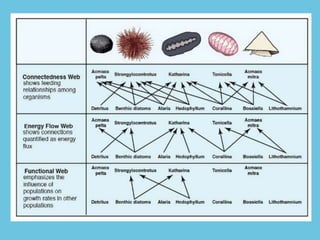
Robert Paine proposed three types
of food webs based on the species
of a rocky intertidal zone on the
coast.
1. Connectedness webs (or
topological food webs) emphasize
feeding relationships among
species, portrayed as links in a
food web.
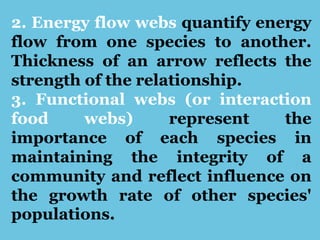
2. Energy flow webs quantify energy
flow from one species to another.
Thickness of an arrow reflects the
strength of the relationship.
3. Functional webs (or interaction
food webs) represent the
importance of each species in
maintaining the integrity of a
community and reflect influence on
the growth rate of other species'
populations.
Applications of Food Webs
The fundamental purpose of food
webs is to describe feeding
relationship among species in a
community. Food webs can be
constructed to describe the
species interactions.
All species in the food webs can be
distinguished into basal species
(autotrophs, such as plants),
intermediate species (herbivores
and intermediate level carnivores,
such as grasshopper and scorpion)
or top predators (high level
carnivores such as fox).
Indirect interaction occurs when
two species do not interact with
each other directly, but
influenced by a third species.
Species can influence one
another in many different ways.
Dr. K. Rama Rao

Food web

  • 2.
    Food web is animportant ecological concept. Basically, food web represents feeding relationships within a community (Smith and Smith 2009)
  • 3.
    A food webis a more complex network, graphical model depicting the many food chains linked together to show the feeding relationships of organisms in an ecosystem.
  • 5.
    The actual complexfood habit of different species in an ecosystem is termed as the food web. As a consequence of food chain /food web, once a pollutant gets absorbed in a species, it is transmitted to the other species of the higher trophic levels.
  • 6.
    In a foodweb nutrients and energy are passed on from one species of living organisms to another. Sun is the ultimate source of energy and energy is absorbed by plants and then transferred through all other organism in a particular area, this transfer of energy is called a food web.
  • 7.
    All of theinterconnected and overlapping food chains in an ecosystem make up a food web. Organisms in food chains are grouped into categories called trophic levels.
  • 8.
  • 9.
    Nearly all autotrophsuse a process called photosynthesis to create “food” (a nutrient called glucose) from sunlight, carbon dioxide, and water.
  • 10.
    Sometimes, a singleorganism gets eaten by many predators or it eats many other organisms. This is when a food chain doesn’t represent the energy flow in a proper manner because there are many trophic levels that interconnect.
  • 12.
    This is wherea food web comes into place. It shows the interactions between different organisms in an ecosystem.
  • 13.
    There are differenttypes of food webs including grazing food webs based on photosynthetic plants (such as algae) or detrital food webs based on decomposers (such as fungi).
  • 14.
    Robert Paine proposedthree types of food webs based on the species of a rocky intertidal zone on the coast. 1. Connectedness webs (or topological food webs) emphasize feeding relationships among species, portrayed as links in a food web.
  • 15.
    2. Energy flowwebs quantify energy flow from one species to another. Thickness of an arrow reflects the strength of the relationship. 3. Functional webs (or interaction food webs) represent the importance of each species in maintaining the integrity of a community and reflect influence on the growth rate of other species' populations.
  • 17.
    Applications of FoodWebs The fundamental purpose of food webs is to describe feeding relationship among species in a community. Food webs can be constructed to describe the species interactions.
  • 18.
    All species inthe food webs can be distinguished into basal species (autotrophs, such as plants), intermediate species (herbivores and intermediate level carnivores, such as grasshopper and scorpion) or top predators (high level carnivores such as fox).
  • 20.
    Indirect interaction occurswhen two species do not interact with each other directly, but influenced by a third species. Species can influence one another in many different ways. Dr. K. Rama Rao