
Review of Cells
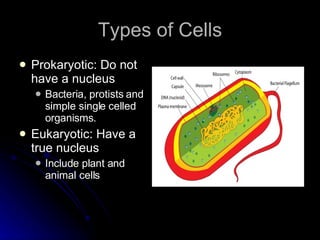
Types of Cells Prokaryotic: Do not have a nucleus Bacteria, protists and simple single celled organisms. Eukaryotic: Have a true nucleus Include plant and animal cells
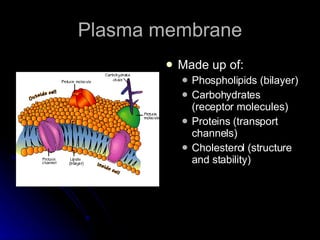
Plasma membrane Made up of: Phospholipids (bilayer) Carbohydrates (receptor molecules) Proteins (transport channels) Cholesterol (structure and stability)
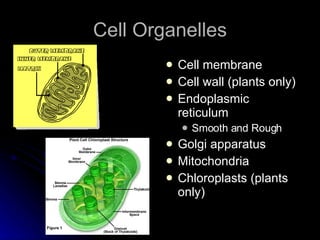
Cell Organelles Cell membrane Cell wall (plants only) Endoplasmic reticulum Smooth and Rough Golgi apparatus Mitochondria Chloroplasts (plants only)
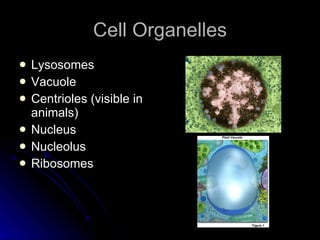
Cell Organelles Lysosomes Vacuole Centrioles (visible in animals) Nucleus Nucleolus Ribosomes
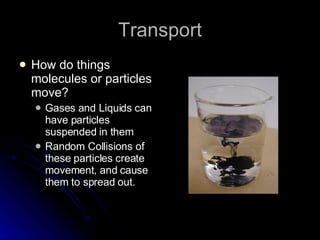
Transport How do things molecules or particles move? Gases and Liquids can have particles suspended in them Random Collisions of these particles create movement, and cause them to spread out.
Passive Transport Does not require energy Two types: Diffusion: from high concentration to low concentration. Until an equilibrium is reached. Osmosis: the diffusion of water. Facilitated Diffusion: The diffusion of larger molecules, with the help of transport protein. Facilitated Diffusion
Active Transport Transport across the membrane that requires the use of energy. Usually occurs up the concentration gradient Uses ATP
 

Review Of Cells

  • 1.
  • 2.
    Types of CellsProkaryotic: Do not have a nucleus Bacteria, protists and simple single celled organisms. Eukaryotic: Have a true nucleus Include plant and animal cells
  • 3.
    Plasma membrane Madeup of: Phospholipids (bilayer) Carbohydrates (receptor molecules) Proteins (transport channels) Cholesterol (structure and stability)
  • 4.
    Cell Organelles Cellmembrane Cell wall (plants only) Endoplasmic reticulum Smooth and Rough Golgi apparatus Mitochondria Chloroplasts (plants only)
  • 5.
    Cell Organelles LysosomesVacuole Centrioles (visible in animals) Nucleus Nucleolus Ribosomes
  • 6.
    Transport How dothings molecules or particles move? Gases and Liquids can have particles suspended in them Random Collisions of these particles create movement, and cause them to spread out.
  • 7.
    Passive Transport Doesnot require energy Two types: Diffusion: from high concentration to low concentration. Until an equilibrium is reached. Osmosis: the diffusion of water. Facilitated Diffusion: The diffusion of larger molecules, with the help of transport protein. Facilitated Diffusion
  • 8.
    Active Transport Transportacross the membrane that requires the use of energy. Usually occurs up the concentration gradient Uses ATP
  • 9.