ECOLOGY
PROF: DAVID LOUIE S. ACOSTA, LPT
ENVISCIE INSTRUCTOR
What is Ecology
Ecology is the science by which we study how
organism ( animals, plants, microbes) interact I
and with the natural word.
 Interactions of living things with each other and
their physical environment
What is Ecology
The word "ecology" comes from the Greek words
oikos and logos, which mean "house" and "word"
or "language" respectively. The term was coined
in 1866 by German zoologist Ernst Haeckel.
• Oikos: Means "house", "household", "dwelling
place", or "family"
• Logos: Means "word", "language", or "language
of reason"
What is Ecology
The term "ecology" literally means "the study of
organisms at home". It refers to the study of how
organisms relate to their environment, both
organic and inorganic.
What is Ecology
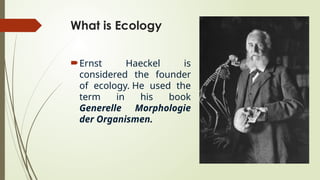
Ernst Haeckel is
considered the founder
of ecology. He used the
term in his book
Generelle Morphologie
der Organismen.
Environment
The environment is the sum of all living and non-living
things that surround us, including the air, water, and
land. It also includes the conditions that influence the
survival of living things
Living component: All need sun, air, water, and earth
To grow: eat, drink, breathe, move and have a babies
Non-living component: Physical Quantities
Habitat and Niche
PART 2
Habitat
In ecology, a habitat is the natural environment
where an organism lives and obtains the resources it
needs to survive. Habitats are made up of living and
nonliving things, and can be terrestrial or aquatic.
A habitat is an environment where an organism lives
throughout the year or for shorter periods of time to
find a mate. The habitat contains all an animal needs
to survive such as food and shelter.
What’s in a habitat?
• Food: Organisms need food to survive.
• Water: Organisms need water to survive, and the amount
of water they need varies.
• Shelter: Organisms need shelter to survive.
• Space: Organisms need space to survive.
• Physical features: The physical features of a habitat
include topography, soil characteristics, climate, and water
quality.
• Species: The species of plants and animals that live in a
habitat.
Example of Habitat
• Polar habitats: These habitats are found at the
Earth's poles, in the Arctic and Antarctica. They are
cold and windy, and some animals that live there
include polar bears, arctic foxes, and arctic wolves.
• Tropical habitats: These habitats are found in the
tropics, which surround the equator. They are
hotter and wetter than other regions of the Earth.
• Subtropical deserts: These habitats are densely
forested with palms and oranges.
Example of Habitat
A microhabitat is a small area within a
habitat that has unique conditions. These
unique conditions may support unique
species that aren't found in the larger
region.
Niche
A niche is the role of species in their
environment. No two species hold the exact
same niche.
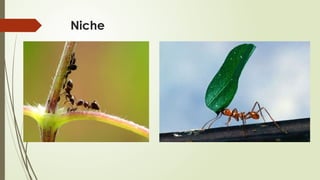
In ecology, a niche is the role and position of a
species in its ecosystem. It describes the physical
and environmental conditions a species needs
to survive, as well as how it interacts with other
species
Niche
What does a niche include
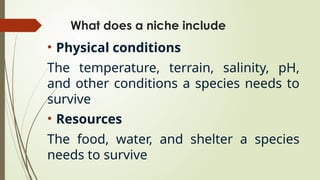
• Physical conditions
The temperature, terrain, salinity, pH,
and other conditions a species needs to
survive
• Resources
The food, water, and shelter a species
needs to survive
What does a niche include
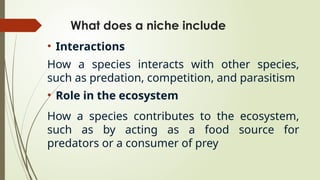
• Interactions
How a species interacts with other species,
such as predation, competition, and parasitism
• Role in the ecosystem
How a species contributes to the ecosystem,
such as by acting as a food source for
predators or a consumer of prey
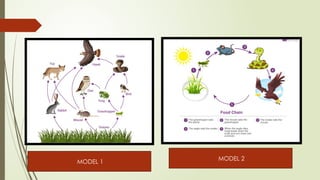
MODEL 1
MODEL 2
FOOD WEB AND FOOD
CHAIN
PART 3
FOOD WEB?
A food web is a diagram that shows the
feeding relationships between organisms
in an ecosystem. It's a visual
representation of who eats whom in a
given environment.
How does food web work?
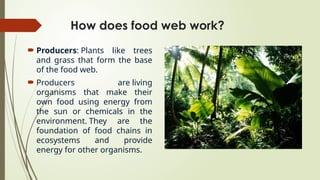
 Producers: Plants like trees
and grass that form the base
of the food web.
 Producers are living
organisms that make their
own food using energy from
the sun or chemicals in the
environment. They are the
foundation of food chains in
ecosystems and provide
energy for other organisms.
How does food web work?
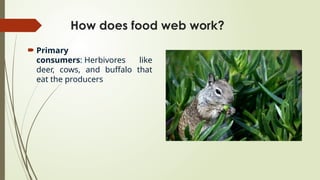
 Primary
consumers: Herbivores like
deer, cows, and buffalo that
eat the producers
How does food web work?
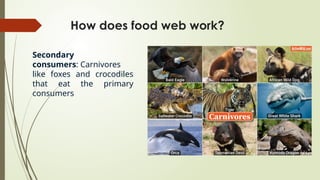
Secondary
consumers: Carnivores
like foxes and crocodiles
that eat the primary
consumers
How does food web work?
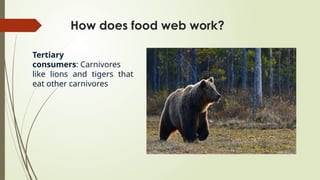
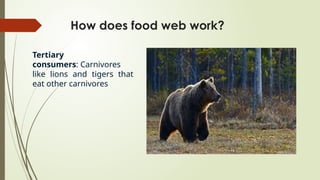
Tertiary
consumers: Carnivores
like lions and tigers that
eat other carnivores
How does food web work?
Tertiary
consumers: Carnivores
like lions and tigers that
eat other carnivores
How does food web work?
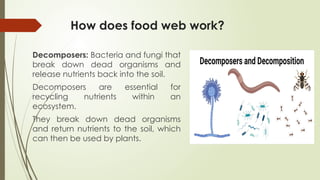
Decomposers: Bacteria and fungi that
break down dead organisms and
release nutrients back into the soil.
Decomposers are essential for
recycling nutrients within an
ecosystem.
They break down dead organisms
and return nutrients to the soil, which
can then be used by plants.
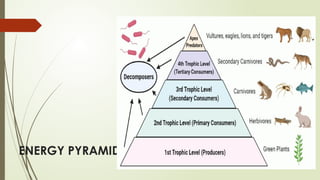
ENERGY PYRAMID
Nutritional Relationship
PART 4
Nutritional Relationships
Autotrophs:
• Organisms that can produce their own food using
sunlight or chemicals, essentially "self-feeders" - like
plants, which use photosynthesis to create their own
food; considered producers in the food chain.
Heterotrophs:
• Organisms that cannot make their own food and must
consume other organisms to obtain energy; all
animals are considered heterotrophs.
Nutritional Relationships
Key takeaway: Autotrophs create their own food,
while heterotrophs must consume other organisms
to survive, with further classifications like
herbivores (plant-eaters), carnivores (meat-eaters),
and omnivores (both plants and animals) depending
on their diet.
Nutritional Relationships
• Herbivores: Heterotrophs that primarily eat plants
as their food source, like rabbits, cows, and giraffes.
• Carnivores:-Heterotrophs that primarily eat meat
from other animals, like lions, tigers, and sharks.
• Omnivores:- Heterotrophs that eat both plants and
animals, like humans, bears, and raccoons.
• Saprophytes: -Organisms that feed on decaying
organic matter, like fungi and certain bacteria,
playing a vital role in decomposition. (AKA
decomposers)
Adaptation
Any physical or behavioral feature that
helps an organism survive.
Beak and teeth shapes
Camouflage vs. bright coloring
Habitat adaptations
Adaptation
Adaptation
• Survival of the fittest
"It is not the strongest of the
species that survive, nor the most
intelligent, but the one that is best
able to adapt to its environment".
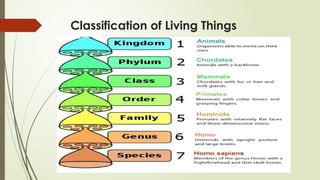
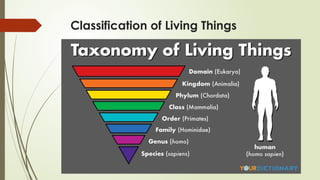
Classification of Living Things
 The seven levels of classification for living organisms are:
• Kingdom: The broadest category of classification
• Phylum: Groups organisms with common features
• Class: A general rank in the taxonomic hierarchy
• Order: A level of classification for living organisms
• Family: A group of related genera
• Genus: A taxonomic rank between family and species. (Genus
and species are combined to form the latin name.)
• Species: The most specific level of classification
Classification of Living Things
• Kingdom Animalia: The most evolved kingdom, which includes
vertebrates and invertebrates
• Phylum Arthropoda: The largest group in the animal kingdom,
which includes most insects
Classification of Living Things
Tolerance Range and
Optimal Range
PART 5
Tolerance range
The range of conditions in which a species
can survive. This range is determined by the
species' ability to tolerate variations in
environmental factors, such as temperature,
sunlight, humidity, soil chemistry, pH, salinity,
and oxygen levels.
Optimal range
The range of conditions within the
tolerance range where a species is
healthiest and can survive and reproduce
most successfully.
Stressful Conditions
Conditions that are close to the lower or
upper limits of an organism's tolerance
range. In stressful conditions, an organism
may survive, but it may produce fewer or
no offspring.
Extreme Conditions
Conditions that are beyond an organism's
tolerance range. In extreme conditions,
an organism will not survive.
Limiting Factor
A limiting factor in ecology is a condition
that restricts the size of a population and
prevents it from growing. Limiting factors
can be biotic or abiotic, and they can impact
both plant and animal populations.
Example of Limiting Factor
Food: When there isn't enough food for a
population, food becomes a limiting factor
Space: When there isn't enough space for a
population, space becomes a limiting factor
Temperature: Temperature can limit a
population's growth
Light intensity: Light intensity can limit a
population's growth
Example of Limiting Factor
 Competition: When a population becomes too large,
competition for resources like food, water, and shelter can
limit growth
 Predation: When a population becomes too large, predation
from predators can limit growth
 Disease: Disease can limit growth
 Natural disasters: Fires and other natural disasters can limit
growth
 Weather: Odd weather can limit growth
 Human activities: Human activities like clear-cutting forests
can limit growth
Limiting factors and carrying capacity
Limiting factors determine the carrying
capacity of a habitat, which is the maximum
population size that the habitat can
support. When a population grows larger
than its carrying capacity, limiting factors
cause the population to decrease.
ENERGY FLOW
 To calculate energy flow in ecology, you primarily need
to determine the amount of energy transferred between
trophic levels in a food chain by calculating the
"ecological efficiency" - which is essentially dividing the
energy available at one trophic level by the energy
available at the previous level, typically expressed as a
percentage, often following the "10% rule" where only
around 10% of energy moves to the next level; this
involves measuring the biomass (energy stored in living
organisms) at each trophic level and comparing them.
ENERGY FLOW
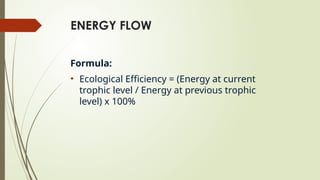
Formula:
• Ecological Efficiency = (Energy at current
trophic level / Energy at previous trophic
level) x 100%
Important factors to consider:
• Primary Productivity: The rate at which producers
(plants) capture solar energy through photosynthesis,
measured as the amount of biomass produced per unit
area per time.
• Gross Primary Productivity (GPP): The total amount of
energy captured by plants through photosynthesis.
• Net Primary Productivity (NPP): The amount of
energy remaining after plants use some for respiration,
which is the energy actually available to consumers.
• Trophic Levels: The position of an organism in a food
chain, with producers at the bottom and top predators
at the top.
Important factors to consider:
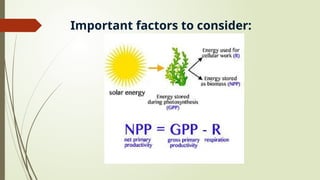
To calculate Net Primary Productivity (NPP), you subtract
the amount of energy a plant loses through respiration
(R) from its Gross Primary Productivity (GPP), using the
formula: NPP = GPP - R.
• GPP (Gross Primary Productivity):
• Represents the total amount of organic matter produced
by plants through photosynthesis per unit area per unit
time.
• R (Respiration):
• Represents the amount of organic matter used by the
plant for its own metabolic processes, essentially the
energy lost through respiration.
Important factors to consider:
Key points about NPP:
• NPP represents the actual amount of plant
biomass available to other organisms in an
ecosystem after the plant has used some of its
energy for its own needs.
• It is typically measured in units of energy per unit
area per unit time (e.g., kcal/m²/year).
• To calculate NPP, you need to measure both GPP
and R, usually through techniques like gas
exchange analysis using a portable
photosynthesis system.

ENVIRONMENTAL SCIENCE - ECOLOGY SCIENCEE

  • 1.
    ECOLOGY PROF: DAVID LOUIES. ACOSTA, LPT ENVISCIE INSTRUCTOR
  • 2.
    What is Ecology Ecologyis the science by which we study how organism ( animals, plants, microbes) interact I and with the natural word.  Interactions of living things with each other and their physical environment
  • 3.
    What is Ecology Theword "ecology" comes from the Greek words oikos and logos, which mean "house" and "word" or "language" respectively. The term was coined in 1866 by German zoologist Ernst Haeckel. • Oikos: Means "house", "household", "dwelling place", or "family" • Logos: Means "word", "language", or "language of reason"
  • 4.
    What is Ecology Theterm "ecology" literally means "the study of organisms at home". It refers to the study of how organisms relate to their environment, both organic and inorganic.
  • 5.
    What is Ecology ErnstHaeckel is considered the founder of ecology. He used the term in his book Generelle Morphologie der Organismen.
  • 6.
    Environment The environment isthe sum of all living and non-living things that surround us, including the air, water, and land. It also includes the conditions that influence the survival of living things Living component: All need sun, air, water, and earth To grow: eat, drink, breathe, move and have a babies Non-living component: Physical Quantities
  • 7.
  • 8.
    Habitat In ecology, ahabitat is the natural environment where an organism lives and obtains the resources it needs to survive. Habitats are made up of living and nonliving things, and can be terrestrial or aquatic. A habitat is an environment where an organism lives throughout the year or for shorter periods of time to find a mate. The habitat contains all an animal needs to survive such as food and shelter.
  • 9.
    What’s in ahabitat?
  • 10.
    What’s in ahabitat? • Food: Organisms need food to survive. • Water: Organisms need water to survive, and the amount of water they need varies. • Shelter: Organisms need shelter to survive. • Space: Organisms need space to survive. • Physical features: The physical features of a habitat include topography, soil characteristics, climate, and water quality. • Species: The species of plants and animals that live in a habitat.
  • 11.
    Example of Habitat •Polar habitats: These habitats are found at the Earth's poles, in the Arctic and Antarctica. They are cold and windy, and some animals that live there include polar bears, arctic foxes, and arctic wolves. • Tropical habitats: These habitats are found in the tropics, which surround the equator. They are hotter and wetter than other regions of the Earth. • Subtropical deserts: These habitats are densely forested with palms and oranges.
  • 12.
    Example of Habitat Amicrohabitat is a small area within a habitat that has unique conditions. These unique conditions may support unique species that aren't found in the larger region.
  • 13.
    Niche A niche isthe role of species in their environment. No two species hold the exact same niche. In ecology, a niche is the role and position of a species in its ecosystem. It describes the physical and environmental conditions a species needs to survive, as well as how it interacts with other species
  • 14.
  • 15.
    What does aniche include • Physical conditions The temperature, terrain, salinity, pH, and other conditions a species needs to survive • Resources The food, water, and shelter a species needs to survive
  • 16.
    What does aniche include • Interactions How a species interacts with other species, such as predation, competition, and parasitism • Role in the ecosystem How a species contributes to the ecosystem, such as by acting as a food source for predators or a consumer of prey
  • 17.
  • 18.
    FOOD WEB ANDFOOD CHAIN PART 3
  • 19.
    FOOD WEB? A foodweb is a diagram that shows the feeding relationships between organisms in an ecosystem. It's a visual representation of who eats whom in a given environment.
  • 20.
    How does foodweb work?  Producers: Plants like trees and grass that form the base of the food web.  Producers are living organisms that make their own food using energy from the sun or chemicals in the environment. They are the foundation of food chains in ecosystems and provide energy for other organisms.
  • 21.
    How does foodweb work?  Primary consumers: Herbivores like deer, cows, and buffalo that eat the producers
  • 22.
    How does foodweb work? Secondary consumers: Carnivores like foxes and crocodiles that eat the primary consumers
  • 23.
    How does foodweb work? Tertiary consumers: Carnivores like lions and tigers that eat other carnivores
  • 24.
    How does foodweb work? Tertiary consumers: Carnivores like lions and tigers that eat other carnivores
  • 25.
    How does foodweb work? Decomposers: Bacteria and fungi that break down dead organisms and release nutrients back into the soil. Decomposers are essential for recycling nutrients within an ecosystem. They break down dead organisms and return nutrients to the soil, which can then be used by plants.
  • 26.
  • 27.
  • 28.
    Nutritional Relationships Autotrophs: • Organismsthat can produce their own food using sunlight or chemicals, essentially "self-feeders" - like plants, which use photosynthesis to create their own food; considered producers in the food chain. Heterotrophs: • Organisms that cannot make their own food and must consume other organisms to obtain energy; all animals are considered heterotrophs.
  • 29.
    Nutritional Relationships Key takeaway:Autotrophs create their own food, while heterotrophs must consume other organisms to survive, with further classifications like herbivores (plant-eaters), carnivores (meat-eaters), and omnivores (both plants and animals) depending on their diet.
  • 30.
    Nutritional Relationships • Herbivores:Heterotrophs that primarily eat plants as their food source, like rabbits, cows, and giraffes. • Carnivores:-Heterotrophs that primarily eat meat from other animals, like lions, tigers, and sharks. • Omnivores:- Heterotrophs that eat both plants and animals, like humans, bears, and raccoons. • Saprophytes: -Organisms that feed on decaying organic matter, like fungi and certain bacteria, playing a vital role in decomposition. (AKA decomposers)
  • 31.
    Adaptation Any physical orbehavioral feature that helps an organism survive. Beak and teeth shapes Camouflage vs. bright coloring Habitat adaptations
  • 32.
  • 33.
    Adaptation • Survival ofthe fittest "It is not the strongest of the species that survive, nor the most intelligent, but the one that is best able to adapt to its environment".
  • 34.
    Classification of LivingThings  The seven levels of classification for living organisms are: • Kingdom: The broadest category of classification • Phylum: Groups organisms with common features • Class: A general rank in the taxonomic hierarchy • Order: A level of classification for living organisms • Family: A group of related genera • Genus: A taxonomic rank between family and species. (Genus and species are combined to form the latin name.) • Species: The most specific level of classification
  • 35.
    Classification of LivingThings • Kingdom Animalia: The most evolved kingdom, which includes vertebrates and invertebrates • Phylum Arthropoda: The largest group in the animal kingdom, which includes most insects
  • 36.
  • 37.
  • 38.
  • 39.
    Tolerance range The rangeof conditions in which a species can survive. This range is determined by the species' ability to tolerate variations in environmental factors, such as temperature, sunlight, humidity, soil chemistry, pH, salinity, and oxygen levels.
  • 40.
    Optimal range The rangeof conditions within the tolerance range where a species is healthiest and can survive and reproduce most successfully.
  • 41.
    Stressful Conditions Conditions thatare close to the lower or upper limits of an organism's tolerance range. In stressful conditions, an organism may survive, but it may produce fewer or no offspring.
  • 42.
    Extreme Conditions Conditions thatare beyond an organism's tolerance range. In extreme conditions, an organism will not survive.
  • 43.
    Limiting Factor A limitingfactor in ecology is a condition that restricts the size of a population and prevents it from growing. Limiting factors can be biotic or abiotic, and they can impact both plant and animal populations.
  • 44.
    Example of LimitingFactor Food: When there isn't enough food for a population, food becomes a limiting factor Space: When there isn't enough space for a population, space becomes a limiting factor Temperature: Temperature can limit a population's growth Light intensity: Light intensity can limit a population's growth
  • 45.
    Example of LimitingFactor  Competition: When a population becomes too large, competition for resources like food, water, and shelter can limit growth  Predation: When a population becomes too large, predation from predators can limit growth  Disease: Disease can limit growth  Natural disasters: Fires and other natural disasters can limit growth  Weather: Odd weather can limit growth  Human activities: Human activities like clear-cutting forests can limit growth
  • 46.
    Limiting factors andcarrying capacity Limiting factors determine the carrying capacity of a habitat, which is the maximum population size that the habitat can support. When a population grows larger than its carrying capacity, limiting factors cause the population to decrease.
  • 47.
    ENERGY FLOW  Tocalculate energy flow in ecology, you primarily need to determine the amount of energy transferred between trophic levels in a food chain by calculating the "ecological efficiency" - which is essentially dividing the energy available at one trophic level by the energy available at the previous level, typically expressed as a percentage, often following the "10% rule" where only around 10% of energy moves to the next level; this involves measuring the biomass (energy stored in living organisms) at each trophic level and comparing them.
  • 48.
    ENERGY FLOW Formula: • EcologicalEfficiency = (Energy at current trophic level / Energy at previous trophic level) x 100%
  • 49.
    Important factors toconsider: • Primary Productivity: The rate at which producers (plants) capture solar energy through photosynthesis, measured as the amount of biomass produced per unit area per time. • Gross Primary Productivity (GPP): The total amount of energy captured by plants through photosynthesis. • Net Primary Productivity (NPP): The amount of energy remaining after plants use some for respiration, which is the energy actually available to consumers. • Trophic Levels: The position of an organism in a food chain, with producers at the bottom and top predators at the top.
  • 50.
    Important factors toconsider: To calculate Net Primary Productivity (NPP), you subtract the amount of energy a plant loses through respiration (R) from its Gross Primary Productivity (GPP), using the formula: NPP = GPP - R. • GPP (Gross Primary Productivity): • Represents the total amount of organic matter produced by plants through photosynthesis per unit area per unit time. • R (Respiration): • Represents the amount of organic matter used by the plant for its own metabolic processes, essentially the energy lost through respiration.
  • 51.
  • 52.
    Key points aboutNPP: • NPP represents the actual amount of plant biomass available to other organisms in an ecosystem after the plant has used some of its energy for its own needs. • It is typically measured in units of energy per unit area per unit time (e.g., kcal/m²/year). • To calculate NPP, you need to measure both GPP and R, usually through techniques like gas exchange analysis using a portable photosynthesis system.