2222ndndndnd semester AY 2012semester AY 2012semester AY 2012semester AY 2012----2013201320132013
Instructor:Instructor:Instructor:Instructor: AngeliAngeliAngeliAngeli A. ValeraA. ValeraA. ValeraA. Valera –––– MagMagMagMag----asoasoasoaso
Introduction to the general principles of
ecology
GENERAL OBJECTIVE :GENERAL OBJECTIVE :
To study major concepts in ecology and
the influence of man on the ecosystem
Define and introduce general principles of ecology and
its relation to other sciences.
Explain the concept of trophic structure and the flow of
energy.
Discuss principles of evolution and behavior of
organisms.
Discuss population structure; growth and density; andDiscuss population structure; growth and density; and
interaction of organisms in a population.
Explain the concept of community ecology in terms of
structure and diversity; habitat and community changes.
Introduce the applications (resource and management,
conservation)
Introduce methods of treating wastes/ pollutants and its
effects to human health.
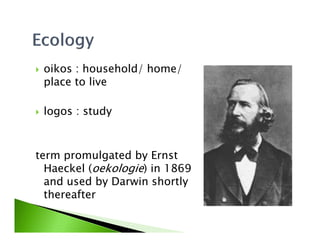
oikos : household/ home/
place to live
logos : study
term promulgated by Ernst
Haeckel (oekologie) in 1869
and used by Darwin shortly
thereafter
By ecology, we mean the body of knowledge
concerning the economy of nature -- the
investigation of the total relations of the
animal both to its organic and to its
inorganic environment; including above all,
its relation with those animals and plantsits relation with those animals and plants
with which it comes directly or indirectly
into contact -- in a word, ecology is the
study of all the complex interrelationships
referred to by Darwin as the conditions of
the struggle for existence. Ernst Haeckel,
1870.
parallel to economy (Haeckel)
= management of the household many principles
in common – resources allocation, cost-benefit
ratios
Burdon-Sanderson (1890s): Elevated Ecology toBurdon-Sanderson (1890s): Elevated Ecology to
one of the three natural divisions of Biology:
Physiology - Morphology – Ecology
Andrewartha (1961): “The scientific study of the
distribution and abundance of organisms.”
Odum (1963): “The structure and function of
Nature.”
(Krebs 1972):
“Ecology is the scientific study of the processes“Ecology is the scientific study of the processes“Ecology is the scientific study of the processes“Ecology is the scientific study of the processes
regulating theregulating theregulating theregulating the distribution and abundance ofdistribution and abundance ofdistribution and abundance ofdistribution and abundance of
organismsorganismsorganismsorganisms and theand theand theand the interactionsinteractionsinteractionsinteractions among them,among them,among them,among them,organismsorganismsorganismsorganisms and theand theand theand the interactionsinteractionsinteractionsinteractions among them,among them,among them,among them,
and the study of how these organisms in turnand the study of how these organisms in turnand the study of how these organisms in turnand the study of how these organisms in turn
mediate themediate themediate themediate the transport and transformation oftransport and transformation oftransport and transformation oftransport and transformation of
energy and matterenergy and matterenergy and matterenergy and matter in the biosphere (i.e., thein the biosphere (i.e., thein the biosphere (i.e., thein the biosphere (i.e., the
study of the design of ecosystemstudy of the design of ecosystemstudy of the design of ecosystemstudy of the design of ecosystem structurestructurestructurestructure
and functionand functionand functionand function).”).”).”).”
Draws upon need to control pests in
agriculture, disease spread in humans
Wildlife and fisheries management and
harvesting
Human population change-demography,Human population change-demography,
important in insurance and government
Mathematics and Computers-Equations
describing systems and simulations
CuriosityCuriosityCuriosityCuriosity – How does the world around us work?
How are we shaped by our surroundings?
Responsibility – How do our actions change our
environment? How do we minimize the detrimental
effects of our actions? Overfishing, habitat
destruction, loss of biodiversity, climate change.
Nature as a guideNature as a guideNature as a guideNature as a guide – The living world has beenNature as a guideNature as a guideNature as a guideNature as a guide – The living world has been
around much longer than we have and has solved
many problems with creative solutions. Ecological
systems are models for sustainability. How can we
feed our growing population? Where will we live?
SustainabilitySustainabilitySustainabilitySustainability – a property of human society in
which ecosystems (including humans) are managed
such that the conditions supporting present day
life on earth can continue.
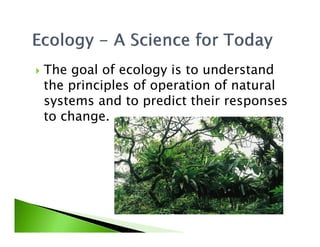
The goal of ecology is to understand
the principles of operation of natural
systems and to predict their responses
to change.to change.
We have a great need for ecological
understanding:
◦ what are the best policies for managing
our environmental support systems -- our
watersheds, agricultural lands, wetlands?watersheds, agricultural lands, wetlands?
◦ we must apply ecological principles to:
solve or prevent environmental problems
inform our economic, political, and social
sectors on how to manage environmental
concerns
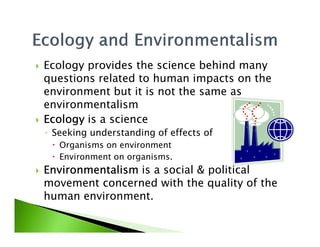
Ecology provides the science behind many
questions related to human impacts on the
environment but it is not the same as
environmentalism
EcologyEcologyEcologyEcology is a scienceEcologyEcologyEcologyEcology is a science
◦ Seeking understanding of effects of
Organisms on environment
Environment on organisms.
EnvironmentalismEnvironmentalismEnvironmentalismEnvironmentalism is a social & political
movement concerned with the quality of the
human environment.
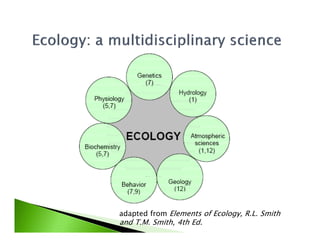
adapted from Elements of Ecology, R.L. Smith
and T.M. Smith, 4th Ed.
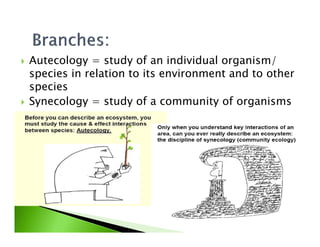
Autecology = study of an individual organism/
species in relation to its environment and to other
species
Synecology = study of a community of organisms
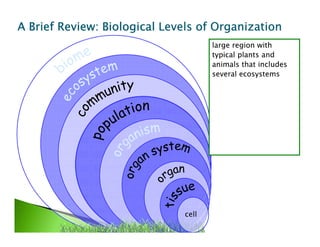
smallest unit of livingsmallest unit of living
thingsthings
group of similar cellsgroup of similar cells
organized to workorganized to work
togethertogether
group of differentgroup of different
kinds of tissueskinds of tissues
working togetherworking together
group of organsgroup of organs
working togetherworking together
one individual livingone individual living
thingthing
all organisms of theall organisms of the
same kind living in onesame kind living in one
areaarea
all interactingall interacting
populations in anpopulations in an
ecosystemecosystem
all living and nonlivingall living and nonliving
things interactingthings interacting
within a certain areawithin a certain area
large region withlarge region with
typical plants andtypical plants and
animals that includesanimals that includes
several ecosystemsseveral ecosystems
A BriefA BriefA BriefA BriefA BriefA BriefA BriefA Brief RRRRRRRRevieweviewevieweviewevieweviewevieweview: Biological: Biological: Biological: Biological: Biological: Biological: Biological: Biological Levels of OrganizationLevels of OrganizationLevels of OrganizationLevels of Organization
cell
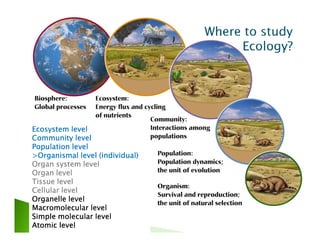
Ecosystem levelEcosystem levelEcosystem levelEcosystem level
Community levelCommunity levelCommunity levelCommunity level
Population levelPopulation levelPopulation levelPopulation level
>>>>OrganismalOrganismalOrganismalOrganismal level (individual)level (individual)level (individual)level (individual)
Organ system levelOrgan system levelOrgan system levelOrgan system level
Organ levelOrgan levelOrgan levelOrgan level
Tissue levelTissue levelTissue levelTissue level
CellularCellularCellularCellular levellevellevellevel
Organelle levelOrganelle levelOrganelle levelOrganelle level
Macromolecular levelMacromolecular levelMacromolecular levelMacromolecular level
Simple molecular levelSimple molecular levelSimple molecular levelSimple molecular level
Atomic levelAtomic levelAtomic levelAtomic level
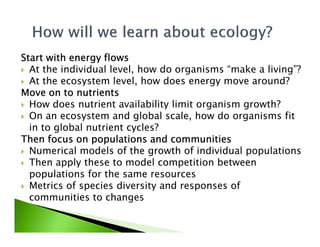
Start with energy flowsStart with energy flowsStart with energy flowsStart with energy flows
At the individual level, how do organisms “make a living”?
At the ecosystem level, how does energy move around?
Move on to nutrientsMove on to nutrientsMove on to nutrientsMove on to nutrients
How does nutrient availability limit organism growth?
On an ecosystem and global scale, how do organisms fit
in to global nutrient cycles?in to global nutrient cycles?
Then focus on populations and communitiesThen focus on populations and communitiesThen focus on populations and communitiesThen focus on populations and communities
Numerical models of the growth of individual populations
Then apply these to model competition between
populations for the same resources
Metrics of species diversity and responses of
communities to changes
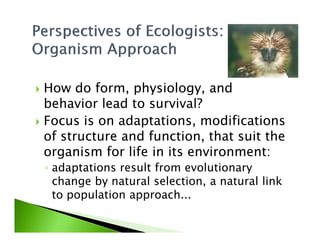
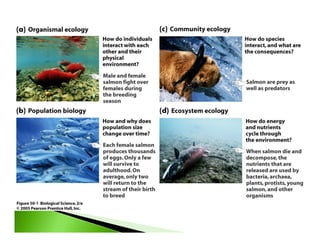
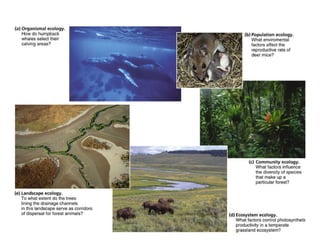
How do form, physiology, and
behavior lead to survival?
Focus is on adaptations, modificationsFocus is on adaptations, modifications
of structure and function, that suit the
organism for life in its environment:
◦ adaptations result from evolutionary
change by natural selection, a natural link
to population approach...
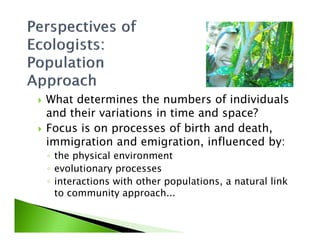
What determines the numbers of individuals
and their variations in time and space?
Focus is on processes of birth and death,Focus is on processes of birth and death,
immigration and emigration, influenced by:
◦ the physical environment
◦ evolutionary processes
◦ interactions with other populations, a natural link
to community approach...
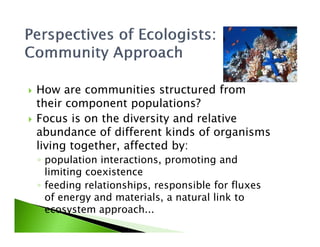
How are communities structured from
their component populations?
Focus is on the diversity and relativeFocus is on the diversity and relative
abundance of different kinds of organisms
living together, affected by:
◦ population interactions, promoting and
limiting coexistence
◦ feeding relationships, responsible for fluxes
of energy and materials, a natural link to
ecosystem approach...
How can we account for the activities of
populations in the common “currencies”
of energy and materials?
Focus is on movements of energy andFocus is on movements of energy and
materials and influences of:
◦ organisms large and small
◦ climate and other physical factors,
including those acting on a global scale, a
natural link to biosphere approach...
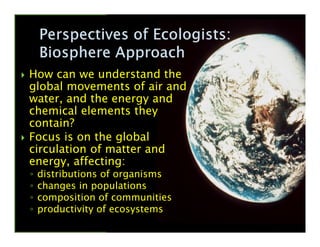
How can we understand the
global movements of air and
water, and the energy and
chemical elements they
contain?contain?
Focus is on the global
circulation of matter and
energy, affecting:
◦ distributions of organisms
◦ changes in populations
◦ composition of communities
◦ productivity of ecosystems
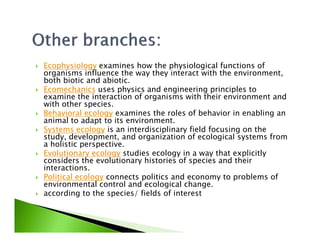
Ecophysiology examines how the physiological functions of
organisms influence the way they interact with the environment,
both biotic and abiotic.
Ecomechanics uses physics and engineering principles to
examine the interaction of organisms with their environment and
with other species.
Behavioral ecology examines the roles of behavior in enabling an
animal to adapt to its environment.animal to adapt to its environment.
Systems ecology is an interdisciplinary field focusing on the
study, development, and organization of ecological systems from
a holistic perspective.
Evolutionary ecology studies ecology in a way that explicitly
considers the evolutionary histories of species and their
interactions.
Political ecology connects politics and economy to problems of
environmental control and ecological change.
according to the species/ fields of interest
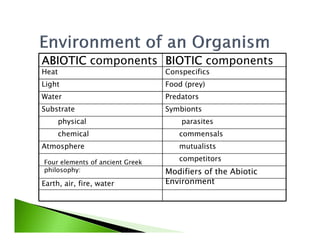
parasitesphysical
SymbiontsSubstrate
PredatorsWater
Food (prey)Light
ConspecificsHeat
BIOTICBIOTICBIOTICBIOTIC componentsABIOTICABIOTICABIOTICABIOTIC components
Earth, air, fire, water
Modifiers of the Abiotic
Environment
competitors
mutualistsAtmosphere
commensalschemical
parasitesphysical
Four elements of ancient Greek
philosophy:

General Ecology Introduction

  • 1.
    2222ndndndnd semester AY2012semester AY 2012semester AY 2012semester AY 2012----2013201320132013 Instructor:Instructor:Instructor:Instructor: AngeliAngeliAngeliAngeli A. ValeraA. ValeraA. ValeraA. Valera –––– MagMagMagMag----asoasoasoaso
  • 2.
    Introduction to thegeneral principles of ecology GENERAL OBJECTIVE :GENERAL OBJECTIVE : To study major concepts in ecology and the influence of man on the ecosystem
  • 3.
    Define and introducegeneral principles of ecology and its relation to other sciences. Explain the concept of trophic structure and the flow of energy. Discuss principles of evolution and behavior of organisms. Discuss population structure; growth and density; andDiscuss population structure; growth and density; and interaction of organisms in a population. Explain the concept of community ecology in terms of structure and diversity; habitat and community changes. Introduce the applications (resource and management, conservation) Introduce methods of treating wastes/ pollutants and its effects to human health.
  • 4.
    oikos : household/home/ place to live logos : study term promulgated by Ernst Haeckel (oekologie) in 1869 and used by Darwin shortly thereafter
  • 5.
    By ecology, wemean the body of knowledge concerning the economy of nature -- the investigation of the total relations of the animal both to its organic and to its inorganic environment; including above all, its relation with those animals and plantsits relation with those animals and plants with which it comes directly or indirectly into contact -- in a word, ecology is the study of all the complex interrelationships referred to by Darwin as the conditions of the struggle for existence. Ernst Haeckel, 1870.
  • 6.
    parallel to economy(Haeckel) = management of the household many principles in common – resources allocation, cost-benefit ratios Burdon-Sanderson (1890s): Elevated Ecology toBurdon-Sanderson (1890s): Elevated Ecology to one of the three natural divisions of Biology: Physiology - Morphology – Ecology Andrewartha (1961): “The scientific study of the distribution and abundance of organisms.” Odum (1963): “The structure and function of Nature.”
  • 7.
    (Krebs 1972): “Ecology isthe scientific study of the processes“Ecology is the scientific study of the processes“Ecology is the scientific study of the processes“Ecology is the scientific study of the processes regulating theregulating theregulating theregulating the distribution and abundance ofdistribution and abundance ofdistribution and abundance ofdistribution and abundance of organismsorganismsorganismsorganisms and theand theand theand the interactionsinteractionsinteractionsinteractions among them,among them,among them,among them,organismsorganismsorganismsorganisms and theand theand theand the interactionsinteractionsinteractionsinteractions among them,among them,among them,among them, and the study of how these organisms in turnand the study of how these organisms in turnand the study of how these organisms in turnand the study of how these organisms in turn mediate themediate themediate themediate the transport and transformation oftransport and transformation oftransport and transformation oftransport and transformation of energy and matterenergy and matterenergy and matterenergy and matter in the biosphere (i.e., thein the biosphere (i.e., thein the biosphere (i.e., thein the biosphere (i.e., the study of the design of ecosystemstudy of the design of ecosystemstudy of the design of ecosystemstudy of the design of ecosystem structurestructurestructurestructure and functionand functionand functionand function).”).”).”).”
  • 8.
    Draws upon needto control pests in agriculture, disease spread in humans Wildlife and fisheries management and harvesting Human population change-demography,Human population change-demography, important in insurance and government Mathematics and Computers-Equations describing systems and simulations
  • 9.
    CuriosityCuriosityCuriosityCuriosity – Howdoes the world around us work? How are we shaped by our surroundings? Responsibility – How do our actions change our environment? How do we minimize the detrimental effects of our actions? Overfishing, habitat destruction, loss of biodiversity, climate change. Nature as a guideNature as a guideNature as a guideNature as a guide – The living world has beenNature as a guideNature as a guideNature as a guideNature as a guide – The living world has been around much longer than we have and has solved many problems with creative solutions. Ecological systems are models for sustainability. How can we feed our growing population? Where will we live? SustainabilitySustainabilitySustainabilitySustainability – a property of human society in which ecosystems (including humans) are managed such that the conditions supporting present day life on earth can continue.
  • 11.
    The goal ofecology is to understand the principles of operation of natural systems and to predict their responses to change.to change.
  • 12.
    We have agreat need for ecological understanding: ◦ what are the best policies for managing our environmental support systems -- our watersheds, agricultural lands, wetlands?watersheds, agricultural lands, wetlands? ◦ we must apply ecological principles to: solve or prevent environmental problems inform our economic, political, and social sectors on how to manage environmental concerns
  • 13.
    Ecology provides thescience behind many questions related to human impacts on the environment but it is not the same as environmentalism EcologyEcologyEcologyEcology is a scienceEcologyEcologyEcologyEcology is a science ◦ Seeking understanding of effects of Organisms on environment Environment on organisms. EnvironmentalismEnvironmentalismEnvironmentalismEnvironmentalism is a social & political movement concerned with the quality of the human environment.
  • 14.
    adapted from Elementsof Ecology, R.L. Smith and T.M. Smith, 4th Ed.
  • 15.
    Autecology = studyof an individual organism/ species in relation to its environment and to other species Synecology = study of a community of organisms
  • 16.
    smallest unit oflivingsmallest unit of living thingsthings group of similar cellsgroup of similar cells organized to workorganized to work togethertogether group of differentgroup of different kinds of tissueskinds of tissues working togetherworking together group of organsgroup of organs working togetherworking together one individual livingone individual living thingthing all organisms of theall organisms of the same kind living in onesame kind living in one areaarea all interactingall interacting populations in anpopulations in an ecosystemecosystem all living and nonlivingall living and nonliving things interactingthings interacting within a certain areawithin a certain area large region withlarge region with typical plants andtypical plants and animals that includesanimals that includes several ecosystemsseveral ecosystems A BriefA BriefA BriefA BriefA BriefA BriefA BriefA Brief RRRRRRRRevieweviewevieweviewevieweviewevieweview: Biological: Biological: Biological: Biological: Biological: Biological: Biological: Biological Levels of OrganizationLevels of OrganizationLevels of OrganizationLevels of Organization cell
  • 17.
    Ecosystem levelEcosystem levelEcosystemlevelEcosystem level Community levelCommunity levelCommunity levelCommunity level Population levelPopulation levelPopulation levelPopulation level >>>>OrganismalOrganismalOrganismalOrganismal level (individual)level (individual)level (individual)level (individual) Organ system levelOrgan system levelOrgan system levelOrgan system level Organ levelOrgan levelOrgan levelOrgan level Tissue levelTissue levelTissue levelTissue level CellularCellularCellularCellular levellevellevellevel Organelle levelOrganelle levelOrganelle levelOrganelle level Macromolecular levelMacromolecular levelMacromolecular levelMacromolecular level Simple molecular levelSimple molecular levelSimple molecular levelSimple molecular level Atomic levelAtomic levelAtomic levelAtomic level
  • 18.
    Start with energyflowsStart with energy flowsStart with energy flowsStart with energy flows At the individual level, how do organisms “make a living”? At the ecosystem level, how does energy move around? Move on to nutrientsMove on to nutrientsMove on to nutrientsMove on to nutrients How does nutrient availability limit organism growth? On an ecosystem and global scale, how do organisms fit in to global nutrient cycles?in to global nutrient cycles? Then focus on populations and communitiesThen focus on populations and communitiesThen focus on populations and communitiesThen focus on populations and communities Numerical models of the growth of individual populations Then apply these to model competition between populations for the same resources Metrics of species diversity and responses of communities to changes
  • 19.
    How do form,physiology, and behavior lead to survival? Focus is on adaptations, modificationsFocus is on adaptations, modifications of structure and function, that suit the organism for life in its environment: ◦ adaptations result from evolutionary change by natural selection, a natural link to population approach...
  • 20.
    What determines thenumbers of individuals and their variations in time and space? Focus is on processes of birth and death,Focus is on processes of birth and death, immigration and emigration, influenced by: ◦ the physical environment ◦ evolutionary processes ◦ interactions with other populations, a natural link to community approach...
  • 21.
    How are communitiesstructured from their component populations? Focus is on the diversity and relativeFocus is on the diversity and relative abundance of different kinds of organisms living together, affected by: ◦ population interactions, promoting and limiting coexistence ◦ feeding relationships, responsible for fluxes of energy and materials, a natural link to ecosystem approach...
  • 22.
    How can weaccount for the activities of populations in the common “currencies” of energy and materials? Focus is on movements of energy andFocus is on movements of energy and materials and influences of: ◦ organisms large and small ◦ climate and other physical factors, including those acting on a global scale, a natural link to biosphere approach...
  • 23.
    How can weunderstand the global movements of air and water, and the energy and chemical elements they contain?contain? Focus is on the global circulation of matter and energy, affecting: ◦ distributions of organisms ◦ changes in populations ◦ composition of communities ◦ productivity of ecosystems
  • 26.
    Ecophysiology examines howthe physiological functions of organisms influence the way they interact with the environment, both biotic and abiotic. Ecomechanics uses physics and engineering principles to examine the interaction of organisms with their environment and with other species. Behavioral ecology examines the roles of behavior in enabling an animal to adapt to its environment.animal to adapt to its environment. Systems ecology is an interdisciplinary field focusing on the study, development, and organization of ecological systems from a holistic perspective. Evolutionary ecology studies ecology in a way that explicitly considers the evolutionary histories of species and their interactions. Political ecology connects politics and economy to problems of environmental control and ecological change. according to the species/ fields of interest
  • 27.
    parasitesphysical SymbiontsSubstrate PredatorsWater Food (prey)Light ConspecificsHeat BIOTICBIOTICBIOTICBIOTIC componentsABIOTICABIOTICABIOTICABIOTICcomponents Earth, air, fire, water Modifiers of the Abiotic Environment competitors mutualistsAtmosphere commensalschemical parasitesphysical Four elements of ancient Greek philosophy: