What is Ecology? 
• The branch of biology that developed from 
natural history is called ecology. 
• Ecology is the study of interactions that take 
place between organisms and their 
environment. 
• Ecologists may ask what a coyote eats, how day 
length influences plants or migrating birds, or 
why tiny shrimp help rid ocean fishes of 
parasites.
The Biosphere 
• On earth, living things are found in the air, on 
land, and in both fresh and salt water. 
• The biosphere is the portion of Earth that 
supports living things. 
• Range of the biosphere is from high in the 
atmosphere to the bottom of the oceans. 
• The biosphere supports a diverse group of 
organisms in a wide range of climates.
• The climate, soils, plants, and animals in one 
part of the world can be very different from 
those same factors in other parts of the world. 
• Living things are affected by both the physical 
or nonliving environment and by other living 
things. 
• Factors that affect organism are both abiotic 
and biotic.
Abiotic Factors 
• Examples of abiotic factors include air 
currents, temperature, moisture. 
• Ecology includes the study of features of the 
environment that are not living because these 
features are part of an organism’s life. 
• Abiotic factors have obvious effects on living 
things and often determine which species 
survive in a particular environment.
Biotic Factors 
• Living things affect other living things. 
• All organisms depend on others directly or 
indirectly for food, shelter, reproduction, or 
protection. 
• Examples plants, animals, bacteria, any thing 
that is living.
Levels of Organization 
• To help ecologists understand the interactions 
of biotic and abiotic parts of the world, they 
have organized the living world into levels. 
• 1. Organism- an individual living thing that is 
made of cells, uses energy, reproduces, 
responds, grows and develops. 
• 2. Population- A group of organisms, all of one 
species, which interbreed and live in the same 
place at the same time.
• 3. Biological community- all the populations of 
different species that live in the same place at 
the same time. 
• 4. Ecosystem- populations of plants and 
animals that interact with each other in a 
given area and with the abiotic components of 
that area. 
• 5. Biosphere- the portion of earth that 
supports life.
Interactions within populations 
• Organisms in a population share the resources 
of their environment may determine how far 
apart the organisms live and how large the 
populations become. 
• Compete with each other for food, water, 
mates, or other resources. 
• Competition increases when resources are in 
short supply.
Interactions within communities 
• A change in one population in a community 
may cause changes in the other populations. 
• Changes can be minor like an increase in 
predators cause a decrease in prey. 
• Changes can be major like a population may 
use up the resources and in turn affecting 
another population.
Biotic and abiotic factors form 
ecosystems 
• Biotic factors like insects, grass, trees, squirrels 
and abiotic factors like water, temperature 
make an ecosystem. 
• Two major kinds of ecosystems-terrestrial 
ecosystems (forest, meadows, etc.)and 
aquatic ecosystem (salt water and fresh water)
Organisms in ecosystems 
• The place where an organism lives out it’s life 
is a habitat. 
• Ecosystems covers a large area of the earth. 
Habitat covers a small area of an ecosystem. 
• Habitat size varies from organism to organism. 
• Habitats are also shared with different species 
of organism.
Survival Relationships 
• A predator is a type of consumer like a lion or 
an insect-eating bird. 
• The animals predators eat are called prey. 
• Predator-prey relationships such as the one 
between cats and mice involve a fight for 
survival. 
• But not organisms living in the same 
environment are in a continuous battle for 
survival.
• Studies have shown that most species survive 
because of the relationships they have with 
other species. 
• The relationship in which there is a close and 
permanent association between organisms of 
different species is called symbiosis. 
• Symbiosis means living together.
The three kinds of symbiotic 
relationships 
• 1. Mutualism 
• Two species of organisms benefit from living 
in close association. 
• Ex. Ants and acacia trees living in the 
subtropical regions of world. The ants protect 
the acacia tree by attacking any animal that 
tries to feed on the tree. The tree provides 
nectar and a home for ants.
• 2. Commensalism 
• One species benefits and the other species is 
neither harmed nor benefited. 
• Ex. Spanish moss on the branches of trees. 
The moss benefits because it uses the tree for 
support. It holds on to the tree. The tree does 
not benefit but is not getting harmed either.
• 3. Parasitism 
• One organism benefits while harming another. 
• Ex. Ticks or fleas on animals. The ticks or fleas 
gets nutrients from animal. 
• Parasites have evolved in such a way that they 
harm, but usually do not kill the host species. 
• If host dies then parasite dies also if they don’t 
find another host. 
• Other examples of parasites: certain bacteria, 
tapeworms, roundworms, mistletoe.
Nutrition and Energy Flow 
Ecologists trace the flow of energy through 
communities to discover nutritional 
relationships between organisms. 
The producers: Autotrophs 
The ultimate source of the energy for life is 
the sun. Plants use the sun’s energy to 
manufacture food in a process called 
photosynthesis.
Grass and trees are autotrophs. Some unicellular 
organisms such as green algae, also make their 
own nutrients. 
Other organisms in the biosphere depend on 
autotrophs for nutrients and energy. These 
dependent organisms are called consumers.
The consumers: Heterotrophs 
A bison eats grass, a deer nibbles the leaves of a 
clover plant and owl swallows a mouse. 
The bison, deer and owl are consumers, 
incapable of producing their own food. They 
obtain nutrients by eating other organisms. 
Heterotrophs include organisms that feed on 
only autotrophs, feed on only other 
heterotrophs, or feed on both autotrophs and 
heterotrophs.
Types of heterotrophs 
1. Herbivore – a heterotroph that feeds only on 
plants. Ex. Rabbits, grasshoppers, squirrels, 
bees. 
2. Heterotrophs that eat other heterotrophs. 
1.Carnivores- animals that kill and eat only 
other animals. Ex. Lions, 
2. Scavenger- do not kill for food but eat 
animals that have already died. Ex. Black 
vultures.
3. Omnivores- consume both autotrophs and 
heterotrophs (plants and meat). Ex. Raccons, 
opossums and bears. 
Decomposers – organisms that break down 
dead and decaying plants and animals into 
simpler molecules that can be more easily 
absorbed. Ex. protazoans, many bacteria, and 
most fungi.
Flow of matter and energy in 
ecosystems 
When you eat food, such as an apple you 
consume matter. 
Matter, in the form of carbon, nitrogen, and 
other elements, flow through the levels of an 
ecosystem from producers to consumers. 
The apple also contains energy from sunlight 
that was trapped in the plant during the process 
of photosynthesis .
As you cycle the matter of the apple, some 
trapped energy is transferred from one level to 
the next. At each level, a certain amount of 
energy is also transferred to the environment as 
heat. 
Question 
How do matter and energy flow through 
ecosystems?
Food chains: Pathways for matter and 
energy 
A food chain is a simple model that scientist use 
to show how matter and energy move through 
an ecosystem. 
In a food chain, nutrients and energy move from 
autotrophs to heterotrophs and, eventually, to 
decomposers.
A food chain is drawn using arrows to indicate 
the direction in which energy is transferred from 
one organism to the next. 
Ex. Berries  mice  black bear 
Most food chains consist of two, three, four 
transfers. The amount of energy remaining in 
the final transfer is only a portion of what was 
available at the first transfer. A portion of the 
energy is given off as heat at each transfer.
Trophic levels represent links 
in the chain 
Each organism in a food chain represents a 
feeding step, or trophic level, in the passage of 
energy and materials. 
A first order heterotroph is an organism that 
feeds on plants, such as a grasshopper. 
A second order heterotroph is an organism that 
feeds on the first order heterotroph. Ex. Bird 
that feeds on a grasshopper.
A food chain represents only one possible route 
for the transfer of matter and energy through 
and ecosystem. 
Many other routes may exist. Many different 
kinds of organisms eat a variety of foods, so a 
single species may feed at several trophic levels
The Food Web 
Ecologists interested in energy flow in an 
ecosystem may set up experiments with as 
many organisms in the community as they can. 
Food web shows all the possible feeding 
relationships at each trophic level in a 
community. 
Food web represents a network of 
interconnected food chains formed by 
herbivores and carnivores.
Energy and trophic levels: Ecological 
Pyramids 
• An ecological pyramid can show how energy 
flows through an ecosystem. 
• The base of the ecological pyramid represents 
the autotrophs, or first trophic level. 
• Higher trophic levels are layered on top of one 
another
The pyramid of energy illustrates that the 
amount of available energy decreases at each 
succeeding trophic level. 
The total energy transfer from one trophic level 
to the next is only about ten percent because 
organisms fail to capture and eat all the food 
energy available at eh trophic level below them.
Cycles In Nature 
Since energy is also transferred to the 
environment as heat generated by the body 
processes of organisms. 
Sunlight is the primary source of all this energy, 
and is always being replenished by the sun. 
Matter, in the form of nutrients, also moves 
through, or is part of, all organisms at each 
trophic level. But matter is cycled and is not 
replenished like the energy from sunlight.
• There is a finite amount of matter. 
The atoms of carbon, nitrogen, and other 
elements that make up the bodies of organisms 
alive today are the same atoms that have been 
on Earth since life began. 
Matter is constantly recycled. It is never lost.
The water cycle 
Life on earth depends on water. 
1. Evaporation- water evaporates from lakes and 
oceans and becomes water vapor in the air. 
2. Transpiration- the loss of water through the 
leaves of plants. 
Where do the drops of water that form on a cold 
can of soda come from?
The water vapor in the air condenses on the 
surface of the can because the can is colder than 
the surrounding air. 
3. Condensation- water vapor condenses. Forms 
clouds. 
4. Precipitation- rain, ice, or snow 
Animals breathe out water vapor when they 
breath. When they perspire or urinate, water 
also is returned to the environment.
The carbon cycle 
All life on Earth is based on carbon molecules. 
Atoms of carbon form the framework for 
proteins, carbohydrates, fats, and other 
important molecules. 
Carbon is the molecule of life.
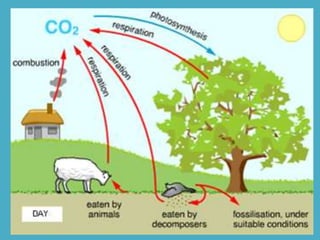
During photosynthesis, energy from the sun is 
used by autotrophic organisms to convert 
carbon dioxide gas into energy-rich carbon 
molecules that many organisms use for food and 
a source of energy. 
Plants take in carbon in the form of carbon 
dioxide for growth and energy.
Heterotrophs, which feed either directly or 
indirectly on the autotrophs, use these carbon 
molecules for growth and energy. 
Carbon is taken out of the atmosphere by 
photosynthesis. 
Carbon is put back in the atmosphere by 
respiration, fuel combustion, and open burning
The nitrogen cycle 
When you add nitrogen fertilizer to a lawn, 
houseplants, or garden, you may see that they 
become greener, bushier, and taller. 
Even though the air is 78% nitrogen, plants seem 
to do better when they receive nitrogen 
fertilizer.
This is because most plants cannot use the 
nitrogen in the air. They use nitrogen in the soil 
that has been converted into more usable 
forms. 
Certain bacteria convert the nitrogen from air 
into these more usable forms. Chemical 
fertilizers also give plants nitrogen in a form they 
can use.
The cycle: 
1. Nitrogen fixing bacteria convert nitrogen in a 
form that plants can use. 
2.Plants use nitrogen to make molecules such 
protein. 
3. Herbivores eat plants and convert plant’s 
protein into an animal protein. 
4. Then carnivores eat herbivores and convert 
the protein in a form that they require.
5. Urine, contains nitrogen compounds so 
animal put nitrogen back to the water or soil. 
6. Organism die and decay, nitrogen returns to 
the soil and eventually to the atmosphere or 
plants can reuse the nitrogen. 
7. Soil bacteria also act on these molecules and 
put nitrogen back into the air.
The Phosphorus Cycle 
All organisms require phosphorus for growth 
and development. Phosphorus cycles in two 
ways. 
Short term cycle. 
1. Plants obtain Phosphorus from the soil. 
2. Animals obtain phosphorus by eating plants. 
3. When animals die, they decompose and the 
phosphorus is returned to the soil to be used 
again.
Long term cycle 
Phosphates washed into water become 
incorporated into rock as insoluble compounds. 
Millions of years later, as the environment 
changes, the rock containing phosphorus is 
exposed. As the rock erodes, the phosphorus 
again becomes part of the local ecological 
system.
Ecology

Ecology

  • 1.
    What is Ecology? • The branch of biology that developed from natural history is called ecology. • Ecology is the study of interactions that take place between organisms and their environment. • Ecologists may ask what a coyote eats, how day length influences plants or migrating birds, or why tiny shrimp help rid ocean fishes of parasites.
  • 2.
    The Biosphere •On earth, living things are found in the air, on land, and in both fresh and salt water. • The biosphere is the portion of Earth that supports living things. • Range of the biosphere is from high in the atmosphere to the bottom of the oceans. • The biosphere supports a diverse group of organisms in a wide range of climates.
  • 3.
    • The climate,soils, plants, and animals in one part of the world can be very different from those same factors in other parts of the world. • Living things are affected by both the physical or nonliving environment and by other living things. • Factors that affect organism are both abiotic and biotic.
  • 4.
    Abiotic Factors •Examples of abiotic factors include air currents, temperature, moisture. • Ecology includes the study of features of the environment that are not living because these features are part of an organism’s life. • Abiotic factors have obvious effects on living things and often determine which species survive in a particular environment.
  • 5.
    Biotic Factors •Living things affect other living things. • All organisms depend on others directly or indirectly for food, shelter, reproduction, or protection. • Examples plants, animals, bacteria, any thing that is living.
  • 6.
    Levels of Organization • To help ecologists understand the interactions of biotic and abiotic parts of the world, they have organized the living world into levels. • 1. Organism- an individual living thing that is made of cells, uses energy, reproduces, responds, grows and develops. • 2. Population- A group of organisms, all of one species, which interbreed and live in the same place at the same time.
  • 7.
    • 3. Biologicalcommunity- all the populations of different species that live in the same place at the same time. • 4. Ecosystem- populations of plants and animals that interact with each other in a given area and with the abiotic components of that area. • 5. Biosphere- the portion of earth that supports life.
  • 8.
    Interactions within populations • Organisms in a population share the resources of their environment may determine how far apart the organisms live and how large the populations become. • Compete with each other for food, water, mates, or other resources. • Competition increases when resources are in short supply.
  • 9.
    Interactions within communities • A change in one population in a community may cause changes in the other populations. • Changes can be minor like an increase in predators cause a decrease in prey. • Changes can be major like a population may use up the resources and in turn affecting another population.
  • 10.
    Biotic and abioticfactors form ecosystems • Biotic factors like insects, grass, trees, squirrels and abiotic factors like water, temperature make an ecosystem. • Two major kinds of ecosystems-terrestrial ecosystems (forest, meadows, etc.)and aquatic ecosystem (salt water and fresh water)
  • 11.
    Organisms in ecosystems • The place where an organism lives out it’s life is a habitat. • Ecosystems covers a large area of the earth. Habitat covers a small area of an ecosystem. • Habitat size varies from organism to organism. • Habitats are also shared with different species of organism.
  • 12.
    Survival Relationships •A predator is a type of consumer like a lion or an insect-eating bird. • The animals predators eat are called prey. • Predator-prey relationships such as the one between cats and mice involve a fight for survival. • But not organisms living in the same environment are in a continuous battle for survival.
  • 13.
    • Studies haveshown that most species survive because of the relationships they have with other species. • The relationship in which there is a close and permanent association between organisms of different species is called symbiosis. • Symbiosis means living together.
  • 14.
    The three kindsof symbiotic relationships • 1. Mutualism • Two species of organisms benefit from living in close association. • Ex. Ants and acacia trees living in the subtropical regions of world. The ants protect the acacia tree by attacking any animal that tries to feed on the tree. The tree provides nectar and a home for ants.
  • 15.
    • 2. Commensalism • One species benefits and the other species is neither harmed nor benefited. • Ex. Spanish moss on the branches of trees. The moss benefits because it uses the tree for support. It holds on to the tree. The tree does not benefit but is not getting harmed either.
  • 16.
    • 3. Parasitism • One organism benefits while harming another. • Ex. Ticks or fleas on animals. The ticks or fleas gets nutrients from animal. • Parasites have evolved in such a way that they harm, but usually do not kill the host species. • If host dies then parasite dies also if they don’t find another host. • Other examples of parasites: certain bacteria, tapeworms, roundworms, mistletoe.
  • 17.
    Nutrition and EnergyFlow Ecologists trace the flow of energy through communities to discover nutritional relationships between organisms. The producers: Autotrophs The ultimate source of the energy for life is the sun. Plants use the sun’s energy to manufacture food in a process called photosynthesis.
  • 18.
    Grass and treesare autotrophs. Some unicellular organisms such as green algae, also make their own nutrients. Other organisms in the biosphere depend on autotrophs for nutrients and energy. These dependent organisms are called consumers.
  • 19.
    The consumers: Heterotrophs A bison eats grass, a deer nibbles the leaves of a clover plant and owl swallows a mouse. The bison, deer and owl are consumers, incapable of producing their own food. They obtain nutrients by eating other organisms. Heterotrophs include organisms that feed on only autotrophs, feed on only other heterotrophs, or feed on both autotrophs and heterotrophs.
  • 20.
    Types of heterotrophs 1. Herbivore – a heterotroph that feeds only on plants. Ex. Rabbits, grasshoppers, squirrels, bees. 2. Heterotrophs that eat other heterotrophs. 1.Carnivores- animals that kill and eat only other animals. Ex. Lions, 2. Scavenger- do not kill for food but eat animals that have already died. Ex. Black vultures.
  • 21.
    3. Omnivores- consumeboth autotrophs and heterotrophs (plants and meat). Ex. Raccons, opossums and bears. Decomposers – organisms that break down dead and decaying plants and animals into simpler molecules that can be more easily absorbed. Ex. protazoans, many bacteria, and most fungi.
  • 22.
    Flow of matterand energy in ecosystems When you eat food, such as an apple you consume matter. Matter, in the form of carbon, nitrogen, and other elements, flow through the levels of an ecosystem from producers to consumers. The apple also contains energy from sunlight that was trapped in the plant during the process of photosynthesis .
  • 23.
    As you cyclethe matter of the apple, some trapped energy is transferred from one level to the next. At each level, a certain amount of energy is also transferred to the environment as heat. Question How do matter and energy flow through ecosystems?
  • 24.
    Food chains: Pathwaysfor matter and energy A food chain is a simple model that scientist use to show how matter and energy move through an ecosystem. In a food chain, nutrients and energy move from autotrophs to heterotrophs and, eventually, to decomposers.
  • 25.
    A food chainis drawn using arrows to indicate the direction in which energy is transferred from one organism to the next. Ex. Berries  mice  black bear Most food chains consist of two, three, four transfers. The amount of energy remaining in the final transfer is only a portion of what was available at the first transfer. A portion of the energy is given off as heat at each transfer.
  • 26.
    Trophic levels representlinks in the chain Each organism in a food chain represents a feeding step, or trophic level, in the passage of energy and materials. A first order heterotroph is an organism that feeds on plants, such as a grasshopper. A second order heterotroph is an organism that feeds on the first order heterotroph. Ex. Bird that feeds on a grasshopper.
  • 27.
    A food chainrepresents only one possible route for the transfer of matter and energy through and ecosystem. Many other routes may exist. Many different kinds of organisms eat a variety of foods, so a single species may feed at several trophic levels
  • 28.
    The Food Web Ecologists interested in energy flow in an ecosystem may set up experiments with as many organisms in the community as they can. Food web shows all the possible feeding relationships at each trophic level in a community. Food web represents a network of interconnected food chains formed by herbivores and carnivores.
  • 30.
    Energy and trophiclevels: Ecological Pyramids • An ecological pyramid can show how energy flows through an ecosystem. • The base of the ecological pyramid represents the autotrophs, or first trophic level. • Higher trophic levels are layered on top of one another
  • 32.
    The pyramid ofenergy illustrates that the amount of available energy decreases at each succeeding trophic level. The total energy transfer from one trophic level to the next is only about ten percent because organisms fail to capture and eat all the food energy available at eh trophic level below them.
  • 34.
    Cycles In Nature Since energy is also transferred to the environment as heat generated by the body processes of organisms. Sunlight is the primary source of all this energy, and is always being replenished by the sun. Matter, in the form of nutrients, also moves through, or is part of, all organisms at each trophic level. But matter is cycled and is not replenished like the energy from sunlight.
  • 35.
    • There isa finite amount of matter. The atoms of carbon, nitrogen, and other elements that make up the bodies of organisms alive today are the same atoms that have been on Earth since life began. Matter is constantly recycled. It is never lost.
  • 36.
    The water cycle Life on earth depends on water. 1. Evaporation- water evaporates from lakes and oceans and becomes water vapor in the air. 2. Transpiration- the loss of water through the leaves of plants. Where do the drops of water that form on a cold can of soda come from?
  • 37.
    The water vaporin the air condenses on the surface of the can because the can is colder than the surrounding air. 3. Condensation- water vapor condenses. Forms clouds. 4. Precipitation- rain, ice, or snow Animals breathe out water vapor when they breath. When they perspire or urinate, water also is returned to the environment.
  • 39.
    The carbon cycle All life on Earth is based on carbon molecules. Atoms of carbon form the framework for proteins, carbohydrates, fats, and other important molecules. Carbon is the molecule of life.
  • 40.
    During photosynthesis, energyfrom the sun is used by autotrophic organisms to convert carbon dioxide gas into energy-rich carbon molecules that many organisms use for food and a source of energy. Plants take in carbon in the form of carbon dioxide for growth and energy.
  • 41.
    Heterotrophs, which feedeither directly or indirectly on the autotrophs, use these carbon molecules for growth and energy. Carbon is taken out of the atmosphere by photosynthesis. Carbon is put back in the atmosphere by respiration, fuel combustion, and open burning
  • 43.
    The nitrogen cycle When you add nitrogen fertilizer to a lawn, houseplants, or garden, you may see that they become greener, bushier, and taller. Even though the air is 78% nitrogen, plants seem to do better when they receive nitrogen fertilizer.
  • 44.
    This is becausemost plants cannot use the nitrogen in the air. They use nitrogen in the soil that has been converted into more usable forms. Certain bacteria convert the nitrogen from air into these more usable forms. Chemical fertilizers also give plants nitrogen in a form they can use.
  • 45.
    The cycle: 1.Nitrogen fixing bacteria convert nitrogen in a form that plants can use. 2.Plants use nitrogen to make molecules such protein. 3. Herbivores eat plants and convert plant’s protein into an animal protein. 4. Then carnivores eat herbivores and convert the protein in a form that they require.
  • 46.
    5. Urine, containsnitrogen compounds so animal put nitrogen back to the water or soil. 6. Organism die and decay, nitrogen returns to the soil and eventually to the atmosphere or plants can reuse the nitrogen. 7. Soil bacteria also act on these molecules and put nitrogen back into the air.
  • 48.
    The Phosphorus Cycle All organisms require phosphorus for growth and development. Phosphorus cycles in two ways. Short term cycle. 1. Plants obtain Phosphorus from the soil. 2. Animals obtain phosphorus by eating plants. 3. When animals die, they decompose and the phosphorus is returned to the soil to be used again.
  • 49.
    Long term cycle Phosphates washed into water become incorporated into rock as insoluble compounds. Millions of years later, as the environment changes, the rock containing phosphorus is exposed. As the rock erodes, the phosphorus again becomes part of the local ecological system.