Introduction to Digital Signal
      Processing (DSP)

               Elena Punskaya
        www-sigproc.eng.cam.ac.uk/~op205


                                 Some material adapted from courses by
                                 Prof. Simon Godsill, Dr. Arnaud Doucet,
                            Dr. Malcolm Macleod and Prof. Peter Rayner


                                                                           1
Course Overview

•  Topics:
    –  Fourier Transforms and Digital Filters 6 letures [me]
    –  Random signals, Optimal Filtering and Signal
       Modelling 6 lectures [Simon Godsill]
    –  Pattern recognition 4 lectures [Zoubin Ghahramani]

•  Handouts:
    –  New: typos, please, e-mail op205@cam.ac.uk
    –  www-sigproc.eng.cam.ac.uk/~op205
    –  Feedback welcome

•  Natural extension of 3F1
                                                          2
Books

Books:

   –  J.G. Proakis and D.G. Manolakis, Digital Signal
      Processing 3rd edition, Prentice-Hall.
   –  R.G Lyons, Understanding Digital Signal
      processing, 2nd edition, Prentice-Hall. (Amazon’s
      top-selling for five straight years)

Material covered
  –  maths (why is it difficult?)
  –  exams
  –  examples papers
  –  help
                                                          3
What is Digital Signal Processing?

Digital: operating by the use of discrete signals to
  represent data in the form of numbers

Signal: a parameter (electrical quantity or effect) that can
  be varied in such a way as to convey information

Processing: a series operations performed according to
  programmed instructions

                     changing or analysing information
                     which is measured as discrete
                     sequences of numbers

                                                           4
The Journey

“Learning digital signal processing is not something
you accomplish; it’s a journey you take”.

                  R.G Lyons, Understanding Digital Signal processing


                                                                       5
Applications of DSP - Radar

Radar and Sonar:

          Examples


            1) target detection – position and
            velocity estimation


                             2) tracking


                                                 6
Applications of DSP - Biomedical


Biomedical: analysis of biomedical signals,
            diagnosis, patient monitoring,
            preventive health care, artificial
            organs
                  Examples:

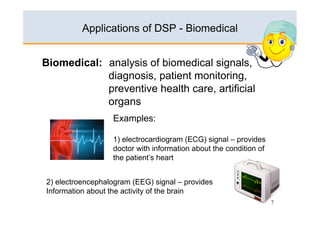
                  1) electrocardiogram (ECG) signal – provides
                  doctor with information about the condition of
                  the patient’s heart


2) electroencephalogram (EEG) signal – provides
Information about the activity of the brain
                                                                   7
Applications of DSP - Speech

Speech applications:

Examples
 1) noise reduction – reducing background noise
 in the sequence produced by a sensing device (microphone)

                       2) speech recognition – differentiating
                       between various speech sounds


 3) synthesis of artificial speech – text to speech
 systems for blind

                                                                 8
Applications of DSP - Communications

Communications:

Examples
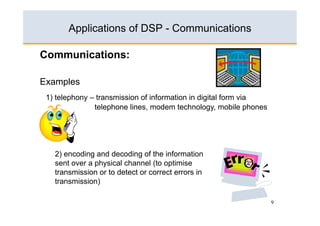
 1) telephony – transmission of information in digital form via
               telephone lines, modem technology, mobile phones


   2) encoding and decoding of the information
   sent over a physical channel (to optimise
   transmission or to detect or correct errors in
   transmission)

                                                                  9
Applications of DSP – Image Processing

Image Processing:

Examples
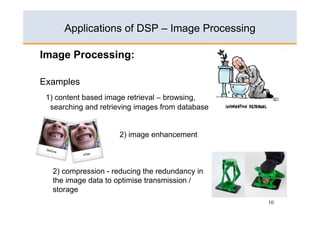
 1) content based image retrieval – browsing,
  searching and retrieving images from database


                     2) image enhancement


  2) compression - reducing the redundancy in
  the image data to optimise transmission /
  storage
                                                  10
Applications of DSP – Music

Music Applications:

                           Examples:

                                 1) Recording


   2) Playback


                    3) Manipulation (mixing, special effects)

                                                                11
Applications of DSP - Multimedia


Multimedia:
                   generation storage and
                   transmission of sound, still
                   images, motion pictures

                Examples:
                1) digital TV


         2) video conferencing
                                                  12
DSP Implementation - Operations


To implement DSP we must be able to:

     Input      Digital             Digital
                Signal              Signal
                          DSP
                                              Output


1) perform numerical operations including, for
   example, additions, multiplications, data transfers
   and logical operations
either using computer or special-purpose hardware

                                                         13
DSP chips

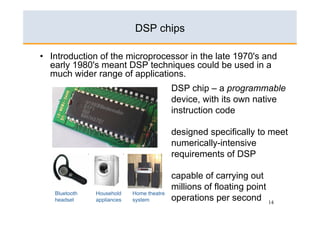
•  Introduction of the microprocessor in the late 1970's and
   early 1980's meant DSP techniques could be used in a
   much wider range of applications.
                                           DSP chip – a programmable
                                           device, with its own native
                                           instruction code

                                           designed specifically to meet
                                           numerically-intensive
                                           requirements of DSP

                                           capable of carrying out
                                           millions of floating point
   Bluetooth   Household    Home theatre
   headset     appliances   system         operations per second 14
DSP Implementation – Digital/Analog Conversion


To implement DSP we must be able to:

                  Digital                      Digital                      Analog
                  Signal                       Signal                       Signal
                                DSP                      Reconstruction


2) convert the digital information, after being processed
   back to an analog signal
        - involves digital-to-analog conversion & reconstruction
                                    (recall from 1B Signal and Data Analysis)
e.g. text-to-speech signal (characters are used to generate artificial
    sound)
                                                                           15
DSP Implementation –Analog/Digital Conversion


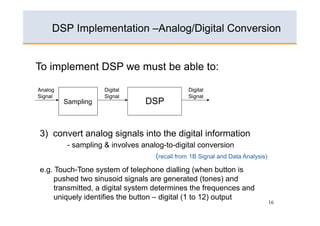
To implement DSP we must be able to:

Analog                Digital                     Digital
Signal                Signal                      Signal
         Sampling                   DSP


3) convert analog signals into the digital information
          - sampling & involves analog-to-digital conversion
                                    (recall from 1B Signal and Data Analysis)
e.g. Touch-Tone system of telephone dialling (when button is
     pushed two sinusoid signals are generated (tones) and
     transmitted, a digital system determines the frequences and
     uniquely identifies the button – digital (1 to 12) output
                                                                                16
DSP Implementation


To implement DSP we must be able to:

Analog              Digital                 Digital                    Analog
Signal              Signal                  Signal                     Signal
         Sampling              DSP                    Reconstruction


    perform both A/D and D/A conversions


e.g. digital recording and playback of music (signal is sensed by
    microphones, amplified, converted to digital, processed, and
    converted back to analog to be played
                                                                       17
Limitations of DSP - Aliasing

Most signals are analog in nature, and have to be sampled
            loss of information
•  we only take samples of the signals at intervals and
   don’t know what happens in between
                                         aliasing
                                                                                    cannot distinguish between
                                                                                    higher and lower frequencies
                                                                                           (recall from 1B Signal
                                                                                           and Data Analysis)

                                                                                    Sampling theorem: to avoid
                                                                                    aliasing, sampling rate must be
                                                                                    at least twice the maximum
                                                                                    frequency component
                                                                                    (`bandwidth’) of the signal
                                                                                                              18
   Gjendemsjø, A. Aliasing Applet, Connexions, http://cnx.org/content/m11448/1.14
Limitations of DSP - Antialias Filter

   •  Sampling theorem says there is enough information
      to reconstruct the signal, which does not mean
      sampled signal looks like original one
                                               correct reconstruction is not
                                         just connecting samples with
                                         straight lines

                                         needs antialias filter (to filter out all
                                         high frequency components before
                                         sampling) and the same for
                                         reconstruction – it does remove
                                         information though
Each sample
is taken at a
slightly earlier          (recall from 1B Signal
part of a cycle           and Data Analysis)
                                                                              19
Limitations of DSP – Frequency Resolution

Most signals are analog in nature, and have to be sampled
           loss of information

•  we only take samples for a limited period of time


                                   limited frequency
                                   resolution

                                   does not pick up “relatively”
                                   slow changes

    (recall from 1B Signal
    and Data Analysis)
                                                            20
Limitations of DSP – Quantisation Error

Most signals are analog in nature, and have to be sampled
             loss of information
•  limited (by the number of bits available) precision in data
   storage and arithmetic

                                     quantisation error

                                     smoothly varying signal
                                     represented by “stepped”
                                     waveform


                                      (recall from 1B Signal
                                      and Data Analysis)
                                                               21
Advantages of Digital over Analog Signal Processing

Why still do it?

•  Digital system can be simply reprogrammed for other
   applications / ported to different hardware / duplicated
  (Reconfiguring analog system means hadware redesign, testing, verification)
•  DSP provides better control of accuracy requirements
  (Analog system depends on strict components tolerance, response may drift with
  temperature)
•  Digital signals can be easily stored without deterioration
  (Analog signals are not easily transportable and often can’t be processed off-line)
•  More sophisticated signal processing algorithms can be
   implemented
   (Difficult to perform precise mathematical operations in analog form)
                                                                              22

Introduction to Digital Signal Processing

  • 1.
    Introduction to DigitalSignal Processing (DSP) Elena Punskaya www-sigproc.eng.cam.ac.uk/~op205 Some material adapted from courses by Prof. Simon Godsill, Dr. Arnaud Doucet, Dr. Malcolm Macleod and Prof. Peter Rayner 1
  • 2.
    Course Overview •  Topics: –  Fourier Transforms and Digital Filters 6 letures [me] –  Random signals, Optimal Filtering and Signal Modelling 6 lectures [Simon Godsill] –  Pattern recognition 4 lectures [Zoubin Ghahramani] •  Handouts: –  New: typos, please, e-mail op205@cam.ac.uk –  www-sigproc.eng.cam.ac.uk/~op205 –  Feedback welcome •  Natural extension of 3F1 2
  • 3.
    Books Books: –  J.G. Proakis and D.G. Manolakis, Digital Signal Processing 3rd edition, Prentice-Hall. –  R.G Lyons, Understanding Digital Signal processing, 2nd edition, Prentice-Hall. (Amazon’s top-selling for five straight years) Material covered –  maths (why is it difficult?) –  exams –  examples papers –  help 3
  • 4.
    What is DigitalSignal Processing? Digital: operating by the use of discrete signals to represent data in the form of numbers Signal: a parameter (electrical quantity or effect) that can be varied in such a way as to convey information Processing: a series operations performed according to programmed instructions changing or analysing information which is measured as discrete sequences of numbers 4
  • 5.
    The Journey “Learning digitalsignal processing is not something you accomplish; it’s a journey you take”. R.G Lyons, Understanding Digital Signal processing 5
  • 6.
    Applications of DSP- Radar Radar and Sonar: Examples 1) target detection – position and velocity estimation 2) tracking 6
  • 7.
    Applications of DSP- Biomedical Biomedical: analysis of biomedical signals, diagnosis, patient monitoring, preventive health care, artificial organs Examples: 1) electrocardiogram (ECG) signal – provides doctor with information about the condition of the patient’s heart 2) electroencephalogram (EEG) signal – provides Information about the activity of the brain 7
  • 8.
    Applications of DSP- Speech Speech applications: Examples 1) noise reduction – reducing background noise in the sequence produced by a sensing device (microphone) 2) speech recognition – differentiating between various speech sounds 3) synthesis of artificial speech – text to speech systems for blind 8
  • 9.
    Applications of DSP- Communications Communications: Examples 1) telephony – transmission of information in digital form via telephone lines, modem technology, mobile phones 2) encoding and decoding of the information sent over a physical channel (to optimise transmission or to detect or correct errors in transmission) 9
  • 10.
    Applications of DSP– Image Processing Image Processing: Examples 1) content based image retrieval – browsing, searching and retrieving images from database 2) image enhancement 2) compression - reducing the redundancy in the image data to optimise transmission / storage 10
  • 11.
    Applications of DSP– Music Music Applications: Examples: 1) Recording 2) Playback 3) Manipulation (mixing, special effects) 11
  • 12.
    Applications of DSP- Multimedia Multimedia: generation storage and transmission of sound, still images, motion pictures Examples: 1) digital TV 2) video conferencing 12
  • 13.
    DSP Implementation -Operations To implement DSP we must be able to: Input Digital Digital Signal Signal DSP Output 1) perform numerical operations including, for example, additions, multiplications, data transfers and logical operations either using computer or special-purpose hardware 13
  • 14.
    DSP chips •  Introductionof the microprocessor in the late 1970's and early 1980's meant DSP techniques could be used in a much wider range of applications. DSP chip – a programmable device, with its own native instruction code designed specifically to meet numerically-intensive requirements of DSP capable of carrying out millions of floating point Bluetooth Household Home theatre headset appliances system operations per second 14
  • 15.
    DSP Implementation –Digital/Analog Conversion To implement DSP we must be able to: Digital Digital Analog Signal Signal Signal DSP Reconstruction 2) convert the digital information, after being processed back to an analog signal - involves digital-to-analog conversion & reconstruction (recall from 1B Signal and Data Analysis) e.g. text-to-speech signal (characters are used to generate artificial sound) 15
  • 16.
    DSP Implementation –Analog/DigitalConversion To implement DSP we must be able to: Analog Digital Digital Signal Signal Signal Sampling DSP 3) convert analog signals into the digital information - sampling & involves analog-to-digital conversion (recall from 1B Signal and Data Analysis) e.g. Touch-Tone system of telephone dialling (when button is pushed two sinusoid signals are generated (tones) and transmitted, a digital system determines the frequences and uniquely identifies the button – digital (1 to 12) output 16
  • 17.
    DSP Implementation To implementDSP we must be able to: Analog Digital Digital Analog Signal Signal Signal Signal Sampling DSP Reconstruction perform both A/D and D/A conversions e.g. digital recording and playback of music (signal is sensed by microphones, amplified, converted to digital, processed, and converted back to analog to be played 17
  • 18.
    Limitations of DSP- Aliasing Most signals are analog in nature, and have to be sampled loss of information •  we only take samples of the signals at intervals and don’t know what happens in between aliasing cannot distinguish between higher and lower frequencies (recall from 1B Signal and Data Analysis) Sampling theorem: to avoid aliasing, sampling rate must be at least twice the maximum frequency component (`bandwidth’) of the signal 18 Gjendemsjø, A. Aliasing Applet, Connexions, http://cnx.org/content/m11448/1.14
  • 19.
    Limitations of DSP- Antialias Filter •  Sampling theorem says there is enough information to reconstruct the signal, which does not mean sampled signal looks like original one correct reconstruction is not just connecting samples with straight lines needs antialias filter (to filter out all high frequency components before sampling) and the same for reconstruction – it does remove information though Each sample is taken at a slightly earlier (recall from 1B Signal part of a cycle and Data Analysis) 19
  • 20.
    Limitations of DSP– Frequency Resolution Most signals are analog in nature, and have to be sampled loss of information •  we only take samples for a limited period of time limited frequency resolution does not pick up “relatively” slow changes (recall from 1B Signal and Data Analysis) 20
  • 21.
    Limitations of DSP– Quantisation Error Most signals are analog in nature, and have to be sampled loss of information •  limited (by the number of bits available) precision in data storage and arithmetic quantisation error smoothly varying signal represented by “stepped” waveform (recall from 1B Signal and Data Analysis) 21
  • 22.
    Advantages of Digitalover Analog Signal Processing Why still do it? •  Digital system can be simply reprogrammed for other applications / ported to different hardware / duplicated (Reconfiguring analog system means hadware redesign, testing, verification) •  DSP provides better control of accuracy requirements (Analog system depends on strict components tolerance, response may drift with temperature) •  Digital signals can be easily stored without deterioration (Analog signals are not easily transportable and often can’t be processed off-line) •  More sophisticated signal processing algorithms can be implemented (Difficult to perform precise mathematical operations in analog form) 22