 What     is Filter ?
  A Filter is an electrical network that can transmit signal
  within a specified frequency range .
 This Frequency range is called PASS BAND and
 Where signal is suppressed is called STOP BAND.
 The Frequency that separates the pass band and the stop
 band is known as CUT-OFF frequency.
 What     is Digital filter and why we use it ?
   Type of filter –
1) Analog filter                  2) Digital filter
     Digital filter use to eliminate the Noise and to Extract the
     signal of interest from the other signal .
 Filtering is not done by RLC it done by using Difference eqn.
It is implement using software like C and Assemble .
 Types      of Digital Filter –
    Depending on the no. of sample point used to
    determine the unit sample (impulse response)of LTI
    system ,digital filter are 2 types –
1)FIR(finite impulse response)filter
2)IIR(infinite impulse response)filter
 What     is Ideal Filter?
    An ideal filter is would transmit signal under the pass
    band without attenuation and completely suppress the
    signal in stop band.
    Characteristics –
    it have constant gain in pass band and zero gain in the
    stop band.
   It has linear phase response.
   It must be causal .
    Ideal filter can not be realize   .
IIR Filter Design –
first design analog IIR filter. Then analog filter converted into
   the digital filter .

Methods –
1)     Impulse Invariant method – In this, we match the analog filter
       impulse response to the digital response.

2)     Approximation of derivative method – In this ,differential
       equation of analog filter transform into difference equation of digital
       filter.

3)     Bilinear method— In this, conformal mapping is done which
       transform the jΩ-Axis into the unit circle in the Z-plane.
   What is basic analog filter Approximation?
Approximation of analog filter is required because the practical
    characteristic of a filter is not identical to ideal characteristic .

The approximation are 3 types -
 1)Butterworth filter approximation
2) Chebyshev filter approximation
3) Elliptic filter approximation

Note- The approximation is used for achieve ideal
    characteristic where as the methods are use to
    transform the analog filter response to digital filter
    response. we use transformation methods for
    designing of ideal characteristic.
Butterworth Filter
   For low pass filter.
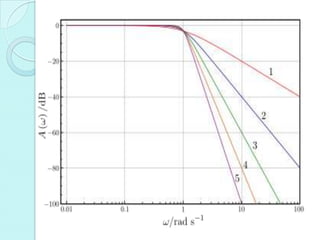
   The main characteristic of Butterworth filter is that the
    pass band is maximally flat. There are no variation
    (ripples) in the pass band.
   The magnitude response of LP Butterworth filter
    is given by -


Where
Ωc =cut off frequency
|H(Ω)|2 =magnitude of LPF
N= order of filter ,that means the no. of stages used in the
  design of analog filter.
Designing of Butterworth filter
Designing steps :
Let -  Ap=Attenuation in pass band
             As=Attenuation in stop band
            Ωp=pass band edge frequency
            Ωc=Cut off frequency
            Ωs=stop band edge frequency
Step 1 :
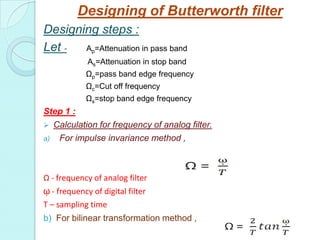
 Calculation for frequency of analog filter.
a) For impulse invariance method ,


Ω - frequency of analog filter
ῳ - frequency of digital filter
T – sampling time
b) For bilinear transformation method ,
Step 2:
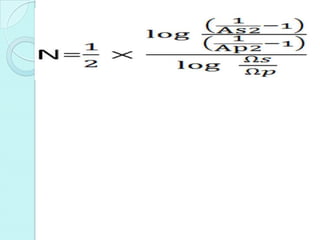
 Evaluate the order N –


Step 3 :
 Calculate cut-off frequency –
a) For impulse invariance method-
Butterworth filter design

Butterworth filter design

  • 1.
     What is Filter ? A Filter is an electrical network that can transmit signal within a specified frequency range . This Frequency range is called PASS BAND and Where signal is suppressed is called STOP BAND. The Frequency that separates the pass band and the stop band is known as CUT-OFF frequency.  What is Digital filter and why we use it ? Type of filter – 1) Analog filter 2) Digital filter Digital filter use to eliminate the Noise and to Extract the signal of interest from the other signal . Filtering is not done by RLC it done by using Difference eqn. It is implement using software like C and Assemble .
  • 2.
     Types of Digital Filter – Depending on the no. of sample point used to determine the unit sample (impulse response)of LTI system ,digital filter are 2 types – 1)FIR(finite impulse response)filter 2)IIR(infinite impulse response)filter  What is Ideal Filter? An ideal filter is would transmit signal under the pass band without attenuation and completely suppress the signal in stop band. Characteristics –  it have constant gain in pass band and zero gain in the stop band.  It has linear phase response.  It must be causal .
  • 3.
    Ideal filter can not be realize . IIR Filter Design – first design analog IIR filter. Then analog filter converted into the digital filter . Methods – 1) Impulse Invariant method – In this, we match the analog filter impulse response to the digital response. 2) Approximation of derivative method – In this ,differential equation of analog filter transform into difference equation of digital filter. 3) Bilinear method— In this, conformal mapping is done which transform the jΩ-Axis into the unit circle in the Z-plane.
  • 4.
    What is basic analog filter Approximation? Approximation of analog filter is required because the practical characteristic of a filter is not identical to ideal characteristic . The approximation are 3 types - 1)Butterworth filter approximation 2) Chebyshev filter approximation 3) Elliptic filter approximation Note- The approximation is used for achieve ideal characteristic where as the methods are use to transform the analog filter response to digital filter response. we use transformation methods for designing of ideal characteristic.
  • 5.
    Butterworth Filter  For low pass filter.
  • 6.
    The main characteristic of Butterworth filter is that the pass band is maximally flat. There are no variation (ripples) in the pass band.  The magnitude response of LP Butterworth filter is given by - Where Ωc =cut off frequency |H(Ω)|2 =magnitude of LPF N= order of filter ,that means the no. of stages used in the design of analog filter.
  • 8.
    Designing of Butterworthfilter Designing steps : Let - Ap=Attenuation in pass band As=Attenuation in stop band Ωp=pass band edge frequency Ωc=Cut off frequency Ωs=stop band edge frequency Step 1 :  Calculation for frequency of analog filter. a) For impulse invariance method , Ω - frequency of analog filter ῳ - frequency of digital filter T – sampling time b) For bilinear transformation method ,
  • 9.
    Step 2:  Evaluatethe order N – Step 3 :  Calculate cut-off frequency – a) For impulse invariance method-