ADAPTIVE FILTER
(ALA for Digital Signal Processing (2171003))
Submitted By:
YADAV VIJAY R (140403111014)
CHAUDHARI RAVI L (140403111016)
Guided By:
Prof. M. I. Patel
Department of E & C Engineering
Sankalchand Patel College of Engineering
Visnagar-384315, Dist. Mehsana (N. G.)
Adaptive filter
 the signal and/or noise characteristics are often
nonstationary and the statistical parameters vary
with time
 An adaptive filter has an adaptation algorithm, that is
meant to monitor the environment and vary the filter
transfer function accordingly
 based in the actual signals received, attempts to find
the optimum filter design
Adaptive filter
 The basic operation now involves two processes :
1. a filtering process, which produces an output signal
in response to a given input signal.
2. an adaptation process, which aims to adjust the filter
parameters (filter transfer function) to the (possibly
time-varying) environment
Often, the (average) square value of the error signal is
used as the optimization criterion
Adaptive filter
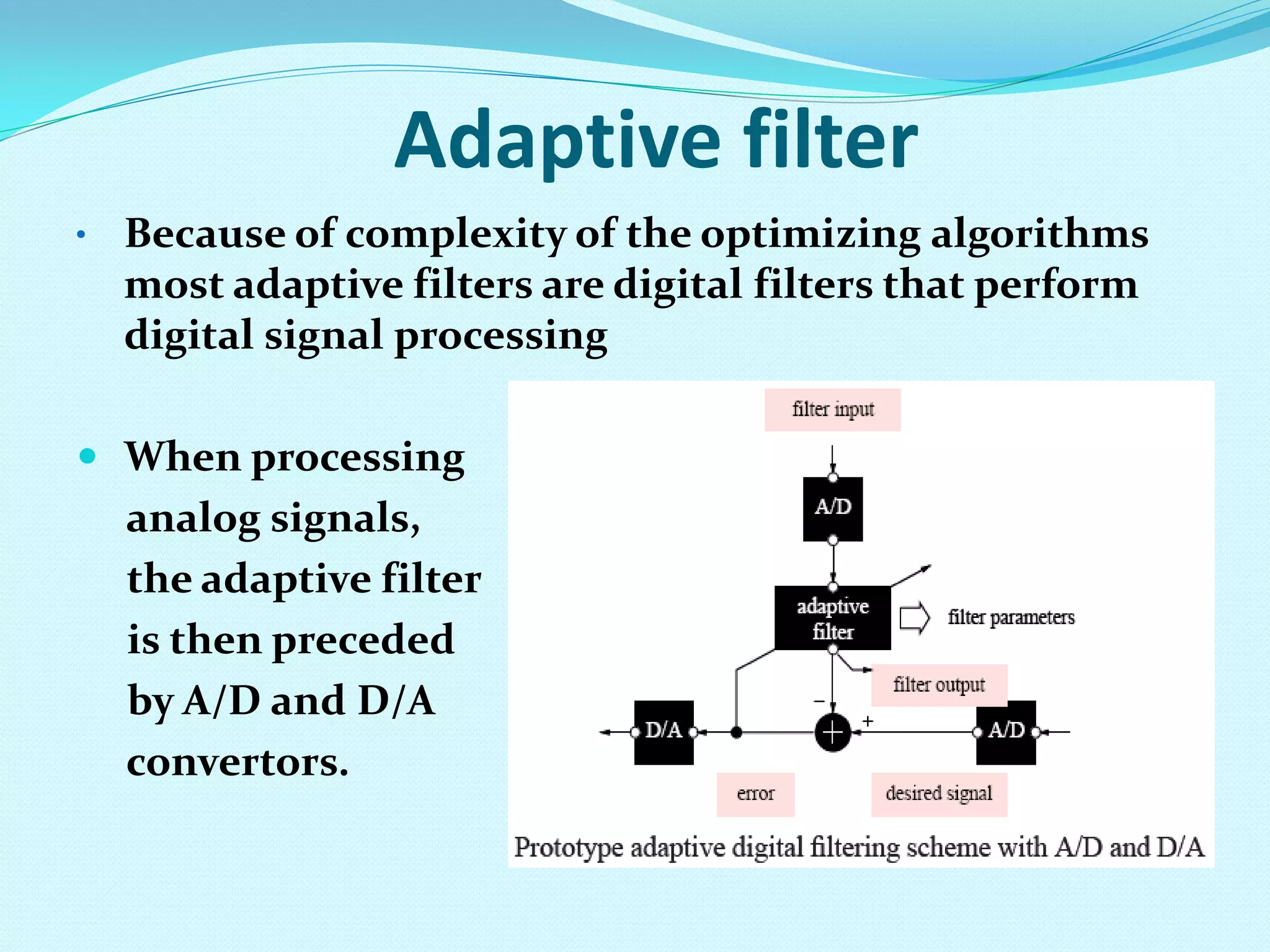
• Because of complexity of the optimizing algorithms
most adaptive filters are digital filters that perform
digital signal processing
 When processing
analog signals,
the adaptive filter
is then preceded
by A/D and D/A
convertors.
Adaptive filter
• The generalization to adaptive IIR filters leads to
stability problems
• It’s common to use
a FIR digital filter
with adjustable
coefficients
Applications of Adaptive Filters:
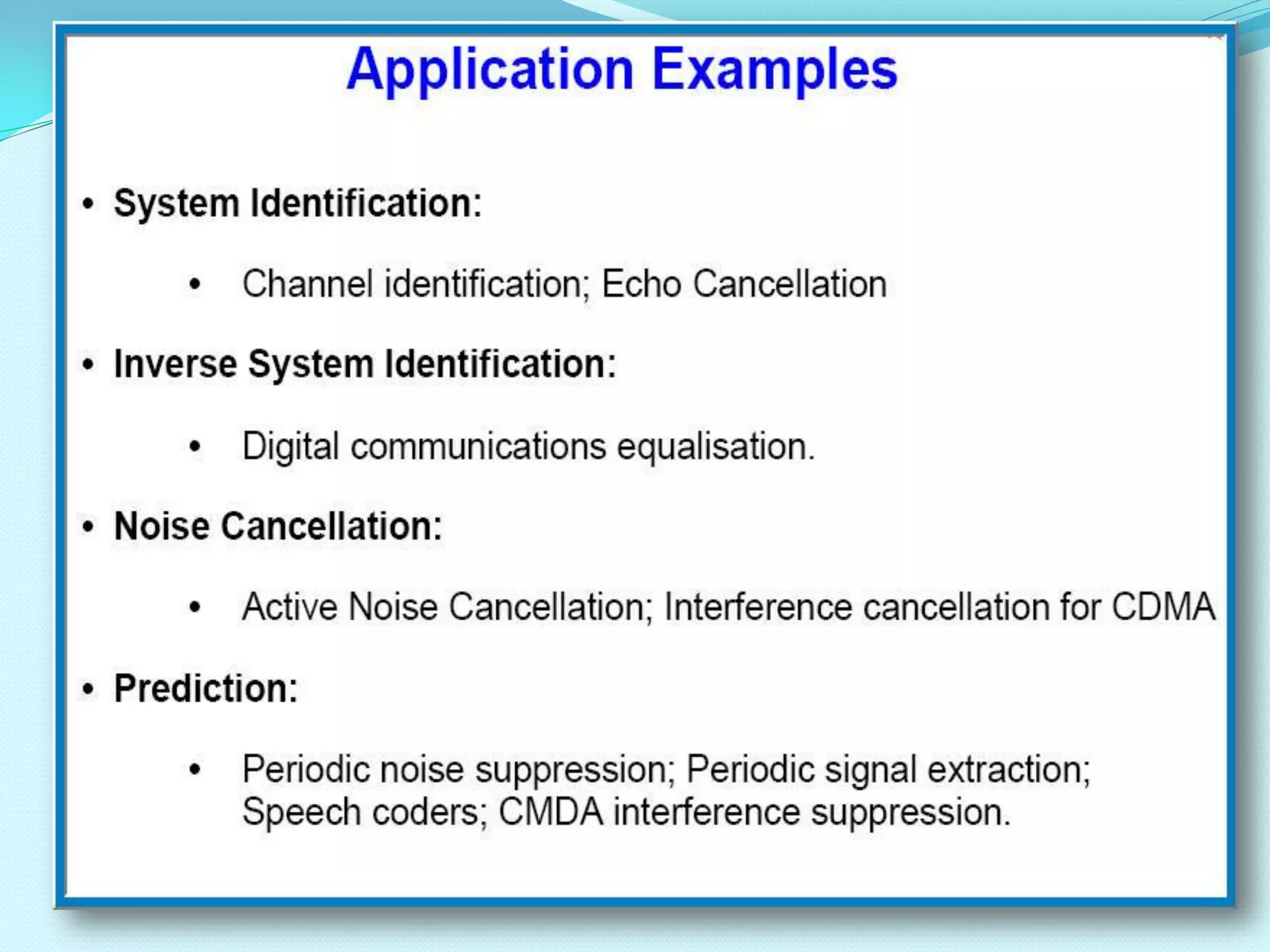
Identification
 Used to provide a linear model of an unknown
plant
 Applications:
 System identification
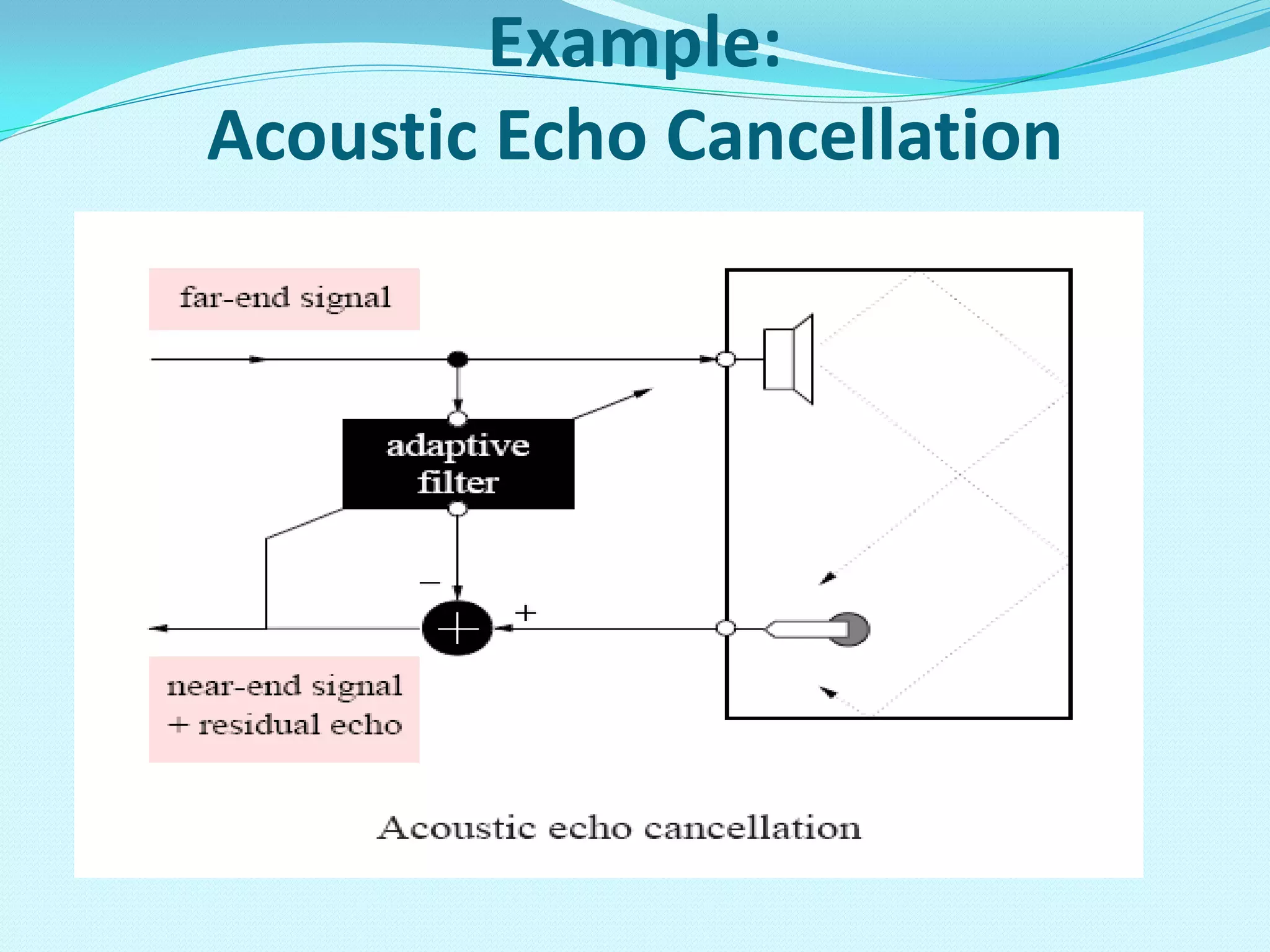
Example:
Acoustic Echo Cancellation
Applications are many
Digital Communications
(OFDM , MIMO , CDMA, and
RFID)
Channel Equalisation
Adaptive noise cancellation
Adaptive echo cancellation
System identification
Smart antenna systems
Blind system equalisation
And many, many others
New Trends in Adaptive Filtering
 Partial Updating Weights.
 Sub-band adaptive filtering.
 Adaptive Kalman filtering.
 Affine Projection Method.
 Time-Space adaptive processing.
 Non-Linear adaptive filtering:-
Neural Networks.
The Volterra Series Algorithm .
Genetic & Fuzzy.
• Blind Adaptive Filtering.
Adaptive filter

Adaptive filter

  • 1.
    ADAPTIVE FILTER (ALA forDigital Signal Processing (2171003)) Submitted By: YADAV VIJAY R (140403111014) CHAUDHARI RAVI L (140403111016) Guided By: Prof. M. I. Patel Department of E & C Engineering Sankalchand Patel College of Engineering Visnagar-384315, Dist. Mehsana (N. G.)
  • 2.
    Adaptive filter  thesignal and/or noise characteristics are often nonstationary and the statistical parameters vary with time  An adaptive filter has an adaptation algorithm, that is meant to monitor the environment and vary the filter transfer function accordingly  based in the actual signals received, attempts to find the optimum filter design
  • 3.
    Adaptive filter  Thebasic operation now involves two processes : 1. a filtering process, which produces an output signal in response to a given input signal. 2. an adaptation process, which aims to adjust the filter parameters (filter transfer function) to the (possibly time-varying) environment Often, the (average) square value of the error signal is used as the optimization criterion
  • 4.
    Adaptive filter • Becauseof complexity of the optimizing algorithms most adaptive filters are digital filters that perform digital signal processing  When processing analog signals, the adaptive filter is then preceded by A/D and D/A convertors.
  • 5.
    Adaptive filter • Thegeneralization to adaptive IIR filters leads to stability problems • It’s common to use a FIR digital filter with adjustable coefficients
  • 6.
    Applications of AdaptiveFilters: Identification  Used to provide a linear model of an unknown plant  Applications:  System identification
  • 7.
  • 11.
    Applications are many DigitalCommunications (OFDM , MIMO , CDMA, and RFID) Channel Equalisation Adaptive noise cancellation Adaptive echo cancellation System identification Smart antenna systems Blind system equalisation And many, many others
  • 12.
    New Trends inAdaptive Filtering  Partial Updating Weights.  Sub-band adaptive filtering.  Adaptive Kalman filtering.  Affine Projection Method.  Time-Space adaptive processing.  Non-Linear adaptive filtering:- Neural Networks. The Volterra Series Algorithm . Genetic & Fuzzy. • Blind Adaptive Filtering.