DIGITAL SIGNAL PROCESSING
Mr. S. Sivakumar
Associate Professor
Department of ECE
SIET, Coimbatore.
DIGITAL SIGNAL PROCESSING
• operating by the
use of discrete
signal to
represent data in
the form of
numbers.
DIGITAL
• any physical
phenomenon which
conveys
information
SIGNAL
• a series of operation
performed according
to programmed
instructions
PROCESSING
Digital signal processing (DSP)
• DSP- use of digital processing, such as by computers
or more specialized digital signal processors,to
perform a wide variety of signal
processing operations.
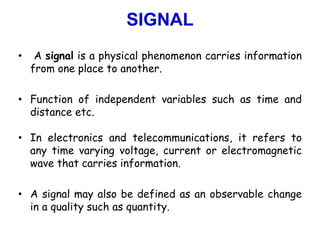
SIGNAL
• A signal is a physical phenomenon carries information
from one place to another.
• Function of independent variables such as time and
distance etc.
• In electronics and telecommunications, it refers to
any time varying voltage, current or electromagnetic
wave that carries information.
• A signal may also be defined as an observable change
in a quality such as quantity.
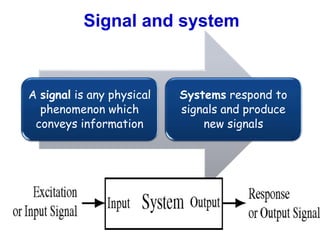
Signal and system
A signal is any physical
phenomenon which
conveys information
Systems respond to
signals and produce
new signals
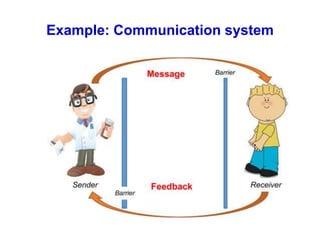
Example: Communication system
Contd…
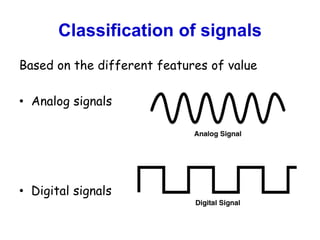
Classification of signals
Based on the different features of value
• Analog signals
• Digital signals
Contd…
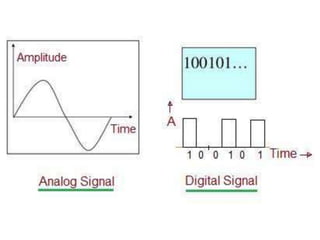
• Analog signals -taking information and translating it
into electric pulses of varying amplitude,
• digital signal information - translated into binary
format where each bit of data is represented by two
distinguishable amplitudes.
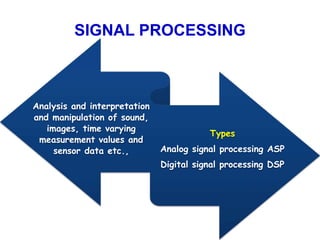
SIGNAL PROCESSING
Analysis and interpretation
and manipulation of sound,
images, time varying
measurement values and
sensor data etc.,
Types
Analog signal processing ASP
Digital signal processing DSP
Signal processing
• The digital signals processed in this
manner are a sequence of numbers that
represent samples of a continuous
variable in a domain such as time, space, or
frequency.
• In digital electronics, a digital signal is
represented as a pulse train, which is
typically generated by the switching of
a transistor.
• DSP can involve linear or nonlinear
operations.
• Nonlinear signal processing is closely
related to nonlinear system identification
• and can be implemented in
the time, frequency, and spatio-temporal
domains
• The application of digital computation to signal
processing allows for many advantages over
analog processing in many applications, such
as error detection and correction in
transmission as well as data compression.
• Digital signal processing is also fundamental
to digital technology, such as digital
telecommunication and wireless communications.
• DSP is applicable to both streaming data and
static (stored) data.
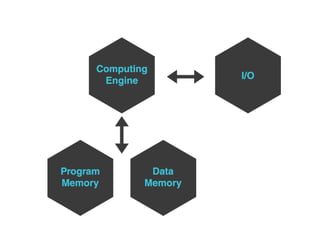
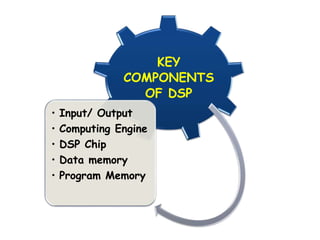
• A DSP contains four key components:
• Computing Engine: Mathematical manipulations,
calculations, and processes by accessing the program, or
task, from the Program Memory and the information
stored in the Data Memory.
• Data Memory: This stores the information to be processed
and works hand in hand with program memory.
• Program Memory: This stores the programs, or tasks, that
the DSP will use to process, compress, or manipulate data.
• I/O: This can be used for various things, depending on the
field DSP is being used for, i.e. external ports, serial
ports, timers, and connecting to the outside world.
KEY
COMPONENTS
OF DSP
• Input/ Output
• Computing Engine
• DSP Chip
• Data memory
• Program Memory
• To understand how digital signal processing, or DSP, compares
with analog circuitry, one would compare the two systems with
any filter function.
• While an analog filter would use amplifiers, capacitors,
inductors, or resistors, and be affordable and easy to assemble,
it would be rather difficult to calibrate or modify the filter
order.
• However, the same things can be done with a DSP system, just
easier to design and modify. The filter function on a DSP system
is software-based, so multiple filters can be chosen from.
• Also, to create flexible and adjustable filters with high-order
responses only requires the DSP software, whereas analog
requires additional hardware.
ANALOG AND DIGITAL
CONVERTER
APPLICATIONS OF DSP
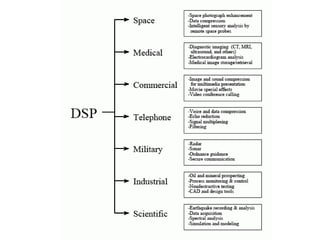
APPLICATIONS OF DSP
audio and speech processing
sonar, radar and other sensor array processing
spectral density estimation
statistical signal processing
digital image processing
data compression
video coding
audio coding
image compression
Others : telecommunications, control systems, biomedical
engineering, and seismology
• The advantages of DSP over Analog Signal Processing are:
1. High Accuracy: The accuracy of the analog filter is
affected by the tolerance of the circuitcomponents used
for design the filter, but DSP has superior control of
accuracy. 2. Cheaper: The digital realization is much
cheaper than the analog realization in many applications. 3.
Flexibility in Configuration: For reconfiguring an analog
system, we can only do it by redesign of system hardware;
where as a DSP System can be easily reconfigured only by
changing the program. 4. Ease of Data Storage: On
magnetic media, without the loss of fidelity the digital
signals can be stored and can be processed off-line in a
remote laboratory. 5. Time Sharing: The cost of the
processing signal can be reduced in DSP by the sharing of
a given processor among a number of signals.
IMPORTANCE OF DSP
• significantly increases the overall value of hearing
protection
• suppresses noise without blocking the speech signal.
• very important aspect of protecting user hearing,
especially when users are immersed in industrial
work environments.
• DSP systems protect users from unhealthy noise
exposure without compromising communication.
• Power. Real world signals are converted into a domain
where abstract scientific and mathematical models are
then applied. The result is a powerful processing system.
• Information. Information can be used to enhance or
improve desired aspects of a signal or even to reduce
undesirable aspects.
• Adaptation. DSP processes information adaptively. This
concept is imperative in a dynamic application such as
sound and speech, especially when applied in industrial
environments.
• Flexibility. DSP creates flexibility. Changes, updates,
customizations, and many other features are available with
the implementation of DSP systems.
• Efficiency. DSP allows users to get the job done
efficiently, practically, and cost effectively.
ADVANTAGES OF DSP OVER ASP
1. Physical size of analog systems is quite large while digital
processors are more compact and light in weight.
2. Analog systems are less accurate because of component
tolerance ex R, L, C and active components. Digital components
are less sensitive to the environmental changes, noise and
disturbances.
3. Digital system is most flexible as software programs & control
programs can be easily modified.
4. Digital signal can be stores on digital hard disk, floppy disk or
magnetic tapes. Hence becomes transportable. Thus easy and
lasting storage capacity.
5. Digital processing can be done offline.
6. Mathematical signal processing algorithm can be routinely
implemented on digital signal processing systems. Digital
controllers are capable of performing complex computation with
constant accuracy at high speed.
7. Digital signal processing systems are upgradeable since that are
software controlled.
8. Possibility of sharing DSP processor between several tasks.
9. The cost of microprocessors, controllers and DSP processors are
continuously going down. For some complex control functions, it
is not practically feasible to construct analog controllers.
10. Single chip microprocessors, controllers and DSP processors
are more versatile and powerful.
• Disadvantages of DSP over ASP
•
• 1. Additional complexity (A/D & D/A
Converters)
• 2. Limit in frequency. High speed AD
converters are difficult to achieve in
practice. In high frequency applications
DSP are not preferred.
•

Digital signal processing

  • 2.
    DIGITAL SIGNAL PROCESSING Mr.S. Sivakumar Associate Professor Department of ECE SIET, Coimbatore.
  • 3.
    DIGITAL SIGNAL PROCESSING •operating by the use of discrete signal to represent data in the form of numbers. DIGITAL • any physical phenomenon which conveys information SIGNAL • a series of operation performed according to programmed instructions PROCESSING
  • 4.
    Digital signal processing(DSP) • DSP- use of digital processing, such as by computers or more specialized digital signal processors,to perform a wide variety of signal processing operations.
  • 5.
    SIGNAL • A signalis a physical phenomenon carries information from one place to another. • Function of independent variables such as time and distance etc. • In electronics and telecommunications, it refers to any time varying voltage, current or electromagnetic wave that carries information. • A signal may also be defined as an observable change in a quality such as quantity.
  • 6.
    Signal and system Asignal is any physical phenomenon which conveys information Systems respond to signals and produce new signals
  • 7.
  • 9.
  • 10.
    Classification of signals Basedon the different features of value • Analog signals • Digital signals
  • 11.
    Contd… • Analog signals-taking information and translating it into electric pulses of varying amplitude, • digital signal information - translated into binary format where each bit of data is represented by two distinguishable amplitudes.
  • 13.
    SIGNAL PROCESSING Analysis andinterpretation and manipulation of sound, images, time varying measurement values and sensor data etc., Types Analog signal processing ASP Digital signal processing DSP
  • 14.
  • 15.
    • The digitalsignals processed in this manner are a sequence of numbers that represent samples of a continuous variable in a domain such as time, space, or frequency. • In digital electronics, a digital signal is represented as a pulse train, which is typically generated by the switching of a transistor.
  • 17.
    • DSP caninvolve linear or nonlinear operations. • Nonlinear signal processing is closely related to nonlinear system identification • and can be implemented in the time, frequency, and spatio-temporal domains
  • 18.
    • The applicationof digital computation to signal processing allows for many advantages over analog processing in many applications, such as error detection and correction in transmission as well as data compression. • Digital signal processing is also fundamental to digital technology, such as digital telecommunication and wireless communications. • DSP is applicable to both streaming data and static (stored) data.
  • 19.
    • A DSPcontains four key components: • Computing Engine: Mathematical manipulations, calculations, and processes by accessing the program, or task, from the Program Memory and the information stored in the Data Memory. • Data Memory: This stores the information to be processed and works hand in hand with program memory. • Program Memory: This stores the programs, or tasks, that the DSP will use to process, compress, or manipulate data. • I/O: This can be used for various things, depending on the field DSP is being used for, i.e. external ports, serial ports, timers, and connecting to the outside world.
  • 21.
    KEY COMPONENTS OF DSP • Input/Output • Computing Engine • DSP Chip • Data memory • Program Memory
  • 22.
    • To understandhow digital signal processing, or DSP, compares with analog circuitry, one would compare the two systems with any filter function. • While an analog filter would use amplifiers, capacitors, inductors, or resistors, and be affordable and easy to assemble, it would be rather difficult to calibrate or modify the filter order. • However, the same things can be done with a DSP system, just easier to design and modify. The filter function on a DSP system is software-based, so multiple filters can be chosen from. • Also, to create flexible and adjustable filters with high-order responses only requires the DSP software, whereas analog requires additional hardware.
  • 23.
  • 25.
  • 26.
    APPLICATIONS OF DSP audioand speech processing sonar, radar and other sensor array processing spectral density estimation statistical signal processing digital image processing data compression video coding audio coding image compression Others : telecommunications, control systems, biomedical engineering, and seismology
  • 29.
    • The advantagesof DSP over Analog Signal Processing are: 1. High Accuracy: The accuracy of the analog filter is affected by the tolerance of the circuitcomponents used for design the filter, but DSP has superior control of accuracy. 2. Cheaper: The digital realization is much cheaper than the analog realization in many applications. 3. Flexibility in Configuration: For reconfiguring an analog system, we can only do it by redesign of system hardware; where as a DSP System can be easily reconfigured only by changing the program. 4. Ease of Data Storage: On magnetic media, without the loss of fidelity the digital signals can be stored and can be processed off-line in a remote laboratory. 5. Time Sharing: The cost of the processing signal can be reduced in DSP by the sharing of a given processor among a number of signals.
  • 30.
    IMPORTANCE OF DSP •significantly increases the overall value of hearing protection • suppresses noise without blocking the speech signal. • very important aspect of protecting user hearing, especially when users are immersed in industrial work environments. • DSP systems protect users from unhealthy noise exposure without compromising communication.
  • 31.
    • Power. Realworld signals are converted into a domain where abstract scientific and mathematical models are then applied. The result is a powerful processing system. • Information. Information can be used to enhance or improve desired aspects of a signal or even to reduce undesirable aspects. • Adaptation. DSP processes information adaptively. This concept is imperative in a dynamic application such as sound and speech, especially when applied in industrial environments. • Flexibility. DSP creates flexibility. Changes, updates, customizations, and many other features are available with the implementation of DSP systems. • Efficiency. DSP allows users to get the job done efficiently, practically, and cost effectively.
  • 34.
    ADVANTAGES OF DSPOVER ASP 1. Physical size of analog systems is quite large while digital processors are more compact and light in weight. 2. Analog systems are less accurate because of component tolerance ex R, L, C and active components. Digital components are less sensitive to the environmental changes, noise and disturbances. 3. Digital system is most flexible as software programs & control programs can be easily modified. 4. Digital signal can be stores on digital hard disk, floppy disk or magnetic tapes. Hence becomes transportable. Thus easy and lasting storage capacity. 5. Digital processing can be done offline.
  • 35.
    6. Mathematical signalprocessing algorithm can be routinely implemented on digital signal processing systems. Digital controllers are capable of performing complex computation with constant accuracy at high speed. 7. Digital signal processing systems are upgradeable since that are software controlled. 8. Possibility of sharing DSP processor between several tasks. 9. The cost of microprocessors, controllers and DSP processors are continuously going down. For some complex control functions, it is not practically feasible to construct analog controllers. 10. Single chip microprocessors, controllers and DSP processors are more versatile and powerful.
  • 36.
    • Disadvantages ofDSP over ASP • • 1. Additional complexity (A/D & D/A Converters) • 2. Limit in frequency. High speed AD converters are difficult to achieve in practice. In high frequency applications DSP are not preferred. •