WELCOME
Digital
Signal
processing
Done by :-
Sri Rakesh
What is DSP ?
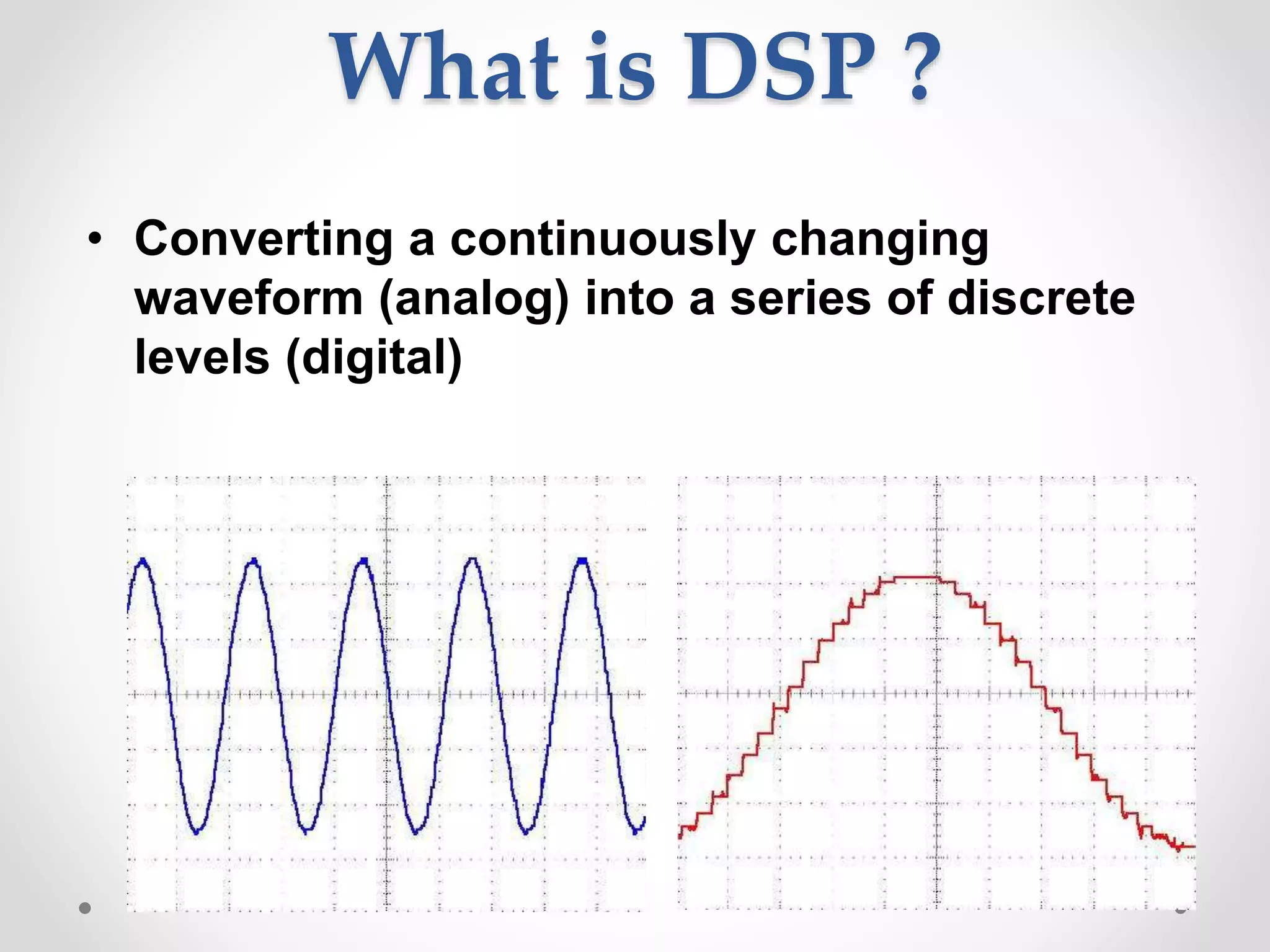
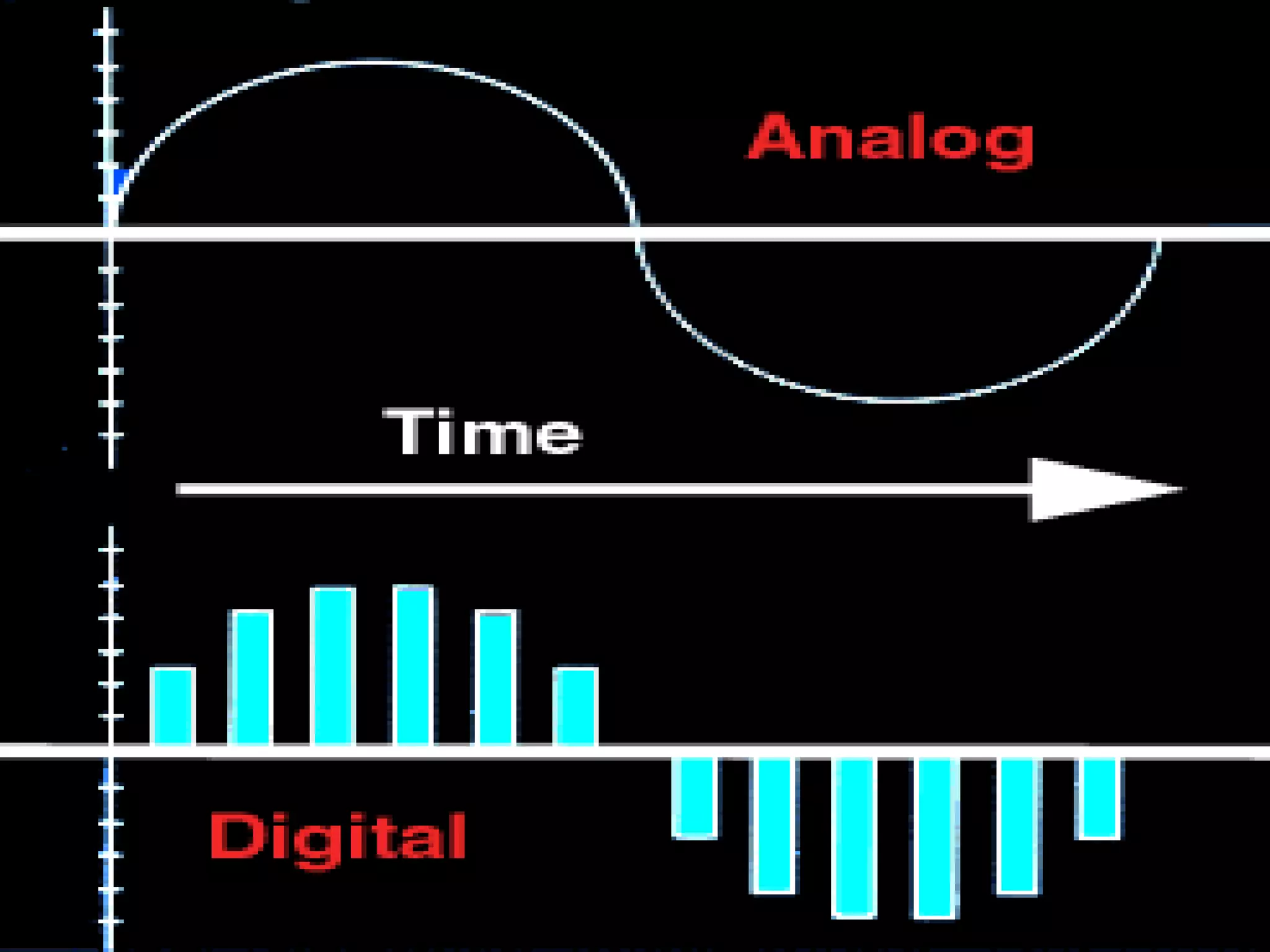
• Converting a continuously changing
waveform (analog) into a series of discrete
levels (digital)
What is DSP?
• DSP = Digital Signal Processing
OR
DSP = Digital Signal Processor?
• DSP used to denote both
o meaning can be deduced from the context in
which the term DSP is used.
• What is a Digital Signal Processor (DSP)?
o Microprocessor specifically designed to
perform fast DSP operations (e.g., Fast
Fourier Transforms, inner products, Multiply
& Accumulate)
What is DSP?
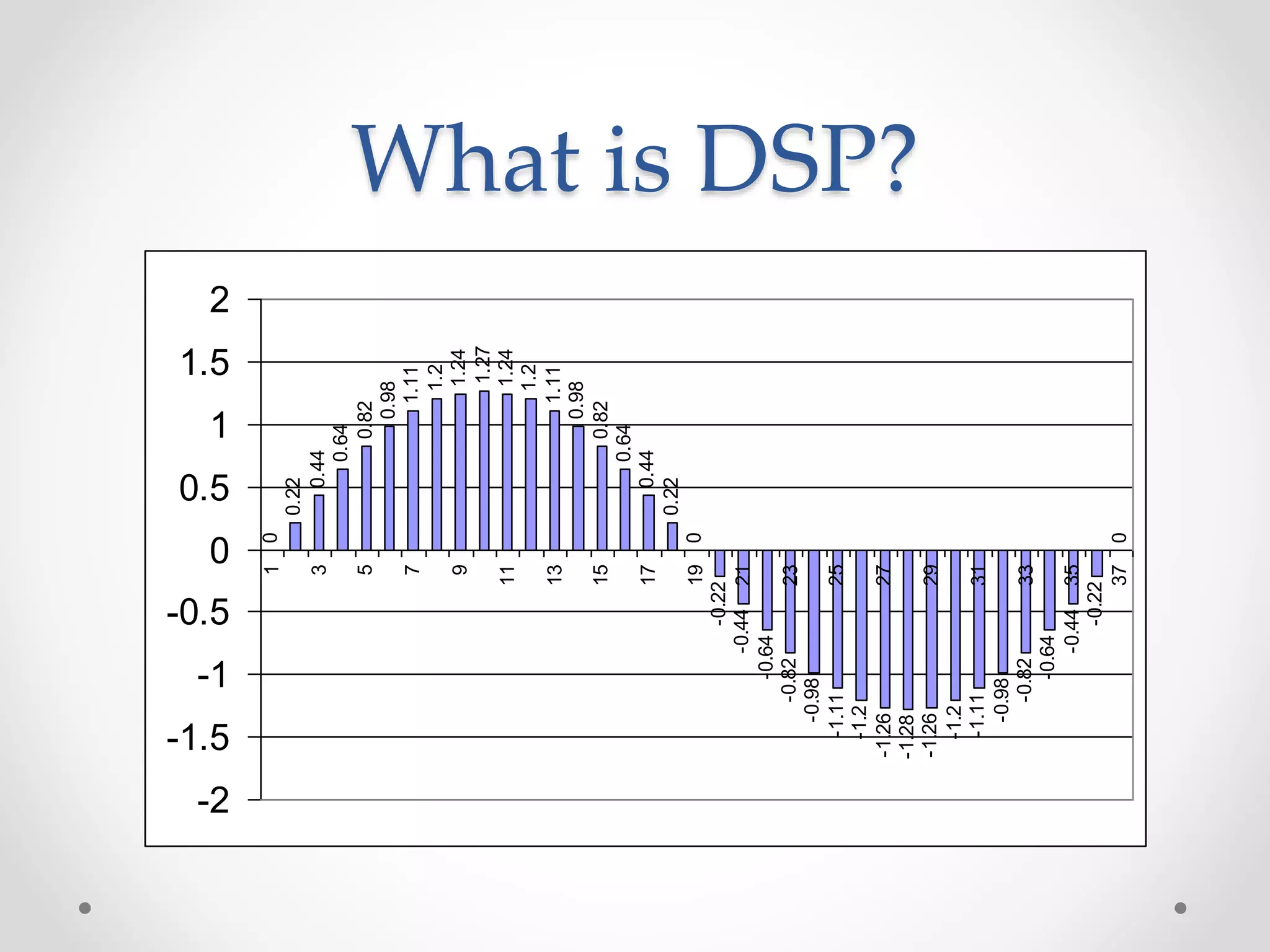
0
0.22
0.44
0.64
0.82
0.98
1.11
1.2
1.24
1.27
1.24
1.2
1.11
0.98
0.82
0.64
0.44
0.22
0
-0.22
-0.44
-0.64
-0.82
-0.98
-1.11
-1.2
-1.26
-1.28
-1.26
-1.2
-1.11
-0.98
-0.82
-0.64
-0.44
-0.22
0
-2
-1.5
-1
-0.5
0
0.5
1
1.5
2
1
3
5
7
9
11
13
15
17
19
21
23
25
27
29
31
33
35
37
How Does It Work?
• Now that we can slice up a waveform and convert it into
digital form, let’s take a look at how it is used in DSP
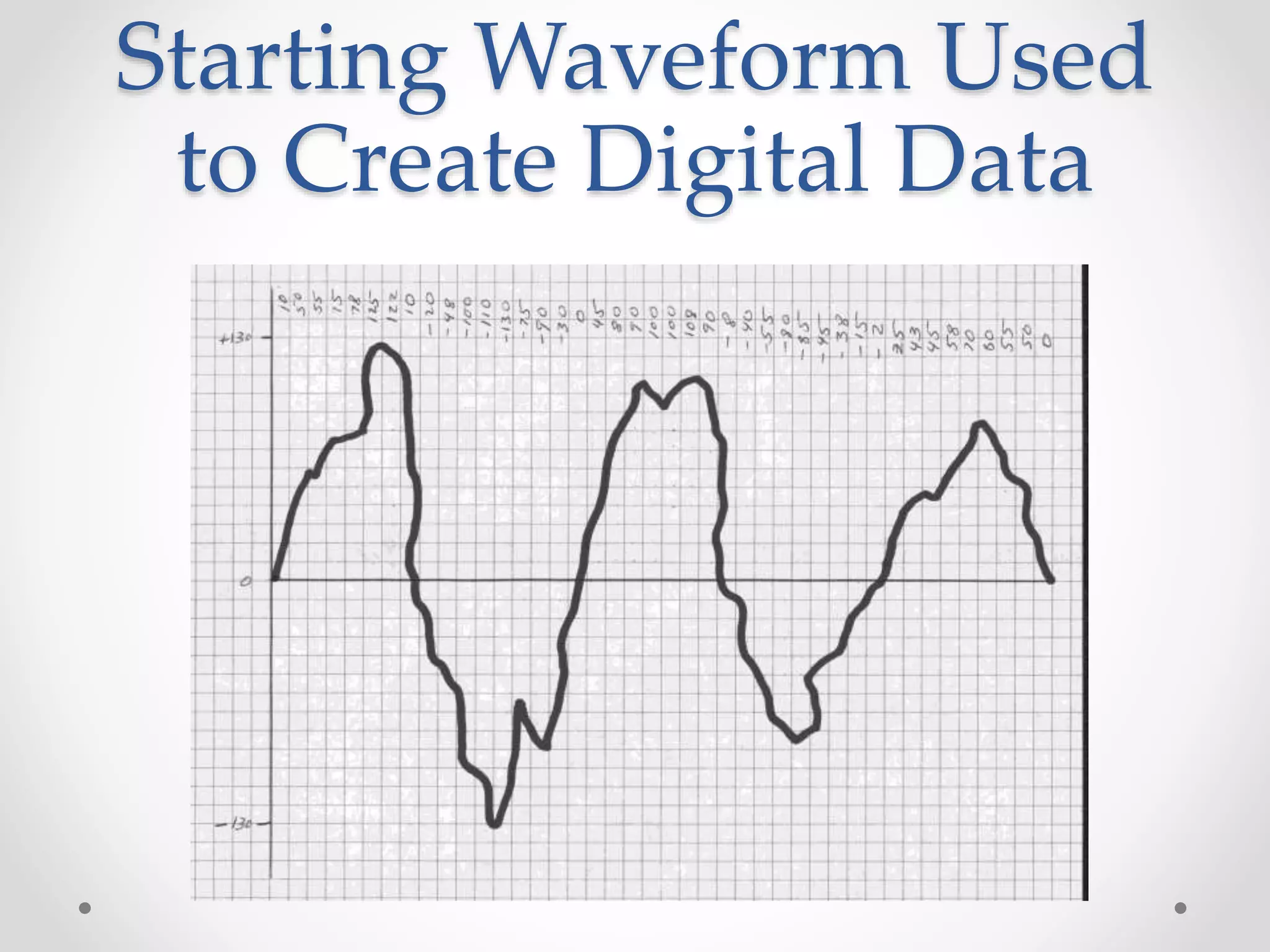
• Draw a simple waveform on graph paper
o Scale appropriately
• “Gather” digital data points to represent the waveform
How Does It Work?
• Once the waveform is in digital form, the real power of
DSP can be realized by mathematical manipulation of
the data
• Using EXCEL spreadsheet software can assist in
manipulating the data and making graphs quickly
• Let’s first do a little filtering of noise
How Does It Work?
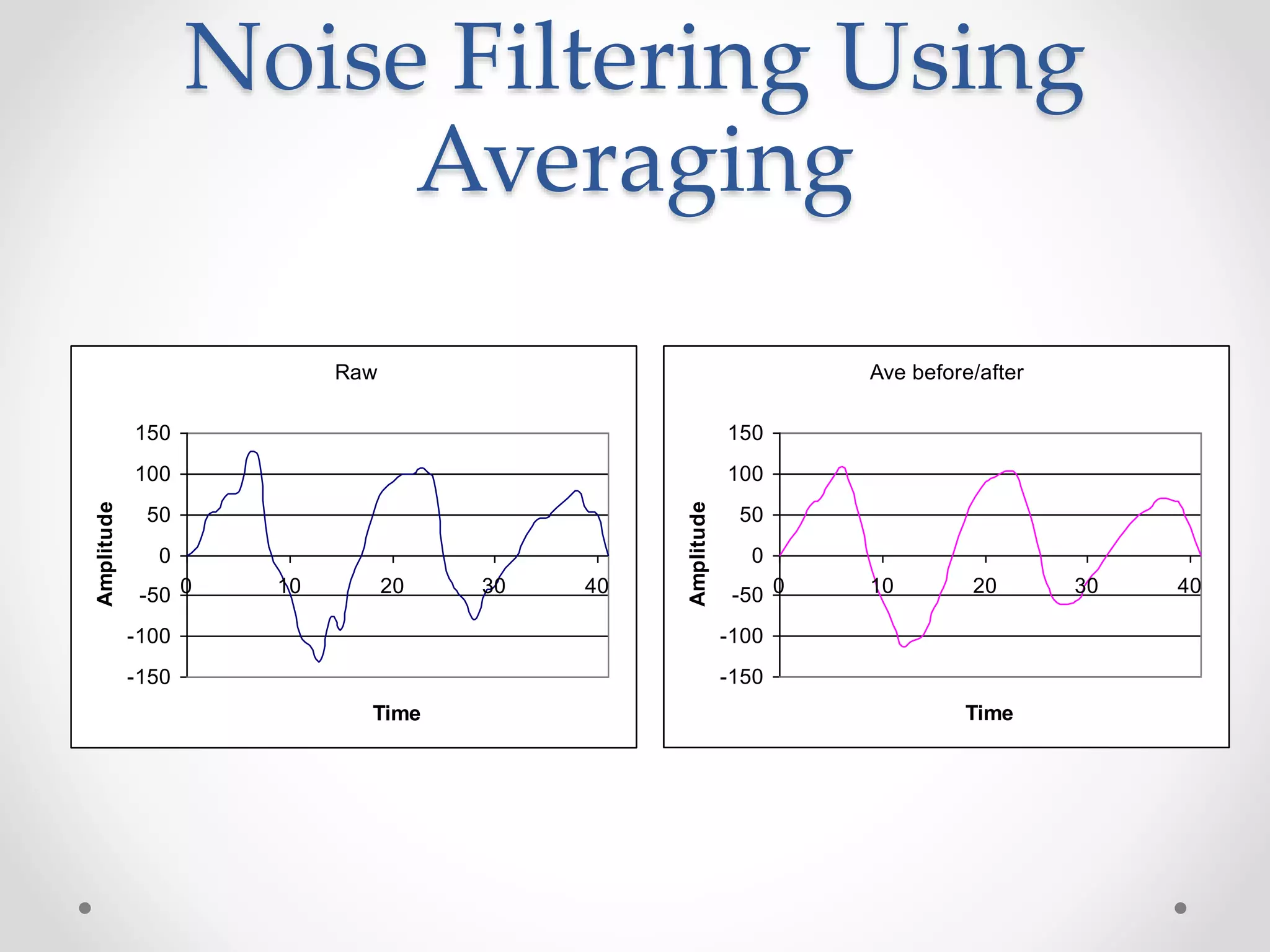
• Using your raw digital data, create a new table of
data that averages three data points
o Average the point before and the point after with the point in the
middle
o Enter all data in EXCEL to help with graphing
How Does It Work?
• Swap your waveform data with a partner
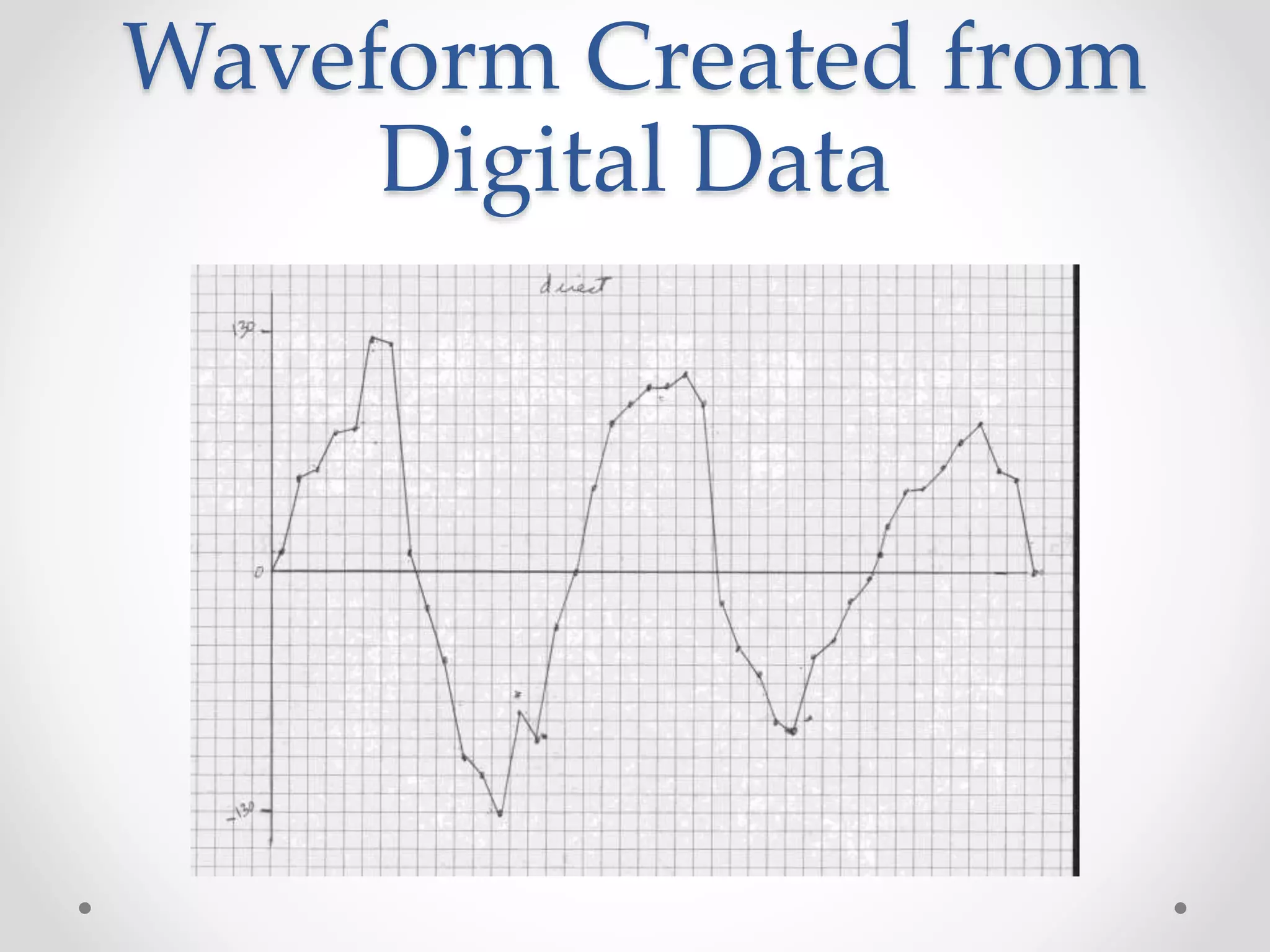
• Using the data, recreate the waveform on a sheet of
graph paper
Starting Waveform Used
to Create Digital Data
Waveform Created from
Digital Data
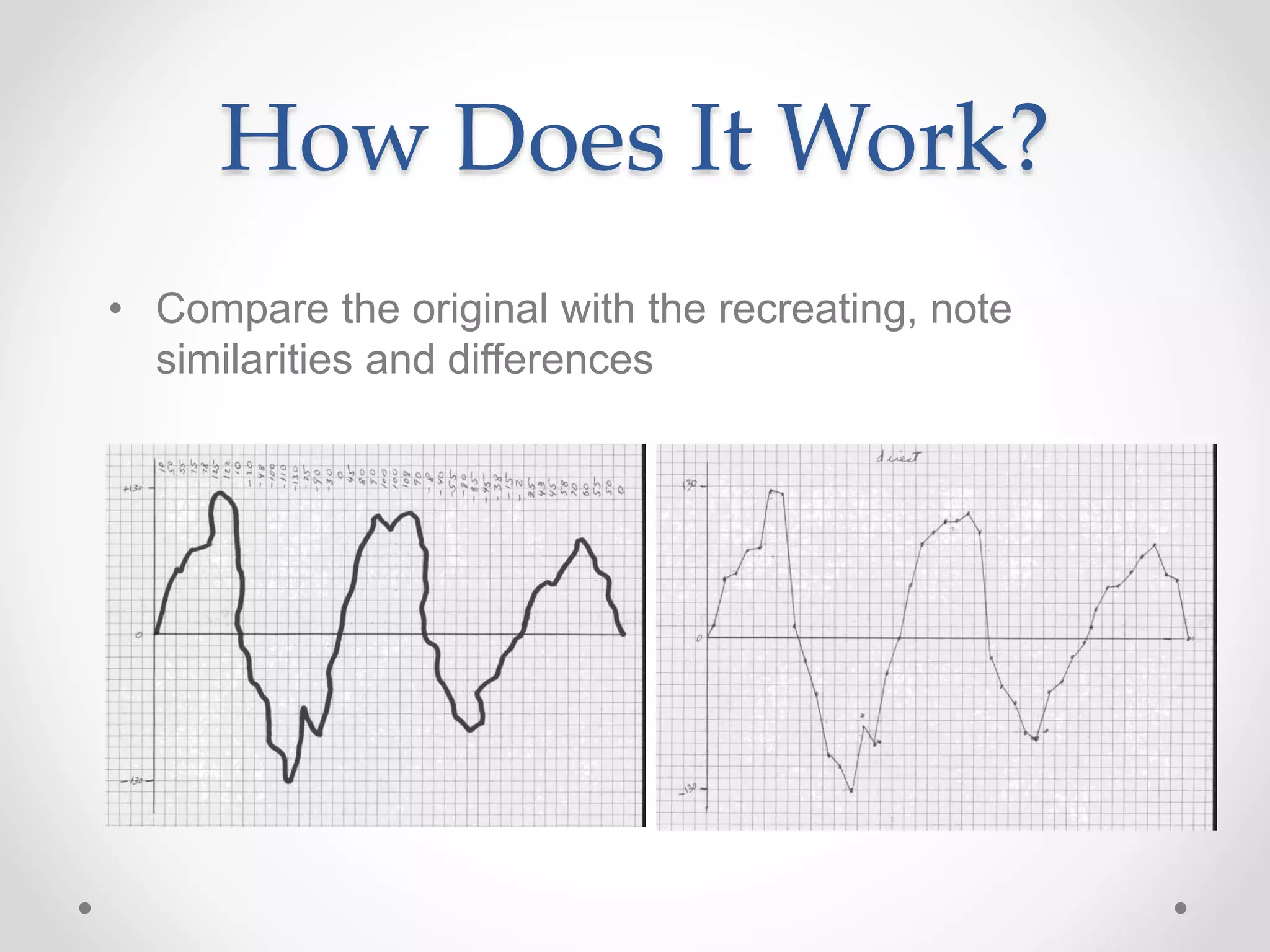
How Does It Work?
• Compare the original with the recreating, note
similarities and differences
Noise Filtering Using
Averaging
Raw
-150
-100
-50
0
50
100
150
0 10 20 30 40
Time
Amplitude
Ave before/after
-150
-100
-50
0
50
100
150
0 10 20 30 40
Time
Amplitude
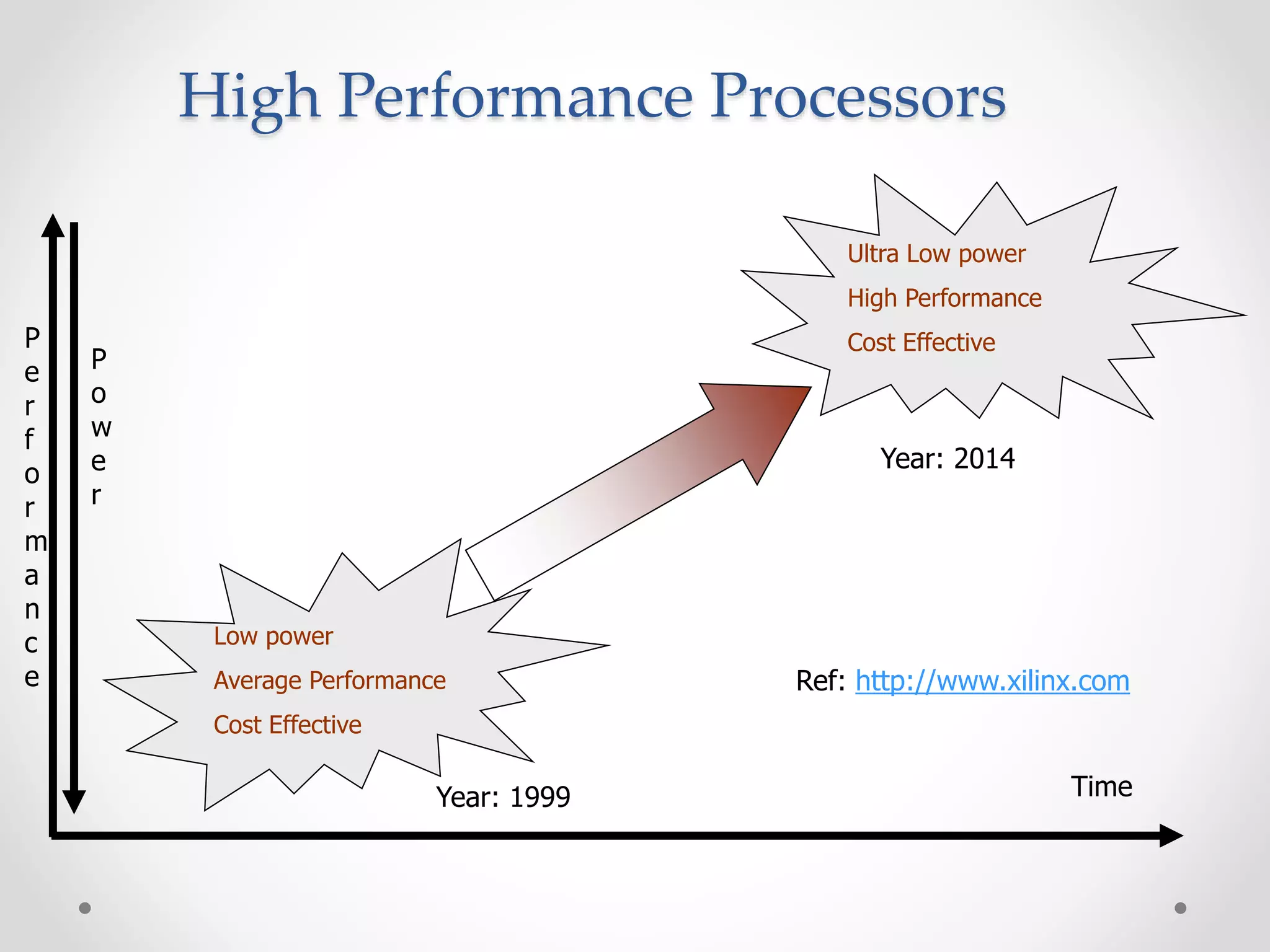
High Performance Processors
Low power
Average Performance
Cost Effective
Ultra Low power
High Performance
Cost Effective
Year: 1999
Year: 2014
Time
P
e
r
f
o
r
m
a
n
c
e
P
o
w
e
r
Ref: http://www.xilinx.com
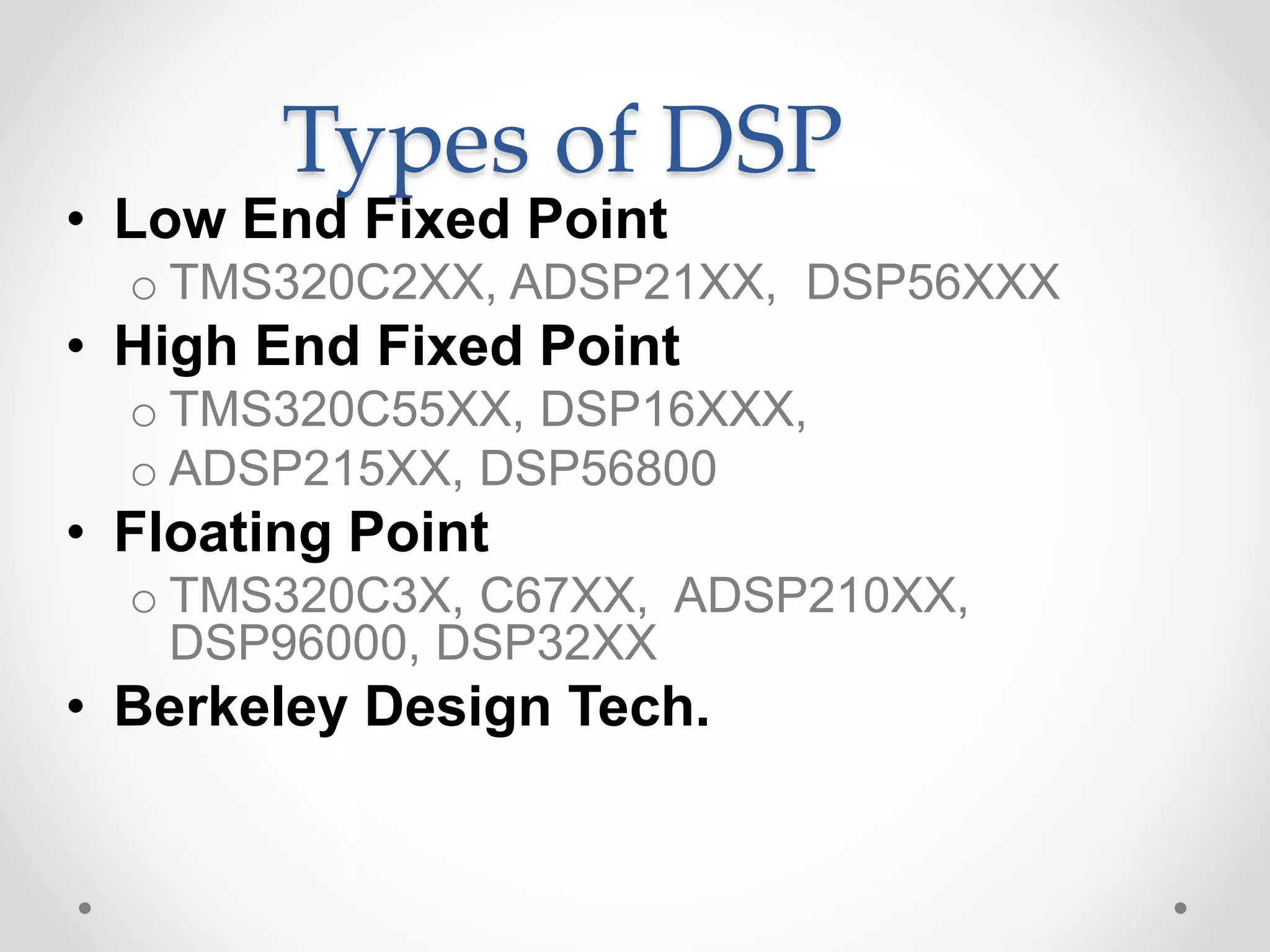
Types of DSP
• Low End Fixed Point
o TMS320C2XX, ADSP21XX, DSP56XXX
• High End Fixed Point
o TMS320C55XX, DSP16XXX,
o ADSP215XX, DSP56800
• Floating Point
o TMS320C3X, C67XX, ADSP210XX,
DSP96000, DSP32XX
• Berkeley Design Tech.
17
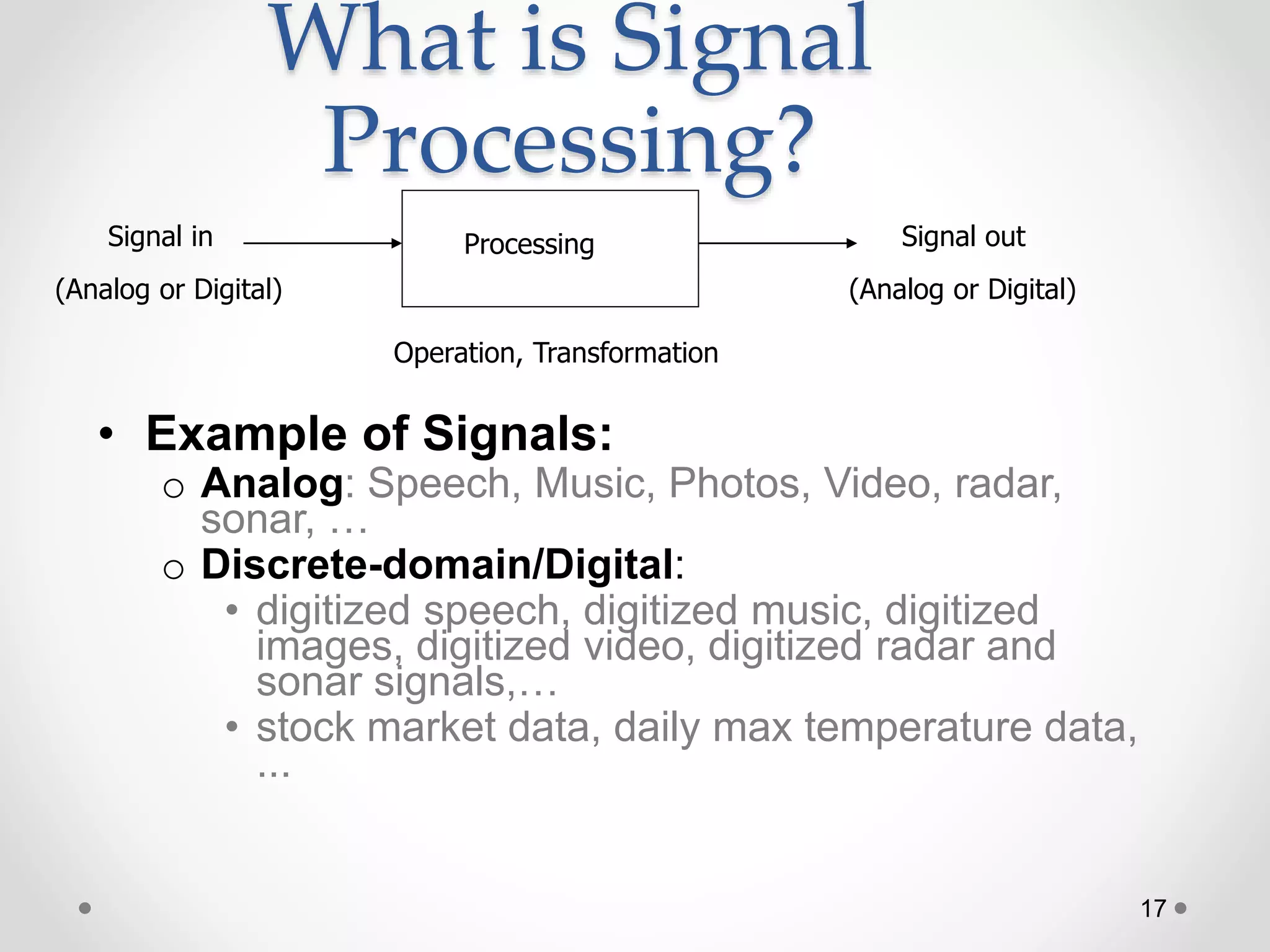
What is Signal
Processing?
• Example of Signals:
o Analog: Speech, Music, Photos, Video, radar,
sonar, …
o Discrete-domain/Digital:
• digitized speech, digitized music, digitized
images, digitized video, digitized radar and
sonar signals,…
• stock market data, daily max temperature data,
...
ProcessingSignal in Signal out
Operation, Transformation
(Analog or Digital) (Analog or Digital)
18
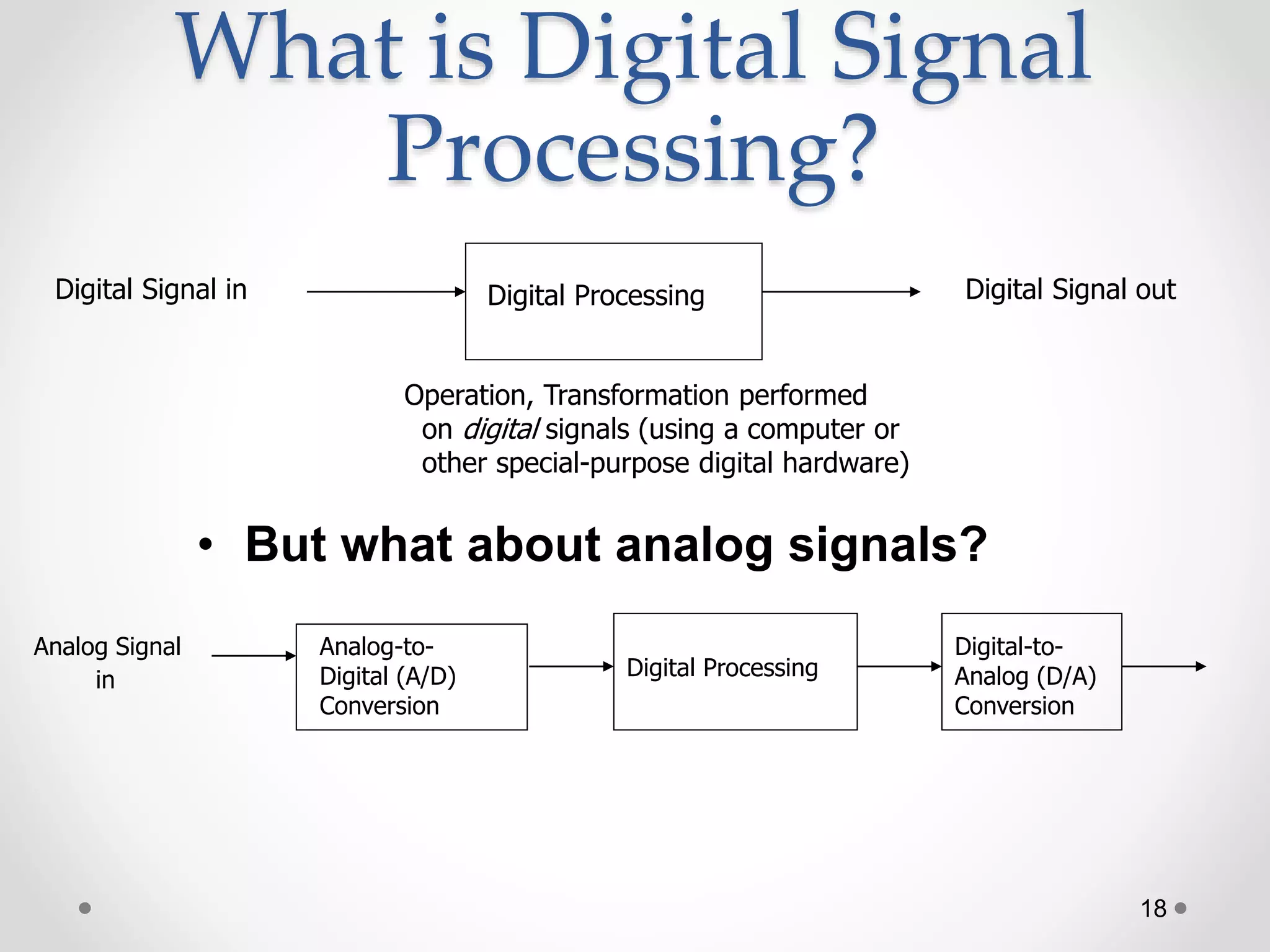
What is Digital Signal
Processing?
• But what about analog signals?
Digital ProcessingDigital Signal in Digital Signal out
Operation, Transformation performed
on digital signals (using a computer or
other special-purpose digital hardware)
Analog Signal
in
Analog-to-
Digital (A/D)
Conversion
Digital Processing
Digital-to-
Analog (D/A)
Conversion
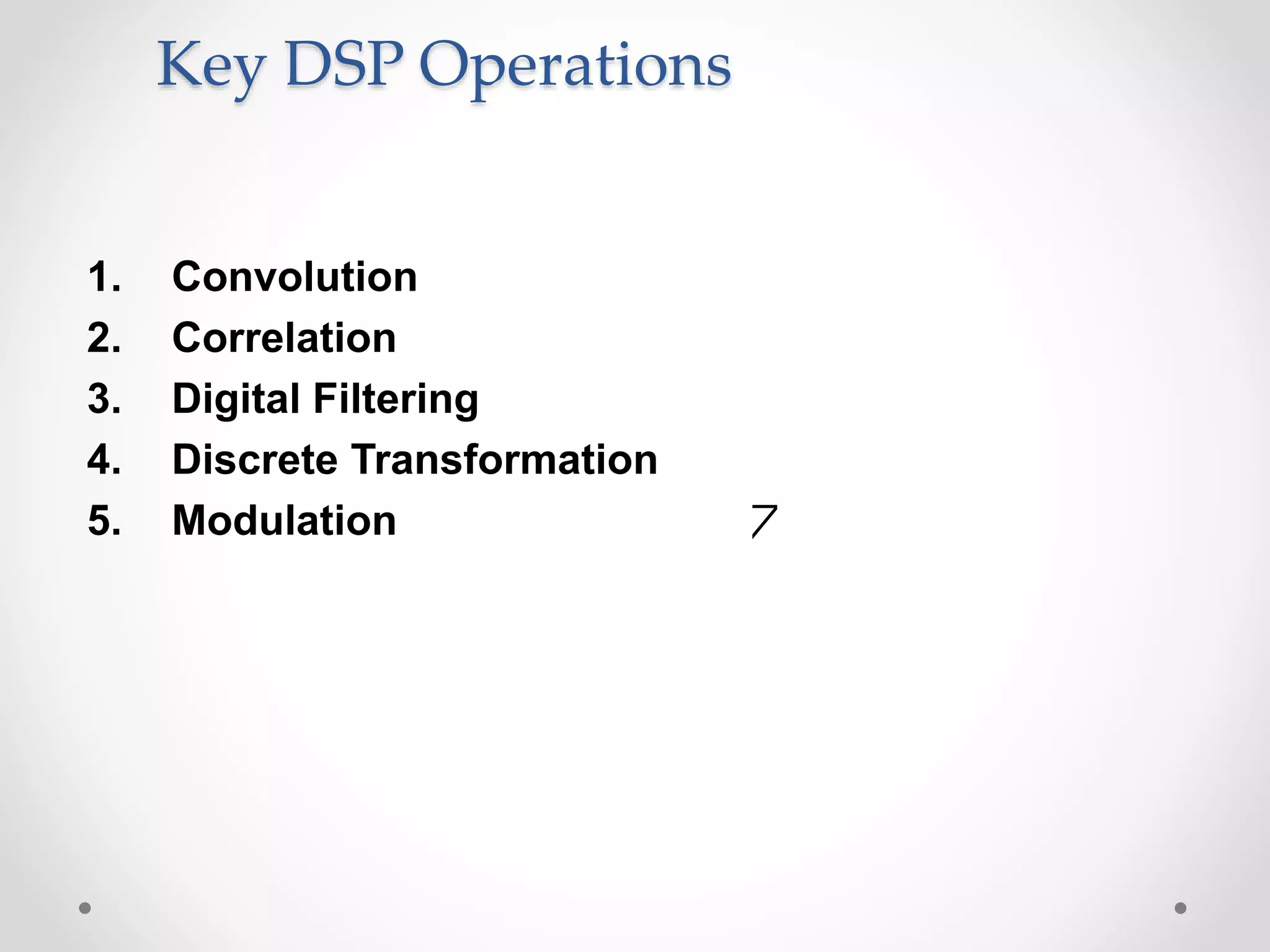
Key DSP Operations
1. Convolution
2. Correlation
3. Digital Filtering
4. Discrete Transformation
5. Modulation
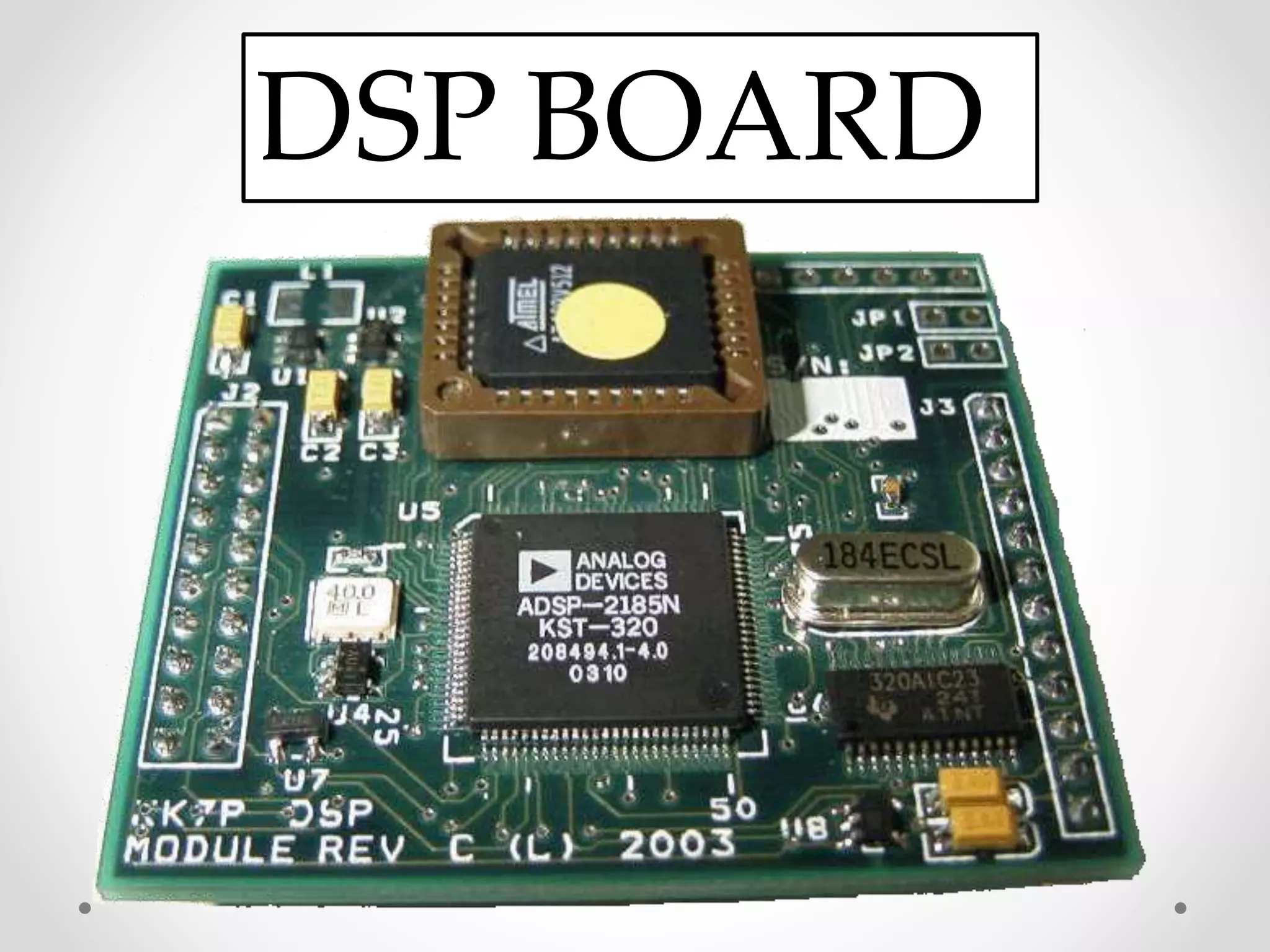
DSP BOARD
21
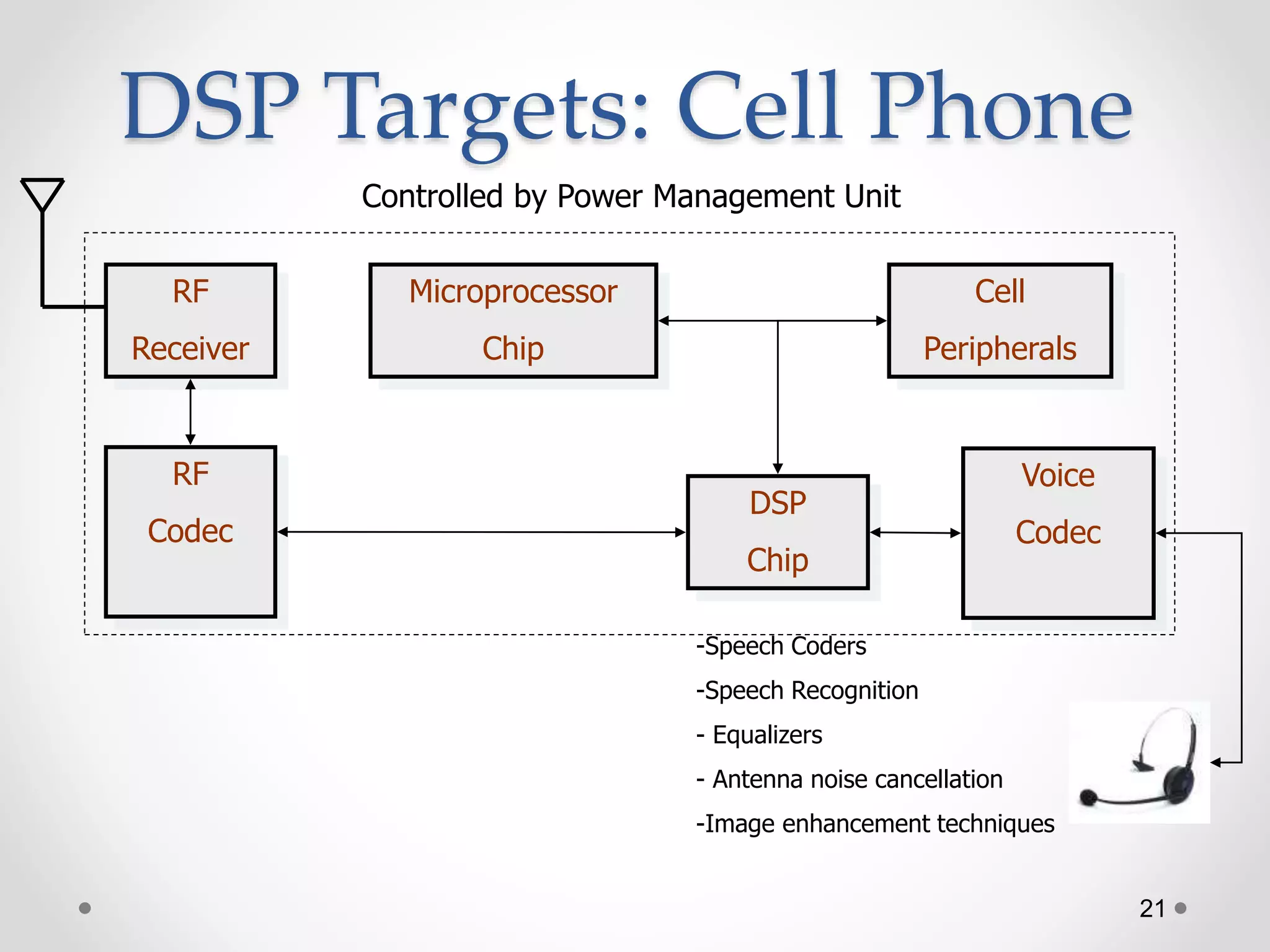
DSP Targets: Cell Phone
-Speech Coders
-Speech Recognition
- Equalizers
- Antenna noise cancellation
-Image enhancement techniques
DSP
Chip
RF
Codec
Voice
Codec
RF
Receiver
Microprocessor
Chip
Cell
Peripherals
Controlled by Power Management Unit
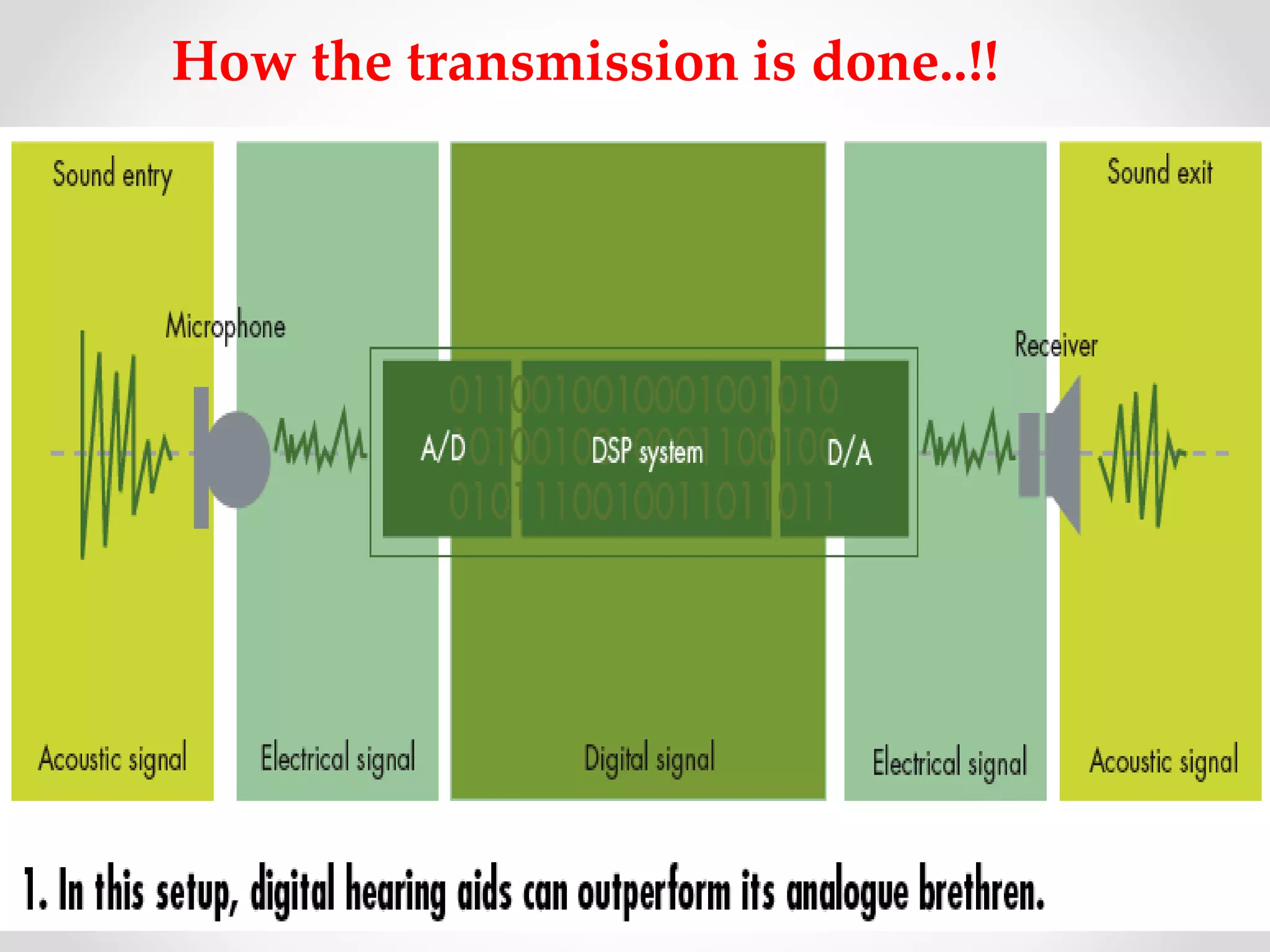
How the transmission is done..!!
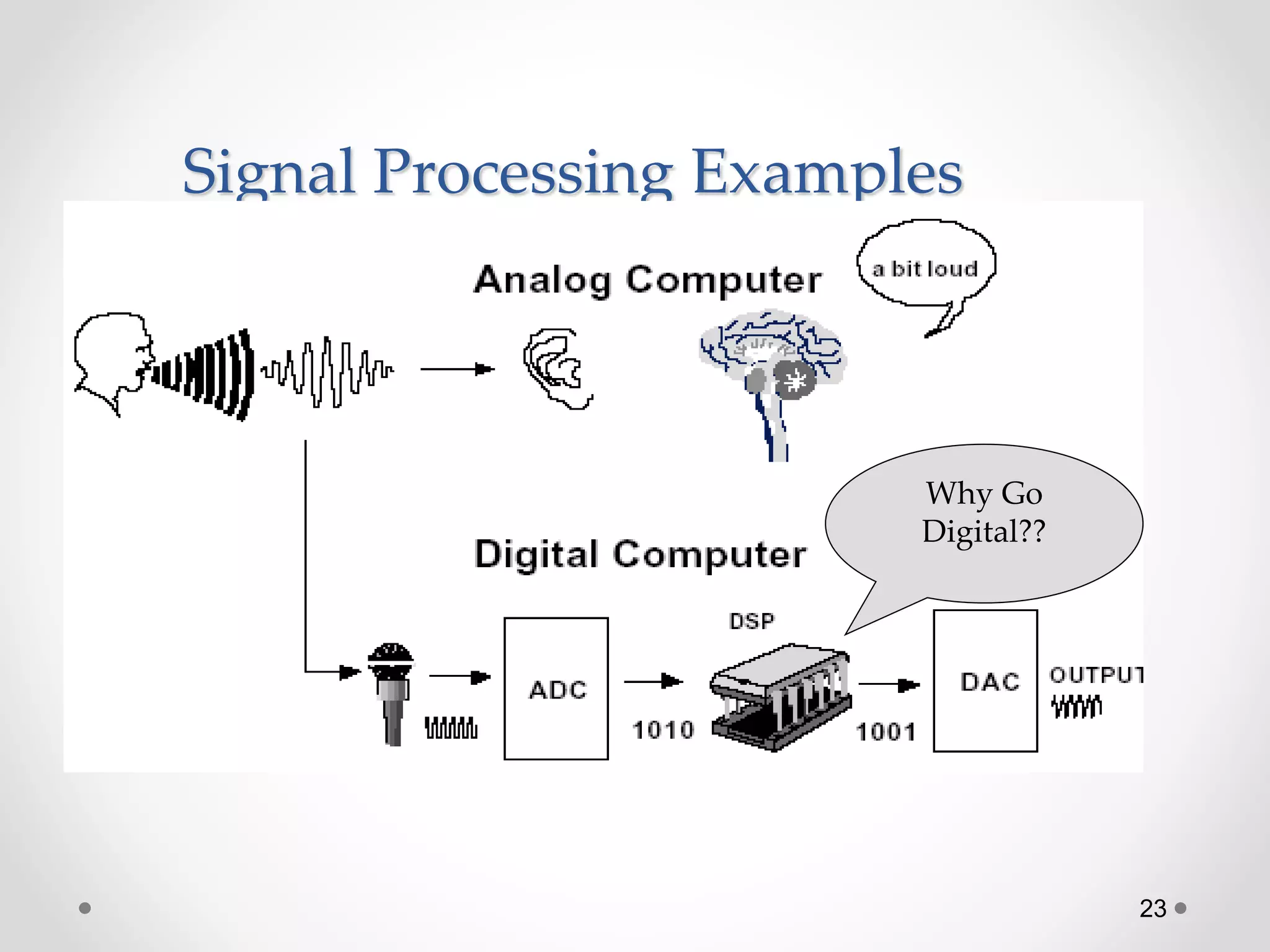
23
Signal Processing Examples
Why Go
Digital??
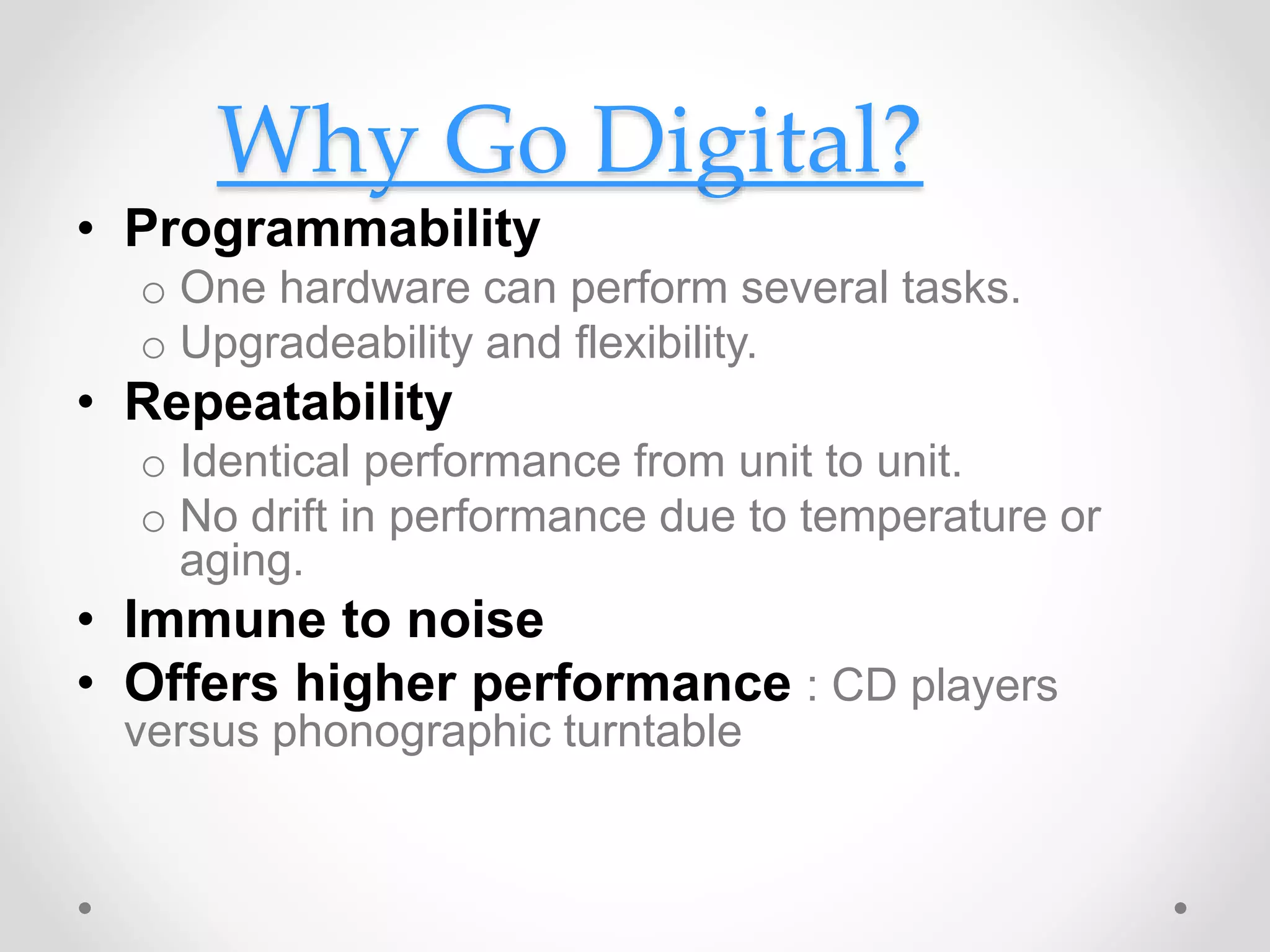
Why Go Digital?
• Programmability
o One hardware can perform several tasks.
o Upgradeability and flexibility.
• Repeatability
o Identical performance from unit to unit.
o No drift in performance due to temperature or
aging.
• Immune to noise
• Offers higher performance : CD players
versus phonographic turntable
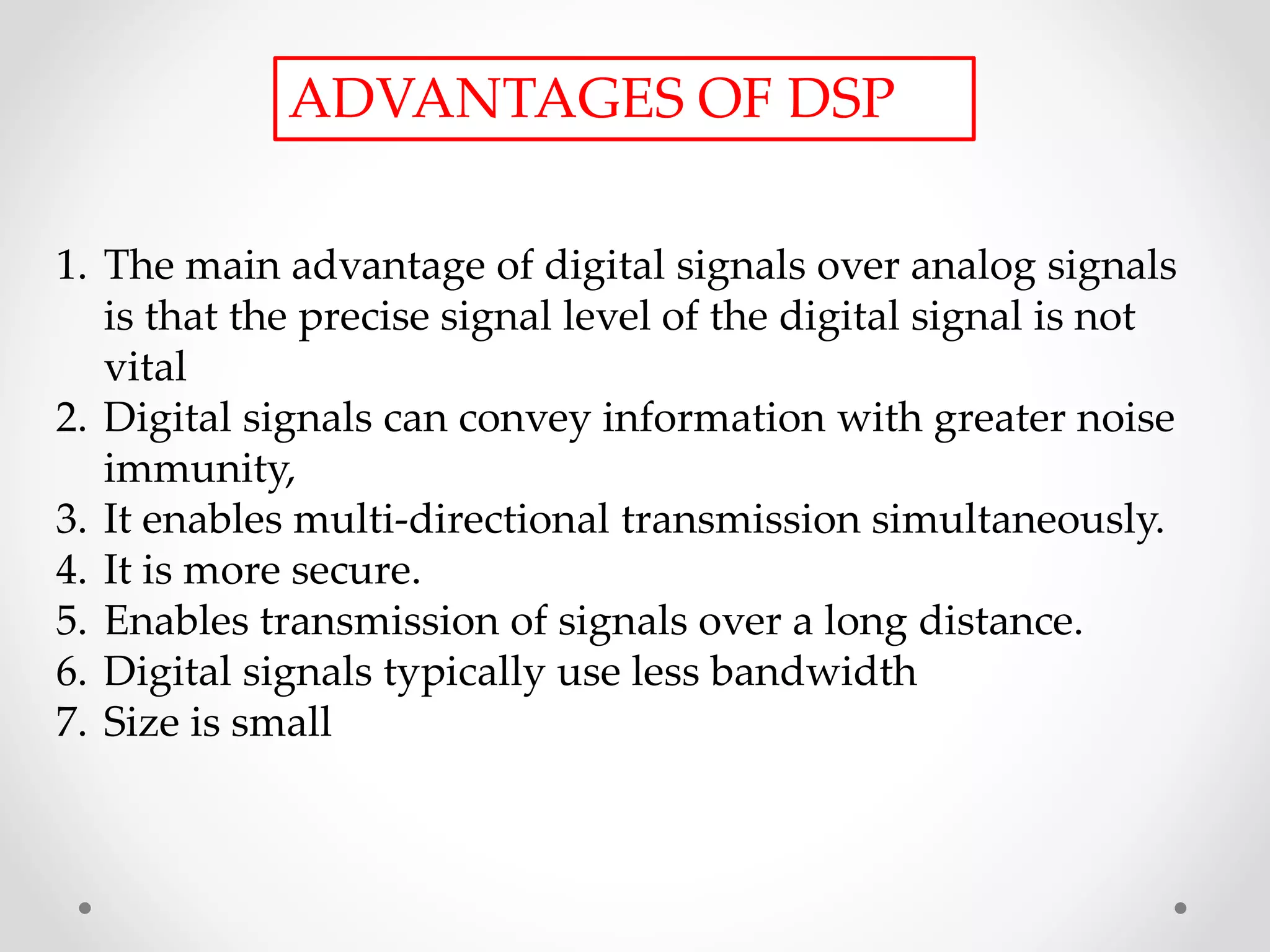
ADVANTAGES OF DSP
1. The main advantage of digital signals over analog signals
is that the precise signal level of the digital signal is not
vital
2. Digital signals can convey information with greater noise
immunity,
3. It enables multi-directional transmission simultaneously.
4. It is more secure.
5. Enables transmission of signals over a long distance.
6. Digital signals typically use less bandwidth
7. Size is small
DISADVANTAGES OF DSP
1. Expensive
2. Harder to design
3. Echo Cancellation
4. Loss of information
THE
END
THANK
YOU
QUIRIES
???

Digital Signal Processing

  • 1.
  • 2.
  • 3.
    What is DSP? • Converting a continuously changing waveform (analog) into a series of discrete levels (digital)
  • 4.
    What is DSP? •DSP = Digital Signal Processing OR DSP = Digital Signal Processor? • DSP used to denote both o meaning can be deduced from the context in which the term DSP is used. • What is a Digital Signal Processor (DSP)? o Microprocessor specifically designed to perform fast DSP operations (e.g., Fast Fourier Transforms, inner products, Multiply & Accumulate)
  • 5.
  • 6.
    How Does ItWork? • Now that we can slice up a waveform and convert it into digital form, let’s take a look at how it is used in DSP • Draw a simple waveform on graph paper o Scale appropriately • “Gather” digital data points to represent the waveform
  • 7.
    How Does ItWork? • Once the waveform is in digital form, the real power of DSP can be realized by mathematical manipulation of the data • Using EXCEL spreadsheet software can assist in manipulating the data and making graphs quickly • Let’s first do a little filtering of noise
  • 8.
    How Does ItWork? • Using your raw digital data, create a new table of data that averages three data points o Average the point before and the point after with the point in the middle o Enter all data in EXCEL to help with graphing
  • 9.
    How Does ItWork? • Swap your waveform data with a partner • Using the data, recreate the waveform on a sheet of graph paper
  • 10.
    Starting Waveform Used toCreate Digital Data
  • 11.
  • 12.
    How Does ItWork? • Compare the original with the recreating, note similarities and differences
  • 13.
    Noise Filtering Using Averaging Raw -150 -100 -50 0 50 100 150 010 20 30 40 Time Amplitude Ave before/after -150 -100 -50 0 50 100 150 0 10 20 30 40 Time Amplitude
  • 14.
    High Performance Processors Lowpower Average Performance Cost Effective Ultra Low power High Performance Cost Effective Year: 1999 Year: 2014 Time P e r f o r m a n c e P o w e r Ref: http://www.xilinx.com
  • 15.
    Types of DSP •Low End Fixed Point o TMS320C2XX, ADSP21XX, DSP56XXX • High End Fixed Point o TMS320C55XX, DSP16XXX, o ADSP215XX, DSP56800 • Floating Point o TMS320C3X, C67XX, ADSP210XX, DSP96000, DSP32XX • Berkeley Design Tech.
  • 17.
    17 What is Signal Processing? •Example of Signals: o Analog: Speech, Music, Photos, Video, radar, sonar, … o Discrete-domain/Digital: • digitized speech, digitized music, digitized images, digitized video, digitized radar and sonar signals,… • stock market data, daily max temperature data, ... ProcessingSignal in Signal out Operation, Transformation (Analog or Digital) (Analog or Digital)
  • 18.
    18 What is DigitalSignal Processing? • But what about analog signals? Digital ProcessingDigital Signal in Digital Signal out Operation, Transformation performed on digital signals (using a computer or other special-purpose digital hardware) Analog Signal in Analog-to- Digital (A/D) Conversion Digital Processing Digital-to- Analog (D/A) Conversion
  • 19.
    Key DSP Operations 1.Convolution 2. Correlation 3. Digital Filtering 4. Discrete Transformation 5. Modulation
  • 20.
  • 21.
    21 DSP Targets: CellPhone -Speech Coders -Speech Recognition - Equalizers - Antenna noise cancellation -Image enhancement techniques DSP Chip RF Codec Voice Codec RF Receiver Microprocessor Chip Cell Peripherals Controlled by Power Management Unit
  • 22.
  • 23.
  • 24.
    Why Go Digital? •Programmability o One hardware can perform several tasks. o Upgradeability and flexibility. • Repeatability o Identical performance from unit to unit. o No drift in performance due to temperature or aging. • Immune to noise • Offers higher performance : CD players versus phonographic turntable
  • 25.
    ADVANTAGES OF DSP 1.The main advantage of digital signals over analog signals is that the precise signal level of the digital signal is not vital 2. Digital signals can convey information with greater noise immunity, 3. It enables multi-directional transmission simultaneously. 4. It is more secure. 5. Enables transmission of signals over a long distance. 6. Digital signals typically use less bandwidth 7. Size is small
  • 26.
    DISADVANTAGES OF DSP 1.Expensive 2. Harder to design 3. Echo Cancellation 4. Loss of information
  • 29.
  • 30.
  • 31.