The Concepts Behind Software Design


   Elena Punskaya, elena.punskaya@eng.cam.ac.uk

                                                  1
Course Objectives
•   Object-Oriented Software Design
    - Understand the benefits of object-oriented analysis and design, its concepts and
      processes
    - Be familiar with formal design tools for object orientated design and analysis
    - Recognise and understand some frequently used design patterns
    - Be aware of the process involved in user interface design

•   Software Systems and Engineering
    - Appreciate the basic design issues and concepts in distributed, real time and concurrent
      systems
    - Understand software development methodologies
    - Understand the main issues and processes necessary to achieve effective software
      product development

•   The course is not about becoming a Code Ninja
    - so we are not going to learn programming in Scala, Ruby on Rails, Go!, Java or Thumb
    - but we might discuss them

•   It is neither about becoming a Project Management Guru
    - so we are not going to make Gantt charts and milestones
    - but we could talk about priorities, teams and metrics


                                                                                   © 2012 Elena Punskaya
                                                                                                          2
                                                              Cambridge University Engineering Department

                                                                                                              2
Books

•   Ian Sommerville, Software Engineering, Addison-Wesley
•   Roger Pressman, Software Engineering: A Practitioner's
    Approach
•   Fred Brooks, The Mythical Man Month, Addison-Wesley
•   Martin Fowler, UML Distilled: A Brief Guide to the Standard
    Object Modeling Language, Addison-Wesley
•   Andrew Hunt and David Thomas, The Pragmatic Programmer
•   Don Norman, Design of Everyday Things
•   Kent Beck with Cynthia Andres, Extreme Programming
    Explained: Embrace Change
•   Donald Norman, Living with Complexity
•   Jez Humble and David Farley, Continuous Delivery: Reliable
    Software Releases Through Build, Test and Deployment
    Automation
•   ...                                                         © 2012 Elena Punskaya
                                                                                       3
                                           Cambridge University Engineering Department

                                                                                           3
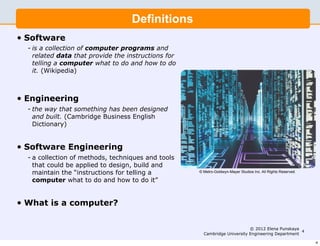
Definitions
•   Software
    - is a collection of computer programs and
      related data that provide the instructions for
      telling a computer what to do and how to do
      it. (Wikipedia)


•   Engineering
    - the way that something has been designed
      and built. (Cambridge Business English
      Dictionary)


•   Software Engineering
    - a collection of methods, techniques and tools
      that could be applied to design, build and
      maintain the “instructions for telling a         © Metro-Goldwyn-Mayer Studios Inc. All Rights Reserved.

      computer what to do and how to do it”


•   What is a computer?


                                                                              © 2012 Elena Punskaya
                                                                                                     4
                                                         Cambridge University Engineering Department

                                                                                                                 4
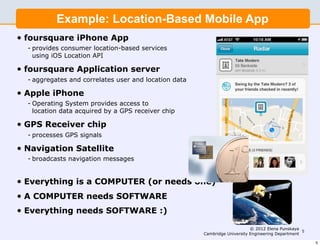
Example: Location-Based Mobile App
•   foursquare iPhone App
    - provides consumer location-based services
      using iOS Location API

•   foursquare Application server
    - aggregates and correlates user and location data

•   Apple iPhone
    - Operating System provides access to
      location data acquired by a GPS receiver chip

•   GPS Receiver chip
    - processes GPS signals

•   Navigation Satellite
    - broadcasts navigation messages


•   Everything is a COMPUTER (or needs one)
•   A COMPUTER needs SOFTWARE
•   Everything needs SOFTWARE :)

                                                                              © 2012 Elena Punskaya
                                                                                                     5
                                                         Cambridge University Engineering Department

                                                                                                         5
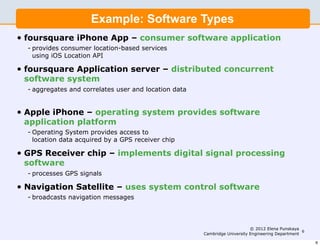
Example: Software Types
•   foursquare iPhone App – consumer software application
    - provides consumer location-based services
      using iOS Location API

•   foursquare Application server – distributed concurrent
    software system
    - aggregates and correlates user and location data


•   Apple iPhone – operating system provides software
    application platform
    - Operating System provides access to
      location data acquired by a GPS receiver chip

•   GPS Receiver chip – implements digital signal processing
    software
    - processes GPS signals

•   Navigation Satellite – uses system control software
    - broadcasts navigation messages


                                                                              © 2012 Elena Punskaya
                                                                                                     6
                                                         Cambridge University Engineering Department

                                                                                                         6
Horses for Courses
•   Not all SOFTWARE is created equal, choose an engineering
    approach accordingly
Our tests suite takes nine minutes to run (distributed
across 30-40 machines). Our code pushes take another
six minutes. Since these two steps are pipelined that
means at peak we’re pushing a new revision of the
code to the website every nine minutes. That’s 6
deploys an hour. Even at that pace we’re often batching
multiple commits into a single test/push cycle. On
average we deploy new code fifty times a day. [1]

This software never crashes. It never needs to be re-
booted. This software is bug-free. It is perfect, as perfect
as human beings have achieved. Consider these stats :
the last three versions of the program – each 420,000
lines long-had just one error each. The last 11 versions
of this software had a total of 17 errors. [2]
                                                                       © 2012 Elena Punskaya
                                                                                              7
                                                  Cambridge University Engineering Department

                                                                                                  7
Software Engineering in Cambridge [3]
•   1948-9 Research on programming methods
    under M.V. Wilkes, including:
    - definition and refinement of Initial Orders (Wheeler);
    - closed subroutines (Wheeler);
    - building of a library of subroutines (all laboratory members
      interested in programming, plus Professor D. R. Hartree).
                                                                                       M.V.Wilkes, 1913-2010
•   6 May 1949, First logged program on EDSAC 1
    (computing squares of 0-99) – World’s first
    stored program computer
•   1950 First Summer School on Programme
    Design for Automatic Digital Computing
    Machines, with 51 attendees
•   1953 Diploma in Numerical Analysis and
    Automatic Computing began
    - The Diploma “would include theoretical and practical work ...
      [and also] instruction about the various types of computing-
      machine ... and the principles of design on which they are                 EDSAC I, 1947/8 P.J.Farmer R.Piggott
      based.”                                                                    M.V.Wilkes W.A.Renwick


                                                                                    © 2012 Elena Punskaya
                                                                                                           8
                                                               Cambridge University Engineering Department

                                                                                                                        8
The NATO Software Engineering Conferences
•    1968: “In Europe alone there are about 10,000 installed computers —
     this number is increasing at a rate of anywhere from 25 per cent to 50 per
     cent per year. The quality of software provided for these computers will
     soon affect more than a quarter of a million analysts and programmers.” [4]


    P. Naur and B. Randell, (Eds.). Software       B. Randell and J.N. Buxton, (Eds.).
    Engineering: Report of a conference            Software Engineering Techniques: Report
    sponsored by the NATO Science                  of a conference sponsored by the NATO
    Committee, Garmisch, Germany, 7-11 Oct.        Science Committee, Rome, Italy, 27-31
    1968, Brussels, Scientific Affairs Division,   Oct. 1969, Brussels, Scientific Affairs
    NATO (1969) 231pp.                             Division, NATO (1970) 164pp.

                                                                                    © 2012 Elena Punskaya
                                                                                                           9
                                                               Cambridge University Engineering Department

                                                                                                               9
1968, Typical Software Project
•   The need for feedback is identified

                                          Selig: “External specifications at any
                                          level describe the software product in
                                          terms of the items controlled by and
                                          available to the user.

                                          The internal design describes the
                                          software product in terms of the
                                          program structures which realize the
                                          external specifications. It has to be
                                          understood that feedback between
                                          the design of the external and
                                          internal specifications is an essential
                                          part of a realistic and effective
                                          implementation process.

                                          Furthermore, this interaction must
                                          begin at the earliest stage of
                                          establishing the objectives, and
                                          continue until completion of the
                                          product.” [4]


                                                                © 2012 Elena Punskaya
                                                                                       10
                                           Cambridge University Engineering Department

                                                                                            10
Learning From Mistakes
•   Traditionally, large scale project disasters are seen as the
    impetus for developing software engineering as a discipline in
    order to mitigate the risks
•   Most referenced disaster projects include:
    - 1991-1992, London Ambulance Service – an attempt to switch to a fully automated
      dispatch system (26 Oct 1992: went live, 02 Nov 1992: switched back to the manual
      system)
    - 1985-1987, Therac-25 – a computer-controlled radiation therapy machine massively
      overdosed 6 people
    - 1996, Ariane 5 – the first launch of a new rocket terminated in self-destruction due to a
      software bug in the control software

•   More recently
    - 2003, Northeast Blackout – a power outage affecting est. 55m people in USA and
      Canada, an early alarm failed due to a “race condition” in the energy management
      system software
    - 2005-2006, Sensotronic Brake Control – almost 2m Mercedes cars recalled, the system
      is no longer used in production
    - April, 2011 – Amazon Elastic Compute Cloud (EC2) service disruption takes down
      FourSquare, Quora, Reddit
    - Oct 2011 – 3 days BlackBerry services outage affecting subscribers worldwide

                                                                                 © 2012 Elena Punskaya
                                                                                                        11
                                                            Cambridge University Engineering Department

                                                                                                             11
Measuring Complexity: Lines of Code
     Software entities are more complex for their size than perhaps
     any other human construct... Many of the classical problems of
     developing software products derive from this essential complexity
     and its nonlinear increases with size.
                            Fred Brooks, “No Silver Bullet – Essence and Accident in Software Engineering” [5]


•   F-22 Raptor: 1.7m
•   Radio and navigation system in the current S-class Mercedes-
    Benz: 20m
•   IBM OS/360 (1966): 1m
•   Android Mobile OS: 1m
•   Facebook main site: 9.2m
•   Google Chrome browser: 4.5m
•   Of course, the number lines depends on the programming
    language and less is not always better
       perl -MYAML -ne '$c{$_}++for split//;END{print Dump%c}' data.txt

                                                                                       © 2012 Elena Punskaya
                                                                                                              12
                                                                  Cambridge University Engineering Department

                                                                                                                   12
Example: Facebook


                                                                                                            '()*+$$,&-.*/&0/$123&456&
                                    *!!"

                                    )!!"

                                    (!!"

                                    '!!"


                         !"##"$%&
                                    &!!"

                                    %!!"

                                    $!!"
•   800m users [8]
                                    #!!"

•   500m visit daily                  !"
                                                     /01.!'"
                                                               234.!'"


                                                                                   +,-.!'"
                                                                         5,6.!'"


                                                                                                       234.!("


                                                                                                                                     /01.!)"
                                                                                                                                               234.!)"


                                                                                                                                                                   +,-.!)"
                                                                                                                                                         5,6.!)"


                                                                                                                                                                             /01.!*"
                                                                                                                                                                                       234.!*"


                                                                                                                                                                                                           +,-.!*"
                                                                                                                                                                                                 5,6.!*"


                                                                                                                                                                                                                     /01.!7"
                                                                                                                                                                                                                               234.!7"


                                                                                                                                                                                                                                                   +,-.!7"
                                                                                                                                                                                                                                         5,6.!7"


                                                                                                                                                                                                                                                                       234.#!"


                                                                                                                                                                                                                                                                                                     /01.##"
                                                                                                                                                                                                                                                                                                               234.##"
                                           +,-.!&"


                                                                                                                           +,-.!("


                                                                                                                                                                                                                                                                                           +,-.#!"
                                                                                             /01.!("


                                                                                                                 5,6.!("


                                                                                                                                                                                                                                                             /01.#!"


                                                                                                                                                                                                                                                                                 5,6.#!"
•   350m on mobile
•   all data is stored in a database (MySQL)
•   60 million queries per second
•   4 million row changes per second

                                                                                                                                                                              © 2012 Elena Punskaya
                                                                                                                                                                                                     13
                                                                                                                                                         Cambridge University Engineering Department

                                                                                                                                                                                                                                                                                                                         13
Example: eBay
•   “The size of the problem
    - The problem involves both the number of changes and
      the velocity of the changes. The eBay code base
      consists of hundreds of thousands of source elements
      (with total lines of code in the tens of millions). The
      applications – which comprise web, services,
      messaging, and batch style – number in the thousands.
      It is common for an application to use tens of
      thousands of source elements. The elements
      themselves are contributed by different teams and are
      shared with other applications.” [8]

                          Code Type                                           Count

     Source elements                                            100,000’s

     Source elements per application                            10,000’s

     Applications                                               1000’s

     Features per month                                         100’s

     Source elements changed per feature                        100’s (sometimes 1000’s)

     Projects                                                   1000’s

     Source elements per project                                10-100’s (sometimes 1000’s)
                                                                                         © 2012 Elena Punskaya
                                                                                                                14
                                                                    Cambridge University Engineering Department

                                                                                                                     14
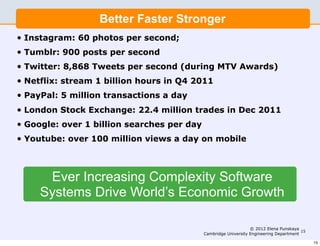
Better Faster Stronger
•   Instagram: 60 photos per second;
•   Tumblr: 900 posts per second
•   Twitter: 8,868 Tweets per second (during MTV Awards)
•   Netflix: stream 1 billion hours in Q4 2011
•   PayPal: 5 million transactions a day
•   London Stock Exchange: 22.4 million trades in Dec 2011
•   Google: over 1 billion searches per day
•   Youtube: over 100 million views a day on mobile


        Ever Increasing Complexity Software
       Systems Drive World’s Economic Growth

                                                                   © 2012 Elena Punskaya
                                                                                          15
                                              Cambridge University Engineering Department

                                                                                               15
Software Engineering Aims
•   Managing complexity and Minimizing risks

       [T]here are known knowns; there are things we know we know.
       We also know there are known unknowns; that is to say we
       know there are some things we do not know.
       But there are also unknown unknowns – there are things we
       do not know we don't know.
                                           Former United States Secretary of Defense Donald Rumsfeld


•   Designing systems that
    - meet requirements (“known knowns”)
    - can adapt to changes (“known unknowns”)
    - and withstand any unexpected use cases (“unknown unknowns”)

•   Software Engineering is also about:

             Making Better Mistakes Tomorrow!
                  Having Happy (Alive) Users!
                                                                                © 2012 Elena Punskaya
                                                                                                       16
                                                           Cambridge University Engineering Department

                                                                                                            16
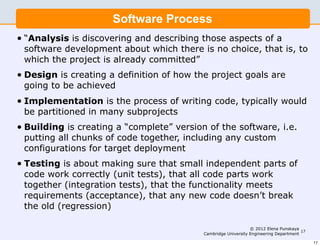
Software Process
•   “Analysis is discovering and describing those aspects of a
    software development about which there is no choice, that is, to
    which the project is already committed”
•   Design is creating a definition of how the project goals are
    going to be achieved
•   Implementation is the process of writing code, typically would
    be partitioned in many subprojects
•   Building is creating a “complete” version of the software, i.e.
    putting all chunks of code together, including any custom
    configurations for target deployment
•   Testing is about making sure that small independent parts of
    code work correctly (unit tests), that all code parts work
    together (integration tests), that the functionality meets
    requirements (acceptance), that any new code doesn’t break
    the old (regression)

                                                                  © 2012 Elena Punskaya
                                                                                         17
                                             Cambridge University Engineering Department

                                                                                              17
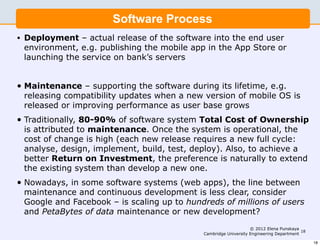
Software Process
•   Deployment – actual release of the software into the end user
    environment, e.g. publishing the mobile app in the App Store or
    launching the service on bank’s servers


•   Maintenance – supporting the software during its lifetime, e.g.
    releasing compatibility updates when a new version of mobile OS is
    released or improving performance as user base grows
•   Traditionally, 80-90% of software system Total Cost of Ownership
    is attributed to maintenance. Once the system is operational, the
    cost of change is high (each new release requires a new full cycle:
    analyse, design, implement, build, test, deploy). Also, to achieve a
    better Return on Investment, the preference is naturally to extend
    the existing system than develop a new one.
•   Nowadays, in some software systems (web apps), the line between
    maintenance and continuous development is less clear, consider
    Google and Facebook – is scaling up to hundreds of millions of users
    and PetaBytes of data maintenance or new development?
                                                                    © 2012 Elena Punskaya
                                                                                           18
                                               Cambridge University Engineering Department

                                                                                                18
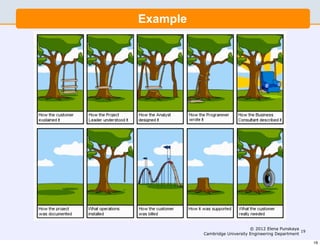
Example


                               © 2012 Elena Punskaya
                                                      19
          Cambridge University Engineering Department

                                                           19
Requirements Analysis not Analysis Paralysis
    The hardest single part of building a software system is
    deciding precisely what to build. No other part of the
    conceptual work is as difficult as establishing the detailed
    technical requirements, including all the interfaces to people, to
    machines, and to other software systems. No other part of the
    work so cripples the resulting system if done wrong.
                          Fred Brooks, “No Silver Bullet – Essence and Accident in Software Engineering” [5]


•   It is impossible to know in advance everything required to
    build the software system. Why?
•   Users don’t know 100% what it should do
•   Developers don’t know 100% how users would use it
•   The only 100% certainty is that things will change:
    - the deployment environment change, e.g. new version of hardware/software platform
    - the business requirements change, e.g. adding a new method to a payment system
    - the scale changes, e.g. from 1m users to 800m


                                                                                         © 2012 Elena Punskaya
                                                                                                                20
                                                                    Cambridge University Engineering Department

                                                                                                                     20
The Answer?
•   Over 40 years since The 1968
    NATO Software Engineering
    conference, the issues discussed
                                              Grow, don’t build, software.
                                                 Fred Brooks, “No Silver Bullet – Essence and
    are as much present as then                            Accident in Software Engineering”


•   No Silver Bullet – there is no
    single answer/process/method
•   but we can ...
✓   Build for Change
✓   Communicate Clearly
✓   Test Continuously, Test Everything
    - problem understanding, user behaviour
      assumptions, code, integration...

✓   Choose the Tools for the Job
    - Object-Oriented Analysis and Design            © Warner Bros. Ent. All rights reserved.

    - Extreme/Agile Programming
    - Continuous Integration/Deployment
    - IDEs, Source Control, UML ...
                                                                     © 2012 Elena Punskaya
                                                                                            21
                                                Cambridge University Engineering Department

                                                                                                 21
References and Further Reading
1. http://timothyfitz.wordpress.com/2009/02/10/continuous-deployment-at-imvu-doing-the-impossible-fifty-times-a-day/

2. http://www.fastcompany.com/magazine/06/writestuff.html

3. http://www.cl.cam.ac.uk/conference/EDSAC99/history.html

4. http://homepages.cs.ncl.ac.uk/brian.randell/NATO/nato1968.PDF

5. http://www.cs.nott.ac.uk/~cah/G51ISS/Documents/NoSilverBullet.html

6. http://www.facebook.com/press/info.php?timeline

7. http://www.facebook.com/press/info.php?statistics

8. http://www.ebaytechblog.com/2011/12/15/rapid-development-setup-in-large-environments/

9. http://www.securityfocus.com/news/8016

10. http://aws.amazon.com/message/65648/

11. http://www.autoweek.com/article/20051216/FREE/51216010

12. http://www.computerworlduk.com/news/mobile-wireless/3310790/we-do-not-know-why-system-failed-says-blackberry-ceo/

13. http://spectrum.ieee.org/green-tech/advanced-cars/this-car-runs-on-code/0

14. http://highscalability.com/

15. http://martinfowler.com/bliki/UseCases.html


                                                                                                                 © 2012 Elena Punskaya
                                                                                                                                        22
                                                                                            Cambridge University Engineering Department

                                                                                                                                             22

Lecture 1 Software Engineering and Design Introduction

  • 1.
    The Concepts BehindSoftware Design Elena Punskaya, elena.punskaya@eng.cam.ac.uk 1
  • 2.
    Course Objectives • Object-Oriented Software Design - Understand the benefits of object-oriented analysis and design, its concepts and processes - Be familiar with formal design tools for object orientated design and analysis - Recognise and understand some frequently used design patterns - Be aware of the process involved in user interface design • Software Systems and Engineering - Appreciate the basic design issues and concepts in distributed, real time and concurrent systems - Understand software development methodologies - Understand the main issues and processes necessary to achieve effective software product development • The course is not about becoming a Code Ninja - so we are not going to learn programming in Scala, Ruby on Rails, Go!, Java or Thumb - but we might discuss them • It is neither about becoming a Project Management Guru - so we are not going to make Gantt charts and milestones - but we could talk about priorities, teams and metrics © 2012 Elena Punskaya 2 Cambridge University Engineering Department 2
  • 3.
    Books • Ian Sommerville, Software Engineering, Addison-Wesley • Roger Pressman, Software Engineering: A Practitioner's Approach • Fred Brooks, The Mythical Man Month, Addison-Wesley • Martin Fowler, UML Distilled: A Brief Guide to the Standard Object Modeling Language, Addison-Wesley • Andrew Hunt and David Thomas, The Pragmatic Programmer • Don Norman, Design of Everyday Things • Kent Beck with Cynthia Andres, Extreme Programming Explained: Embrace Change • Donald Norman, Living with Complexity • Jez Humble and David Farley, Continuous Delivery: Reliable Software Releases Through Build, Test and Deployment Automation • ... © 2012 Elena Punskaya 3 Cambridge University Engineering Department 3
  • 4.
    Definitions • Software - is a collection of computer programs and related data that provide the instructions for telling a computer what to do and how to do it. (Wikipedia) • Engineering - the way that something has been designed and built. (Cambridge Business English Dictionary) • Software Engineering - a collection of methods, techniques and tools that could be applied to design, build and maintain the “instructions for telling a © Metro-Goldwyn-Mayer Studios Inc. All Rights Reserved. computer what to do and how to do it” • What is a computer? © 2012 Elena Punskaya 4 Cambridge University Engineering Department 4
  • 5.
    Example: Location-Based MobileApp • foursquare iPhone App - provides consumer location-based services using iOS Location API • foursquare Application server - aggregates and correlates user and location data • Apple iPhone - Operating System provides access to location data acquired by a GPS receiver chip • GPS Receiver chip - processes GPS signals • Navigation Satellite - broadcasts navigation messages • Everything is a COMPUTER (or needs one) • A COMPUTER needs SOFTWARE • Everything needs SOFTWARE :) © 2012 Elena Punskaya 5 Cambridge University Engineering Department 5
  • 6.
    Example: Software Types • foursquare iPhone App – consumer software application - provides consumer location-based services using iOS Location API • foursquare Application server – distributed concurrent software system - aggregates and correlates user and location data • Apple iPhone – operating system provides software application platform - Operating System provides access to location data acquired by a GPS receiver chip • GPS Receiver chip – implements digital signal processing software - processes GPS signals • Navigation Satellite – uses system control software - broadcasts navigation messages © 2012 Elena Punskaya 6 Cambridge University Engineering Department 6
  • 7.
    Horses for Courses • Not all SOFTWARE is created equal, choose an engineering approach accordingly Our tests suite takes nine minutes to run (distributed across 30-40 machines). Our code pushes take another six minutes. Since these two steps are pipelined that means at peak we’re pushing a new revision of the code to the website every nine minutes. That’s 6 deploys an hour. Even at that pace we’re often batching multiple commits into a single test/push cycle. On average we deploy new code fifty times a day. [1] This software never crashes. It never needs to be re- booted. This software is bug-free. It is perfect, as perfect as human beings have achieved. Consider these stats : the last three versions of the program – each 420,000 lines long-had just one error each. The last 11 versions of this software had a total of 17 errors. [2] © 2012 Elena Punskaya 7 Cambridge University Engineering Department 7
  • 8.
    Software Engineering inCambridge [3] • 1948-9 Research on programming methods under M.V. Wilkes, including: - definition and refinement of Initial Orders (Wheeler); - closed subroutines (Wheeler); - building of a library of subroutines (all laboratory members interested in programming, plus Professor D. R. Hartree). M.V.Wilkes, 1913-2010 • 6 May 1949, First logged program on EDSAC 1 (computing squares of 0-99) – World’s first stored program computer • 1950 First Summer School on Programme Design for Automatic Digital Computing Machines, with 51 attendees • 1953 Diploma in Numerical Analysis and Automatic Computing began - The Diploma “would include theoretical and practical work ... [and also] instruction about the various types of computing- machine ... and the principles of design on which they are EDSAC I, 1947/8 P.J.Farmer R.Piggott based.” M.V.Wilkes W.A.Renwick © 2012 Elena Punskaya 8 Cambridge University Engineering Department 8
  • 9.
    The NATO SoftwareEngineering Conferences • 1968: “In Europe alone there are about 10,000 installed computers — this number is increasing at a rate of anywhere from 25 per cent to 50 per cent per year. The quality of software provided for these computers will soon affect more than a quarter of a million analysts and programmers.” [4] P. Naur and B. Randell, (Eds.). Software B. Randell and J.N. Buxton, (Eds.). Engineering: Report of a conference Software Engineering Techniques: Report sponsored by the NATO Science of a conference sponsored by the NATO Committee, Garmisch, Germany, 7-11 Oct. Science Committee, Rome, Italy, 27-31 1968, Brussels, Scientific Affairs Division, Oct. 1969, Brussels, Scientific Affairs NATO (1969) 231pp. Division, NATO (1970) 164pp. © 2012 Elena Punskaya 9 Cambridge University Engineering Department 9
  • 10.
    1968, Typical SoftwareProject • The need for feedback is identified Selig: “External specifications at any level describe the software product in terms of the items controlled by and available to the user. The internal design describes the software product in terms of the program structures which realize the external specifications. It has to be understood that feedback between the design of the external and internal specifications is an essential part of a realistic and effective implementation process. Furthermore, this interaction must begin at the earliest stage of establishing the objectives, and continue until completion of the product.” [4] © 2012 Elena Punskaya 10 Cambridge University Engineering Department 10
  • 11.
    Learning From Mistakes • Traditionally, large scale project disasters are seen as the impetus for developing software engineering as a discipline in order to mitigate the risks • Most referenced disaster projects include: - 1991-1992, London Ambulance Service – an attempt to switch to a fully automated dispatch system (26 Oct 1992: went live, 02 Nov 1992: switched back to the manual system) - 1985-1987, Therac-25 – a computer-controlled radiation therapy machine massively overdosed 6 people - 1996, Ariane 5 – the first launch of a new rocket terminated in self-destruction due to a software bug in the control software • More recently - 2003, Northeast Blackout – a power outage affecting est. 55m people in USA and Canada, an early alarm failed due to a “race condition” in the energy management system software - 2005-2006, Sensotronic Brake Control – almost 2m Mercedes cars recalled, the system is no longer used in production - April, 2011 – Amazon Elastic Compute Cloud (EC2) service disruption takes down FourSquare, Quora, Reddit - Oct 2011 – 3 days BlackBerry services outage affecting subscribers worldwide © 2012 Elena Punskaya 11 Cambridge University Engineering Department 11
  • 12.
    Measuring Complexity: Linesof Code Software entities are more complex for their size than perhaps any other human construct... Many of the classical problems of developing software products derive from this essential complexity and its nonlinear increases with size. Fred Brooks, “No Silver Bullet – Essence and Accident in Software Engineering” [5] • F-22 Raptor: 1.7m • Radio and navigation system in the current S-class Mercedes- Benz: 20m • IBM OS/360 (1966): 1m • Android Mobile OS: 1m • Facebook main site: 9.2m • Google Chrome browser: 4.5m • Of course, the number lines depends on the programming language and less is not always better perl -MYAML -ne '$c{$_}++for split//;END{print Dump%c}' data.txt © 2012 Elena Punskaya 12 Cambridge University Engineering Department 12
  • 13.
    Example: Facebook '()*+$$,&-.*/&0/$123&456& *!!" )!!" (!!" '!!" !"##"$%& &!!" %!!" $!!" • 800m users [8] #!!" • 500m visit daily !" /01.!'" 234.!'" +,-.!'" 5,6.!'" 234.!(" /01.!)" 234.!)" +,-.!)" 5,6.!)" /01.!*" 234.!*" +,-.!*" 5,6.!*" /01.!7" 234.!7" +,-.!7" 5,6.!7" 234.#!" /01.##" 234.##" +,-.!&" +,-.!(" +,-.#!" /01.!(" 5,6.!(" /01.#!" 5,6.#!" • 350m on mobile • all data is stored in a database (MySQL) • 60 million queries per second • 4 million row changes per second © 2012 Elena Punskaya 13 Cambridge University Engineering Department 13
  • 14.
    Example: eBay • “The size of the problem - The problem involves both the number of changes and the velocity of the changes. The eBay code base consists of hundreds of thousands of source elements (with total lines of code in the tens of millions). The applications – which comprise web, services, messaging, and batch style – number in the thousands. It is common for an application to use tens of thousands of source elements. The elements themselves are contributed by different teams and are shared with other applications.” [8] Code Type Count Source elements 100,000’s Source elements per application 10,000’s Applications 1000’s Features per month 100’s Source elements changed per feature 100’s (sometimes 1000’s) Projects 1000’s Source elements per project 10-100’s (sometimes 1000’s) © 2012 Elena Punskaya 14 Cambridge University Engineering Department 14
  • 15.
    Better Faster Stronger • Instagram: 60 photos per second; • Tumblr: 900 posts per second • Twitter: 8,868 Tweets per second (during MTV Awards) • Netflix: stream 1 billion hours in Q4 2011 • PayPal: 5 million transactions a day • London Stock Exchange: 22.4 million trades in Dec 2011 • Google: over 1 billion searches per day • Youtube: over 100 million views a day on mobile Ever Increasing Complexity Software Systems Drive World’s Economic Growth © 2012 Elena Punskaya 15 Cambridge University Engineering Department 15
  • 16.
    Software Engineering Aims • Managing complexity and Minimizing risks [T]here are known knowns; there are things we know we know. We also know there are known unknowns; that is to say we know there are some things we do not know. But there are also unknown unknowns – there are things we do not know we don't know. Former United States Secretary of Defense Donald Rumsfeld • Designing systems that - meet requirements (“known knowns”) - can adapt to changes (“known unknowns”) - and withstand any unexpected use cases (“unknown unknowns”) • Software Engineering is also about: Making Better Mistakes Tomorrow! Having Happy (Alive) Users! © 2012 Elena Punskaya 16 Cambridge University Engineering Department 16
  • 17.
    Software Process • “Analysis is discovering and describing those aspects of a software development about which there is no choice, that is, to which the project is already committed” • Design is creating a definition of how the project goals are going to be achieved • Implementation is the process of writing code, typically would be partitioned in many subprojects • Building is creating a “complete” version of the software, i.e. putting all chunks of code together, including any custom configurations for target deployment • Testing is about making sure that small independent parts of code work correctly (unit tests), that all code parts work together (integration tests), that the functionality meets requirements (acceptance), that any new code doesn’t break the old (regression) © 2012 Elena Punskaya 17 Cambridge University Engineering Department 17
  • 18.
    Software Process • Deployment – actual release of the software into the end user environment, e.g. publishing the mobile app in the App Store or launching the service on bank’s servers • Maintenance – supporting the software during its lifetime, e.g. releasing compatibility updates when a new version of mobile OS is released or improving performance as user base grows • Traditionally, 80-90% of software system Total Cost of Ownership is attributed to maintenance. Once the system is operational, the cost of change is high (each new release requires a new full cycle: analyse, design, implement, build, test, deploy). Also, to achieve a better Return on Investment, the preference is naturally to extend the existing system than develop a new one. • Nowadays, in some software systems (web apps), the line between maintenance and continuous development is less clear, consider Google and Facebook – is scaling up to hundreds of millions of users and PetaBytes of data maintenance or new development? © 2012 Elena Punskaya 18 Cambridge University Engineering Department 18
  • 19.
    Example © 2012 Elena Punskaya 19 Cambridge University Engineering Department 19
  • 20.
    Requirements Analysis notAnalysis Paralysis The hardest single part of building a software system is deciding precisely what to build. No other part of the conceptual work is as difficult as establishing the detailed technical requirements, including all the interfaces to people, to machines, and to other software systems. No other part of the work so cripples the resulting system if done wrong. Fred Brooks, “No Silver Bullet – Essence and Accident in Software Engineering” [5] • It is impossible to know in advance everything required to build the software system. Why? • Users don’t know 100% what it should do • Developers don’t know 100% how users would use it • The only 100% certainty is that things will change: - the deployment environment change, e.g. new version of hardware/software platform - the business requirements change, e.g. adding a new method to a payment system - the scale changes, e.g. from 1m users to 800m © 2012 Elena Punskaya 20 Cambridge University Engineering Department 20
  • 21.
    The Answer? • Over 40 years since The 1968 NATO Software Engineering conference, the issues discussed Grow, don’t build, software. Fred Brooks, “No Silver Bullet – Essence and are as much present as then Accident in Software Engineering” • No Silver Bullet – there is no single answer/process/method • but we can ... ✓ Build for Change ✓ Communicate Clearly ✓ Test Continuously, Test Everything - problem understanding, user behaviour assumptions, code, integration... ✓ Choose the Tools for the Job - Object-Oriented Analysis and Design © Warner Bros. Ent. All rights reserved. - Extreme/Agile Programming - Continuous Integration/Deployment - IDEs, Source Control, UML ... © 2012 Elena Punskaya 21 Cambridge University Engineering Department 21
  • 22.
    References and FurtherReading 1. http://timothyfitz.wordpress.com/2009/02/10/continuous-deployment-at-imvu-doing-the-impossible-fifty-times-a-day/ 2. http://www.fastcompany.com/magazine/06/writestuff.html 3. http://www.cl.cam.ac.uk/conference/EDSAC99/history.html 4. http://homepages.cs.ncl.ac.uk/brian.randell/NATO/nato1968.PDF 5. http://www.cs.nott.ac.uk/~cah/G51ISS/Documents/NoSilverBullet.html 6. http://www.facebook.com/press/info.php?timeline 7. http://www.facebook.com/press/info.php?statistics 8. http://www.ebaytechblog.com/2011/12/15/rapid-development-setup-in-large-environments/ 9. http://www.securityfocus.com/news/8016 10. http://aws.amazon.com/message/65648/ 11. http://www.autoweek.com/article/20051216/FREE/51216010 12. http://www.computerworlduk.com/news/mobile-wireless/3310790/we-do-not-know-why-system-failed-says-blackberry-ceo/ 13. http://spectrum.ieee.org/green-tech/advanced-cars/this-car-runs-on-code/0 14. http://highscalability.com/ 15. http://martinfowler.com/bliki/UseCases.html © 2012 Elena Punskaya 22 Cambridge University Engineering Department 22